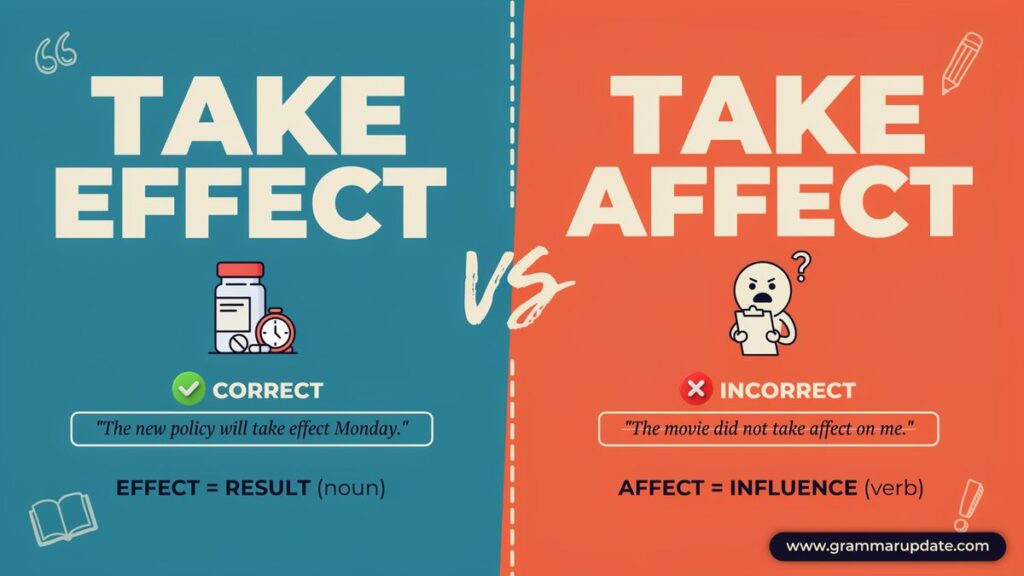
Is it take effect vs take affect? Don’t worry you are not the only one. These two words look alike and sound similar, so it’s easy to mix them up. The good news is that the rule is simple once you know it. In everyday English, the correct phrase is “take effect,” which means something becomes active or starts working. “Take affect” is almost always incorrect. In this guide, you’ll learn the difference between the two, see plenty of real-life examples, and discover easy memory tricks that will help you choose the correct phrase with confidence every time.
Is It Take Effect vs Take Affect?
If you’ve searched for “is it take effect vs take affect,” here’s the simple answer.
The correct phrase is:
Take effect
The incorrect phrase in standard English is:
Take affect
Whenever something begins working, becomes official, or starts producing results, you should use take effect.
Examples:
- The new policy will take effect next Monday.
- The medicine should take effect within thirty minutes.
- The agreement will take effect after both parties sign it.
- The updated software will take effect after you restart your computer.
Many people accidentally write take affect because affect and effect sound almost the same. However, pronunciation does not determine correct grammar. Their meanings and functions are different.
If someone asks, “Which is correct take effect vs take affect?” the answer is always take effect in normal writing and conversation.
Learn the difference between confusing word pairs
Dammit vs Damn It Which One Is Correct?
The Correct Phrase Is Take Effect
The phrase take effect has existed in English for centuries. It appears in legal documents, government announcements, business contracts, medical instructions, academic writing, and everyday conversations.
When something takes effect, it becomes active or starts producing its intended result.
For example:
- The law takes effect tomorrow.
- The policy will take effect at midnight.
- The changes take effect immediately.
- The decision takes effect after approval.
- The order takes effect today.
Notice a common pattern. Each example describes something beginning to operate.
This is why dictionaries define take effect as becoming effective, becoming operational, or beginning to work.
You might also hear similar expressions such as:
| Phrase | Meaning |
|---|---|
| Take effect | Become active |
| Come into effect | Become active |
| Go into effect | Become official |
| Become effective | Start working |
| Enter into force | Become legally active |
These expressions all describe the same general idea: something starts working or becomes official.
Learn the difference between confusing word pairs
Rosin vs Resin Difference and Which is Correct?
Why Take Affect Is Usually Incorrect
Many English learners ask whether take affect meaning exists.
In almost every situation, the answer is no.
The word affect is usually a verb. It means to influence or change something.
Examples include:
- Weather can affect your travel plans.
- Stress affects your health.
- Exercise affects your energy level.
- Good leadership affects employee morale.
Since affect is normally a verb, it cannot function correctly after the verb take in this expression.
Compare these examples.
Correct:
- The new regulation will take effect next month.
Incorrect:
- The new regulation will take affect next month.
The second sentence sounds similar when spoken, yet it breaks standard English grammar rules.
That’s why grammar experts consistently recommend using take effect instead.
Learn the difference between confusing word pairs
Waving vs Waiving Which is correct and Difference?
The Rare Exception You Should Know
Some people wonder whether is take affect grammatically correct under any circumstances.
There is one rare exception.
In psychology and psychiatry, affect can be a noun. It refers to a person’s observable emotional expression.
For example:
- The patient displayed a flat affect during the interview.
- Doctors observed a limited affect throughout the examination.
Even in this specialized field, the expression take affect is not used.
This medical definition explains why affect occasionally appears as a noun, but it does not change the grammar rule for the phrase take effect.
Unless you’re writing about clinical psychology, you can safely remember that take affect is incorrect.
Learn the difference between confusing word pairs
Performing vs Preforming difference and Which One Is Correct?
What Does Take Effect Mean?
Understanding the take effect meaning makes the grammar much easier to remember.
The take effect definition is simple:
To begin working, become active, become official, or start producing results.
Think of flipping a light switch.
Before you flip it, nothing happens.
After you flip it, the light works.
That moment is when the change takes effect.
The same idea applies to laws, medicines, agreements, policies, software updates, and business decisions.
Simple Definition
Take effect means something starts operating exactly as intended.
It marks the point when an action changes from planned to active.
Examples include:
- The discount takes effect today.
- The vaccine takes effect after several days.
- The insurance coverage takes effect on January 1.
- The software update takes effect after installation.
In every example, something begins working.
What Happens When Something Takes Effect?
When something takes effect, one of several things usually happens.
- A rule becomes enforceable.
- A policy becomes official.
- A medicine begins working.
- A contract becomes legally binding.
- A software update becomes active.
- A decision starts producing real-world results.
This idea appears everywhere in everyday English.
Imagine your employer announces a new vacation policy.
The announcement happens today.
The policy starts next month.
You would say:
“The new policy will take effect next month.”
The policy exists today, but it doesn’t become active until next month.
That difference is exactly what the phrase expresses.
Learn the difference between confusing word pairs
Tomatoes vs Tomatos difference and Which Is Correct?
Common Synonyms for Take Effect
English offers several phrases with similar meanings.
| Expression | Meaning | Common Usage |
|---|---|---|
| Take effect | Become active | General English |
| Go into effect | Become official | Laws and regulations |
| Come into effect | Become operational | Formal writing |
| Become effective | Start working | Business and legal writing |
| Become operational | Begin functioning | Technology and engineering |
| Enter into force | Become legally valid | International law |
Although these expressions share similar meanings, take effect remains the most common and natural choice in everyday English.
Why Take Effect Is Grammatically Correct
To understand why take effect is correct, it helps to know how English grammar works.
The word effect is usually a noun.
A noun names a person, place, thing, or idea.
In this phrase, effect refers to the result or operation that begins after something becomes active.
Take functions as the verb.
Effect functions as the noun.
Together they create an idiomatic phrase that means “to become active.”
This combination follows standard English grammar perfectly.
Examples include:
- The contract will take effect after signing.
- The order takes effect immediately.
- The change took effect yesterday.
- The rule has taken effect across the state.
- The medication is taking effect now.
Notice how the verb changes with tense while the noun remains the same.
| Tense | Example |
|---|---|
| Present | The rule takes effect today. |
| Past | The rule took effect yesterday. |
| Present perfect | The rule has taken effect. |
| Present continuous | The medicine is taking effect. |
| Future | The rule will take effect tomorrow. |
Learning these patterns makes it much easier to use the phrase naturally in conversation and writing.
Learn the difference between confusing word pairs
Sergeant vs Sargent difference and Which Is Correct?
How the Phrase Functions in a Sentence
One reason this expression appears so often is that it fits naturally into many sentence structures.
1.You can place it after a subject.
- The agreement takes effect today.
- The policy takes effect next month.
2.You can use it with future events.
- This change will take effect tomorrow.
- The decision will take effect after approval.
3.You can use it in questions.
- When does it take effect?
- When will the change take effect?
- When will the policy take effect?
- When will the agreement take effect?
- When does the new law take effect?
These questions are common in workplaces, schools, government announcements, legal documents, and customer service conversations.
Learn the difference between confusing word pairs
Insuring vs Ensuring Difference and which is correct?
Why “Take Affect” Is Incorrect
Once you understand the jobs that affect and effect perform in a sentence, the confusion becomes much easier to solve.
The phrase take effect is part of standard English because effect works correctly in this expression. By contrast, take affect is almost always a grammatical error.
Many people type “take affect” simply because the two words sound similar. English has many commonly confused words, and this pair ranks near the top because pronunciation offers very little help.
Think of it this way.
You can say:
- The new rule will take effect.
- The medication should take effect soon.
- The agreement takes effect after both parties sign it.
You cannot say:
- The new rule will take affect.
- The medication should take affect soon.
- The agreement takes affect after signing.
Those sentences are incorrect because affect usually acts as a verb. It cannot replace the noun effect in this established phrase.
Affect Is Usually a Verb
In everyday English, affect means to influence, change, or have an impact on something.
It describes an action rather than a result.
Examples:
- Lack of sleep can affect your concentration.
- Heavy rain affected traffic across the city.
- Exercise positively affects your mood.
- Rising prices affect household budgets.
- Your attitude can affect your performance at work.
Notice that affect answers the question, “What changed or influenced something?”
It never means “become active.”
That is why affect does not belong in the phrase take effect.
Why Affect Cannot Follow “Take”
The expression take effect is an idiom. English contains many fixed expressions that use specific words.
For example:
- Take action
- Take responsibility
- Take control
- Take advantage
- Take effect
Changing one word breaks the expression.
Imagine replacing words in other common phrases.
Incorrect:
- Take responsibility → Take duty
- Take action → Take movement
- Take control → Take commandment
The meaning becomes awkward or incorrect.
The same thing happens when you replace effect with affect.
The phrase no longer follows standard English usage.
The Rare Psychology Meaning of Affect
If you look through a medical dictionary, you may discover that affect can also be a noun.
In psychology and psychiatry, affect refers to a person’s visible emotional expression.
For example:
- The patient showed a flat affect.
- The doctor observed an appropriate affect throughout the interview.
- The therapist noted a restricted affect during the evaluation.
This specialized definition surprises many people.
However, it does not change the grammar rule.
Even mental health professionals do not say take affect when discussing policies, laws, contracts, or medicine becoming active.
Outside psychology, take affect remains incorrect.
Learn the difference between confusing word pairs
Leeched vs Leached Difference and which is correct ?
Affect vs Effect What’s the Difference?
Understanding the difference between affect and effect is the easiest way to avoid this mistake forever.
Although the words look similar, they perform different grammatical roles.
In most situations:
- Affect is a verb.
- Effect is a noun.
That simple distinction solves most grammar questions.
Affect Meaning
The affect meaning in everyday English is “to influence,” “to change,” or “to have an impact on.”
Think of affect as something that creates change.
Examples:
- Stress affects your sleep.
- Good teachers affect students in positive ways.
- Weather affects crop production.
- Inflation affects the cost of living.
- Regular practice affects your confidence.
Each sentence describes something causing influence or change.
That is why grammar books describe affect as a verb.
Effect Meaning
The effect meaning is the result, outcome, or consequence of an action.
Instead of describing an action, effect describes what happens afterward.
Examples:
- The new policy had a positive effect.
- The medicine produced the desired effect.
- The storm had little effect on traffic.
- The training had a lasting effect on employee performance.
- Better communication creates a positive effect in the workplace.
Notice the pattern.
Affect creates change.
Effect is the result of that change.
Affect vs Effect Side-by-Side
This comparison makes the difference easier to remember.
| Affect | Effect |
|---|---|
| Usually a verb | Usually a noun |
| Means to influence | Means a result or outcome |
| Describes an action | Describes the result |
| Happens before the result | Happens after the action |
| “Rain affects traffic.” | “The effect was significant.” |
One helpful way to remember this relationship is:
Action → Affect
Result → Effect
Once you understand that sequence, the correct phrase becomes obvious.
A policy does not “take influence.”
It “takes effect.”
Learn the difference between confusing word pairs
Anyway vs Any Way Difference and which is Correct?
Affect vs Effect in a Sentence
Seeing both words together helps reinforce their meanings.
Example 1
Heavy snow affected travel.
The effect was widespread flight delays.
Example 2
The manager’s encouragement affected employee morale.
The effect was higher productivity.
Example 3
The medication affected the patient’s symptoms.
The effect appeared within one hour.
Example 4
Poor communication affected the project.
The effect was a delayed launch.
These examples show why grammar experts often teach the pair together instead of separately.
Learn the difference between confusing word pairs
Lint vs Lent Difference Which one is correct?
Affect vs Effect Grammar Rules
Most grammar mistakes disappear when you remember three simple rules.
| Rule | Example |
|---|---|
| Affect usually acts as a verb. | Noise affects concentration. |
| Effect usually acts as a noun. | The effect was immediate. |
| Take effect is a fixed phrase. | The changes take effect today. |
These rules cover the vast majority of situations you’ll encounter in school, business, and everyday writing.
Learn the difference between confusing word pairs
Choose vs Chose Difference which one is correct?
Can Effect Be a Verb?
Many people assume effect is always a noun.
Actually, effect can also be a verb, although it appears much less often.
When effect functions as a verb, it means “to bring about” or “to cause.”
Examples:
- The company hopes to effect meaningful change.
- The committee worked to effect improvements.
- Strong leadership can effect lasting reform.
This usage is formal and appears mainly in legal, academic, and business writing.
Most everyday conversations never use effect as a verb.
That is why many English learners never encounter this meaning.
Can Affect Ever Be a Noun?
Yes.
As mentioned earlier, affect noun meaning belongs mainly to psychology.
Mental health professionals use affect to describe observable emotional expression rather than inner feelings.
Examples include:
- Blunted affect
- Flat affect
- Appropriate affect
- Restricted affect
Outside medical contexts, this noun usage is uncommon.
For everyday English, remembering “affect is usually a verb” remains the safest rule.
Learn the difference between tricky grammar more words
Then vs Than difference which one is correct ?
Take Effect vs Take Affect Comparison Table
If you’re still wondering about take effect vs take affect meaning, this table provides a quick reference.
| Phrase | Correct? | Meaning | Standard English Usage |
|---|---|---|---|
| Take effect | Yes | Become active or official | Correct |
| Take affect | No | Not used in standard English | Incorrect |
| Go into effect | Yes | Become legally active | Correct |
| Go into affect | No | Not standard English | Incorrect |
| Come into effect | Yes | Become operational | Correct |
| Come into affect | No | Incorrect | Not used |
Learn the difference between tricky grammar more words
Flatform vs Platform Difference which is correct?
Common Expressions That Use Effect
The word effect appears in many everyday expressions.
Learning these phrases strengthens your understanding of correct English usage.
| Expression | Meaning |
|---|---|
| Take effect | Become active |
| Go into effect | Become official |
| Come into effect | Become operational |
| Take immediate effect | Start immediately |
| Take full effect | Reach complete effectiveness |
| Take effect today | Become active today |
| Take effect tomorrow | Become active tomorrow |
| Take effect later | Become active at a future time |
| Take effect at midnight | Become active at midnight |
| Cause and effect | Relationship between an action and its result |
| Immediate effect | Instant result |
| Positive effect | Beneficial result |
| Negative effect | Harmful result |
| Lasting effect | Long-term result |
| Desired effect | Intended outcome |
| Adverse effect | Harmful consequence |
Notice how effect consistently refers to a result, an outcome, or something becoming active.
That pattern stays remarkably consistent throughout English.
Real-World Examples of “Take Effect”
You’ll encounter this phrase in many situations.
Legal documents
- The new law takes effect on January 1.
- The regulation will take effect after publication.
Business
- The salary increase takes effect next pay period.
- The revised policy takes effect immediately.
Healthcare
- Most pain medication begins to take effect within thirty minutes.
- The vaccine takes full effect after several weeks.
Technology
- The security update will take effect after your device restarts.
- The configuration changes have taken effect successfully.
Education
- The grading policy takes effect at the beginning of the semester.
- Attendance requirements take effect next academic year.
Learn the difference between tricky grammar more words
Stopping vs Stoping Which Spelling Is Correct?
Examples of “Take Effect” in Everyday English
One reason the phrase take effect is so common is that it appears in nearly every area of daily life. Whether you’re reading a government announcement, signing a contract, installing software, or taking medicine, you’ll see this expression used to describe the moment something becomes active.
The phrase does not simply mean “to happen.” Instead, it refers to the exact point when a rule, decision, agreement, or action starts producing results.
Let’s look at how native English speakers use it in different situations.
Laws and Government
Government agencies often announce when a law, regulation, or tax change becomes legally enforceable. In these situations, take effect is the standard phrase.
Examples:
- The new law will take effect on January 1.
- The regulation takes effect next month.
- The updated tax rules will take effect after approval.
- The emergency order takes effect immediately.
- The voting rules took effect last year.
You may also hear:
- The law goes into effect tomorrow.
- The rule comes into effect next week.
All three expressions are correct, although take effect is the most common in everyday English.
Workplace Policies
Employers regularly announce policy changes, benefit updates, and new procedures.
Examples:
- The new attendance policy will take effect on Monday.
- The salary increase takes effect next pay period.
- The revised dress code takes effect today.
- The remote work policy will take effect next month.
- The vacation policy has taken effect across all offices.
When employees ask, “When will the policy take effect?” they are asking when the policy officially starts.
Contracts and Agreements
Business contracts usually include an effective date. This tells both parties exactly when the agreement becomes legally binding.
Examples:
- The agreement takes effect after both parties sign it.
- The contract will take effect on July 1.
- The revised terms take effect immediately upon acceptance.
- The license takes effect once payment is received.
- The partnership agreement has taken effect.
Many contracts also include phrases such as:
- Effective date
- Effective immediately
- Agreement takes effect
- Legal effect
These terms clearly identify when legal rights and responsibilities begin.
Medicine and Healthcare
Doctors and pharmacists frequently use take effect when discussing medications and treatments.
Examples:
- The pain reliever should take effect within 20 minutes.
- The antibiotic may take several days to take full effect.
- The vaccine takes effect after your immune system responds.
- The treatment is taking effect as expected.
- The anesthesia took effect quickly.
Patients often ask questions like:
- When will this medicine take effect?
- How long does it take to take effect?
- Has the medication taken effect yet?
These are all natural examples of take effect usage.
Insurance
Insurance policies also use this phrase because coverage starts on a specific date.
Examples:
- Your insurance coverage takes effect on January 1.
- The policy will take effect after the first payment.
- Coverage takes effect immediately after approval.
- The renewal takes effect next month.
The effective date determines when benefits become available.
Banking and Finance
Banks regularly announce updates that become active on a future date.
Examples:
- The new interest rate takes effect tomorrow.
- The account changes take effect today.
- The revised banking policy will take effect next week.
- The updated fee schedule has taken effect.
Financial institutions choose this wording because it removes uncertainty about timing.
Technology and Software Updates
Technology companies also rely on this expression when software updates or security changes become active.
Examples:
- The software update will take effect after you restart your device.
- The new settings take effect immediately.
- Your password change has taken effect.
- The security update takes full effect after installation.
- The new feature will take effect tomorrow.
This wording tells users exactly when they can expect changes.
Education
Schools and universities often announce new academic policies using take effect.
Examples:
- The grading policy takes effect next semester.
- The revised curriculum will take effect this fall.
- The attendance rules take effect today.
- The scholarship changes take effect next academic year.
- The updated examination policy has taken effect.
Whether you’re reading a school handbook or a university website, you’ll frequently encounter this expression.
Learn the difference between tricky grammar more words
Crain vs Crane difference Which one Is Correct?
Examples Using Popular Search Phrases
Many people search Google with complete questions instead of individual words. Here are some of the most common searches answered with natural examples.
“This Change Will Take Effect or Affect”
Correct:
- This change will take effect next Monday.
Incorrect:
- This change will take affect next Monday.
Remember that the sentence refers to a change becoming active, not influencing something.
“When Will This Take Effect or Affect?”
Correct:
- When will this take effect?
Possible answer:
- It will take effect at midnight.
“Will Take Effect or Affect”
Correct examples:
- The agreement will take effect after approval.
- The law will take effect next year.
- The software update will take effect overnight.
“Go Into Effect or Affect”
Correct:
- The regulation will go into effect tomorrow.
Incorrect:
- The regulation will go into affect tomorrow.
“With Immediate Effect or Affect”
Correct:
- The decision is effective immediately.
- The new policy takes effect immediately.
- The rule is implemented with immediate effect.
Incorrect:
- With immediate affect
“I Have That Effect or Affect on Someone”
Correct:
- I have that effect on people.
Incorrect:
- I have that affect on people.
In this sentence, effect means result.
Common Expressions That Use “Effect”
The word effect appears in many fixed expressions. Learning these phrases helps improve your English word choice.
| Expression | Meaning |
|---|---|
| Take effect | Become active |
| Come into effect | Become active |
| Go into effect | Become official |
| Take immediate effect | Start immediately |
| Take full effect | Reach maximum effectiveness |
| Immediate effect | Instant result |
| Cause and effect | Relationship between action and outcome |
| Positive effect | Beneficial result |
| Negative effect | Harmful result |
| Desired effect | Intended outcome |
| Intended effect | Planned result |
| Lasting effect | Long-term result |
| Adverse effect | Harmful consequence |
These expressions appear regularly in newspapers, business documents, healthcare information, and government publications.
Side Effect vs Affect
Another common source of confusion is side effect vs affect.
The correct phrase is side effect.
Why?
Because effect is a noun meaning “result.”
Examples:
- Headaches are a common side effect.
- Drowsiness is a possible side effect.
- One side effect of the medication is dry mouth.
Incorrect:
- Side affect
You’ll also hear related expressions such as:
- Common side effects
- Adverse effect
- Positive effect
- Negative effect
- Desired effect
Each one refers to a result rather than an action.
Cause and Effect
One of the easiest ways to remember the difference between affect and effect is the familiar phrase cause and effect.
Every cause produces an effect.
For example:
Cause:
Heavy rainfall.
Effect:
Flooded streets.
Cause:
Regular exercise.
Effect:
Better health.
Cause:
Poor communication.
Effect:
Project delays.
Notice that effect always represents the outcome.
Mini Case Study One Word, One Big Difference
Imagine a human resources manager sending this email to every employee.
“The updated remote work policy will take affect on August 1.”
Although employees understand the intended message, the spelling mistake immediately reduces the company’s professional image.
Now compare it with this version.
“The updated remote work policy will take effect on August 1.”
The second sentence is grammatically correct, polished, and suitable for business communication.
This small correction matters because official documents often become permanent records. A single word can influence how readers judge professionalism and attention to detail.
Learn the difference between confusing more English words
Fourteen vs Forteen Which Spelling Is Correct?
Common Mistakes Writers Make
Even experienced writers occasionally confuse affect and effect.
Here are the most common mistakes.
Mistake: Writing “Take Affect”
Incorrect:
- The policy will take affect tomorrow.
Correct:
- The policy will take effect tomorrow.
Mistake: Confusing Influence With Result
Incorrect:
- The weather had a bad affect on traffic.
Correct:
- The weather had a bad effect on traffic.
Here, effect means the result.
Mistake: Using Effect Instead of Affect as a Verb
Incorrect:
- Noise effects my concentration.
Correct:
- Noise affects my concentration.
Remember that affect usually describes the action of influencing something.
Mistake: Assuming Similar Pronunciation Means Similar Meaning
Because affect and effect are pronounced similarly, many writers choose the wrong spelling without thinking about the sentence’s meaning.
Instead of relying on sound, ask yourself one simple question.
Am I talking about influence or about a result?
If you’re describing influence, choose affect.
If you’re describing a result or something becoming active, choose effect.
That single question will help you avoid this mistake almost every time.
Why People Confuse Affect and Effect
If you’ve ever mixed up affect and effect, you’re in good company. These two words have confused students, professionals, and even experienced writers for decades. They look similar, sound almost identical, and sometimes appear in the same sentence. That combination makes them one of the most commonly confused terms in English grammar.
Fortunately, once you understand why people confuse them, avoiding the mistake becomes much easier.
Nearly Identical Spelling
Only one letter separates affect and effect.
Compare them:
- Affect
- Effect
When you’re writing quickly, your brain may recognize the familiar pattern instead of the correct word. This is especially common when typing emails, reports, or text messages.
Similar Pronunciation
In everyday American English, affect and effect are pronounced very similarly.
Because they sound alike, many people choose the wrong spelling based on pronunciation alone.
English contains many words like this. For example:
| Word Pair | Common Confusion |
|---|---|
| Their / There | Possession vs. Place |
| Your / You’re | Possession vs. “You are” |
| Than / Then | Comparison vs. Time |
| Accept / Except | Receive vs. Exclude |
| Affect / Effect | Influence vs. Result |
Instead of relying on sound, always think about the word’s meaning.
Both Words Can Change Parts of Speech
Another reason this pair is confusing is that neither word follows one rule 100 percent of the time.
Most of the time:
- Affect is a verb.
- Effect is a noun.
However, there are exceptions.
Affect can be a noun in psychology, where it refers to a person’s outward emotional expression.
Examples:
- The patient displayed a flat affect.
- The therapist observed a restricted affect.
Effect can also be a verb in formal English, meaning “to bring about” or “to accomplish.”
Examples:
- The committee hopes to effect positive change.
- The organization worked to effect meaningful reforms.
These exceptions are real, but they’re uncommon. In everyday writing, the basic rule still applies.
Spell Check Doesn’t Always Catch Context Errors
Modern spelling tools can identify many mistakes, but they often miss correctly spelled words used in the wrong context.
For example:
Incorrect:
- The policy will take affect tomorrow.
Because affect is a real English word, many spell checkers won’t flag it.
This is called a context error. The spelling is correct, but the word choice is wrong.
That’s why understanding grammar is more reliable than depending entirely on software.
Learn the difference between confusing more English words
Favs vs Faves Difference Which Is Correct?
Easy Tricks to Remember the Difference
You don’t have to memorize complicated grammar rules. A few simple memory tricks can help you choose the correct word almost every time.
A = Action, E = End Result
This is one of the easiest ways to remember affect vs. effect.
- Affect = Action
- Effect = End Result
Think about what the sentence describes.
If something is influencing another thing, use affect.
If you’re talking about the result, use effect.
Examples:
- Lack of sleep affects concentration.
- The effect is reduced productivity.
The Cause-and-Effect Memory Trick
You’ve probably heard the phrase cause and effect.
This expression reinforces the meaning of effect as the result of something.
Think of it like this:
Cause → Affect → Effect
For example:
- Cause: Heavy rain
- Affect: The rain affects traffic.
- Effect: The effect is a long traffic jam.
This sequence helps you see how the words relate to each other.
The “Take Effect” Shortcut
Whenever you write the phrase take effect, remember this simple question:
Can something “take influence”?
No.
Can something “take a result” or “become active”?
Yes.
That is why take effect is the correct phrase.
A Quick Memory Table
| If You Mean… | Use This Word |
|---|---|
| Influence | Affect |
| Result | Effect |
| Become active | Take effect |
| Become official | Go into effect |
| Emotional expression (psychology) | Affect (noun) |
| Bring about (formal) | Effect (verb) |
Learn the difference between confusing more English words
Enquiries vs Inquiries Which Spelling Is Correct?
Practice Session Take Effect vs Take Affect
Choose the correct word to complete each sentence: Take Effect vs Take Affect
- The new company policy will take ______ next Monday.
- Stress can ______ your ability to concentrate.
- The medicine should take ______ within 30 minutes.
- The heavy rain had little ______ on the football game.
- This change will take ______ immediately.
- Poor communication can ______ team performance.
- The new law will go into ______ next year.
- The teacher’s encouragement had a positive ______ on her students.
- High temperatures can ______ battery life.
- The updated software will take ______ after you restart your computer.
- The manager’s decision will ______ the entire department.
- The treatment has finally taken ______.
- The company’s new pricing policy takes ______ today.
- Lack of sleep can ______ your memory.
- The storm had a lasting ______ on the local community.
- The agreement will take ______ once both parties sign it.
- The new safety rules will ______ every employee.
- The vaccine usually takes ______ within a few weeks.
- Exercise has a positive ______ on mental health.
- The new tax regulation will take ______ on January 1.
- Noise can ______ your productivity while working.
- The policy changes have already taken ______.
- The new school rule will take ______ at the beginning of the semester.
- Smoking can ______ your overall health.
- The training program had an immediate ______ on employee performance.
Answers
- effect
- affect
- effect
- effect
- effect
- affect
- effect
- effect
- affect
- effect
- affect
- effect
- effect
- affect
- effect
- effect
- affect
- effect
- effect
- effect
- affect
- effect
- effect
- affect
- effect
Here’s a trusted source for clear word meanings:
FAQs
Is it “take affect” or “take effect”?
The correct phrase is “take effect.” It means something becomes active, official, or starts working. “Take affect” is not grammatically correct in standard English.
What does “take effect” mean?
“Take effect” means to begin working, become active, or become official. For example, a new policy takes effect on the date it starts being enforced.
How do you use “take effect” in a sentence?
You can use “take effect” to describe when something starts operating.
Examples:
- The new rule will take effect next Monday.
- The medication should take effect within an hour.
What is the difference between “take effect” and “take affect”?
“Take effect” is the correct expression that means “become active.” “Take affect” is incorrect because affect is usually a verb, while the phrase requires the noun effect.
When should I use “take effect”?
Use “take effect” whenever you’re talking about something becoming active or official, such as a law, policy, contract, software update, or medication.
How soon does medicine take effect?
Medicine takes effect at different speeds depending on the drug, dosage, and how your body responds. Some medications work within minutes, while others may take several days or weeks.
Does medicine take effect vs take affect?
The correct phrase is “medicine takes effect.” This means the medication has started working.
Does a law go into effect or go into affect?
The correct expression is “go into effect.” It means the law becomes legally enforceable on its effective date.
Do you say “with immediate effect” or “with immediate affect”?
The correct phrase is “with immediate effect.” It means something starts immediately without any delay.
What is another way to say “take effect”?
Depending on the context, you can say:
- Become active
- Become effective
- Go into effect
- Come into effect
- Become operational
- Enter into force (legal English)
What is the opposite of “take effect”?
The opposite depends on the context. Common opposites include:
- Expire
- End
- Become invalid
- Be canceled
- Be revoked
- Cease to apply
How do I use affect and effect correctly?
Use affect when you mean “to influence.”
Example:
- Lack of sleep affects your concentration.
Use effect when you mean “a result.”
Example:
- The lack of sleep had a negative effect on my concentration.
What is an example of affect?
Here are two examples:
- Cold weather can affect your energy level.
- Good leadership affects employee morale.
In both sentences, affect means “to influence.”
What is an example of effect?
Here are two examples:
- The new policy had a positive effect on productivity.
- The medicine produced the desired effect.
Here, effect refers to the result.
How do you use affect and effect in the same sentence?
You can use both words together like this:
“The weather affected the game, and the effect was a delayed start.”
Why are affect and effect so confusing?
They’re confusing because they look alike, sound similar, and relate to change or results. However, affect is usually a verb, while effect is usually a noun.
What are the two meanings of affect?
The word affect has two accepted meanings:
- As a verb, it means “to influence.”
- As a noun in psychology, it refers to a person’s visible emotional expression.
Can effect be used as a verb?
Yes. In formal English, effect can be a verb meaning “to bring about” or “to accomplish.”
Example:
- The committee hopes to effect meaningful reforms.
Do I say “affect me” or “effect me”?
In most situations, say “affect me.”
Example:
- The decision will affect me.
Use “effect me” only in the rare formal sense of “bring about me,” which is uncommon in everyday English.
Do you say “I have that effect on people” or “I have that affect on people”?
The correct expression is “I have that effect on people.” Here, effect means the result you have on others.
Do you say “side effects” or “side affects”?
The correct phrase is “side effects.” It refers to unintended results, especially from medicine or treatment.
What does “to that effect” mean?
“To that effect” means “with a similar meaning” or “expressing that general idea.”
Example:
- The manager made a statement to that effect during the meeting.
When will something take effect?
Something takes effect on its effective date, which is the date it officially begins working or becomes enforceable. The exact timing depends on the law, policy, agreement, or decision involved.
What is the easiest trick to remember affect vs. effect?
Remember this simple rule:
- Affect = Action (usually a verb)
- Effect = End Result (usually a noun)
If something influences another thing, use affect. If you’re talking about the result or something becoming active, use effect.
Learn the difference between confusing more English words
Cognisant vs Cognizant difference which is correct ?
Conclusion
If you’ve ever stopped mid-sentence wondering, “Is it take effect vs take affect?” you’re not alone. It’s a common mix-up because the words look and sound alike. The good news is that the rule is much simpler than it seems.
Whenever you mean that something becomes active, official, or starts working, the correct phrase is “take effect.” The phrase “take affect” is almost always incorrect in standard English because affect is usually a verb that means “to influence,” while effect is usually a noun that means “a result.” That’s why laws, policies, contracts, medicines, and software updates all take effect—not take affect.
Here’s a quick way to remember it: if something begins working, choose “take effect.” If something influences another thing, use “affect.” One word describes an action, and the other describes the result.
Now the next time you see a sentence like “The new policy will take effect tomorrow,” you won’t hesitate. You’ll know it’s correct, understand why it’s correct, and avoid one of the most common grammar mistakes in English. That’s a small change that can make a big difference in your writing.

Jhon AJS, the creative mind behind Grammar Update, is an experienced blogger passionate about simplifying English grammar. He focuses on explaining confusing word vs word differences, grammar rules, punctuation, and sentence structure in a clear and practical way. Through easy to understand guides and examples, Jhon helps readers improve their writing and communicate with confidence. With years of blogging experience, he continues to share helpful insights that make learning grammar simple, useful, and accessible for everyone.