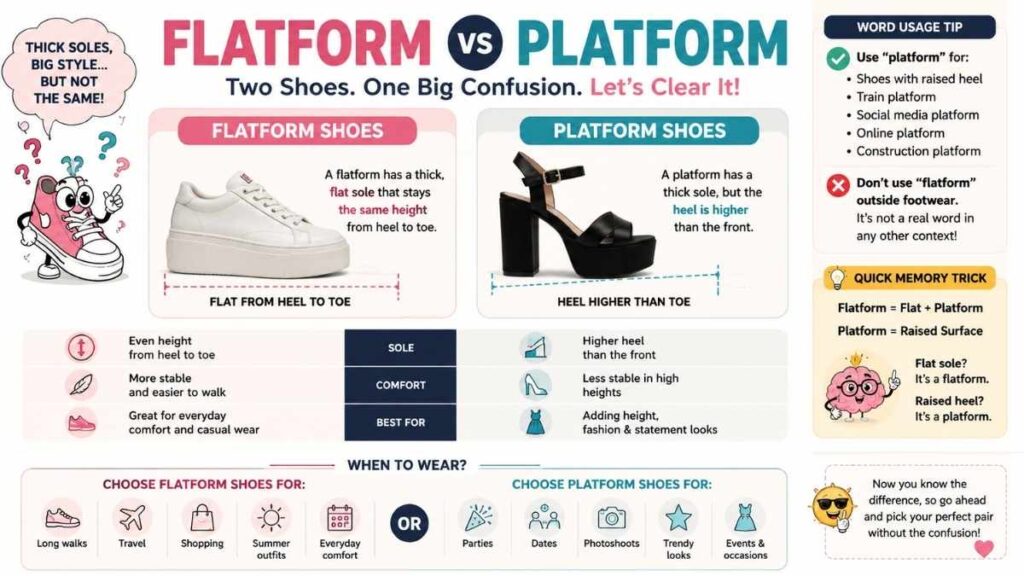
At first glance, the flatform vs platform comparison can be confusing because both shoes have thick soles and look similar. However, they’re not the same. A platform shoe usually has a raised heel, while a flatform shoe has one thick, level sole from heel to toe. That’s the key difference. Once you understand this simple rule, it’s easy to tell them apart. In this guide, you’ll learn what each term means, when to use it correctly, and how to choose the right shoe for your style and comfort. By the end, you won’t confuse a flatform with a platform again.
Flatform vs Platform quick answer
Before exploring the details, here’s a quick comparison.
| Feature | Flatform | Platform |
|---|---|---|
| Meaning | A shoe with a thick, flat sole | A raised surface or a shoe with a thick elevated sole |
| Heel | No separate heel | May have a raised heel |
| Sole Shape | Even from front to back | May be higher at the heel |
| Uses Outside Fashion | No | Yes |
| Common Examples | Flatform sandals, flatform sneakers | Platform shoes, platform boots, platform heels, social media platform |
The easiest way to remember the difference is this:
- Every flatform is a type of platform footwear.
- Not every platform shoe is a flatform.
Learn the difference between confusing word pairs
Presentor vs Presenter Which Spelling Is Correct?
What Does Platform Mean?
Understanding the platform meaning is the first step toward clearing up the confusion.
The word platform has existed in English for centuries. It generally describes a raised or elevated surface built for a specific purpose. Over time, its meaning expanded into many industries, including technology, transportation, construction, entertainment, and fashion.
That makes platform one of the most versatile words in the English language.
Platform in Everyday English
In everyday conversation, a platform usually refers to a raised surface where people stand, work, or access transportation.
Common examples include:
- A train platform where passengers wait.
- A stage platform used for speeches and performances.
- A loading platform in warehouses.
- A viewing platform at parks and tourist attractions.
In these situations, platform has nothing to do with shoes.
Platform in Technology
Technology introduced another meaning that millions of people use daily.
Examples include:
- Social media platform
- Digital platform
- Online platform
- Streaming platform
- Learning platform
Popular operating systems such as Windows, iOS, and Android are also considered software platforms because they support applications and services.
If someone asks, “Social media platform or flatform?” the correct answer is always platform.
The same rule applies to phrases like:
- Online platform
- Digital platform
- Business platform
- E-commerce platform
The word flatform is never correct in these contexts.
Platform in Construction
Construction workers also use the word platform regularly.
A construction platform is a stable, raised working surface that supports workers, equipment, or materials.
Examples include:
- Scaffolding platforms
- Maintenance platforms
- Loading platforms
- Work platforms
If you’re discussing architecture, engineering, or construction, the correct term is always platform.
Platform in Fashion
Fashion gives platform another meaning.
A platform shoe features an elevated sole that increases height by adding thickness beneath the foot. The sole can extend under the forefoot, the heel, or both.
Unlike traditional high heels, platform shoes often reduce the angle between the heel and the toe because the front of the shoe is also raised. This design can improve comfort while still providing extra height.
Today, platform footwear includes many styles, such as:
- Platform sneakers
- Platform boots
- Platform loafers
- Platform mules
- Platform sandals
- Platform heels
Because of this variety, many shoppers mistakenly assume every thick sole shoe is a flatform. That’s not the case.
Learn the difference between confusing word pairs
Stopping vs Stoping Which Spelling Is Correct?
What Does Flatform Mean?
Now let’s look at the flatform meaning.
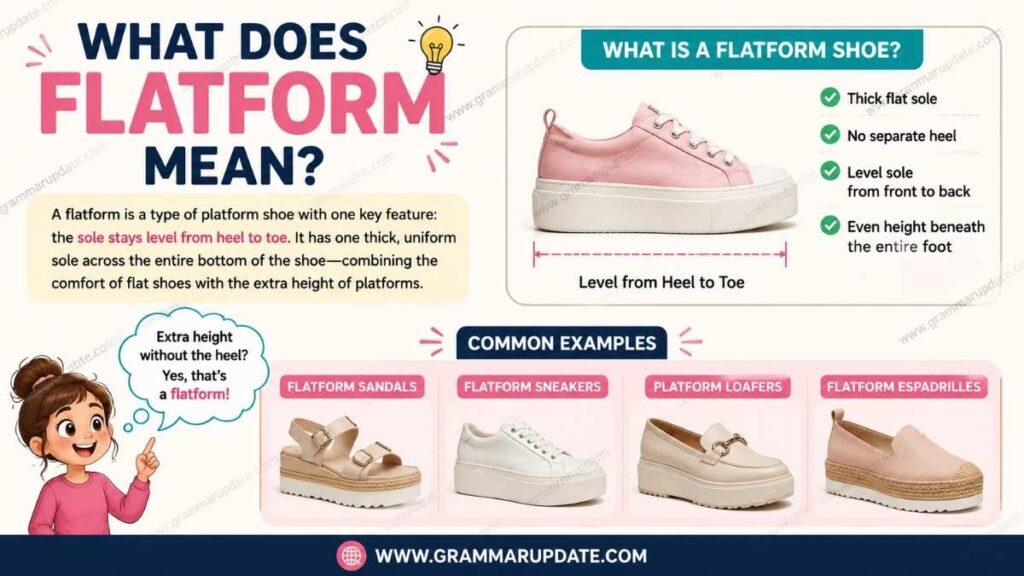
A flatform is a specific type of platform shoe with one defining feature: the sole stays level from the heel to the toe.
Instead of having a raised heel, a flatform uses one thick, uniform sole across the entire bottom of the shoe.
Think of it as combining the comfort of flat shoes with the extra height of platform footwear.
What Is a Flatform Shoe?
If you’ve ever wondered, “What is a flatform shoe?” the answer is surprisingly simple.
A flatform shoe has:
- A thick flat sole
- No separate heel
- A level sole from front to back
- Even height beneath the entire foot
Because the heel-to-toe height stays nearly identical, your foot remains in a more neutral position than it would inside many platform heels.
This design often improves shoe stability and walking comfort during everyday activities.
Common examples include:
- Flatform sandals
- Flatform sneakers
- Flatform loafers
- Flatform espadrilles
Many people choose flatform footwear because it delivers extra height without creating the steep foot angle found in traditional heels.
How the Name Flatform Was Created
The word flatform combines two familiar words:
- Flat
- Platform
The name perfectly describes the shoe’s design. It has the height of a platform with the shape of a flat shoe.
Fashion brands and retailers widely use the term today. You’ll often find categories labeled:
- Women’s flatform shoes
- Comfortable flatform sandals
- Flatform sneakers
- Casual flatform sandals
Although dictionaries recognize flatform, its use remains mostly limited to footwear.
Flatform Sandals
Among all styles, flatform sandals are some of the most popular.
Their thick flat sole provides added height while keeping the foot evenly supported.
Many people choose comfortable flatform sandals for:
- Summer vacations
- City walks
- Beach trips
- Weekend outings
- Casual office wear
Because the sole remains level, many wearers find them easier to balance in than shoes with elevated heels.
That doesn’t mean every flatform feels the same. Comfort still depends on several factors, including:
- Midsole cushioning
- Outsole grip
- Shoe materials
- Foot support
- Sole thickness
A well-designed flatform sandal combines all of these features to create a comfortable walking experience.
Learn the difference between confusing word pairs
Focuses vs Focusses Which Spelling Is Correct?
Flatform vs Platform The Main Differences
Now that you understand both definitions, comparing platform vs flatform becomes much easier.
Although they share thick soles, their construction differs in important ways.
| Feature | Flatform | Platform |
|---|---|---|
| Sole Design | Thick flat sole | Thick raised sole |
| Heel | No separate heel | Often includes a raised heel |
| Foot Position | Neutral foot position | Foot may tilt forward |
| Walking Feel | Stable and even | Depends on heel height |
| Common Styles | Flatform sandals, flatform sneakers | Platform heels, platform boots, platform sandals |
The biggest difference between platform and flatform is the heel design.
A flatform keeps the entire foot at one consistent height. A platform shoe may lift the heel higher than the front of the foot, creating a different walking experience.
This difference also affects shoe anatomy.
A typical platform shoe may include:
- Raised heel
- Raised toe box
- Thick outsole
- Cushioned midsole
- Elevated forefoot
A flatform usually features:
- Uniform sole
- Thick flat sole
- Level outsole
- Consistent sole thickness
- Balanced foot support
These design differences influence comfort, stability, and style.
Learn the difference between confusing word pairs
Anual vs Annual Which Spelling Is Correct?
Is Flatform a Real Word?
Yes. Flatform is a real word.
Although it doesn’t appear as often as platform, it has become a standard term in the fashion industry.
Major footwear brands, fashion magazines, online retailers, and designers use the word to describe shoes with a thick, level sole.
However, flatform has a much narrower meaning than platform.
You should only use flatform when talking about footwear.
These examples are correct:
- She bought new flatform sandals for summer.
- Flatform sneakers are comfortable for travel.
- Many women’s flatform shoes provide extra height without high heels.
These examples are incorrect:
- Social media flatform
- Construction flatform
- Online flatform
- Digital flatform
In every one of those cases, the correct word is platform.
Learn the difference between confusing word pairs
Learn the difference between confusing word pairs
Cognisant vs Cognizant difference which is correct ?
Is Platform a Real Word?
Absolutely.
Platform is an established English word with several meanings. It appears in dictionaries, technical manuals, business documents, engineering guides, and everyday conversations.
Depending on the context, platform can refer to:
- A raised physical surface
- A transportation area
- A construction structure
- A digital service
- An operating system
- A type of shoe
Because platform has so many meanings, context matters.
If you’re discussing software, transportation, construction, or technology, platform is always the correct choice.
Learn the difference between confusing word pairs
Fourteen vs Forteen Which Spelling Is Correct?
Platform Shoes vs Flatform Shoes
Many shoppers use the terms platform shoes and flatform shoes as if they mean the same thing. They don’t. While both belong to the family of thick sole shoes, their construction creates a different look, feel, and walking experience.
The easiest way to understand the difference is to focus on the sole.
A platform shoe raises your foot above the ground with a thick sole. In many styles, the heel sits higher than the front of the shoe. A flatform shoe also has a thick sole, but it stays level from the heel to the toe. That creates a more balanced foot position.
Here’s a simple comparison.
| Feature | Platform Shoes | Flatform Shoes |
|---|---|---|
| Sole | Thick raised sole | Thick flat sole |
| Heel | Often raised | No separate heel |
| Foot Position | Slight forward angle in many styles | Neutral and level |
| Height | Moderate to very high | Moderate |
| Best For | Fashion, added height, statement looks | Everyday comfort, casual wear |
Although every flatform is a type of platform footwear, not every platform shoe is a flatform. That’s why understanding shoe construction matters when shopping.
Platform Sneakers
Platform sneakers combine athletic-inspired designs with elevated soles.
Instead of a standard sneaker sole, they use a thicker midsole and outsole to increase height while maintaining a sporty appearance.
Many people choose platform sneakers because they:
- Add extra height without wearing heels.
- Match casual and street-style outfits.
- Provide good cushioning for everyday wear.
- Work well with jeans, dresses, and wide-leg pants.
Some platform sneakers include a slightly raised heel, while others keep the sole nearly even. The exact design depends on the brand.
Platform Boots
Platform boots have remained popular for decades and continue to appear in modern footwear trends.
These boots usually feature:
- Thick elevated soles
- Chunky heel designs
- Durable outsoles
- Extra ankle support
Some styles use dramatic platform heel design for fashion, while others focus on everyday comfort with moderate sole thickness.
Platform boots are common during cooler seasons because they combine height with stability.
Platform Heels
The Platform heels are different from regular high heels.
Traditional high heels lift only the heel, forcing the foot into a steeper angle. Platform heels also raise the front of the shoe, reducing the difference between the heel and the toe.
This design creates several advantages.
- Better weight distribution
- More cushioning beneath the front of the foot
- Reduced pressure compared with similar heel heights
- Improved balance in many styles
That doesn’t mean every platform heel feels comfortable. Heel height, shoe materials, arch support, and overall construction still play important roles.
Flatform Sneakers
Flatform sneakers have become a favorite among people who want height without sacrificing comfort.
Instead of lifting only the heel, they use a thick uniform sole across the entire shoe.
Benefits include:
- Better shoe stability
- More natural walking motion
- Even weight distribution
- Comfortable walking shoes for daily activities
Many travelers choose flatform sneakers because they pair easily with casual clothing and provide more support than many fashion-focused shoes.
Flatform Sandals
Flatform sandals continue to rank among the most popular women’s summer sandals.
Unlike platform sandals with raised heels, flatform sandals use a thick flat sole that stays level across the foot.
They’re commonly worn for:
- Vacations
- Beach trips
- Weekend shopping
- Outdoor events
- Casual office outfits
Modern footwear brands now produce comfortable flatform sandals with memory foam footbeds, lightweight midsoles, and flexible outsoles, making them suitable for long walks.
Which Is More Comfortable?
Comfort depends on more than whether you choose a platform or a flatform.
Several design features influence how a shoe feels.
These include:
- Sole thickness
- Midsole cushioning
- Arch support
- Shoe materials
- Outsole grip
- Overall fit
Generally speaking, flatform footwear provides a more balanced walking experience because the foot stays level.
Platform footwear, however, comes in many designs. Some casual platform shoes feel almost as comfortable as flatforms, while very high platform heels naturally place more pressure on the foot.
If walking comfort is your top priority, many people prefer flatform shoes for everyday wear.
Learn the difference between confusing more English words
To Bad vs Too Bad Which is correct and usage?
Platform Heels vs Flatform Shoes
One of the biggest questions shoppers ask is whether they should buy platform heels or flatform shoes.
The answer depends on where and how you’ll wear them.
Platform heels are designed to create height while maintaining better comfort than traditional high heels.
Flatform shoes focus on stability instead of dramatic elevation.
Here’s a direct comparison.
| Feature | Platform Heels | Flatform Shoes |
|---|---|---|
| Heel | Raised | None |
| Sole | Thick with elevated heel | Thick and level |
| Walking Comfort | Moderate | High |
| Stability | Depends on heel height | Excellent |
| Best Use | Parties, formal events, fashion | Everyday wear, travel, casual outfits |
If you’re attending a wedding, dinner party, or evening event, platform heels often create a more polished appearance.
If you’re spending hours on your feet, flatform shoes usually provide greater stability and less foot fatigue.
Learn the difference between confusing more English words
Message vs Messege Which Spelling Is Correct?
Flatform Sandals Explained
Many people searching for “What are flatform sandals?” simply want to know why these shoes have become so popular.
The answer is easy to see once you try them.
Flatform sandals combine the simplicity of flat sole sandals with the height of elevated footwear.
Unlike traditional sandals, they use a thick flat sole beneath the entire foot.
Most flatform sandals include:
- Thick flat sole
- Adjustable straps
- Cushioned footbeds
- Lightweight construction
- Slip-resistant outsole
This design makes them a practical choice for everyday sandals, especially during warm weather.
Many fashion experts also appreciate their versatility.
You can wear flatform sandals with:
- Shorts
- Linen pants
- Maxi dresses
- Denim skirts
- Casual jumpsuits
Because they add height without creating an aggressive heel angle, they work well for both comfort and style.
Platform Shoes Explained
If you’ve ever asked, “What is a platform shoe?” the answer goes beyond simply having a thick sole.
Platform shoes raise the foot using additional material beneath the sole.
The amount of elevation varies depending on the style.
Popular types include:
- Platform sneakers
- Platform boots
- Platform loafers
- Platform mules
- Platform sandals
- Platform heels
Some designs focus on comfort, while others prioritize fashion.
Today’s women’s platform shoes appear in everything from casual collections to luxury designer footwear.
Many brands now combine thick sole sandals with lightweight materials, making them easier to wear than older platform styles.
Modern platform footwear often includes:
- Cushioned midsoles
- Flexible outsoles
- Shock-absorbing foam
- Lightweight rubber soles
- Better traction
These improvements have made platform shoes much more comfortable than many people expect.
Platform or Flatform in Construction
Outside the fashion industry, this question has only one correct answer.
The correct word is platform.
Construction professionals use platform to describe raised working surfaces built for safety and access.
Examples include:
- Work platform
- Scaffolding platform
- Maintenance platform
- Loading platform
- Access platform
The word flatform has no meaning in construction terminology.
Using it in engineering documents or workplace communication would be incorrect.
Social Media Platform or Flatform?
Technology creates another area where people occasionally make this mistake.
The correct phrase is always social media platform.
Major services such as Facebook, Instagram, LinkedIn, TikTok, X, and YouTube are all social media platforms.
The same applies to:
- Digital platform
- Online platform
- Streaming platform
- Education platform
- Business platform
Since flatform refers only to a type of shoe, it should never replace platform in technology discussions.
Online Platform or Flatform?
If you’re talking about websites, software, or internet services, platform is always the correct choice.
Examples include:
- Learning platform
- E-commerce platform
- Booking platform
- Gaming platform
- Cloud platform
Businesses also describe Windows, iOS, and Android as operating system platforms because they support software applications.
Flatform has no role in these contexts.
Platform vs Flatform for Walking
One of the most common questions buyers ask is, “Which is better for walking: platform or flatform?”
The answer depends on the shoe’s design, but flatforms often have an advantage for long periods of walking.
Here’s why.
A flatform keeps your foot in a neutral position from heel to toe. That even design helps distribute body weight more evenly across the foot.
Many people notice benefits such as:
- Better balance
- Improved shoe stability
- Less pressure on the forefoot
- More natural walking motion
- Reduced foot fatigue during daily wear
Platform shoes can also be comfortable, especially those designed with moderate heel height, quality cushioning, and supportive insoles.
However, very high platform heels may change your walking pattern because of the raised heel.
If you’re choosing footwear for sightseeing, commuting, or long shopping trips, comfortable flatform sandals and flatform sneakers are often the better option.
If your goal is to gain height while creating a fashionable look, comfortable platform shoes may be the right choice.
Learn the difference between confusing more English words
Whose vs Who’s Difference and Using Each Word Correctly
Flatform vs Platform Women’s Shoes
Women’s footwear includes hundreds of styles, yet few create as much confusion as flatform vs platform women’s shoes. At first glance, they look similar because both feature thick soles. Once you wear them, however, the differences become much more noticeable.
Platform shoes often focus on adding height and making a fashion statement. Flatform shoes, on the other hand, combine extra height with a level sole that feels more balanced during everyday activities.
Here’s a quick comparison.
| Feature | Women’s Platform Shoes | Women’s Flatform Shoes |
|---|---|---|
| Heel | Often raised | No separate heel |
| Sole | Thick elevated sole | Thick flat sole |
| Height | Moderate to high | Moderate |
| Best For | Dressy and fashion-forward outfits | Everyday comfort and casual wear |
| Walking Comfort | Varies by heel height | Usually excellent |
Both styles continue to appear in modern footwear trends, giving shoppers plenty of choices for work, travel, weekends, and special occasions.
Common Mistakes People Make
Many people confuse these terms because they focus only on the thick sole. In reality, the sole’s shape is what matters most.
Here are the mistakes people make most often.
Calling Every Thick Sole Shoe a Flatform
Not every thick sole shoe is a flatform.
If the heel sits higher than the front of the shoe, it’s a platform rather than a flatform.
Using Flatform Outside Footwear
Flatform belongs almost exclusively to the fashion industry.
These examples are incorrect:
- Social media flatform
- Online flatform
- Construction flatform
- Digital flatform
In every one of these examples, the correct word is platform.
Assuming Every Platform Shoe Has a Very High Heel
Many platform shoes have only a slight elevation.
Platform sneakers, platform loafers, and casual platform sandals often provide just enough height to improve style without dramatically changing the way you walk.
Confusing Wedges With Flatforms
A wedge has a continuous sole that becomes higher toward the heel.
A flatform stays level from front to back.
Although both increase height, they use different shoe construction.
Learn the difference between confusing more English words
Genius vs Genious Correct Spelling and Usage
Wedge vs Platform vs Flatform
Another common source of confusion is the difference between wedges, platforms, and flatforms.
Each style changes foot position in a different way.
| Feature | Wedge | Platform | Flatform |
|---|---|---|---|
| Sole Shape | Angled | Thick elevated sole | Thick flat sole |
| Heel | Built into the sole | Often separate | None |
| Foot Position | Forward angle | Slight to moderate angle | Neutral |
| Best For | Dressy occasions | Fashion and extra height | Everyday comfort |
| Stability | Moderate | Good | Excellent |
The biggest difference is how the sole is built.
A wedge lifts the heel gradually.
A platform raises the entire shoe but often keeps the heel slightly higher.
A flatform raises the foot evenly from heel to toe.
Knowing these shoe sole types makes shopping much easier.
Learn the difference between confusing more English words
Their vs Thier Which One Is Correct in English Grammar?
Which One Should You Choose?
If you’re trying to decide which is better, platform or flatform, think about where you’ll wear the shoes.
No single style is perfect for everyone.
The best choice depends on comfort, fashion preferences, and daily activities.
Choose platform shoes if you:
- Want to appear taller.
- Like bold fashion footwear.
- Need shoes for parties or evening events.
- Enjoy trendy shoes with extra height.
- Prefer platform boots or platform heels.
Choose flatform shoes if you:
- Walk frequently.
- Want better stability.
- Prefer casual footwear.
- Travel often.
- Like comfortable walking shoes.
- Need supportive everyday shoes.
Many people eventually own both styles because each serves a different purpose.
Fix common more word mistakes in English
Outting vs Outing Correct Spelling and Proper Usage
Practice Section Flatform vs Platform
Choose the correct word to complete each sentence. Flatform vs Platform
- A social media ______ lets users share photos and videos.
- My new ______ has a thick, level sole from heel to toe.
- The passengers waited on the train ______ until the train arrived.
- She wore ______ sandals because they were comfortable for walking.
- A ______ heel usually adds extra height while reducing the foot angle compared with a regular high heel.
- The workers stood on a safety ______ during the building inspection.
- If the sole is completely flat from front to back, it is called a ______.
- Many people choose ______ sneakers for everyday comfort.
- Windows, iOS, and Android are operating system ______.
- The fashion store displayed several pairs of ______ boots for the winter season.
- A ______ usually has a raised heel, while a flatform has a level sole.
- We bought comfortable ______ sandals for our beach vacation.
- The teacher uploaded the lesson to an online ______.
- Thick, even soles are a key feature of ______ footwear.
- The delivery truck backed up to the loading ______.
- Her ______ shoes made her look taller without wearing traditional high heels.
- A ______ is commonly used in construction to provide a safe working surface.
- The designer introduced colorful ______ sneakers in the new collection.
- The conference was streamed through a digital ______.
- Many travelers prefer ______ shoes because they offer a stable walking experience.
- The actress paired her dress with elegant ______ heels.
- The hiking trail ended at a wooden viewing ______.
- Most ______ sandals have a uniform sole instead of a raised heel.
- The company launched a new learning ______ for students worldwide.
- Understanding the difference between a ______ and a platform shoe makes shopping much easier.
Answers
- platform
- flatform shoe
- platform
- flatform
- platform
- platform
- flatform
- flatform
- platforms
- platform
- platform shoe
- flatform
- platform
- flatform
- platform
- platform
- platform
- flatform
- platform
- flatform
- platform
- platform
- flatform
- platform
- flatform
Here’s a trusted source for clear word meanings:
FAQs
Is every thick sole shoe considered a flatform?
No. A thick sole alone doesn’t make a shoe a flatform. A flatform has a completely level sole from the heel to the toe, while many platform shoes have a raised heel.
Can a platform shoe have a flat sole?
Yes. Some platform shoes have a nearly level sole. However, if the sole remains uniformly flat from front to back, the shoe is generally classified as a flatform.
Do flatform shoes add as much height as platform shoes?
Usually not. Flatform shoes provide moderate height with a uniform sole, while platform shoes can add much more height, especially styles with elevated heels.
Are flatform shoes suitable for long walks?
Many are. Flatform shoes often offer better stability because the sole stays level, making them a popular choice for shopping, sightseeing, and everyday wear. Comfort still depends on cushioning, fit, and support.
Can men wear platform or flatform shoes?
Absolutely. While these styles are often marketed toward women, many brands also produce platform boots, sneakers, loafers, and sandals for men.
Are platform sneakers better than regular sneakers?
Platform sneakers provide extra height and a fashionable appearance. Whether they’re better depends on your needs. Regular sneakers are often lighter, while platform sneakers offer a more elevated look.
Are flatform shoes appropriate for the office?
Yes. Simple leather or suede flatform loafers, sandals, or sneakers can work well in business-casual workplaces, provided they match the dress code.
Do platform shoes make you look taller?
Yes. The thick elevated sole increases your overall height, making platform shoes a popular choice for people who want extra lift without traditional stilettos.
Can platform shoes help improve posture?
Not necessarily. While some supportive platform shoes encourage better alignment, posture depends more on proper fit, arch support, and overall shoe design than sole height alone.
Are flatform shoes lightweight?
Many modern flatform shoes use lightweight foam, EVA, or rubber soles. However, materials vary by brand, so some styles are heavier than others.
What’s the easiest way to identify a flatform shoe?
Look at the side profile. If the sole stays the same thickness from the heel to the toe, it’s a flatform. If the heel rises above the front of the shoe, it’s a platform.
Do platform sandals work for everyday wear?
Yes. Many platform sandals are designed with cushioned footbeds and supportive soles, making them comfortable for daily use when properly fitted.
Can platform shoes be worn in every season?
Yes. Platform footwear comes in many styles, including sandals for summer, sneakers for spring, loafers for fall, and boots for winter.
Do flatform shoes go with dresses?
Yes. Flatform shoes pair well with maxi dresses, midi dresses, skirts, jumpsuits, and wide-leg pants, making them a versatile fashion choice.
Are platform shoes still fashionable?
Yes. Platform shoes continue to appear in seasonal collections from both luxury designers and everyday footwear brands, making them a lasting fashion trend rather than a short-lived style.
Fix common more word mistakes in English
Putting vs Puting Which Spelling Is Correct?
Conclusion
The confusion between flatform vs platform is easier to solve than it seems. The key difference is in the sole. A platform shoe has an elevated sole and often includes a raised heel, while a flatform shoe has one thick, level sole from heel to toe.A simple way to remember it is this: a flatform is a flat platform. If the sole stays even from front to back, it’s a flatform. If the heel sits higher or you’re talking about technology, transportation, or construction, the correct word is platform.Now you can shop with confidence and use both terms correctly. Whether you’re choosing stylish platform heels, comfortable flatform sandals, or discussing a social media platform, you’ll know exactly which word fits the situation. One small difference in design makes all the difference in meaning.

Jhon AJS, the creative mind behind Grammar Update, is an experienced blogger passionate about simplifying English grammar. He focuses on explaining confusing word vs word differences, grammar rules, punctuation, and sentence structure in a clear and practical way. Through easy to understand guides and examples, Jhon helps readers improve their writing and communicate with confidence. With years of blogging experience, he continues to share helpful insights that make learning grammar simple, useful, and accessible for everyone.