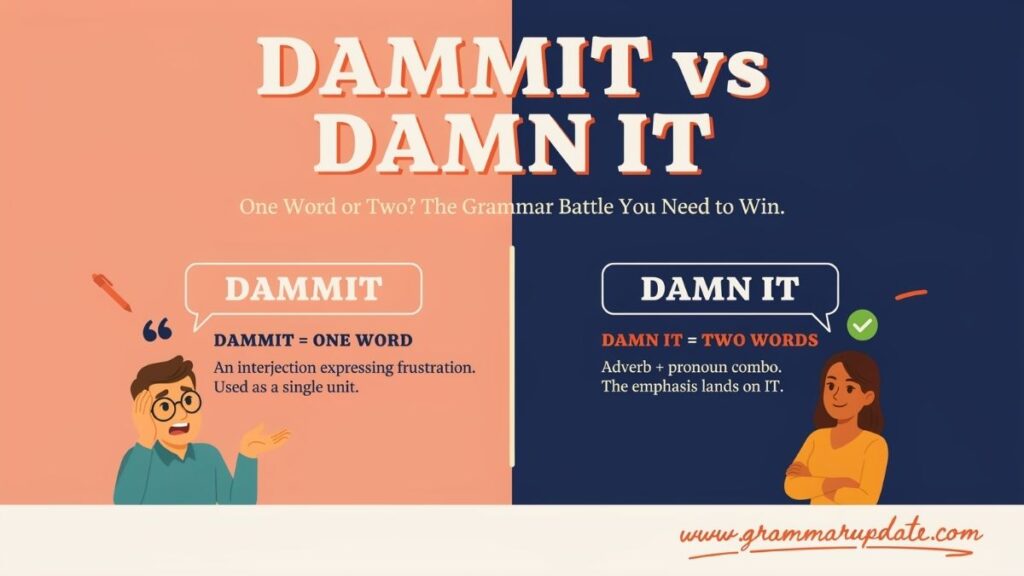
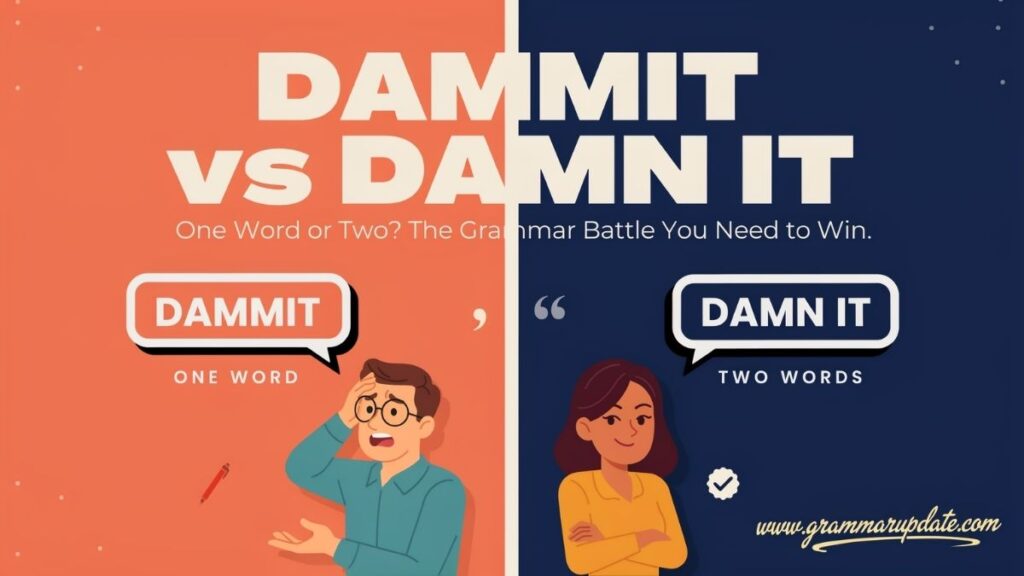
Have you ever typed “Dammit!” and then wondered if it should actually be “Damn it”? You’re not alone. The confusion between Dammit vs Damn It is common because both spellings look correct and sound exactly the same when people speak. So, which one should you use? The simple answer is that both are correct, but they work best in different situations. “Damn it” is the original two-word expression, while “dammit” is the accepted one-word form used in casual writing and conversation. This guide explains the difference in plain English, clears up the confusion, and helps you choose the right spelling every time.
Quick Answer
If you’re looking for the short answer, here it is.
- “Damn it” is the original two-word expression.
- “Dammit” is an accepted one-word spelling used mainly in informal English.
- Both express frustration, annoyance, disappointment, or anger.
- “Damn it” is generally the better choice in formal editing and careful writing.
- “Dammit” works naturally in dialogue, fiction, texting, social media, and casual conversations.
- “Damnit” is generally considered a misspelling and isn’t recognized as the standard spelling by major dictionaries.
In other words, if someone asks, “Dammit or damn it?” the answer depends on the context rather than the meaning.
Dammit vs Damn
| Feature | Dammit | Damn It |
|---|---|---|
| Spelling | One word | Two words |
| Meaning | Expression of frustration | Expression of frustration |
| Grammar | Lexicalized interjection | Verb + pronoun phrase used as an interjection |
| Formality | Informal | More suitable for careful writing |
| Common Usage | Texting, dialogue, social media | Books, edited writing, speech |
| Dictionary Status | Recognized by major dictionaries | Standard English expression |
| Tone | Slightly stronger and more emotional | Slightly more deliberate |
The biggest difference between dammit vs damn it is spelling and style rather than meaning.
Fix common more word mistakes in English
Firey vs Fiery difference Which one Is Correct?
What Does “Damn It” Mean?
Understanding the damn it meaning makes the spelling much easier to remember.
“Damn it” is an exclamation people use when something goes wrong or causes frustration. Originally, the phrase literally meant to condemn or curse something. Over time, however, it lost much of that literal force and became a common emotional expression.
Today, most people don’t use it with a religious meaning. Instead, they use it to express feelings such as:
- Frustration
- Anger
- Surprise
- Disappointment
- Irritation
- Regret
The modern damn it definition focuses more on emotion than on actually cursing someone or something.
How “Damn It” Works Grammatically
From a grammar perspective, “damn” is the verb while “it” is the object.
Originally, the phrase meant something close to:
“Damn it.”
In other words:
“Curse it.”
As English evolved, speakers began using the entire phrase as an emotional interjection instead of a literal command.
This explains why many grammar experts still view “damn it” as the traditional spelling.
Damn It Examples
Here are several examples of damn it in a sentence.
- Damn it! I forgot my wallet at home.
- Damn it, the meeting starts in five minutes.
- She whispered, “Damn it,” after dropping her phone.
- Damn it! I studied the wrong chapter.
Notice that the phrase usually appears with an exclamation mark because it expresses strong emotion.
Fix common more word mistakes in English
Pose vs Poise Difference and Which one is correct ?
What Does “Dammit” Mean?
The dammit meaning is virtually identical to the meaning of “damn it.”
The difference is that “dammit” has become a single written word that represents how people actually pronounce the expression in everyday speech.
When people speak quickly, they rarely pronounce both words separately.
Instead of saying:
“Damn… it…”
They usually say something closer to:
“Dammit!”
Eventually, writers started spelling the expression exactly as it sounded.
That process created the accepted spelling “dammit.”
Dammit Definition
Most modern dictionaries define “dammit” as an informal exclamation expressing annoyance, frustration, or anger.
The word functions as an interjection rather than as a traditional verb phrase.
This is why many language experts describe it as a lexicalized interjection.
Dammit Examples
Here are some natural examples of dammit in a sentence.
- Dammit! I missed the last train.
- He muttered, “Dammit,” under his breath.
- Dammit, why won’t this computer start?
- She laughed and said, “Dammit, not again.”
These examples show why “dammit” feels especially natural in dialogue.
Fix common more word mistakes in English
Leary vs Leery Which Is Correct and Difference?
Dammit vs Damn It What’s the Real Difference?
Many people assume there’s a grammar difference between dammit vs damn it. In reality, the difference is mostly stylistic.
Here’s what separates them.
Spelling
“Damn it” contains two separate words.
“Dammit” combines them into one.
Neither spelling changes the meaning.
Meaning
Both expressions communicate frustration, annoyance, disappointment, or anger.
Whether you write:
- Damn it!
- Dammit!
The emotional message remains the same.
Pronunciation
The dammit pronunciation and damn it pronunciation are almost identical.
Most speakers naturally blend the sounds together.
That’s one reason the one-word spelling became popular.
Grammar
This is where the expressions differ slightly.
“Damn it” preserves the original grammatical structure.
“Dammit” functions as a single interjection.
This explains why searches for dammit vs damn it grammar continue to be popular among English learners.
Tone
Many readers feel that “dammit” sounds quicker, sharper, and more emotional.
“Damn it” can feel slightly more deliberate because the words remain separate.
The difference is subtle rather than absolute.
Learn the difference between commonly mixed-up more words
Fistulogram vs Fistulagram which is correct and Difference ?
Is “Dammit” a Real Word?
One of the most common questions online is:
Is dammit a word?
Yes.
Major dictionaries recognize “dammit” as a legitimate English word.
Although it began as an informal spelling, dictionaries now include it because millions of English speakers use it consistently.
This reflects an important principle of language.
English dictionaries describe how people actually use words rather than trying to force every word to stay exactly as it was centuries ago.
That means “dammit” has earned its place through widespread use.
How Dictionaries Spell “Dammit”
Several respected dictionaries recognize “dammit” as a standard informal spelling.
These include:
- Merriam-Webster
- Cambridge Dictionary
- Oxford English Dictionary
Their entries generally describe it as an informal exclamation expressing annoyance or frustration.
Because these dictionaries recognize the spelling, editors no longer consider it an accidental typo.
This also answers questions such as:
- Merriam-Webster dammit
- Cambridge dictionary dammit
- Oxford dictionary dammit
- how dictionaries spell dammit
All three acknowledge that “dammit” is an accepted informal form.
Learn the difference between commonly mixed-up more words
Peice vs Piece Which Spelling Is Correct?
Which One Is Grammatically Correct?
Many people ask:
Is damn it correct?
Yes.
“Damn it” is grammatically correct.
Others ask:
Is dammit grammatically correct?
Yes.
In modern English, “dammit” is also grammatically acceptable because it functions as an established interjection.
Instead of asking which one is correct, it’s better to ask:
Which one fits this situation?
That’s a much more useful question.
When Should You Use “Damn It”?
Choose “damn it” when you’re writing:
- Formal essays
- Academic papers
- Professional editing
- News articles
- Careful nonfiction
- Situations where preserving the original phrase matters
Although editors may still remove profanity entirely, if the expression remains, “damn it” often matches formal style guides more closely.
When Should You Use “Dammit”?
Choose “dammit” when writing:
- Fiction
- Dialogue
- Screenplays
- Text messages
- Social media posts
- Informal emails
- Casual conversations
The one-word spelling often sounds closer to natural speech.
That’s why novelists frequently prefer it when writing realistic dialogue.
Learn the difference between commonly mixed-up more words
Mold vs Mould Which Spelling Is Correct?
Why People Confuse Dammit and Damn It
The confusion doesn’t happen because English learners are careless.
Instead, several language patterns naturally create uncertainty.
Fast Speech Blends the Words
People rarely pause between “damn” and “it.”
Instead, both words merge into a single sound.
That spoken pronunciation encourages writers to combine the words.
English Constantly Evolves
English changes every generation.
Many expressions that began as two separate words eventually became one word.
Examples include:
- Goodbye
- Nonetheless
- Maybe
- Today
The development of “dammit” follows a similar pattern.
Informal Writing Encourages Simplification
Text messages, online conversations, and social media favor quick, natural spellings.
As a result, informal English expressions often become shorter over time.
“Dammit” fits that trend perfectly.
Pronunciation Influences Spelling
Another reason involves phonetic spelling.
People often write words the way they hear them.
Since “dammit pronunciation” sounds like one word, many writers naturally spell it that way.
This explains why searches such as:
- how to spell dammit
- how to spell damn it
- why is dammit one word
- why is damn it two words
continue to appear frequently.
Learn the difference between commonly mixed-up more words
Defense vs Defence Which Spelling Is Correct?
Common Mistakes to Avoid
Although both accepted spellings exist, several mistakes still appear regularly.
Writing “Damnit”
One of the biggest mistakes is writing:
Damnit
Most dictionaries do not recognize this spelling.
When comparing dammit vs damnit or damnit vs dammit, remember that the version with two “m” letters is the accepted spelling.
The missing letter changes the standard spelling.
Assuming “Dammit” Is Wrong
Some people believe “dammit” is automatically incorrect.
That isn’t true.
Modern dictionaries recognize it as an accepted informal spelling.
Using Either Expression in Professional Documents
Even when the spelling is correct, the expression itself may not fit every audience.
Business reports, academic research, legal writing, and professional correspondence usually avoid profanity altogether.
In those situations, choosing a more neutral expression often creates a stronger impression.
Origin and History of Dammit
The story behind dammit vs damn it shows how spoken English influences written English. The original expression was “damn it,” which dates back hundreds of years. People used it as a literal curse, meaning “may it be damned.”
Over time, however, the phrase became less literal. Instead of expressing an actual curse, speakers used it simply to show frustration or disappointment. As pronunciation became faster in everyday conversation, “damn it” often sounded like a single word.
Eventually, writers began spelling it the way it sounded. That informal spelling became “dammit.”
This change is common in English. Spoken language often shapes spelling, especially with frequently used expressions.
Where “Damn It” Came From
The verb “damn” entered English through Old French and ultimately traces back to the Latin word damnare, meaning “to condemn” or “to pronounce guilty.”
Originally, saying “damn it” carried a much stronger meaning than it does today. It implied wishing condemnation upon someone or something.
Modern English speakers rarely think about that original meaning. Instead, they use it as an emotional reaction.
For example:
- Damn it! I forgot my keys.
- Damn it! The printer stopped working again.
Neither sentence is a literal curse. Both simply express frustration.
How “Dammit” Became One Word
The transition from “damn it” to “dammit” happened naturally through speech.
When spoken quickly, the phrase sounds like this:
Dam-mit
Because millions of people pronounced it that way, publishers, novelists, and dictionary editors gradually accepted the combined spelling.
Language experts call this process lexicalization. A phrase becomes so common that speakers begin treating it as a single word.
That is why many dictionaries now classify “dammit” as a lexicalized interjection.
This also explains searches like:
- why is dammit one word
- why is dammit spelled with two m’s
- can dammit be one word
Dammit Etymology
Understanding the dammit etymology helps explain the spelling.
The word developed from:
damn + it
Notice what happened during pronunciation.
The “n” sound blends with the following vowel sound, creating a pronunciation that naturally sounds like “dammit.”
English often doubles consonants in words that develop through pronunciation. The extra “m” helps preserve the short vowel sound.
That’s why the accepted spelling is:
Dammit
Not:
Damit
And not:
Damnit
Trey vs Tray What’s the Difference?
Why Is Dammit Spelled With Two M’s?
Many learners wonder why the accepted dammit spelling contains two “m” letters.
The answer comes from English spelling conventions.
When a short vowel comes before a consonant, English frequently doubles the consonant.
Compare these words:
| Short Vowel | Double Consonant |
|---|---|
| running | nn |
| swimming | mm |
| beginning | nn |
| forgetting | tt |
| dammit | mm |
Although “dammit” developed differently from these words, the spelling follows a familiar English pattern.
That is why “dammit” looks more natural than “damnit.”
Disk vs Disc What’s the Difference and Which one Is Correct?
Why Is “Damnit” Considered Incorrect?
Searches for damnit vs dammit appear frequently because many people assume the spellings are interchangeable.
They are not.
Major dictionaries recognize:
- Dammit
- Damn it
They generally do not recognize:
- Damnit
The incorrect version probably appeared because writers tried to spell the phrase exactly as they heard it.
If you want the correct spelling of dammit, choose either:
- Dammit
- Damn it
Avoid “damnit” in edited writing.
Is “Dammit” Considered a Bad Word?
Another common question is:
Is dammit a bad word?
The answer depends on the audience and setting.
Most people consider it a mild swear word rather than an extremely offensive one.
Compared with stronger profanity, “dammit” usually ranks as relatively mild.
However, schools, workplaces, religious settings, and family publications may still discourage its use.
Think about your audience before including it.
Feal vs Feel Which Spelling Is Correct?
Understanding Mild Profanity
English contains different levels of profanity.
Here’s a general comparison.
| Expression | Strength |
|---|---|
| Heck | Very mild |
| Darn it | Very mild |
| Dang it | Mild |
| Damn it | Mild to moderate |
| Dammit | Mild to moderate |
Even though “dammit” isn’t among the strongest curse words in English, many readers still consider it inappropriate in formal communication.
God Dammit Meaning vs God Damn It Meaning
These expressions often create additional confusion.
“God damn it” is the original phrase.
“God dammit” is an informal written variation.
Both express stronger frustration than simply saying “dammit.”
Because the expression includes a religious reference, some people consider it offensive regardless of spelling.
Use extra care before including either form in professional or public writing.
Fix common more word mistakes in English
Muscle vs Mussel Which is Difference and usage?
American English Spelling vs British English Usage
One interesting fact about dammit vs damn it is that the difference has little to do with regional spelling.
Unlike words such as:
- Color / Colour
- Center / Centre
Both American English spelling and British English usage recognize “damn it” and “dammit.”
The difference depends more on formality than geography.
American English
American writers frequently use:
- Damn it
- Dammit
Novels, television scripts, online discussions, and social media commonly use the one-word form.
British English
British publications also recognize both forms.
Edited nonfiction often prefers “damn it,” while dialogue regularly includes “dammit.”
There is no strict American-versus-British rule.
Learn the difference between commonly mixed-up more words
Emigrate vs Immigrate Difference and usage
Dammit vs Damn It in Formal and Informal Writing
Choosing the right version depends on your audience.
| Writing Type | Recommended Choice |
|---|---|
| Academic papers | Avoid both if possible |
| Business emails | Avoid both |
| Professional reports | Avoid both |
| Fiction dialogue | Dammit |
| Screenplays | Dammit |
| Text messages | Dammit |
| Social media | Dammit |
| Careful edited prose | Damn it |
This table summarizes the difference between dammit and damn it in English.
Writing Dialogue Naturally
Authors often choose “dammit” because dialogue should sound like real speech.
For example:
“I practiced all week,” Jake groaned. “Dammit, I still missed the shot.”
Writing the phrase as one word reflects natural pronunciation.
If a character speaks slowly for emphasis, however, “damn it” may sound more intentional.
Example:
“Damn it,” she said quietly. “We were so close.”
Both versions work.
The surrounding dialogue determines which feels more authentic.
Punctuation After Dammit
Another frequent question concerns English punctuation rules.
Should you write:
Dammit!
or
Dammit.
The answer depends on emotion.
Use an exclamation mark when expressing sudden frustration.
Example:
Dammit! I forgot my passport.
Use a comma when the word introduces a sentence.
Example:
Dammit, I knew this would happen.
Use a period only when the emotion is restrained.
Example:
He sighed. “Dammit.”
Proper punctuation helps readers hear the intended tone.
Learn the difference between commonly mixed-up more words
Imbed vs Embed Which Spelling Should You Use?
Common Grammar Mistakes
Here are several grammar correction tips that editors regularly recommend.
Avoid these errors.
Writing “Damnit”
Incorrect:
Damnit!
Correct:
Dammit!
Adding Extra Spaces
Incorrect:
Damn it
Correct:
Damn it
Using the Expression in Formal Reports
Although the spelling may be correct, the tone often isn’t.
Choose neutral alternatives when writing professionally.
Similar Expressions
English offers many alternatives that express frustration without sounding as strong.
| Expression | Tone |
|---|---|
| Darn it | Very mild |
| Dang it | Mild |
| Shoot | Mild |
| Heck | Very mild |
| Good grief | Mild |
| Oh no | Neutral |
These expressions work well when writing for younger audiences or professional settings.
Learn the difference between confusing more English words
Planing vs Planning Difference and Correct Usage
Popular Culture References
The expression appears throughout modern entertainment.
Dammit by Blink-182
One of the best-known examples is “Dammit,” the hit song by Blink-182.
Its popularity introduced the one-word spelling to millions of listeners and helped reinforce “dammit” as the familiar informal form.
Dammit Doll
The Dammit Doll is a novelty stress-relief toy designed to be humorously hit against a desk or wall while venting frustration.
Its name intentionally uses the one-word spelling because it sounds more conversational and memorable.
Dammit Memes
Internet culture frequently uses “dammit” in memes because the shorter spelling matches casual online communication.
Dammit vs Damn It Reddit
Reddit discussions regularly debate:
- Which spelling is correct?
- Is “dammit” a real word?
- Why is “damnit” incorrect?
Most discussions reach the same conclusion.
Both “dammit” and “damn it” are accepted, while “damnit” is generally treated as a misspelling.
Learn the difference between confusing more English words
Tonite vs Tonight Difference and Which is Correct?
Dammit vs Damn It Comparison Table
| Feature | Dammit | Damn It |
|---|---|---|
| Accepted spelling | Yes | Yes |
| Dictionary spelling | Yes | Yes |
| Informal English expressions | Yes | Yes |
| Formal writing | Less suitable | More suitable |
| Dialogue | Excellent choice | Good choice |
| Text messages | Common | Less common |
| Social media | Very common | Common |
| Original form | No | Yes |
Quick Memory Trick
Here’s an easy way to remember the difference.
If you’re writing something casual that should sound like real speech, “dammit” usually fits naturally.
If you’re writing carefully edited prose or want to preserve the original phrase, choose “damn it.”
And remember one simple rule:
Never write “damnit.”
Learn the difference between confusing more English words
Suprise vs Surprise Which is Correct Spelling?
Practice Section Dammit vs Damn It
Choose the correct answer for each sentence. Fill in the blank with either “Dammit vs Damn It .”
- “________! I forgot my umbrella at home.”
- Sarah whispered, “________,” after missing the final shot.
- In formal writing, many editors prefer the spelling “________.”
- “________! The printer jammed again,” Mark complained.
- The original two-word expression is “________.”
- The novel’s dialogue used “________” to sound more natural.
- “________! I left my phone in the car.”
- If you’re writing a business report, it’s better to avoid both “” and “.”
- Most dictionaries recognize “________” as an accepted informal spelling.
- “________! We missed the last train.”
- The phrase “________” is the traditional spelling.
- The actor shouted, “________!” during the dramatic scene.
- Writers often choose “________” in text messages and online chats.
- “________! I deleted the wrong file.”
- Grammar guides generally accept both “” and “.”
- “________! That was my favorite coffee mug.”
- The editor changed “damnit” to “________.”
- “________! I can’t believe I locked myself out.”
- The expression “________” originally functioned as a verb followed by a pronoun.
- Fiction authors often write “________” because it reflects everyday speech.
- “________! My laptop battery just died.”
- The standard dictionary spelling is “________,” not “damnit.”
- “________! I answered the wrong question on the test.”
- Careful nonfiction often keeps the expression as “________.”
- “________! I almost had the winning answer.”
Answers
- Dammit
- Dammit
- Damn it
- Dammit
- Damn it
- Dammit
- Dammit
- dammit, damn it
- Dammit
- Dammit
- Damn it
- Dammit
- Dammit
- Dammit
- dammit, damn it
- Dammit
- Dammit
- Dammit
- Damn it
- Dammit
- Dammit
- Dammit
- Dammit
- Damn it
- Dammit
Here’s a trusted source for clear word meanings:
FAQs
Is “dammit” the same as “damn it”?
Yes. “Dammit” and “damn it” have the same meaning. Both express frustration, annoyance, or disappointment. The main difference is spelling. “Damn it” is the original two-word phrase, while “dammit” is the accepted one-word informal spelling.
Is “damn it” or “dammit” correct?
Both are correct. “Damn it” is the traditional two-word expression, and “dammit” is an accepted informal variant found in major dictionaries. The best choice depends on your writing style and audience.
Is “dammit” an actual word?
Yes. “Dammit” is a real English word recognized by dictionaries such as Merriam-Webster and Cambridge Dictionary. It functions as an informal interjection that expresses frustration or anger.
What does “damn it” or “dammit” mean?
Both expressions mean the same thing. They are emotional exclamations people use when something goes wrong, is disappointing, or causes irritation.
What kind of word is “dammit”?
“Dammit” is an interjection. It stands alone to express emotion rather than acting as a noun, verb, adjective, or adverb.
Is “dammit” considered slang?
Not exactly. While “dammit” is informal, dictionaries classify it as an interjection rather than slang. It is widely accepted in everyday English and informal writing.
Is “dammit” a bad word?
“Dammit” is generally considered a mild swear word. Most people view it as less offensive than stronger profanity, but it may still be inappropriate in formal, religious, or professional settings.
Is “dammit” an insult?
No. “Dammit” is usually an exclamation of frustration rather than an insult directed at another person. However, the tone and context can affect how listeners perceive it.
How do you use “damn it” correctly?
Use “damn it” as an interjection when expressing frustration or disappointment. For example: “Damn it! I forgot my wallet.” In formal writing, avoid it unless it is necessary for dialogue or quotation.
Is “damn it” two words?
Yes. “Damn it” is the original and traditional two-word expression. It remains grammatically correct and is often preferred in careful or edited writing.
How do you spell “dammit” correctly?
The correct one-word spelling is “dammit,” with two “m” letters. Avoid writing “damnit,” which is generally considered a misspelling.
Why is “dammit” spelled with two m’s?
The double “m” follows standard English spelling patterns and reflects the word’s pronunciation. It has become the accepted spelling in modern dictionaries.
Where did the word “dammit” come from?
“Dammit” developed from the phrase “damn it.” As people began pronouncing the two words together in everyday speech, the combined spelling became common and was eventually accepted by dictionaries.
Can I use “dammit” in professional writing?
It’s best to avoid both “dammit” and “damn it” in professional, academic, or business writing because they are forms of mild profanity. Choose a neutral expression instead.
What can I say instead of “dammit”?
If you want a less offensive alternative, try:
- Darn it
- Dang it
- Oh no
- Shoot
- Good grief
- Rats
- Blast
- Well, that’s frustrating
Is “God damn it” stronger than “dammit”?
Yes. “God damn it” is generally considered stronger because it includes a religious reference. Some readers may find it more offensive than simply saying “dammit.”
How do you pronounce “dammit”?
“Dammit” is usually pronounced as “DAM-it,” with the stress on the first syllable. It sounds almost identical to the way most people naturally say “damn it” in conversation.
Is “dammit” acceptable in novels and dialogue?
Yes. Fiction writers often use “dammit” because it reflects natural spoken English and helps dialogue sound realistic.
What’s the difference between “dammit,” “damn it,” and “damnit”?
“Dammit” and “damn it” are both accepted spellings with the same meaning. “Damnit” is generally considered a misspelling and is not recognized as the standard form by major dictionaries.
Is “heck” a cuss word?
“Heck” is generally not considered a swear word. It is a mild substitute for stronger expressions and is widely accepted in family-friendly conversations.
Learn the difference between confusing more English words
Cubical vs Cubicle Usage and Common Mistakes
Conclusion
The confusion between “dammit” and “damn it” is easier to solve than it first appears. Both spellings are correct, and both express frustration, annoyance, or disappointment. The real difference is in how they’re written. “Damn it” is the original two-word expression and is a better choice for formal or carefully edited writing. “Dammit” is the accepted one-word form that reflects natural speech, making it ideal for casual writing, dialogue, text messages, and social media.
One mistake you should avoid is writing “damnit.” Although it’s a common misspelling, it isn’t the standard form recognized by major dictionaries.
A simple way to remember the rule is this: if you’re writing something formal, choose “damn it.” If you’re writing the way people naturally speak, “dammit” works perfectly. Now you can use either spelling with confidence and leave the confusion behind. After all, English is challenging enough without letting one extra space or one missing letter ruin your day!

Jhon AJS, the creative mind behind Grammar Update, is an experienced blogger passionate about simplifying English grammar. He focuses on explaining confusing word vs word differences, grammar rules, punctuation, and sentence structure in a clear and practical way. Through easy to understand guides and examples, Jhon helps readers improve their writing and communicate with confidence. With years of blogging experience, he continues to share helpful insights that make learning grammar simple, useful, and accessible for everyone.