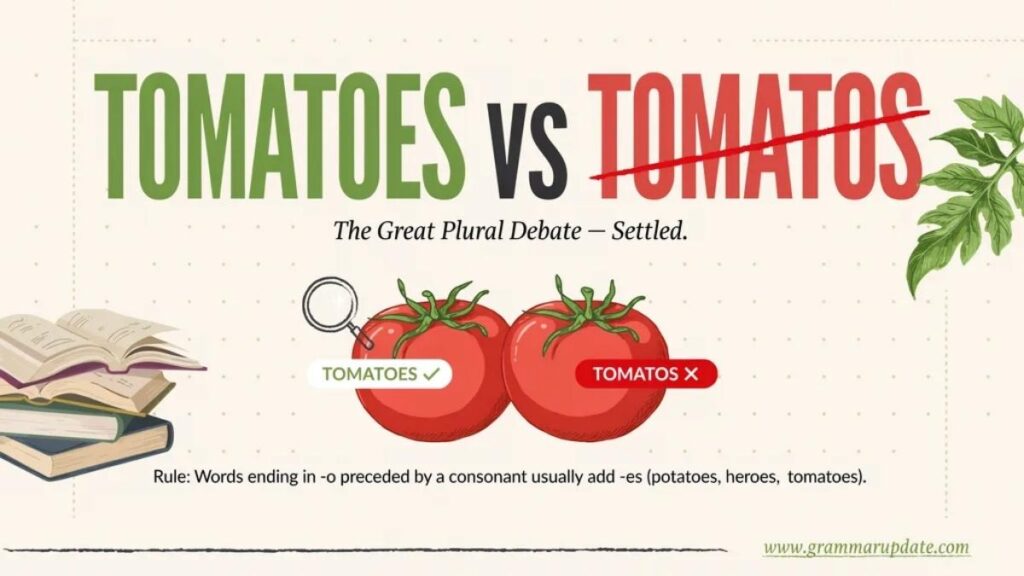
Have you ever typed “tomatoes vs tomatos” and stopped to wonder which one is actually correct? If so, you are definitely not alone. This is one of those small spelling mistakes that catches even confident English writers. At first glance, both words may look correct, but only one follows standard English spelling rules. The good news is that the answer is simple once you know the rule behind it. In this guide, you will learn why tomatoes is the correct spelling, why tomatos is a common mistake, and how to remember the difference with ease. After reading, you will never second guess yourself when writing the plural of tomato again.
Quick Answer Tomatoes vs Tomatos?
The correct spelling is tomatoes.
The spelling tomatos is incorrect in standard English. Whether you write for an American audience or a British audience, the correct plural of tomato is always tomatoes.
If you’re wondering, “Is tomatoes correct?” the answer is yes. If you’re asking, “Is tomatos a word?” the answer is no. Modern English dictionaries recognize only tomatoes as the standard plural form.
Here’s a quick comparison.
| Word | Correct? | Meaning |
|---|---|---|
| Tomatoes | Yes | The plural of tomato |
| Tomatos | No | A common misspelling |
Whenever you need to refer to more than one tomato, always write tomatoes.
Examples:
- I bought fresh tomatoes for tonight’s salad.
- The tomatoes are growing well this summer.
- She sliced three tomatoes for the sandwiches.
Incorrect examples:
- I bought fresh tomatos.
- The tomatos were delicious.
If you remember only one thing from this article, remember this:
Tomato becomes tomatoes, not tomatos.
Learn the difference between confusing word pairs
Stared vs Starred How to Use Each Word Correctly
What Does “Tomatoes” Mean?
Before learning the spelling rule, it’s helpful to understand the meaning of the word.
Tomatoes is the plural form of the noun tomato. It refers to two or more tomatoes, whether they are fresh, cooked, canned, dried, or growing on a tomato plant.
Tomatoes meaning:
The word tomatoes describes multiple edible fruits produced by the tomato plant. Although many people think of tomatoes as vegetables because they are used in cooking, botanically they are fruits because they develop from the flower of the plant and contain seeds.
Examples include:
- Fresh tomatoes
- Cherry tomatoes
- Roma tomatoes
- Green tomatoes
- Heirloom tomatoes
Examples in sentences:
- Fresh tomatoes taste best during summer.
- We planted tomatoes in our backyard garden.
- The chef used ripe tomatoes to make homemade pasta sauce.
- Local farmers harvested thousands of tomatoes this season.
Because tomatoes is a plural noun, it always refers to more than one tomato.
Tomato Singular or Plural
Many learners ask whether tomato is singular or plural.
Here’s the simple answer.
| Form | Example |
|---|---|
| Singular noun | One tomato |
| Plural noun | Two tomatoes |
Examples:
Singular:
- This tomato looks perfectly ripe.
Plural:
- These tomatoes are ready to eat.
Understanding the difference between singular and plural nouns makes English grammar much easier.
Learn the difference between confusing word pairs
Taught vs Tought Correct Spelling and Usage
What Is the Plural of Tomato?
The plural of tomato is tomatoes.
This is one of the most frequently searched grammar questions online because the answer doesn’t follow the pattern many learners expect.
Many English nouns become plural simply by adding an “s.”
Examples:
| Singular | Plural |
|---|---|
| Book | Books |
| Chair | Chairs |
| Apple | Apples |
| Car | Cars |
However, tomato follows a different pluralization rule.
Instead of adding only an “s,” English adds “es.”
Tomato → Tomatoes
This is the correct plural form of tomato in English.
So if you’re asking:
- What is the plural of tomato?
- What is the plural form of tomato?
- How to spell tomato plural?
- How do you spell tomatoes?
The answer is always the same:
Tomatoes.
Is “Tomatos” Ever a Correct Word?
One of the most common questions people ask is whether tomatos is a real word.
The answer is simple.
No.
Tomatos meaning:
There is no accepted meaning because tomatos is not recognized as a standard English word.
Major dictionaries, grammar references, publishers, schools, and style guides all reject tomatos spelling.
That means:
- It isn’t accepted in academic writing.
- It isn’t accepted in business writing.
- It isn’t accepted in journalism.
- It isn’t accepted in books.
- It isn’t accepted in professional communication.
If you type tomatos into most grammar-checking software, you’ll immediately receive a spelling correction suggesting tomatoes.
Why Do People Still Write “Tomatos”?
There are several reasons.
Many people assume every noun becomes plural by adding an “s.”
Others simply forget that tomato belongs to a group of nouns ending in “o” that add “es.”
Fast typing also contributes to the mistake. Since people often pronounce the final syllable quickly, they accidentally leave out the “e.”
Autocorrect usually fixes this error today, but not everyone notices the correction.
Learn the difference between confusing word pairs
Mama vs Momma Correct Spelling and Difference
Tomatoes vs Tomatos Side-by-Side Comparison
The easiest way to understand the difference is to compare both spellings directly.
| Feature | Tomatoes | Tomatos |
|---|---|---|
| Correct spelling | Yes | No |
| Dictionary word | Yes | No |
| Standard English | Yes | No |
| Academic writing | Yes | No |
| Professional writing | Yes | No |
| Business communication | Yes | No |
| Accepted worldwide | Yes | No |
| Grammar checkers approve | Yes | No |
The comparison makes one thing very clear.
Tomatoes is the only correct spelling.
Tomatoes vs Tomatos Meaning
Many readers search for tomatoes tomatos meaning because they wonder whether both words have different definitions.
They don’t.
Tomatoes has a clear meaning. It is the plural form of tomato.
Tomatos has no separate meaning because it isn’t an accepted English word. It exists only as a misspelling created by applying the wrong plural rule.
That means:
- Tomatoes = correct plural noun.
- Tomatos = incorrect spelling.
Learn the difference between confusing word pairs
Unkept vs Unkempt Difference and Usage
Why Do People Confuse Tomatoes and Tomatos?
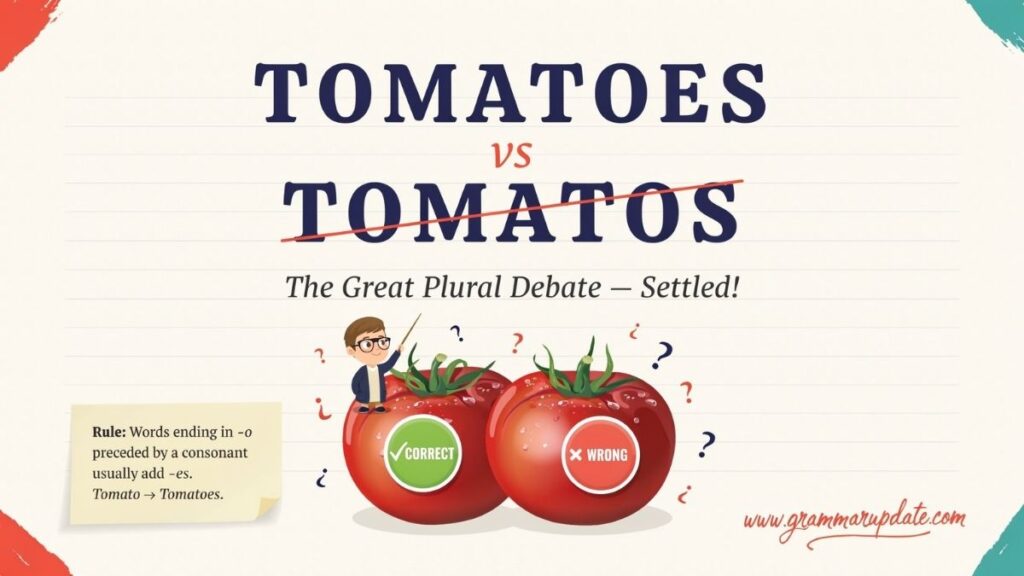
English spelling isn’t always predictable. That’s why even experienced writers occasionally hesitate.
Several factors contribute to the confusion.
Most English Nouns Simply Add “S”
People naturally learn simple plural patterns first.
For example:
- Cat → Cats
- Dog → Dogs
- Table → Tables
Because this rule works most of the time, many people assume tomato should become tomatos.
Instead, English grammar requires tomatoes.
Words Ending in O Don’t Always Follow One Rule
This is where English becomes tricky.
Some nouns ending in o add “es.”
Others simply add “s.”
That inconsistency causes confusion.
For example:
| Singular | Correct Plural |
|---|---|
| Tomato | Tomatoes |
| Potato | Potatoes |
| Hero | Heroes |
| Echo | Echoes |
| Mango | Mangoes or Mangos |
Meanwhile:
| Singular | Correct Plural |
|---|---|
| Photo | Photos |
| Piano | Pianos |
| Radio | Radios |
| Video | Videos |
| Studio | Studios |
Since there isn’t one universal rule for every noun ending in o, people often guess incorrectly.
Pronunciation Doesn’t Reveal the Spelling
Another reason for the confusion is pronunciation.
When people speak quickly, they don’t clearly hear the added “e.”
As a result, they may mistakenly write tomatos even though they correctly pronounce tomatoes.
This happens with many common spelling mistakes in English.
English Developed from Multiple Languages
Modern English borrowed words from Latin, French, Italian, Spanish, Germanic languages, and many others.
Because of this long history, English spelling rules aren’t perfectly consistent.
Instead of trying to force every word into one rule, it’s often easier to learn the most common patterns and memorize the exceptions.
Learn the difference between confusing word pairs
Infront vs In Front? Which Is Correct?
The Grammar Rule Behind “Tomatoes”
Now let’s answer the question many learners ask:
Why is tomatoes spelled with “es”?
The answer lies in English plural rules.
Many nouns ending in a consonant plus “o” form the plural by adding “es.”
Formula:
Consonant + o + es
Examples:
| Singular | Plural |
|---|---|
| Tomato | Tomatoes |
| Potato | Potatoes |
| Hero | Heroes |
| Echo | Echoes |
This pattern has been part of standard English spelling for centuries and appears in dictionaries, grammar books, educational materials, and style guides.
Because tomato ends with the consonant “t” followed by the letter “o,” its correct plural becomes tomatoes.
This explains why adding “es to tomato” is correct and why “tomato plus es” creates the proper plural noun.
It also answers common questions such as:
- Why is tomatoes spelled with es?
- Why does tomato become tomatoes?
- Do you add es to tomato?
- What is the tomato plural spelling rule?
The answer is always the same.
Tomato follows the English pluralization rule that adds “es” to many nouns ending in a consonant plus “o.”
Learn the difference between confusing word pairs
Training vs Trainning Which One Is Correct?
Words Ending in O Which Ones Add “-es” and Which Ones Add “-s”?
Now that you know why tomato becomes tomatoes, it’s time to look at the bigger picture. English plural rules aren’t always straightforward. Some nouns ending in “o” take “-es,” while others simply add “-s.”
That’s why many people wonder whether they should write tomatoes vs tomatos.
The good news is that you don’t need to memorize hundreds of words. Learning the most common patterns will help you avoid many spelling mistakes in English.
Common Words Ending in O That Add “-es”
Many nouns ending in a consonant plus “o” form the plural by adding “-es.”
| Singular | Plural |
|---|---|
| Tomato | Tomatoes |
| Potato | Potatoes |
| Hero | Heroes |
| Echo | Echoes |
| Torpedo | Torpedoes |
| Veto | Vetoes |
These are standard spellings in both British English and American English.
Common Words Ending in O That Add Only “-s”
Some words ending in “o” simply add an “s.”
| Singular | Plural |
|---|---|
| Photo | Photos |
| Piano | Pianos |
| Radio | Radios |
| Video | Videos |
| Studio | Studios |
| Zoo | Zoos |
| Logo | Logos |
Many of these words entered English from other languages or developed different plural patterns over time.
Why Doesn’t Every Word Follow the Same Rule?
English has borrowed vocabulary from many languages over hundreds of years. As a result, pluralization in English isn’t perfectly consistent.
Some words preserved their historical spelling, while others gradually adopted simpler plural forms.
This is why English grammar often relies on usage instead of one universal rule.
The safest approach is to learn the most common nouns ending in “o” individually.
Learn the difference between confusing word pairs
Challenge vs Challange Which Is Actually Right?
Tomatoes vs Potatoes Why They Follow the Same Rule
If you can remember potatoes, you’ll never forget tomatoes.
Both words end with a consonant followed by “o,” and both add “-es” to form the plural.
| Singular | Plural |
|---|---|
| Potato | Potatoes |
| Tomato | Tomatoes |
Many grammar teachers pair these two words because they share the same spelling rule.
A simple memory trick is:
“If you’re buying potatoes, you’re probably buying tomatoes too.”
Since both vegetables often appear together in recipes, your brain naturally links their spellings.
This also answers questions like:
- Plural of potato and tomato in English
- Plural of tomato and potato
- Why are potatoes and tomatoes spelled with es?
The answer is that both follow the same standard English plural rule.
Tomatoes vs Tomatos UK vs US
Many learners wonder whether tomatoes vs tomatos UK differs from tomatoes vs tomatos US.
The answer is simple.
No.
Both British English and American English use tomatoes.
There is no spelling variation between the two.
| English Variety | Correct Spelling |
|---|---|
| British English | Tomatoes |
| American English | Tomatoes |
| Canadian English | Tomatoes |
| Australian English | Tomatoes |
Unlike words such as colour/color or organise/organize, tomato has exactly the same plural spelling everywhere English is spoken.
That means:
- Tomatoes vs tomatos UK → Tomatoes
- Tomatoes vs tomatos US → Tomatoes
There is no accepted version where tomatos is correct.
Learn the difference between commonly mixed-up more words
Well Deserved vs Well-Deserved Which Is Correct?
British English Tomato vs American English Tomato
Although the spelling stays the same, pronunciation differs slightly.
This often leads people to search for:
- British English tomato
- American English tomato
- UK English spelling
- US English spelling
The spelling remains identical.
Only the pronunciation changes.
Tomato Pronunciation UK vs US
One of the most famous pronunciation differences in English involves the word tomato.
Americans and Britons pronounce the second syllable differently.
Tomato Pronunciation US
Approximate pronunciation:
tə-MAY-toh
IPA:
/təˈmeɪtoʊ/
Example:
“I bought a fresh tomato.”
Tomato Pronunciation UK
Approximate pronunciation:
tə-MAH-toh
IPA:
/təˈmɑːtəʊ/
Example:
“I picked a ripe tomato.”
This pronunciation difference inspired the famous saying:
“You say tomato, I say tomato.”
Although the pronunciation changes, the spelling never does.
Learn the difference between commonly mixed-up more words
Studder vs Stutter Difference Explained and Usage
How Do You Pronounce Tomatoes?
The plural follows the same pronunciation pattern.
Tomatoes Pronunciation American
Approximate pronunciation:
tə-MAY-tohz
IPA:
/təˈmeɪtoʊz/
Tomatoes Pronunciation British
Approximate pronunciation:
tə-MAH-tohz
IPA:
/təˈmɑːtəʊz/
Again, only the vowel sound changes.
The spelling remains tomatoes in every variety of standard English.
Tomato vs Tomato Pronunciation
Many people search for “tomato vs tomato pronunciation” because they hear different accents.
The word itself doesn’t change.
Only the pronunciation differs depending on the speaker’s accent.
| Variety | Pronunciation |
|---|---|
| American English | tə-MAY-toh |
| British English | tə-MAH-toh |
Neither pronunciation is more correct than the other.
Both are accepted worldwide.
Learn the difference between commonly mixed-up more words
Natzi vs Nazi Which Is the Correct Spelling?
Tomato Plural Possessive Explained
Another area that confuses many writers is the tomato plural possessive.
Let’s make it simple.
Tomatoes
This is the regular plural noun.
Example:
The tomatoes are fresh.
Tomato’s
This is the singular possessive.
It means something belongs to one tomato.
Example:
The tomato’s skin was unusually thick.
Tomatoes’
This is the plural possessive.
It means something belongs to multiple tomatoes.
Example:
The tomatoes’ flavor improved after ripening.
Here’s an easy comparison.
| Form | Meaning |
|---|---|
| Tomato | One tomato |
| Tomatoes | More than one tomato |
| Tomato’s | Belonging to one tomato |
| Tomatoes’ | Belonging to several tomatoes |
Understanding the apostrophe helps you avoid another common grammar mistake.
Learn the difference between commonly mixed-up more words
Smoky vs Smokey Differences and Correct Usage
Tomatoes Apostrophe Rules
Many people place the apostrophe incorrectly.
Remember these simple rules.
If there is one tomato:
Tomato’s
If there are many tomatoes:
Tomatoes’
Examples:
Correct:
- The tomato’s seeds were visible.
- The tomatoes’ color became brighter in the sun.
Incorrect:
- Tomatos’
- Tomatos’s
- Tomatoes’s
Following these apostrophe rules makes your writing look much more professional.
Tomatoes vs Tomatos in Real Sentences
Seeing real examples is one of the fastest ways to remember the correct spelling.
| Incorrect Sentence | Correct Sentence |
|---|---|
| I bought fresh tomatos. | I bought fresh tomatoes. |
| The tomatos are delicious. | The tomatoes are delicious. |
| We planted tomatos last spring. | We planted tomatoes last spring. |
| These tomatos need more water. | These tomatoes need more water. |
| The soup contains tomatos. | The soup contains tomatoes. |
| Farmers harvested many tomatos. | Farmers harvested many tomatoes. |
Notice how every incorrect sentence becomes correct simply by replacing tomatos with tomatoes.
Learn the difference between commonly mixed-up more words
Realize vs Realise Which is Correct and Usage?
Common Mistakes People Make
Even experienced writers occasionally make this mistake.
Here are the most common errors.
Forgetting the “-es”
Incorrect:
Three tomatos
Correct:
Three tomatoes
Mixing Up Possessives
Incorrect:
Tomatos’
Correct:
Tomatoes’
Assuming Every Word Ending in O Adds Only “S”
Many learners apply one rule to every noun ending in “o.”
Unfortunately, English doesn’t work that way.
Compare these examples.
| Correct | Incorrect |
|---|---|
| Tomatoes | Tomatos |
| Potatoes | Potatos |
| Heroes | Heros |
| Photos | Photoes |
| Pianos | Pianoes |
Learning these common words individually will save you from repeated spelling errors.
Learn the difference between commonly mixed-up more words
Heros vs Heroes Which Spelling Is Correct?
Tomatoes in Professional, Academic, and Everyday Writing
Using the correct spelling matters more than many people realize.
Academic Writing
Teachers expect standard English spelling.
Writing tomatos in an essay may cost points because it is an obvious spelling mistake.
Business Communication
Professional emails, reports, and presentations should always use tomatoes.
Small spelling errors can affect credibility.
Food Blogs and Recipes
Recipe writers almost always mention tomatoes.
Correct spelling builds trust with readers and improves the overall quality of the content.
Grocery Stores and Packaging
Food labels consistently use tomatoes.
You’ll see examples such as:
- Diced tomatoes
- Crushed tomatoes
- Sun-dried tomatoes
- Whole peeled tomatoes
Major food companies, supermarkets, and cookbooks all follow the same standard spelling.
Everyday Conversation
Although spoken English doesn’t reveal the spelling, written communication always should.
Whether you’re sending a text message or posting on social media, tomatoes remains the correct form.
Mini Case Study Why One Letter Matters
Imagine two restaurant menus.
Menu A:
“Fresh Pasta with Roasted Tomatos”
Menu B:
“Fresh Pasta with Roasted Tomatoes”
Most customers will immediately recognize Menu B as more polished and professional.
One missing letter may seem minor, but it influences how readers judge quality and attention to detail.
That’s why editors, publishers, teachers, and grammar checkers consistently recommend using the standard spelling: tomatoes.
Learn the difference between commonly mixed-up more words
Hoping vs Hopeing Which Spelling Is Correct?
What Dictionaries and Grammar Experts Say About Tomatoes vs Tomatos
When you’re unsure about a spelling, the best place to check is a trusted dictionary. Fortunately, every major English dictionary agrees on this topic.
They all recognize tomatoes as the correct plural of tomato and identify tomatos as a misspelling.
Here is what leading language authorities use.
| Dictionary | Accepted Spelling |
|---|---|
| Merriam-Webster | Tomatoes |
| Oxford English Dictionary | Tomatoes |
| Cambridge Dictionary | Tomatoes |
| Collins English Dictionary | Tomatoes |
| Dictionary.com | Tomatoes |
No modern standard English dictionary lists tomatos as the correct plural form.
This answers several common questions at once.
- Is tomatos a word? No.
- Is tomatoes correct? Yes.
- Is tomatos a correct spelling? No.
- Tomatoes vs tomatos: Which is correct? Tomatoes.
Whether you’re writing an email, preparing an academic paper, or publishing a recipe, dictionaries consistently recommend using tomatoes.
What Grammar Checkers Say
Modern grammar and spelling tools also recognize only one correct spelling.
Popular grammar checkers such as Grammarly, Microsoft Editor, Apple Writing Tools, and Google Docs automatically flag tomatos as an incorrect spelling and suggest tomatoes instead.
That happens because these tools rely on standard English dictionaries and accepted grammar rules.
If your writing software highlights tomatos with a red underline, it’s correcting a genuine spelling mistake rather than a style preference.
Memory Tricks to Never Misspell Tomatoes Again
English spelling can be challenging, but a few simple tricks make this word easy to remember.
Remember Potato and Tomato Together
These two words follow the same plural rule.
Potato → Potatoes
Tomato → Tomatoes
If you can spell potatoes, you can spell tomatoes.
Think of the Extra “E”
Many writers forget the “e” before the final “s.”
Picture the word like this:
Tomato + es = Tomatoes
That simple formula works every time.
Read It Out Loud
When you say the complete word slowly, you’ll naturally hear the ending.
To-ma-toes
Although pronunciation isn’t a spelling rule, slowing down often helps you remember the extra letters.
Practice with Real Sentences
Instead of memorizing isolated words, use them in everyday writing.
For example:
- I planted tomatoes in my garden.
- Fresh tomatoes make delicious salsa.
- We bought ripe tomatoes at the farmers market.
Writing the correct spelling several times helps build long-term memory.
Learn the difference between confusing more English words
Pent vs Pant Usage and Difference Explained
Words Commonly Confused Alongside Tomatoes
Tomatoes isn’t the only word that causes confusion.
Several English nouns ending in “o” create similar spelling questions.
| Singular | Correct Plural | Common Mistake |
|---|---|---|
| Tomato | Tomatoes | Tomatos |
| Potato | Potatoes | Potatos |
| Hero | Heroes | Heros |
| Echo | Echoes | Echos |
Other words follow a different pattern.
| Singular | Correct Plural |
|---|---|
| Photo | Photos |
| Piano | Pianos |
| Radio | Radios |
| Video | Videos |
| Studio | Studios |
This is why learning the pluralization rule is more helpful than relying on guesswork.
Tomato Plural in German
Many readers also search for tomato plural in German.
The German word for tomato is:
Tomate
The plural form is:
Tomaten
Here’s a simple comparison.
| English | German |
|---|---|
| Tomato | Tomate |
| Tomatoes | Tomaten |
Example:
English:
The tomatoes are fresh.
German:
Die Tomaten sind frisch.
If you’re learning both languages, remember that German forms the plural differently from English.
Tomato Translation in Other Languages
While this article focuses on English grammar, it can be helpful to see how the word changes across languages.
| Language | Singular | Plural |
|---|---|---|
| English | Tomato | Tomatoes |
| German | Tomate | Tomaten |
| Spanish | Tomate | Tomates |
| French | Tomate | Tomates |
| Italian | Pomodoro | Pomodori |
Every language has its own pluralization rules, which explains why spelling patterns don’t always match English.
Learn the difference between confusing more English words
All-time favorite vs all times favorite Which Is Correct?
Common Spelling Mistakes to Avoid
Here are several mistakes that appear frequently in emails, essays, blog posts, and social media.
Incorrect:
- Tomatos
- Tomatos’
- Tomatos’s
- Tomatoe
Correct:
- Tomatoes
- Tomato’s
- Tomatoes’
Always proofread your work before publishing or submitting it.
One small spelling error can distract readers from an otherwise excellent piece of writing.
Quick Practice
See if you can spot the mistake before checking the answers.
| Sentence | Correct or Incorrect? |
|---|---|
| We picked fresh tomatoes today. | Correct |
| The tomatos were delicious. | Incorrect |
| Tomato’s color changed as it ripened. | Correct |
| The tomatoes’ flavor was amazing. | Correct |
| I bought three tomatos yesterday. | Incorrect |
Answers:
- Fresh tomatoes today ✔
- The tomatos were delicious ✘ → tomatoes
- Tomato’s color changed ✔
- Tomatoes’ flavor was amazing ✔
- Three tomatos yesterday ✘ → tomatoes
Practicing with real examples is one of the fastest ways to improve your English spelling.
Quick Summary
Here’s everything covered in this guide.
| Question | Answer |
|---|---|
| Correct spelling | Tomatoes |
| Incorrect spelling | Tomatos |
| Singular | Tomato |
| Plural of tomato | Tomatoes |
| Is tomatos a word? | No |
| Is tomatoes correct? | Yes |
| British English | Tomatoes |
| American English | Tomatoes |
| Tomato plural possessive | Tomatoes’ |
| Singular possessive | Tomato’s |
| German plural | Tomaten |
Key Takeaways
If you’re still wondering whether to write tomatoes vs tomatos, the answer is simple.
Tomatoes is always the correct spelling in standard English.
The word tomato forms its plural by adding “-es,” making tomatoes the correct plural noun. The spelling tomatos is a common error that isn’t accepted by dictionaries, grammar experts, schools, publishers, or professional editors.
Both British English and American English use exactly the same spelling. The only noticeable difference is pronunciation.
Understanding the pluralization rule also helps you spell similar words correctly, including potatoes and heroes.
Whenever you’re writing about multiple tomatoes, remember this simple pattern:
Tomato → Tomatoes
That’s the standard spelling every time.
Learn the difference between confusing more English words
Sergeant vs Sargent difference and Which Is Correct?
Practice Session Tomatoes vs Tomatos
Choose the correct word to complete each sentence.
Options: tomatoes | tomatos
- I bought fresh __________ from the local farmers market.
- The chef sliced three ripe __________ for the salad.
- We planted __________ in our backyard garden this spring.
- The __________ were ready to harvest after a warm summer.
- She used fresh __________ to make homemade pasta sauce.
- My grandmother grows juicy __________ every year.
- The grocery store sells organic __________ on weekends.
- The recipe calls for two large __________.
- The sandwich tastes better with fresh __________.
- We picked red __________ from the tomato plant.
- The soup contains roasted __________ and fresh basil.
- Several __________ fell off the vine after the storm.
- The market displayed colorful __________ in wooden baskets.
- These __________ are perfect for making salsa.
- The pizza is topped with sliced __________.
- Farmers harvested thousands of __________ this season.
- I added chopped __________ to the vegetable stew.
- Fresh __________ are rich in vitamins and antioxidants.
- The children helped wash the __________ before dinner.
- We stored the ripe __________ in the kitchen.
- The salad includes cucumbers, onions, and __________.
- The gardener watered the __________ every morning.
- These __________ taste sweeter than the ones we bought last week.
- The restaurant serves grilled __________ with herbs.
- Everyone enjoyed the fresh __________ from the garden.
Answers
- tomatoes
- tomatoes
- tomatoes
- tomatoes
- tomatoes
- tomatoes
- tomatoes
- tomatoes
- tomatoes
- tomatoes
- tomatoes
- tomatoes
- tomatoes
- tomatoes
- tomatoes
- tomatoes
- tomatoes
- tomatoes
- tomatoes
- tomatoes
- tomatoes
- tomatoes
- tomatoes
- tomatoes
- tomatoes
Here’s a trusted source for clear word meanings:
FAQs
What is correct, tomatos or tomatoes?
The correct spelling is tomatoes. It is the standard plural of tomato in both British and American English. Tomatos is a misspelling and isn’t accepted in standard English.
Which is correct, tomato or tomatoe?
Tomato is correct. Tomatoe is an incorrect spelling and doesn’t appear in standard English dictionaries.
How do the Americans spell tomato?
Americans spell it tomato, and the plural is tomatoes. The spelling is the same in American and British English. Only the pronunciation differs.
Is it potatos or potatoes?
Potatoes is correct. Like tomato, potato forms its plural by adding “-es.” Potatos is a misspelling.
What is the plural of potato?
The plural of potato is potatoes.
Can you spell tomato with an “e” on the end?
No. The correct singular spelling is tomato. Adding an “e” to make tomatoe is incorrect.
How do you spell tomato plural?
The correct tomato plural spelling is tomatoes. Simply add “-es” to tomato.
What is the plural of tomato?
The plural of tomato is tomatoes.
Is tomatoes the correct spelling?
Yes. Tomatoes is the only correct plural spelling recognized by standard English dictionaries and grammar guides.
Is tomatos a word?
No. Tomatos isn’t a valid English word. It is simply a common misspelling of tomatoes.
How do you spell onion and tomato?
The correct spellings are onion and tomato. Their plural forms are onions and tomatoes.
What is a group of tomatoes called?
There isn’t a special collective noun for tomatoes. A group is commonly called a basket of tomatoes, a crate of tomatoes, a bowl of tomatoes, or simply tomatoes.
What do Brits call tomatoes?
British people call them tomatoes, just like Americans. The spelling is identical, although the pronunciation differs.
Do British people say tomato or tomato?
British speakers say tomato with a different vowel sound than Americans, often pronounced “tə-MAH-toh.” However, the spelling remains tomato.
How do Australians say “tomato”?
Australians generally pronounce tomato similarly to British English, with a broad “ah” sound. The spelling is still tomato.
What is tomato pronunciation in American English?
In American English, tomato is commonly pronounced “tə-MAY-toh.”
What is tomato pronunciation in British English?
In British English, tomato is commonly pronounced “tə-MAH-toh.”
Why is tomatoes spelled with “-es”?
Tomato ends with a consonant followed by the letter “o.” According to standard English spelling rules, many nouns ending this way form the plural by adding “-es.”
Do you add “-s” or “-es” to tomato?
You add “-es.” The correct plural is tomatoes.
What is the tomato plural possessive?
The plural possessive is tomatoes’. It shows that something belongs to multiple tomatoes.
Example:
The tomatoes’ flavor improved after roasting.
Why do people misspell tomatoes as tomatos?
Many people assume every noun becomes plural by adding only “s.” Because English has exceptions for some words ending in “o,” tomato correctly becomes tomatoes instead of tomatos.
Which words follow the same spelling rule as tomato?
Several nouns ending in a consonant plus “o” also add “-es,” including:
- Potato → Potatoes
- Hero → Heroes
- Echo → Echoes
- Torpedo → Torpedoes
Which words ending in “o” add only “-s”?
Some common examples include:
- Photo → Photos
- Piano → Pianos
- Radio → Radios
- Video → Videos
- Studio → Studios
What is tomato in German?
The German word for tomato is Tomate.
What is the plural of tomato in German?
The plural is Tomaten.
Is tomato a fruit or a vegetable?
Botanically, a tomato is a fruit because it develops from the flower of the plant and contains seeds. In cooking, it’s commonly treated as a vegetable because of its savory flavor.
What is the scientific name of the tomato?
The scientific name of the cultivated tomato is Solanum lycopersicum.
Why did Europeans not want to eat tomatoes at first?
When tomatoes first arrived in Europe during the 16th century, many people believed they were poisonous because they belonged to the nightshade family. Over time, people discovered they were safe and highly nutritious.
What is the difference between tomato and tomatoes?
Tomato is the singular noun referring to one fruit. Tomatoes is the plural noun referring to two or more.
How can I remember the correct spelling of tomatoes?
A simple trick is to pair it with potato:
- Potato → Potatoes
- Tomato → Tomatoes
Both words follow the same plural spelling rule, making them easy to remember.
Learn the difference between confusing more English words
Insuring vs Ensuring Difference and which is correct?
Conclusion
English spelling can be tricky, but “tomatoes vs tomatos” does not have to be one of those confusing mistakes anymore. The correct plural of tomato is always tomatoes. The spelling tomatos isn’t accepted in standard English, whether you’re writing for school, work, or everyday communication.
A simple way to remember the rule is to pair tomato with potato. Just as potato becomes potatoes, tomato becomes tomatoes by adding “-es.” Once you remember this pattern, you’ll never have to second-guess yourself again.
The next time you’re writing a recipe, shopping list, email, or social media post, use tomatoes with confidence. One extra letter may seem small, but using the correct spelling makes your writing clearer, more professional, and more credible. Now that you know the rule, you can leave the “tomatos” mistake behind and enjoy writing with confidence every time.

Jhon AJS, the creative mind behind Grammar Update, is an experienced blogger passionate about simplifying English grammar. He focuses on explaining confusing word vs word differences, grammar rules, punctuation, and sentence structure in a clear and practical way. Through easy to understand guides and examples, Jhon helps readers improve their writing and communicate with confidence. With years of blogging experience, he continues to share helpful insights that make learning grammar simple, useful, and accessible for everyone.