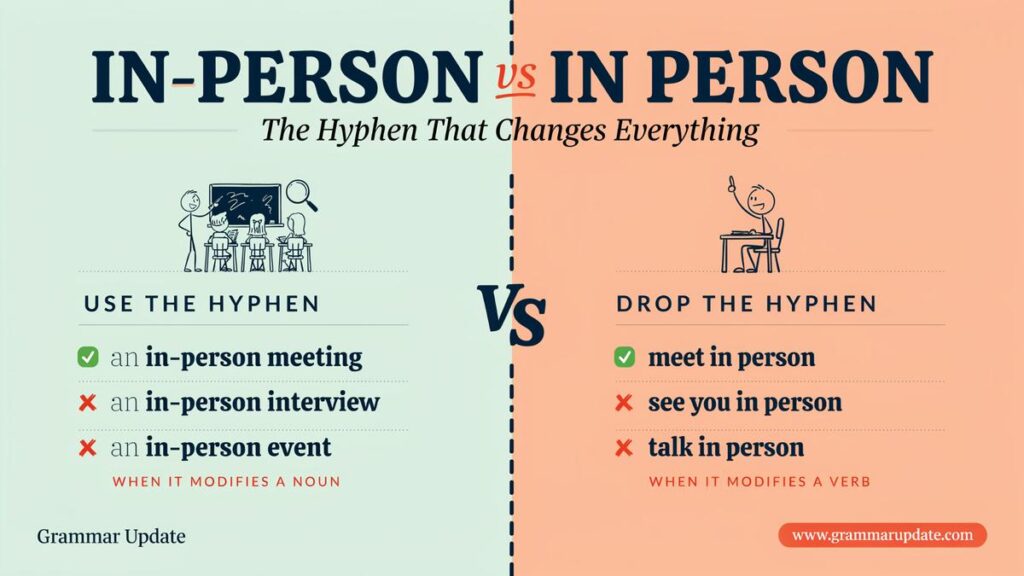
“Should I write in-person vs in person?” That tiny hyphen has confused countless writers, and it’s easy to see why. Both forms are correct, but they don’t work the same way. The secret is knowing where each one belongs in a sentence. Once you understand that simple grammar rule, the confusion disappears. In this guide, you’ll learn the real difference between In-Person vs In Person, when to use each form, common mistakes to avoid, and plenty of clear examples that make the rule easy to remember and even easier to use in everyday writing.
Quick Answer In-Person vs In Person
If you’re looking for the short answer, here it is.
Use “in-person” with a hyphen when it comes before a noun and describes that noun.
Examples:
- We scheduled an in-person meeting.
- She attended an in-person interview.
- The company offers in-person classes.
Use “in person” without a hyphen after a verb when it explains how an action happens.
Examples:
- We met in person.
- She attended the interview in person.
- Please sign the document in person.
This simple rule answers most questions about in person vs in-person.
Quick Comparison
| In-Person | In Person |
|---|---|
| Hyphenated | No hyphen |
| Acts as an adjective | Acts as an adverbial phrase |
| Comes before a noun | Usually follows a verb |
| Describes a noun | Describes how an action happens |
| In-person meeting | Meet in person |
| In-person event | Attend in person |
| In-person class | Study in person |
If you’re asking, “Is it in person or in-person?” the answer depends on where the phrase appears in the sentence.
Learn the difference between basic English word mistakes
Kindergarten vs Kindergarden which is Correct and Usage?
What Is the Difference Between In-Person vs In Person?
The difference isn’t about spelling preference. It’s about grammar.
Although both expressions describe physical presence instead of virtual communication, they play different grammatical roles.
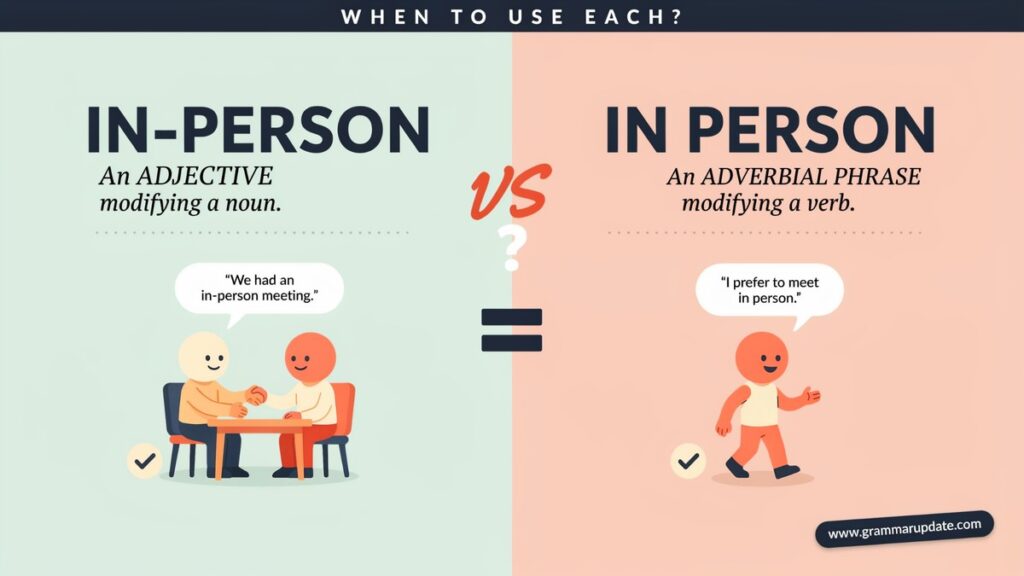
“In-person” is a compound adjective. It modifies a noun that follows it.
“In person” is an adverbial phrase. It explains how someone performs an action.
Think of it this way:
An in-person meeting describes the type of meeting.
Meet in person explains how people meet.
The meaning stays almost the same, but the sentence structure changes.
Featured Snippet Answer
The difference between in-person vs in person is grammatical. Use “in-person” with a hyphen before a noun because it functions as a compound adjective. Use “in person” without a hyphen after a verb because it functions as an adverbial phrase describing how an action takes place.
Learn the difference between basic English word mistakes
Rumor vs Rumour Difference and Usage
Why Do People Confuse “In-Person” and “In Person”?
This mistake happens because both expressions sound exactly alike when spoken.
English often relies on punctuation rather than pronunciation to show grammatical relationships. Since you can’t hear a hyphen, many writers aren’t sure which version belongs in a sentence.
Remote work has also increased the use of these expressions. Before video conferencing became common, most meetings happened face-to-face without much discussion about terminology. Today, people regularly compare online meetings with in-person meetings, making the distinction more visible than ever.
Here are some common reasons people mix them up.
- Both expressions have the same pronunciation.
- Spellcheck doesn’t always catch the mistake.
- Many websites use the wrong version.
- Social media posts often ignore hyphenation rules.
- Informal writing encourages inconsistent grammar.
If you’ve searched for “in-person vs in person reddit” or “in person vs in person reddit,” you’ve probably seen conflicting advice. That’s because online discussions sometimes rely on personal preference instead of established English grammar rules.
Fortunately, dictionaries and style guides agree on the correct usage.
What Does “In-Person” Mean?
The in-person definition is simple.
“In-person” means occurring with people physically present rather than communicating through technology such as phone calls, video meetings, or emails.
It functions as an adjective that describes a noun.
Examples include:
- in-person meeting
- in-person interview
- in-person event
- in-person appointment
- in-person training
- in-person class
In every example, the hyphenated form comes before the noun it modifies.
Why Is “In-Person” Hyphenated?
Many writers ask, “Why is in-person hyphenated?”
The answer comes from English hyphenation rules.
When two or more words work together as a single adjective before a noun, they often become a hyphenated adjective. This helps readers understand that both words describe the same noun together.
Compare these examples.
Correct:
- an in-person interview
- an in-person event
- an in-person workshop
Incorrect:
- an in person interview
- an in person event
- an in person workshop
Without the hyphen, the sentence becomes awkward because the words no longer function as one modifier.
This follows one of the most common grammar rules for hyphens in English.
Learn the difference between basic English word mistakes
Compair vs Compare Which Is Correct and usage?
Understanding the Grammar Behind “In-Person”
The expression “in-person” is known as a compound adjective.
A compound adjective combines two or more words into one descriptive unit before a noun.
Other familiar examples include:
| Compound Adjective | Example Sentence |
|---|---|
| Well-known | She is a well-known author. |
| Full-time | He has a full-time job. |
| Long-term | They signed a long-term contract. |
| High-quality | We bought high-quality equipment. |
| In-person | The school offers in-person classes. |
Notice that each compound adjective appears before a noun.
The same pattern applies to in-person.
This explains why many grammar experts describe it as a hyphenated adjective or an in-person modifier.
Learn the difference between basic English word mistakes
Busing vs Bussing Difference and Correct Usage
When to Use In-Person
Use in-person before a noun whenever you want to describe the type of person, event, meeting, appointment, interview, or activity.
You should use in-person before a noun in situations like these:
- An in-person meeting
- An in-person interview
- An in-person class
- An in-person appointment
- An in-person event
- An in-person conference
- An in-person workshop
- An in-person consultation
- An in-person training session
Notice that every noun immediately follows the adjective.
This pattern answers another common question: “When to use in-person?”
The rule is simple.
If the phrase comes before a noun and describes that noun, use the hyphenated form.
In-Person Examples
Here are some correct in-person examples you can use as models.
- The company scheduled an in-person meeting for Monday.
- We attended an in-person conference in Chicago.
- She completed an in-person interview before receiving the job offer.
- The university offers in-person classes during the fall semester.
- Patients must book an in-person appointment for this procedure.
- The organization hosted an in-person event for local volunteers.
- Our team prefers in-person collaboration for complex projects.
- The school requires in-person attendance during final exams.
- We organized an in-person workshop for new employees.
- The clinic provides in-person consultations every weekday.
Each sentence uses “in-person” correctly because it modifies the noun that follows.
Common Patterns with “In-Person”
You’ll often see these combinations in business, education, healthcare, and government communication.
| Common Expression | Correct Usage |
|---|---|
| In-person meeting | Correct |
| In-person interview | Correct |
| In-person appointment | Correct |
| In-person event | Correct |
| In-person class | Correct |
| In-person training | Correct |
| In-person attendance | Correct |
| In-person consultation | Correct |
| In-person workshop | Correct |
| In-person conference | Correct |
If you’re writing professional emails, reports, or announcements, these phrases follow standard English usage and appear in major dictionaries and editorial style guides.
Learn the difference between basic English word mistakes
Lilies vs Lillies Which Is the Correct Spelling?
What Does “In Person” Mean?
Now let’s look at the second form.
The in person definition is meeting, speaking, or doing something while physically present rather than through a phone call, email, video conference, or another remote method.
Unlike the hyphenated version, “in person” is not an adjective. It is an adverbial phrase that explains how an action happens.
Think of it this way.
You don’t describe a noun with “in person.” Instead, you describe the action.
Examples:
- We met in person.
- She spoke to the manager in person.
- Please sign the agreement in person.
- They attended the ceremony in person.
In every sentence, the phrase explains how the action took place.
Why Doesn’t “In Person” Have a Hyphen?
Many people ask, “Should in person be hyphenated?”
Usually, the answer is no.
The words stay separate because they don’t work together as a compound adjective. Instead, they function as an adverbial phrase that follows the verb.
Compare these examples.
Correct:
- I met the client in person.
- She appeared in person.
- We talked in person.
Incorrect:
- I met the client in-person.
- She appeared in-person.
- We talked in-person.
Removing the hyphen makes the sentence grammatically correct because the phrase no longer modifies a noun.
This is one of the easiest hyphenation rules to remember.
Learn the difference between confusing word pairs
Unorganized vs Disorganized Difference and Use?
Understanding the Grammar Behind “In Person”
Grammar becomes much easier once you know each expression’s role.
“In person” acts as an adverbial phrase. More specifically, many grammar books describe it as a prepositional phrase because it begins with the preposition “in.”
The phrase answers questions such as:
- How did you meet?
- How did she speak?
- How did they attend?
For example:
“We met in person.”
How did we meet?
In person.
The phrase modifies the verb “met,” not a noun.
That is why grammar experts classify it as an in person adverb rather than an adjective.
When to Use In Person
Use “in person” after a verb whenever you want to explain that someone did something while physically present.
Here are common situations where the non-hyphenated form is correct.
- Meet in person.
- Attend in person.
- Work in person.
- Study in person.
- Speak in person.
- Talk in person.
- See someone in person.
- Sign in person.
- Appear in person.
- Participate in person.
- Communicate in person.
- Join a meeting in person.
If the phrase explains the action instead of describing a noun, you almost always need the version without a hyphen.
In Person Examples
These in person examples show how the phrase naturally follows the verb.
- We finally met in person after months of video calls.
- Please attend in person if possible.
- The applicant appeared in person to complete the paperwork.
- You must sign the documents in person.
- I prefer to speak in person when discussing important decisions.
- They joined the celebration in person.
- Students study in person three days each week.
- We talked in person before making our final decision.
- Customers may pay in person at the front desk.
- The witness appeared in person before the court.
Each sentence answers the question “How did it happen?”
That simple test helps you choose the correct form almost every time.
Learn the difference between confusing word pairs
Requester vs Requestor Which Is Correct and usage?
Common Patterns with “In Person”
You’ll often see these phrases in everyday communication.
| Common Expression | Correct Usage |
|---|---|
| Meet in person | Correct |
| Attend in person | Correct |
| Work in person | Correct |
| Speak in person | Correct |
| Talk in person | Correct |
| Study in person | Correct |
| Appear in person | Correct |
| Sign in person | Correct |
| See someone in person | Correct |
| Join a meeting in person | Correct |
These expressions appear regularly in business communication, legal documents, healthcare instructions, school notices, and travel information.
In-Person vs In Person Side-by-Side Comparison
Although the meanings are closely related, their grammar is different.
| Feature | In-Person | In Person |
|---|---|---|
| Part of speech | Compound adjective | Adverbial phrase |
| Hyphen | Yes | No |
| Position | Before a noun | Usually after a verb |
| Function | Describes a noun | Describes how an action happens |
| Grammar role | Adjective usage | Adverb usage |
| Example | In-person meeting | Meet in person |
This table summarizes the difference between in person and in-person in one glance.
Learn the difference between confusing word pairs
Message vs Messege Which Spelling Is Correct?
In-Person vs In Person Grammar
Understanding the grammar rule is much easier than memorizing dozens of examples.
Remember these two principles.
Use in-person before a noun.
Examples:
- in-person meeting
- in-person class
- in-person appointment
- in-person interview
- in-person event
Use in person after a verb.
Examples:
- attend in person
- meet in person
- work in person
- speak in person
- appear in person
This simple rule answers most questions about in-person vs in person grammar.
In-Person vs In Person Examples
Let’s compare both forms in similar sentences.
| Correct | Why It Works |
|---|---|
| We scheduled an in-person meeting. | The adjective describes “meeting.” |
| We met in person yesterday. | The phrase describes how we met. |
| She completed an in-person interview. | The adjective modifies “interview.” |
| She interviewed in person. | The phrase modifies the verb. |
| They organized an in-person event. | The adjective modifies “event.” |
| They attended the event in person. | The phrase explains attendance. |
| The school offers in-person classes. | The adjective describes “classes.” |
| Students study in person. | The phrase explains how students study. |
Looking at paired examples makes the rule much easier to remember.
Learn the difference between confusing word pairs
Sence vs Sense Which Is Correct and Usage?
Real-Life Examples
These situations appear every day in workplaces, schools, hospitals, and public services.
Business Communication
Correct:
- We scheduled an in-person meeting with the client.
- Please attend the meeting in person.
Hiring
Correct:
- Candidates must complete an in-person interview.
- Finalists will interview in person.
Education
Correct:
- The university offers in-person classes.
- Students attend lectures in person.
Healthcare
Correct:
- Please book an in-person appointment.
- Patients must appear in person for identification.
Events
Correct:
- The conference includes several in-person events.
- Thousands attended the conference in person.
Notice how the grammar changes while the meaning stays almost identical.
Learn the difference between confusing word pairs
Programming vs Programing Which Spelling Is Correct?
Common Expressions Explained
In-Person Meeting or In Person Meeting?
The correct expression is:
In-person meeting
The adjective comes before the noun “meeting.”
Incorrect:
In person meeting
This mistake appears frequently online because many writers forget the hyphen.
Attend In Person vs In-Person?
The correct phrase is:
Attend in person.
The phrase follows the verb “attend.”
Example:
Please attend in person if you can.
Join Us In Person or In-Person?
The correct invitation is:
Join us in person.
Since the phrase follows the verb “join,” no hyphen is needed.
In Person or In-Person Appointment?
Use:
An in-person appointment.
Example:
The doctor scheduled an in-person appointment for Friday.
In Person or In-Person Interview?
Correct:
An in-person interview.
Later you could write:
I interviewed in person.
Both are correct because they serve different grammatical functions.
In Person or In-Person Event?
Correct:
An in-person event.
Example:
The company announced an in-person event for employees across the country.
In Person or In-Person Class?
Correct:
An in-person class.
Example:
Students returned to an in-person class after the winter break.
In Person Only or In-Person Only?
Both expressions can be correct, but they serve different purposes.
Use “in person only” after a verb.
Example:
Applications are accepted in person only.
Use “in-person only” before a noun.
Example:
This is an in-person-only workshop.
The hyphen joins the words because they describe the noun “workshop.”
Many organizations also write “in-person only event” or “in-person-only event.” The second version is often preferred because the entire compound modifies the noun.
Learn the difference between confusing word pairs
Granddad vs Grandad which spelling is Correct and Usage?
Common Mistakes Writers Make
Even experienced writers sometimes hesitate when deciding between “In-Person vs In Person” The mistake usually isn’t about meaning. It’s about grammatical usage. Once you know whether the phrase describes a noun or an action, the correct choice becomes much easier.
Here are the mistakes people make most often and how to avoid them.
Using “In Person” Before a Noun
This is probably the most common error.
Incorrect:
- We held an in person meeting.
- She attended an in person interview.
- The company organized an in person event.
Correct:
- We held an in-person meeting.
- She attended an in-person interview.
- The company organized an in-person event.
Whenever the phrase comes before a noun and modifies it, use the hyphenated form.
Using “In-Person” After a Verb
Some writers hyphenate every use because they remember seeing “in-person meeting.”
That creates another mistake.
Incorrect:
- We met in-person.
- Please attend in-person.
- They spoke in-person.
Correct:
- We met in person.
- Please attend in person.
- They spoke in person.
After a verb, the phrase explains how something happened, so the hyphen disappears.
Hyphenating Everything
Some people assume every appearance of the phrase needs a hyphen.
That isn’t how English punctuation works.
Compare these examples.
| Incorrect | Correct |
|---|---|
| Meet in-person | Meet in person |
| Work in-person | Work in person |
| Talk in-person | Talk in person |
| Speak in-person | Speak in person |
| See someone in-person | See someone in person |
The non-hyphenated form is correct because each phrase follows a verb.
Forgetting the Noun Test
Before writing the phrase, ask yourself one simple question.
“Does it describe a noun?”
If the answer is yes, write “in-person.”
If the answer is no, and it describes the action instead, write “in person.”
That quick test eliminates most grammar mistakes.
Mixing Both Forms in the Same Sentence
Sometimes both forms belong in one sentence.
For example:
The company hosted an in-person meeting, and everyone attended in person.
This sentence is completely correct because each expression serves a different grammatical purpose.
The first describes the meeting.
The second describes how people attended.
Learn the difference between tricky grammar more words
Counselor vs Councilor Which is the Difference and Usage?
Easy Memory Trick You’ll Never Forget
Grammar becomes much easier when you stop memorizing rules and start recognizing patterns.
Here’s a simple trick that works almost every time.
The Noun Test
If the phrase comes directly before a noun, use the hyphen.
Examples:
- in-person class
- in-person interview
- in-person appointment
- in-person attendance
- in-person event
The phrase describes the noun, so it acts as an adjective.
The Verb Test
If the phrase follows a verb, don’t use a hyphen.
Examples:
- meet in person
- attend in person
- work in person
- speak in person
- appear in person
- participate in person
The phrase explains how the action happens.
The Two-Second Rule
Ask yourself these questions.
Is the next word a noun?
If yes, use “in-person.”
Is the phrase explaining an action?
If yes, use “in person.”
Most writers can choose the correct form in less than two seconds using this method.
In-Person Meeting Meaning
Many readers search for the in-person meeting meaning because the phrase appears frequently in business communication.
An in-person meeting is a meeting where participants gather in the same physical location instead of communicating remotely through video conferencing, phone calls, or email.
Examples include:
- A staff meeting in the conference room.
- A client presentation at the company office.
- A classroom discussion.
- A project planning session.
- A medical consultation.
Since “in-person” describes the noun “meeting,” the hyphen is always required.
Examples:
- We scheduled an in-person meeting for Tuesday.
- The CEO requested an in-person meeting with department managers.
- Our first in-person meeting helped build stronger relationships.
Learn the difference between tricky grammar more words
Reining vs Reigning Which Is Difference?
In-Person vs In Person in Modern Business Communication
The workplace uses these expressions every day.
Understanding the difference helps you write professional emails, reports, invitations, and announcements.
Examples:
- The training includes both online and in-person sessions.
- Please attend the meeting in person whenever possible.
- Our company prefers in-person collaboration for strategic planning.
- Employees may work in person or remotely.
- New hires complete an in-person orientation before starting work.
Notice how both forms often appear in the same document.
Each one has a different grammatical purpose.
In-Person vs In Person in Education
Schools and universities also use these expressions regularly.
Examples:
- The college offers in-person classes during the fall semester.
- Students study in person four days each week.
- Parents attended the conference in person.
- Teachers conducted in-person assessments.
- The workshop includes both virtual and in-person instruction.
Educational writing follows the same grammar rule.
Nothing changes simply because the setting changes.
In-Person vs In Person in Healthcare
Healthcare organizations rely on clear communication.
Using the correct form prevents confusion.
Examples:
- Schedule an in-person appointment.
- Patients must appear in person with identification.
- The clinic offers in-person consultations.
- Please sign the consent form in person.
- Emergency evaluations require in-person attendance.
The same grammatical pattern applies throughout medical communication.
Learn the difference between tricky grammar more words
Appendices vs Appendixes Which is Correct and Usage?
In-Person vs In Person in American and British English
Many grammar rules differ between American and British English.
This isn’t one of them.
Both varieties follow the same rule.
Whether you’re writing in the United States, Canada, the United Kingdom, or Australia, the distinction remains the same.
Use the hyphen before a noun.
Remove the hyphen after a verb.
Major dictionaries and editorial style guides consistently recommend this approach.
Usage Trends in Modern English
The phrase became much more common after remote work, online learning, and virtual conferences expanded worldwide.
Today you’ll frequently see expressions such as:
- in-person conference
- in-person interview
- in-person training
- in-person event
- in-person attendance
- work in person
- attend in person
- join a meeting in person
Although these expressions appear more often than they did a decade ago, the grammar rule has remained unchanged.
Only their frequency has increased.
Quick Reference Guide
| If You Want to Write… | Use |
| An interview | In-person interview |
| A meeting | In-person meeting |
| An appointment | In-person appointment |
| A class | In-person class |
| An event | In-person event |
| Attend physically | Attend in person |
| Meet physically | Meet in person |
| Speak directly | Speak in person |
| Sign documents | Sign in person |
| See someone physically | See someone in person |
Learn the difference between tricky grammar more words
Canon vs Cannon Difference and Usage
Practice Session In-Person vs In Person
Choose the correct option to complete each sentence: in-person vs in person.
- The company scheduled an __________ meeting for all employees.
- We finally met __________ after months of video calls.
- Students must attend the first __________ class of the semester.
- Please appear __________ to verify your identity.
- She completed an __________ interview before receiving the job offer.
- The doctor recommended an __________ appointment for further evaluation.
- Our team prefers to work __________ when planning major projects.
- The university offers both online and __________ courses.
- You must sign the contract __________.
- They hosted an __________ event for local business owners.
- We spoke __________ to discuss the new proposal.
- The museum provides __________ guided tours every weekend.
- Applicants are required to appear __________ with a valid photo ID.
- The school organized an __________ orientation for new students.
- I’d rather explain the issue __________ than over the phone.
- The manager arranged an __________ training session for new hires.
- Patients should check __________ at the front desk.
- The conference featured several __________ workshops.
- Our client wanted to meet __________ before signing the agreement.
- The company announced an __________ interview for the final candidates.
- Volunteers must register __________ on the day of the event.
- We enjoyed our first __________ conference after several virtual events.
- The professor prefers to answer questions __________ during office hours.
- Every employee must complete the __________ safety training.
- The judge ordered the witness to appear __________ next Monday.
Answers
- in-person
- in person
- in-person
- in person
- in-person
- in-person
- in person
- in-person
- in person
- in-person
- in person
- in-person
- in person
- in-person
- in person
- in-person
- in person
- in-person
- in person
- in-person
- in person
- in-person
- in person
- in-person
- in person
Here’s a trusted source for clear word meanings:
FAQs
Is an in-person class hyphenated?
Yes. Write “in-person class” with a hyphen because “in-person” is a compound adjective describing the noun “class.” If the phrase comes after a verb, remove the hyphen. For example: “Students attended the class in person.”
When should I hyphenate in person?
Hyphenate it only when it comes before a noun and acts as an adjective. Examples include “in-person meeting,” “in-person event,” and “in-person interview.” Do not use a hyphen when the phrase follows a verb, such as “We met in person.”
Does “in-person meeting” have a hyphen?
Yes. “In-person meeting” is the correct spelling because the hyphen joins the two words into a single adjective that modifies “meeting.”
How do you spell the phrase “in person”?
It has two correct forms depending on the sentence. Write “in-person” before a noun, such as “an in-person appointment.” Write “in person” after a verb, such as “Please appear in person.”
Does in-person training have a hyphen?
Yes. “In-person training” is correct because “in-person” describes the noun “training.”
What is another way to say “in person”?
Common alternatives include:
- Face-to-face
- In the same room
- Physically present
- On-site
- Directly
- In attendance
Choose the one that best matches your context.
What are the basic rules for using a hyphen?
A hyphen is commonly used to:
- Form compound adjectives before a noun.
- Join certain compound words.
- Prevent confusion in meaning.
- Connect some prefixes with words when required by standard spelling conventions.
Should “third person” be hyphenated?
No. “Third person” is usually written as two separate words. However, it becomes hyphenated when used as a compound adjective before a noun, such as “third-person narration.”
How do you write “in-person meeting” correctly?
The correct form is “in-person meeting.” Since “in-person” modifies the noun “meeting,” it requires a hyphen.
Does “first person” have a hyphen?
Usually, no. Write “first person” as two words. Use a hyphen only when it comes before another noun, such as “first-person perspective.”
What does “in-person meeting” mean?
An in-person meeting is a meeting where participants gather in the same physical location instead of communicating through video calls, phone calls, or email.
Does “in office” have a hyphen?
Generally, no. Write “in office” as two words when describing someone’s location or status. However, compounds like “in-office meeting” are hyphenated when they function as adjectives before a noun.
What is the correct choice: in-person vs in person?
Use “in-person” before a noun and “in person” after a verb. The correct choice depends on the grammatical role the phrase plays in the sentence.
Do I always need a hyphen for “in person”?
No. Use the hyphen only when the phrase functions as a compound adjective before a noun. Otherwise, write it as two separate words.
Is an in-person appointment hyphenated?
Yes. “In-person appointment” is the correct form because “in-person” describes the noun “appointment.”
How can I tell if a word should be hyphenated?
Ask whether two or more words work together to describe a noun before it appears. If they function as one adjective, a hyphen is often appropriate. Always check a current dictionary for words with established spellings.
What is the correct way to write “in person”?
Write “in-person” before a noun and “in person” after a verb. This follows standard English grammar and punctuation rules.
What is the opposite of “in person”?
Common opposites include:
- Online
- Virtually
- Remotely
- By phone
- Through video conferencing
The best choice depends on the situation.
When should I not use a hyphen?
Avoid a hyphen when the phrase follows a verb instead of modifying a noun. For example, write “We met in person,” not “We met in-person.”
What are the most common hyphen mistakes?
Common mistakes include:
- Forgetting the hyphen in compound adjectives.
- Adding hyphens where they are not needed.
- Hyphenating words after a verb.
- Writing inconsistent forms in the same document.
Do you hyphenate “in-person meeting”?
Yes. “In-person meeting” always takes a hyphen because the phrase modifies the noun “meeting.”
What do you call an in-person meeting?
You can call it:
- Face-to-face meeting
- On-site meeting
- Physical meeting
- Direct meeting
- Office meeting
“In-person meeting” remains the most widely accepted and neutral term.
What is a synonym for “in-person meeting”?
Depending on the context, you can use:
- Face-to-face meeting
- On-site meeting
- Physical meeting
- Live meeting
- Office meeting
Each carries a slightly different nuance.
What does “in-person session” mean?
An in-person session is a class, appointment, consultation, workshop, or meeting where participants are physically present together instead of joining remotely.
Is “in person” two words or hyphenated?
Both forms are correct. Use “in person” as two words after a verb and “in-person” with a hyphen before a noun.
Conclusion
If you’ve ever wondered whether to write “In-Person vs In Person,” you’re definitely not alone. The good news is that the rule is much simpler than it looks. Just remember this: use “in-person” before a noun because it describes that noun, and use “in person” after a verb because it explains how something happens.
For example, write “an in-person meeting” but “We met in person.” That’s the entire rule. Once you know where the phrase belongs in a sentence, the correct choice becomes easy.
Don’t let one small hyphen make you question your writing. Think of it as a helpful guide, not a grammar trap. With this simple rule in mind, you’ll know exactly when to use each form in emails, school assignments, business documents, and everyday conversations. The more you practice, the more natural it will feel, and soon you’ll choose the correct form without even thinking about it.

Jhon AJS, the creative mind behind Grammar Update, is an experienced blogger passionate about simplifying English grammar. He focuses on explaining confusing word vs word differences, grammar rules, punctuation, and sentence structure in a clear and practical way. Through easy to understand guides and examples, Jhon helps readers improve their writing and communicate with confidence. With years of blogging experience, he continues to share helpful insights that make learning grammar simple, useful, and accessible for everyone.