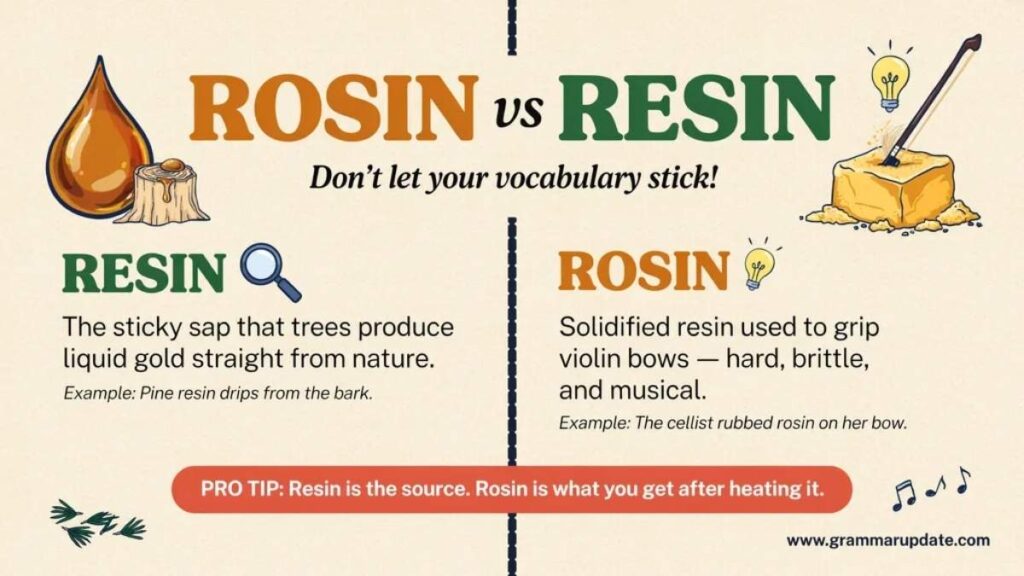
Have you ever stopped and wondered, “Is it rosin or resin?” If so, you’re not alone. These two words look almost the same, which is why they’re often confused. However, they don’t mean the same thing. Resin is the sticky substance naturally produced by trees and cannabis plants, while rosin is a product made from resin or created through heat and pressure extraction in the cannabis industry. Think of it like grapes and grape juice they are closely connected, but they’re not the same. In this Rosin vs Resin guide, you’ll learn the difference, understand when to use each word, and avoid this common mistake with confidence.
Rosin vs Resin at a Glance
Although the words sound alike, rosin and resin are not identical products. Resin is the natural sticky substance produced by certain plants, especially pine trees. Rosin is created by heating and refining that natural resin until its volatile compounds evaporate, leaving behind a solid material with different properties.
The table below provides a quick comparison.
| Feature | Rosin | Resin |
|---|---|---|
| Definition | A refined material made from natural resin or a solventless cannabis concentrate | A naturally occurring sticky substance produced by plants, especially conifers |
| Source | Pine resin or cannabis flower, hash, or kief | Trees, plants, and cannabis trichomes |
| Production | Heat and pressure extraction or refining natural resin | Produced naturally by the plant |
| Extraction Method | Mechanical extraction with no chemical solvents | Naturally secreted or extracted using solvent-based methods for some concentrates |
| Texture | Solid, sticky, or sap-like depending on type | Sticky, viscous, and often softer |
| Common Uses | Violin bows, soldering, adhesives, sports, cannabis concentrates | Plant defense, epoxy products, varnishes, incense, cannabis extracts |
| Solvents Required | No for solventless rosin | Live resin commonly uses hydrocarbon extraction |
| Terpene Preservation | Excellent when processed correctly | Excellent in live resin made from fresh-frozen cannabis |
| Purity | Very high because no extraction solvents remain | High when properly processed and purified |
| Typical Consumers | Musicians, manufacturers, cannabis users | Manufacturers, artists, cannabis consumers, industrial users |
One important point often gets overlooked. Resin is the starting material in many situations. Rosin is usually the finished product after processing or extraction. That’s why the words are related but not interchangeable.
Learn the difference between confusing word pairs
Steer vs Stear Spelling Mistake and Usage
Why the Rosin vs Resin Difference Matters
At first glance, using the wrong word may seem harmless. However, in many industries, mixing them up can completely change the meaning of what you’re saying.
Imagine asking a violin shop for resin instead of violin rosin. The employee immediately knows you’re using the wrong term because violin bows require rosin to create friction against the strings.
Understanding the correct terminology also helps you compare products more accurately. Questions like these become much easier to answer once you know the basics:
- What is the difference between rosin and resin?
- Is rosin better than resin?
- Is resin stronger than rosin?
- Does rosin taste better than resin?
- Why is rosin more expensive than resin?
- Are rosin carts better than resin carts?
- What is the difference between live rosin and live resin?
Instead of relying on marketing claims or social media opinions, you’ll understand how extraction methods influence quality, purity, aroma, and overall performance.
Learn the difference between confusing word pairs
Attornies vs Attorneys Differences and Usage
Quick Facts About Rosin and Resin
Here are several facts that immediately clear up many common misconceptions.
| Fact | Explanation |
|---|---|
| Resin occurs naturally | Trees and cannabis plants naturally produce resin as a protective substance. |
| Rosin is processed | Rosin is created through refining or mechanical extraction rather than direct plant secretion. |
| Live resin isn’t solventless | Live resin typically uses butane extraction or propane extraction under controlled conditions. |
| Live rosin is solventless | Live rosin uses only heat and pressure extraction after processing fresh-frozen material into hash. |
| Both preserve terpenes | Modern extraction techniques can preserve excellent terpene profiles when performed correctly. |
| Neither is automatically stronger | Potency depends on genetics, extraction quality, cannabinoid content, and production methods. |
These differences explain why conversations about rosin vs resin potency, rosin vs resin purity, rosin vs resin flavor, and rosin vs resin quality are so common among consumers.
Learn the difference between confusing word pairs
Distress vs Duress Differences and Usage
Where You’ll Encounter Rosin and Resin
One reason people become confused is that both materials appear across many industries. The meaning changes depending on the context.
Music
Violinists, cellists, and bass players apply rosin to their bow hair before playing. Without it, the bow would slide across the strings instead of producing clear sound.
Cannabis
Cannabis users compare live rosin vs live resin, rosin carts vs resin carts, and rosin vs distillate when selecting concentrates for vaping or dabbing.
Manufacturing
Industrial companies use both natural and synthetic resin in plastics, coatings, adhesives, and composite materials. Pine rosin also plays an important role in printing inks, rubber manufacturing, soldering flux, and paper production.
Art and Crafts
Artists often work with epoxy resin to create jewelry, river tables, decorative coatings, and molds. Pine rosin also appears in specialty varnishes and traditional woodworking finishes.
Sports and Performance
Baseball pitchers, weightlifters, gymnasts, ballet dancers, and rock climbers use rosin to improve grip. Searches for rosin vs resin ballet often stem from this practical application, as dancers rely on rosin to reduce slipping on stage.
Why This Guide Goes Beyond Simple Definitions
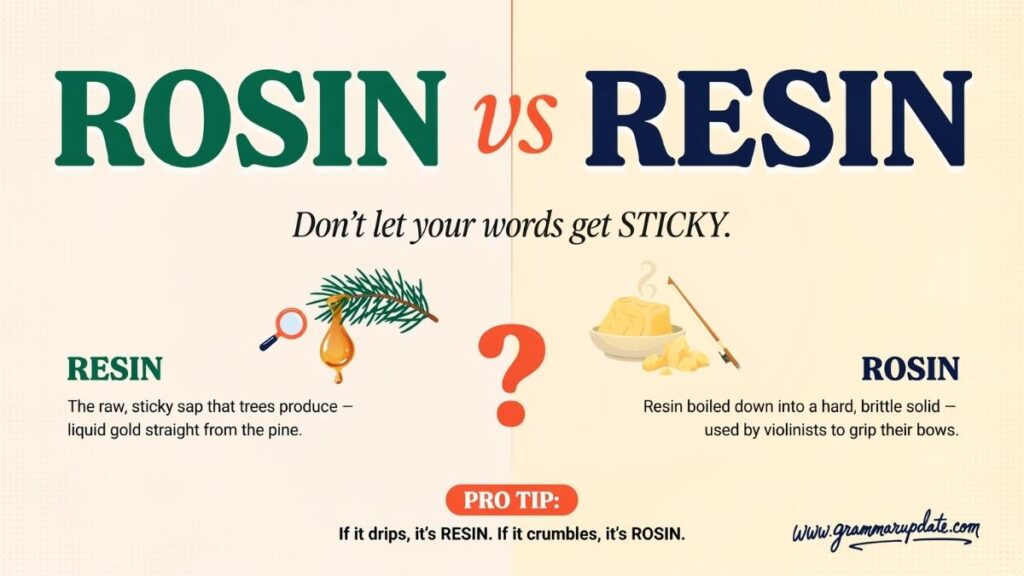
Many articles stop after saying that resin comes from trees and rosin is made from resin. While technically true, that explanation barely scratches the surface.
Today’s consumers also want answers about:
- Rosin vs resin extraction
- Rosin vs resin extraction method
- Solventless vs solvent-based extraction
- Heat and pressure extraction
- Hydrocarbon extraction
- Cannabis concentrate extraction
- Rosin vs resin yield
- Rosin vs resin shelf life
- Rosin vs resin flavor
- Rosin vs resin purity
- Rosin vs resin price
- Rosin vs resin products
- Rosin vs resin vape
- Rosin vs resin wax
- Rosin vs resin comparison
Learn the difference between confusing word pairs
Which vs Witch vs Wich Differences and Usage
What Is Rosin?
Rosin is a solid or semi-solid material created by processing natural resin or by using a solventless extraction method on cannabis. Although the same word appears in different industries, the basic idea remains the same: rosin is a refined product with specific properties that make it useful for a wide range of applications.
In traditional manufacturing, rosin comes from pine tree resin. Workers collect the sticky resin, heat it to remove volatile oils such as turpentine, and leave behind a hard, amber-colored substance known as rosin.
In the cannabis industry, the meaning is slightly different. Cannabis rosin is a premium concentrate made by applying heat and pressure to cannabis flower, kief, or hash. This mechanical extraction method produces a clean extract without chemical solvents. That’s why many consumers associate solventless rosin with purity and quality.
Understanding this distinction is the first step toward understanding the real rosin vs resin difference.
Rosin Definition
A simple definition is:
Rosin is a refined natural resin or a solventless cannabis concentrate produced through heat and pressure extraction.
Unlike raw resin, rosin doesn’t occur naturally in its finished form. It must be created through a controlled extraction or refining process.
Because of its versatility, rosin appears in industries ranging from music and electronics to sports and cannabis production.
How Rosin Is Made
The production process depends on the type of rosin.
Traditional Pine Rosin
Manufacturers begin by collecting resin from pine trees. The resin contains both solid compounds and volatile oils.
The production process typically includes these steps:
- Collect raw pine resin.
- Filter out bark and debris.
- Heat the resin carefully.
- Remove volatile oils through distillation.
- Cool the remaining material.
- Package the finished rosin.
The final product is harder, more stable, and easier to transport than raw tree resin.
Cannabis Rosin
Cannabis rosin uses an entirely different approach known as heat and pressure extraction.
Instead of chemicals, producers use specialized equipment called a rosin press.
The basic rosin extraction process includes:
- Select high-quality cannabis flower, hash, or kief.
- Place the material inside a filter bag if needed.
- Apply controlled heat.
- Apply several tons of pressure.
- Collect the sticky concentrate as it flows from the plant material.
- Cool and package the extract.
This rosin extraction method relies entirely on mechanical extraction.
No butane extraction, propane extraction, or other solvent-based extraction methods are required.
That makes rosin one of today’s most popular solventless concentrates.
Learn the difference between confusing word pairs
Midday vs Mid Day Which Spelling Is Correct in Modern English?
Why Solventless Extraction Matters
One reason people compare live rosin vs live resin is the extraction process itself.
Rosin is produced through solventless extraction explained by one simple principle:
Heat softens the plant oils while pressure squeezes them from the plant material.
Because no hydrocarbon solvents are involved, many consumers appreciate the simplicity of the process.
Potential advantages include:
- No residual extraction solvents
- Minimal processing
- Excellent terpene preservation
- Rich cannabinoid profile
- Full-spectrum extract
- Natural flavor
However, solventless doesn’t automatically mean better. Quality depends heavily on the starting material and the skill of the producer.
A poorly made solventless concentrate may perform worse than a carefully produced live resin.
Types of Rosin
Rosin isn’t a single product. Several varieties exist depending on the source material and intended use.
Pine Rosin
This is the traditional rosin used throughout industry.
Common applications include:
- Violin bows
- Baseball
- Ballet
- Gymnastics
- Rubber manufacturing
- Adhesives
- Printing inks
- Soldering flux
Flower Rosin
Flower rosin comes directly from dried cannabis flower.
It offers a straightforward extraction process but usually produces a lower yield than hash rosin.
Hash Rosin
Hash rosin starts with high-quality hash rather than whole flower.
Because the starting material contains concentrated trichomes, the finished product often delivers exceptional purity, flavor, and terpene preservation.
Many premium cannabis brands consider hash rosin the highest-quality solventless concentrate available.
Live Rosin
Live rosin begins with fresh-frozen cannabis rather than dried flower.
After producing ice water hash, manufacturers press it using heat and pressure.
This approach preserves delicate aromatic compounds that might otherwise disappear during drying.
As a result, live rosin often provides:
- Rich aroma
- Vibrant flavor
- Full-spectrum cannabinoid profile
- Excellent terpene profile
- Premium concentrate quality
This explains why searches for “is live rosin better than live resin” continue to grow.
Learn the difference between confusing word pairs
Waring vs Wearing Differences and Usage with Examples
Common Uses of Rosin
Rosin serves many industries beyond cannabis.
Musical Instruments
The best-known example is violin rosin.
Bowed string instruments require friction between the bow hair and strings.
Without rosin, the bow would simply glide across the string without producing a strong tone.
Musicians regularly apply fresh rosin to maintain sound quality.
This is why discussions about rosin vs resin violin have a simple answer.
Violinists use rosin, not raw resin.
Ballet and Dance
Professional dancers often sprinkle powdered rosin on the stage floor.
The extra grip reduces slipping during jumps, turns, and landings.
This long-standing practice explains searches related to rosin vs resin ballet.
Resin itself isn’t used for this purpose.
Baseball
Pitchers occasionally use rosin bags to improve grip while throwing.
Major League Baseball provides rosin bags on the mound because they help absorb moisture without dramatically altering the baseball.
Electronics
Rosin plays an important role in soldering.
Rosin-based flux removes oxidation from metal surfaces and helps solder bond properly.
Without flux, electrical connections may become weak or unreliable.
Printing and Adhesives
Industrial manufacturers add rosin to:
- Printing inks
- Pressure-sensitive adhesives
- Varnishes
- Sealants
- Rubber compounds
Its natural tackiness improves bonding performance across many products.
Learn the difference between confusing word pairs
Finaly vs Finally Differences and Usage
Why Cannabis Rosin Has Become So Popular
The cannabis market has experienced tremendous growth in solventless concentrates over the past decade.
Several factors explain this trend.
Clean Extraction
Consumers appreciate that cannabis rosin avoids solvent-based extraction.
Many see mechanical extraction as a cleaner production method.
Flavor Preservation
Rosin often preserves delicate terpenes responsible for aroma and taste.
As a result, many enthusiasts searching for rosin vs resin flavor prefer premium live rosin.
Full-Spectrum Experience
Instead of isolating only THC, high-quality rosin retains a broad range of cannabinoids and terpenes.
Many users describe this as a more complete cannabis experience.
Premium Quality
Rosin production requires high-quality starting material and careful processing.
Because of that, premium solventless rosin usually commands a higher price than many other concentrate types.
Advantages of Rosin
Although every concentrate has strengths and weaknesses, rosin offers several notable benefits.
| Advantage | Why It Matters |
|---|---|
| Solventless extraction | No chemical solvents during production |
| Excellent flavor | Preserves natural terpenes |
| High purity | Minimal processing |
| Full-spectrum profile | Retains many cannabinoids and aromatic compounds |
| Versatile | Used for dabbing, vaping, and pressing into cartridges |
| Natural extraction process | Uses only heat and pressure |
These qualities contribute to discussions about rosin vs resin quality and rosin vs resin purity.
Potential Limitations of Rosin
Rosin isn’t perfect.
Like any concentrate, it involves trade-offs.
Common limitations include:
- Lower production yield compared with some solvent-based methods
- Higher manufacturing costs
- Premium retail prices
- Greater dependence on starting material quality
- Smaller production scale
These factors help explain searches such as “Why is rosin more expensive than resin?” and “Rosin vs resin price.”
Quick Facts About Rosin
| Feature | Details |
|---|---|
| Source | Pine resin or cannabis flower, hash, or kief |
| Production | Heat and pressure extraction or resin refining |
| Solvents | None for cannabis rosin |
| Extraction Type | Mechanical extraction |
| Texture | Sticky, buttery, or glass-like depending on processing |
| Aroma | Rich and terpene-forward |
| Common Uses | Music, sports, electronics, adhesives, cannabis concentrates |
| Shelf Life | Best preserved in cool, airtight storage |
| Popular Products | Rosin cart, rosin vape, rosin wax, hash rosin, live rosin |
Learn the difference between confusing word pairs
Laser vs Lazer know the Difference
What Is Resin?
Resin is a naturally occurring sticky substance produced by many plants, especially coniferous trees such as pine, spruce, fir, and cedar. Its primary purpose is to protect the plant. When the bark is damaged by insects, fungi, or harsh weather, resin flows over the wound and forms a protective seal. This natural defense helps prevent infection and reduces moisture loss.
Outside the plant world, the word “resin” has a broader meaning. It can also refer to synthetic materials engineered for manufacturing, construction, art, and countless industrial applications. Because the same word applies to both natural and machine made materials, it’s important to understand the context before comparing resin with rosin.
In the cannabis industry, resin refers to the sticky trichomes that cover cannabis flowers. These tiny crystal-like glands contain cannabinoids, terpenes, and other natural compounds responsible for the plant’s aroma, flavor, and effects.
Knowing this resin definition makes the rosin and resin difference much easier to understand. Resin is the original material. Rosin is a refined or extracted product created from it.
Resin Definition
A simple definition is:
Resin is a sticky organic substance naturally produced by plants or a manufactured polymer designed for industrial and commercial applications.
Depending on the industry, resin can refer to:
- Tree resin
- Cannabis resin
- Epoxy resin
- Polyester resin
- Acrylic resin
- Polyurethane resin
Although these products share the same name, they have very different chemical properties and uses.
How Natural Resin Is Produced
Unlike rosin, resin doesn’t require manufacturing to exist. Trees produce it naturally throughout their lives.
When a tree’s bark is damaged, specialized cells release resin to cover the exposed area.
This protective layer helps:
- Block bacteria
- Prevent fungal infections
- Deter insects
- Reduce water loss
- Protect damaged tissue
Over time, the resin hardens and seals the wound, allowing the tree to continue growing.
This natural defense system has existed for millions of years.
In fact, fossilized tree resin eventually becomes amber, preserving ancient insects, leaves, and even tiny organisms that scientists study today.
What Is Cannabis Resin?
Cannabis resin is very different from tree resin, although both are natural plant secretions.
Cannabis plants develop thousands of microscopic trichomes across their flowers and sugar leaves.
These trichomes produce valuable compounds such as:
- THC
- CBD
- Minor cannabinoids
- Terpenes
- Flavonoids
- Natural oils
The sticky coating surrounding the flowers is cannabis resin.
Without these resin glands, cannabis wouldn’t produce the cannabinoids and aromatic compounds that make different strains unique.
This explains why resin plays such an important role in cannabis concentrate extraction.
Whether manufacturers produce live resin, distillate, hash, or rosin, the process begins with resin-rich plant material.
How Live Resin Is Made
One of the most searched topics in the cannabis industry is live resin vs live rosin.
To understand that comparison, you first need to understand how live resin is produced.
Unlike traditional dried flower extraction, live resin starts with fresh-frozen cannabis.
Immediately after harvest, the plants are frozen instead of dried.
Freezing helps preserve delicate terpenes that would otherwise evaporate during curing.
The extraction process generally includes:
- Harvest fresh cannabis plants.
- Freeze them immediately.
- Place the frozen material into specialized extraction equipment.
- Use hydrocarbon extraction, typically butane extraction, propane extraction, or a blend of both.
- Purge the remaining solvents under carefully controlled conditions.
- Collect the finished live resin concentrate.
This solvent-based extraction method differs completely from the heat and pressure extraction used for rosin.
Solvent-Based Extraction Explained
Many discussions about solventless vs solvent-based extraction center around resin production.
Live resin typically relies on hydrocarbons to dissolve cannabinoids and terpenes from the plant material.
Common solvents include:
- Butane
- Propane
- Butane-propane blends
Professional extraction facilities use closed-loop systems designed to recover and recycle these solvents safely.
After extraction, manufacturers remove nearly all remaining solvents during a purification process.
When performed correctly, licensed laboratories verify that residual solvent levels meet strict regulatory standards before products reach consumers.
This is why high-quality live resin can still achieve excellent purity despite using solvents during production.
Natural Resin vs Synthetic Resin
Not every resin comes from nature.
Today’s manufacturing industries produce synthetic resin for products that require durability, flexibility, or chemical resistance.
Here’s a comparison.
| Feature | Natural Resin | Synthetic Resin |
|---|---|---|
| Source | Trees and plants | Manufactured from chemical compounds |
| Renewable | Yes | Usually petroleum-based |
| Common Uses | Varnish, incense, adhesives | Plastics, coatings, composites, flooring |
| Appearance | Sticky, amber-colored | Varies by formulation |
| Examples | Pine resin, dammar resin | Epoxy, polyester, acrylic resin |
Synthetic resin plays a major role in modern manufacturing because engineers can customize its properties for different applications.
Common Types of Resin
Resin exists in many forms, each designed for a specific purpose.
Pine Resin
Collected directly from pine trees, pine resin serves as the starting material for producing rosin and turpentine.
Cannabis Resin
The sticky trichomes found on cannabis flowers.
These resin glands contain cannabinoids and terpenes used to produce premium cannabis extracts.
Epoxy Resin
Widely used for:
- River tables
- Jewelry
- Countertops
- Protective coatings
- Art projects
Once cured, epoxy resin becomes extremely hard and durable.
Polyester Resin
Commonly used in:
- Fiberglass boats
- Automotive parts
- Construction materials
- Industrial manufacturing
Acrylic Resin
Frequently found in:
- Paints
- Protective coatings
- Adhesives
- Architectural finishes
Each type serves a different purpose, even though they’re all called resin.
Learn the difference between confusing word pairs
Worshipped vs Worshiped Difference and Usage
Common Uses of Resin
Because resin has unique chemical and physical properties, manufacturers rely on it across numerous industries.
Construction
Synthetic resin appears in:
- Flooring
- Wall coatings
- Waterproof sealants
- Structural composites
Art and Crafts
Artists use epoxy resin to create:
- Jewelry
- Decorative trays
- Tabletops
- Sculptures
- Home décor
Manufacturing
Industrial facilities use resin for:
- Plastic production
- Adhesives
- Laminates
- Composite materials
- Automotive components
Marine Industry
Fiberglass boats depend heavily on polyester resin for strength and durability.
Electronics
Certain specialized resins protect electronic components from moisture, vibration, and corrosion.
Cannabis Industry
Cannabis resin serves as the raw material for producing numerous concentrate types, including:
- Live resin
- Resin vape
- Resin cartridge
- Resin wax
- Cannabis extract
- Full-spectrum extract
These products have become increasingly popular as concentrate technology continues to improve.
Transferred vs Transfered, Which Is Correct?
Why Resin Is Important in Cannabis Production
Without cannabis resin, modern cannabis concentrates wouldn’t exist.
The resin glands contain nearly everything extraction laboratories want to preserve:
- Cannabinoids
- Terpenes
- Flavor compounds
- Aroma compounds
- Plant oils
Extraction methods simply separate these valuable compounds from the surrounding plant material.
Different extraction processes produce different concentrate types.
Examples include:
| Extraction Method | Result |
|---|---|
| Heat and pressure extraction | Rosin |
| Hydrocarbon extraction | Live resin |
| Ethanol extraction | Cannabis oil |
| CO₂ extraction | Cannabis extract |
| Distillation | Distillate |
This comparison helps explain why consumers often search for cannabis extract types and concentrate types when comparing products.
Advantages of Resin
Natural and processed resin offer several important advantages.
- Excellent source of cannabinoids and terpenes
- Supports production of numerous concentrate types
- Highly versatile
- Used across dozens of industries
- Available in both natural and synthetic forms
- Excellent for manufacturing durable materials
These benefits contribute to discussions about resin quality and resin yield.
Learn the difference between tricky grammar more words
Naive vs Nieve, Which Spelling Is Correct and Usage?
Potential Limitations of Resin
Like rosin, resin has certain drawbacks depending on its application.
Some concentrate production methods require expensive extraction equipment.
Hydrocarbon extraction also demands strict safety standards because butane and propane are highly flammable.
Other considerations include:
- Complex manufacturing
- Specialized laboratory equipment
- Regulatory requirements
- Higher production costs for premium concentrates
- Proper solvent removal before consumer use
These factors don’t necessarily reduce quality, but they do influence production methods and pricing.
Quick Facts About Resin
| Feature | Details |
|---|---|
| Source | Trees, plants, cannabis trichomes, or synthetic manufacturing |
| Production | Naturally secreted or chemically manufactured |
| Common Cannabis Product | Live resin |
| Common Industrial Products | Epoxy, fiberglass, adhesives, plastics |
| Extraction Method | Usually solvent-based for cannabis concentrates |
| Texture | Sticky, thick, viscous, or hardened depending on type |
| Main Components | Cannabinoids, terpenes, plant oils, natural compounds, or synthetic polymers |
| Uses | Manufacturing, art, electronics, construction, cannabis concentrates |
| Shelf Life | Varies by product and storage conditions |
Rosin and Resin The Key Connection
One of the biggest reasons people confuse these terms is that they’re closely related.
Tree resin is the raw material that becomes pine rosin after heating removes volatile oils.
Similarly, cannabis resin contains the valuable compounds that can be transformed into different cannabis concentrates through various extraction methods. One of those methods is mechanical heat and pressure extraction, which produces solventless rosin. Another is hydrocarbon extraction, which creates live resin.
In other words, resin is the starting point, while rosin is one possible finished product.
Rosin vs Resin Side-by-Side Comparison
Now that you understand what rosin and resin are individually, it’s time to compare them side by side. This is where most of the confusion disappears. Although the two materials are closely connected, they differ in how they’re produced, how they’re used, and what properties they offer.
The term “resin” refers to the natural sticky substance produced by plants or, in some industries, a manufactured polymer. Rosin is a processed product. In traditional industries, it’s made by refining natural tree resin. In the cannabis industry, it’s a solventless concentrate created by applying heat and pressure to cannabis flower, hash, or kief.
This simple distinction explains much of the rosin vs resin difference, but there are many other factors worth comparing.
Rosin vs Resin Comparison Chart
| Feature | Rosin | Resin |
|---|---|---|
| Definition | Refined tree resin or a solventless cannabis concentrate | Natural plant secretion or synthetic polymer |
| Origin | Produced from resin through processing or mechanical extraction | Naturally produced by plants or manufactured chemically |
| Extraction Method | Heat and pressure extraction or resin refining | Naturally secreted or extracted using solvent-based methods |
| Solvents Required | No for cannabis rosin | Often yes for live resin concentrates |
| Texture | Sticky, buttery, shatter-like, or sap-like | Sticky, viscous, or liquid depending on type |
| Flavor | Rich, natural, terpene-forward | Excellent flavor, especially live resin |
| Aroma | Strong and fresh | Strong with excellent terpene preservation |
| Purity | High because no extraction solvents remain | High when properly purified |
| Yield | Usually lower | Often higher using solvent-based extraction |
| Production Cost | Higher | Generally lower for large-scale production |
| Typical Uses | Music, sports, cannabis concentrates, soldering | Construction, art, manufacturing, cannabis extraction |
| Consumer Appeal | Solventless and premium | Wide variety of products and price points |
At first glance, many characteristics seem similar. However, the production methods create meaningful differences in consistency, purity, and cost.
Learn the difference between tricky grammar more words
Phoenix vs Pheonix Difference and Usage
Rosin and Resin Difference Explained
One of the easiest ways to remember the difference between rosin and resin is to think of resin as the starting material.
A pine tree naturally produces resin.
That resin can later be heated and refined into rosin.
The same principle applies to cannabis.
Cannabis plants naturally produce resin inside their trichomes.
Manufacturers can then transform those resin glands into different concentrate types depending on the extraction method they choose.
For example:
- Heat and pressure extraction produces rosin.
- Hydrocarbon extraction produces live resin.
- Distillation produces distillate.
Although all three products come from the same plant, they are completely different concentrates.
Rosin vs Resin Extraction
The biggest technical difference between the two lies in the extraction process.
Rosin Extraction Method
Rosin uses mechanical extraction.
Instead of chemicals, producers rely on controlled heat and pressure.
The basic process looks like this:
- Prepare cannabis flower, hash, or kief.
- Apply carefully controlled heat.
- Apply high pressure with a rosin press.
- Collect the concentrated oil.
- Cool and package the finished product.
Because no solvents enter the process, this method is often called solventless extraction.
Many consumers specifically look for solventless concentrate products because they appreciate the straightforward production process.
Resin Extraction Method
Most live resin products rely on solvent-based extraction.
Rather than squeezing oils from the plant, extraction equipment uses hydrocarbons to dissolve cannabinoids and terpenes.
Common extraction solvents include:
- Butane
- Propane
- Butane-propane blends
After extraction, technicians carefully remove nearly all remaining solvents before laboratory testing.
When performed correctly, this process creates a clean, flavorful concentrate with excellent terpene preservation.
Learn the difference between tricky grammar more words
Authorization vs Authorisation Which is Correct?
Solventless vs Solvent-Based Extraction
Many buying decisions come down to one question:
Should you choose solventless or solvent-based extraction?
Each approach offers distinct advantages.
Solventless Extraction
Advantages include:
- No chemical solvents
- Simple mechanical extraction
- Excellent purity
- Premium product reputation
- Strong terpene preservation
Possible drawbacks include:
- Lower extraction efficiency
- Smaller production yield
- Higher production costs
- More expensive retail pricing
Solvent-Based Extraction
Advantages include:
- Higher extraction efficiency
- Larger production yield
- Consistent large-scale manufacturing
- Excellent terpene retention with fresh-frozen material
- Lower production cost per gram
Possible drawbacks include:
- Requires specialized laboratories
- Uses highly controlled extraction equipment
- More complex manufacturing process
Neither approach is automatically better.
Instead, each serves different goals and different consumers.
Learn the difference between tricky grammar more words
Performing vs Preforming difference and Which One Is Correct?
Heat and Pressure Extraction vs Hydrocarbon Extraction
These two production methods dominate today’s premium cannabis concentrate market.
Heat and Pressure Extraction
Heat and pressure extraction works through pure mechanical force.
As pressure increases, cannabinoids and terpenes separate from the plant material and flow onto collection paper.
Because the process uses only temperature and pressure, many consumers view it as the most natural extraction method available.
Hydrocarbon Extraction
Hydrocarbon extraction works differently.
Instead of squeezing plant oils, butane or propane dissolves desirable compounds from fresh cannabis.
Later, technicians remove the solvents under carefully controlled conditions.
The result is live resin with impressive aroma and flavor.
This explains why searches for hydrocarbon extraction, butane extraction, propane extraction, and solvent extraction explained continue to grow.
Rosin vs Resin Quality
Quality depends on far more than the extraction method.
Several factors influence the final product.
Starting Material
High-quality cannabis flower produces higher-quality concentrates regardless of extraction style.
Poor flower rarely becomes premium concentrate.
Genetics
Different cannabis cultivars produce different cannabinoid and terpene profiles.
Some strains naturally yield more resin than others.
Processing Skill
Experienced extraction technicians consistently produce cleaner, more flavorful concentrates.
Temperature control, pressure settings, filtration, and storage all influence quality.
Freshness
Fresh-frozen cannabis often preserves more aromatic compounds than dried flower.
That’s one reason live resin remains so popular.
Rosin vs Resin Purity
Purity is another common comparison.
Many consumers assume rosin is automatically purer because it’s solventless.
The reality is more nuanced.
Rosin Purity
Rosin contains no added extraction solvents.
However, poor filtration may leave behind tiny particles of plant material.
Resin Purity
Modern extraction laboratories remove residual solvents during post-processing.
Licensed producers also perform laboratory testing before products reach consumers.
When produced correctly, both concentrate types can achieve very high purity.
Rosin vs Resin Yield
Yield refers to how much concentrate manufacturers obtain from the original plant material.
This area often favors solvent-based extraction.
Rosin Yield
Typical factors affecting yield include:
- Flower quality
- Moisture content
- Press temperature
- Pressure
- Press time
Lower yields contribute to higher production costs.
Resin Yield
Hydrocarbon extraction generally recovers more cannabinoids from the plant.
This increased extraction efficiency often lowers manufacturing costs.
Higher yield is one reason live resin products are commonly available at competitive prices.
Rosin vs Resin Production
The production process also influences scalability.
Rosin production typically requires:
- Rosin press
- Filter bags
- Temperature control
- Manual handling
- Small production batches
Live resin production generally requires:
- Closed-loop extraction equipment
- Hydrocarbon recovery systems
- Vacuum ovens
- Laboratory testing
- Commercial-scale facilities
The larger equipment investment supports higher-volume manufacturing.
Rosin vs Resin Consistency
Concentrates can vary widely in appearance.
Rosin commonly appears as:
- Badder
- Butter
- Sap
- Jam
- Pull-and-snap
- Fresh press
Live resin often appears as:
- Sugar
- Sauce
- Diamonds and sauce
- Budder
- Crumble
Texture depends on post-processing techniques, cannabinoid content, and terpene concentration rather than extraction alone.
Rosin vs Resin Shelf Life
Proper storage matters regardless of concentrate type.
The biggest threats include:
- Heat
- Oxygen
- Light
- Moisture
For the longest shelf life:
- Store concentrates in airtight glass containers.
- Keep them in a cool, dark location.
- Avoid repeated exposure to warm temperatures.
- Limit air exposure after opening.
Proper storage helps preserve cannabinoids, terpenes, flavor, and consistency.
The Biggest Difference Between Rosin and Resin
After comparing every category, one difference stands above the rest.
Resin is the plant’s natural starting material.
Rosin is a processed product created from that material.
Everything else flows from this distinction.
In traditional industries, tree resin becomes pine rosin through heating and refinement.
In cannabis production, resin-rich trichomes become different concentrates depending on the extraction process. Heat and pressure create solventless rosin, while hydrocarbon extraction produces live resin.
This relationship explains why people often confuse the two words. They’re connected, but they aren’t interchangeable.
Rosin vs Resin Cannabis
The discussion around rosin vs resin cannabis has become one of the hottest topics in the cannabis industry. As concentrates continue to grow in popularity, consumers want products that deliver exceptional flavor, high potency, and a clean extraction process. That’s where the debate begins.
Although both rosin and resin originate from the same cannabis plant, they are produced differently. Those production methods influence nearly every aspect of the final concentrate, including its aroma, texture, purity, yield, and price.
If you’ve searched for questions like “Which is better rosin or resin?”, “Is rosin better than resin?”, or “What is the difference between live rosin and live resin?”, you’re asking the same questions many experienced cannabis users continue to debate.
The answer isn’t as simple as choosing one over the other. Each concentrate has strengths that make it the better option for certain preferences and situations.
Understanding Cannabis Resin
Before comparing concentrates, it’s important to understand what cannabis resin actually is.
Cannabis flowers are covered with tiny mushroom-shaped glands called trichomes. These trichomes produce the sticky resin that contains the plant’s most valuable compounds, including:
- THC
- CBD
- Minor cannabinoids
- Terpenes
- Flavonoids
- Natural plant oils
Without cannabis resin, there would be no premium cannabis concentrates.
Every extraction method begins with these resin-rich trichomes.
The goal is simply to separate those compounds from the surrounding plant material while preserving as much flavor, aroma, and cannabinoid content as possible.
What Is Live Resin?
Live resin is a premium cannabis concentrate produced from fresh-frozen cannabis plants instead of dried flower.
Immediately after harvest, growers freeze the plants to preserve delicate terpenes that often diminish during the drying and curing process.
Extraction technicians then use solvent-based extraction, typically involving butane, propane, or a carefully balanced blend of both hydrocarbons.
Once extraction is complete, nearly all solvents are removed through controlled purification before laboratory testing.
The result is a concentrate known for its:
- Rich aroma
- Strong flavor
- High terpene content
- Excellent cannabinoid preservation
- Smooth consistency
Live resin has become one of the most popular concentrate types because it captures much of the fresh plant’s original character.
What Is Live Rosin?
Live rosin also begins with fresh-frozen cannabis, but the production process changes dramatically after harvest.
Instead of using hydrocarbon extraction, producers first create ice water hash from the frozen material.
That hash is then pressed using heat and pressure.
No chemical solvents are involved at any stage.
This process creates a solventless concentrate with impressive terpene preservation and a naturally rich cannabinoid profile.
Many enthusiasts consider live rosin one of the highest-quality concentrates available today.
Live Rosin vs Live Resin
The comparison between live rosin vs live resin is one of the most searched topics in the cannabis community.
Although both products preserve fresh cannabis characteristics, they achieve those results through different extraction methods.
| Feature | Live Rosin | Live Resin |
|---|---|---|
| Starting Material | Fresh-frozen cannabis | Fresh-frozen cannabis |
| Extraction Method | Heat and pressure extraction | Hydrocarbon extraction |
| Solvents Used | None | Butane, propane, or blends |
| Extraction Type | Mechanical extraction | Solvent-based extraction |
| Terpene Preservation | Excellent | Excellent |
| Cannabinoid Profile | Full-spectrum | Full-spectrum |
| Production Cost | Higher | Lower |
| Retail Price | Usually more expensive | Usually more affordable |
Both products deliver premium experiences, but the production method remains the defining difference.
Difference Between Live Rosin and Live Resin
Consumers often assume the only difference is whether solvents are used.
In reality, several factors separate these concentrates.
Extraction Process
Live rosin uses only heat and pressure after creating ice water hash.
Live resin relies on hydrocarbon extraction followed by solvent removal.
Production Difficulty
Producing premium live rosin requires several labor-intensive steps.
Growers must:
- Harvest quality flower
- Freeze immediately
- Produce premium bubble hash
- Dry the hash correctly
- Press it carefully
Each step influences the final quality.
Live resin production also demands expertise but depends more on sophisticated extraction equipment than manual processing.
Yield
One reason live rosin costs more is its lower yield.
Multiple processing stages naturally reduce the amount of finished concentrate.
Live resin extraction generally recovers more usable concentrate from the same amount of cannabis.
Availability
Because live resin is easier to produce at commercial scale, consumers often find more live resin products than live rosin products.
Rosin vs Resin Flavor
Flavor is one of the biggest reasons many consumers choose premium concentrates.
Terpenes create the distinctive aroma and taste associated with different cannabis cultivars.
Examples include:
- Citrus
- Pine
- Earth
- Berry
- Diesel
- Floral
- Sweet fruit
- Herbal spice
Does Rosin Taste Better Than Resin?
Many experienced users believe solventless rosin offers a softer, cleaner flavor because the extraction process relies only on heat and pressure.
Others prefer live resin because hydrocarbon extraction can preserve an exceptionally broad terpene profile from fresh-frozen cannabis.
In practice, flavor depends more on:
- Plant genetics
- Harvest timing
- Freshness
- Extraction quality
- Storage conditions
A poorly produced live rosin may taste worse than expertly produced live resin.
Likewise, premium live rosin can outperform average live resin.
Rosin vs Resin Potency
Potency is another area where misconceptions are common.
Many shoppers assume one concentrate is always stronger.
That isn’t true.
THC levels vary depending on:
- Cannabis genetics
- Extraction efficiency
- Laboratory processing
- Product formulation
Some live resin products test higher in THC.
Some live rosin products do as well.
Others produce nearly identical laboratory results.
Is Rosin More Potent Than Resin?
Not necessarily.
Is Live Resin More Potent Than Live Rosin?
Not automatically.
Potency depends on the individual product rather than the extraction method alone.
When comparing concentrates, laboratory test results provide a much more accurate picture than marketing claims.
Rosin vs Resin Purity
Purity often becomes the deciding factor for many buyers.
Rosin
Because rosin uses solventless extraction, consumers appreciate its simple production process.
There are no extraction solvents to remove.
Resin
Although live resin begins with hydrocarbons, reputable manufacturers remove residual solvents before laboratory testing.
Licensed products must meet regulatory standards for safety before reaching consumers.
Both concentrates can achieve outstanding purity when produced correctly.
Rosin vs Resin Quality
Quality depends on far more than whether a product is solventless.
Several factors influence every premium concentrate.
Starting Material
Great concentrates begin with healthy, resin-rich cannabis.
Poor-quality flower rarely produces premium extracts.
Terpene Preservation
Proper temperature control helps preserve valuable aromatic compounds.
Processing Skill
Experienced extraction teams consistently produce cleaner, more flavorful concentrates.
Storage
Improper storage gradually reduces flavor and aroma regardless of extraction style.
Rosin vs Resin Yield
Yield affects both manufacturing efficiency and retail pricing.
Live Rosin Yield
Live rosin production involves:
- Fresh cannabis
- Ice water hash
- Drying
- Pressing
Each stage reduces the amount of finished concentrate.
Lower yields contribute to higher prices.
Live Resin Yield
Hydrocarbon extraction usually recovers more cannabinoids and terpenes from the plant material.
Higher extraction efficiency supports larger production volumes.
Rosin vs Resin Price
Consumers often ask why solventless concentrates cost more.
Several reasons explain the difference.
Why Is Rosin More Expensive Than Resin?
Producing premium live rosin requires:
- Higher-quality starting material
- More labor
- Additional processing steps
- Lower yields
- Longer production times
These factors increase manufacturing costs.
Live resin typically requires expensive extraction equipment, but commercial-scale production often lowers the cost per gram.
Rosin vs Resin Effects
Many people expect different extraction methods to create dramatically different effects.
In reality, the experience depends on several variables.
These include:
- THC concentration
- Cannabinoid profile
- Terpene profile
- Consumption method
- Individual tolerance
Both live rosin and live resin can produce powerful effects when made from high-quality cannabis.
Which Is Better Rosin vs Resin?
This question doesn’t have one universal answer.
Instead, the better concentrate depends on your priorities.
Choose Live Rosin If You Prefer
- Solventless extraction
- Minimal processing
- Premium craftsmanship
- Excellent flavor
- Full-spectrum concentrate
Choose Live Resin If You Prefer
- Greater affordability
- Wider product selection
- Excellent terpene preservation
- Strong potency
- Consistent commercial availability
Neither concentrate is objectively superior.
Each excels in different areas.
Quick Cannabis Comparison
| Category | Live Rosin | Live Resin |
|---|---|---|
| Solventless | Yes | No |
| Fresh-Frozen Cannabis | Yes | Yes |
| Flavor | Excellent | Excellent |
| Aroma | Excellent | Excellent |
| Potency | High | High |
| Purity | Very high | Very high when properly processed |
| Production Cost | Higher | Lower |
| Yield | Lower | Higher |
| Availability | Limited | Widely available |
| Ideal Buyer | Solventless enthusiasts | Consumers seeking value and variety |
Rosin vs Resin Carts, Wax, Vape, and Distillate
As cannabis concentrates have become more popular, so have the products made from them. Today, consumers can choose from vape cartridges, disposable vapes, wax concentrates, and highly refined oils. While these products may look similar on a dispensary shelf, the concentrate inside can be very different.
This is where many buyers become confused. Terms such as rosin carts vs resin carts, live resin vs rosin carts, and rosin vs resin vs distillate often appear together, making it difficult to know which product best matches your preferences.
The key is understanding what each product contains and how it’s made.
Rosin Carts vs Resin Carts
A vape cartridge is simply a cartridge filled with cannabis concentrate. The difference comes from the type of concentrate inside.
What Is a Rosin Cartridge?
A rosin cartridge contains solventless cannabis rosin.
Manufacturers produce the concentrate through heat and pressure extraction before carefully preparing it for vaporization.
High-quality rosin cartridges usually contain:
- Solventless rosin
- Naturally occurring cannabinoids
- Native terpenes
- Full-spectrum plant compounds
Many producers avoid adding artificial flavorings because premium rosin already delivers a rich terpene profile.
What Is a Resin Cartridge?
A resin cartridge contains live resin concentrate.
The concentrate comes from fresh-frozen cannabis extracted through hydrocarbon extraction.
Most live resin cartridges preserve:
- Natural cannabinoids
- Fresh cannabis terpenes
- Strong aroma
- Full-spectrum characteristics
Because live resin begins with fresh-frozen cannabis, many users appreciate its vibrant flavor and strain-specific profile.
Learn the difference between tricky grammar more words
Tomatoes vs Tomatos difference and Which Is Correct?
Rosin Carts vs Resin Carts Comparison
| Feature | Rosin Cart | Resin Cart |
|---|---|---|
| Concentrate | Solventless rosin | Live resin |
| Extraction Method | Heat and pressure | Hydrocarbon extraction |
| Solvents Used | None | Used during extraction and removed afterward |
| Flavor | Rich and natural | Bright and terpene-rich |
| Aroma | Excellent | Excellent |
| Price | Usually higher | Usually lower |
| Availability | Less common | Widely available |
Both products deliver premium vaping experiences, but the extraction process remains their biggest difference.
Live Rosin vs Live Resin Carts
Many premium dispensaries now offer both live rosin carts and live resin carts.
Although both begin with fresh-frozen cannabis, their manufacturing methods differ.
1.Live Rosin Carts
Live rosin carts typically appeal to consumers who prioritize:
- Solventless extraction
- Minimal processing
- Premium craftsmanship
- Full-spectrum extracts
2.Live Resin Carts
Live resin carts often attract buyers looking for:
- Excellent terpene preservation
- Strong strain-specific flavor
- Wider availability
- Better affordability
Neither option is automatically better.
Instead, the choice depends on what matters most to the individual consumer.
Are Rosin Carts Better Than Resin Carts?
This is one of the most common questions among cannabis users.
The answer depends on your priorities.
If your highest priority is avoiding solvent-based extraction, a rosin cartridge may be the better choice.
If you want a premium vape at a more accessible price, a live resin cartridge may provide outstanding value.
Many experienced users keep both available for different situations.
Rosin Vape vs Resin Vape
The term “vape” generally refers to the complete vaping device rather than the concentrate itself.
Whether you’re using a disposable vape or a refillable battery, the experience depends largely on what’s inside the cartridge.
Rosin Vape
A rosin vape usually offers:
- Solventless concentrate
- Smooth flavor
- Full-spectrum cannabinoids
- Strong terpene preservation
Resin Vape
A resin vape commonly provides:
- Fresh cannabis aroma
- Excellent terpene profile
- Consistent vapor production
- Broad strain selection
Both options continue to grow in popularity as concentrate technology improves.
Learn the difference between confusing more English words
Sergeant vs Sargent difference and Which Is Correct?
Rosin Concentrate vs Resin Concentrate
Not all concentrates are created equally.
Rosin concentrate and resin concentrate differ primarily in extraction method.
Rosin Concentrate
Produced through:
- Heat
- Pressure
- Mechanical extraction
Characteristics include:
- Solventless production
- High purity
- Rich flavor
- Premium pricing
Resin Concentrate
Produced through:
- Hydrocarbon extraction
- Controlled laboratory processing
Characteristics include:
- Excellent terpene retention
- Higher extraction efficiency
- Greater production yield
- Competitive pricing
Understanding these production methods helps explain the ongoing debate surrounding rosin vs resin concentrate.
Rosin Wax vs Resin Wax
Wax is another common concentrate consistency.
The word “wax” describes texture rather than extraction method.
Both rosin and resin can appear in wax-like forms depending on post-processing.
Rosin Wax
Rosin wax develops through careful whipping or curing after pressing.
It often features:
- Soft consistency
- Easy handling
- Strong aroma
- Rich flavor
Resin Wax
Live resin wax results from specialized post-processing techniques following hydrocarbon extraction.
Common characteristics include:
- Creamy texture
- Excellent terpene content
- Smooth application
- Consistent appearance
The texture alone doesn’t indicate quality.
Instead, production methods and starting material play much larger roles.
Learn the difference between confusing more English words
Insuring vs Ensuring Difference and which is correct?
Rosin vs Distillate
Another comparison frequently seen in dispensaries is rosin vs distillate.
Although both are cannabis concentrates, they’re produced very differently.
What Is Distillate?
Distillate is a highly refined cannabis oil created through repeated purification and fractional distillation.
The process isolates cannabinoids, often producing THC concentrations above 90 percent.
However, many naturally occurring terpenes are removed during refinement.
Manufacturers sometimes add terpenes back later to improve flavor.
Rosin vs Distillate Comparison
| Feature | Rosin | Distillate |
|---|---|---|
| Extraction | Heat and pressure | Solvent extraction followed by distillation |
| Terpenes | Naturally preserved | Often removed and later reintroduced |
| Flavor | Rich and strain-specific | Depends on added terpenes |
| Cannabinoid Profile | Full-spectrum | Primarily isolated cannabinoids |
| Processing | Minimal | Highly refined |
| Texture | Sticky, buttery, or sap-like | Thick oil |
| Common Uses | Dabbing, vaping | Vape cartridges, edibles, tinctures |
Many consumers choose rosin because they value naturally preserved terpenes.
Others prefer distillate because of its high THC concentration and versatility.
Resin vs Distillate
Live resin and distillate also differ significantly.
Live Resin
Advantages include:
- Fresh cannabis flavor
- Excellent terpene profile
- Full-spectrum cannabinoids
- Rich aroma
Distillate
Advantages include:
- High THC concentration
- Consistent potency
- Neutral flavor when desired
- Broad product compatibility
Neither concentrate replaces the other.
Instead, each serves different consumer preferences.
Rosin vs Resin vs Distillate
This three-way comparison highlights the biggest differences.
| Category | Rosin | Live Resin | Distillate |
|---|---|---|---|
| Extraction Method | Heat and pressure | Hydrocarbon extraction | Solvent extraction plus distillation |
| Solventless | Yes | No | No |
| Fresh-Frozen Cannabis | Sometimes | Yes | Usually no |
| Flavor | Excellent | Excellent | Moderate unless terpenes are added |
| Terpene Preservation | Excellent | Excellent | Lower after refinement |
| Cannabinoid Profile | Full-spectrum | Full-spectrum | Mostly isolated cannabinoids |
| Processing | Minimal | Moderate | Extensive |
| Typical Price | Highest | Mid-range | Usually most affordable |
| Best Known For | Purity | Flavor | Potency |
This comparison explains why so many experienced consumers consider extraction method just as important as THC percentage.
Choosing the Right Concentrate
Rather than asking which concentrate is universally best, consider what matters most to you.
1.Choose rosin if you value:
- Solventless extraction
- Minimal processing
- Natural terpene preservation
- Premium craftsmanship
2.Choose live resin if you value:
- Fresh-frozen cannabis
- Strong flavor
- Excellent aroma
- Better affordability
3.Choose distillate if you value:
- High THC concentration
- Versatile product options
- Consistent cannabinoid levels
- Lower prices
Common Misconceptions
Several myths continue to circulate online.
Myth Rosin Is Always Stronger
Not necessarily.
Potency depends on the specific product, laboratory results, and cannabinoid profile.
Myth Live Resin Contains Dangerous Solvents
Professional extraction facilities remove residual solvents during manufacturing.
Licensed products undergo laboratory testing before reaching consumers.
Myth Distillate Is Low Quality
Distillate simply serves a different purpose.
Its highly refined cannabinoid profile makes it useful for vape cartridges, edibles, tinctures, and many infused products.
Myth Expensive Always Means Better
Price often reflects production costs, extraction difficulty, and yield rather than overall quality.
A carefully produced live resin may outperform an average-quality rosin.
Likewise, a premium solventless rosin can deliver an exceptional experience that justifies its higher price.
Rosin vs Resin Flavor
Flavor is one of the biggest reasons cannabis enthusiasts compare rosin and resin. While potency often grabs the headlines, many experienced users believe that flavor tells the real story of a concentrate’s quality.
A concentrate’s taste comes primarily from terpenes. These natural aromatic compounds give cannabis its distinctive scents and flavors, ranging from citrus and pine to berries, herbs, and fuel-like notes.
Both rosin and live resin can preserve an impressive terpene profile, but they achieve that goal through different extraction methods.
Does Rosin Taste Better Than Resin?
There isn’t a universal winner.
Many people describe solventless rosin as having a cleaner, softer, and more natural flavor because it isn’t exposed to hydrocarbon solvents during extraction.
Others prefer live resin because fresh-frozen cannabis preserves delicate terpenes that might otherwise fade during drying and curing.
In reality, flavor depends on several factors:
- Cannabis genetics
- Harvest timing
- Freshness of the plant
- Extraction process
- Storage conditions
- Producer experience
A premium live resin may offer better flavor than an average rosin, while expertly made live rosin can outperform nearly any other concentrate.
Terpene Preservation
Terpenes are fragile compounds.
Excessive heat, oxygen, and light gradually reduce their intensity.
Both live resin and live rosin are designed to preserve as many terpenes as possible.
High-quality concentrates often retain aromas such as:
- Lemon
- Orange
- Pine
- Lavender
- Earth
- Tropical fruit
- Sweet candy
- Diesel
This rich terpene profile contributes to the distinctive flavor that concentrate enthusiasts seek.
Rosin vs Resin Potency
One of the most common misconceptions is that one concentrate is always stronger than the other.
The truth is much more complicated.
Is Rosin More Potent Than Resin?
Not necessarily.
Rosin potency depends on:
- Cannabis strain
- Cannabinoid profile
- Extraction efficiency
- Quality of the starting material
Some solventless rosin products test above 80% THC.
Others contain lower THC levels while preserving a broader range of cannabinoids and terpenes.
Is Resin Stronger Than Rosin?
Again, there isn’t a simple yes or no answer.
Many live resin concentrates also reach high THC levels while maintaining excellent terpene preservation.
Instead of asking which concentrate is stronger, it’s more useful to compare laboratory test results for individual products.
Potency Isn’t Everything
High THC doesn’t automatically create a better experience.
Many consumers value the interaction between cannabinoids and terpenes, often called the entourage effect.
A concentrate with balanced cannabinoids and rich terpenes may provide a more enjoyable experience than one focused only on THC percentage.
Rosin vs Resin Purity
Purity is another major factor when comparing premium concentrates.
Rosin Purity
Because rosin uses solventless extraction, there are no extraction solvents involved.
The concentrate comes directly from cannabis flower, hash, or kief using heat and pressure.
Many consumers appreciate this straightforward production method.
Resin Purity
Live resin begins with hydrocarbon extraction.
However, professional laboratories carefully remove residual solvents before products are tested and packaged.
Licensed products must meet strict regulatory standards for residual solvent levels.
When produced correctly, both rosin and live resin achieve exceptional purity.
The quality of manufacturing matters far more than the extraction method alone.
Rosin vs Resin Quality
Quality isn’t determined by one characteristic.
Instead, several factors work together.
Plant Genetics
Premium concentrates begin with premium cannabis.
Healthy, resin-rich plants naturally produce better extracts.
Harvest Timing
Harvesting too early or too late can reduce cannabinoid and terpene quality.
Extraction Skill
Temperature control, pressure settings, filtration, and purification all influence the final concentrate.
Storage
Proper storage protects cannabinoids and terpenes from degradation.
Even the best concentrate gradually loses quality when exposed to heat, light, or air.
Rosin vs Resin Yield
Yield measures how much concentrate producers obtain from the original plant material.
This directly affects manufacturing costs.
Rosin Yield
Several variables influence rosin production.
These include:
- Moisture content
- Press temperature
- Pressure
- Press time
- Flower quality
- Hash quality
Rosin generally produces lower yields because mechanical extraction cannot recover every available cannabinoid.
Resin Yield
Hydrocarbon extraction typically removes cannabinoids and terpenes more efficiently.
Higher extraction efficiency often produces larger quantities of concentrate from the same amount of plant material.
That improved yield helps reduce manufacturing costs.
Rosin vs Resin Price
Consumers frequently notice that solventless products cost more.
There are good reasons for that.
Why Is Rosin More Expensive Than Resin?
Rosin production involves:
- Premium cannabis flower
- Ice water hash for live rosin
- Careful drying
- Mechanical pressing
- Lower extraction yield
- Greater labor requirements
Every additional production step increases costs.
Live resin also requires sophisticated extraction equipment, but commercial-scale production usually improves efficiency and lowers costs.
Average Price Factors
Several factors influence retail pricing.
- Cannabis quality
- Extraction method
- Brand reputation
- Product availability
- Regional regulations
- Laboratory testing
- Packaging
Rather than focusing only on price, compare quality, terpene content, and laboratory results.
Rosin vs Resin Shelf Life
Proper storage extends the life of every concentrate.
The greatest threats include:
- Heat
- Air
- Moisture
- Direct sunlight
Storage Tips
For the best results:
- Store concentrates in airtight glass containers.
- Keep them in a cool, dark place.
- Avoid repeated temperature changes.
- Close containers immediately after use.
Following these simple practices helps preserve flavor, aroma, potency, and consistency.
Rosin vs Resin Consistency
Concentrates appear in many different textures.
Rosin commonly appears as:
- Fresh press
- Badder
- Butter
- Jam
- Sap
Live resin often appears as:
- Sugar
- Sauce
- Diamonds
- Budder
- Crumble
Texture depends largely on post-processing methods rather than extraction alone.
Learn the difference between confusing more English words
Leeched vs Leached Difference and which is correct ?
Rosin vs Resin Effects
Consumers often ask whether one concentrate produces stronger effects.
The answer depends on much more than extraction.
Important factors include:
- THC level
- CBD content
- Minor cannabinoids
- Terpene profile
- Individual tolerance
- Consumption method
Because each concentrate contains a unique chemical profile, experiences vary from person to person.
Which Is Better Rosin vs Resin?
This is probably the most frequently asked question.
The honest answer is that neither concentrate is objectively better.
Each excels in different areas.
Choose Rosin If You Value
- Solventless extraction
- Minimal processing
- Premium craftsmanship
- Excellent purity
- Full-spectrum cannabinoids
- Rich natural flavor
Choose Live Resin If You Value
- Fresh-frozen cannabis
- Outstanding terpene preservation
- Excellent aroma
- Higher extraction efficiency
- Better affordability
- Greater product availability
The best choice depends entirely on your priorities.
Which Is Stronger Rosin vs Resin?
Strength should never be judged by extraction method alone.
Compare products using:
- Laboratory cannabinoid results
- Terpene profile
- Product freshness
- Brand reputation
- Independent testing
Some live resin products test higher in THC.
Some live rosin products do the same.
Others deliver similar potency but different flavor profiles.
Quick Comparison
| Category | Rosin | Live Resin |
|---|---|---|
| Extraction | Heat and pressure | Hydrocarbon extraction |
| Solventless | Yes | No |
| Flavor | Excellent | Excellent |
| Terpene Preservation | Excellent | Excellent |
| Potency | High | High |
| Purity | Very high | Very high when properly processed |
| Production Yield | Lower | Higher |
| Production Cost | Higher | Lower |
| Retail Price | Premium | More affordable |
| Availability | Limited | Widely available |
Expert Perspective
Most extraction professionals agree on one important point.
The quality of the starting cannabis has a greater impact on the finished concentrate than the extraction method itself.
A premium cannabis cultivar processed with care can produce outstanding rosin or exceptional live resin.
Poor-quality plant material, on the other hand, rarely becomes a premium concentrate regardless of the extraction process.
Rosin vs Resin for Violin, Ballet, Trees, Art, and Crafts
The terms rosin and resin appear in many industries beyond cannabis. Musicians use rosin to create sound, dancers rely on it for traction, artists work with resin to create stunning pieces, and manufacturers use both materials in countless products.
Because the same two words appear in such different settings, it’s easy to assume they mean the same thing everywhere. In reality, each industry uses them in a specific way.
Understanding these practical applications makes the difference between rosin and resin much easier to remember.
Rosin vs Resin Violin
If you’ve ever watched a violinist prepare before a performance, you’ve probably seen them rub a small block of amber-colored material across the bow.
That material is rosin.
Without it, the bow would slide across the strings with very little friction, producing a weak or inconsistent sound.
Why Violinists Use Rosin
A violin bow is made with tightly stretched horsehair or synthetic fibers.
On its own, the bow hair is too smooth to grip the strings effectively.
Rosin creates microscopic friction between the bow and the strings.
This friction allows the string to vibrate properly, producing a clear, rich tone.
Without rosin, even an expensive violin won’t perform as intended.
Why Resin Isn’t Used
Natural tree resin remains soft and sticky.
If musicians applied raw resin directly to a bow, it would create excessive stickiness and attract dust and debris.
Rosin solves this problem because it is refined and hardened.
The result is controlled friction rather than an uncontrolled sticky surface.
That is why the answer to the common search query “rosin vs resin violin” is straightforward.
Violins use rosin, not raw resin.
Types of Violin Rosin
Musicians choose different rosin formulas depending on climate and playing style.
Common options include:
- Light rosin
- Dark rosin
- Bass rosin
- Cello rosin
- Violin rosin
Light rosin generally performs well in warm climates because it is harder and less sticky.
Dark rosin is softer and often preferred in colder environments where additional grip is helpful.
Case Study: Why Professional Musicians Reapply Rosin
Professional orchestras don’t apply rosin once and forget about it.
Instead, musicians regularly refresh the bow because rosin gradually wears away during performances.
Too little rosin reduces grip.
Too much rosin creates excess dust and can negatively affect sound quality.
Finding the right balance is part of proper instrument maintenance.
Rosin vs Resin Ballet
Another industry where confusion appears is dance.
Many people search for rosin vs resin ballet because they notice dancers using white powder before performances.
That powder is powdered rosin.
Why Ballet Dancers Use Rosin
Stage floors vary considerably.
Some become slippery under bright stage lights or after repeated performances.
Rosin improves traction by increasing friction between ballet shoes and the floor.
This additional grip helps dancers perform:
- Pirouettes
- Grand jetés
- Arabesques
- Pointe work
- Fast directional changes
Improved stability also reduces the risk of slips during demanding routines.
Does Ballet Use Resin?
Not directly.
Although rosin originates from tree resin, dancers use refined powdered rosin rather than natural resin.
Raw resin would remain sticky and difficult to spread evenly across a performance surface.
Other Sports That Use Rosin
Ballet isn’t the only activity that benefits from rosin.
Athletes also use it in:
- Baseball
- Weightlifting
- Gymnastics
- Pole fitness
- Rock climbing
- Bowling
Each activity depends on improved grip rather than adhesive strength.
Rosin vs Resin Tree
The relationship between rosin and resin becomes easiest to understand when looking at trees.
Everything begins with natural tree resin.
What Is Tree Resin?
Tree resin is a sticky liquid produced naturally by many coniferous trees.
Common resin-producing species include:
- Pine
- Spruce
- Fir
- Cedar
- Larch
Trees produce resin as part of their natural defense system.
When insects damage the bark or branches break, resin flows toward the wound.
It helps protect the tree by:
- Sealing damaged tissue
- Preventing moisture loss
- Trapping insects
- Slowing fungal infections
- Blocking harmful microorganisms
This protective mechanism has evolved over millions of years.
How Tree Resin Becomes Rosin
The transformation is surprisingly simple.
After collecting resin from the tree, manufacturers heat it carefully.
As the temperature rises, volatile oils such as turpentine evaporate.
The remaining solid material cools into rosin.
The process can be summarized like this:
Tree → Resin → Heat → Rosin
Remembering this sequence helps eliminate much of the confusion surrounding the terms.
Tree Resin Facts
| Feature | Tree Resin |
|---|---|
| Produced Naturally | Yes |
| Primary Purpose | Plant defense |
| Sticky | Yes |
| Contains Volatile Oils | Yes |
| Can Become Rosin | Yes |
Rosin vs Resin in Art and Crafts
Outside the cannabis industry, resin is perhaps most famous in the world of art.
Epoxy resin has become one of the most popular materials for artists, woodworkers, and DIY enthusiasts.
What Is Epoxy Resin?
Epoxy resin is a synthetic resin that hardens after being mixed with a curing agent.
Once cured, it becomes:
- Clear
- Durable
- Water resistant
- Glossy
- Strong
Its versatility makes it suitable for a wide range of creative projects.
Common Resin Art Projects
Artists use resin to create:
- River tables
- Jewelry
- Serving trays
- Coasters
- Sculptures
- Wall art
- Decorative bowls
- Keychains
The material can also encapsulate flowers, shells, photographs, and other keepsakes.
Why Rosin Isn’t Used for Resin Art
Although the names sound similar, rosin lacks many properties needed for artistic casting.
Rosin softens more easily when heated.
It also scratches and deforms more readily than cured epoxy resin.
For this reason, artists almost always choose synthetic resin instead of pine rosin.
Rosin in Traditional Crafts
Rosin still plays an important role in several traditional crafts.
Examples include:
- Wood finishing
- Violin varnish production
- Printing inks
- Bookbinding
- Leather treatments
- Handmade adhesives
These applications take advantage of rosin’s natural tackiness and compatibility with other materials.
Resin in Modern Manufacturing
Synthetic resin appears in thousands of products used every day.
Examples include:
- Kitchen countertops
- Automotive parts
- Boat hulls
- Protective coatings
- Flooring systems
- Electronic components
- Composite materials
Engineers value resin because manufacturers can tailor its properties for specific applications.
Some formulations emphasize flexibility.
Others maximize strength, heat resistance, or chemical resistance.
Rosin vs Resin Products
The easiest way to remember their different uses is by comparing common products.
| Rosin Products | Resin Products |
|---|---|
| Violin rosin | Epoxy resin |
| Rosin bags | River tables |
| Ballet rosin | Jewelry |
| Soldering flux | Fiberglass |
| Printing inks | Protective coatings |
| Adhesives | Industrial plastics |
| Cannabis rosin | Live resin concentrates |
Learn the difference between confusing more English words
Anyway vs Any Way Difference and which is Correct?
Rosin vs Resin in Manufacturing
Rosin and resin are both valuable industrial materials, but they serve different purposes. Resin often acts as the base ingredient for plastics, composites, and coatings, while rosin is commonly added to improve adhesion, friction, flexibility, or processing performance.
Because they have different chemical properties, manufacturers choose one over the other depending on the product they want to create.
Industrial Uses of Rosin
Rosin has been used in manufacturing for centuries. Its natural tackiness and compatibility with other materials make it useful in many industries.
Common applications include:
- Printing inks
- Pressure-sensitive adhesives
- Rubber manufacturing
- Soldering flux
- Paper sizing
- Varnishes
- Sealants
- Chewing gum base
- Industrial coatings
Rosin also improves grip in sports products and serves as an ingredient in specialty waxes.
Industrial Uses of Resin
Synthetic and natural resins appear in thousands of everyday products.
Manufacturers use resin to produce:
- Plastic components
- Fiberglass
- Epoxy flooring
- Countertops
- Electrical insulation
- Marine coatings
- Automotive parts
- Aerospace composites
- Construction adhesives
- Protective finishes
Because synthetic resins can be engineered with specific characteristics, they have become essential across nearly every manufacturing sector.
Rosin vs Resin Which Is Better?
One of the most searched questions is:
“Rosin vs resin which is better?”
The answer depends entirely on what you’re comparing.
For Cannabis Concentrates
If your priorities are:
- Solventless extraction
- Minimal processing
- Premium craftsmanship
Rosin may be the better choice.
If you prefer:
- Wider availability
- Better affordability
- Excellent terpene preservation
- Consistent production
Live resin may better suit your needs.
For Musical Instruments
Rosin is the clear winner.
Violins, violas, cellos, and basses require rosin to produce proper friction between the bow and the strings.
Raw resin isn’t suitable for this application.
For Art Projects
Resin is the preferred material.
Epoxy resin cures into a durable surface that’s ideal for furniture, jewelry, and decorative art.
Rosin isn’t designed for these projects.
For Manufacturing
Neither material is universally better.
Each serves a different function depending on the product being manufactured.
Learn the difference between tricky grammar more words
Waving vs Waiving Which is correct and Difference?
Practice Session Rosin vs Resin
Choose either rosin or resin to complete each sentence correctly. Rosin vs Resin
- The violinist rubbed ________ on the bow before the concert.
- Pine trees naturally produce ________ to protect damaged bark.
- Live ________ is made from fresh-frozen cannabis using hydrocarbon extraction.
- Cannabis ________ is extracted using heat and pressure without chemical solvents.
- The artist poured clear epoxy ________ into the silicone mold.
- A baseball pitcher may use a ________ bag to improve grip.
- Sticky cannabis ________ contains cannabinoids and terpenes.
- Heat removes volatile oils from tree ________ to produce rosin.
- Ballet dancers often sprinkle powdered ________ on the stage for better traction.
- Epoxy ________ is commonly used to make river tables and jewelry.
- Premium hash ________ is known for its rich terpene profile.
- Tree ________ acts as a natural defense against insects and fungi.
- A ________ press is used during solventless cannabis extraction.
- Live ________ typically uses butane or propane during extraction.
- Soldering flux often contains ________ derived from pine trees.
- Fresh cannabis flowers are covered with sticky ________ glands called trichomes.
- Manufacturers refine pine ________ to create solid rosin.
- A high-quality live ________ cartridge preserves the aroma of fresh-frozen cannabis.
- The woodworker sealed the tabletop with epoxy ________.
- Professional musicians carry violin ________ in their instrument cases.
- Mechanical heat and pressure extraction produces cannabis ________.
- The damaged pine tree released ________ after its bark was cut.
- Many artists prefer epoxy ________ because it cures into a durable surface.
- Solventless ________ is produced without butane or propane.
- Understanding the difference between ________ and resin helps you choose the correct word in every situation.
Answers
- rosin
- resin
- resin
- rosin
- resin
- rosin
- resin
- resin
- rosin
- resin
- rosin
- resin
- rosin
- resin
- rosin
- resin
- resin
- resin
- resin
- rosin
- rosin
- resin
- resin
- rosin
- rosin
Here’s a trusted source for clear word meanings:
FAQs
What is the difference between rosin and resin?
Resin is the sticky substance naturally produced by trees and cannabis plants. Rosin is a finished product made from that resin. In cannabis, rosin is created through solventless heat and pressure extraction, while live resin is typically produced using hydrocarbon extraction.
Is rosin just resin?
No. Rosin and resin are related but not the same. Resin is the raw material, while rosin is produced by processing tree resin or by mechanically extracting cannabis using heat and pressure.
Will resin or rosin get you higher?
Neither is guaranteed to produce stronger effects. The experience depends on THC content, cannabinoid profile, terpene profile, dosage, and your individual tolerance rather than whether the product is rosin or resin.
Will rosin get me higher than resin?
Not necessarily. Some live resin concentrates contain more THC, while some live rosin products do. Always compare laboratory test results instead of assuming one extraction method is stronger.
Will live resin get me higher than live rosin?
It depends on the specific product. Potency varies by cannabis strain, extraction quality, and cannabinoid content rather than extraction method alone.
Does rosin get you less high?
Not automatically. High-quality rosin can be just as potent as live resin. The overall effects depend on the concentrate’s cannabinoid and terpene profile.
Does rosin get you super high?
Premium rosin concentrates can contain high levels of cannabinoids, making them much stronger than traditional cannabis flower. However, the intensity varies from product to product.
What is so special about rosin?
Rosin is valued because it’s produced without chemical solvents. Its solventless extraction process helps preserve natural cannabinoids and terpenes while creating a clean, full-spectrum concentrate.
Why do people like live resin over rosin?
Many consumers enjoy live resin because it’s made from fresh-frozen cannabis, offers excellent terpene preservation, has vibrant flavor, and is often more affordable than live rosin.
Should I buy live resin or rosin?
Choose live rosin if you prefer solventless extraction and premium craftsmanship. Choose live resin if you want excellent flavor, strong terpene preservation, and better value for the price.
Is live rosin worth the extra money?
For many enthusiasts, yes. Live rosin requires more labor, lower yields, and additional processing, which often results in a premium concentrate with exceptional flavor and purity.
Which tastes better, live resin or live rosin?
Both deliver excellent flavor. Live rosin often has a cleaner, more natural taste, while live resin is known for preserving the fresh aroma of recently harvested cannabis. Personal preference usually determines the favorite.
Is live rosin the cleanest vape?
Many consumers consider live rosin one of the cleanest vape options because it’s produced without extraction solvents. However, quality still depends on the manufacturer and laboratory testing.
Is rosin healthier to smoke?
No cannabis product can be considered completely healthy to smoke. Some people choose rosin because it’s solventless, but inhaling any combusted or vaporized substance carries potential health risks.
Can you smoke rosin by itself?
Yes. Rosin is commonly consumed by dabbing, vaporizing, or adding small amounts to flower. Follow local laws and consume responsibly.
Can you smoke freshly pressed rosin?
Yes. Freshly pressed rosin can be consumed immediately, although some users prefer to cure it first to alter its texture and flavor.
Can I smoke live rosin in a joint?
Yes. Many people place a small amount of live rosin inside a joint to increase potency and enhance flavor. Use only a small amount to ensure an even burn.
Can you smoke rosin in a normal bong?
Rosin is typically consumed with a dab rig or concentrate-compatible vaporizer. While some people add small amounts to flower in a bong, using concentrates directly in a regular bong bowl isn’t the most efficient method.
What is the best way to smoke rosin?
Many experienced users prefer low-temperature dabbing because it preserves terpenes and delivers smooth, flavorful vapor. Concentrate vaporizers are another popular option.
Why do people smoke rosin?
People choose rosin because it offers solventless extraction, strong terpene preservation, full-spectrum cannabinoids, and a rich, natural flavor.
Why do people put rosin in their joints?
Adding rosin increases cannabinoid concentration, enhances flavor, and creates a slower-burning, more potent smoking experience.
Why is rosin so expensive?
Rosin costs more because production requires high-quality cannabis, skilled processing, lower extraction yields, and significant labor. These factors increase manufacturing costs.
What’s more expensive, resin or rosin?
In the cannabis market, premium live rosin is usually more expensive than live resin because solventless production yields less concentrate and requires more processing.
How much is 1 gram of rosin worth?
The price varies depending on location, quality, and brand. Premium live rosin generally costs more than many other cannabis concentrates due to its labor-intensive production.
How much does an ounce of live rosin cost?
An ounce of live rosin is significantly more expensive than most other concentrates because producing that quantity requires large amounts of high-quality cannabis and careful solventless processing.
How much bud does it take to make 1 gram of rosin?
The amount varies depending on the strain, moisture content, and extraction efficiency. Flower rosin commonly yields around 15% to 25%, but results differ between cultivars.
How much rosin can you get from 1 ounce of flower?
Yield depends on the cannabis variety and extraction conditions. Many growers achieve approximately 4 to 7 grams from one ounce of high-quality flower, although results can vary.
What strain yields the most rosin?
Resin-rich cultivars with abundant trichomes generally produce the highest rosin yields. Genetics, cultivation practices, and harvest timing all influence extraction results.
Can you press fresh bud into rosin?
Freshly harvested flower is usually too wet for pressing. Most producers use properly dried flower or fresh-frozen material processed into hash before making live rosin.
Does rosin make edibles stronger?
Rosin doesn’t automatically make edibles stronger. Potency depends on the amount of cannabinoids used in the recipe and proper decarboxylation before cooking.
Is a 10 mg rosin gummy strong?
For many beginners, 10 mg is considered a moderate dose. Experienced consumers may find it mild, while first-time users should start slowly and wait before consuming more.
What does a rosin high feel like?
The experience varies by strain and cannabinoid profile. Many users describe full-spectrum rosin as flavorful, aromatic, and well-balanced because it preserves cannabinoids and terpenes.
Do I leave live rosin in the fridge?
Many producers recommend refrigerating live rosin for long-term storage. Allow it to reach room temperature before opening the container to reduce moisture buildup.
How do I tell if I have rosin or resin?
The easiest way is to check the product label. Rosin should indicate solventless extraction or heat and pressure extraction, while live resin typically mentions hydrocarbon extraction or fresh-frozen cannabis.
How can I tell if rosin is fake?
Signs of questionable products include missing laboratory results, unclear labeling, unusually low prices, artificial smells, or unknown manufacturers. Purchase only from licensed, reputable sources.
What is the best resin to buy?
The best resin depends on your preferences. Look for products with verified laboratory testing, strong terpene content, reputable brands, and transparent production information.
Do violins use resin or rosin?
Violins use rosin, not raw resin. Rosin creates the friction needed between the bow hair and the strings to produce sound.
What is the highest quality rosin?
For cannabis concentrates, many enthusiasts consider high-quality live hash rosin to be among the finest solventless concentrates because of its purity, flavor, and terpene preservation. For musical instruments, premium violin rosin varies based on the instrument, climate, and playing style.
What is the best rosin for beginners?
Beginners should choose a high-quality rosin from a reputable manufacturer that matches their intended use. Violinists should select rosin designed for their specific instrument, while cannabis consumers should begin with small amounts of lab-tested solventless rosin.
Are horses slaughtered for violin bows?
No. Traditional violin bows use horsehair that is typically collected during routine grooming or after natural harvesting. The horsehair industry is separate from bow manufacturing, and quality varies among suppliers.
What eats violin bow hair?
Insects such as carpet beetles and clothes moth larvae can damage natural horsehair if bows are stored improperly. Keeping bows clean and stored in protective cases helps prevent damage.
Is Pernambuco wood illegal?
Pernambuco wood is not universally illegal, but it is protected under international trade regulations due to conservation concerns. Legitimate bow makers follow applicable laws and documentation requirements.
Is a $200 violin good?
A $200 violin can be a good beginner instrument for students and casual players. Intermediate and professional musicians typically invest in higher-quality instruments for improved tone, craftsmanship, and durability.
Conclusion
The confusion between rosin vs resin is easy to understand because the words look and sound similar. However, they don’t mean the same thing. Resin is the natural sticky substance produced by trees and cannabis plants. Rosin is the finished product made by processing resin or by using heat and pressure to extract cannabis concentrates without solvents.
A simple way to remember the difference is this: resin comes first, and rosin comes after processing. Once you know that rule, choosing the correct word becomes much easier.
Whether you are talking about cannabis concentrates, violin bows, ballet, tree sap, or resin art, using the right term helps you communicate clearly and avoid common mistakes. The next time you see rosin or resin, you won’t have to guess you’ll know exactly which word is correct and why.

Jhon AJS, the creative mind behind Grammar Update, is an experienced blogger passionate about simplifying English grammar. He focuses on explaining confusing word vs word differences, grammar rules, punctuation, and sentence structure in a clear and practical way. Through easy to understand guides and examples, Jhon helps readers improve their writing and communicate with confidence. With years of blogging experience, he continues to share helpful insights that make learning grammar simple, useful, and accessible for everyone.