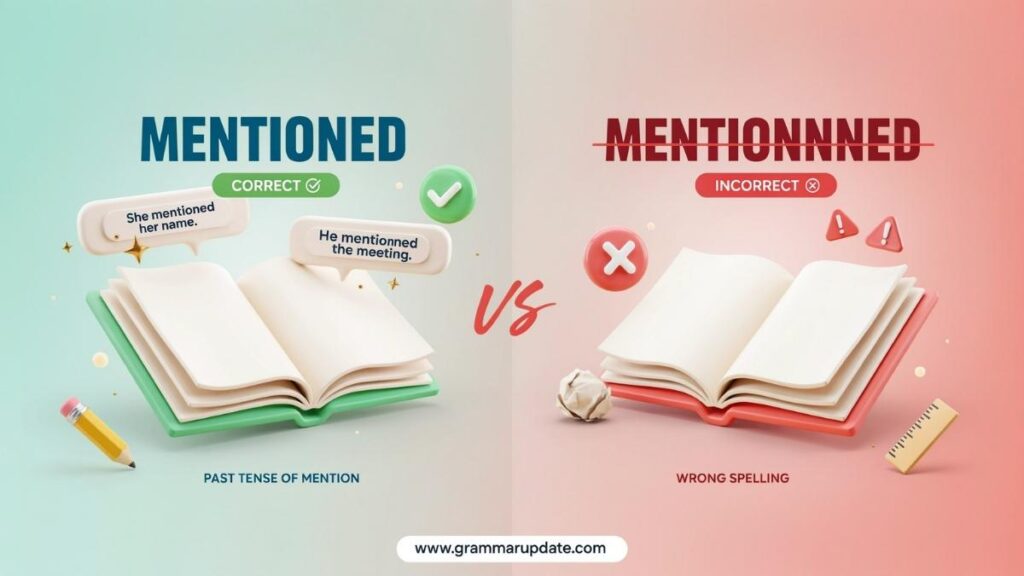
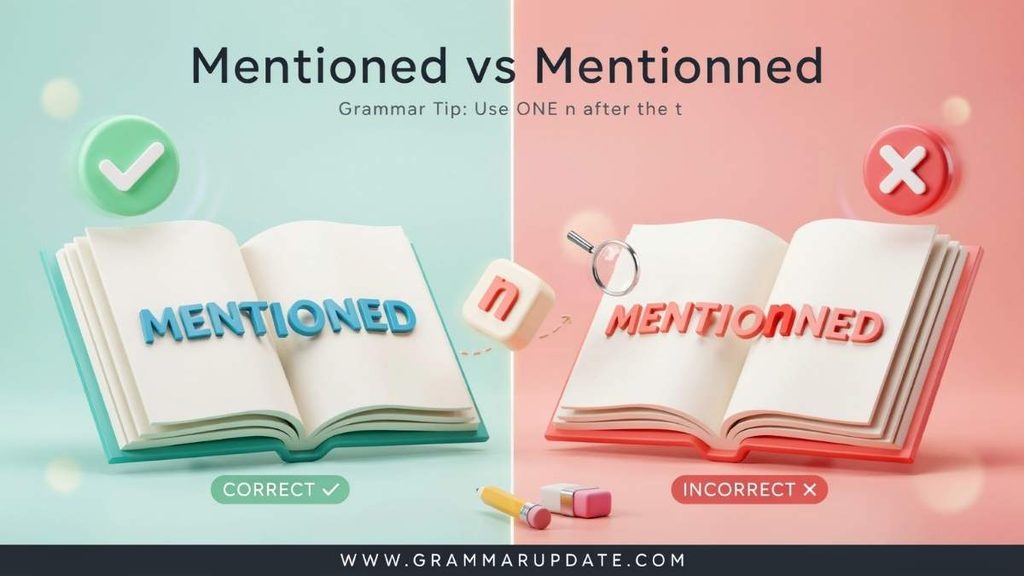
The difference between Mentioned vs Mentionned is just one letter, but that tiny mistake can make your writing look less polished! The correct spelling is “mentioned,” while “mentionned” is incorrect in standard English. Luckily, there’s no complicated grammar rule to memorize. Once you understand when to use “mention” and “mentioned,” you can avoid common spelling and grammar mistakes in emails, essays, and everyday conversations. This guide breaks down the difference with simple explanations and practical examples, so you can stop second-guessing your spelling and get your words right every time.
Quick answer
| Feature | Mentioned | Mentionned |
|---|---|---|
| Correct English spelling | Yes | No |
| Meaning | Referred to someone or something | No standard English meaning as a form of mention |
| Grammar | Past tense and past participle | Incorrect verb form |
| Spelling pattern | Mention + ed | Adds an unnecessary n |
| Example | She mentioned the meeting. | She mentionned the meeting. |
| Suitable for formal writing | Yes | No |
Fix common more word mistakes in English
Bony vs Boney difference and usage ?
Mentioned vs Mentionned the difference?
Mentioned is the correct spelling in standard English. Mentionned is a misspelling.
Use mentioned when someone referred to a person, subject, event, or piece of information in the past. You can also use it with helping verbs such as has, have, and had to form perfect tenses.
For example:
- Correct: She mentioned your name during the meeting.
- Incorrect: She mentionned your name during the meeting.
- Correct: I have mentioned this issue before.
- Incorrect: I have mentionned this issue before.
The spelling rule is straightforward: add -ed to the base verb mention.
Mention + ed = mentioned
You don’t need to add another n. The base verb already has the correct spelling, so adding the extra letter creates an error.
Learn the difference between confusing word pairs
Endure vs Indure Which Spelling Is Correct?
What Does Mentioned Mean?
Mentioned means referred to someone or something, spoke about it, or brought it to someone’s attention. People use the word when they want to show that information came up in a conversation, message, document, or other form of communication.
For example, if your teacher mentioned an upcoming exam, the teacher referred to the exam during a conversation or lesson. The teacher may have explained the date or simply brought it up briefly.
The word doesn’t tell you how much detail the speaker provided. Context helps you understand that part.
Mentioned Definition and Meaning in English
Mentioned is the past tense and past participle of mention, a regular verb.
Here are a few examples that show its meaning:
- My friend mentioned a new restaurant. The friend referred to the restaurant during a conversation.
- The report mentioned several problems. The report referred to those problems.
- She mentioned your suggestion to the manager. She shared your suggestion with the manager.
- The article mentioned two important dates. The article included references to those dates.
- He mentioned that he might arrive late. He shared information about a possible delay.
In each example, mentioned indicates that someone referred to information. The word doesn’t necessarily mean that the person explained the subject in detail.
How to Use Mentioned in a Sentence
You can use mentioned in several sentence structures, depending on what you want to express.
When referring to a person or thing, use it with a direct object.
- She mentioned the deadline.
- The teacher mentioned the assignment.
- They mentioned the new policy.
You can also use mentioned before a clause that explains the information.
- He mentioned that the store closes early.
- She mentioned that the meeting had changed.
- The manager mentioned that the team needed more time.
In passive sentences, mentioned can appear with a form of be.
- Your name was mentioned during the interview.
- Several concerns were mentioned in the report.
- The new policy has been mentioned in earlier discussions.
These examples show that mentioned works in everyday conversations as well as formal writing.
What Does You Were Mentioned Mean?
The phrase you were mentioned means that someone referred to you in a conversation, email, meeting, report, social media post, or another form of communication.
The exact meaning depends on the situation.
For example, if a colleague says, “You were mentioned during the meeting,” someone referred to you while discussing a topic. If a friend says, “You were mentioned in a post,” someone referred to you in that online post.
Being mentioned doesn’t automatically mean that someone praised or criticized you. The phrase only tells you that someone referred to you. You need additional context to understand what they said and why.
Similarly, the expression mentioned by name means that someone specifically used your name rather than referring to you indirectly.
Learn the difference between confusing word pairs
CatchUp vs Catch up Differences and Usage ?
Why Is Mentioned Correct and Mentionned Incorrect?
The difference comes from the spelling of the base verb. English forms the past tense of the regular verb mention by adding the suffix -ed.
The correct form is mentioned, not mentionned.
To understand why, look at the word’s structure:
- Base verb: mention
- Past tense: mentioned
- Past participle: mentioned
- Present participle: mentioning
The base verb doesn’t require a spelling change before you add -ed. You simply keep mention intact and attach the ending.
Why Does Mentioned Have Only One N?
Mention has one n at the end of its written base form. When you add -ed, you preserve the original spelling.
Mention + ed = mentioned
The consonant-doubling rule doesn’t apply to this word. English doubles the final consonant in certain words, but it doesn’t double every consonant before adding a suffix.
Compare these examples:
| Base verb | Correct past tense | Spelling rule |
|---|---|---|
| Mention | Mentioned | Add -ed |
| Open | Opened | Add -ed |
| Listen | Listened | Add -ed |
| Plan | Planned | Double the final n |
| Stop | Stopped | Double the final p |
| Admit | Admitted | Double the final t |
The examples illustrate why you shouldn’t apply one spelling pattern to every verb.
For instance, plan becomes planned because it follows the consonant-doubling pattern. However, mention already ends in the written sequence -ion, so you simply add -ed.
Why Do People Confuse Mentioned vs Mentionned?
Several factors can lead to this spelling mistake.
First, writers sometimes apply the consonant-doubling rule too broadly. Words such as planned, stopped, and admitted may encourage them to double a consonant in other verbs, even when the rule doesn’t apply.
Second, typing quickly can introduce an extra letter. Since mentionned looks similar to mentioned, you might overlook the error while proofreading.
Third, people who know other languages may encounter related words with different spelling conventions. French, for example, uses mentionner as a verb and mentionné as its past participle. These forms follow French rules rather than English ones.
Finally, repeated exposure to an incorrect spelling can make it look familiar. However, familiarity doesn’t make a spelling correct.
The easiest way to prevent this error is to check the base verb before adding a suffix.
Learn the difference between basic English word mistakes
Minuscule vs Miniscule which one is correct ?
Mentioned Grammar Rules and Verb Forms
Mention is a regular English verb. It follows the usual pattern for forming its simple past tense and past participle by adding -ed.
Understanding its different forms helps you choose the right word for each sentence.
Mention Verb Forms
| Verb form | Example | Use |
|---|---|---|
| Mention | Please mention the deadline. | Base form |
| Mentions | She mentions the deadline often. | Simple present with a singular third-person subject |
| Mentioned | She mentioned the deadline yesterday. | Simple past |
| Mentioned | She has mentioned the deadline. | Past participle |
| Mentioning | She is mentioning the deadline now. | Present participle |
Each form serves a different grammatical purpose.
Use mention after modal verbs such as can, will, and should. For example, “I will mention your suggestion tomorrow.”
Use mentions with a third-person singular subject in the simple present. For example, “He mentions the issue every week.”
Use mentioned for completed past actions. For example, “They mentioned the issue yesterday.”
You can also use mentioned after have, has, or had. For example, “She has mentioned the issue before.”
Finally, use mentioning in continuous tenses and other structures that require the -ing form. For example, “He is mentioning the issue now.”
Mention vs Mentioned What’s the Difference?
Mention is the base verb, while mentioned is its past tense and past participle.
Consider these examples:
| Mention | Mentioned |
|---|---|
| Please mention the deadline. | She mentioned the deadline yesterday. |
| I will mention your suggestion. | I have mentioned your suggestion already. |
| They mention the issue regularly. | The issue was mentioned in the report. |
The surrounding words often tell you which form to use. After a modal verb such as will, use mention. When describing a completed past action, use mentioned.
Mentioned vs Mentioning
The Mentioned and mentioning share the same base verb, but their grammatical roles differ.
Mentioned usually describes a completed action or serves as a past participle.
Example: The supervisor mentioned the new policy yesterday.
Mentioning often describes an action in progress or appears after certain verbs and prepositions.
Example: The supervisor is mentioning the new policy now.
You can also say, “Thank you for mentioning the issue.” Here, mentioning follows the preposition for.
Choose the form that matches the sentence structure. Don’t replace mentioned with mentioning simply because both words come from the same verb.
Learn the difference between basic English word mistakes
Accommodate vs Accomodate Which one Is Correct?
Mentioned vs Mentionned Examples in Everyday Writing
Examples can help you recognize the correct spelling in different contexts. Whether you’re writing an email, preparing a report, or having a conversation, the spelling remains the same.
Correct Sentences With Mentioned
Everyday conversation:
- My sister mentioned a new restaurant near her office.
- He mentioned that the weather might change.
- You mentioned a book I wanted to read.
Workplace communication:
- The manager mentioned the updated schedule during the meeting.
- We mentioned the budget concerns in our discussion.
- The team has already mentioned this issue to the project leader.
Professional emails:
- As mentioned in my previous email, the deadline is Friday.
- I mentioned the missing attachment in my earlier message.
- The points mentioned below require your attention.
Academic writing:
- The author mentioned several limitations in the study.
- The previously mentioned theory provides a useful framework.
- The report mentioned two factors that influenced the results.
News and social media:
- The article mentioned a change in local regulations.
- She mentioned me in her latest post.
- The creator mentioned the original source in the caption.
These examples demonstrate that the spelling doesn’t change with the setting. The same word works in casual speech, formal writing, and online communication.
Incorrect Sentences With Mentionned
Here are common spelling errors and their corrections.
| Incorrect sentence | Correct sentence |
|---|---|
| She mentionned the meeting. | She mentioned the meeting. |
| He has mentionned your name. | He has mentioned your name. |
| As mentionned above, the rule applies. | As mentioned above, the rule applies. |
| The issue was mentionned in the report. | The issue was mentioned in the report. |
| They mentionned the problem yesterday. | They mentioned the problem yesterday. |
In every example, the correction requires only one change: remove the extra n.
The sentence structure doesn’t need to change because mentioned already provides the correct verb form.
A Practical Editing Example
Imagine that you’re editing a company newsletter and find this sentence:
The director mentionned the new safety policy during Monday’s meeting.
The meaning is clear, but the spelling error makes the sentence look unpolished.
The corrected version reads:
The director mentioned the new safety policy during Monday’s meeting.
This small correction improves the writing without changing its meaning. It also shows why proofreading matters. A sentence can communicate the right idea and still contain an error that deserves attention.
Learn the difference between basic English word mistakes
Patient vs Patience which one is correct ?
How to Use Mentioned in Emails, Reports, and Documents
The word mentioned often helps writers refer to information without repeating every detail. However, certain expressions have specific meanings, so choosing the right phrase can make your writing clearer.
Mentioned in an Email
In professional communication, mentioned often refers to information shared in an earlier message or included in the current email.
For example:
- As mentioned in my previous email, the meeting begins at 10 a.m.
- I’ve mentioned the revised deadline below.
- The documents mentioned in your message are attached.
- As mentioned earlier, please submit the report by Friday.
These phrases help readers connect the current message with information they’ve already received.
The expression as mentioned in my previous email means that the sender has already referred to the information in an earlier email.
For example, “As mentioned in my previous email, the final report is due on October 15” reminds the recipient of the earlier message.
Although this phrase is grammatically correct, it can sound abrupt if you use it to express frustration. For a softer tone, try “To recap my earlier email, the final report is due on October 15.”
You could also write, “As noted in my earlier message, the final report is due on October 15.”
The best choice depends on your relationship with the reader and the tone you want to convey.
As Mentioned Above vs As Mentioned Earlier
These expressions are similar, but they don’t always refer to the same thing.
As mentioned above points to information that appears earlier in the same document, message, or piece of writing.
Example: As mentioned above, the application requires two references.
As mentioned earlier refers to something stated or discussed previously. It can refer to an earlier paragraph, an earlier section, or a previous conversation.
Example: As mentioned earlier, the team will review the proposal on Friday.
| Phrase | Meaning | Best use |
|---|---|---|
| As mentioned above | The information appears earlier in the text. | Articles, reports, and documents |
| As mentioned earlier | The information appeared or was discussed before. | Conversations, emails, and presentations |
| As mentioned below | The information appears later in the text. | Instructions and reports |
| As previously mentioned | The information has already been introduced. | Formal or professional writing |
Choose the phrase that matches the location of the information. If you’re referring to an earlier paragraph, as mentioned above may work well. If you’re referring to something discussed in a previous meeting, as mentioned earlier is more natural.
Mentioned in a Report, Document, or Contract
In formal writing, mentioned can refer to information that appears in a written record.
For example:
- The revised policy was mentioned in the report.
- The payment deadline is mentioned in the contract.
- The author mentioned three possible explanations in the article.
- The name mentioned in the document belongs to the project coordinator.
However, being mentioned in a document doesn’t necessarily mean that something is formally established or legally required.
A contract might mention a deadline in an explanatory section. Whether that deadline creates a binding obligation depends on the contract’s wording and applicable law, not on the word mentioned alone.
Similarly, a research paper might mention a theory without supporting it in detail. The verb tells you that the author referred to the theory, not necessarily that the author proved it.
Mentioned by Name
The expression mentioned by name means that someone specifically identified a person or entity by using their name.
Examples:
- The speaker mentioned the researcher by name.
- Two employees were mentioned by name in the report.
- The article mentioned the company by name.
The phrase is more specific than simply saying someone was mentioned. A person can be discussed indirectly without anyone using their name.
For example, “The manager discussed the new employee” doesn’t tell you whether the manager used the employee’s name. However, “The manager mentioned the new employee by name” makes that detail explicit.
Learn the difference between confusing word pairs
Drier vs Dryer Which one Is Correct?
Is Mentionned Ever Correct in English?
In ordinary English writing, mentionned isn’t the correct spelling of the past tense or past participle of mention.
You should use mentioned in American, British, Canadian, and Australian English.
However, context matters when you encounter an unfamiliar sequence of letters. A misspelled English word might appear in a quotation, username, brand name, or passage written in another language. That doesn’t make mentionned an accepted English verb form.
Is Mentionned a British English Spelling?
No. Mentionned isn’t a recognized British English alternative to mentioned.
The same rule applies to other major varieties of English.
| English variety | Correct spelling | Incorrect form |
|---|---|---|
| American English | Mentioned | Mentionned |
| British English | Mentioned | Mentionned |
| Canadian English | Mentioned | Mentionned |
| Australian English | Mentioned | Mentionned |
Regional spelling differences do exist. For example, American English generally uses color, while British English usually uses colour. However, these regional conventions don’t change the spelling of mentioned.
You don’t need to memorize different forms for different countries. The correct spelling remains mentioned wherever you write standard English.
What About French and Other Languages?
The extra n may look familiar to readers who know French.
French uses the verb mentionner and its past participle mentionné. These forms follow French spelling conventions, including the accent in mentionné.
English, however, uses mention and mentioned. The languages share related vocabulary, but their verb forms don’t follow identical spelling patterns.
If you’re writing in English, use mentioned. If you’re writing a French sentence, follow French grammar and spelling instead.
This distinction can help multilingual writers avoid carrying spelling patterns from one language into another.
Learn the difference between confusing word pairs
Coozie vs Koozie Which one Is Correct and usage ?
How to Remember the Correct Spelling of Mentioned
You don’t need a complicated memory trick to remember this word. Start with the base verb and add the correct ending.
Start With the Base Word
Remember the simple pattern:
Mention + ed = mentioned
Say or write the base word first. Then add -ed without changing the spelling.
This approach also helps with other regular verbs, such as opened and listened.
Check for the Extra N
When proofreading, look for mentionned and compare it with the base verb mention.
If you find the extra n, remove it.
You can also use a spell-checker to flag the mistake. However, don’t rely on automated tools alone. Read the complete sentence to make sure the word fits the context.
Learn the Rule Instead of Memorizing the Error
Understanding the difference between mentioned and planned is more useful than simply memorizing two separate words.
Mention becomes mentioned without consonant doubling. Plan becomes planned with a doubled n because it follows a different spelling pattern.
Once you recognize that English uses different patterns for different verbs, you’ll be less likely to add unnecessary letters.
Learn the difference between confusing word pairs
Foodie vs Foody Which One Is Correct?
How to Pronounce Mentioned
The standard American English pronunciation of mentioned is /ˈmɛnʃənd/.
The word has two syllables, with the main stress on the first syllable. Its middle consonant sound is /ʃ/, the same sound you hear in ship and wish.
Here are the key points:
- The first syllable carries the main stress.
- The middle sound is “sh.”
- The final -ed doesn’t create a separate syllable.
- The extra n in mentionned doesn’t create a different standard English pronunciation.
Learning the pronunciation can help you recognize the word when speaking or listening. However, pronunciation alone won’t always reveal a spelling mistake, so it’s still useful to remember the correct written form.
Synonyms for Mentioned
If you want to avoid repeating mentioned, you can choose a synonym that fits the context.
| Synonym | Meaning or use | Example |
|---|---|---|
| Referred to | Directed attention to a subject or person | She referred to the new policy. |
| Noted | Pointed out or recorded information | The report noted a change in demand. |
| Stated | Expressed something clearly | He stated that the deadline had changed. |
| Cited | Referred to a source, fact, or example | The researcher cited three studies. |
| Brought up | Introduced a subject for discussion | She brought up the budget issue. |
| Discussed | Talked or wrote about something in detail | They discussed the proposal. |
| Observed | Made a comment or expressed an observation | The reviewer observed that the argument lacked evidence. |
| Acknowledged | Recognized or admitted something | The manager acknowledged the delay. |
These words aren’t interchangeable in every situation.
For example, mentioned can describe a brief reference to a subject, while discussed often suggests a more detailed exchange. Similarly, cited frequently appears in academic writing when a writer refers to evidence or a source.
Consider these sentences:
- The author mentioned the study. The author referred to it.
- The author cited the study. The author used it as a reference or source.
- The author discussed the study. The author examined or explained it.
Learn the difference between basic English word mistakes
Habit vs Habbit Which Spelling Is Correct ?
practice session Mentioned vs Mentionned
Complete each sentence with the correct word or phrase. Choose between “Mentioned vs Mentionned .
1. She ______ the new project during yesterday’s meeting.
2. Have you ______ the deadline to your manager?
3. I forgot to ______ the most important detail in my email.
4. He ______ my name in his presentation last week.
5. As ______ above, the deadline is Friday.
6. The teacher ______ the spelling mistake in my essay.
7. Did you ______ the meeting time to everyone?
8. I have already ______ this issue several times.
9. She is ______ the changes required for the report.
10. The report ______ three important challenges.
11. We should ______ this point before making a final decision.
12. He did ______ the problem during our conversation.
13. The previously ______ information is available in the first section.
14. I wanted to have ______ the additional requirements in my message.
15. She has ______ that she will attend the event.
16. The manager ______ the new policy yesterday.
17. As I ______ earlier, you need to submit the form today.
18. Please let me know if I forgot to ______ anything important.
19. The author has ______ several useful examples in the article.
20. He was ______ the benefits of the new system when the meeting ended.
21. Which spelling is correct: “mentionned” or “mentioned”? The correct word is ______.
22. I did ______ the issue, but nobody responded.
23. The points ______ below explain the process in detail.
24. She ______ the name of the book in her review.
25. We have already ______ the main differences between the two words.
Answers
- mentioned
- mentioned
- mention
- mentioned
- mentioned
- mentioned
- mention
- mentioned
- mentioning
- mentioned
- mention
- mention
- mentioned
- mentioned
- mentioned
- mentioned
- mentioned
- mention
- mentioned
- mentioning
- mentioned
- mention
- mentioned
- mentioned
- mentioned
Here’s a trusted source for clear word meanings:
FAQs
Which is correct mention vs mentioned?
Both “mention” and “mentioned” are correct, but they serve different purposes. “Mention” is the base form of the verb, while “mentioned” is its past tense and past participle. For example, “I will mention the details” and “I mentioned the details yesterday.”
Is it abovementioned or above mentioned?
“Abovementioned” is generally written as one word when used as an adjective meaning previously mentioned. For example, “Please review the abovementioned conditions.” However, “mentioned above” often sounds more natural in everyday writing.
Is “as mentioned” grammatically correct?
Yes, “as mentioned” is grammatically correct. It refers to information already discussed or written. For example, “As mentioned earlier, the deadline is Friday.”
Which is correct: “I did mention” or “I did mentioned”?
“I did mention” is correct because the auxiliary verb “did” must be followed by the base form of the main verb. For example, “I did mention the deadline during our conversation.” “I did mentioned” is grammatically incorrect.
What is the past tense of mention?
The past tense of “mention” is “mentioned.” For example, “She mentioned your suggestion during the meeting.” “Mentioned” also serves as the past participle, as in “I have mentioned this issue before.”
What is a better word for mention?
The best alternative depends on the context. You can use “refer to” when discussing a subject, “state” when expressing information, “note” when drawing attention to a point, or “cite” when referring to a source.
What is another way to say “as mentioned above”?
Alternatives include “as stated earlier,” “as discussed previously,” “as noted above,” and “as explained earlier.” In professional writing, “as discussed earlier” often sounds clear and natural.
Is it “below mentioned” or “mentioned below”?
“Mentioned below” is the more natural expression. For example, “Please review the documents mentioned below.” If you are introducing a list, “listed below” or “the following” may be even clearer.
What does abovementioned mean?
“Abovementioned” means something that has already been referred to in a document or conversation. For example, “The abovementioned rules apply to all employees.” In simple writing, “mentioned earlier” is often easier to understand.
Is “you’ve mentioned” or “you mentioned” correct?
Both are correct. “You mentioned” describes a past statement, while “you’ve mentioned” connects a past statement to the present or emphasizes its relevance now. For example, “You mentioned the report yesterday” and “You’ve mentioned this concern several times.”
What can I say instead of “as mentioned”?
You can use “as discussed,” “as noted,” “as explained,” or “as stated earlier.” Choose the phrase that best fits your meaning. For example, “As discussed, we will begin the project next week.”
Is “as I said earlier” grammatically correct?
Yes, “as I said earlier” is grammatically correct. It refers to something you previously stated. In formal emails or reports, “as discussed earlier” or “as noted previously” may sound more professional.
When should I use mention and mentioned?
Use “mention” after modal verbs such as “will,” “can,” and “should,” and after “to.” Use “mentioned” for the simple past tense and with auxiliary verbs such as “have,” “has,” and “had.” For example, “I should mention this” and “I have mentioned this before.”
Is “I forgot to mention” correct?
Yes, “I forgot to mention” is grammatically correct. It means you failed to include or bring up something earlier. For example, “I forgot to mention that the meeting starts at 10 a.m.”
What are the verb forms of mention?
The main forms of “mention” are mention, mentions, mentioned, and mentioning. For example, “I mention,” “she mentions,” “they mentioned,” and “he is mentioning.” The past tense and past participle are both “mentioned.”
What can I use instead of mentioned?
Depending on the context, you can use “stated,” “noted,” “reported,” “explained,” “identified,” or “referred to.” For example, “The author mentioned the results” could become “The author reported the results.”
What does “I mentioned” mean?
“I mentioned” means that you referred to, brought up, or spoke about something in the past. For example, “I mentioned your idea to the team” means you told the team about your idea.
What is another way to say mentioning?
Alternatives to “mentioning” include “referring to,” “discussing,” “noting,” “bringing up,” and “pointing out.” Use the word that best describes whether you briefly refer to something or discuss it in detail.
What is a stronger word for mention?
“Emphasize,” “highlight,” “stress,” and “underscore” are stronger alternatives when you want to draw attention to an important point. For example, “The report highlights the risks” gives the idea more emphasis than “The report mentions the risks.”
What is another word for stated or mentioned?
Common alternatives include “declared,” “noted,” “reported,” “expressed,” “indicated,” and “specified.” Use “stated” for a clear assertion, “reported” for information shared with others, and “specified” for precise details.
How do you use mentioned in a sentence?
Use “mentioned” to describe something brought up in the past or to form a perfect tense. For example, “She mentioned the new schedule yesterday” and “I have mentioned this issue before.” In formal writing, “the details mentioned above” is generally more natural than “the mentioned details.”
How can I professionally say “as I mentioned before”?
You can say “as discussed earlier,” “as noted in my previous email,” or “as previously stated.” For example, “As noted in my previous email, please submit the revised document by Monday.”
What is another way to say “previously mentioned”?
You can use “mentioned earlier,” “previously discussed,” “noted above,” or “referenced earlier.” For example, “Please follow the procedure mentioned earlier.”
What is another word for mention in an essay?
In an essay, alternatives include “discuss,” “address,” “examine,” “highlight,” “note,” and “refer to.” Use “examine” or “analyze” when exploring a topic in depth rather than simply referring to it.
What does “under mentioned” mean?
“Under mentioned” is not the standard expression for referring to information that follows. Use “mentioned below,” “listed below,” or “the following” instead. For example, “Please review the following points.”
Which is correct: “I have mentioned” or “I had mentioned”?
Both are correct, but they describe different time relationships. “I have mentioned” connects a past action to the present, while “I had mentioned” describes an action that happened before another past event. For example, “I have mentioned the issue already” and “I had mentioned the issue before the meeting began.”
What does “it is mentioned” mean?
“It is mentioned” means that something is referred to in a document, report, or conversation. For example, “It is mentioned in the report that sales increased.” This construction uses the passive voice.
What is a formal synonym for mentioned?
Formal alternatives include “stated,” “noted,” “indicated,” “referenced,” and “documented.” For example, “The report noted a significant increase in sales.” Choose a synonym that preserves the original meaning.
What should I say instead of “don’t mention it”?
“Don’t mention it” is a polite response to thanks. Alternatives include “You’re welcome,” “No problem,” “My pleasure,” and “Happy to help.” “My pleasure” works particularly well in formal or service-oriented situations.
What is another term for “as I have mentioned”?
You can say “as previously noted,” “as discussed earlier,” or “as I stated above.” For example, “As previously noted, all applicants must provide identification.”
Is “What if I told you” grammatically correct?
Yes, “What if I told you” is grammatically correct. It introduces a hypothetical situation or information the listener may not know. For example, “What if I told you that the deadline had changed?”
Which is correct: “as me” or “as I”?
The correct choice depends on the sentence structure. Use “I” when the pronoun acts as the subject, as in “As I mentioned earlier, the plan has changed.” Use “me” when it acts as an object, as in “She has the same opinion as me.”
What should I say instead of “as I said”?
You can use “as I explained earlier,” “as noted previously,” “as discussed,” or “as I mentioned before.” In professional writing, “as discussed earlier” often sounds neutral and collaborative.
Why do we say “mention not”?
“Mention not” is an old-fashioned or literary expression meaning “do not mention it.” However, “not to mention” is a different, common expression used to add another point. For example, “The trip was expensive, not to mention exhausting.” In everyday conversation, “don’t mention it” is the usual response to thanks.
Is “I forgot to tell you” grammatically correct?
Yes, “I forgot to tell you” is grammatically correct. It means you intended to share information but did not do so earlier. For example, “I forgot to tell you that the office will be closed tomorrow.”
Is “I forget” grammatically correct?
Yes, “I forget” is grammatically correct when describing a habit or a recurring difficulty remembering something. For example, “I often forget people’s names.” For a single event in the past, use “I forgot.”
Is “I forgot to mention” or “I mentioned” correct?
Both are correct, but they have different meanings. “I forgot to mention” means you failed to share something, while “I mentioned” means you did share or refer to it. For example, “I forgot to mention the meeting time” means you left out that detail. “I mentioned the meeting time” means you told someone about it.
Learn the difference between basic English word mistakes
Occurring vs Occuring Which one Is Correct?
Conclusion
Still confused about “mentioned vs mentionned”? Here’s the good news: there’s no tricky spelling battle to worry about. “Mentioned” is the only correct spelling in standard English. “Mentionned” has one extra “n” that simply doesn’t belong there!
Remember, use “mention” when talking about something you will say or want to say, and use “mentioned” when referring to something you already said. For example, write “I will mention it tomorrow,” “I mentioned it yesterday,” and “I have mentioned it before.” Also, remember that “did” takes the base form, so “I did mention” is correct, not “I did mentioned.”
Once you understand these simple rules, choosing the right word becomes easy. No more second-guessing, no more extra letters, and no more grammar confusion. Keep practicing, and you’ll know exactly when to use “mention” and “mentioned.”

Jhon AJS, the creative mind behind Grammar Update, is an experienced blogger passionate about simplifying English grammar. He focuses on explaining confusing word vs word differences, grammar rules, punctuation, and sentence structure in a clear and practical way. Through easy to understand guides and examples, Jhon helps readers improve their writing and communicate with confidence. With years of blogging experience, he continues to share helpful insights that make learning grammar simple, useful, and accessible for everyone.