Have you ever typed stoping instead of stopping and wondered if your keyboard was playing tricks on you? You are not alone. The confusion between stopping vs stoping catches many writers because the words look almost identical. Here’s the surprise: one is the correct everyday spelling, while the other is a real technical term used in mining and geology. That tiny missing letter completely changes the meaning. In this guide, you’ll learn the difference, understand the grammar rule behind stopping, discover when stoping is actually correct, and see plenty of simple examples that make this spelling puzzle easy to remember for good.
Stopping vs Stoping The Quick Answer
If you’re wondering, “Is stopping vs stoping correct?” the answer depends on what you’re writing.
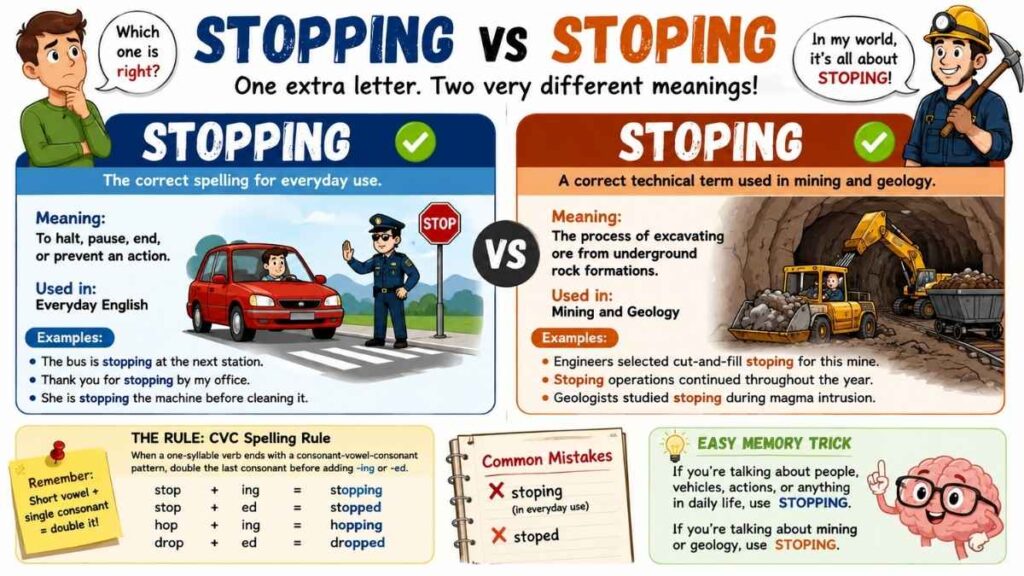
For everyday English, stopping is the correct spelling. It is the present participle and gerund of the verb stop. You use it whenever someone or something comes to a halt.
Stoping is also a real English word, but it belongs almost exclusively to the mining industry. It describes the process of excavating ore from underground rock formations.
Here’s the simplest way to remember it:
| Word | Correct? | Meaning | Where It’s Used |
|---|---|---|---|
| Stopping | Yes | Halting, pausing, or ending an action | Everyday English |
| Stoping | Yes | Excavating ore underground | Mining and geology |
If your topic has nothing to do with mining engineering or ore extraction, you almost certainly need stopping.
Learn the difference between confusing more English words
Straight vs Strait Difference and Which Is Correct and Usage?
Stopping vs Stoping at a Glance
Understanding the stoping vs stopping difference becomes much easier when you compare them side by side.
| Feature | Stopping | Stoping |
|---|---|---|
| Correct everyday spelling | Yes | No |
| Dictionary word | Yes | Yes |
| Part of speech | Present participle or gerund | Technical noun or verb |
| Used in conversation | Frequently | Rarely |
| Used in mining | No | Yes |
| Used in education and business writing | Yes | Almost never |
Although both words appear in dictionaries, they belong to completely different contexts.
Learn the difference between confusing more English words
Focuses vs Focusses Which Spelling Is Correct?
What Does Stopping Mean?
The stopping definition is simple. Stopping is the present participle and gerund form of the verb stop. It describes the action of coming to a halt or causing something to cease.
In everyday English, stopping meaning includes several common situations:
- Ending movement
- Pausing an activity
- Preventing an action
- Bringing something to an end
- Interrupting a process
For example:
- The driver is stopping at the next traffic light.
- Thank you for stopping by my office.
- She is stopping the machine before cleaning it.
- Heavy rain is stopping the game.
- They’re stopping work early because of the weather.
Each sentence shows the stopping correct spelling because the speaker is talking about halting or ending an action.
Stopping appears in almost every type of writing, including:
- News articles
- Academic papers
- Business communication
- Emails
- Books
- Websites
- Social media
- Everyday conversations
Because it is so common, many spelling mistakes happen when people accidentally write stoping instead.
Learn the difference between confusing more English words
Anual vs Annual Which Spelling Is Correct?
What Does Stoping Mean?
Many people ask, “Is stoping a word?”
Yes. Stoping is a real English word. However, it has a specialized meaning that most people never encounter outside the mining industry.
The stoping definition refers to the process of extracting valuable ore from underground deposits. Workers remove sections of rock to create large underground openings known as stopes.
In simple terms:
Stoping means excavating underground rock to recover minerals or ore.
The word comes from the noun stope, which describes the underground space created after ore has been removed.
What Is a Stope?
A stope is an underground chamber formed during mining operations.
Instead of saying miners are digging random tunnels, mining engineers describe the ore extraction area as a stope.
That means:
- A stope is the underground opening.
- Stoping is the process used to create that opening.
This distinction is an important part of mining terminology.
Stoping in Mining
Stoping in mining plays a major role in underground mineral extraction. Different mining methods use different types of stoping depending on the surrounding rock, ore body, and safety requirements.
Some of the most common underground stoping methods include:
- Cut-and-fill stoping
- Open stoping
- Shrinkage stoping
- Sublevel stoping
- Vertical crater retreat stoping
Each technique removes ore while maintaining the stability of the surrounding rock.
For example:
“The engineers selected cut-and-fill stoping because the ore body was steep and irregular.”
This is a correct stoping example because it refers to a recognized mining process.
Stoping in Geology
Although stoping is primarily a mining term, geologists also use it in a different context.
Stoping geology refers to a process where rising magma breaks off pieces of surrounding rock during its movement through Earth’s crust. Those rock fragments may sink into the molten material while the magma continues upward.
This geological process helps explain how magma chambers expand over time.
For example:
“Geologists believe stoping played an important role in the formation of the granite intrusion.”
Here, stoping geology describes a natural geological process rather than mining activity.
Learn the difference between commonly mixed-up more words
Presentor vs Presenter Which Spelling Is Correct?
Stopping vs Stoping What’s the Difference?
The difference between stopping vs stoping becomes obvious once you understand their meanings.
Stopping belongs to everyday English grammar.
Stoping belongs to mining engineering and geology.
Here’s a simple comparison.
| Category | Stopping | Stoping |
|---|---|---|
| Everyday English | Yes | No |
| Grammar word | Yes | No |
| Mining vocabulary | No | Yes |
| Geological terminology | No | Yes |
| Means halting | Yes | No |
| Means ore extraction | No | Yes |
A useful memory trick is this:
If you’re talking about someone who stops walking, driving, talking, or working, use stopping.
If you’re talking about underground ore extraction or geological rock movement, use stoping.
Why Is Stopping Spelled With Two Ps?
One of the most common grammar questions is, “Why is stopping spelled with two p’s?”
The answer comes from one of the most important English spelling rules.
The verb stop follows the CVC spelling rule.
CVC stands for:
- Consonant
- Vowel
- Consonant
The word stop has exactly this pattern.
- S = consonant
- T = consonant
- O = short vowel
- P = consonant
Because stop ends with a single consonant after a short vowel sound, English spelling rules require you to double the final consonant before adding certain suffixes.
This is known as the double consonant rule or doubling consonants spelling.
Adding -ing to Stop
When adding ing to stop:
Stop + ing does not become stoping.
Instead, the final p doubles.
Stop + ing = stopping
The same rule applies to many common English words.
| Base Word | Correct Form |
|---|---|
| Stop | Stopping |
| Hop | Hopping |
| Run | Running |
| Sit | Sitting |
| Drop | Dropping |
| Swim | Swimming |
Every one of these words follows the same English spelling conventions.
Adding -ed to Stop
The same spelling rule applies when adding the suffix -ed.
Correct:
- Stopped
Incorrect:
- Stoped
This explains the stoped or stopped difference.
Because stop follows the consonant vowel consonant rule, the final consonant doubles before adding ed.
| Incorrect | Correct |
|---|---|
| Stoped | Stopped |
| Stoping | Stopping |
Learn the difference between commonly mixed-up more words
Fourteen vs Forteen Which Spelling Is Correct?
Stoped vs Stopped Which Spelling Is Correct?
Another common spelling mistake appears when people write the past tense of stop. Many writers type stoped because it seems logical to add only -ed. However, English spelling rules require a different form.
Stopped is the correct spelling.
Stoped is incorrect in standard English because the verb stop follows the CVC spelling rule. Since stop ends with a short vowel followed by a single consonant, you must double the final p before adding the suffix -ed.
Here’s a quick comparison.
| Spelling | Correct? | Reason |
|---|---|---|
| Stopped | Yes | Follows the CVC spelling rule |
| Stoped | No | The final consonant should be doubled |
Examples:
Correct:
- She stopped talking when the teacher entered the room.
- The bus stopped at every station.
- We stopped for lunch after a long drive.
Incorrect:
- She stoped talking.
- The bus stoped suddenly.
If you remember that stopping uses two p’s, you’ll also remember that stopped does too.
Learn the difference between commonly mixed-up more words
Favs vs Faves Difference Which Is Correct?
Stopping in a Sentence
Seeing a word in context makes it much easier to remember. These stopping in a sentence examples show how the word works in everyday English.
Everyday Examples
- He is stopping at the grocery store before heading home.
- Thank you for stopping by this afternoon.
- They are stopping the project until they receive approval.
- The police officer is stopping traffic to let pedestrians cross.
- She kept stopping to answer phone calls.
Workplace Examples
- The manager is stopping production while the equipment is inspected.
- Our team is stopping work early because the software update is complete.
- The company is stopping unnecessary expenses this quarter.
School Examples
- The teacher kept stopping during the lesson to answer questions.
- Students practiced stopping at every punctuation mark while reading aloud.
- The coach emphasized stopping before changing direction.
Travel Examples
- The train is stopping at every major city.
- We enjoyed stopping at small towns during our road trip.
- The tour bus is stopping for photos at the viewpoint.
These examples all use stopping meaning halting, pausing, or bringing something to an end.
Fix common more word mistakes in English
Cognisant vs Cognizant difference which is correct ?
Stoping in a Sentence
Because stoping is a technical term, you’ll usually find it in engineering reports, mining manuals, and geology textbooks rather than everyday conversation.
Here are several stoping in a sentence examples.
Mining Examples
- Engineers selected open stoping because the ore body was stable.
- The company invested in modern stoping equipment to improve safety.
- Underground stoping increased ore recovery while reducing waste rock.
- The mining operation adopted cut-and-fill stoping for steep deposits.
- Stoping activities continued throughout the year.
Geological Examples
- Researchers studied stoping during the formation of the magma chamber.
- Geological evidence suggests stoping contributed to the expansion of the intrusion.
- Scientists examined rock fragments created through stoping.
These examples demonstrate stoping correct usage in technical writing.
Fix common more word mistakes in English
Payed vs Paid Difference and Which One is Correct?
Common Spelling Mistakes Related to Stop
The words stop, stopped, and stopping cause confusion because English spelling rules aren’t always obvious. Most mistakes happen when writers forget to double the final consonant.
Here are the errors seen most often.
| Incorrect | Correct |
|---|---|
| Stoping | Stopping |
| Stoped | Stopped |
| Stoppped | Stopped |
| Stopsing | Stopping |
| Stopinng | Stopping |
These mistakes usually happen for one of three reasons.
- The writer forgets the double consonant rule.
- The writer types too quickly.
- The writer assumes every verb simply adds -ing or -ed.
Fortunately, once you understand the spelling pattern, these errors become easy to avoid.
Fix common more word mistakes in English
Enquiries vs Inquiries Which Spelling Is Correct?
The CVC Spelling Rule Explained
Many people ask, “Why double p in stopping?” The answer lies in one of the most important English spelling rules.
The CVC pattern stands for:
- Consonant
- Vowel
- Consonant
The word stop fits this pattern.
| Letter | Type |
|---|---|
| S | Consonant |
| T | Consonant |
| O | Short vowel |
| P | Consonant |
When a one-syllable verb ends with a short vowel followed by one consonant, you double the final consonant before adding certain suffixes such as -ing or -ed.
Examples include:
| Base Verb | -ing Form | Past Tense |
|---|---|---|
| Stop | Stopping | Stopped |
| Hop | Hopping | Hopped |
| Drop | Dropping | Dropped |
| Sit | Sitting | Sat |
| Run | Running | Ran |
This rule protects the short vowel sound.
Compare these words:
- Hop → Hopping
- Stop → Stopping
- Drop → Dropping
Without the extra consonant, the pronunciation could change or look unfamiliar to readers. Doubling the final consonant keeps the spelling consistent with English pronunciation.
Fix common more word mistakes in English
Crain vs Crane difference Which one Is Correct?
Why People Misspell Stopping
Even experienced writers occasionally type stoping instead of stopping. That doesn’t happen because the rule is difficult. It happens because our brains often focus on meaning instead of spelling while we write.
Here are the most common reasons.
Forgetting the Rule
Many people remember the word but forget to apply the CVC spelling rule.
Typing Too Quickly
Fast typing often leads to dropped letters, especially repeated consonants.
Autocorrect Doesn’t Catch Everything
Most spelling tools identify obvious mistakes, but they don’t always recognize words that are technically correct in another context. Since stoping is a legitimate mining term, some programs may not flag it as an error.
Confusing Technical Vocabulary
Someone may come across stoping in a mining article and mistakenly assume it’s an alternative spelling of stopping. In reality, the two words have completely different meanings.
Learn the difference between often confused words
Visiter vs Visitor Difference Which One Is Correct?
British English vs American English
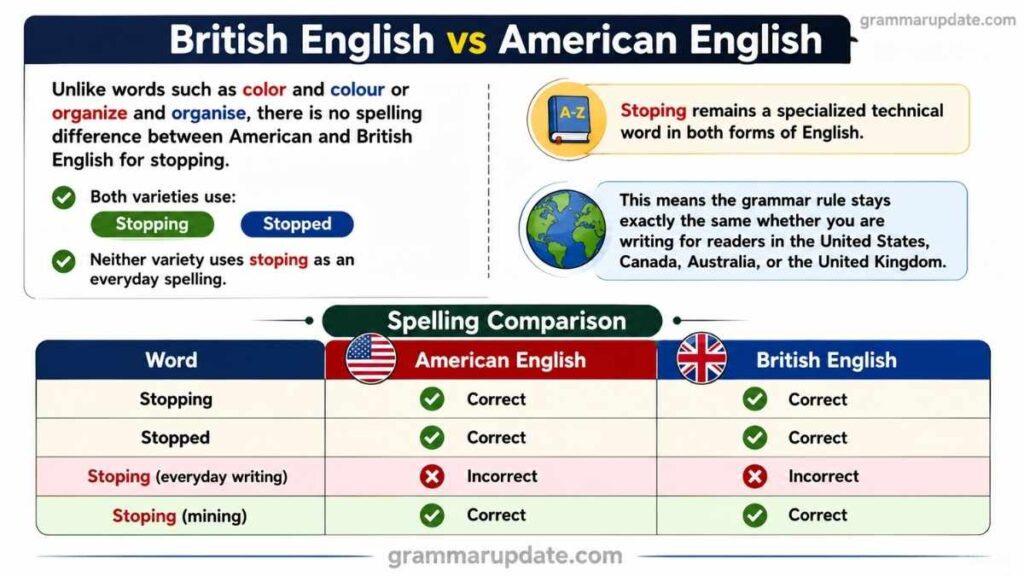
Unlike words such as color and colour or organize and organise, there is no spelling difference between American and British English for stopping.
Both varieties use:
- Stopping
- Stopped
Neither variety uses stoping as an everyday spelling.
Stoping remains a specialized technical word in both forms of English.
This means:
| Word | American English | British English |
|---|---|---|
| Stopping | Correct | Correct |
| Stopped | Correct | Correct |
| Stoping (everyday writing) | Incorrect | Incorrect |
| Stoping (mining) | Correct | Correct |
Whether you’re writing for readers in the United States, Canada, Australia, or the United Kingdom, the grammar rule stays exactly the same.
Learn the difference between often confused words
Trouper vs Trooper Which One Is Correct?
Synonyms of Stopping
Sometimes you may want to avoid repeating the word stopping. Choosing a synonym can make your writing smoother while keeping the meaning clear.
Depending on the context, you can use:
- Halting
- Pausing
- Ending
- Ceasing
- Interrupting
- Preventing
- Blocking
- Suspending
- Discontinuing
- Quitting
Each synonym has a slightly different shade of meaning.
For example:
- The company is halting production.
- The teacher is pausing the lesson.
- Heavy rain is preventing construction work.
- Police are blocking the road after the accident.
Choose the word that best matches the situation rather than replacing stopping automatically.
Learn the difference between commonly misused words
Stolen vs Stollen Difference and usage?
Synonyms Related to Stoping
Because stoping is a technical mining term, it doesn’t have many direct synonyms. Instead, writers often use related industry expressions.
These include:
- Ore extraction
- Underground excavation
- Mining excavation
- Stope mining
- Underground mining methods
Although these phrases describe similar processes, they don’t always replace stoping exactly. In technical documents, stoping remains the preferred term.
Real-World Case Study
Imagine two professionals reading the same sentence.
“The company is stoping operations this month.”
An office manager would probably assume the sentence contains a spelling mistake because stopping is expected in everyday business writing.
A mining engineer, however, might pause for a different reason. In mining, stoping refers to excavating ore, not shutting down operations. The sentence creates confusion because it mixes a technical mining term with a general business context.
Now compare it with these revised versions.
Correct business sentence:
“The company is stopping operations this month.”
Correct mining sentence:
“The company expanded stoping operations to reach a new ore zone.”
The difference comes from context, not pronunciation. Using the correct word makes your meaning immediately clear and prevents misunderstandings.
Learn the difference between commonly misused words
Useing vs Using Which Spelling Is Correct?
Practical Tips to Remember the Difference
If you often confuse stopping and stoping, these simple memory tricks can help.
- If you mean “to halt,” choose stopping.
- If you mean “to extract ore underground,” choose stoping.
- Remember that stop follows the CVC spelling rule, so the final p doubles before adding -ing or -ed.
- If your article has nothing to do with mining engineering or geology, stopping is almost certainly the correct choice.
- When proofreading, pay extra attention to words ending in -ing and -ed because they are common sources of spelling errors.
Practice Section Stopping vs Stoping
Test your understanding of stopping vs stoping by filling in the blanks with the correct word.
Fill in the Blanks
- The bus is __________ at every station along the route.
- Thank you for __________ by to say hello.
- The workers are using cut-and-fill __________ to extract ore safely.
- She __________ talking when the teacher entered the classroom.
- Engineers recommended open __________ for this underground mine.
- The police officer is __________ traffic during the parade.
- We __________ for lunch after driving for three hours.
- The company is __________ production until the new equipment arrives.
- Modern __________ methods improve both safety and productivity in mining.
- Why is __________ spelled with two p’s?
- The miners began __________ after completing the safety inspection.
- He kept __________ every few minutes to check the map.
- The geologist explained how __________ can occur as magma rises through Earth’s crust.
- The train __________ suddenly because of an obstacle on the tracks.
- Thank you for __________ to help the injured cyclist.
- Underground __________ creates large openings called stopes.
- She is __________ work early to attend a family event.
- The report discussed several __________ techniques used for ore extraction.
- They __________ the machine before repairing it.
- Our guide explained the difference between __________ and stoping.
- The construction crew is __________ work because of heavy rain.
- The mining company invested in safer __________ equipment.
- The driver avoided __________ in the middle of the highway.
- The professor explained that __________ is a specialized mining term.
- Before adding “-ing” to the verb “stop,” remember that the correct spelling is __________.
Answers
- stopping
- stopping
- stoping
- stopped
- stoping
- stopping
- stopped
- stopping
- stoping
- stopping
- stoping
- stopping
- stoping
- stopped
- stopping
- stoping
- stopping
- stoping
- stopped
- stopping
- stopping
- stoping
- stopping
- stoping
- stopping
Here’s a trusted source for clear word meanings:
FAQs
Is it spelled stopped or stoped?
The correct spelling is stopped. Because the verb stop follows the consonant-vowel-consonant (CVC) spelling rule, you double the final p before adding -ed. Stoped is a common misspelling.
How do you spell stoping?
The spelling stoping is correct only in mining and geology, where it refers to the process of excavating ore or certain geological processes. If you mean “to stop” or “to pause,” the correct spelling is stopping.
What is the definition of stoping?
Stoping is the process of extracting ore from an underground mine. In geology, it can also describe the process in which rising magma breaks away pieces of surrounding rock.
What does stoping mean?
Stoping means removing valuable ore from underground rock formations during mining operations. The term comes from the word stope, which is the underground opening created after the ore is extracted.
Does the word “stopping” exist?
Yes. Stopping is a standard English word. It is the present participle and gerund of the verb stop, meaning to pause, halt, prevent, or bring something to an end.
Why do you double the p in stopped?
You double the p because stop follows the CVC (consonant-vowel-consonant) spelling rule. When adding the suffix -ed to a one-syllable verb ending in a short vowel and a single consonant, the final consonant doubles.
Why do people misspell “stopped”?
Many people forget the double consonant rule or type too quickly. Since stop is a short word, it’s easy to assume adding -ed creates stoped, but the correct spelling is stopped.
How do you use stoping in a sentence?
Here’s a correct example:
“The mining company adopted cut-and-fill stoping to improve ore recovery.”
In everyday writing, stoping should not replace stopping.
How do you spell heart-stopping?
The correct spelling is heart-stopping with a hyphen when it acts as a compound adjective before a noun.
Example:
“That was a heart-stopping moment.”
What does stopping mean?
Stopping means coming to a halt, pausing, ending an activity, or preventing something from continuing.
Example:
“The rain is stopping the outdoor concert.”
What is another word for stopping?
Depending on the context, you can use:
- Halting
- Pausing
- Ceasing
- Ending
- Preventing
- Interrupting
- Suspending
- Blocking
Choose the synonym that best fits your sentence.
What are the disadvantages of stoping?
In underground mining, stoping can present several challenges, including:
- Higher operating costs
- Ground stability concerns
- Ventilation requirements
- Increased safety risks
- More complex mine planning
Modern mining methods help reduce many of these risks through improved engineering and safety practices.
How do you use stopping in a sentence?
Here are two examples:
- The train is stopping at the next station.
- Thank you for stopping by this afternoon.
Both examples use stopping to describe pausing or coming to a halt.
How do you say stop in past tense?
The past tense of stop is stopped.
Example:
“We stopped for coffee before continuing our trip.”
What is the noun of stopping?
Stopping itself can function as a gerund, which is a verb ending in -ing that acts as a noun.
Example:
“Stopping suddenly can be dangerous.”
In this sentence, stopping is the subject and functions as a noun.
Conclusion
The difference between stopping vs stoping is easier than it first appears. If you’re talking about pausing, ending, or preventing something, stopping is the correct spelling. If you’re writing about underground mining or geology, stoping is the right technical term.A simple way to remember the rule is this: unless you’re discussing mines and ore extraction, you almost always need stopping. It follows the standard English spelling rule, which is why the final p doubles before adding -ing or -ed.One extra letter might seem like a small detail, but it can completely change the meaning of your sentence. Now that you know the difference, you can use both words correctly and avoid a mistake that catches many writers. The next time you see stopping vs stoping, you’ll know exactly which one belongs in your sentence.

Jhon AJS, the creative mind behind Grammar Update, is an experienced blogger passionate about simplifying English grammar. He focuses on explaining confusing word vs word differences, grammar rules, punctuation, and sentence structure in a clear and practical way. Through easy to understand guides and examples, Jhon helps readers improve their writing and communicate with confidence. With years of blogging experience, he continues to share helpful insights that make learning grammar simple, useful, and accessible for everyone.