Have you ever stopped in the middle of a sentence because you couldn’t decide whether to write “Then vs Than”? Don’t worry you’ve got plenty of company. The then vs than mistake is one of the most common grammar mix-ups in English because these words look and sound similar. The good news is that they’re easy to tell apart once you know one simple rule. In this then vs than guide, you’ll learn what each word means, when to use it, common mistakes to avoid, and easy examples that make everything clear. By the end, choosing the right word will feel simple and natural.
Then vs Than What’s the Difference?
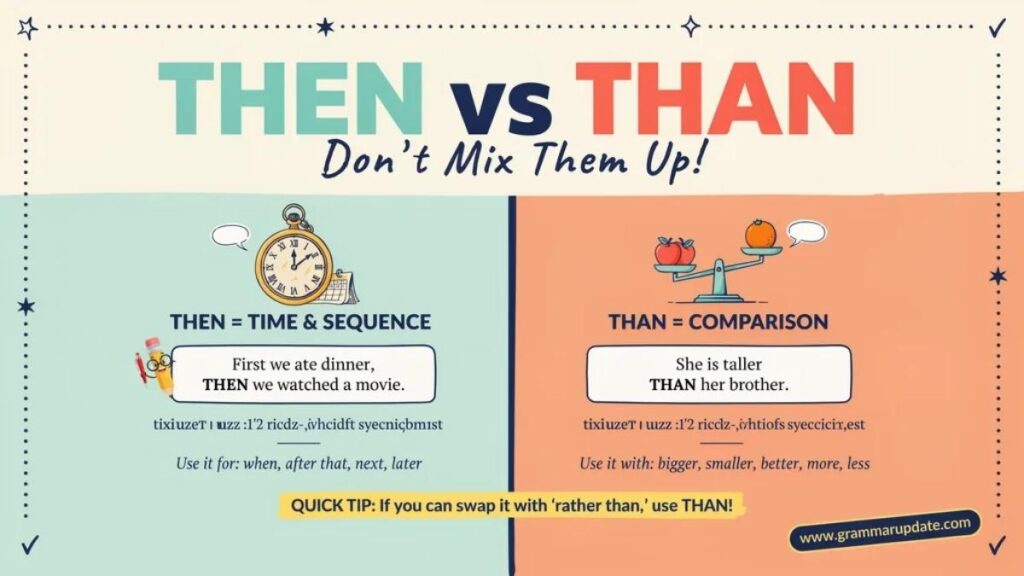
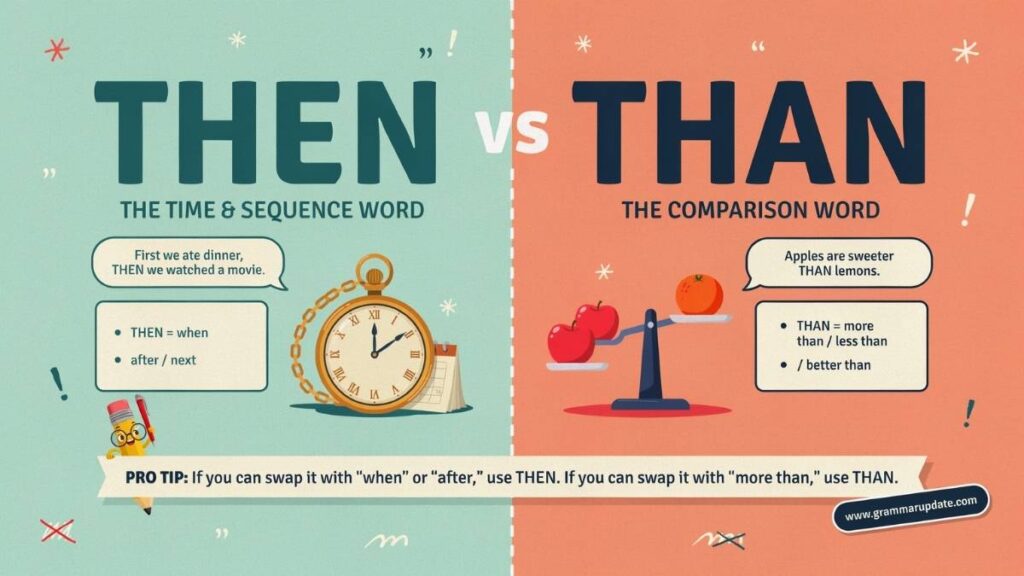
The difference between then and than is surprisingly straightforward.
Use “then” when talking about time, sequence, or what happens next.
Use “than” when making a comparison between people, places, things, or ideas.
Although only one letter separates these words, their meanings are completely different. Understanding this distinction will make your writing clearer and more professional.
Here’s a quick comparison.
| Feature | Then | Than |
|---|---|---|
| Main purpose | Shows time or sequence | Shows comparison |
| Part of speech | Usually an adverb | Usually a conjunction or preposition |
| Helps answer | What happened next? | Which one is being compared? |
| Example | Finish your homework, then watch TV. | Sarah is taller than Emma. |
If you remember only one rule, remember this:
- Use then for time.
- Use than for comparisons.
That single rule solves most then vs than mistakes.
Learn the difference between confusing more English words
Enquiries vs Inquiries Which Spelling Is Correct?
Then vs Than Meaning
Understanding the then vs than meaning makes choosing the correct word much easier.
“Then” connects events in chronological order. It tells readers what happened first and what happened after that. It can also introduce a result in an if-then statement.
“Than” connects two things being compared. It often follows comparative adjectives or comparative adverbs like better, faster, taller, more, less, and rather.
Consider these examples.
Correct:
- We ate dinner, then we watched a movie.
- This laptop is faster than my old one.
Incorrect:
- We ate dinner, than we watched a movie.
- This laptop is faster then my old one.
Simply asking yourself one question can prevent the mistake.
Are you talking about time?
Use then.
Are you comparing two things?
Use than.
What Does “Then” Mean?
The word “then” usually functions as an adverb. It describes time, order, or the next step in a sequence of events.
You will often see it in instructions, stories, conversations, recipes, and directions.
Then Shows Time
Sometimes “then” simply means “at that time.”
Examples:
- I lived in Texas back then.
- She wasn’t interested then.
- Things were much different then.
Notice how each sentence refers to a particular moment in time.
Then Shows the Sequence of Events
One of the most common uses of “then” is to organize actions.
These transition word then examples make writing easier to follow.
Examples:
- Brush your teeth. Then go to bed.
- First wash the vegetables. Then chop them.
- We packed our bags. Then we left for the airport.
- Finish your assignment. Then submit it online.
These are classic then for sequence examples because they show the order of events.
Then Shows the Next Step
Instructions often rely on “then.”
Examples:
- Click Save. Then restart the computer.
- Add the flour. Then mix everything together.
- Read the chapter. Then answer the questions.
Without transition words like “then,” instructions become harder to follow.
Then in If-Then Statements
Another common use appears in conditional sentences.
These if then sentence examples show how one event depends on another.
Examples:
- If it rains, then we’ll stay inside.
- If you study regularly, then you’ll improve your grades.
- If the lights turn red, then stop your car.
- If you save money, then you can buy a new laptop.
Many programming languages also use if-then logic because it clearly expresses conditions and results.
Common Synonyms for Then
Depending on the sentence, “then” may be replaced with:
- Next
- Afterward
- Later
- Subsequently
- At that time
- Following that
Each synonym still relates to time or the sequence of actions.
Learn the difference between confusing more English words
Dammit vs Damn It Which One Is Correct?
What Does “Than” Mean?
Unlike “then,” the word “than” almost always introduces a comparison.
Whenever you compare two people, two objects, two ideas, or two actions, “than” is usually the correct choice.
Think of “than” as the comparison word in English grammar.
Than Compares People
Examples:
- Mia is taller than Olivia.
- Jack is younger than his brother.
- Emily speaks more clearly than I do.
- Noah runs faster than everyone else.
These are classic than for comparisons examples.
Than Compares Objects
Examples:
- Gold is heavier than aluminum.
- This phone costs more than that one.
- My backpack is lighter than yours.
- Electric cars are quieter than gasoline cars.
These examples compare two objects directly.
Than Compares Ideas
Comparisons don’t always involve physical things.
Examples:
- Reading is more relaxing than watching television.
- Learning by doing is better than memorizing.
- Honesty is more valuable than popularity.
You can compare almost anything as long as two ideas are involved.
Than After Comparative Adjectives
Many comparative adjectives require “than.”
Common examples include:
- Bigger than
- Smaller than
- Better than
- Worse than
- Taller than
- Shorter than
- Faster than
- Slower than
- Stronger than
- Easier than
Example sentences:
- Winter is colder than summer.
- Today’s meeting was shorter than yesterday’s.
- This route is easier than the old one.
Than After Comparative Adverbs
Comparative adverbs also use “than.”
Examples:
- She finished earlier than expected.
- He speaks more confidently than before.
- The team worked harder than ever.
This pattern appears frequently in formal and informal writing.
Learn the difference between confusing more English words
Firey vs Fiery difference Which one Is Correct?
Then vs Than Grammar Rules
Learning a few simple grammar rules removes almost all confusion.
Here are the most important then vs than grammar rules every writer should know.
Rule One Use Then for Time
Whenever your sentence involves time, sequence of actions, or chronological order, choose “then.”
Examples:
- We finished lunch. Then we visited the museum.
- First sign in. Then update your password.
- She called me then.
Rule Two Use Than for Comparisons
Whenever two things are compared, use “than.”
Examples:
- This chair is more comfortable than that one.
- Jake is taller than Ben.
- Dogs usually learn commands faster than cats.
Rule Three If You Can Replace the Word With “Next,” Use Then
Example:
- Finish your breakfast. Next, brush your teeth.
Since “next” works perfectly, “then” is correct.
Rule Four If You Can Replace the Word With “Compared With,” Use Than
Example:
- Coffee tastes stronger compared with tea.
That means “than” belongs in the original sentence.
Rule Five Comparative Words Almost Always Need Than
Watch for these comparison words.
- More
- Less
- Better
- Worse
- Bigger
- Smaller
- Higher
- Lower
- Faster
- Slower
- Easier
- Harder
- Older
- Younger
If one of these words appears, there’s a strong chance that “than” follows.
Examples:
- More than enough
- Better than expected
- Less than five minutes
- Older than me
Learn the difference between confusing more English words
Pose vs Poise Difference and Which one is correct ?
Then vs Than in English
One reason learners struggle with then vs than in English is that the words differ by only one letter. They also sound similar in everyday conversation, especially when people speak quickly.
Despite their similar appearance, they belong to different parts of speech and serve completely different purposes.
| Then | Than |
|---|---|
| Time transition word | Comparison word |
| Shows sequence of events | Compares two things |
| Usually an adverb | Usually a conjunction or preposition |
| Answers “What happened next?” | Answers “Compared with what?” |
Thinking about the function instead of the spelling makes the correct choice much easier.
Then vs Than Pronunciation
Many people ask about then vs than pronunciation because the two words sound alike.
In most American English accents:
- Then sounds like “then.”
- Than often sounds like “than” or sometimes closer to “thən” in casual speech.
Although native speakers may pronounce them similarly during fast conversations, their meanings remain completely different.
A simple listening trick can help.
When you hear someone describing the order of events, they almost certainly mean “then.”
When you hear someone comparing two things, they almost certainly mean “than.”
Your ears may not always notice the difference, but the sentence meaning will.
Learn the difference between confusing more English words
Fistulogram vs Fistulagram which is correct and Difference ?
Common Then vs Than Mistakes
Even native English speakers mix up these two words. Most mistakes happen because “then” and “than” look almost identical and sound very similar in everyday speech. Fortunately, once you know what to watch for, these errors become easy to avoid.
Here are some of the most common then vs than mistakes.
| Incorrect | Correct | Why |
|---|---|---|
| She is smarter then me. | She is smarter than me. | A comparison needs “than.” |
| We finished dinner than went home. | We finished dinner then went home. | The sentence shows the next event. |
| I’d rather then stay home. | I’d rather than stay home. | The phrase is always “rather than.” |
| There are less then ten people here. | There are less than ten people here. | “Less than” compares an amount. |
| First mix the ingredients than bake. | First mix the ingredients then bake. | The sentence gives steps in order. |
A simple habit can prevent almost every mistake. Before choosing the word, ask yourself one question.
“Am I comparing something or describing what happens next?”
If you’re comparing, use “than.”
If you’re talking about time or sequence, use “then.”
Learn the difference between confusing word pairs
Peice vs Piece Which Spelling Is Correct?
Why People Confuse Then and Than
The confusion doesn’t happen because English learners aren’t trying. It happens because these words share several similarities.
They Look Almost the Same
Only one letter separates the words.
- Then
- Than
When typing quickly, it’s easy to hit the wrong key without noticing.
They Sound Similar
In natural conversation, many speakers reduce vowel sounds. As a result, the pronunciation becomes very close, making the spelling harder to remember.
Spell Check Doesn’t Always Help
Grammar checkers often miss the error because both words are spelled correctly.
Consider this sentence.
“I am taller then my brother.”
The spelling is correct, but the word choice is wrong. Only a grammar checker that understands context can catch the mistake.
Fast Typing Creates Errors
Many people know the rule but accidentally type the wrong word. Careful proofreading helps catch these small mistakes before you publish or send your writing.
Learn the difference between confusing word pairs
Mold vs Mould Which Spelling Is Correct?
Then vs Than in Common Phrases
Some expressions appear so often that it’s worth memorizing them.
Rather Than or Rather Then?
The correct phrase is always:
Rather than
Examples:
- I’d rather walk than drive.
- She chose tea rather than coffee.
- We stayed home rather than going out.
- He apologized rather than making excuses.
“Rather then” is incorrect.
Less Than or Less Then?
Always write:
Less than
Examples:
- The meeting lasted less than an hour.
- The book costs less than $20.
- There were less than fifty guests.
- The package weighs less than two pounds.
Since the phrase compares amounts, “than” is required.
More Than
“More than” also expresses comparison.
Examples:
- She has more than twenty books.
- The movie lasted more than two hours.
- Success requires more than talent.
- I enjoyed the trip more than I expected.
Better Than
Examples:
- Practice is better than guessing.
- This restaurant is better than the one downtown.
- Experience is better than assumptions.
Other Than
Examples:
- Other than rain, the weather was perfect.
- No one other than Alex knew the answer.
- We discussed everything other than work.
If… Then
This pattern introduces a condition and its result.
Examples:
- If you practice every day, then you’ll improve.
- If the door is locked, then use the spare key.
- If the battery dies, then recharge it immediately.
Okay Then or Okay Than?
The correct expression is:
Okay then.
Examples:
- Okay then, let’s get started.
- Okay then, I’ll see you tomorrow.
- Okay then, thanks for your help.
“Okay than” is never correct.
Learn the difference between confusing word pairs
Defense vs Defence Which Spelling Is Correct?
Then and Than Examples in Everyday Life
Learning grammar becomes much easier when you see realistic examples instead of isolated sentences.
School Examples
- Finish the worksheet, then check your answers.
- Olivia scored higher than Liam.
- Read the story, then answer the questions.
- Science is easier for Maya than history.
Workplace Examples
- Review the report, then send it to the client.
- This proposal is stronger than the previous version.
- We completed the presentation, then scheduled the meeting.
- Sales increased more than expected.
Home Examples
- Wash the vegetables, then cut them.
- This couch is larger than the old one.
- Clean your room, then watch television.
- The blue paint looks brighter than the gray paint.
Travel Examples
- Check in online, then head to the airport.
- Driving is faster than taking the bus.
- We visited Chicago, then flew to Seattle.
- The hotel was better than we expected.
These then and than examples show how naturally both words appear in everyday writing.
Learn the difference between confusing word pairs
Trey vs Tray What’s the Difference?
Then vs Than Sentence Examples
The best way to master these words is through repetition.
Then for Sequence Examples
- We finished breakfast, then went hiking.
- First gather your materials, then begin the project.
- She answered the phone, then smiled.
- The lights went out. Then everything became quiet.
- Finish one task, then start another.
Each sentence follows the sequence of actions.
Than for Comparisons Examples
- My brother is older than I am.
- Summer is warmer than winter.
- Reading is more relaxing than scrolling through social media.
- The blue car is faster than the red one.
- This solution works better than the last one.
Each example compares two people, things, or ideas.
Then vs Than Comparison
Sometimes seeing both words side by side makes the difference obvious.
| Situation | Correct Word | Example |
|---|---|---|
| Showing time | Then | We ate lunch, then went shopping. |
| Giving instructions | Then | Click Save, then restart the computer. |
| Comparing size | Than | This box is larger than that one. |
| Comparing speed | Than | A train is faster than a bicycle. |
| Showing order | Then | First study, then relax. |
| Comparing quality | Than | This camera is better than mine. |
Whenever you feel unsure, identify the purpose of the sentence before choosing the word.
How to Remember Then vs Than
Many students ask, “How do you remember then vs than?”
These simple memory tricks work surprisingly well.
The Letter “E” Means Events
The word “then” contains the letter “E.”
Think of:
- Events
- Episodes
- Eventually
Each relates to time.
The Letter “A” Means Comparison
The word “than” contains the letter “A.”
Think of:
- Compare
- Contrast
- Against
Every comparison needs “than.”
Ask One Quick Question
Before writing, pause for two seconds.
Is the sentence comparing two things?
If yes, choose “than.”
If not, and you’re talking about time or sequence, choose “then.”
This habit quickly becomes automatic.
Learn the difference between confusing word pairs
Disk vs Disc What’s the Difference and Which one Is Correct?
Then vs Than for Students
Students often struggle with these commonly confused words because they memorize spelling instead of meaning.
A better approach is to focus on how each word functions.
Teachers often explain it this way.
- “Then” tells what happens next.
- “Than” compares two things.
That simple explanation works well for elementary grammar, middle school grammar, and even ESL grammar lessons.
Classroom Activity
Ask students to hold up one card labeled “Then” and another labeled “Than.”
Read sentences aloud.
Students raise the correct card.
Examples:
- Sarah is taller ___ Emma.
- We finished lunch ___ went outside.
- This puzzle is easier ___ the last one.
- First wash your hands ___ sit down.
Interactive activities improve grammar retention much more than memorization alone.
Then vs Than for ESL Learners
English language learners often face additional challenges because many languages don’t distinguish these ideas with separate words.
Helpful strategies include:
- Read English books regularly.
- Practice sentence correction.
- Keep a list of comparison words.
- Highlight transition words while reading.
- Complete grammar exercises every week.
- Proofread slowly before submitting assignments.
Consistent practice builds confidence over time.
Learn the difference between confusing more English words
Feal vs Feel Which Spelling Is Correct?
Proofreading Tips to Avoid Then vs Than Mistakes
Even experienced writers occasionally type the wrong word. Good proofreading habits can catch these mistakes before anyone else sees them.
Try these practical tips.
- Read your writing one sentence at a time instead of skimming the entire page.
- Look for comparison words like better, more, less, taller, faster, older, and easier. They almost always require “than.”
- Look for sequence words like first, next, afterward, and finally. They often pair with “then.”
- Read the sentence aloud. Hearing the sentence can help you notice whether it describes time or a comparison.
- Slow down when editing. Most mistakes happen during fast typing rather than because of poor grammar knowledge.
- Don’t rely entirely on spell check. Since both words are spelled correctly, many spelling tools won’t detect the wrong choice.
These simple proofreading habits improve writing accuracy and reduce common grammar errors.
Quick Reference Chart
Keep this chart in mind whenever you’re unsure.
| If your sentence… | Use |
|---|---|
| Shows time | Then |
| Shows the next step | Then |
| Describes the order of events | Then |
| Uses an if-then statement | Then |
| Compares two people | Than |
| Compares two objects | Than |
| Compares two ideas | Than |
| Uses words like better, more, less, or taller | Than |
This quick reference works well for students, teachers, ESL learners, and anyone who wants to improve English grammar.
Learn the difference between confusing more English words
Presentor vs Presenter Which Spelling Is Correct?
Real-World Examples
Here are a few examples you might see every day.
In Emails
Correct:
“Please review the document, then send your feedback.”
Incorrect:
“Please review the document, than send your feedback.”
On Social Media
Correct:
“This movie is better than I expected.”
Incorrect:
“This movie is better then I expected.”
In Recipes
Correct:
“Heat the oil, then add the onions.”
Recipes rely on the sequence of events, so “then” is the right choice.
In Sports
Correct:
“Our team played better than last week.”
This sentence compares two performances.
In School Assignments
Correct:
“Complete Part A, then answer the discussion questions.”
The instruction follows a clear order.
Learn the difference between confusing more English words
Fourteen vs Forteen Which Spelling Is Correct?
Practice Session Then vs Than
Choose the correct word to complete each sentence then vs than.
- Finish your homework, _____ you can watch your favorite show.
- Emma is taller _____ her younger sister.
- We packed our bags, _____ headed to the airport.
- This math problem is easier _____ the last one.
- If you leave now, _____ you’ll avoid heavy traffic.
- I’d rather read a book _____ watch TV.
- There were fewer people _____ expected at the concert.
- First wash your hands, _____ set the table.
- My new phone works better _____ my old one.
- We ate dinner, _____ went for a walk.
- Olivia finished the race faster _____ Mia.
- Complete Step 1, _____ move on to Step 2.
- This jacket is warmer _____ the one I wore yesterday.
- Back _____, people wrote more letters by hand.
- If the weather improves, _____ we’ll have a picnic.
- Your presentation was more organized _____ mine.
- Mix the ingredients well, _____ pour the batter into the pan.
- The blue backpack is lighter _____ the black one.
- First check your answers, _____ submit the test.
- Noah arrived earlier _____ everyone else.
- We visited the museum, _____ stopped for lunch.
- This route is shorter _____ the highway.
- If you practice every day, _____ your skills will improve.
- She chose coffee rather _____ tea.
- Think carefully, _____ make your final decision.
Answers
- then
- than
- then
- than
- then
- than
- than
- then
- than
- then
- than
- then
- than
- then
- then
- than
- then
- than
- then
- than
- then
- than
- then
- than
- then
Here’s a trusted source for clear word meanings:
FAQs
When should you use “than” instead of “then”?
Use “than” when you’re comparing two or more people, things, places, or ideas. If your sentence includes words like better, more, less, taller, or faster, “than” is almost always the correct choice.
Example:
- This book is better than the movie.
When should you use “then” instead of “than”?
Use “then” when referring to time, the next step, or the order of events. It often appears in instructions, stories, and if-then statements.
Example:
- Finish your homework, then go outside.
Do you say “OK then” or “OK than”?
The correct phrase is “OK then” or “Okay then.” You’re referring to the next part of the conversation, not making a comparison.
Example:
- Okay then, let’s begin.
Are “than” and “then” easily confused?
Yes. They look similar, sound alike in casual speech, and differ by only one letter. However, they have different meanings. “Then” relates to time, while “than” is used for comparisons.
Does “then” indicate a consequence?
Yes. “Then” can introduce the result of a condition in an if-then sentence.
Example:
- If you study consistently, then you’ll improve your grades.
Why do people keep writing “then” instead of “than”?
Most mistakes happen because the words sound similar and are typed quickly. Since both are correctly spelled words, spell check often doesn’t catch the error. Careful proofreading usually solves the problem.
Is “then” correct grammar?
Yes. “Then” is grammatically correct when it refers to time, sequence, or a consequence.
Correct:
- We ate lunch, then went shopping.
Incorrect:
- She is taller then me.
What’s another word for “then”?
Depending on the context, you can replace “then” with:
- Next
- Afterward
- Later
- Subsequently
- Following that
- At that time
Choose the synonym that best fits your sentence.
Is it correct to say “alright then”?
Yes. “Alright then” is a common and grammatically correct expression used to acknowledge something, agree with someone, or move a conversation forward.
Do you say “better than” or “better then”?
The correct phrase is “better than” because it compares two things.
Example:
- This solution is better than the previous one.
Why do Americans mix up “then” and “than”?
People in the United States—and many other English-speaking countries—confuse these words because they have similar spelling and pronunciation. The mistake isn’t unique to American English.
Why do we use “then”?
We use “then” to show time, sequence, or the next action. It helps readers understand the chronological order of events.
Example:
- First stir the ingredients. Then bake the cake.
What are common mistakes with “then”?
The most common mistakes include:
- Writing “better then” instead of “better than.”
- Writing “less then” instead of “less than.”
- Using “than” when describing the next step in instructions.
- Confusing “then” and “than” in emails or school assignments.
Is it “less than” or “less then”?
The correct phrase is “less than.” It compares an amount, number, or measurement.
Examples:
- Less than 10 minutes.
- Less than $50.
What’s an easy trick to remember then vs than?
Think of these simple memory aids:
- Then = Time or the next Event.
- Than = Comparison.
If you’re comparing, choose “than.” If you’re talking about time or order, choose “then.”
What is the basic rule for then and than?
The rule is simple:
- Use “then” for time, sequence, or results.
- Use “than” for comparisons.
Remembering this single rule will help you use both words correctly in almost every sentence.
Is it correct to say “but then”?
Yes. “But then” is a common expression used to introduce a contrasting event or unexpected outcome.
Example:
- I wanted to leave early, but then it started raining.
What are the two main meanings of “then”?
“Then” has two primary meanings:
- It refers to a point in time.
- It shows the next step or sequence of events.
Example:
- I lived there back then.
- Finish your work, then relax.
Do you put a comma after “then”?
Sometimes. If “then” introduces the next independent clause or acts as an introductory transition, a comma may improve readability.
Example:
- We finished dinner, then we watched a movie.
When “then” simply modifies the verb, no comma is usually needed.
Example:
- She then opened the door.
What can you say instead of “then”?
Possible alternatives include:
- Next
- Later
- Afterward
- Subsequently
- Following that
- At that point
The best replacement depends on the context.
What does “then” actually mean?
“Then” means at that time, next, afterward, or as a result. It helps describe when something happened or what happened next.
Should you start a sentence with “then”?
Yes. Starting a sentence with “Then” is perfectly acceptable, especially when describing a sequence of events.
Example:
- Then everyone applauded.
How do you use “then” correctly?
Use “then” whenever your sentence involves:
- Time
- Order of events
- Instructions
- The next step
- If-then conditions
Examples:
- We finished breakfast. Then we left.
- If you agree, then we’ll continue.
Do you say “less than” or “less then”?
Always write “less than.” Since the phrase compares quantities, “than” is required.
Is it “less than 2 years” or “fewer than 2 years”?
Both expressions can be correct, but they emphasize different ideas.
- “Less than 2 years” is the standard and most natural expression when referring to a period of time.
- “Fewer than 2 years” is uncommon because “years” represent a duration rather than individual countable items.
For most situations, “less than 2 years” is the preferred choice.
Learn the difference between confusing more English words
Sentence vs Sentance Which Spelling Is Correct?
Conclusion
The difference between then vs than is much easier than it first appears. Just remember one simple rule: use “then” when talking about time, the order of events, or what happens next. Use “than” when comparing two or more people, places, things, or ideas. If you ever feel unsure, ask yourself, “Am I comparing something?” If the answer is yes, use “than.” If you’re describing what happens next, use “then.”
Don’t worry if you’ve mixed them up before. It’s one of the most common grammar mistakes in English, and even experienced writers make it from time to time. With a little practice and careful proofreading, you’ll use both words correctly without thinking twice. Keep this guide handy whenever you need a quick reminder, and soon choosing between “then” and “than” will feel as easy as saying the alphabet—just with fewer embarrassing typos.

Jhon AJS, the creative mind behind Grammar Update, is an experienced blogger passionate about simplifying English grammar. He focuses on explaining confusing word vs word differences, grammar rules, punctuation, and sentence structure in a clear and practical way. Through easy to understand guides and examples, Jhon helps readers improve their writing and communicate with confidence. With years of blogging experience, he continues to share helpful insights that make learning grammar simple, useful, and accessible for everyone.