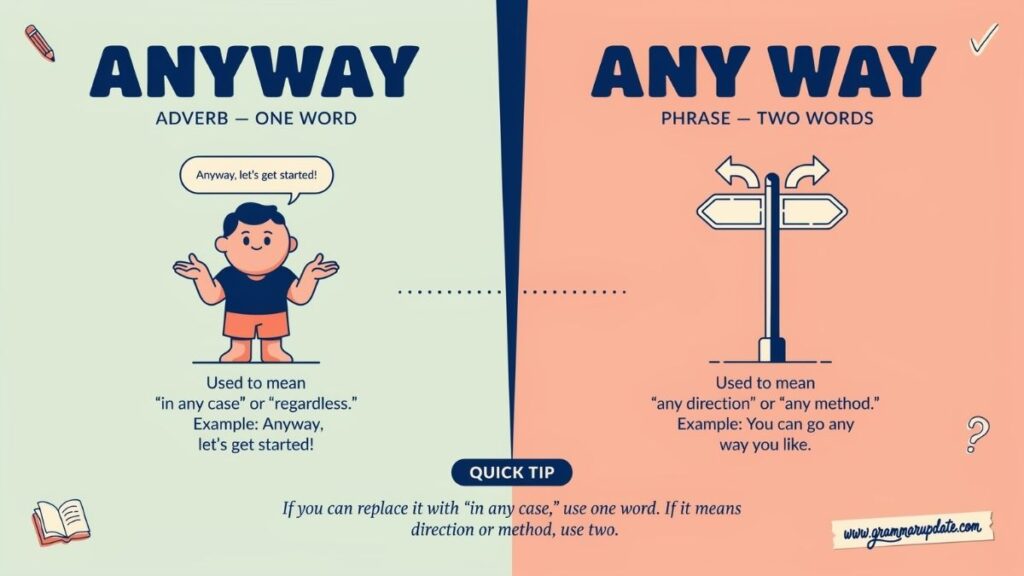
The confusion around Anyway vs Any Way is common because both expressions sound the same, but they have different meanings and uses. The good news is that the rule is easy to learn. Once you understand when each one is correct, you’ll avoid this common grammar mistake with confidence. In this guide, you’ll learn the difference through simple explanations, easy grammar rules, helpful examples, and practical tips. By the end, you’ll know exactly which expression to use in every situation.
Anyway vs Any Way The Quick Answer
Before diving into the grammar lesson, here’s the simple rule.
| Expression | Meaning | Part of Speech | Example |
|---|---|---|---|
| Anyway | Nevertheless, regardless, moving on, in any case | Adverb (also a discourse marker) | Anyway, let’s get started. |
| Any way | Any method, any manner, any possible means | Determiner + noun phrase | Is there any way to fix this? |
If you’re talking about continuing a conversation, changing topics, or saying “regardless,” use “anyway.”
If you’re talking about a method, possibility, or manner of doing something, use “any way.”
A simple memory trick is this:
- If you can replace it with “regardless” or “in any case,” write “anyway.”
- If you can replace it with “by any method” or “in any manner,” write “any way.”
This simple test solves most cases of anyway vs any way without memorizing complicated grammar rules.
Learn the difference between basic English word mistakes
Mold vs Mould Which Spelling Is Correct?
Anyway Meaning
Understanding anyway meaning is the first step toward using it correctly.
The word “anyway” is a single-word adverb. It usually means:
- Regardless
- Nevertheless
- In any case
- Moving on to another topic
- Returning to the main point
In modern English, “anyway” often acts as a transition word. It helps speakers guide a conversation from one idea to another without sounding abrupt.
For example:
- Anyway, let’s continue our meeting.
- I didn’t enjoy the movie. Anyway, the popcorn was excellent.
- It was raining. We went hiking anyway.
In each example, “anyway” connects ideas instead of describing a method.
Anyway Definition
According to major English dictionaries, “anyway” means:
- In spite of that
- Regardless of circumstances
- In any case
- As a transition to another point
Because it connects ideas so naturally, you’ll hear it every day in conversations, interviews, podcasts, and presentations.
Anyway Is an Adverb
One of the most common grammar questions is, “Is anyway an adverb?”
Yes.
The adverb “anyway” modifies an entire sentence rather than a single verb.
Examples:
- Anyway, we’ll solve the problem tomorrow.
- She apologized anyway.
- The project was difficult. Anyway, everyone finished on time.
This is why many grammar books describe it as both an adverb and a discourse marker.
Anyway Usage
Correct anyway usage appears in many situations.
You can use it:
- To introduce a new point
- To return to your main topic
- To show that something happened despite obstacles
- To conclude a discussion
- To keep a conversation moving
Examples include:
- Anyway, where were we?
- I wasn’t hungry, but I ate anyway.
- Anyway, let’s finish today’s lesson.
- He forgot his notes. Anyway, he gave a great presentation.
These examples show why “anyway” is common in everyday English.
Anyway Synonyms
Depending on the sentence, you can replace “anyway” with:
- Regardless
- In any case
- Nevertheless
- Nonetheless
- Even so
- Still
- Despite that
For example:
Original:
Anyway, we finished the project.
Alternative:
Nevertheless, we finished the project.
Original:
Anyway, let’s move on.
Alternative:
In any case, let’s move on.
Although these words share similar meanings, “anyway” sounds more natural in conversational English.
Learn the difference between basic English word mistakes
Lint vs Lent Difference Which one is correct?
Any Way Meaning
Now let’s look at any way meaning.
Unlike “anyway,” “any way” consists of two separate words.
- “Any” is a determiner.
- “Way” is a noun.
Together they refer to any method, manner, or possible approach.
Examples:
- Is there any way to solve this puzzle?
- We’ll help any way we can.
- She searched for any way possible to contact him.
Notice that these sentences discuss methods or possibilities rather than transitions in conversation.
Any Way Definition
The phrase “any way” means:
- In any manner
- By any method
- Through any possible means
Whenever you’re discussing how something can be done, “any way” is usually the correct choice.
Any Way Grammar
Understanding any way grammar is surprisingly simple.
Ask yourself this question:
“Am I talking about a method?”
If the answer is yes, write “any way.”
Consider these examples.
Correct:
- Is there any way to improve this report?
- We’ll help any way possible.
- She tried any way she could think of.
Incorrect:
- Any way, let’s begin.
The first group discusses methods. The last sentence tries to introduce a new topic, so it requires “anyway.”
Any Way Usage
Correct any way usage often appears with verbs such as:
- Help
- Solve
- Find
- Improve
- Reach
- Contact
- Finish
- Complete
Examples:
- Can you find any way to reduce costs?
- We’ll support you any way we can.
- Is there any way around this rule?
- She explored every option but couldn’t find any way forward.
These examples focus on possibilities rather than transitions.
Any Way Sentence Examples
Here are more examples that demonstrate proper any way spelling.
- Is there any way to arrive earlier?
- We’ll assist any way you need.
- She looked for any way out of the building.
- Do you know any way to repair this computer?
- They searched for any way possible to save time.
Notice that every sentence could replace “any way” with “by any method” without changing the meaning.
Learn the difference between basic English word mistakes
Choose vs Chose Difference which one is correct?
Anyway vs Any Way What’s the Difference?
The difference between anyway and any way becomes clear once you focus on meaning instead of spelling.
Although the expressions sound the same, they perform different jobs in English grammar.
| Feature | Anyway | Any Way |
|---|---|---|
| Number of words | One | Two |
| Part of speech | Adverb | Determiner + noun |
| Main meaning | Regardless, nevertheless, moving on | Any method or manner |
| Used for | Connecting ideas | Describing possibilities or methods |
| Common in conversation | Very common | Less common |
| Common in questions | Occasionally | Very common |
Grammar Difference
The biggest anyway vs any way difference is grammatical function.
“Anyway” behaves like an adverb.
Example:
- Anyway, let’s continue.
“Any way” behaves like a noun phrase.
Example:
- Is there any way to continue?
One introduces the next idea. The other refers to a method.
Meaning Difference
Many learners search for anyway vs any way meaning because the pronunciation is identical.
Remember this rule.
Use “anyway” when you mean:
- Regardless
- In any case
- Moving on
Use “any way” when you mean:
- In any manner
- By any method
- Through any possible means
Anyway vs Any Way in a Sentence
Compare these sentence examples.
Anyway:
- The weather was terrible. Anyway, we enjoyed the trip.
- Anyway, let’s answer the next question.
- She didn’t agree, but she helped anyway.
Any way:
- Is there any way to reach the airport faster?
- We’ll support you any way we can.
- They searched for any way possible to reduce expenses.
Seeing both forms side by side makes the correct word choice much easier.
Learn the difference between basic English word mistakes
Then vs Than difference which one is correct ?
Is “Anyway” One Word or Two?
One of the most common questions is, “Is anyway one word?”
Yes.
“Anyway” is one word when it means “regardless,” “in any case,” or serves as a transition word.
Examples:
- Anyway, let’s begin.
- He came anyway.
- Anyway, I have another idea.
Another frequent question is, “Is any way two words?”
Yes.
Write “any way” as two words only when you’re referring to a method, possibility, or manner.
Examples:
- Is there any way to finish today?
- We’ll help any way we can.
- She searched for any way possible.
A simple test can help.
Replace the phrase with “by any method.”
If the sentence still makes sense, write “any way.”
Replace it with “regardless.”
If the sentence still makes sense, write “anyway.”
This quick substitution method is one of the easiest proofreading tips for avoiding this common English mistake.
When to Use Anyway
Knowing when to use anyway makes your writing smoother and more natural.
To Change the Topic
Speakers often use “anyway” to shift the conversation.
Examples:
- Anyway, let’s discuss tomorrow’s meeting.
- Anyway, that’s enough about sports.
To Return to the Main Point
People frequently get distracted during conversations. “Anyway” helps them return to the original subject.
Examples:
- Anyway, where were we?
- Anyway, let’s continue the lesson.
To Show That Something Happened Regardless
Here, “anyway” means “despite everything.”
Examples:
- It was snowing, but they traveled anyway.
- She wasn’t feeling well, yet she attended anyway.
To Conclude a Discussion
Many speakers naturally end conversations with “anyway.”
Examples:
- Anyway, thanks for your help.
- Anyway, I’ll see you tomorrow.
To Keep Conversation Flowing
In spoken English, “anyway” works as a discourse marker. It helps conversations sound smooth instead of abrupt.
Examples:
- Anyway, what do you think?
- Anyway, that’s another story.
- Anyway, let’s move on to the next example.
This type of anyway usage is especially common in everyday English, podcasts, interviews, classrooms, and business meetings.
Learn the difference between basic English word mistakes
Dammit vs Damn It Which One Is Correct?
When to Use Any Way
Knowing when to use any way is just as important as knowing when to use anyway. Although these expressions sound the same, they do completely different jobs.
Use “any way” whenever you’re talking about a method, manner, or possible approach. In other words, if you could replace the phrase with “by any method” or “in any manner,” then “any way” is the correct choice.
To Talk About a Method
This is the most common use of “any way.”
Examples:
- Is there any way to unlock the phone?
- We need to find any way to reduce costs.
- Can you think of any way to improve this design?
Each sentence asks about a possible method or solution.
To Express Possibility
Sometimes “any way” refers to any available option.
Examples:
- Is there any way around the traffic?
- They searched for any way out.
- She looked for any way to finish before the deadline.
In Questions
Questions often use “any way” because they ask whether a solution exists.
Examples:
- Is there any way to recover deleted files?
- Is there any way to contact customer support?
- Do you know any way to save this document?
In Negative Statements
The phrase also appears naturally in negative sentences.
Examples:
- There wasn’t any way to avoid the delay.
- We couldn’t find any way forward.
- There isn’t any way to change the result now.
In Conditional Sentences
Conditional statements frequently include “any way.”
Examples:
- If there’s any way to help, let me know.
- If you find any way to solve it, tell the team.
- If there’s any way possible, we’ll make it happen.
Learn the difference between commonly mixed-up more words
Firey vs Fiery difference Which one Is Correct?
Anyway vs Any Way With Examples
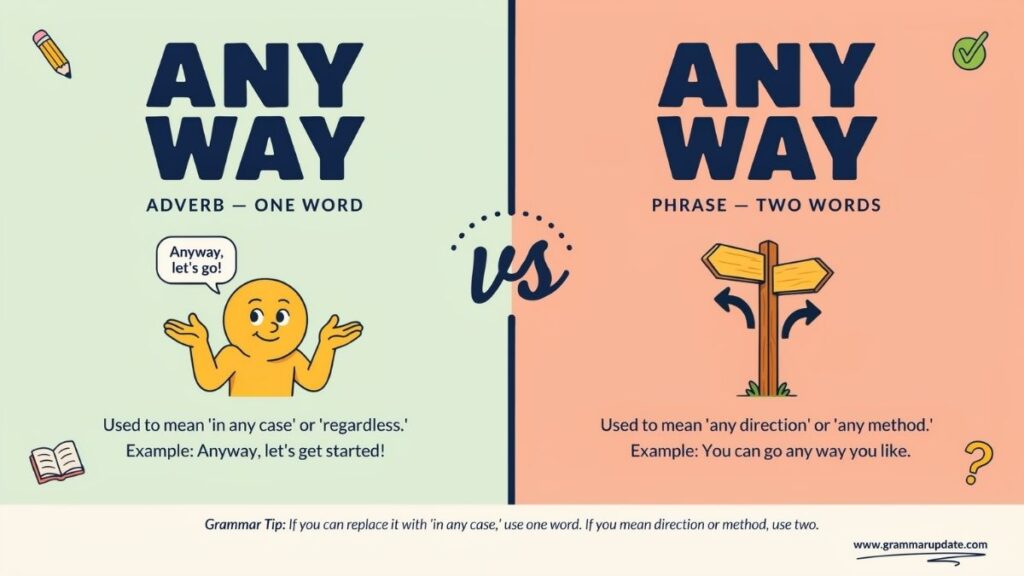
Sometimes the easiest way to understand confusing English words is to compare them side by side.
| Anyway | Any Way |
|---|---|
| Anyway, let’s start the meeting. | Is there any way to start earlier? |
| She wasn’t interested, but she came anyway. | We’ll help any way we can. |
| Anyway, what happened next? | Do you know any way to fix this? |
| Anyway, let’s move to another topic. | They searched for any way possible. |
| I didn’t expect him to win anyway. | Can you think of any way around the problem? |
Notice the pattern.
“Anyway” connects ideas.
“Any way” talks about methods.
That simple distinction explains nearly every example you’ll encounter.
Learn the difference between commonly mixed-up more words
Pose vs Poise Difference and Which one is correct ?
Anyway vs Any Way in Everyday English
Native speakers use both expressions regularly, but in different situations.
You’ll hear “anyway” more often because conversations frequently shift from one topic to another.
Examples:
- Anyway, how was your vacation?
- Anyway, that’s enough about work.
- Anyway, let’s order dinner.
You’ll see “any way” whenever someone discusses options or solutions.
Examples:
- Is there any way to park nearby?
- We’ll help any way we can.
- She searched for any way to solve the puzzle.
Learning these patterns makes word choice much easier.
Anyway vs Anyways
Another common source of confusion is anyway vs anyways meaning.
Many people wonder whether “anyways” is correct.
The short answer is yes. “Anyways” is a real word. However, it isn’t the best choice for every situation.
What Does Anyways Mean?
The word “anyways” has essentially the same meaning as “anyway.”
Examples:
- Anyways, let’s continue.
- Anyways, I have to leave now.
The meaning doesn’t change.
The tone does.
Is Anyways Informal?
Yes.
Most grammar guides consider “anyways” an informal variation of “anyway.”
You’ll hear it in casual conversation throughout North America, but you’ll rarely see it in professional writing, academic papers, newspapers, or business documents.
For formal writing, choose “anyway.”
Anyway vs Anyways Explained
| Anyway | Anyways |
|---|---|
| Standard English | Informal English |
| Preferred in writing | Mostly conversational |
| Common in books | Less common |
| Appropriate in business writing | Usually avoided |
| Same meaning | Same meaning |
If you’re unsure which one to use, “anyway” is almost always the safer choice.
Anyway or Anyways Examples
Correct:
- Anyway, let’s continue the presentation.
- Anyway, I appreciate your help.
Informal speech:
- Anyways, I’ll call you later.
- Anyways, that’s what happened.
Although native speakers often say “anyways,” professional editors usually recommend “anyway.”
Learn the difference between commonly mixed-up more words
Leary vs Leery Which Is Correct and Difference?
Anyway vs Anyhow
Another pair that causes confusion is anyway vs anyhow.
Fortunately, the difference is much smaller.
What Does Anyhow Mean?
“Anyhow” usually means:
- Anyway
- Regardless
- Somehow
Examples:
- We finished the project anyhow.
- Anyhow, let’s continue.
- She solved the problem somehow.
Anyway vs Anyhow Difference
Both words often mean “regardless” or “in any case.”
The main difference is tone.
| Anyway | Anyhow |
|---|---|
| More common | Slightly less common |
| Neutral tone | Slightly more informal or conversational |
| Frequently used as a discourse marker | Often means “somehow” as well |
Examples:
- Anyway, let’s move on.
- Anyhow, let’s move on.
Both sentences are correct.
However, “anyway” sounds more natural in modern American English.
Which One Should You Choose?
For everyday writing, emails, articles, and business communication, “anyway” is usually the better option.
Use “anyhow” when it fits your writing style or when you specifically mean “somehow.”
Learn the difference between commonly mixed-up more words
Fistulogram vs Fistulagram which is correct and Difference ?
Anyway or By the Way
Many learners ask about anyway or by the way because both expressions introduce new ideas.
Despite that similarity, they have different purposes.
By the Way Meaning
“By the way” introduces additional information.
Examples:
- By the way, your package arrived.
- By the way, congratulations on your promotion.
The new information is related but not essential.
Anyway Meaning
“Anyway” returns to the original topic or indicates that something happened regardless of another fact.
Examples:
- Anyway, let’s continue our lesson.
- It was expensive, but I bought it anyway.
Anyway or By the Way Difference
| Anyway | By the Way |
|---|---|
| Returns to the main topic | Introduces a side topic |
| Means regardless or moving on | Means incidentally |
| Keeps the conversation focused | Adds extra information |
Compare these examples.
Correct:
- We talked about movies for twenty minutes. Anyway, let’s finish today’s meeting.
Correct:
- By the way, have you seen my keys?
The first sentence changes back to the main discussion.
The second introduces unrelated information.
Learn the difference between commonly mixed-up more words
Peice vs Piece Which Spelling Is Correct?
British English vs American English
Unlike many spelling differences between American and British English, “anyway” and “any way” do not change across the two varieties.
Both American and British dictionaries use the same spellings.
American English
Examples:
- Anyway, let’s begin.
- Is there any way to help?
British English
Examples:
- Anyway, we’ll discuss it tomorrow.
- Is there any way around the problem?
The grammar remains exactly the same.
What About Anyways?
This is where a small difference appears.
“Anyways” is heard more often in North American conversation than in British English.
Even so, major style guides still recommend “anyway” for formal writing.
Why Correct Usage Matters
Choosing the correct expression does more than satisfy grammar enthusiasts.
It also improves clarity.
Readers understand your meaning immediately when you use the right form.
Better Professional Writing
Mistakes involving “anyway” and “any way” may seem small, but they can affect how professional your writing appears.
Whether you’re writing:
- Emails
- Reports
- Job applications
- Blog posts
- Academic assignments
using the correct expression demonstrates attention to detail.
Stronger Academic Writing
Teachers and professors often notice common grammar errors.
Using “anyway” correctly shows that you understand parts of speech and correct word usage.
Clear Communication
Good grammar removes unnecessary confusion.
Compare these sentences.
Incorrect:
- Any way, let’s continue.
Correct:
- Anyway, let’s continue.
Incorrect:
- I don’t know anyway to solve it.
Correct:
- I don’t know any way to solve it.
Small changes make a big difference.
Easier Proofreading
Many grammar checkers can identify these mistakes, but they don’t always catch every error.
That’s why understanding the grammar rules yourself is valuable.
When proofreading, ask two simple questions.
- Does this sentence mean “regardless” or “moving on”? Use “anyway.”
- Does this sentence refer to a method or possibility? Use “any way.”
Learn the difference between tricky grammar more words
Focuses vs Focusses Which Spelling Is Correct?
Common Mistakes With Anyway vs Any Way
Even experienced writers occasionally mix up “anyway” and “any way.” The good news is that most mistakes follow the same patterns. Once you recognize them, they’re easy to avoid.
Mistake: Using “Any Way” Instead of “Anyway”
Incorrect:
- Any way, let’s begin.
- Any way, I enjoyed the movie.
Correct:
- Anyway, let’s begin.
- Anyway, I enjoyed the movie.
Remember, if the word means “regardless,” “in any case,” or helps move the conversation forward, write “anyway.”
Mistake: Using “Anyway” Instead of “Any Way”
Incorrect:
- Is there anyway to solve this?
- We will help anyway we can.
Correct:
- Is there any way to solve this?
- We will help any way we can.
If you’re talking about a method or possibility, always write “any way.”
Mistake: Using “Anyways” in Professional Writing
While “anyways” is a real word, it sounds informal.
Formal:
- Anyway, thank you for your time.
Informal:
- Anyways, I’ll see you later.
Choose “anyway” for business writing, academic papers, reports, and professional emails.
Mistake: Confusing “Anyway” With “By the Way”
These expressions are not interchangeable.
Incorrect:
- By the way, let’s get back to today’s topic.
Better:
- Anyway, let’s get back to today’s topic.
“By the way” introduces extra information.
“Anyway” returns to the main discussion.
Easy Memory Tricks
You don’t need to memorize dozens of grammar rules. These simple tricks work almost every time.
The “Regardless” Test
If “regardless” fits naturally, use “anyway.”
Example:
- We went hiking anyway.
- We went hiking regardless.
Both sentences have the same meaning.
The “Method” Test
If “by any method” fits, use “any way.”
Example:
- Is there any way to fix this?
- Is there any method to fix this?
The meaning stays the same.
Count the Words
One word:
- Anyway
Two words:
- Any way
If you’re describing a way or method, you’ll almost always need two words.
Read the Sentence Out Loud
Ask yourself a simple question.
“Am I changing the topic, or am I talking about a method?”
That question usually gives you the answer immediately.
Learn the difference between tricky grammar more words
Presentor vs Presenter Which Spelling Is Correct?
Quick Reference Chart
| If You Mean… | Use |
|---|---|
| Regardless | Anyway |
| In any case | Anyway |
| Moving on | Anyway |
| A method | Any way |
| A manner | Any way |
| A possible solution | Any way |
Learn the difference between tricky grammar more words
Fourteen vs Forteen Which Spelling Is Correct?
Practice Session Anyway vs Any Way
Choose the correct answer for each sentence. Fill in each blank with either “Anyway vs Any Way”
- __________, let’s begin today’s grammar lesson.
- Is there __________ to solve this problem before tomorrow?
- We decided to go hiking __________, even though it was cloudy.
- Can you think of __________ to improve your writing skills?
- __________, thanks for sharing your ideas.
- She couldn’t find __________ to unlock the door.
- It was getting late, but they stayed __________.
- We’ll help __________ we can.
- __________, let’s get back to the main topic.
- Is there __________ to contact the manager directly?
- I wasn’t feeling well, but I went to work __________.
- They searched for __________ possible to save time.
- __________, what happened after the meeting?
- Can you suggest __________ to reduce the cost?
- He finished the race __________ despite his injury.
- We’ll support you __________ possible.
- __________, let’s move on to the next question.
- There wasn’t __________ to avoid the traffic jam.
- She completed the project __________.
- Is there __________ to recover the deleted photos?
- __________, I’ll send you the report this afternoon.
- They looked for __________ to solve the puzzle.
- We enjoyed the concert __________.
- Do you know __________ to make this recipe healthier?
- __________, that’s all for today’s lesson.
Answers
- Anyway
- any way
- anyway
- any way
- Anyway
- any way
- anyway
- any way
- Anyway
- any way
- anyway
- any way
- Anyway
- any way
- anyway
- any way
- Anyway
- any way
- anyway
- any way
- Anyway
- any way
- anyway
- any way
- Anyway
Here’s a trusted source for clear word meanings:
FAQs
What is the difference between anyway vs any way?
The difference between “anyway” and “any way” is their meaning and grammar. “Anyway” is an adverb that means “regardless,” “in any case,” or helps move a conversation forward. “Any way” is a two-word phrase that means “by any method” or “in any manner.”
Can I help in anyway vs any way?
The correct phrase is “Can I help in any way?” because you’re asking about a method or manner of helping. “Anyway” would be incorrect in this context.
Correct:
- Can I help in any way?
Incorrect:
- Can I help in anyway?
What’s the difference between anyway and either way?
“Anyway” means “regardless” or “moving on.” “Either way” means that the outcome remains the same regardless of which option is chosen.
Example:
- Anyway, let’s continue the meeting.
- Either way, we’ll finish the project today.
What is the difference between anyway and everyway?
“Anyway” is a standard English word. “Everyway” is not considered standard English and rarely appears outside of historical or poetic writing. In modern English, use “anyway.”
Is it grammatically correct to say “anyways”?
Yes. “Anyways” is a real word, but it is considered informal. It is acceptable in casual conversation but should generally be avoided in professional, academic, or formal writing.
Why do people say “anyway”?
People use “anyway” to return to the main topic, conclude a discussion, or indicate that something happened despite another circumstance. It also helps conversations flow naturally.
How do you say “anyway” politely?
You can replace “anyway” with more formal alternatives such as:
- In any case
- Nevertheless
- Regardless
- Even so
- That said
These options often sound more polished in professional writing.
When can I use anyway?
Use “anyway” when you mean:
- Regardless
- In any case
- Despite that
- Returning to the main point
- Changing the topic smoothly
Who uses the word “anyways” most often?
“Anyways” is most common in casual conversation, especially among native English speakers in North America. It appears much less often in formal writing.
What can I use instead of “anyway”?
Depending on the context, you can use:
- Regardless
- In any case
- Nevertheless
- Nonetheless
- Even so
- Still
- That said
Choose the replacement that best fits your sentence.
Does “anyways” have a negative connotation?
No. “Anyways” does not have a negative meaning. It is simply viewed as more informal than “anyway.” Some readers may consider it less appropriate in professional writing.
What does any way mean?
“Any way” means “by any method,” “in any manner,” or “through any possible means.” It always refers to a method, possibility, or approach.
Example:
- Is there any way to fix this?
Is any way the same as anyway?
No. Although they sound alike, they have different meanings.
- Anyway = regardless or moving on.
- Any way = any method or manner.
Do it anyway vs any way?
The correct phrase is “Do it anyway” because it means “do it regardless of the circumstances.”
Example:
- It may be difficult, but do it anyway.
What does that mean anyway?
The phrase “What does that mean anyway?” asks someone to explain the true meaning of something. Here, “anyway” adds emphasis to the question rather than referring to a method.
Is using anyway rude?
No. “Anyway” is not rude when used appropriately. However, saying it abruptly to end someone’s conversation may sound dismissive depending on your tone.
Is “anyways” acceptable in informal writing?
Yes. “Anyways” is acceptable in text messages, personal emails, social media, and casual conversations. For formal writing, “anyway” is the better choice.
What is slang for “anyway”?
Some informal alternatives include:
- Anyways
- So…
- Well…
- At any rate
These expressions are common in everyday speech but may not fit formal writing.
Does the word “anyway” exist?
Yes. “Anyway” is a standard English word recognized by major dictionaries. It has been used in English for centuries.
What can I say instead of “anyway”?
Some useful alternatives include:
- Regardless
- In any case
- Even so
- Nevertheless
- Nonetheless
- That said
- Still
How do you say “anyways” elegantly?
In formal writing, replace “anyways” with:
- Anyway
- In any case
- Nevertheless
- Regardless
- That said
These alternatives sound more polished and professional.
What is the formal equivalent of anyway?
The most common formal alternatives are:
- In any case
- Nevertheless
- Nonetheless
- Regardless
- Even so
These expressions work well in reports, business emails, and academic writing.
Can I start a sentence with “anyway”?
Yes. Starting a sentence with “anyway” is grammatically correct.
Example:
- Anyway, let’s continue with today’s lesson.
A comma usually follows “anyway” when it begins a sentence.
How do you use anyway in a sentence?
Here are a few examples:
- Anyway, let’s finish the meeting.
- I wasn’t hungry, but I ate anyway.
- It started raining. Anyway, we continued walking.
Why is it anyway and not anyways?
“Anyway” is the standard form used in formal English. “Anyways” developed later as an informal variation and is less widely accepted in professional writing.
Is it rude when someone says “anyways”?
No. The word itself is not rude. However, the tone of voice and context may make it sound impatient or dismissive.
How do you professionally say “anyways”?
Instead of “anyways,” use:
- Anyway
- In any case
- Nevertheless
- That said
- Regardless
These expressions are more suitable for workplace and academic communication.
What does “anyways” mean?
“Anyways” has the same meaning as “anyway.” It usually means “regardless” or signals a return to the main topic, but it is considered informal.
How do you say “anyway” in slang?
Casual alternatives include:
- Anyways
- So
- Well then
- Alright then
These expressions are common in conversation but should be used carefully in formal writing.
What is the opposite of “anyway”?
There is no direct opposite of “anyway.” Depending on the sentence, possible opposites include:
- Therefore
- Consequently
- Because of that
- As a result
The best choice depends on the context.
What’s another word for “in any way”?
You can replace “in any way” with:
- By any method
- In any manner
- By any means
- In any fashion
- Through any approach
Is “anyways” grammatically wrong?
No. “Anyways” is grammatically valid but informal. Most editors recommend using “anyway” in formal writing.
What is a better way to say “anyways”?
Better alternatives include:
- Anyway
- In any case
- Nevertheless
- Regardless
- Even so
These sound more professional and are widely accepted.
Is there a comma after “anyway”?
Usually, yes. When “anyway” starts a sentence or interrupts one, it is typically followed by a comma.
Examples:
- Anyway, let’s begin.
- Anyway, I appreciate your help.
When it appears at the end of a sentence, no comma is usually needed before it unless the sentence structure requires one.
Example:
- I decided to go anyway.
When should I use any way?
Use “any way” whenever you’re referring to a method, possibility, or manner.
Examples:
- Is there any way to solve this?
- We’ll help any way we can.
Is there anyway or is there any way?
The correct phrase is “Is there any way…?” because you’re asking whether a method or possibility exists.
Correct:
- Is there any way to fix this?
Incorrect:
- Is there anyway to fix this?
What do you mean by any way?
“Any way” means “any method,” “any manner,” or “any possible approach.”
Example:
- We’ll support you any way we can.
How do you use any way in a sentence?
Here are a few examples:
- Is there any way to improve this report?
- She searched for any way out.
- We’ll help any way possible.
What’s the difference between by the way and anyway?
“By the way” introduces additional or unrelated information. “Anyway” returns to the main topic or means “regardless.”
Examples:
- By the way, your package arrived today.
- Anyway, let’s continue our discussion.
Learn the difference between tricky grammar more words
Cognisant vs Cognizant difference which is correct ?
Conclusion
The difference between anyway vs any way is easier than it seems. The secret is to focus on the meaning. Use “anyway” when you mean “regardless,” “in any case,” or when you’re moving the conversation to the next point. Use “any way” when you’re talking about a method, manner, or possible solution.
A simple trick can help you remember. If you can replace the words with “by any method,” choose “any way.” If you can replace them with “regardless” or “in any case,” choose “anyway.” This quick test works in most situations.
Don’t worry if you’ve mixed them up before. It’s one of the most common English mistakes, and even confident writers pause to check it sometimes. With a little practice, the correct choice will become second nature.
The next time you wonder whether to write anyway vs any way, you’ll know exactly which one fits your sentence. Keep practicing, pay attention to the meaning, and your writing will become clearer, more natural, and more professional. After all, great grammar isn’t about being perfect. It’s about making your message easy for everyone to understand.

Jhon AJS, the creative mind behind Grammar Update, is an experienced blogger passionate about simplifying English grammar. He focuses on explaining confusing word vs word differences, grammar rules, punctuation, and sentence structure in a clear and practical way. Through easy to understand guides and examples, Jhon helps readers improve their writing and communicate with confidence. With years of blogging experience, he continues to share helpful insights that make learning grammar simple, useful, and accessible for everyone.