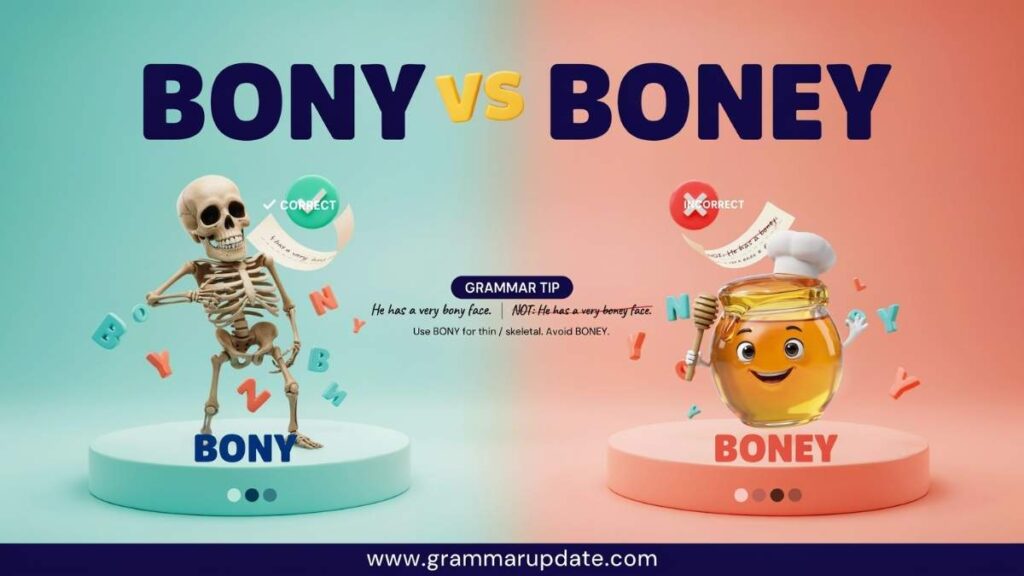
Bony vs boney can be confusing because the two spellings look almost identical. So, are they both correct, or is one a spelling mistake? The answer is simple: bony is the standard and more common spelling, while boney is a less common variant. Both forms appear in English, but knowing which one to use can help you avoid mistakes in your writing. In this guide, you’ll learn what each word means, how they differ, and when to use them. With clear explanations and simple examples, you’ll understand the difference and choose the right spelling with confidence.
quick answer
| Feature | Bony | Boney |
|---|---|---|
| Meaning | Having prominent bones or relating to bones | Generally the same meaning |
| Part of speech | Adjective | Adjective |
| Spelling status | Standard spelling | Less common variant |
| American English | Preferred | Less common |
| British English | Standard spelling | Less common |
| Example | His bony fingers gripped the handle. | His boney fingers gripped the handle. |
Fix common more word mistakes in English
CatchUp vs Catch up Differences and Usage ?
What Does Bony Mean?
Bony is an adjective that describes something with prominent bones or a close connection to the skeletal structure. Its precise meaning depends on the context. When you describe a person as bony, you usually mean that their bones stand out because relatively little flesh covers them. In anatomy, however, the word can describe structures made of or associated with bone.
Bony Definition and Meaning
The word bony has two main uses. It can describe a thin appearance with noticeable bones, or it can refer to a structure associated with bone tissue.
For example, a person may have bony hands, a dog may have a bony frame, and a medical report may mention a bony structure near a joint. Each example uses the same adjective, but the context changes its meaning.
Here are a few examples:
- The old dog had a bony frame.
- She rested her bony hands on the table.
- The doctor examined the bony structure around the joint.
- His bony shoulders showed beneath his loose shirt.
In each sentence, bony describes a person, an animal, or an anatomical feature.
Bony Meaning When Describing a Person
When someone asks about the meaning of a bony person, they usually want to know whether the word means thin or skinny. Although these words overlap, they don’t mean exactly the same thing.
A bony person has noticeable bones, such as prominent cheekbones, visible ribs, or sharply defined joints. However, a person can have a naturally slender build without having especially prominent bones.
The word can also sound critical when you use it to describe someone’s appearance. For a more neutral description, you might say that someone has a slender build or prominent cheekbones.
For example, “She has bony wrists” describes a physical feature, while “She looks too bony” adds a judgment that could sound unkind. Consider your audience before using the word to describe another person.
Bony Meaning When Describing Body Parts
Bony often appears before nouns that refer to parts of the body. These combinations help readers picture a person’s physical features without requiring a lengthy explanation.
| Expression | Meaning | Example |
|---|---|---|
| Bony fingers | Fingers with noticeable bones or joints | His bony fingers tapped the desk. |
| Bony face | A face with prominent facial bones | Her bony face had defined cheekbones. |
| Bony frame | A body with prominent bones and relatively little covering flesh | The coat hung loosely over his bony frame. |
| Bony shoulders | Shoulders where the bones stand out | His bony shoulders showed through the shirt. |
| Bony knees | Knees with prominent kneecaps or little surrounding flesh | Her bony knees protruded beneath the shorts. |
These expressions don’t always suggest poor health. Body shape varies from person to person, and prominent bones can be a natural physical feature.
Bony Meaning in Anatomy and Biology
In anatomy, bony can describe structures made of bone or associated with the skeleton. For example, a bony prominence is a noticeable projection of bone, while a bony structure may refer to part of the skeleton surrounding a joint.
This scientific use differs from the everyday description of a thin person. A medical report that mentions bony tissue doesn’t suggest that someone looks skinny. Instead, the word identifies a particular type of tissue or anatomical feature.
Bony Fish Meaning
The phrase bony fish has a specific meaning in biology. It refers to fish in the group Osteichthyes, whose skeletons consist primarily of bone rather than cartilage. Salmon, tuna, cod, and goldfish are familiar examples.
Sharks and rays, by contrast, belong to the cartilaginous fish group.
The phrase can also appear in everyday discussions about food. For instance, a bony fish fillet contains noticeable bones that someone may need to remove before eating. In this context, bony describes the presence of bones rather than a biological classification.
Learn the difference between often confused words
Wholey vs Wholly difference and usage ?
What Does Boney Mean?
Boney generally carries the same meaning as bony. It can describe a person with prominent bones or something associated with a skeletal structure. The main difference is spelling preference, not meaning.
Although readers can usually understand boney, the form appears less often in standard edited English. Therefore, most writers should choose bony when they want to follow conventional spelling.
Boney Definition and Usage
The boney definition is essentially the same as the definition of bony: having prominent bones or relating to bones.
For example, someone might write, “The old man’s boney hands rested on his walking stick.” The meaning is clear, but the preferred spelling is bony.
The same applies to descriptions such as a boney face or a boney frame. In ordinary writing, use bony face and bony frame instead.
Boney Meaning in English
The phrase boney meaning in English refers to the same basic idea as bony meaning in English. The additional e doesn’t ordinarily create a separate definition.
Consider these examples:
| Less common spelling | Preferred spelling |
|---|---|
| The dog had a boney appearance. | The dog had a bony appearance. |
| She held his boney hand gently. | She held his bony hand gently. |
| His boney shoulders showed beneath the jacket. | His bony shoulders showed beneath the jacket. |
The examples show how the spellings work in similar sentences. However, the standard form makes a better choice for professional documents, educational articles, and other edited content.
Learn the difference between often confused words
Minuscule vs Miniscule which one is correct ?
Bony vs Boney Which Spelling Is Correct?
If you’re asking whether bony vs boney is correct, use bony as your default spelling. It is the standard form in American English and also appears in British, Canadian, and Australian English.
Boney exists as a less common spelling variant, so it would be misleading to claim that nobody uses it correctly. Still, its existence doesn’t make both forms equally common or equally suitable for formal writing.
When to Use Bony
Choose bony for most everyday and professional situations, including school assignments, business reports, blog posts, academic writing, and general communication.
For example, write, “The scan showed a change in the bony structure surrounding the joint.” Similarly, write, “The child had bony knees” when describing noticeable physical features.
Using the standard spelling also makes editing easier. When you write a long article, consistent spelling helps readers follow your ideas without unnecessary distractions.
When Boney May Be Acceptable
Boney may appear in informal writing, older texts, proper names, titles, and quotations. In these situations, the context determines whether you should preserve the spelling.
For example, if a character in a story has the name Boney, retain that spelling when referring to the character. Changing a proper name to Bony could alter the intended name.
The same principle applies to direct quotations. If you’re reproducing someone’s original words, preserve the original spelling when accuracy requires it.
Is Boney a Word?
Yes, boney appears as a spelling variant of bony. However, it remains the less common form, and many writers will rarely need it in ordinary prose.
Dictionaries may differ in how they present spelling variants. Some include a variant under the main entry, while others direct readers toward the more common form. When accuracy matters, check a reputable dictionary and follow the style guide for your publication.
For most writing tasks, you can avoid uncertainty by choosing bony.
Learn the difference between confusing more English words
Patient vs Patience which one is correct ?
Why Do People Confuse Bony vs Boney?
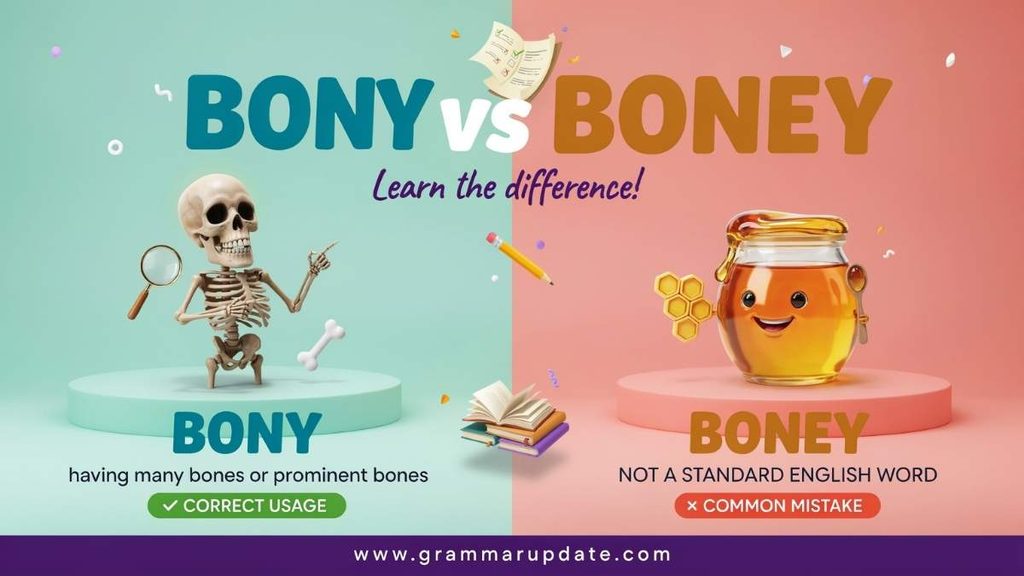
The confusion makes sense because both spellings look plausible. The base word bone ends in a silent e, so writers may assume that the adjective should retain that letter.
However, English spelling conventions don’t always work by keeping every letter from the original word.
The Connection Between Bone and Bony
The adjective bony comes from the noun bone. English forms the standard adjective by dropping the final e and adding y.
The pattern is simple:
Bone → Bony
Other familiar words follow a similar pattern.
| Base word | Derived word | Example |
|---|---|---|
| Noise | Noisy | The noisy room made conversation difficult. |
| Ice | Icy | The icy road required extra care. |
| Grease | Greasy | The greasy pan needed washing. |
| Bone | Bony | His bony fingers wrapped around the cup. |
These examples illustrate a recurring spelling pattern, although not every English word follows the same rule.
Similar Pronunciation
Bony vs boney generally sound alike in English. Both have two syllables, with the stress on the first syllable.
As a result, pronunciation doesn’t usually help you choose the correct spelling. If you hear someone say the word, you won’t necessarily know which form they would write.
Instead, rely on standard usage and the spelling pattern. When you’re unsure, checking a dictionary takes only a moment.
Informal Writing and Online Usage
Informal messages and online posts often contain spelling variants. Writers may type quickly, retain the final e by mistake, or copy a form they have seen elsewhere.
However, seeing a word online doesn’t automatically make it the preferred spelling. A reader will probably understand a sentence such as “His boney fingers held the cup,” but an editor would generally change it to “His bony fingers held the cup.”
The key distinction is that a recognizable word isn’t always the best choice for formal writing.
Learn the difference between confusing more English words
Drier vs Dryer Which one Is Correct?
Bony vs Boney Key Differences
The main differences involve spelling convention and frequency. Both forms function as adjectives and generally carry the same meaning.
| Category | Bony | Boney |
|---|---|---|
| Spelling | Standard form | Less common variant |
| Meaning | Having prominent bones or relating to bones | Generally the same |
| Grammar | Adjective | Adjective |
| Formal writing | Preferred | Usually avoided |
| Everyday writing | Recommended | Less common |
| Proper names | Use when intended | Preserve when part of a name |
Spelling Difference
Bony contains four letters, while boney contains five. The extra e doesn’t ordinarily create a new meaning. Instead, it marks a less common spelling variant.
Grammar and Word Usage
Both forms function as adjectives and can modify nouns such as fingers, face, frame, and structure.
For example, “The bony fingers held the pencil” and “The boney fingers held the pencil” follow the same grammatical structure. The difference lies in spelling preference.
Frequency and Writing Style
Bony is the better choice when you want to follow standard English usage. In edited content, consistent spelling also matters. Avoid switching between bony structure and boney structure in the same article without a specific reason.
Learn the difference between confusing more English words
Foodie vs Foody Which One Is Correct?
Spelling Rules Why Is It Bony Instead of Boney?
The spelling becomes easier to remember when you connect the adjective to its base word.
How Bony Forms From Bone
English forms bony by removing the final e from bone and adding y.
The transformation looks like this:
- Base word: bone
- Remove the final e: bon
- Add y: bony
The result is an adjective that describes something characterized by bones or associated with them.
Although this pattern works for bony, don’t assume that every word ending in e follows precisely the same rule. English contains exceptions, and some derived words retain the final e.
Why Boney Looks Possible
Boney looks logical because it preserves the entire base word bone before adding y. Writers may assume that keeping the original spelling makes the derived form correct.
However, familiar-looking spelling patterns don’t always determine the standard form. In this case, bony is the established spelling.
To remember the distinction, focus on the familiar relationship between bone and bony rather than trying to create a new spelling rule.
Bony vs Boney Pronunciation
Pronunciation doesn’t usually distinguish these spellings. Both generally have two syllables and first-syllable stress.
How to Pronounce Bony
In American English, bony is commonly pronounced BOH-nee. The first syllable carries the stress, while the final syllable has a long e sound.
How to Pronounce Boney
Boney generally has the same pronunciation. The extra written e doesn’t normally create another syllable or change the sound.
Therefore, if you need to distinguish the two forms, focus on spelling rather than pronunciation.
Word Origin of Bony vs Boney
The history of both forms connects to the word bone, which has a long history in English.
Origin of Bone
The word bone comes from Old English bān. It has Germanic roots and has referred to the hard structures that form the skeleton throughout its history.
Today, bone refers to an individual skeletal structure or the hard tissue that supports and protects parts of the body.
Development of Bony
English formed the adjective bony from bone. The word developed its familiar uses, including descriptions of prominent bones and anatomical structures.
Today, writers use it in everyday conversation, literature, medical descriptions, and biological writing.
Development of Boney
Boney functions as a spelling variant of bony. It doesn’t ordinarily represent a separate word with a distinct meaning.
Without reliable historical evidence for a precise timeline, it’s best not to assign the variant an exact date of origin. For modern writing, the key point is that bony remains the preferred form.
Learn the difference between confusing more English words
Habit vs Habbit Which Spelling Is Correct ?
Bony vs Boney in American and British English
Some English words have different standard spellings in different countries. Bony isn’t one of those cases.
American English Spelling
American English favors bony. Use it in school assignments, workplace documents, website content, and general communication.
For example, an American writer would normally describe prominent cheekbones as part of a bony face rather than a boney face.
British English Spelling
The British English also uses bony as the standard spelling. British writers don’t need to retain the final e simply because the base word is bone.
Therefore, boney isn’t the standard British alternative.
Canadian and Australian English Spelling
Canadian and Australian English also use bony as the standard form. Writers in these regions can generally follow the same spelling preference as American and British writers.
| Variety of English | Preferred spelling |
|---|---|
| American English | Bony |
| British English | Bony |
| Canadian English | Bony |
| Australian English | Bony |
This comparison shows that the difference is primarily about standard usage rather than regional spelling.
Bony vs Boney Examples in Everyday Writing
Examples help you apply the spelling correctly in different situations.
Examples in Daily Conversation
- His bony fingers struggled to open the jar.
- The old dog had a bony frame after its illness.
- She rested her chin on her bony hands.
- His bony knees showed through the holes in his jeans.
- The character had a long, bony face and sharp cheekbones.
Each sentence uses bony as an adjective to describe a physical feature.
Examples in Professional Writing
The word also appears in medical and anatomical descriptions.
- The scan showed a change in the bony structure surrounding the joint.
- The report described a prominent bony projection near the elbow.
- The specialist examined the bony landmarks before completing the assessment.
These examples use bony in an anatomical sense. They don’t suggest that a person is skinny.
Examples in Academic Writing
In biology and anatomy, bony can describe the composition or structure of bones.
- Bony tissue provides structural support to the skeleton.
- The human skeleton contains bones that protect internal organs and support movement.
- Bony fish have skeletons made primarily of bone rather than cartilage.
These sentences show how context determines the word’s meaning.
Examples in Creative Writing
Writers often use physical details to make characters more vivid. For instance, “The stranger extended a bony hand from beneath his oversized coat” gives readers a clear visual impression.
Depending on the story, the description might suggest age, hardship, frailty, or simply a particular body shape. Use the word when it supports the scene, but avoid repeating it so often that your descriptions become predictable.
Learn the difference between confusing word pairs
Endure vs Indure Which Spelling Is Correct?
Common Mistakes With Bony vs Boney
Even a small spelling difference can cause uncertainty. These are the main mistakes to avoid.
Using Boney as the Default Spelling
Some writers retain the e because the base word is bone. However, the preferred adjective is bony.
Less preferred: The dog had a boney nose.
Preferred: The dog had a bony nose.
The correction follows standard spelling without changing the meaning.
Assuming Boney Has a Different Meaning
Adding the e doesn’t ordinarily change the adjective’s meaning. Both forms generally describe prominent bones or something related to bones.
When comparing the spellings, focus on standard usage rather than inventing a difference between their definitions.
Thinking Boney Is Always Wrong
It’s also misleading to claim that boney can never appear in acceptable English. The spelling exists as a less common variant and may appear in names, quotations, or informal text.
The better approach is to prefer bony in ordinary writing while considering the context before correcting the alternative.
Confusing Bony With Bonny
Bony and bonny look similar, but their meanings differ.
| Word | Meaning | Example |
|---|---|---|
| Bony | Having prominent bones or relating to bones | The dog had a bony frame. |
| Boney | Less common variant of bony | His boney fingers held the cup. |
| Bonny | Attractive, pretty, or pleasing, especially in British and Scottish usage | The song described a bonny lass. |
Remember that bonny describes beauty or attractiveness, while bony describes bones or bone-related features.
Memory Tricks to Remember Bony vs Boney
You don’t need a complicated rule to remember the difference. A simple connection to the base word is enough.
Remember the Bone-to-Bony Pattern
Think of the transformation: bone becomes bony. The final e disappears when the standard adjective forms.
Choose the Shorter Standard Spelling
When describing prominent bones, use bony. You don’t need the extra e in expressions such as bony fingers, bony knees, or bony structure.
Check the Context Before Correcting Boney
If you see Boney in a person’s name or an exact quotation, don’t automatically change it. First determine whether it’s a proper name, a deliberate spelling, or an ordinary adjective.
This simple check helps you avoid unnecessary corrections.
Learn the difference between confusing word pairs
Accommodate vs Accomodate Which one Is Correct?
Synonyms and Antonyms for Bony
Related words can help you choose more precise descriptions. However, synonyms aren’t interchangeable in every context.
Bony Synonyms for Physical Appearance
| Synonym | Meaning | Example |
|---|---|---|
| Thin | Having relatively little body mass or width | He was thin after a long illness. |
| Skinny | Very thin; often informal | The skinny cat squeezed through the gap. |
| Scrawny | Unusually thin, often suggesting little flesh or strength | The scrawny puppy needed proper care. |
| Gaunt | Thin and often drawn-looking, especially after illness or hardship | Her gaunt face showed signs of exhaustion. |
| Lean | Having little excess body fat; often neutral or positive | The athlete had a lean build. |
| Skeletal | Resembling a skeleton or extremely thin | The abandoned building had a skeletal frame. |
| Angular | Having sharp angles or prominent contours | His angular face had defined cheekbones. |
| Emaciated | Abnormally thin, often because of severe undernutrition or illness | The rescued animal appeared emaciated. |
Choose the word that best fits the situation. For example, lean often sounds neutral or positive, while scrawny can sound negative. Emaciated usually suggests severe thinness associated with illness or inadequate nutrition.
Bony Synonyms for Anatomical Structures
When describing bones or anatomy, useful alternatives include osseous and skeletal.
Osseous means relating to bone or consisting of bone. It often appears in medical and scientific writing. Skeletal refers to the skeleton or its structure.
For example, osseous tissue is a technical term, while skeletal structure is a broader description. Neither word replaces bony naturally in every sentence.
Related Words: Bone, Boneless, Skeletal, and Osseous
Several words share a connection with bony:
- Bone: The hard connective tissue that forms the skeleton of humans and many animals.
- Boneless: Having no bones or having the bones removed, as in boneless chicken.
- Skeletal: Relating to the skeleton or resembling it.
- Osseous: Relating to bone, especially in scientific and medical contexts.
- Bonelike: Resembling bone in appearance, texture, or another characteristic.
These words have related meanings but serve different purposes. Boneless describes the absence or removal of bones, while bony often emphasizes their presence or prominence.
What Are the Antonyms of Bony?
The opposite of bony depends on the context. When describing someone’s appearance, possible contrasts include fleshy, plump, chubby, and rounded.
However, none of these words works as a universal opposite. A fleshy hand has more flesh or soft tissue, while a rounded face describes shape.
When bony refers to an anatomical structure, the best contrast may depend on the tissue or feature under discussion. Bone and cartilage, for instance, are different tissues, but they aren’t simple opposites in every context.
Choose an antonym that matches the sentence rather than relying on one word for every use.
Learn the difference between tricky grammar more words
Occurring vs Occuring Which one Is Correct?
practice session Bony vs Boney
Complete each sentence with the correct word: bony vs boney. Check your understanding of their meanings, spelling, and usage.
1. The old man had a thin face with a very ______ appearance.
2. The doctor examined the patient’s ______ structure.
3. The fish belongs to a group commonly known as ______ fish.
4. After losing weight, his arms looked unusually ______.
5. The scientist studied the ______ framework of the human body.
6. Her ______ fingers wrapped around the small cup.
7. The skeleton provides support through the body’s ______ structures.
8. The dog looked thin, with its ______ ribs clearly visible.
9. Many fish have skeletons made primarily of bone and are called ______ fish.
10. The child’s ______ knees showed through the torn pants.
11. The word ______ usually describes something related to bones or having prominent bones.
12. The artist drew a ______ hand with every joint clearly visible.
13. The patient’s ______ shoulders became noticeable after significant weight loss.
14. In anatomy, the term ______ structure refers to the framework formed by bones.
15. The hiker’s face appeared ______ after several days without enough food.
16. A shark has a skeleton made primarily of cartilage rather than the typical skeleton of ______ fish.
17. The word formed by dropping the final “e” from “bone” and adding “y” is ______.
18. The puppy’s ______ legs looked long and thin.
19. The doctor explained how ______ tissue supports and protects the body.
20. His ______ appearance made his cheekbones and jawline stand out.
21. The writer used the word ______ to describe the character’s thin wrists.
22. The marine biologist compared cartilaginous fish with ______ fish.
23. Although “boney” appears as a spelling variant, “______” is the more common standard spelling.
24. The patient’s ______ hands had prominent knuckles.
25. When describing a person whose bones are clearly visible, ______ is generally the preferred spelling.
Answers
- bony
- bony
- bony
- bony
- bony
- bony
- bony
- bony
- bony
- bony
- bony
- bony
- bony
- bony
- bony
- bony
- bony
- bony
- bony
- bony
- bony
- bony
- bony
- bony
- bony
Here’s a trusted source for clear word meanings:
FAQs
Can “bony” describe things other than a person’s appearance?
Yes. “Bony” can describe body parts, anatomical structures, or animals with prominent bones. For example, a person might have bony fingers, or a doctor might describe a bony growth.
Is “bony” suitable for formal and academic writing?
Yes. “Bony” is appropriate in formal writing, medical explanations, and biology discussions. In technical contexts, the term “osseous” may be more precise when referring specifically to bone tissue.
What is the difference between bony and skeletal?
“Bony” describes something related to bones or having prominent bones. “Skeletal” usually refers to the skeleton or can describe someone who appears extremely thin. For example, you might describe a person’s bony hands or discuss the skeletal structure of the human body.
Can you describe fish or meat as bony?
Yes. You can use “bony” to describe fish or meat that contains many bones. For example, “The fish tasted delicious, but it was too bony to eat comfortably.” The word describes the amount or prominence of the bones, not the food’s flavor.
Learn the difference between confusing word pairs
Coozie vs Koozie Which one Is Correct and usage ?
Conclusion
Now you know the difference between bony vs boney. Bony is the standard and more common spelling when describing prominent bones or something related to bones. Boney is a less common variant, but you’ll usually want to use bony in everyday and formal writing. The spelling trick is simple: drop the final e from bone and add y to get bony. Also, don’t mix up bony with bonny, which means attractive or pleasing. One small spelling choice can make your writing clearer, so remember: when in doubt, go with bony!

Jhon AJS, the creative mind behind Grammar Update, is an experienced blogger passionate about simplifying English grammar. He focuses on explaining confusing word vs word differences, grammar rules, punctuation, and sentence structure in a clear and practical way. Through easy to understand guides and examples, Jhon helps readers improve their writing and communicate with confidence. With years of blogging experience, he continues to share helpful insights that make learning grammar simple, useful, and accessible for everyone.