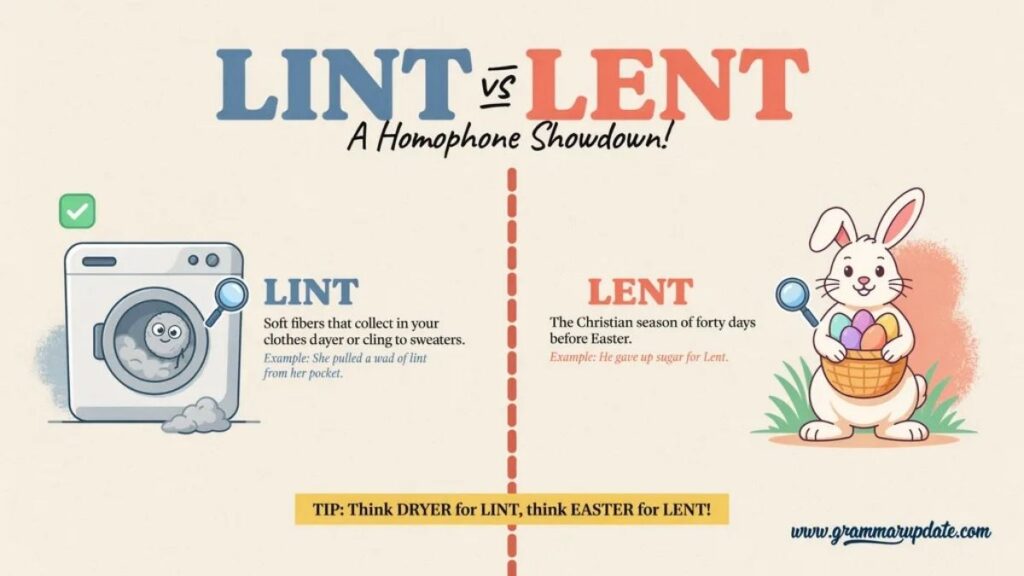
Have you ever seen the words “lint” and “Lent” and wondered if they meant the same thing? You’re not the only one. Because they differ by just one letter, many people use the wrong word without realizing it. The good news is that the difference is simple once you know what each word means. In this complete guide to lint vs lent, you’ll learn when to use each word, why Lent is capitalized, how the past tense of lend is different, and how to avoid this common spelling mistake. With easy explanations, real-life examples, and helpful grammar tips, you’ll use the correct word with confidence every time.
Lint vs Lent Quick Answer
Here’s the simplest way to remember the difference.
| Word | Meaning | Part of Speech | Example |
|---|---|---|---|
| Lint | Tiny fibers, dust, or fuzz from fabric | Common noun | There’s lint in the dryer trap. |
| Lent | The Christian season before Easter or the past tense of lend | Proper noun or verb | Christians observe Lent before Easter. She lent me her notebook. |
The answer is simple:
- Use lint when talking about fuzzy fibers on clothing or inside a dryer.
- Use Lent with a capital “L” when referring to the Christian fasting season before Easter.
- Use lent with a lowercase “l” only as the past tense of lend.
This simple distinction explains the lint vs lent grammar question that confuses many English learners.
Quick Facts
| Question | Answer |
|---|---|
| What is lint? | Tiny fabric fibers that collect on clothes and in dryers. |
| What is Lent? | A Christian season of prayer, fasting, and preparation before Easter. |
| Is Lent capitalized? | Yes, when referring to the religious season. |
| Is lint capitalized? | No, unless it starts a sentence. |
| Is Lent the past tense of lend? | No. The past tense of lend is lent, but the religious season Lent is a different word with a different origin. |
Learn the difference between confusing more English words
Dammit vs Damn It Which One Is Correct?
What Does Lint Mean?
The lint meaning is straightforward. Lint refers to tiny pieces of fiber that come off fabric, towels, blankets, carpets, and clothing during normal use or washing. These fuzzy fibers often gather in pockets, on dark clothing, or inside a dryer.
If you’ve ever cleaned the lint trap after drying clothes, you’ve already seen lint.
Lint Definition
Lint is a common noun that describes soft, loose fibers that separate from cloth over time. These fibers may mix with dust and lint from the air to create small fuzzy clumps.
In everyday English, lint usually appears in conversations about laundry, clothing care, and household cleaning.
Common Sources of Lint
You can find fabric lint almost anywhere.
- Dryer lint inside the lint trap
- Lint on clothes after washing
- Pocket lint
- Blankets and towels
- Sweaters made from wool
- Dust and lint around furniture
- Pet hair mixed with fuzzy fibers
Removing lint regularly helps clothing last longer and improves dryer safety.
Why Does Dryer Lint Matter?
Many people overlook dryer lint, but cleaning it is important.
When lint builds up inside a dryer trap, it blocks airflow. Poor airflow forces the dryer to work harder, increases drying time, and raises energy use. More importantly, excessive lint can become a fire hazard because the fibers are highly flammable.
Cleaning the lint trap after every load is one of the simplest ways to keep a dryer running safely.
Everyday Examples of Lint
These examples show how naturally the word appears in conversation.
- I cleaned the lint trap before starting another load.
- There’s white lint on your black jacket.
- This sweater leaves lint everywhere.
- Use a lint roller before your interview.
- The blanket sheds tiny fabric fibers.
Notice that every sentence refers to clothing, fabric, or fuzzy fibers.
Common Expressions Using Lint
Although lint has one main meaning, you’ll hear it in several common expressions.
| Expression | Meaning |
|---|---|
| Lint roller | A sticky roller used to remove lint from clothing. |
| Lint trap | The filter inside a clothes dryer that collects fibers. |
| Pocket lint | Small bits of lint found inside pockets. |
| Remove lint | Clean fuzzy fibers from clothing or household items. |
| Clothing lint | Fibers attached to garments after washing or wearing. |
These phrases appear frequently in household guides, cleaning instructions, and clothing care articles.
Historical Meaning of Lint
Before modern medical supplies became common, lint also referred to soft linen fibers used for dressing wounds.
Doctors and nurses once placed clean lint over injuries because it helped absorb fluids and protect damaged skin.
Although this older meaning still appears in historical texts, most people today associate lint with laundry and clothing.
Easy Way to Remember Lint
Here’s a simple trick.
Think of the letter “I” in lint as standing for “inside.”
- Inside the dryer
- Inside your pocket
- Inside your washing machine
If you’re talking about fuzzy fibers, lint is always the correct choice.
Learn the difference between confusing more English words
Choose vs Chose Difference which one is correct?
What Does Lent Mean?
Unlike lint, Lent has nothing to do with clothing or laundry.
The Lent meaning refers to an important season in Christianity. It is a period of reflection, prayer, fasting, and preparation before Easter Sunday.
Millions of Christians around the world observe Lent every year as part of their religious tradition.
Lent Definition
Lent is the forty-day season leading up to Easter, not counting Sundays in many Christian traditions.
It begins on Ash Wednesday and ends shortly before Easter Sunday. During this time, many Christians focus on spiritual growth through prayer, repentance, fasting, and acts of generosity.
When referring to the religious season, Lent is always capitalized because it is a proper noun.
What Is Lent?
If someone asks, “What is Lent?” the simplest answer is this:
Lent is a Christian observance that prepares believers for Easter by encouraging reflection, self-discipline, and renewed faith.
Many churches hold special services throughout the season, and some people choose to give up certain foods or habits as a personal reminder of their spiritual commitment.
Lent Season Meaning
The Lent season meaning goes beyond simply avoiding certain foods.
For many Christians, Lent is a time to:
- Pray more regularly.
- Read the Bible.
- Reflect on personal growth.
- Practice forgiveness.
- Help people in need.
- Prepare spiritually for Easter.
These traditions have been observed for centuries across many Christian denominations.
The Forty Days of Lent
The 40 days of Lent symbolize the forty days Jesus spent fasting in the wilderness before beginning His public ministry.
Because Sundays are traditionally considered celebration days in many churches, they are usually not included in the forty-day count.
This connection explains why fasting, prayer, and repentance remain central themes throughout the season.
Common Lent Traditions
Although customs vary around the world, many Christians participate in similar practices.
- Prayer and fasting
- Reading Scripture
- Attending church services
- Giving something up for Lent
- Donating to charities
- Performing acts of kindness
- Preparing for Holy Week and Easter
These traditions help believers focus on faith rather than everyday distractions.
Is Lent Mentioned in the Bible?
This question often appears in searches for lint vs lent Bible meaning.
The word “Lent” does not appear in most English Bible translations.
However, the practices associated with Lent have biblical foundations.
Examples include:
- Jesus fasting for forty days in the wilderness.
- Prayer and repentance.
- Acts of charity.
- Preparing spiritually before important events.
Because of these biblical themes, many churches observe Lent even though the season itself is a later Christian tradition.
Why Is Lent Capitalized?
One of the biggest grammar questions is whether Lent should have a capital letter.
The answer is yes.
Lent is the name of a specific religious season in the Christian calendar, making it a proper noun.
Compare these examples.
Correct:
- Lent begins on Ash Wednesday.
- Many Christians fast during Lent.
Incorrect:
- lent begins on Ash Wednesday.
The lowercase word lent has an entirely different meaning because it is the past tense of lend.
Easy Way to Remember Lent
Here’s a helpful memory trick.
Think of the capital “L” in Lent as standing for “Lord.”
When you’re talking about Christianity, Easter, prayer, or the Christian calendar, the capitalized word Lent is the correct spelling.
Learn the difference between confusing more English words
Then vs Than difference which one is correct ?
Lint vs Lent Side-by-Side Comparison
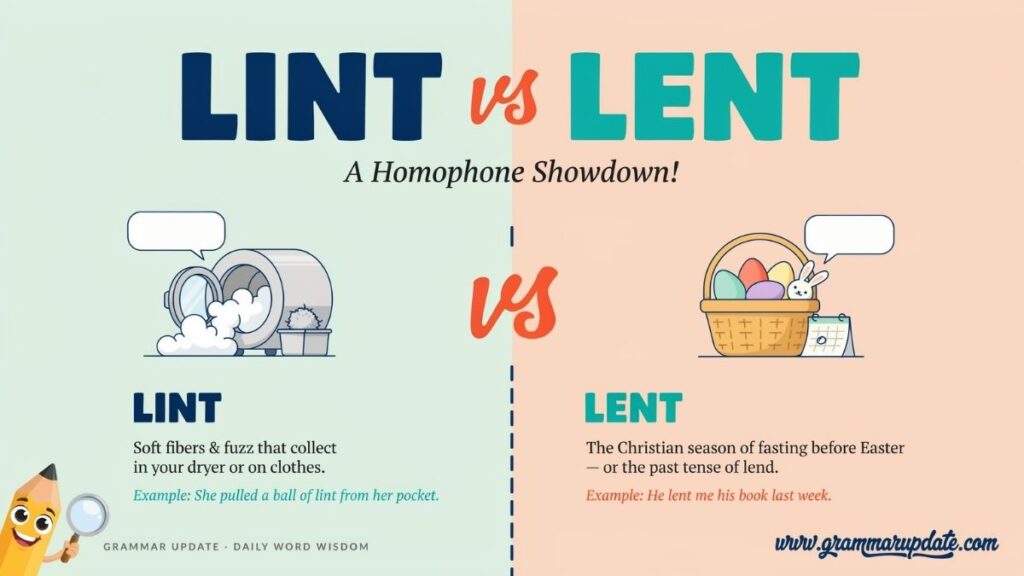
Although lint and Lent look almost identical, they belong to completely different categories of English vocabulary. One is a common noun related to fabric. The other is either a proper noun for a religious season or the past tense of the verb lend.
This table makes the lint vs lent difference easy to understand.
| Feature | Lint | Lent |
|---|---|---|
| Meaning | Tiny fabric fibers or fuzz | Christian season before Easter or the past tense of lend |
| Part of Speech | Common noun | Proper noun or verb |
| Pronunciation | /lɪnt/ | /lɛnt/ |
| Capitalized? | No | Yes, when referring to the Christian season |
| Common Context | Laundry, clothing, cleaning | Christianity, grammar, lending |
| Example | Clean the lint trap. | We observed Lent this year. |
| Related Words | Lint roller, dryer lint, fabric lint | Easter, Ash Wednesday, Holy Week, lend |
The difference between lint and Lent becomes much easier to remember once you connect each word with its usual setting. If you’re talking about clothes or fuzzy fibers, use lint. If you’re discussing Christianity or the past tense of lend, use lent or Lent depending on the meaning.
Learn the difference between often confused words
Firey vs Fiery difference Which one Is Correct?
Lint vs Lent Meaning Explained
The lint vs lent meaning often confuses English learners because the words are similar in spelling and pronunciation. However, they have no connection in origin or definition.
Lint refers to tiny pieces of fabric that collect on clothing, blankets, towels, and inside dryers.
Lent, on the other hand, usually refers to the Christian fasting season before Easter. The lowercase word lent is also the past tense of lend.
Once you understand these meanings, choosing the correct word becomes much easier.
Why People Confuse Lint and Lent
Several factors make these words easy to mix up.
- They differ by only one letter.
- Their pronunciation is very similar.
- Both are short English words.
- Spell-check may not catch the mistake because both are correctly spelled words.
- Many people know one word better than the other.
For example, someone unfamiliar with Christianity might accidentally write “Lint begins on Ash Wednesday,” even though the correct word is Lent.
Likewise, someone typing quickly might write “Please clean the Lent trap,” when they actually mean the lint trap.
One Letter Makes a Big Difference
Changing a single letter completely changes the meaning.
| Incorrect | Correct |
|---|---|
| The lint season begins in spring. | The Lent season begins before Easter. |
| Clean the Lent trap. | Clean the lint trap. |
| I found Lent on my sweater. | I found lint on my sweater. |
| We celebrated lint before Easter. | We celebrated Lent before Easter. |
This is why lint vs lent grammar matters in everyday writing.
Easy Memory Trick
A simple memory trick can prevent mistakes.
Remember these three clues.
For lint:
- Think of fibers.
- Think of fabric.
- Think of your dryer.
For Lent:
- Think of Easter.
- Think of prayer.
- Think of the Christian calendar.
1.If the sentence mentions clothing, laundry, or fuzzy fibers, choose lint.
2.If it mentions Easter, fasting, church, or Ash Wednesday, choose Lent.
3.If the sentence talks about giving someone something temporarily, choose lent because it is the past tense of lend.
Learn the difference between often confused words
Trey vs Tray What’s the Difference?
Lint vs Lent in the Bible
Many people search for lint vs lent Bible because they wonder whether both words appear in Scripture.
The answer is simple.
Lint has no special biblical meaning.
Lent is closely connected with Christian tradition, but the season itself is not specifically named in most English Bible translations.
Does the Bible Mention Lent?
The word Lent does not appear in most modern English translations of the Bible.
However, many of the practices associated with Lent come directly from biblical teachings.
These include:
- Prayer
- Fasting
- Repentance
- Generosity
- Spiritual preparation
Because these themes appear throughout Scripture, Christians have observed Lent for centuries as a time to strengthen their faith.
Jesus and the Forty Days
The tradition of Lent is closely linked to Jesus fasting for forty days in the wilderness before beginning His ministry.
According to the Gospels, Jesus spent forty days praying and fasting while resisting temptation.
That event became the model for the 40 days of Lent observed in many Christian churches today.
Biblical Themes Behind Lent
Although churches observe Lent in different ways, most focus on similar spiritual goals.
- Growing closer to God through prayer
- Turning away from sin through repentance
- Practicing self-control through fasting
- Helping people in need
- Preparing for Easter Sunday
These practices explain the lint vs lent Christian meaning that many readers want to understand.
Learn the difference between often confused words
Mold vs Mould Which Spelling Is Correct?
Is It Lent Right Now?
One of the most common online searches is “Is it Lent right now?”
The answer depends entirely on today’s date because Lent changes every year.
Unlike holidays with fixed calendar dates, Lent follows the date of Easter.
When Does Lent Begin?
Lent begins on Ash Wednesday.
Ash Wednesday marks the start of the Christian fasting season and reminds believers of humility, repentance, and spiritual renewal.
Many churches hold special services where ashes are placed on worshippers’ foreheads as a symbol of repentance.
When Does Lent End?
Different Christian traditions mark the end of Lent in slightly different ways.
Many churches consider Lent to end before the evening Mass of the Lord’s Supper on Holy Thursday.
Others view the season as concluding on Holy Saturday before Easter Sunday.
Either way, Lent prepares Christians for Easter, the celebration of Jesus’ resurrection.
Holy Week
The final week before Easter is known as Holy Week.
Important days include:
- Palm Sunday
- Holy Thursday
- Good Friday
- Holy Saturday
- Easter Sunday
These events form the most important period in the Christian calendar.
Why the Dates Change
The Easter season follows a traditional calendar calculation rather than a fixed date.
As a result:
- Ash Wednesday changes every year.
- Lent season dates also change.
- Easter Sunday falls on a different date each year.
If you’re wondering, “Is it Lent right now?” simply check the current year’s Christian calendar.
Learn the difference between often confused words
Defense vs Defence Which Spelling Is Correct?
How to Use Lint and Lent Correctly in Sentences
One of the easiest ways to master confused words is by reading real examples.
The following lint vs lent sentences show how each word works naturally.
Sentences with Lint
These examples all use lint correctly.
- Please clean the lint trap after every load of laundry.
- My black shirt attracts lint very easily.
- The blanket leaves fabric lint all over the couch.
- I used a lint roller before the meeting.
- Pocket lint collected at the bottom of my jeans.
Notice that every sentence relates to clothing, cleaning, or fabric fibers.
Sentences with Lent
These examples refer to the Christian season.
- Our church begins Lent with an Ash Wednesday service.
- Many families pray together during Lent.
- She decided to give up chocolate for Lent.
- Lent encourages prayer, fasting, and generosity.
- Holy Week takes place near the end of Lent.
Each sentence focuses on Christianity rather than laundry.
Sentences Using Lent as the Past Tense of Lend
The lowercase word lent has a completely different meaning in these examples.
- My neighbor lent me a ladder.
- She lent a book to her teacher.
- He lent someone money during an emergency.
- Dad lent me his truck for the weekend.
- My sister lent me a pen during class.
These examples answer another common question: “What is the past tense of lend?”
The answer is always lent.
Quick Comparison
| Sentence | Correct Word |
|---|---|
| Clean the dryer trap. | Lint |
| We attended church during Easter season. | Lent |
| My friend gave me a book temporarily. | Lent |
| My sweater is covered with fuzzy fibers. | Lint |
| Christians prepare for Easter. | Lent |
Learn the difference between often confused words
Fliers vs Flyers Which Spelling Is Correct and Usage?
Pronunciation Guide
The lint vs lent pronunciation is another reason people confuse these words.
Both begin with the same “L” sound and end with a “T” sound. Only the middle vowel changes slightly.
| Word | Pronunciation | Sounds Like |
|---|---|---|
| Lint | /lɪnt/ | “lint” with a short “i” sound |
| Lent | /lɛnt/ | “lent” with a short “e” sound |
When spoken quickly, the difference may be difficult to hear, especially for English learners.
Tips for Better Pronunciation
Try these simple techniques.
- Say “pin” before saying lint to match the short “i” sound.
- Say “pen” before saying Lent to match the short “e” sound.
- Practice each word in complete sentences instead of saying them alone.
- Listen to native speakers pronounce both words and repeat them aloud.
Word Origins and Etymology
Learning where words come from can make them much easier to remember. Although lint and Lent look alike, they have completely different histories.
Origin of Lint
The word lint comes from older Germanic languages and originally referred to fibers from linen. Over time, its meaning expanded to include the tiny fuzzy fibers that come off clothing, towels, blankets, and other fabrics.
Today, when people ask, “What is lint?” they almost always mean the soft fibers found on clothes or collected in a dryer lint trap.
Origin of Lent
The word Lent has a very different background. It comes from an Old English word meaning “spring” or “lengthening,” referring to the time of year when the days become longer.
As Christianity spread through England, the word became the name of the religious season leading up to Easter. That’s why Lent is capitalized when it refers to the Christian observance.
Different Histories, Different Meanings
Although the spellings are similar, these words developed independently.
| Word | Origin | Modern Meaning |
|---|---|---|
| Lint | Old Germanic languages | Fabric fibers or fuzz |
| Lent | Old English | Christian season before Easter or the past tense of lend |
Their similar appearance is simply a coincidence. There is no historical relationship between the two words.
Learn the difference between often confused words
Alot vs A Lot vs allot Which is Correct and Usage
Lint vs Lent Grammar Explained
The lint vs lent grammar question usually comes down to understanding parts of speech and capitalization.
Lint is always a common noun.
Lent can be either:
- A proper noun referring to the Christian season.
- The past tense of the verb lend.
Knowing which role the word plays makes choosing the correct spelling easy.
Lint Is a Common Noun
A common noun names a general thing instead of a specific one.
Examples include:
- Lint covered my sweater.
- I emptied the lint trap.
- Remove the lint before wearing the jacket.
Unless it begins a sentence, lint is never capitalized.
Lent as a Proper Noun
When referring to the Christian observance, Lent is a proper noun because it names a specific season.
Correct examples:
- Lent begins on Ash Wednesday.
- Many churches observe Lent every year.
- Easter follows Lent.
Incorrect examples:
- lent begins on Ash Wednesday.
- We celebrate lent every spring.
Lent as the Past Tense of Lend
The lowercase word lent is the simple past tense and past participle of lend.
Examples include:
- She lent me her calculator.
- I lent my neighbor a ladder.
- They lent us camping equipment.
This use has nothing to do with Christianity.
Lend vs Lent
Many learners also confuse lend vs lent.
Here’s the difference.
| Word | Function | Example |
|---|---|---|
| Lend | Present tense verb | Please lend me your notebook. |
| Lent | Past tense of lend | She lent me her notebook yesterday. |
Think of it this way.
- Today you lend.
- Yesterday you lent.
That simple pattern works every time.
Learn the difference between often confused words
Girlie vs Girly Which Spelling Is Correct?
Common Mistakes with Lint and Lent
Because these words look alike, writers often choose the wrong one without realizing it.
Here are the most common grammar mistakes.
Mistake One Using Lint Instead of Lent
Incorrect:
- We observe lint before Easter.
Correct:
- We observe Lent before Easter.
Remember that the Christian season always uses a capital L.
Mistake Two Capitalizing Lint
Incorrect:
- There is Lint on my shirt.
Correct:
- There is lint on my shirt.
Since lint is a common noun, it stays lowercase unless it starts a sentence.
Mistake Three Confusing Lent with the Past Tense of Lend
Incorrect:
- She Lent me a book yesterday.
Correct:
- She lent me a book yesterday.
The religious season is capitalized. The verb is not.
Mistake Four Mixing Up Context
Sometimes the sentence itself tells you which word belongs.
Incorrect:
- Please clean the Lent trap.
Correct:
- Please clean the lint trap.
Incorrect:
- We celebrated lint during Holy Week.
Correct:
- We celebrated Lent during Holy Week.
Reading the entire sentence usually makes the correct choice obvious.
British vs American English
Many spelling comparisons involve differences between British and American English.
Fortunately, lint vs lent English has no regional spelling differences.
Whether you’re writing in the United States, Canada, Australia, or the United Kingdom, the spellings remain exactly the same.
| Word | American English | British English |
|---|---|---|
| Lint | Lint | Lint |
| Lent | Lent | Lent |
| Lent (past tense of lend) | Lent | Lent |
This means you never need to change the spelling based on your audience.
The only thing that changes is the context.
Learn the difference between often confused words
Molding vs Moulding Which Spelling Is Correct and Usage?
Lint vs Lent in Everyday Examples
Reading real-life examples is one of the fastest ways to master confused words.
Around the House
- Clean the lint trap after every load.
- Dust and lint collected behind the television.
- My black jacket attracts lint easily.
- This towel leaves fuzzy fibers everywhere.
Church
- Our family attends church every Sunday during Lent.
- Many people fast during Lent.
- Holy Week is the final week of Lent.
- Easter Sunday follows the Lent season.
School
- The teacher explained the difference between lint and Lent.
- Students completed a vocabulary lesson on commonly confused words.
- The class practiced capitalization rules.
Work
- Someone left lint on the conference room chairs.
- My coworker lent me a charger during the meeting.
- The office held a clothing drive during Lent.
These examples show how the surrounding words immediately reveal the correct spelling.
Lint vs Lent for Kids
Children often learn these words while building their English vocabulary.
A simple explanation works best.
Lint is the fuzzy stuff that sticks to your clothes.
Lent is a special time before Easter when many Christians pray, help others, and sometimes give up something they enjoy.
Here’s an easy memory trick for kids.
- Lint lives in the laundry room.
- Lent lives on the church calendar.
Because the two words belong in completely different places, they’re much easier to remember.
Learn the difference between tricky grammar more words
Muscle vs Mussel Which is Difference and usage?
How to Remember Lint vs Lent
If you still hesitate before choosing the correct spelling, these memory tricks can help.
Memory Trick One
Lint has the letter “i.”
Think of “inside the dryer.”
Memory Trick Two
Lent starts with a capital “L.”
Think of “Lord” and “Lent.”
Memory Trick Three
If someone borrows something, think about the verb lend.
Today:
- I lend my friend a pen.
Yesterday:
- I lent my friend a pen.
Memory Trick Four
Ask yourself one simple question.
Am I talking about clothing or Christianity?
1.If it’s clothing, choose lint.
2.If it’s Christianity, choose Lent.
3.If it’s borrowing something, choose lent.
These quick checks eliminate almost every mistake.
Lint vs Lent Explained
The lint vs lent explained answer is surprisingly simple.
Although the words differ by only one letter, they belong to entirely different topics.
- Lint refers to tiny fabric fibers found on clothing or inside dryers.
- Lent refers to the Christian season before Easter.
- Lent is also the past tense of lend when written with a lowercase “l.”
Once you identify the context, choosing the correct word becomes almost automatic.
Instead of memorizing spellings alone, connect each word with its meaning.
Think about laundry for lint.
Think about Easter for Lent.
Learn the difference between tricky grammar more words
Whose vs Who’s Difference and Using Each Word Correctly
Practice Session Lint vs Lent
Choose the correct word for each sentence: lint, Lent, or lent.
- Please clean the __________ trap after every load of laundry.
- Many Christians spend more time in prayer during __________.
- My brother __________ me his bicycle for the weekend.
- There was white __________ all over my black sweater.
- __________ begins on Ash Wednesday.
- She __________ me a pen because I forgot mine.
- I used a __________ roller to remove pet hair from my jacket.
- During __________, many people choose to give up sweets.
- Pocket __________ collected at the bottom of my jeans.
- Our church holds special services throughout __________.
- The dryer stopped working because the __________ trap was completely full.
- My neighbor __________ us a ladder to paint the garage.
- You should remove __________ from the dryer after each use.
- Holy Week comes near the end of __________.
- My friend __________ me his history book before the exam.
- The towel left __________ on my dark pants.
- Some Christians fast during __________ as part of their religious observance.
- She __________ me her umbrella when it started raining.
- The cat’s fur and __________ covered the couch.
- We prepared for Easter by observing __________.
- Dad __________ me his toolbox to fix my bike.
- I noticed blue __________ on my new coat.
- The pastor spoke about the meaning of __________ during Sunday’s sermon.
- My teacher __________ me a dictionary during class.
- Always clean the __________ trap to help your dryer work safely.
Answers
- lint
- Lent
- lent
- lint
- Lent
- lent
- lint
- Lent
- lint
- Lent
- lint
- lent
- lint
- Lent
- lent
- lint
- Lent
- lent
- lint
- Lent
- lent
- lint
- Lent
- lent
- lint
Here’s a trusted source for clear word meanings:
FAQs
Is it called Lent or lint?
It depends on the context. Lent is the correct word for the Christian season of prayer, fasting, and preparation before Easter. Lint refers to the tiny fibers that collect on clothing and in dryer lint traps. Although the words look similar, they have completely different meanings.
Is it Lent or lint for Catholics?
For Catholics, the correct word is Lent. It is the liturgical season that begins on Ash Wednesday and prepares believers for Easter through prayer, fasting, and acts of charity. Lint has no religious meaning in Catholicism.
Is it Lent or lint for Easter?
The correct term is Lent. Lent is the season leading up to Easter Sunday. It is a time of spiritual preparation observed by many Christian denominations.
What is the forbidden word during Lent?
There is no officially forbidden word during Lent. However, in many churches, the word “Alleluia” (or “Hallelujah”) is traditionally omitted from worship services until Easter as a sign of reflection and anticipation.
What does “lint” mean for Catholics?
Lint has no religious meaning for Catholics. It simply means tiny fabric fibers or fuzz found on clothing, blankets, or in a dryer lint trap.
Can lint be for Christians?
No. Lint is an ordinary English word related to clothing and fabric. It has no connection to Christianity, Christian traditions, or the observance of Lent.
What is forbidden during Lent for Catholics?
Catholics are generally required to abstain from eating meat on Ash Wednesday and the Fridays of Lent. Ash Wednesday and Good Friday are also days of fasting for many adult Catholics. Catholics are also encouraged to avoid sinful behavior and practice self-discipline throughout the season.
Is lint used in church?
No. The word lint is not used as a religious term in churches. If someone is referring to the Christian season before Easter, the correct word is Lent.
Did Jesus ever tell people to observe Lent?
Jesus did not command Christians to observe Lent by name. However, the tradition is based on biblical themes such as His forty days of fasting in the wilderness, prayer, repentance, and spiritual preparation.
Are eggs banned during Lent?
In the Roman Catholic Church today, eggs are generally allowed during Lent. Historically, some Christian traditions avoided eggs and dairy during the fasting season, but current practices vary among denominations.
Why is “Alleluia” not used during Lent?
Many churches temporarily omit “Alleluia” during Lent to create a more reflective atmosphere. The joyful word returns during Easter celebrations to mark Christ’s resurrection.
What meat is not eaten during Lent?
Roman Catholics traditionally abstain from beef, pork, chicken, turkey, lamb, and other meats on Ash Wednesday and Fridays during Lent. Fish and seafood are generally permitted.
What are the three pillars of Lent?
The three pillars of Lent are:
- Prayer
- Fasting
- Almsgiving (charitable giving)
These practices help Christians grow spiritually and prepare for Easter.
What’s the difference between lint and Lent?
Lint is made of tiny fabric fibers found on clothes and in dryers. Lent is the Christian season before Easter. The lowercase word lent is also the past tense of the verb lend.
What types of Christians do not observe Lent?
Some Protestant churches, including many Baptist, Pentecostal, Evangelical, and non-denominational congregations, do not formally observe Lent. However, practices vary widely between churches and individual believers.
What is the 3-1-1 rule for Lent?
There is no universal Christian or Catholic rule officially known as the “3-1-1 rule for Lent.” If the term is used, it usually refers to a local church guideline rather than an official teaching.
What if I accidentally eat meat on Friday during Lent?
Accidentally eating meat is generally not considered the same as intentionally breaking the practice. If it was an honest mistake, Catholics are typically encouraged to continue observing Lent faithfully rather than becoming discouraged.
What can Catholics not do on Good Friday?
Many Catholics observe Good Friday by:
- Fasting
- Abstaining from meat
- Attending church services
- Spending time in prayer and reflection
Specific practices may vary depending on local bishops’ guidelines and individual circumstances.
What color is worn on Ash Wednesday?
The liturgical color for Ash Wednesday is violet (purple). It symbolizes repentance, reflection, and preparation for Easter.
Why do priests sometimes hold up two fingers when blessing people?
The two raised fingers traditionally symbolize the two natures of Jesus Christ—fully divine and fully human. Different blessing gestures may vary among Christian traditions.
Learn the difference between tricky grammar more words
Affend vs Offend Which Spelling Is Correct in English?
Conclusion
It’s easy to mix up lint and Lent because they differ by just one letter. However, their meanings are completely different. Lint is the soft, fuzzy fibers that collect on clothes and in dryer traps. Lent is the Christian season of prayer, fasting, and preparation before Easter. The lowercase word lent is also the past tense of lend, meaning to give something temporarily.
The easiest way to avoid this common mistake is to think about the context. If you’re talking about clothing, fabric, or a dryer, use lint. If you are talking about Christianity, Easter, or the church calendar, use Lent. you are talking about borrowing something in the past, use lent.
Remember this simple rule: lint belongs in the laundry room, Lent belongs on the Christian calendar, and lent belongs in sentences about borrowing. Keep that in mind, and you’ll never confuse these words again.

Jhon AJS, the creative mind behind Grammar Update, is an experienced blogger passionate about simplifying English grammar. He focuses on explaining confusing word vs word differences, grammar rules, punctuation, and sentence structure in a clear and practical way. Through easy to understand guides and examples, Jhon helps readers improve their writing and communicate with confidence. With years of blogging experience, he continues to share helpful insights that make learning grammar simple, useful, and accessible for everyone.