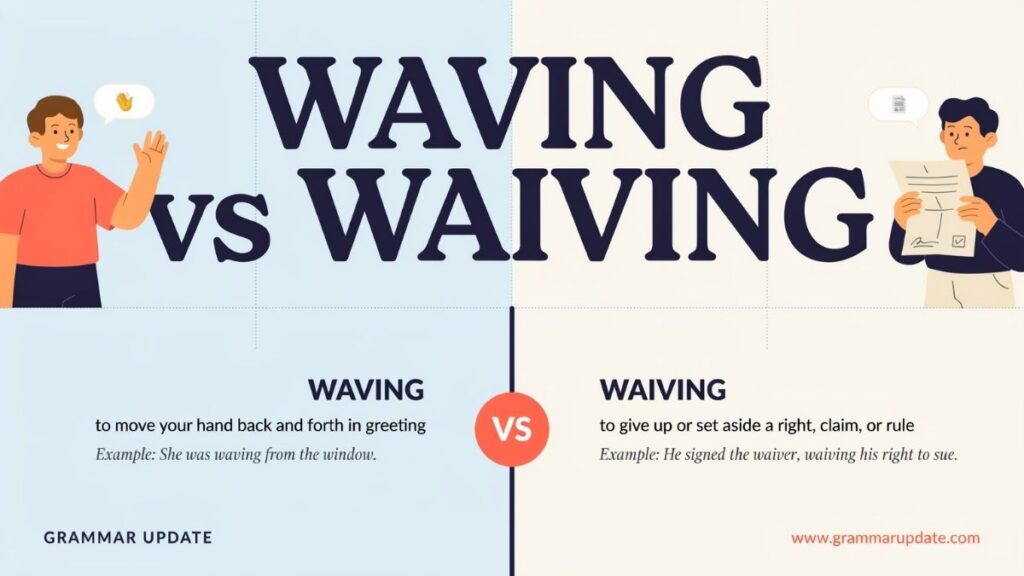
Have you ever stopped typing because you couldn’t decide between waving vs waiving? It’s a surprisingly common mistake. Since both words sound exactly the same, it’s easy to pick the wrong one without realizing it. Here’s the simple difference: waving means moving your hand to greet, signal, or say goodbye, while waiving means giving up a fee, right, or requirement. Mixing them up can completely change what you mean. Don’t worry, though. This guide makes the difference simple and memorable with clear explanations, everyday examples, and practical tips. By the end, you’ll know exactly which word to use and why every time.
Waving vs Waiving Quick Answer
If you’re in a hurry, here’s the simple rule.
| Word | Meaning | Example |
|---|---|---|
| Wave | To move your hand, arm, or another object as a signal or greeting. | She waved goodbye before leaving. |
| Waive | To voluntarily give up a right, fee, rule, or requirement. | The bank waived the monthly fee. |
A quick memory trick helps many people remember the difference.
- Wave involves movement.
- Waive involves permission or giving something up.
Think about it this way:
You wave your hand.
You waive a fee.
That simple rule solves most situations.
Learn the difference between often confused words
Summarize vs Summarise Which Spelling Is Correct?
What Does Waving Mean?
The waving meaning is straightforward. Waving describes the action of moving your hand, arm, or another object back and forth. People usually do this to greet someone, say goodbye, attract attention, or communicate from a distance.
The wave definition from major English dictionaries centers on movement used as a signal or gesture.
You might:
- Wave your hand to greet a neighbor.
- Wave goodbye before a flight.
- Wave hello across a parking lot.
- Wave at someone across the street.
- Wave to someone standing outside.
- Watch a flag waving in the wind.
All of these describe a physical hand movement or another visible motion.
Common Situations Where People Use “Wave”
Here are some everyday situations where the word appears naturally.
Greeting someone
When you see a friend across the room, you may wave at someone instead of walking over immediately.
Saying goodbye
Parents often stand outside and wave goodbye as children leave for school.
Getting attention
If a waiter doesn’t notice your table, you might wave your hand politely.
Giving directions
Airport ground crews wave aircraft using specialized hand signals.
Sports events
Fans enjoy flag waving in the wind while cheering for their favorite team.
These examples all involve visible movement rather than permission or legal decisions.
Waving Meaning in English
The waving meaning in English includes both literal and figurative uses.
Literal meaning:
- Moving your hand.
- Moving a flag.
- Moving an object back and forth.
Figurative meaning:
Sometimes writers use wave metaphorically.
For example:
- A wave of excitement spread through the crowd.
- She waved away the criticism.
Although these expressions use the word wave, they don’t relate to waiving a fee or giving up a legal right.
Examples of Waving Used Correctly
These examples demonstrate correct grammar usage.
- She started waving your hand as soon as she recognized her friend.
- Everyone was waving goodbye after the ceremony.
- The children were waving hello to the parade.
- He decided to wave at a friend from across the street.
- The tour guide waved to someone waiting near the entrance.
- Thousands of fans enjoyed hand waving during the concert.
- The athlete smiled while moving your hand toward the cheering crowd.
- We could see colorful flags waving in the wind from miles away.
Notice that every sentence describes movement.
Learn the difference between often confused words
Abley vs Ably Which Spelling Is Correct in English?
What Does Waiving Mean?
The waiving meaning is completely different.
Waive means to voluntarily give up, surrender, excuse, remove, or cancel something that you are legally or officially allowed to enforce.
The waive definition often appears in legal, financial, educational, insurance, banking, and business documents.
Organizations may:
- Waive a fee.
- Waive a cost.
- Waive a charge.
- Waive a penalty.
- Waive a requirement.
- Waive a rule.
- Waive a condition.
- Waive an obligation.
- Waive legal rights.
Individuals may also waive a right if they choose not to exercise it.
Waiving Meaning in English
The waiving meaning in English focuses on intentionally giving something up.
Instead of collecting money or enforcing a rule, the person or organization decides not to require it.
For example:
A university may waive an application fee.
A bank may waive a service fee.
An employer may waive a requirement for experienced applicants.
A judge cannot automatically waive every law, but certain procedural requirements may be waived under specific legal rules.
Common Situations Where “Waive” Is Used
Banks
Banks sometimes waive a monthly maintenance fee for customers who maintain a minimum balance.
Universities
Many colleges waive an application fee during special admission events.
Airlines
An airline may waive change fees after severe weather.
Insurance companies
Insurers occasionally waive a deductible under promotional or special circumstances.
Employers
Some employers waive certain experience requirements for exceptional candidates.
Government agencies
Agencies sometimes waive deadlines when emergencies occur.
Each example involves officially removing a requirement rather than physically moving something.
Examples of Waive Used Correctly
Here are several correct examples.
- The company agreed to waive a fee for first-time customers.
- The court allowed him to waive a right after confirming he understood the consequences.
- The bank decided to waive a charge because of the billing error.
- The university may waive a cost for qualified applicants.
- The organization agreed to waive a requirement during the emergency.
- The contract states that both parties may waive an obligation in writing.
- The customer requested that the bank waive a penalty.
- The airline waived the service fee after canceling the flight.
Every sentence involves giving something up or removing a requirement.
Learn the difference between often confused words
Carat vs Caret vs Karat Which is Differences?
Waving vs Waiving Side-by-Side Comparison
The easiest way to remember the difference between waving vs waiving is to compare them directly.
| Feature | Waving | Waiving |
|---|---|---|
| Meaning | Moving your hand or another object | Giving up a right, fee, charge, or requirement |
| Base verb | Wave | Waive |
| Common context | Greetings, signals, gestures | Business, banking, education, contracts, law |
| Physical action | Yes | No |
| Legal meaning | No | Yes |
| Financial meaning | No | Yes |
| Example | She waved at her neighbor. | The bank waived the monthly fee. |
When comparing waving vs waiving meaning, remember one key idea.
If someone is moving, choose waving.
If someone is canceling, excusing, or giving something up, choose waiving.
Learn the difference between often confused words
Exercise vs Exorcise Differences and Correct Usage
Waving vs Waiving? How to Choose the Right Word
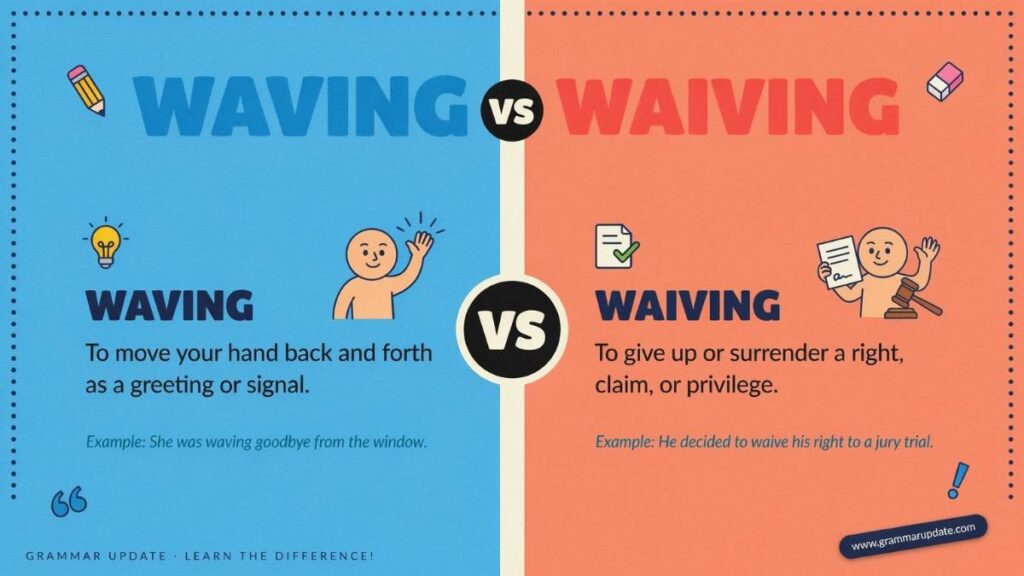
Many writers stop for a moment and ask themselves, “Should I write waving vs waiving?”
The answer depends entirely on what is happening in the sentence.
Ask yourself one simple question.
Is someone physically moving a hand, arm, flag, or another object?
If yes, use wave.
If no, ask another question.
Is someone giving up a fee, legal right, charge, rule, or requirement?
If yes, use waive.
Here is a quick decision guide.
| If you mean… | Use… |
|---|---|
| Moving your hand | Wave |
| Greeting someone | Wave |
| Saying hello | Wave |
| Saying goodbye | Wave |
| Signaling someone | Wave |
| Canceling a fee | Waive |
| Removing a charge | Waive |
| Giving up a legal right | Waive |
| Excusing a requirement | Waive |
This simple check works in almost every situation.
Learn the difference between often confused words
Canon vs Cannon Difference and Usage
Why People Confuse Waving and Waiving
English contains many homophone words, and wave and waive are a perfect example.
They sound exactly alike, but their spellings and meanings are completely different.
Several factors cause this confusion.
They Are Homophones
Wave and waive pronunciation is identical in standard American English.
Because both words sound the same, writers often choose the wrong spelling when typing quickly.
Their Spellings Look Similar
Only one letter separates the two words.
Wave
Waive
That extra “i” completely changes the meaning.
Spell Check Doesn’t Always Help
Grammar software checks spelling, but it cannot always understand your intended meaning.
For example:
“The company waved my application fee.”
The sentence contains correctly spelled words, so many spelling tools won’t flag it. However, the correct wording is:
“The company waived my application fee.”
This is why understanding the difference between wave and waive matters more than relying on software alone.
Fast Typing Causes Errors
Many people know the correct word but accidentally type the wrong one while writing emails, essays, or text messages.
Reading your work carefully helps catch these mistakes before someone else does.
Learn the difference between often confused words
Molding vs Moulding Which Spelling Is Correct and Usage?
Wave vs Waive Understanding the Base Words
The easiest way to master waiving vs waving is to understand the original verbs.
Wave Meaning
The wave meaning refers to moving something back and forth.
Examples include:
- Wave your hand.
- Wave a flag.
- Wave hello.
- Wave goodbye.
- Wave to a person.
- Wave at someone.
Every example describes visible movement.
Waive Meaning
The waive meaning refers to voluntarily giving something up.
Examples include:
- Waive a fee.
- Waive a charge.
- Waive payment.
- Waive a cost.
- Waive a right.
- Waive legal rights.
- Waive an obligation.
These examples involve official permission, legal decisions, or financial policies rather than physical actions.
Learn the difference between often confused words
Girlie vs Girly Which Spelling Is Correct?
Wave or Waive a Fee? Understanding the Correct Expression
One of the most common grammar questions is, “Is it waive or wave a fee?” The correct answer is always waive a fee.
When an organization removes a payment that you would normally have to make, it waives the fee. The word waive means to voluntarily give up or cancel a requirement, payment, or legal right.
Writing “wave a fee” is incorrect because you cannot physically move a fee like you wave your hand or a flag.
Examples:
Correct:
- The university agreed to waive a fee for all military veterans.
- The bank decided to waive a service fee after the billing mistake.
- The airline waived the baggage fee because the flight was canceled.
Incorrect:
- The bank waved the monthly fee.
- The college waved the application fee.
Whenever money, charges, penalties, or requirements are removed, use waive.
Waive a Fee Meaning
The phrase waive a fee meaning is simple. It means an organization decides not to collect money that would normally be required.
Common examples include:
- Waive an application fee
- Waive a bank fee
- Waive a service fee
- Waive a membership fee
- Waive a registration fee
For example, many colleges waive an application fee during special admissions events. Likewise, banks may waive monthly maintenance fees if customers maintain a qualifying account balance.
Waive a Cost and Waive a Charge
The same rule applies when discussing costs and charges.
A company may:
- Waive a cost
- Waive a charge
- Waive payment
- Waive a penalty
Each phrase means the customer no longer has to pay.
Example sentences:
- The retailer agreed to waive a charge after delivering the wrong product.
- The insurance company decided to waive a cost for emergency repairs.
- The hotel waived the cancellation penalty because of severe weather.
These phrases frequently appear in customer service, banking, insurance, and legal documents.
Wave or Waive Your Hand?
Another question people often ask is, “Should you say wave or waive your hand?”
The correct phrase is always wave your hand.
Your hand moves. It doesn’t give up legal rights or cancel payments.
Examples:
Correct:
- Please wave your hand if you have a question.
- She smiled and waved her hand from across the street.
- The children kept waving their hands during the parade.
Incorrect:
- Please waive your hand.
- She waived her hand to say hello.
Whenever you’re describing a physical hand movement, use wave.
Waving Your Hand Meaning
The waving your hand meaning refers to moving your hand to communicate without speaking.
People wave their hands for many reasons.
Common situations include:
- Greeting someone
- Saying goodbye
- Getting attention
- Signaling a driver
- Celebrating a victory
- Directing traffic
- Welcoming guests
Hand waving is one of the oldest forms of nonverbal communication. Long before modern technology, people relied on hand gestures to communicate across distances.
Learn the difference between tricky grammar more words
Alot vs A Lot vs allot Which is Correct and Usage
Wave Hello, Wave Goodbye, and Wave at Someone
Many everyday English expressions use the word wave.
Examples include:
- Wave hello
- Wave goodbye
- Wave at someone
- Wave to someone
- Wave at a friend
- Wave to a person
These expressions all describe physical movement.
Examples in sentences:
- Emily waved hello as she entered the classroom.
- Everyone waved goodbye when the train departed.
- Mark waved at someone standing across the parking lot.
- The little girl waved to her grandparents.
- Fans kept waving flags throughout the championship game.
Notice that every example involves movement rather than permission.
Waive a Right A Common Legal Expression
Unlike wave, waive often appears in legal writing.
To waive a right means to voluntarily give up a legal protection or privilege.
Examples include:
- Waive a right
- Waive legal rights
- Waive the right to sue
- Waive the right to a trial
- Waive an obligation
- Waive a condition
These decisions are usually made knowingly and often require written agreement.
For example:
A defendant may waive the right to a jury trial.
An employee may waive certain employment benefits through a signed agreement.
A customer may waive claims by accepting specific contract terms.
Because legal rights are important, courts often require proof that the person understands the consequences before rights are waived.
What Does Waive Off Mean?
Many people search for waive off meaning because they encounter the phrase in news articles or business writing.
Waive off generally means to remove, excuse, cancel, or forgive a requirement, fee, or obligation.
Examples:
- The government waived off certain penalties after the natural disaster.
- The company waived off late payment charges.
- Officials waived off inspection requirements during the emergency.
In some regions, especially South Asian English, waive off appears more frequently than in American English.
In modern US English, writers often prefer:
- Waive the fee
- Waive the charge
- Waive the requirement
Instead of:
- Waive off the fee
Both forms are understood, but the shorter version is usually preferred in American business writing.
Learn the difference between tricky grammar more words
Spicey vs Spicy Which Spelling Is Correct?
Waive Off Meaning in English
The waive off meaning in English is closely related to forgiving, excusing, canceling, or removing something.
Examples include:
- Waive off a penalty
- Waive off a requirement
- Waive off a charge
Although grammatically acceptable in many varieties of English, American style guides often recommend simply using waive.
Wave Off vs Waive Off
These expressions are easy to confuse because they sound similar.
However, they have different meanings.
Wave off means to signal someone away or cancel something using a hand gesture.
Examples:
- The referee waved off the goal.
- The airport worker waved off the aircraft.
- The police officer waved traffic away.
Waive off means to remove or excuse a requirement.
Examples:
- The company waived off the processing fee.
- The school waived off the registration charge.
Remember this simple rule:
If a hand gesture is involved, choose wave off.
If something is canceled or forgiven, choose waive off.
Learn the difference between tricky grammar more words
Click vs Clique Which is Difference and usage?
Waving vs Waiving in Sentences
The easiest way to understand the difference between waving vs waiving is to compare them side by side.
| Waving | Waiving |
|---|---|
| She was waving to her family. | The airline was waiving baggage fees. |
| They kept waving flags. | The university was waiving application fees. |
| We saw children waving goodbye. | The bank was waiving monthly charges. |
| He was waving his hand. | The company was waiving contract penalties. |
Seeing both words together helps reinforce the correct meaning.
Wave and Waive in a Sentence
Here are examples that use both words correctly.
- The manager waved at the visitors before agreeing to waive the entrance fee.
- She waved goodbye after the school waived her application fee.
- The judge waved to the audience before explaining why the defendant could waive a right.
- The employee waved hello while the company waived a charge for loyal customers.
- The tour guide waved at the group after the museum waived admission fees.
These examples clearly demonstrate the difference between wave and waive.
Learn the difference between tricky grammar more words
Reining vs Reigning Which Is Difference?
Common Mistakes People Make
Although the rule is simple, writers frequently make the same errors.
Mistake 1: Using “wave” for money
Incorrect:
The bank waved the fee.
Correct:
The bank waived the fee.
Mistake 2: Using “waive” for greetings
Incorrect:
She waived at her friend.
Correct:
She waved at her friend.
Mistake 3: Assuming spell check catches everything
Spell check verifies spelling.
It does not always verify meaning.
That’s why sentences like “The company waved my fee” may not trigger an error.
Mistake 4: Forgetting the context
Always ask yourself:
Is this about movement?
Or is it about removing a requirement?
The answer almost always reveals the correct spelling.
Learn the difference between confusing more English words
Appendices vs Appendixes Which is Correct and Usage?
A Memory Trick You’ll Never Forget
Memory tricks work because they connect words with simple images.
Try these:
Wave contains the word “AVE.”
Imagine an avenue where people stand outside waving during a parade.
Waive contains an extra “I.”
Think of “I give it up.”
When you waive something, you voluntarily give it up.
Another easy reminder is this:
Movement equals wave.
Permission equals waive.
That one sentence prevents most mistakes.
Synonyms for Wave
Depending on the context, you can replace wave with several similar words.
| Word | Best Use |
|---|---|
| Gesture | General movement |
| Signal | Communication |
| Beckon | Invite someone closer |
| Salute | Military greeting |
| Motion | Direct someone |
| Greet | Welcome someone |
Example:
Instead of saying, “He waved to the crowd,” you could write, “He greeted the crowd with a friendly gesture.”
Synonyms for Waive
Waive has several useful alternatives depending on the situation.
| Word | Common Context |
|---|---|
| Cancel | Fees and payments |
| Excuse | Requirements |
| Forgive | Debt or payment |
| Remove | Charges |
| Exempt | Rules or qualifications |
| Relinquish | Rights |
| Renounce | Legal rights |
| Surrender | Claims |
Each synonym carries a slightly different meaning, so choose the one that best matches your sentence.
Learn the difference between confusing more English words
Hustle vs Hussle Which is Correct Spelling and Usage?
Real-World Examples of Wave and Waive
Here are examples from everyday life.
Education
A university may waive an application fee for students with financial need.
Banking
A bank might waive monthly maintenance charges for premium account holders.
Healthcare
Hospitals sometimes waive certain administrative fees during financial hardship programs.
Travel
Airlines often waive change fees when severe weather disrupts flights.
Sports
Fans spend hours waving team flags before a championship game.
Family
Parents wave goodbye as children board the school bus.
Business
Companies occasionally waive late payment penalties to maintain good customer relationships.
These real-world situations show why understanding the difference between waving vs waiving improves both everyday writing and professional communication.
Learn the difference between confusing more English words
Unselect vs Deselect Which Term Is Correct?
Waving vs Waiving in Professional Writing
Using the correct word matters even more in professional communication. A small spelling mistake can change the meaning of a sentence and make your writing appear less polished.
Business emails, legal documents, contracts, and academic papers often include the word waive. Meanwhile, wave usually appears in everyday conversations, stories, or descriptions of physical actions.
Understanding the difference between waving vs waiving helps you communicate clearly and avoid misunderstandings.
Business Communication
Businesses frequently use waive when discussing fees, charges, or company policies.
Examples:
- We are pleased to waive the application fee for new customers.
- The company agreed to waive a charge after reviewing your complaint.
- We may waive a cost if the product arrives damaged.
- The membership fee will be waived for qualifying applicants.
Using wave instead of waive in these examples would be incorrect because no physical movement is involved.
Legal Documents
Legal writing commonly includes the word waive because people or organizations may voluntarily give up certain rights or protections.
Examples include:
- Waive a right
- Waive legal rights
- Waive an obligation
- Waive a condition
- Waive the right to sue
- Waive the right to a trial
Many legal agreements require a written waiver before rights are considered surrendered.
A legal waiver is an official document stating that a person knowingly gives up a specific right or claim.
Academic Writing
Universities often use waive in admission policies and financial aid information.
Examples include:
- The university may waive an application fee.
- Students may request a fee waiver.
- Certain language requirements may be waived for qualified applicants.
Academic institutions rarely use wave unless describing physical movement in research or literature.
Customer Service
Customer service representatives often use waive when helping customers.
Examples:
- We have decided to waive the late payment fee.
- The service charge has been waived.
- We can waive the replacement cost under warranty.
These phrases are common in banking, insurance, travel, and online shopping.
Learn the difference between confusing more English words
Tieing vs Tying Which Spelling Is Correct in English?
British English vs American English
Many people wonder whether British English and American English treat these words differently.
The answer is simple.
There is no spelling difference between wave and waive in either variety of English.
Both American and British dictionaries define the words in the same way.
| American English | British English |
|---|---|
| Wave | Wave |
| Waive | Waive |
The pronunciation of wave and waive is also the same in both varieties.
Because they sound identical, they are classified as homophones.
Whether you’re writing for a US audience or an international audience, the same grammar rules apply.
Learn the difference between confusing more English words
Counselor vs Councilor Which is the Difference and Usage?
Wave vs Waive Pronunciation
One reason these words are confusing is that they sound exactly alike.
| Word | Pronunciation |
|---|---|
| Wave | /weɪv/ |
| Waive | /weɪv/ |
Since the pronunciation is identical, readers must rely on context to understand the intended meaning.
For example:
- She waved at the crowd.
- The company waived the fee.
Although both words sound the same, their meanings are completely different.
This makes them classic examples of homophone words.
What Dictionaries Say
Leading English dictionaries agree on the meanings of these words.
Wave definition
To move your hand, arm, or another object back and forth as a greeting, signal, or expression.
Waive definition
To voluntarily give up a claim, right, fee, requirement, or privilege.
Major dictionaries also recognize that these words are commonly confused because they share the same pronunciation.
Quick Comparison Chart
| Feature | Wave | Waive |
|---|---|---|
| Meaning | Move your hand or another object | Give up a right, fee, or requirement |
| Physical action | Yes | No |
| Legal term | No | Yes |
| Financial term | No | Yes |
| Greeting | Yes | No |
| Contracts | No | Yes |
| Banking | No | Yes |
| Common phrase | Wave goodbye | Waive a fee |
Everyday Examples
These examples show how naturally each word fits its proper context.
Wave examples
- She waved hello from across the street.
- The children were waving goodbye to their teacher.
- He waved at someone waiting outside.
- Everyone started waving their hands during the concert.
- The flag was waving in the wind.
Waive examples
- The bank agreed to waive a fee.
- The airline decided to waive baggage charges.
- The company waived a penalty after reviewing the complaint.
- The customer requested that the service fee be waived.
- The applicant asked the university to waive the application fee.
Learn the difference between confusing more English words
Granddad vs Grandad which spelling is Correct and Usage?
Practice Session Waving vs Waiving
Fill in the blank with the correct word: wave, waive, waved, waived, waving vs waiving.
- The bank agreed to __________ the monthly service fee.
- Sarah stood at the gate, __________ goodbye to her family.
- The university may __________ the application fee for eligible students.
- Please __________ your hand if you know the answer.
- The airline __________ the baggage fee because of the delayed flight.
- The children were __________ at the parade as it passed by.
- The customer asked the company to __________ the late payment charge.
- The referee __________ off the goal after noticing a foul.
- The company is __________ the processing fee for new customers this month.
- Emma smiled and __________ to her teacher across the playground.
- The judge explained that the defendant could __________ the right to a jury trial.
- Fans kept __________ colorful flags throughout the championship game.
- Our internet provider decided to __________ the installation fee.
- Please don’t forget to __________ at your neighbors when you drive by.
- The hotel __________ the cancellation penalty because of the severe storm.
- We saw hundreds of people __________ hello during the community parade.
- The organization agreed to __________ a requirement for qualified applicants.
- He was __________ his hand to get the waiter’s attention.
- The company refused to __________ the additional service charge.
- The lawyer advised her not to __________ her legal rights without understanding the agreement.
- The little boy happily __________ to his grandparents from the school bus.
- The college announced it was __________ application fees for first-generation students.
- The officer __________ traffic through the construction zone.
- Many businesses will __________ certain fees during special promotions.
- Before boarding the train, everyone __________ goodbye to their friends.
Answers
- waive
- waving
- waive
- wave
- waived
- waving
- waive
- waved
- waiving
- waved
- waive
- waving
- waive
- wave
- waived
- waving
- waive
- waving
- waive
- waive
- waved
- waiving
- waved
- waive
- waved
Here’s a trusted source for clear word meanings:
FAQs
Is it waiving vs waving?
It depends on the meaning. Use waving when talking about moving your hand, arm, or another object. Use waiving when talking about giving up a fee, right, rule, or requirement.
Is it waiving a fee or waving a fee?
The correct phrase is waiving a fee. A company or organization waives a fee when it decides not to charge you. Waving a fee is incorrect because a fee cannot be physically moved.
Is it waive or wave a fee?
The correct expression is waive a fee. You use waive when canceling or removing a payment, charge, or requirement.
Do you wave or waive a fee?
You waive a fee. For example, a bank may waive a monthly service fee for eligible customers.
Is it waiving vs waving a flag?
The correct phrase is waving a flag because a flag is physically moving or being moved.
Is it waiving rights or waving rights?
The correct phrase is waiving rights. It means voluntarily giving up legal rights or claims. Waving rights is incorrect.
Is it waiving through or waving through?
The correct phrase depends on the context. Wave through means to signal someone to continue moving, such as a police officer waving traffic through. Waive through is generally incorrect in standard English.
Is it waiving or waving hello?
The correct phrase is waving hello because you’re greeting someone with a hand gesture.
Is it waved me off or waived me off?
The correct phrase is waved me off. It means someone signaled you to leave or continue with a hand gesture. Waived me off is incorrect in this context.
Is it waived or waved?
Use waived when something like a fee, charge, or right is given up or canceled. Use waved when someone moves a hand, arm, or object.
What’s the difference between waiving and waving?
Waving refers to a physical movement, such as greeting or signaling someone. Waiving means voluntarily giving up a fee, right, obligation, or requirement.
What is the meaning of waving?
Waving means moving your hand, arm, or another object back and forth to greet someone, say goodbye, or get attention.
What does waving mean in simple words?
In simple words, waving means moving your hand or another object to communicate without speaking.
What does waving at someone mean?
Waving at someone means moving your hand to greet them, get their attention, or say goodbye.
What do you mean by waving?
Waving is a hand gesture used to communicate visually. People commonly wave to say hello, goodbye, or attract attention.
Is waving an action?
Yes. Waving is a physical action that involves moving your hand, arm, or another object.
Is waving a gesture?
Yes. Waving is one of the most common nonverbal gestures used around the world for greetings and communication.
What type of verb is waving?
Waving is the present participle and gerund form of the verb wave. It can function as a verb or a noun depending on the sentence.
How do you use waving in a sentence?
Example:
The children were waving happily as the parade passed by.
What is the correct spelling of waving?
The correct spelling is waving. It comes from the verb wave.
What does waving a flag mean?
Waving a flag means moving a flag back and forth. It may show celebration, support, patriotism, or signal information depending on the situation.
Is it waive or wave the white flag?
The correct phrase is wave the white flag. A white flag is physically raised or moved to signal surrender or a desire to negotiate.
When did waving become a greeting?
Historians believe hand waving has been used as a greeting for thousands of years. Raising an empty hand showed peaceful intentions and eventually became a common gesture for saying hello or goodbye.
What does waiving mean?
Waiving means voluntarily giving up or canceling a right, fee, charge, requirement, or obligation.
What is the meaning of waiving?
The meaning of waiving is choosing not to enforce or claim something that you have the legal or official right to require.
What does waiving someone mean?
The phrase waiving someone is uncommon in English. Usually, waive applies to fees, rights, requirements, or charges rather than people.
What does it mean to waive something?
To waive something means to voluntarily give it up or decide not to enforce it.
What is an example of waiving?
Example:
The university waived the application fee for students with financial need.
How do you use waive in a sentence?
Example:
The airline agreed to waive the change fee because of severe weather.
What does waive mean in simple words?
In simple words, waive means to give up or cancel something that would normally apply.
What does waive mean in work?
In the workplace, waive often means removing a company rule, fee, requirement, or obligation under certain circumstances.
What is waiving my right?
Waiving your right means voluntarily giving up a legal protection or privilege that you are entitled to.
What does waiving your rights mean?
It means choosing not to exercise certain legal rights. This decision should always be made carefully because it can have legal consequences.
Does waiving your right mean you agree?
Not always. Waiving a right simply means giving up the ability to use that right. It does not automatically mean you agree with every part of a situation or contract.
What is another word for waive?
Depending on the context, similar words include cancel, excuse, exempt, forgive, relinquish, surrender, or renounce.
What is the other word for waiving?
Possible alternatives include canceling, excusing, relinquishing, surrendering, exempting, or giving up.
What is a synonym for waived?
Common synonyms include canceled, excused, forgiven, exempted, relinquished, and surrendered.
What is another word for waiver?
Depending on the context, alternatives include exemption, release, consent, authorization, disclaimer, or permission.
What is waiver in simple words?
A waiver is an official document or agreement stating that someone gives up a specific right or requirement.
What is the noun of waiving?
The noun form of waiving is waiver.
Does waived mean free?
Not exactly. Waived means a fee or charge has been removed, so you do not have to pay it. It doesn’t necessarily mean the product or service itself is free.
What is the opposite of waived?
The opposite of waived is enforced, required, charged, collected, or applied, depending on the context.
What’s another word for waving?
Depending on the sentence, alternatives include gesturing, signaling, beckoning, greeting, saluting, or motioning.
What is a word for waving?
Words such as gesturing, signaling, beckoning, or motioning can replace waving in many situations.
What’s another word for waver?
Common synonyms include hesitate, falter, fluctuate, vacillate, or be uncertain. This word has a different meaning from wave and waive.
conclusion
If waving vs waiving has ever made you stop and think, you are in good company. These two words sound exactly alike, so confusing them is easy. The trick is to focus on what you’re talking about. If someone is moving a hand to say hello, goodbye, or get attention, the correct word is wave. If someone is canceling a fee, giving up a right, or removing a requirement, the correct word is waive. That’s all there is to it. Keep this simple rule in mind, and you’ll avoid a common grammar mistake that trips up many writers. The next time you’re unsure, remember this: you wave your hand, but you waive a fee. Simple, clear, and easy to remember.

Jhon AJS, the creative mind behind Grammar Update, is an experienced blogger passionate about simplifying English grammar. He focuses on explaining confusing word vs word differences, grammar rules, punctuation, and sentence structure in a clear and practical way. Through easy to understand guides and examples, Jhon helps readers improve their writing and communicate with confidence. With years of blogging experience, he continues to share helpful insights that make learning grammar simple, useful, and accessible for everyone.