Have you ever stopped while writing and wondered, “Should I use Enquiries vs Inquiries? If so, you are in good company. This tiny spelling difference has confused students, professionals, and even experienced writers for years. To make things even trickier, both words are correct but they aren’t always used in the same way. Its one of those grammar puzzles that can make you question every sentence you write. Fortunately, the answer is much simpler than it seems. Once you understand the difference between inquiry and enquiry, you’ll know exactly which spelling to use, when to use it, and how to avoid this common English mistake with confidence.
Enquiries vs Inquiries at a Glance
If you’re looking for the short answer, here it is.
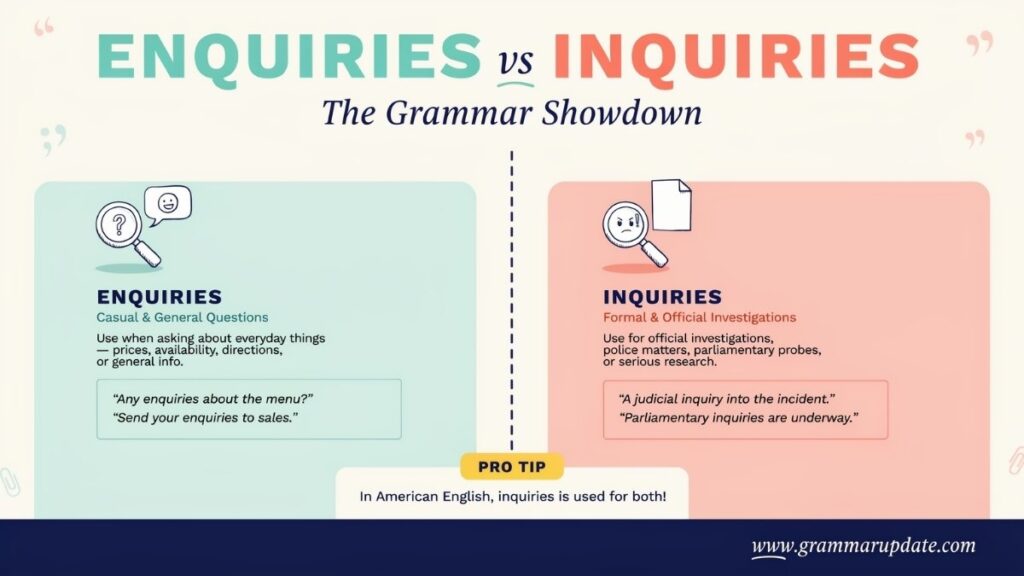
- Inquiries is the standard spelling in American English.
- Enquiries is the preferred spelling in British English for general requests for information.
- In modern English, both words often share the same meaning, although some British style guides still distinguish between them.
- The most important rule is to stay consistent with the variety of English you’re using.
Quick Comparison Table
| Feature | Enquiry / Enquiries | Inquiry / Inquiries |
|---|---|---|
| Preferred in British English | Yes | Sometimes |
| Preferred in American English | Rarely | Yes |
| Common meaning | Request for information | Request for information or investigation |
| Formal investigation | Sometimes | Commonly preferred |
| Everyday business writing | Common in the UK | Standard in the US |
Quick Rule: If you’re writing for an American audience, choose inquiries. If you’re writing for a British audience, enquiries is usually the better choice for general requests for information.
Learn the difference between confusing more English words
Phoenix vs Pheonix Difference and Usage
What Do “Enquiry” and “Inquiry” Mean?
At first glance, these words look almost identical. They even sound nearly the same when spoken. The only visible difference is the first vowel. However, that single letter creates one of the most common spelling questions in English.
The truth is simple. Both spellings are legitimate English words. Their preferred use depends mainly on regional spelling conventions and, in some cases, the level of formality.
Understanding the difference between inquiry and enquiry begins with their definitions.
Enquiry Definition
The enquiry definition is straightforward.
An enquiry is generally a request for information. Someone makes an enquiry because they want an answer, clarification, or additional details.
For example:
- A customer sends an enquiry about product pricing.
- A traveler makes an enquiry about hotel availability.
- A student submits an enquiry regarding course admission.
In everyday British English, enquiry usually refers to asking a question rather than conducting a formal investigation.
Common Enquiry Examples
- General customer enquiry
- Product enquiry
- Booking enquiry
- Sales enquiry
- Information enquiry
- Employment enquiry
Each of these examples involves someone seeking information rather than investigating a serious matter.
Inquiry Definition
The inquiry definition is slightly broader.
An inquiry can also mean a request for information. However, it frequently refers to a formal investigation, especially in American English.
Examples include:
- A police inquiry
- A government inquiry
- A legal inquiry
- A scientific inquiry
- A public inquiry
American businesses also use inquiry for ordinary customer questions.
For example:
- Customer inquiry
- Product inquiry
- Service inquiry
- Sales inquiry
Because of this broader use, inquiry meaning in English often includes both simple questions and official investigations.
Do They Mean the Same Thing?
One reason writers struggle with inquiry or enquiry grammar is that dictionaries don’t always present identical guidance.
Traditionally, British English distinguished between the two words.
According to this older convention:
- Enquiry meant an informal request for information.
- Inquiry referred to an official investigation.
For example:
- The customer made an enquiry about shipping costs.
- The government launched an inquiry into the accident.
Today, however, that distinction isn’t always followed.
Many modern dictionaries recognize that both spellings often overlap in meaning. Publishers, businesses, universities, and government organizations may choose one spelling consistently as part of their editorial style rather than because of a strict grammar rule.
As a result, inquiry and enquiry frequently appear as interchangeable terms, especially outside legal and governmental writing.
Learn the difference between confusing more English words
Treet vs Treat Spelling Confusion and Usage
Enquiries vs Inquiries The Main Difference Explained
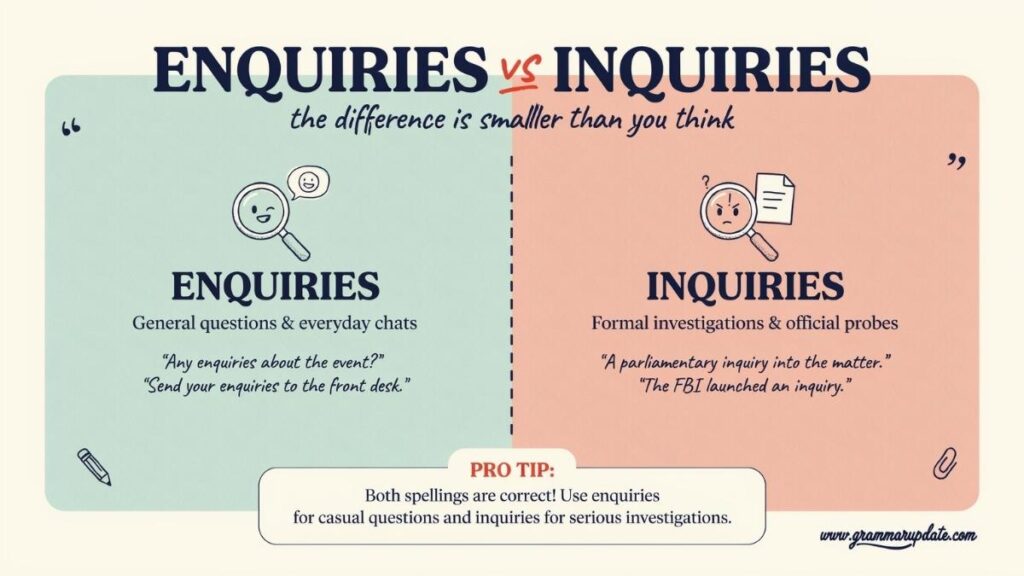
If someone asks, “What is the difference between inquiry and enquiry?” the simplest answer is this:
The biggest difference is not meaning. It’s location.
Your audience usually determines which spelling you should use.
Let’s look at how different English-speaking countries use these words.
Inquiry in American English
When discussing inquiry in American English, the rule is simple.
Americans almost always use inquiry.
Whether someone is asking a basic question or investigating a major event, inquiry is the accepted spelling.
Examples include:
- Customer inquiry
- Product inquiry
- Billing inquiry
- Research inquiry
- Public inquiry
- Police inquiry
- Academic inquiry
You’ll rarely see enquiry in American newspapers, universities, businesses, or government publications.
Inquiry Examples
Here are several examples of inquiry in a sentence:
- The customer submitted an inquiry about delivery times.
- Our support team answered every inquiry within one business day.
- Congress opened an inquiry into the reported violations.
- The university received hundreds of scholarship inquiries.
- Scientists continued their inquiry into climate patterns.
These examples demonstrate how flexible the American spelling has become.
Enquiry in British English
When discussing enquiry in British English, things become slightly more nuanced.
Many British organizations continue using enquiry when referring to everyday questions.
Examples include:
- Customer enquiry
- Booking enquiry
- Product enquiry
- Sales enquiry
- Information enquiry
Meanwhile, many government agencies and legal organizations still reserve inquiry for official investigations.
For example:
- Public inquiry
- Judicial inquiry
- Government inquiry
- Official inquiry
This traditional distinction isn’t mandatory, but it remains common enough that writers should understand it.
Enquiry Examples
Here are several examples of enquiry in a sentence:
- We received your enquiry yesterday.
- Thank you for your sales enquiry.
- Please send your booking enquiry using the online form.
- Her enquiry helped clarify the application process.
- Every customer enquiry receives a response within 24 hours.
These examples reflect standard British business writing.
Enquiries vs Inquiries UK
One of the most searched questions online is “Enquiries vs Inquiries UK.”
The answer reflects modern British publishing practices.
In the United Kingdom:
- Enquiry remains popular for everyday communication.
- Inquiry often appears in legal, governmental, parliamentary, or official investigations.
- Many publishers accept either spelling as long as it remains consistent throughout the document.
For example:
| Situation | Preferred UK Usage |
|---|---|
| Customer support | Enquiry |
| Product information | Enquiry |
| University admissions | Enquiry |
| Public investigation | Inquiry |
| Government investigation | Inquiry |
| Police investigation | Inquiry |
Although this distinction isn’t universal, following it helps your writing sound more natural to British readers.
Enquiries vs Inquiries US
The situation in the United States is much simpler.
If you’re writing for an American audience, choose inquiry every time.
American dictionaries, educational institutions, news organizations, businesses, and government agencies overwhelmingly prefer this spelling.
You’ll commonly encounter phrases such as:
- Customer inquiry
- Business inquiry
- Technical inquiry
- Legal inquiry
- Research inquiry
- Official inquiry
Using enquiry in American writing isn’t technically incorrect, but it immediately signals British spelling and may look unfamiliar to many US readers.
International English: Which Spelling Should You Use?
Global businesses often serve customers from dozens of countries. That raises another common question:
Should I use inquiry or enquiry?
The answer depends on your audience.
| Audience | Recommended Spelling |
|---|---|
| United States | Inquiry |
| United Kingdom | Enquiry for general questions, Inquiry for formal investigations |
| Canada | Usually Inquiry, though Enquiry also appears |
| Australia | Enquiry is common, Inquiry is also accepted |
| New Zealand | Enquiry is generally preferred |
| International audience | Choose one style and remain consistent |
Consistency matters more than choosing one spelling over the other. Mixing enquiries vs inquiries within the same article, report, email, or website makes your writing appear inconsistent and less professional.
Smoky vs Smokey Differences and Correct Usage
When to Use Enquiries
If you’re writing for a British audience, you’ll typically use enquiries when someone is requesting information rather than conducting a formal investigation. This spelling appears frequently in customer service, retail, education, hospitality, and everyday business communication across the United Kingdom and many Commonwealth countries.
Although some organizations use inquiry in every context, enquiries remains the preferred choice for general questions in British English.
A simple way to remember this is to think of an enquiry as someone asking for information, clarification, or assistance.
Common Situations for Using Enquiries
You’ll commonly see enquiries in situations such as:
- Customer support requests
- Product information
- Booking requests
- Sales questions
- University admissions
- Service inquiries on UK websites
- General requests for information
These are all examples of enquiry for information rather than a formal investigation.
Enquiry Examples
Here are some natural examples of enquiry in everyday British English.
- We welcome all customer enquiries.
- Please submit your enquiry using the contact form.
- The admissions office answered every enquiry within two business days.
- Thank you for your enquiry regarding our training courses.
- The hotel responded promptly to my booking enquiry.
- If you have any further enquiries, please contact our support team.
These examples show how naturally enquiry fits into everyday British communication.
Enquiry in Business Writing
Business writing in the UK commonly includes phrases such as:
- Sales enquiries
- Customer enquiries
- Product enquiries
- Partnership enquiries
- Media enquiries
- General enquiries
If you’ve visited the website of a British company, you’ve probably seen a menu item labeled “General Enquiries.” This wording feels natural to UK readers and follows standard British spelling conventions.
Learn the difference between confusing more English words
Useing vs Using Which Spelling Is Correct?
When to Use Inquiries
If you’re writing for an American audience, inquiries is almost always the correct choice. American English generally doesn’t distinguish between informal questions and formal investigations. Instead, inquiry serves both purposes.
Whether someone contacts customer support or a government agency launches an investigation, inquiry is the accepted spelling.
Common Situations for Using Inquiries
Use inquiry in contexts such as:
- Customer service
- Business communication
- Academic writing
- Research papers
- Government reports
- Legal documents
- Official investigations
- News reporting
This broader usage explains why inquiry in American English appears far more often than enquiry.
Inquiry Examples
These examples reflect standard American English.
- We received your inquiry this morning.
- Please submit your inquiry through our online form.
- The company responded to every customer inquiry.
- The committee launched an inquiry into the incident.
- Scientists continued their inquiry into renewable energy.
- The newspaper reported on the government inquiry.
Each sentence sounds natural and follows standard American usage.
Learn the difference between tricky grammar more words
Swap vs Swop Difference which one is coorrect ?
Enquiries vs Inquiries in Business Writing
Business communication is one of the most common places where writers question Enquiries vs Inquiries usage.
The answer depends entirely on your audience.
If your company primarily serves customers in the United States, use inquiry consistently across your website, emails, contact forms, and marketing materials.
If your business targets customers in the United Kingdom, enquiries is generally the preferred choice for requests for information.
Business Writing Comparison
| Audience | Preferred Term |
|---|---|
| US customers | Customer inquiry |
| UK customers | Customer enquiry |
| US support page | Submit an inquiry |
| UK support page | Submit an enquiry |
| US sales team | Sales inquiries |
| UK sales team | Sales enquiries |
Choosing the appropriate regional spelling helps your communication look polished, professional, and consistent.
Learn the difference between tricky grammar more words
Smoothe vs Smooth Which is Correct and Usage?
Enquiries vs Inquiries in Academic Writing
Academic writing usually follows the spelling conventions of the institution, publisher, or journal.
American universities almost always use inquiry.
Common examples include:
- Scientific inquiry
- Research inquiry
- Academic inquiry
- Inquiry-based learning
British universities may use either spelling. However, enquiry often appears when referring to requests for information from prospective students.
For example:
- Admissions enquiry
- Course enquiry
- Student enquiry
When discussing formal research or investigations, British institutions frequently use inquiry.
Always follow your university’s editorial style guide if one is available.
Learn the difference between tricky grammar more words
That’s Mean vs that means Difference and which one is correct?
Enquiries vs Inquiries in Legal English
Legal writing tends to preserve the traditional distinction between the two spellings.
In British legal English, inquiry is commonly reserved for official investigations.
Examples include:
- Public inquiry
- Judicial inquiry
- Parliamentary inquiry
- Government inquiry
- Independent inquiry
These phrases describe formal investigations conducted by courts, governments, or public authorities.
By contrast, enquiries usually refer to routine requests for information made by individuals, businesses, or organizations.
Recognizing this distinction helps legal writing remain accurate and consistent.
Learn the difference between confusing word pairs
Entwined vs Intertwined What’s the Difference and usage?
Enquiries vs Inquiries in Customer Service
Customer service teams handle thousands of information requests every day. The spelling you choose should reflect the audience you’re serving.
British Customer Service
You’ll commonly see phrases such as:
- Customer enquiries
- General enquiries
- Product enquiries
- Billing enquiries
- Sales enquiries
American Customer Service
American businesses typically use:
- Customer inquiries
- Product inquiries
- Billing inquiries
- Sales inquiries
- Service inquiries
Although the spelling changes, the meaning remains the same. In every case, customers are requesting information or assistance.
Enquiries vs Inquiries Side-by-Side Comparison
| Feature | Enquiry | Inquiry |
|---|---|---|
| Preferred in British English | Yes | Sometimes |
| Preferred in American English | Rarely | Yes |
| Request for information | Yes | Yes |
| Formal investigation | Sometimes | Yes |
| Business writing | Common in the UK | Standard in the US |
| Government investigations | Occasionally | Common |
| Legal English | Limited | Common |
| Academic writing | Less common internationally | More common internationally |
This comparison makes one point clear. In most situations, regional spelling matters more than any difference in meaning.
Advice vs Advise What’s the Difference?
Common Words and Phrases That Use Enquiry or Inquiry
Learning common expressions makes it much easier to choose the correct spelling.
Common British Expressions
These phrases regularly appear on British websites, business documents, and customer service pages.
- General enquiries
- Customer enquiries
- Sales enquiries
- Media enquiries
- Booking enquiries
- Membership enquiries
- Employment enquiries
- Information enquiries
Common American Expressions
These expressions are standard throughout the United States.
- Customer inquiries
- Product inquiries
- Technical inquiries
- Business inquiries
- Public inquiry
- Legal inquiry
- Research inquiry
- Government inquiry
Notice that inquiry comfortably covers both everyday requests for information and formal investigations in American English.
Learn the difference between confusing word pairs
Allusion vs Illusion Difference and which is correct ?
Enquiries vs Inquiries Pronunciation
Another reason people confuse these words is that they sound almost identical.
Whether someone says enquiry or inquiry, the pronunciation is nearly the same.
Approximate pronunciation:
- Enquiry: en-KWY-ree
- Inquiry: in-KWY-ree
Depending on regional accents, the first syllable may sound slightly different. Even so, pronunciation doesn’t determine which spelling is correct. Your audience and the variety of English you’re using should guide your choice.
Learn the difference between confusing word pairs
Learn the difference between confusing word pairs
Resale vs Resell What’s the Difference?
What Major Dictionaries and Style Guides Say
Leading dictionaries and editorial style guides agree on one important point.
Both spellings are correct.
The preferred spelling simply depends on regional language conventions and editorial style.
Oxford English Dictionary
The Oxford English Dictionary recognizes both enquiry and inquiry. It explains that enquiry has traditionally referred to requests for information in British English, while inquiry has often been used for formal investigations.
Cambridge Dictionary
Cambridge Dictionary accepts both spellings and notes that inquiry is the preferred form in American English.
Merriam-Webster
Merriam-Webster lists inquiry as the standard American spelling and identifies enquiry as a British variant.
Collins Dictionary
Collins Dictionary recognizes the traditional distinction between enquiry and inquiry but also notes that the difference has become less strict in modern English.
AP Style
The Associated Press Stylebook follows American English conventions and consistently recommends inquiry.
Chicago Manual of Style
The Chicago Manual of Style also follows standard American English and uses inquiry throughout books, journals, and professional publications.
What This Means for Writers
After comparing major dictionaries and respected style guides, one conclusion stands out.
There isn’t a single universally correct spelling.
Instead, the right choice depends on four factors:
- Your audience
- The country you’re writing for
- Your organization’s style guide
- Consistency throughout your document
If you’re writing for an American audience, use inquiry.
If you’re writing for a British audience, enquiry is generally the preferred choice for everyday requests for information, while inquiry remains common for official investigations.
Enquiries vs Inquiries in Real World Writing
Understanding the grammar rule is only part of the picture. Seeing how these words appear in everyday writing makes choosing the correct spelling much easier. Businesses, universities, government agencies, publishers, and customer service teams all follow regional spelling conventions rather than creating their own rules.
Once you recognize these patterns, deciding between inquiry and enquiry becomes much more natural.
Enquiries vs Inquiries in Business Writing
Businesses want their communication to feel familiar to their audience. That’s why companies usually follow the spelling conventions of the country where they operate.
For example, an American company is likely to use:
- Customer Inquiries
- Sales Inquiries
- Product Inquiries
- Billing Inquiries
A British company will often use:
- Customer Enquiries
- Sales Enquiries
- Product Enquiries
- Billing Enquiries
Neither version is wrong. The difference simply reflects regional spelling preferences.
Learn the difference between commonly mixed-up more words
Dysregulated vs Disregulated Correct Usage Explained
Case Study A Global Business
Imagine an international software company with offices in London and New York.
Its UK website features a page titled “General Enquiries.”
Its US website uses “General Inquiries.”
The company hasn’t changed the meaning. Instead, it has adapted its language to meet the expectations of each audience. This small change creates a more natural experience for readers and strengthens the brand’s credibility.
Enquiries vs Inquiries in Government and Legal Writing
Government organizations often follow more traditional language conventions.
In the United Kingdom, inquiry commonly refers to an official investigation.
Examples include:
- Public inquiry
- Government inquiry
- Judicial inquiry
- Parliamentary inquiry
- Independent inquiry
These investigations examine important public issues, legal matters, or government decisions.
By contrast, enquiries usually refer to routine requests for information.
Examples include:
- Public enquiries
- Visitor enquiries
- Information enquiries
In the United States, inquiry serves both purposes.
You’ll commonly encounter phrases such as:
- Criminal inquiry
- Congressional inquiry
- Government inquiry
- Customer inquiry
American English generally doesn’t distinguish between the two meanings.
Enquiries vs Inquiries in Academic Writing
Educational institutions also follow regional spelling conventions.
A university in the United Kingdom may invite prospective students to submit course enquiries or admissions enquiries.
An American university will almost always ask applicants to submit admissions inquiries or financial aid inquiries.
Academic publications follow a similar pattern.
American research papers frequently include terms such as:
- Scientific inquiry
- Research inquiry
- Academic inquiry
- Inquiry-based learning
British academic publications may use either spelling, depending on the publisher’s editorial style.
Enquiries vs Inquiries in Customer Service
Customer service provides another clear example of regional spelling differences.
A UK business might display messages such as:
- Contact us for general enquiries.
- We aim to answer all customer enquiries within 24 hours.
- Please complete the enquiry form.
An American company would write:
- Contact us for general inquiries.
- We respond to customer inquiries within one business day.
- Please complete the inquiry form.
The message remains exactly the same. Only the spelling changes to match the audience.
Learn the difference between confusing word pairs
Visiter vs Visitor Difference Which One Is Correct?
Common Mistakes People Make
Although the rule is relatively simple, many writers still make avoidable mistakes.
Understanding these common errors will help you write with greater confidence.
Mixing Both Spellings in One Document
One of the most common mistakes is switching between enquiry and inquiry within the same article, email, report, or website.
For example:
- Customer enquiries
- Product inquiries
- Billing enquiries
- Sales inquiries
Unless you’re intentionally comparing the two spellings, this inconsistency can make your writing appear careless.
Choose one regional style and use it consistently throughout your document.
Assuming One Spelling Is Always Wrong
Some people believe enquiry is incorrect because they rarely encounter it.
Others assume inquiry is exclusively American.
Neither assumption is accurate.
Both spellings are correct. The appropriate choice depends on your audience and the variety of English you’re using.
Ignoring Your Audience
Imagine sending a marketing campaign to customers in the United Kingdom while using American spelling throughout.
Your message will still be understood, but it may feel less natural to British readers.
Likewise, using enquiry across a website aimed at American customers can seem unfamiliar.
Always consider who will read your content before deciding which spelling to use.
Believing They Always Have Different Meanings
Some grammar books teach that enquiry always means a request for information while inquiry always refers to an official investigation.
Although this distinction has historical roots, modern English doesn’t always follow it.
Today, many dictionaries recognize that the meanings frequently overlap, especially outside legal and governmental writing.
Learn the difference between confusing word pairs
Crain vs Crane difference Which one Is Correct?
Quick Tips for Remembering the Difference
If you’re still unsure which spelling to choose, these simple guidelines can help.
- Writing for readers in the United States? Use inquiry.
- Writing for readers in the United Kingdom? Use enquiry for general questions.
- Writing about a formal investigation? Inquiry is widely accepted in both British and American English.
- Writing for an international audience? Choose one spelling style and use it consistently.
Consistency is far more important than memorizing every historical rule.
Enquiries vs Inquiries Examples
The following examples show how each spelling is used in real sentences.
British English Examples
- We appreciate your enquiry.
- Please send your booking enquiry before Friday.
- Customer enquiries are answered during business hours.
- The travel agency responded promptly to every enquiry.
- For further enquiries, please contact our support team.
American English Examples
- Thank you for your inquiry.
- We received your product inquiry today.
- Customer inquiries are processed within one business day.
- The committee opened an inquiry into the incident.
- Scientists continued their inquiry into renewable energy.
Learn the difference between confusing word pairs
Authorization vs Authorisation Which is Correct?
Enquiries vs Inquiries at a Glance
| Topic | Enquiry | Inquiry |
|---|---|---|
| Preferred in British English | Yes | Yes, mainly for formal investigations |
| Preferred in American English | Rarely | Yes |
| General request for information | Common | Common |
| Official investigation | Sometimes | Very common |
| Business communication | Common in the UK | Standard in the US |
| Legal and government writing | Less common | Very common |
| Academic writing | Occasionally | Widely used |
Learn the difference between tricky grammar more words
Conex or Connex Differences Explained
Practice Section Enquiries vs Inquiries
- The customer sent an __________ about the return policy. (UK)
- We received several product __________ from customers across the United States. (US)
- The government announced an official __________ into the accident. (UK)
- Please submit your __________ through our online contact form. (US)
- The hotel responded to my booking __________ within an hour. (UK)
- Scientists continued their __________ into renewable energy technologies. (US)
- Thank you for your __________ regarding our training courses. (UK)
- The committee opened an __________ after reviewing the evidence. (US)
- Our support team answers all customer __________ within one business day. (US)
- The university welcomed admissions __________ from prospective students. (UK)
- The judge ordered a public __________ into the incident. (UK)
- Please direct all sales __________ to our marketing department. (UK)
- The police launched an __________ following the complaint. (US)
- We appreciate your __________ and will respond shortly. (UK)
- Every customer __________ is recorded for quality assurance. (US)
- The company received hundreds of employment __________ this month. (UK)
- Congress announced an __________ into the financial reports. (US)
- For general __________, please contact our reception desk. (UK)
- The research team began an __________ into climate change. (US)
- Customer __________ are handled Monday through Friday. (UK)
- The newspaper covered the official __________ in detail. (US)
- Please email your __________ before the registration deadline. (UK)
- The organization received thousands of customer __________ last year. (US)
- A judicial __________ examined the government’s response. (UK)
- We have received your __________ and will reply within 24 hours. (Choose the correct spelling for either US or UK English.)
Answers
| No. | Correct Answer |
|---|---|
| 1 | enquiry |
| 2 | inquiries |
| 3 | inquiry |
| 4 | inquiry |
| 5 | enquiry |
| 6 | inquiry |
| 7 | enquiry |
| 8 | inquiry |
| 9 | inquiries |
| 10 | enquiries |
| 11 | inquiry |
| 12 | enquiries |
| 13 | inquiry |
| 14 | enquiry |
| 15 | inquiry |
| 16 | enquiries |
| 17 | inquiry |
| 18 | enquiries |
| 19 | inquiry |
| 20 | enquiries |
| 21 | inquiry |
| 22 | enquiry |
| 23 | inquiries |
| 24 | inquiry |
| 25 | enquiry (UK) / inquiry (US) |
Here’s a trusted source for clear word meanings:
FAQs
Which is correct, enquiries vs inquiries?
Both are correct. Enquiries is the preferred plural form in British English for general requests for information, while inquiries is the standard plural form in American English for both general questions and formal investigations.
Is it enquiry vs inquiry in the US?
In the United States, inquiry is the standard spelling. American dictionaries, businesses, universities, and government agencies rarely use enquiry.
What does enquire mean?
Enquire means to ask for information, seek clarification, or request details about something. It is the British English spelling of the verb.
What is the difference between inquire vs enquire?
The main difference is regional spelling. Inquire is the preferred verb in American English, while enquire is more common in British English. Both mean “to ask for information.”
Do you make inquiries vs enquiries?
The correct choice depends on your audience. In American English, you make inquiries. In British English, you usually make enquiries when requesting information.
What does “enquiries” mean?
Enquiries is the plural form of enquiry. It refers to multiple requests for information, questions, or requests for clarification.
Is it correct to say enquiry?
Yes. Enquiry is a correct English word and is widely used in British English, especially for general questions and requests for information.
What is a polite word for inquiry?
Depending on the context, you can use words such as request, question, query, information request, or request for clarification as polite alternatives.
How do Americans say “inquiry”?
Americans use and pronounce inquiry as the standard spelling. The pronunciation is typically “in-KWY-ree.”
Is “I am inquiring” correct grammar?
Yes. I am inquiring is grammatically correct and means you are currently asking for information or seeking clarification.
How do you use the word “enquiry”?
Use enquiry when writing in British English to describe a request for information.
Example:
“We received your enquiry and will respond within one business day.”
Is enquire commonly used?
Yes. Enquire remains common in British English, particularly in customer service, business communication, and everyday writing. It is uncommon in American English.
Do I say enquiry or inquiry?
Choose the spelling that matches your audience. Use inquiry for American English and enquiry for British English when referring to general requests for information.
What is an example of enquire?
Example:
“I’d like to enquire about your pricing plans.”
Do Americans say “inquire vs enquire”?
Americans almost always use inquire. The spelling enquire is considered a British English variant.
When should I use enquiries?
Use enquiries when writing for a British audience and referring to multiple requests for information, such as customer enquiries or sales enquiries.
What is an example of an enquiry?
Example:
“The customer submitted an enquiry about product availability.”
What are the different types of inquiries?
Common types of inquiries include:
- Customer inquiries
- Business inquiries
- Legal inquiries
- Government inquiries
- Scientific inquiries
- Research inquiries
- Academic inquiries
- Technical inquiries
How do you use enquiries in a sentence?
Example:
“Our team handles customer enquiries from Monday through Friday.”
Is it “for any inquiry” or “for any enquiries”?
Use for any inquiry in American English and for any enquiries in British English.
Is it made inquiries or made enquiries?
Both are correct depending on the variety of English.
- American English: “She made several inquiries.”
- British English: “She made several enquiries.”
What’s a more sophisticated word for inquire?
Depending on the context, alternatives include investigate, examine, question, request information, seek clarification, or consult.
What is a formal word for asking questions?
Formal alternatives include inquire, investigate, request information, seek clarification, consult, and make an inquiry.
What words can I use instead of inquiry?
Common synonyms include:
- Question
- Query
- Request
- Investigation
- Examination
- Information request
- Consultation
The best choice depends on the context.
Is enquiry ever used in American English?
Yes, but very rarely. Most American writers and organizations use inquiry, making enquiry uncommon in US English.
How do British people say “inquiry”?
British speakers pronounce inquiry much like American speakers. The pronunciation changes very little, even though British English also uses enquiry.
Is inquiry a formal word?
It can be. Inquiry often refers to formal investigations, especially in legal and government contexts, but it also describes ordinary requests for information in American English.
What is the difference between enquiries vs inquiries?
The primary difference is regional spelling. Enquiries is generally preferred in British English for requests for information, while inquiries is the standard spelling in American English for both information requests and investigations.
How do you use inquiry?
Example:
“Please submit your inquiry through our online contact form.”
Is it “Thank you for your inquiry” or “Thank you for your enquiry”?
Both are correct.
- American English: “Thank you for your inquiry.”
- British English: “Thank you for your enquiry.”
Is enquiry formal or informal?
In British English, enquiry is suitable for both formal and informal communication when referring to requests for information. It is commonly used in business, education, and customer service.
Is enquire still commonly used?
Yes. Enquire continues to be widely used in British English, although inquire is becoming more common in some international publications.
Should I use enquire vs inquire?
Use enquire when following British English conventions. Use inquire when writing in American English.
How do you use enquire in a sentence?
Example:
“Please enquire at the reception desk for additional information.”
Why does enquire mean?
Enquire means to ask for information, seek details, or request clarification. It comes from the same historical root as inquire and carries the same core meaning.
What’s another word for enquire?
Depending on the situation, you could use:
- Ask
- Question
- Request information
- Seek information
- Consult
- Investigate
- Check
- Clarify
Is it “I am writing to enquire” or “I am writing to inquire”?
Both are correct.
- British English: “I am writing to enquire about the position.”
- American English: “I am writing to inquire about the position.”
Learn the difference between confusing word pairs
Flys vs Flies Correct Spelling and Common Mistakes
Conclusion
Don’t let one little letter make your writing harder than it needs to be. Although inquiry and enquiry look almost identical, the choice is actually straightforward once you know your audience. Use inquiry for American English and enquiry for general requests in British English. If you are writing about an official investigation, inquiry is the spelling you’ll most often see in both varieties of English. Most importantly, stay consistent throughout your writing. Think of inquiry and enquiry as two sides of the same coin. Neither is wrong they simply belong to different audiences. Now that you know the difference, you can write emails, reports, articles, and business documents with confidence. The next time this spelling question pops up, you will have the right answer in seconds.

Jhon AJS, the creative mind behind Grammar Update, is an experienced blogger passionate about simplifying English grammar. He focuses on explaining confusing word vs word differences, grammar rules, punctuation, and sentence structure in a clear and practical way. Through easy to understand guides and examples, Jhon helps readers improve their writing and communicate with confidence. With years of blogging experience, he continues to share helpful insights that make learning grammar simple, useful, and accessible for everyone.