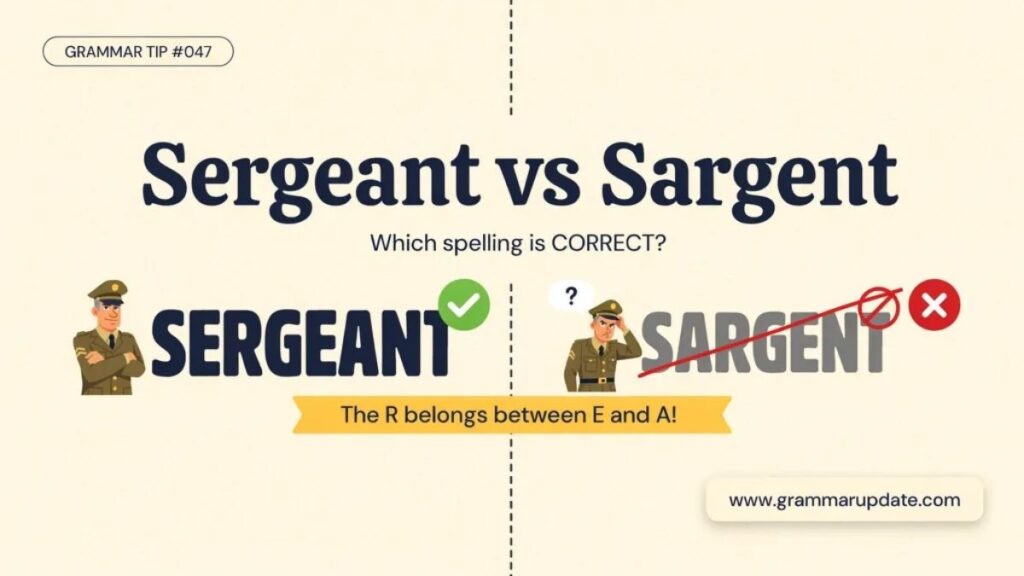
Sergeant vs Sargent, These two words sound almost the same, so its easy to mix them up. Its one of those classic English spelling tricks that catches even careful writers. The good news is that the difference is simple. Sergeant is the correct spelling for the official military and police rank, while Sargent is usually a person’s last name. In this guide, you’ll learn when to use each word, why people confuse them, and how to remember the correct spelling with easy examples, practical tips, and clear explanations.
Sergeant vs Sargent Quick Answer
Here’s the simple answer.
- Sergeant is the correct spelling for the military rank and the police rank.
- Sargent is not a military or police rank. It is primarily a surname, also known as a last name.
- If you’re referring to someone serving in the Army, Marines, Air Force, or a police department, always write Sergeant.
- If you’re referring to someone whose family name is Sargent, then Sargent is correct.
This distinction solves most cases of Sergeant vs Sargent confusion.
Which spelling is correct?
The correct spelling depends entirely on the context.
Use Sergeant when referring to:
- A military rank
- A police rank
- A noncommissioned officer
- Official military terminology
- Law enforcement titles
Use Sargent when referring to:
- A person’s surname
- A business or organization with the name Sargent
- Streets, schools, or locations named after someone with the Sargent last name
Many people wonder, “Is Sargent a correct spelling of Sergeant?” The answer is no. While Sargent is a real word, it is not the correct spelling of the official rank.
Quick examples
Correct:
- Sergeant Miller led the training exercise.
- The police sergeant interviewed the witnesses.
- She was promoted to Sergeant after years of dedicated service.
Correct:
- John Singer Sargent painted remarkable portraits.
- Josh Sargent plays professional soccer.
- The Sargent family has lived here for generations.
Incorrect:
- Sargent Johnson commanded the platoon.
- Please report to Sargent Davis immediately.
Unless Davis’s last name is actually Sargent, those sentences contain a Sergeant spelling mistake.
Learn the difference between commonly misused words
Kinesthesiology vs Kinesiology difference Explained
Sergeant vs Sargent at a Glance
| Feature | Sergeant | Sargent |
|---|---|---|
| Correct military rank | Yes | No |
| Correct police rank | Yes | No |
| Official rank title | Yes | No |
| Common English noun | Yes | No |
| Family surname | Rare | Yes |
| Common misspelling | No | Yes |
| Used in military writing | Yes | No |
| Used in law enforcement | Yes | No |
This table answers one of the most common searches related to Sergeant vs Sargent meaning.
What Does Sergeant Mean?
The Sergeant definition is straightforward. A sergeant is a noncommissioned officer who supervises personnel, maintains discipline, and helps carry out leadership responsibilities.
Although duties vary between organizations, every sergeant serves as an important link between junior personnel and higher-ranking officers.
The word Sergeant appears in military organizations around the world and in many civilian law enforcement agencies.
Sergeant in the Military
A Sergeant military rank is one of the most respected leadership positions among enlisted personnel.
Rather than commanding entire units like commissioned officers, sergeants lead smaller teams while ensuring soldiers complete missions safely and efficiently.
Their responsibilities often include:
- Leading squads
- Training new recruits
- Maintaining discipline
- Supervising daily operations
- Ensuring readiness
- Mentoring junior soldiers
A Sergeant army rank carries significant responsibility because sergeants work directly with the soldiers who perform day-to-day operations.
Military experts often describe sergeants as the backbone of the armed forces because they combine practical experience with leadership.
Common military branches using the rank include:
- Army
- Marine Corps
- Air Force
- National Guard
- Many allied military organizations
When discussing Sergeant vs Sargent military, remember that every official military publication uses Sergeant.
Sergeant in Law Enforcement
The Sergeant police rank is equally important.
A police sergeant typically supervises officers during daily patrols and investigations. They act as frontline leaders who balance administrative duties with operational responsibilities.
Typical responsibilities include:
- Supervising patrol officers
- Reviewing incident reports
- Coordinating investigations
- Responding to major emergencies
- Managing shift assignments
- Training new officers
In many departments, promotion to sergeant marks the first step into formal leadership.
That’s why Sergeant or Sargent police is another frequently searched phrase. The official title is always Sergeant.
Sergeant in Other Organizations
Outside the military and police, Sergeant also appears in several other settings.
Examples include:
- Fire departments
- Correctional institutions
- Security organizations
- Military academies
- Cadet programs
Historical titles also include:
- Sergeant-at-Arms
- Staff Sergeant
- First Sergeant
- Gunnery Sergeant
- Master Sergeant
Each title includes the same official Sergeant spelling.
Example Sentences
Here are examples showing the correct usage.
Military
- The sergeant briefed the squad before sunrise.
- Every new recruit reported to the sergeant for instructions.
- The sergeant inspected each soldier’s equipment.
Police
- The police sergeant approved the patrol schedule.
- The sergeant questioned the witnesses after the incident.
- Officers notified the sergeant immediately.
General
- She earned the rank of sergeant through years of dedication.
- The sergeant praised the team’s professionalism.
- Everyone respected the sergeant’s leadership.
Learn the difference between commonly misused words
maintained vs maintenanced Differences Explained
What Does Sargent Mean?
Unlike Sergeant, Sargent is usually a proper noun.
That means it serves as a surname rather than a job title or military rank.
Many people searching “What does Sargent mean?” expect another military definition. Instead, they discover that Sargent meaning almost always refers to a family name.
Because it functions as a proper noun, Sargent begins with a capital letter when used as someone’s last name.
Examples include:
- Emily Sargent
- Michael Sargent
- David Sargent
If you replace Sergeant with Sargent in military writing, the sentence becomes incorrect unless you’re referring to someone’s surname.
Sargent as a Family Name
The Sargent surname has existed for centuries.
Like many English family names, it developed from occupations or historical spellings before becoming a hereditary surname.
Today, thousands of people around the world have Sargent as their last name.
This explains another common question:
Is Sargent a surname?
Yes.
Is Sargent a last name?
Yes.
Is Sargent a military rank?
No.
Is Sargent a police rank?
No.
Understanding this difference immediately clears up much of the Sergeant vs Sargent meaning confusion.
Famous People with the Sargent Surname
Several well-known individuals have helped make the Sargent surname recognizable.
John Singer Sargent
John Singer Sargent was one of history’s greatest portrait painters. His works continue to appear in major museums around the world. Although many people see the name Sargent and assume it’s connected to the military rank, it’s simply his surname.
Josh Sargent
Josh Sargent is an American professional soccer player who has represented the United States internationally. Again, Sargent is his family name rather than a title.
These examples show why context matters so much when discussing Sergeant or Sargent.
Places and Businesses Named Sargent
You’ll also encounter Sargent in place names and business names.
Examples include:
- Sargent County
- Sargent Road
- Sargent School
- Companies carrying the Sargent brand name
These names honor families or individuals rather than military ranks.
Example Sentences
Correct examples include:
- John Singer Sargent created stunning portraits.
- Josh Sargent scored the winning goal.
- The Sargent family attended the community event.
- Sargent Avenue was closed for construction.
Incorrect examples include:
- The army promoted him to Sargent.
- Please report to Police Sargent Lewis.
Those examples contain a common spelling of sergeant mistake unless Lewis’s surname happens to be Sargent.
Learn the difference between commonly misused words
Present vs Presant Differences and Correct Usage
Sergeant vs Sargent Side-by-Side Comparison
| Feature | Sergeant | Sargent |
|---|---|---|
| Meaning | Military or police rank | Family surname |
| Part of speech | Common noun | Proper noun |
| Used as an official rank | Yes | No |
| Used as a surname | Occasionally | Yes |
| Common usage | Military, law enforcement | Personal names |
| Correct abbreviation | Sgt. | None |
| Appears in official military documents | Yes | No |
| Appears in police organizations | Yes | No |
When people search “Sergeant vs Sargent pronunciation,” they often expect different pronunciations. Surprisingly, both names are pronounced very similarly. That similarity is exactly why so many spelling errors happen.
Learn the difference between commonly misused words
Prooving vs Proving Difference
Why People Confuse Sergeant and Sargent
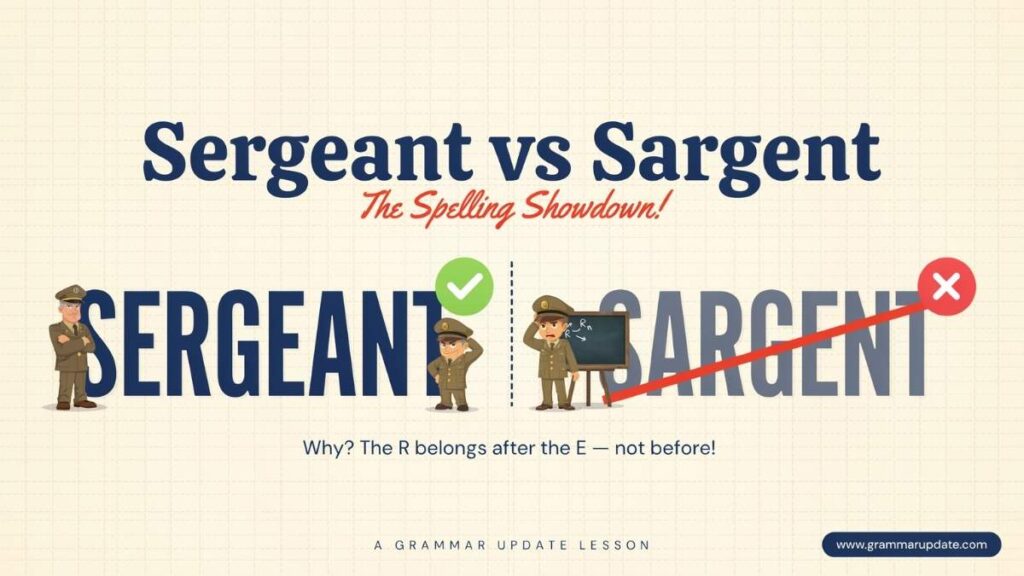
If you’ve ever typed “Sargent” instead of “Sergeant,” you’re in good company. It’s one of the most common spelling mistakes in English because the word doesn’t look the way it sounds.
Most people hear the word first and write it based on its pronunciation. Since Sergeant is commonly pronounced sar-jent, many naturally assume it should be spelled “Sargent.” This is a classic example of spelling based on pronunciation rather than historical spelling.
The confusion appears everywhere—from classroom assignments and workplace emails to online forums and social media posts.
Here are the biggest reasons people mix them up.
Pronunciation Causes the Mistake
The biggest reason is simple: Sergeant pronunciation doesn’t match its spelling.
Most English speakers pronounce it as:
sar-jent
Notice what you don’t hear clearly:
- The second “e”
- The “g” before “e”
- The unusual “ea” letter combination
Because of this, many people write exactly what they hear.
For example:
Incorrect:
- Sargent Smith reported for duty.
- Police Sargent Johnson arrived first.
Correct:
- Sergeant Smith reported for duty.
- Police Sergeant Johnson arrived first.
This explains why searches like “Why does Sergeant sound like Sargent?” and “Sergeant pronunciation Reddit” continue to trend online.
Fast Typing and Autocorrect
Another reason is simple typing habits.
Many people type quickly without thinking about uncommon spellings. Since “Sargent” is a legitimate surname, spell checkers don’t always flag it as an error.
Imagine writing:
“The Sargent instructed the recruits.”
A grammar checker may not identify “Sargent” as incorrect because it recognizes it as a proper noun.
That’s why proofreading matters, especially in formal writing.
Similar-Looking Spellings
English contains many words that sound alike but have different meanings.
Examples include:
- Principal vs Principal’s
- Stationary vs Stationery
- Complement vs Compliment
Sergeant vs Sargent belongs in this group of commonly confused words.
The spellings differ by only one letter, making mistakes easy to overlook.
Lack of Familiarity with Military and Police Ranks
People who have never served in the military or worked in law enforcement may not encounter the rank often.
Without regular exposure, they naturally rely on pronunciation instead of memorizing the official spelling.
Someone who sees the rank only once or twice a year is much more likely to type “Sargent.”
Learn the difference between commonly misused words
Signer vs Signor Difference and Correct Usage
Why “Sergeant” Is the Official Spelling
Many people ask:
Why is Sergeant spelled that way?
The answer lies in history.
English inherited thousands of words from French after the Norman Conquest of England in 1066. During that period, many military and legal terms entered English while keeping much of their original spelling.
Sergeant is one of them.
Although pronunciation evolved over the centuries, the spelling remained largely unchanged.
This is why the word looks unusual today.
Military Usage
Every modern English-speaking military uses Sergeant as the official rank title.
Examples include:
- United States Army
- United States Marine Corps
- United States Air Force
- British Army
- Canadian Armed Forces
- Australian Army
Whether you’re discussing Sergeant vs Sargent army or Sergeant vs Sargent military, every official publication uses Sergeant.
No military organization recognizes “Sargent” as a rank.
Police Usage
Law enforcement agencies also use Sergeant.
Examples include:
- Police Sergeant
- Detective Sergeant
- Patrol Sergeant
- Staff Sergeant in certain agencies
If you’re writing reports, resumes, or news articles, always use Sergeant when referring to the official police rank.
Government Documents
Government agencies consistently use Sergeant in:
- Military regulations
- Promotion orders
- Personnel records
- Training manuals
- Police department policies
- Official correspondence
Because these documents establish legal and professional standards, they reinforce the accepted spelling.
Dictionaries and Style Guides
Major dictionaries define Sergeant as an official military or police rank.
Style guides used by journalists, publishers, and government agencies also recommend Sergeant in every professional context.
None list “Sargent” as an alternative spelling for the rank.
Learn the difference between commonly misused words
Bachelor vs Batchelor Difference and Correct Usage
Is “Sargent” Ever Correct?
Yes.
Although Sargent is incorrect as a military or police title, it is completely correct when it refers to a person’s name.
That’s why context matters.
When Referring to a Person’s Last Name
Many families have carried the Sargent surname for generations.
Examples include:
- Amanda Sargent
- Robert Sargent
- Thomas Sargent
In these cases, changing the spelling to Sergeant would actually create an error.
Always respect the spelling of someone’s legal name.
Businesses, Schools, and Locations
You’ll also find Sargent used in names such as:
- Sargent Elementary School
- Sargent Road
- Sargent County
- Sargent Manufacturing Company
These names originate from people or families, not military ranks.
Never Change a Person’s Name
Suppose someone’s business card says:
Emily Sargent
You should never write:
Emily Sergeant
Likewise, if someone is officially a Police Sergeant, you shouldn’t write Police Sargent.
Proper nouns should always keep their original spelling.
Learn the difference between commonly misused words
Courtesy vs Curtesy Usage and Common Mistakes
Sergeant in Different Professions
Although most people associate the title with the Army, the rank exists in many professions.
Leadership responsibilities vary, but the core purpose remains the same: supervising personnel while maintaining discipline and efficiency.
Army Sergeant
The Sergeant army rank is one of the best-known enlisted leadership positions.
An Army sergeant usually:
- Leads a squad
- Trains soldiers
- Maintains discipline
- Oversees equipment
- Ensures mission readiness
Because sergeants work directly with soldiers, they’re often considered the backbone of the Army.
Marine Corps Sergeant
Marine sergeants lead Marines during both training and operations.
Responsibilities include:
- Tactical leadership
- Mentoring junior Marines
- Conducting inspections
- Supervising daily activities
The Marine Corps also includes higher enlisted ranks such as:
- Staff Sergeant
- Gunnery Sergeant
- Master Sergeant
- First Sergeant
- Sergeant Major
Air Force Sergeant
Historically, the Air Force used several sergeant titles for enlisted personnel. While the rank structure has evolved over time, the term Sergeant remains an important part of Air Force history and military terminology.
Police Sergeant
The Sergeant police rank usually serves as the first supervisory position within a police department.
A police sergeant may:
- Supervise patrol shifts
- Coordinate emergency responses
- Review reports
- Approve arrests
- Mentor new officers
- Evaluate officer performance
Their leadership directly affects public safety and department operations.
Sheriff’s Office Sergeant
Many sheriff’s offices also include sergeants.
Depending on the jurisdiction, they supervise:
- Patrol deputies
- Jail personnel
- Court security officers
- Criminal investigators
Although duties differ, the title remains Sergeant.
Sergeant vs Captain What’s the Difference?
One of the most common searches is Sergeant vs Captain.
Although both are leaders, they belong to different categories of military ranks.
| Feature | Sergeant | Captain |
|---|---|---|
| Rank group | Enlisted | Commissioned officer |
| Leadership level | Squad or small unit | Company-sized unit or larger |
| Commission required | No | Yes |
| Primary role | Direct leadership | Planning and command |
A captain generally outranks a sergeant.
Captains develop operational plans, while sergeants ensure those plans are carried out effectively by enlisted personnel.
Think of it this way:
- The captain decides what the unit will accomplish.
- The sergeant helps make sure it actually happens.
Both positions are essential.
Sergeant vs Lieutenant What’s the Difference?
Another frequent question is the Difference between Sergeant and Lieutenant.
Although both supervise people, they occupy different levels within the chain of command.
| Feature | Sergeant | Lieutenant |
|---|---|---|
| Rank category | Enlisted | Commissioned officer |
| Leadership role | Frontline supervisor | Unit commander |
| Commissioned | No | Yes |
| Reports to | Higher NCOs or officers | Captains or higher officers |
A lieutenant normally outranks a sergeant.
However, experienced sergeants often possess years of practical leadership experience that complements a lieutenant’s command responsibilities.
Promotion Path
A simplified enlisted path looks like this:
Private
Corporal
Sergeant
Staff Sergeant
Sergeant First Class
Master Sergeant
Sergeant Major
Officer progression follows a separate track beginning with Second Lieutenant.
Understanding these differences helps answer searches such as:
- Sergeant vs lieutenant rank
- Difference between Sergeant and Lieutenant
- Sergeant vs Captain rank
Sergeant vs Corporal
Many people also compare Sergeant vs Corporal.
Both are noncommissioned officers in many armed forces, but a sergeant generally carries greater leadership responsibilities.
| Corporal | Sergeant |
|---|---|
| Junior NCO | Senior NCO |
| Leads small teams | Supervises larger teams or squads |
| Entry-level leadership | Experienced frontline leadership |
Promotion from corporal to sergeant often represents a significant increase in responsibility.
Sergeant vs Major
The comparison Sergeant vs Major can be confusing because “Major” exists as both an officer rank and within senior enlisted titles such as Sergeant Major.
A Major is a commissioned officer.
A Sergeant Major is a senior enlisted leader.
Although the titles share the word “Sergeant,” they belong to different leadership structures.
Understanding these distinctions helps you interpret military rank names correctly and prevents confusion when reading military documents or news reports.
Learn the difference between commonly misused words
Excited vs Exited learn the Difference and Usage
Sergeant vs Sargent in the Army
If you’ve searched for Sergeant vs Sargent in the Army or Sergeant vs Sargent military, the answer is straightforward. Every official military branch uses Sergeant as the correct rank title.
Whether you’re reading a promotion order, training manual, service record, or military regulation, you’ll see Sergeant not Sargent.
The rank appears throughout the enlisted leadership structure and plays a critical role in daily military operations.
Common Army sergeant titles include:
- Sergeant (SGT)
- Staff Sergeant (SSG)
- Sergeant First Class (SFC)
- Master Sergeant (MSG)
- First Sergeant (1SG)
- Sergeant Major (SGM)
- Command Sergeant Major (CSM)
Each of these titles follows the same official Sergeant spelling.
Common Mistakes in Military Writing
Writers often make these errors:
Incorrect:
- Sargent Davis received a promotion.
- The Sargent inspected the squad.
- Sargent First Class Wilson addressed the soldiers.
Correct:
- Sergeant Davis received a promotion.
- The Sergeant inspected the squad.
- Sergeant First Class Wilson addressed the soldiers.
Even a single misplaced letter can reduce the professionalism of military writing.
Military Writing Tip
Before submitting military documents, always check:
- Rank titles
- Name spellings
- Rank abbreviations
- Capitalization
Accuracy matters because military terminology follows strict standards.
Learn the difference between confusing word pairs
Sponser vs Sponsor Difference and Usage
Sergeant or Sargent in Police Writing
The same rule applies in law enforcement.
Every official police department uses Sergeant as the rank title.
You may see titles such as:
- Patrol Sergeant
- Detective Sergeant
- Shift Sergeant
- Traffic Sergeant
- Training Sergeant
You’ll never see “Police Sargent” unless Sargent is someone’s surname.
How to Address a Police Sergeant
Examples include:
- Good morning, Sergeant.
- Thank you, Sergeant Williams.
- Please notify Sergeant Brown.
These forms are standard in law enforcement communication.
Common Reporting Mistakes
Avoid writing:
- Police Sargent
- Detective Sargent
- Shift Sargent
These mistakes often occur because writers rely on pronunciation rather than the official spelling.
Learn the difference between confusing word pairs
Useable vs Usable Difference and Correct Usage
Sergeant vs Sargent Meaning Explained
Many readers search for Sergeant vs Sargent meaning because both words sound nearly identical.
Here’s the simplest explanation.
| Word | Meaning |
|---|---|
| Sergeant | A military or police rank |
| Sargent | A surname or family name |
Although their pronunciations are very similar, their meanings are completely different.
Sergeant Definition
A Sergeant is:
- A noncommissioned officer in the military.
- A supervisory rank in many police departments.
- A leadership position responsible for training, discipline, and operational success.
Sargent Meaning
Sargent usually refers to:
- A person’s last name.
- A family surname.
- A business or place named after someone with that surname.
It does not refer to a military rank.
Learn the difference between confusing word pairs
Anyway vs Any Way Difference and which is Correct?
Sergeant vs Sargent Abbreviation
One of the most common questions is:
What is the abbreviation for Sergeant?
The standard abbreviation is:
Sgt.
This abbreviation appears in:
- Military records
- Police reports
- Government documents
- News articles
- Personnel files
Examples:
- Sgt. Miller
- Sgt. Johnson
- Sgt. Ramirez
Sergeant Abbreviation in the Army
The U.S. Army uses standardized abbreviations for enlisted ranks.
Some examples include:
| Rank | Abbreviation |
|---|---|
| Sergeant | SGT |
| Staff Sergeant | SSG |
| Sergeant First Class | SFC |
| Master Sergeant | MSG |
| First Sergeant | 1SG |
| Sergeant Major | SGM |
| Command Sergeant Major | CSM |
These abbreviations appear in official military publications.
Sergeant Abbreviation in Police Departments
Police agencies usually use:
Sgt.
Examples:
- Sgt. Adams investigated the case.
- Sgt. Lewis supervised the evening shift.
Notice that there is no accepted abbreviation for Sargent because it is not an official rank.
Origin and Etymology of Sergeant
Many people ask:
Why is Sergeant spelled that way?
The answer dates back hundreds of years.
Old French Origin
The word comes from the Old French word “sergent.”
That French word described someone who served another person, especially in military or legal roles.
Over time, English adopted the word while preserving much of its original spelling.
This explains why Sergeant looks unusual compared to its pronunciation.
Latin Roots
Old French “sergent” developed from the Latin word “serviens,” meaning “one who serves.”
The Latin verb “servire” means “to serve.”
The evolution looks like this:
Latin
↓
Old French
↓
Middle English
↓
Modern English
Although pronunciation changed gradually, the spelling remained remarkably stable.
Historical Development
During the Middle Ages, a sergeant could serve several roles, including:
- Military assistant
- Royal official
- Court officer
- Legal representative
- Household servant
As military organizations became more structured, the title evolved into the modern enlisted rank we recognize today.
Learn the difference between confusing more English words
Perfer vs Prefer Usage and Common Mistakes
Serjeant vs Sergeant
Another common source of confusion is Serjeant vs Sergeant.
Both spellings have historical roots.
What Is Serjeant?
Serjeant is an older English spelling.
Today, it survives mainly in historical and legal contexts.
Examples include:
- Serjeant-at-Arms
- Serjeant-at-Law
Outside these specialized titles, modern English overwhelmingly uses Sergeant.
Is Serjeant Still Used?
Yes, but only in limited situations.
You’ll occasionally encounter Serjeant in:
- Historical documents
- Legal history
- Parliamentary traditions
- Museums
- Academic writing
For everyday English, Sergeant is the accepted spelling.
British English vs American English
Many spelling differences exist between British English and American English.
Examples include:
| American English | British English |
|---|---|
| Color | Colour |
| Center | Centre |
| Organize | Organise |
However, Sergeant is not one of those differences.
Sergeant Spelling in American English
American military spelling uses:
Sergeant
Sergeant Spelling in British English
British military spelling also uses:
Sergeant
That surprises many people because they’re expecting two different spellings.
There aren’t any.
Both countries use Sergeant.
How Is Sergeant Pronounced?
One of the biggest reasons for spelling confusion is pronunciation.
Sergeant is commonly pronounced:
sar-jent
Although the spelling includes “ea,” most speakers don’t pronounce those letters separately.
This creates a disconnect between spelling and pronunciation.
Sergeant vs Sargent Pronunciation
Interestingly, Sergeant and Sargent are pronounced almost exactly the same in everyday speech.
That’s why people naturally type:
Sargent
instead of:
Sergeant
The pronunciation hasn’t changed much over the centuries, but the spelling preserves the word’s historical roots.
Learn the difference between confusing more English words
Parents’ vs Parent’s Differences and Correct Usage
Common Mistakes to Avoid
The following errors appear frequently online.
Mistake 1 Using Sargent as a Military Rank
Incorrect:
- Sargent Williams reported for duty.
Correct:
- Sergeant Williams reported for duty.
Mistake 2 Assuming Pronunciation Determines Spelling
English contains many words whose spelling doesn’t perfectly match pronunciation.
Examples include:
- Colonel
- Lieutenant
- Choir
- Island
- Sergeant
Sergeant belongs in that group.
Mistake 3 Confusing a Surname with a Rank
Remember:
Sergeant = rank
Sargent = surname
Keeping that distinction in mind eliminates most spelling mistakes.
Mistake 4 Using the Wrong Abbreviation
Correct:
Sgt.
Incorrect:
Sarg.
Sgtt.
Ser.
Real-World Examples
Military Documents
Correct:
“Sergeant Davis completed leadership training.”
Police Reports
Correct:
“Sergeant Wilson responded to the emergency.”
News Articles
Correct:
“Police Sergeant Maria Lopez received the department’s highest leadership award.”
Books
Many military history books consistently use Sergeant because it is the official rank title.
Everyday Conversation
Correct:
“My cousin was promoted to Sergeant last month.”
Incorrect:
“My cousin became a Sargent.”
Learn the difference between confusing more English words
Leeched vs Leached Difference and which is correct ?
Sergeant vs Sargent on Reddit and Online Forums
Searches like:
- Sergeant vs Sargent Reddit
- Sargent vs Sergeant Reddit
- Why is Sergeant spelled that way Reddit
- Is Sargent a word Reddit
appear frequently because users hear the word before seeing it written.
Across these discussions, the same conclusion emerges.
- Sergeant is the official rank.
- Sargent is a surname.
- Pronunciation causes the confusion.
The consensus aligns with dictionaries, military publications, and police style guides.
Learn the difference between confusing more English words
Insuring vs Ensuring Difference and which is correct?
Practice Session Sergeant vs Sargent
Choose the correct word to complete each sentence: Sergeant vs Sargent.
- Officer James was promoted to __________ after ten years of service.
- __________ Williams led the squad during the training exercise.
- The famous painter John Singer __________ created many celebrated portraits.
- Every new recruit reported to the __________ before the drill began.
- Emily __________ received an award for her community service.
- The police __________ reviewed the incident report before the end of the shift.
- Josh __________ scored the winning goal for his team.
- The __________ instructed the soldiers to prepare for inspection.
- Detective __________ interviewed the witnesses at the crime scene.
- The __________ family has lived in the town for generations.
- During roll call, the __________ checked every soldier’s attendance.
- Sarah __________ published her first novel this year.
- The Army __________ praised the platoon for its discipline.
- Please report to __________ Brown immediately.
- The museum displayed several paintings by John Singer __________.
- The __________ supervised the officers during the night patrol.
- Michael __________ donated books to the local library.
- Every __________ is expected to lead by example.
- Officer Lee earned the rank of __________ after completing leadership training.
- Rebecca __________ teaches history at the university.
- The commanding officer congratulated the __________ on the successful mission.
- __________ Avenue was closed for road maintenance this morning.
- The __________ briefed the team before they entered the building.
- The award was presented to Police __________ Hernandez for outstanding leadership.
- The __________ surname appears in many historical records throughout the United States.
Answers
- Sergeant
- Sergeant
- Sargent
- Sergeant
- Sargent
- Sergeant
- Sargent
- Sergeant
- Sergeant
- Sargent
- Sergeant
- Sargent
- Sergeant
- Sergeant
- Sargent
- Sergeant
- Sargent
- Sergeant
- Sergeant
- Sargent
- Sergeant
- Sargent
- Sergeant
- Sergeant
- Sargent
Here’s a trusted source for clear word meanings:
FAQs
Is it spelled Sargent or Sergeant?
The correct spelling for the military and police rank is Sergeant. Sargent is usually a surname, not an official rank title.
What is the meaning of Sargent?
Sargent is primarily a family surname. It can also appear in the names of businesses, schools, streets, and places, but it does not refer to a military or police rank.
What is the meaning of Sergeant?
A Sergeant is a noncommissioned officer (NCO) in the military or a supervisory rank in many police departments. Sergeants lead personnel, enforce discipline, and oversee daily operations.
Is it drill sergeant or drill sargent?
The correct term is Drill Sergeant. The U.S. Army officially uses the title Drill Sergeant for soldiers who train new recruits.
What rank is higher than a Sergeant?
Several ranks are higher than Sergeant. Depending on the military branch, these may include Staff Sergeant, Sergeant First Class, Master Sergeant, First Sergeant, Sergeant Major, and commissioned officers such as Lieutenant and Captain.
Why is Sergeant sometimes spelled Serjeant?
Serjeant is an older English spelling that survives mainly in historical and legal titles, such as Serjeant-at-Arms. Modern military and police organizations use Sergeant.
Why is Sergeant pronounced “sar-jent”?
The pronunciation comes from centuries of language evolution. Although the spelling comes from the Old French word sergent, the spoken form gradually changed while the historical spelling remained.
What makes someone a Sergeant?
A person becomes a Sergeant by meeting the promotion requirements of their military branch or police department. Promotion usually depends on experience, leadership ability, performance, training, and examinations.
Is there a trick to spelling Sergeant?
Yes. Remember that Sergeant contains the letters “EA.” Another helpful tip is to associate Sergeant with the official abbreviation Sgt., which can help you recall the correct spelling.
Is Sargeant a word?
No. Sargeant is not the accepted spelling of the military or police rank. The correct spelling is Sergeant.
What does Sargent mean in English?
In English, Sargent is most commonly a surname. Unlike Sergeant, it does not describe a military rank or law enforcement position.
How do you address a Sergeant?
In conversation, you can address a sergeant by saying “Sergeant” followed by their last name, such as “Sergeant Taylor.” In many situations, simply saying “Sergeant” is also appropriate.
Why do drill sergeants say “maggot”?
“Maggot” is an informal nickname some drill sergeants have historically used to emphasize discipline and motivate recruits during training. It is not an official military term and practices vary by instructor and training environment.
What is the nickname for a Sergeant in the Army?
Common informal nicknames include “Sarge” and “Top” for certain senior sergeants. These nicknames depend on military tradition, branch, and unit culture.
What do you call a female drill sergeant?
You address a female drill sergeant exactly the same way as a male drill sergeant: “Drill Sergeant.” The title does not change based on gender.
What is the hardest rank to achieve in the Army?
General is the highest and one of the rarest active-duty ranks. Among enlisted personnel, Sergeant Major of the Army is the highest enlisted position and is held by only one soldier at a time.
Does a Sergeant outrank a detective?
Not necessarily. In many police departments, detective is an assignment rather than a rank. A police Sergeant usually supervises detectives and patrol officers, but the structure varies by agency.
What is slang for Sergeant?
“Sarge” is the most common informal nickname for a Sergeant. It is widely used in military and law enforcement settings, although official communication generally uses the full rank.
Is a Lieutenant higher than a Sergeant?
Yes. A Lieutenant is a commissioned officer and normally outranks a Sergeant, who is a noncommissioned officer.
How old are Sergeants usually?
There is no fixed age. Many military sergeants are in their mid-20s to late 30s, while police sergeants often gain the rank after several years of service and may be older.
Which is correct, Sergeant or Sargent?
Sergeant is correct for the military and police rank. Sargent is generally correct only when referring to someone’s surname.
Why do soldiers say “Sarnt”?
“Sarnt” is an informal spoken pronunciation used in some military traditions and regional accents. It reflects speech rather than the official spelling, which remains Sergeant.
How do Marines spell Sergeant?
The U.S. Marine Corps uses the standard spelling Sergeant. The same spelling applies to Staff Sergeant, Gunnery Sergeant, and other sergeant ranks.
Is Sergeant a high rank in the Army?
Sergeant is considered an important enlisted leadership rank. While it is not among the highest ranks, it marks the beginning of significant leadership responsibilities as a noncommissioned officer.
How do the British spell Sergeant?
Both British English and American English use the spelling Sergeant for the military and police rank. The older spelling Serjeant is now limited to certain historical and legal contexts.
What is the rarest rank in the Army?
The rank of General of the Army is one of the rarest in U.S. military history because it is awarded only under exceptional circumstances. Among enlisted ranks, Sergeant Major of the Army is unique because only one person holds the position at a time.
Can a woman be a Sergeant?
Yes. Women serve as Sergeants in the Army, Marine Corps, Air Force, police departments, and many other organizations. The rank is the same regardless of gender.
Do you salute a Sergeant Major?
In most military organizations, enlisted personnel such as Sergeant Majors do not receive salutes based solely on rank. Salutes are generally exchanged with commissioned officers. However, military customs and regulations should always be followed.
What’s higher, a Lieutenant or a Sergeant?
A Lieutenant is higher than a Sergeant in the military chain of command because Lieutenants are commissioned officers.
Why can’t you call a Sergeant “Sir”?
“Sir” is traditionally used to address commissioned officers. Sergeants are addressed by their rank because they are noncommissioned officers.
What do soldiers say when a Sergeant walks in?
Responses vary by unit and situation. In formal settings, soldiers may come to attention and greet the Sergeant according to military customs and regulations.
Why is it Sergeant and not Sargent?
The spelling Sergeant comes from the Old French word sergent and has remained largely unchanged for centuries. Although pronunciation evolved, the historical spelling became the official form.
What is another word for Sergeant?
Depending on the context, similar terms include noncommissioned officer (NCO), squad leader, or supervisor. These terms are related but are not exact replacements for the rank of Sergeant.
Is it spelled Sergeant or Sargeant?
The correct spelling is Sergeant. Sargeant is a common misspelling and is not the official military or police rank.
How do Australians spell Sergeant?
Australia uses the standard spelling Sergeant in both the military and police services.
What’s higher, Staff Sergeant or Sergeant?
Staff Sergeant is higher than Sergeant in the enlisted rank structure of many military organizations.
Does a Sergeant outrank an officer?
No. Commissioned officers, such as Lieutenants and Captains, outrank Sergeants. However, experienced Sergeants often provide essential leadership and guidance to junior officers.
Is it okay to call a Staff Sergeant “Sergeant”?
In many military branches, it is acceptable to address a Staff Sergeant simply as “Sergeant” during conversation, although customs may vary.
What is the nickname for a Master Sergeant?
Some units informally use “Top” for senior enlisted leaders, especially First Sergeants. Master Sergeant is generally addressed by the full rank or as “Sergeant,” depending on military customs.
Do they say “ma’am” in the military?
Yes. “Ma’am” is a respectful form of address for female commissioned officers and is commonly used throughout the military.
Why do soldiers say “Sir”?
Soldiers say “Sir” as a sign of respect when addressing commissioned officers. It is part of military customs and professional etiquette.
What does it mean when a drill sergeant says “Half right, face”?
“Half right, face” is a drill command directing soldiers to turn approximately 45 degrees to the right while maintaining formation. It helps position troops during drill movements.
Conclusion
The confusion between Sergeant vs Sargent is easier to understand than you might think. They sound almost the same, but they do not mean the same thing. Sergeant is the correct spelling for the official military and police rank. Sargent is usually a person’s last name. That’s the key difference to remember.
If you’re writing about the Army, Marines, Air Force, or a police officer, always use Sergeant. If you’re referring to someone’s family name, use Sargent. Don’t let the pronunciation trick you English has plenty of words that sound different from how they’re spelled, and Sergeant is one of them.
Now you know the correct spelling, the meaning of each word, and when to use them. The next time someone asks, “Is it Sergeant or Sargent?” you’ll have the right answer. One is a rank, the other is a surname. Mystery solved, spelling saved, and your writing just became a little more accurate.

Jhon AJS, the creative mind behind Grammar Update, is an experienced blogger passionate about simplifying English grammar. He focuses on explaining confusing word vs word differences, grammar rules, punctuation, and sentence structure in a clear and practical way. Through easy to understand guides and examples, Jhon helps readers improve their writing and communicate with confidence. With years of blogging experience, he continues to share helpful insights that make learning grammar simple, useful, and accessible for everyone.