Have you ever stopped typing because you couldn’t decide between favs vs faves? You’re not alone. That single extra letter has confused countless writers, even though the answer is surprisingly simple. Both words are informal abbreviations of favorite and share the same meaning, but their usage often depends on style and personal preference. Understanding when to use each one can make your writing sound more natural and confident. In this guide, you’ll clear up the favs vs faves confusion, learn the correct spelling, explore real-life examples, and avoid common mistakes so you can choose the right form every time.
Favs vs Faves Quick Answer
If you’re looking for the short answer, here it is.
Both favs and faves are accepted informal abbreviations of the word favorite, or favourite in British English. Neither changes the meaning of the original word.
The main difference lies in style and personal preference, not grammar.
- Favs is a shorter abbreviation that appears frequently in apps, websites, menus, and user interfaces where space is limited.
- Faves is a more natural-looking spelling because it reflects how the word is pronounced in everyday conversation.
In other words, the favs vs faves meaning debate isn’t about different definitions. Both words refer to someone’s favorite things, people, places, songs, movies, books, or activities.
The Simple Rule
Use faves when writing casually in blogs, text messages, or social media posts.
Use favs when you need a shorter label, such as:
- Favorites folders
- Mobile apps
- Navigation menus
- Character-limited interfaces
- Hashtags
Whenever you’re writing formally, avoid both abbreviations and use the full word favorite or favourite instead.
Which Form Is More Common?
There isn’t a universal winner.
Both spellings appear regularly in modern internet slang, online communication, and social media language. However, each tends to appear in different situations.
| Word | Most Common Use | Formal? |
|---|---|---|
| Fav | Singular abbreviation | No |
| Fave | Singular abbreviation with natural pronunciation | No |
| Favs | Plural abbreviation in apps and interfaces | No |
| Faves | Plural abbreviation in conversation and social media | No |
| Favorite | Standard American English | Yes |
| Favourite | Standard British English | Yes |
The choice usually comes down to writing style rather than grammar.
Learn the difference between confusing more English words
Cognisant vs Cognizant difference which is correct ?
What Do Favs and Faves Mean?
Understanding faves meaning and favs meaning starts with the original word.
Both terms are simply shortened forms of favorite.
Instead of writing:
“My favorite movies are classic comedies.”
Someone might casually write:
“My faves are classic comedies.”
Or:
“Here are my favs this month.”
The meaning stays exactly the same.
Favs Meaning
The favs definition is straightforward.
Favs is the plural abbreviation of favorite.
It refers to multiple favorite items, people, or choices.
Examples include:
- My favs this year are action movies.
- These are my favs on Spotify.
- Save your favs before deleting the app.
- My favs always change with the season.
Because it’s shorter, many websites and apps use the favs spelling in buttons, menus, and navigation labels.
Faves Meaning
The faves definition is almost identical.
Faves is another plural abbreviation of favorite.
Many writers feel it looks more natural because the spelling matches its pronunciation.
Examples:
- My faves include science fiction novels.
- These are my current Netflix faves.
- Share your summer faves.
- My travel faves are Italy and Japan.
When discussing faves meaning in text, the word simply means favorite things.
Are They Exactly the Same?
Yes.
From a meaning standpoint, there is virtually no difference.
Whether someone writes:
- My favs
- My faves
They are expressing exactly the same idea.
The only noticeable distinction is the writer’s personal preference and writing style.
Pronunciation Guide
Both words sound almost identical.
| Word | Pronunciation |
|---|---|
| Fav | /fav/ |
| Fave | /fayv/ |
| Favs | /favz/ |
| Faves | /fayvz/ |
Because fave closely matches the spoken pronunciation of favorite, some writers naturally prefer adding the extra “e.
Learn the difference between confusing more English words
That’s Mean vs that means Difference and which one is correct?
Favs vs Faves: What’s the Difference?
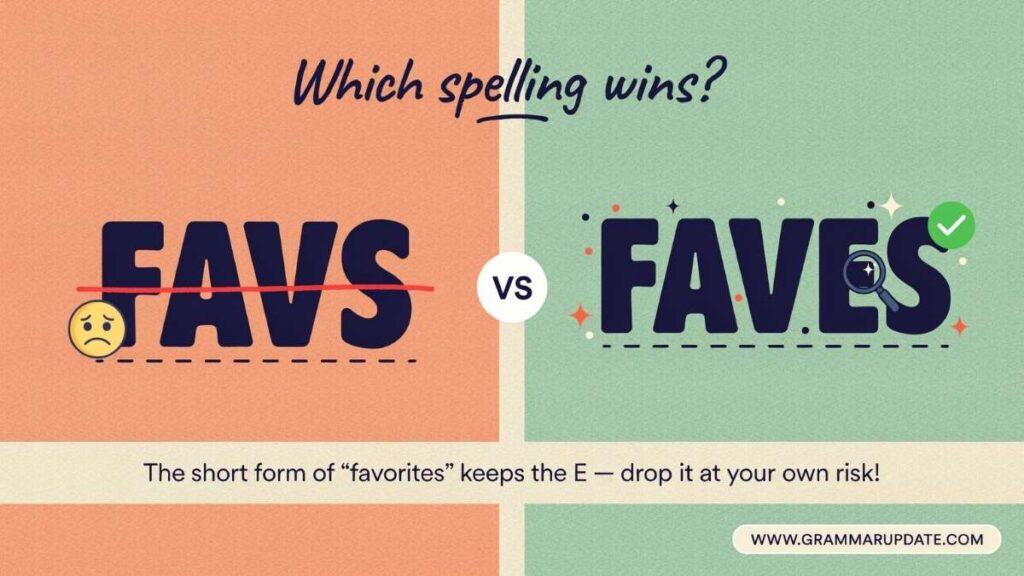
One of the biggest misconceptions is that one spelling is correct while the other is wrong.
That’s not true.
The difference between fav and fave is mainly visual rather than grammatical.
Spelling Difference
Compare the two forms.
| Word | Spelling |
|---|---|
| Favs | Ends with “s” |
| Faves | Ends with “es” |
Adding the letter “e” doesn’t change the meaning.
Instead, it creates a spelling that more closely reflects how people pronounce the word. That’s why anyone searching how to spell faves or how to spell favs will find that both forms are widely used online.
Meaning Difference
There isn’t one.
Both words can refer to:
- Favorite books
- Favorite movies
- Favorite foods
- Favorite games
- Favorite songs
- Favorite people
The comparisons favs vs favorite and faves vs favorite show that only the length of the word changes, not its meaning.
Usage Difference
Although the words are interchangeable, each has developed its own common usage.
Favs appears more often in:
- Apps
- Software
- Website menus
- User interface labels
- Gaming platforms
Faves appears more often in:
- Blogs
- Lifestyle articles
- YouTube captions
- Social media posts
- Everyday conversations
These are common writing patterns rather than strict grammar rules.
Learn the difference between confusing more English words
Advice vs Advise What’s the Difference?
Tone and Style Comparison
Choosing between faves or favs usually depends on tone.
| Situation | Better Choice |
|---|---|
| Instagram caption | Faves |
| TikTok post | Faves |
| Mobile app menu | Favs |
| Playlist label | Favs |
| Text message | Either |
| Academic paper | Favorite |
| Business proposal | Favorite |
A simple guideline is to use faves when writing naturally and conversationally. Use favs when space is limited.
Fix common more word mistakes in English
Allusion vs Illusion Difference and which is correct ?
Favs vs Faves vs Favorite
Many English learners compare favs vs faves vs favorite because the words look similar but aren’t used in the same situations.
Understanding how each one fits into everyday English removes most of the confusion.
When to Use Favorite
Favorite remains the standard word in American English.
Use it in:
- Academic writing
- Business communication
- Professional emails
- Reports
- Books
- Newspapers
- Official documents
Example:
Pizza is my favorite food.
This version is appropriate in every setting.
When to Use Fav
Many people ask, “Is fav short for favorite?”
Yes.
Fav is the shortest favorite abbreviation available.
Examples:
- My fav movie
- My fav song
- My fav place
Because it’s extremely brief, it appears frequently in text messages, SMS language, and social media.
When to Use Fave
Another common question is, “Is fave short for favorite?”
Yes.
Like fav, fave is an accepted favorite short form used in casual English writing.
Many people prefer it because the spelling looks closer to the way the word is pronounced.
Examples:
- That’s my fave dessert.
- She’s my fave singer.
- My fave vacation was Hawaii.
When to Use Favs
Use favs when referring to multiple favorites in informal situations.
Examples:
- My movie favs
- My vacation favs
- Editor’s favs
- Reader favs
This texting abbreviation for favorite works especially well in interfaces where every character counts.
When to Use Faves
Use faves when writing conversationally.
Examples:
- My beauty faves
- My reading faves
- My holiday faves
- My coffee shop faves
Many bloggers, influencers, and lifestyle websites naturally prefer this version.
Fix common more word mistakes in English
Resale vs Resell What’s the Difference?
Comparison Table
| Word | Singular or Plural | Formal | Common Use |
|---|---|---|---|
| Favorite | Singular | Yes | Standard writing |
| Favourite | Singular | Yes | British English |
| Fav | Singular | No | Texting and chat |
| Fave | Singular | No | Casual conversation |
| Favs | Plural | No | Apps and interfaces |
| Faves | Plural | No | Blogs and social media |
Each abbreviation serves the same purpose: shortening the word favorite for quicker communication.
Fix common more word mistakes in English
Visiter vs Visitor Difference Which One Is Correct?
Is Favs vs Faves the Correct Spelling?
This question appears in search engines every day.
The answer is simple.
The debate over which is correct, favs vs faves, doesn’t have a single winner because both spellings are acceptable in informal English.
Neither word appears often in formal grammar guides because they are abbreviations rather than standard dictionary entries. However, both are widely understood in modern English, online culture, and digital communication.
If you’re wondering, “Is faves a word?” or “Is favs a word?” the answer is that both are recognized as common informal abbreviations. They have become popular through everyday use, especially in text messaging, social media, and online conversations.
In practice, readers understand both forms immediately. Your choice usually depends on your audience, the platform you’re writing for, and your personal style rather than strict grammar rules.
The Origin of Favs and Faves
Language changes as the way people communicate changes. As text messaging, online forums, and social media became part of everyday life, writers naturally looked for quicker ways to write common words. That’s how abbreviations such as fav, fave, favs, and faves became part of everyday internet vocabulary.
The original word favorite has existed in English for centuries. As digital communication became more popular, people shortened it to fav to save time and space. Later, many writers added the letter “e” to create fave because it more closely matched the way the word is pronounced. The plural forms favs and faves developed from those singular abbreviations.
Neither version replaced the standard word favorite. Instead, they became convenient shortcuts for casual writing, social media posts, text messaging, and other forms of online communication where speed and simplicity matter.
Fix common more word mistakes in English
Enquiries vs Inquiries Which Spelling Is Correct?
Favs vs Faves in American and British English
One of the most common questions is whether geography affects the choice between favs and faves. The answer is yes, but not in the way many people expect.
The biggest difference between American and British English isn’t the abbreviation itself. Instead, it’s the spelling of the original word.
Americans write favorite.
British writers use favourite.
Both countries, however, commonly shorten these words in casual communication.
American English Usage
In American English, the standard spelling is favorite.
When people shorten it, they often choose one of these forms:
- Fav
- Fave
- Favs
- Faves
You’ll find these abbreviations in:
- Text messages
- Social media posts
- Online reviews
- Blog articles
- Video captions
- Shopping apps
There isn’t an official American rule that says one abbreviation is better than the other. Instead, writers choose whichever version feels more natural.
Examples:
- These are my favorite books.
- These are my fav books.
- These are my fave books.
- These are my favs.
- These are my faves.
Every sentence sounds natural in an informal setting.
British English Usage
British English uses the spelling favourite instead of favorite.
Because the original word includes an extra “u,” many learners assume the abbreviation changes too. It doesn’t.
People in the UK still commonly write:
- Fav
- Fave
- Favs
- Faves
They do not write “favou” or any other shortened variation.
Examples:
- My favourite football team is Arsenal.
- Arsenal is my fave team.
- These are my holiday favs.
- Those are my travel faves.
The abbreviation stays simple regardless of the spelling of the original word.
Learn how to use confusing more words correctly
Forest vs Forrest Which Spelling Is Correct and Usage?
Favorite vs Favourite
The spelling difference between favorite and favourite has existed for hundreds of years.
| American English | British English |
|---|---|
| Favorite | Favourite |
| Favorite color | Favourite colour |
| Favorite movie | Favourite film |
| Favorite player | Favourite player |
The abbreviations remain almost identical in both varieties of English.
This is why searches such as favorite abbreviation in American English and favorite abbreviation in British English usually lead to the same answer.
Does the UK Prefer Fav or Fave?
There isn’t a universal preference.
Some British writers use fav because it’s shorter.
Others prefer fave because it better reflects pronunciation.
Both versions appear regularly across social media, blogs, and online conversations.
If you’re writing for an international audience, either abbreviation works in casual content. For formal writing, always use the complete word favourite.
Learn how to use confusing more words correctly
Programming vs Programing Which Spelling Is Correct?
Regional Comparison Table
| Region | Standard Word | Informal Abbreviations |
|---|---|---|
| United States | Favorite | Fav, Fave, Favs, Faves |
| United Kingdom | Favourite | Fav, Fave, Favs, Faves |
| Canada | Favourite | Fav, Fave, Favs, Faves |
| Australia | Favourite | Fav, Fave, Favs, Faves |
The abbreviations stay consistent even though the standard spelling changes.
When Should You Use Favs?
Although favs and faves have the same meaning, favs often appears where space is limited.
Its shorter spelling makes it a practical choice for digital platforms.
You’ll commonly see favs in:
- Mobile applications
- Music playlists
- Shopping websites
- Streaming platforms
- Navigation menus
- Dashboard labels
Examples:
- My favs playlist
- Saved favs
- Customer favs
- Staff favs
- Editor’s favs
Many developers and designers also choose favs because it fits neatly into buttons and menus without taking up extra space.
Casual Text Messages
Texting encourages short, quick communication.
Examples:
- Those are my favs.
- Send me your favs.
- My favs changed this week.
- Which ones are your favs?
These messages sound natural and conversational.
Social Media
Character limits have influenced online writing for years.
You’ll often find captions such as:
- My summer favs.
- Current skincare favs.
- My book favs this month.
- Weekend favs.
The abbreviation keeps captions clean without changing the meaning.
Apps and User Interfaces
Many digital products use favs because every character matters.
Examples include:
- Save to Favs
- View Favs
- My Favs
- Favs List
This is especially common in mobile apps where screen space is limited.
Lists and Collections
Another popular use is in titles.
Examples:
- Reader Favs
- Fan Favs
- Holiday Favs
- Top Movie Favs
- Customer Favs
The shorter label is easy to scan and fits neatly into headings.
Learn how to use confusing more words correctly
Loosing vs Losing Common English Mistake
When Should You Use Faves?
Faves usually appears in writing that sounds more conversational.
Because the spelling matches pronunciation, many people think it feels warmer and more natural.
Blogs and Lifestyle Writing
Lifestyle websites frequently use faves in article titles.
Examples include:
- My Summer Faves
- Beauty Faves You’ll Love
- Kitchen Faves
- Monthly Reading Faves
The word creates a relaxed tone that fits personal writing.
Reviews and Recommendations
Writers also use faves when sharing opinions.
Examples:
- These are my coffee shop faves.
- Here are my movie faves.
- These books became my instant faves.
- Our editor’s faves this month.
This style sounds friendly instead of overly formal.
Entertainment and Pop Culture
Entertainment websites often prefer faves because it fits the casual tone of celebrity news and reviews.
Examples:
- Fan faves returned this season.
- Award show faves.
- Our music festival faves.
- Streaming service faves.
The abbreviation blends naturally with modern internet culture.
Everyday Conversation
If you say the word aloud, you’re more likely to pronounce it like “fave.”
That’s one reason many people naturally type:
- That’s my fave.
- They’re my faves.
- My travel faves never disappoint.
- My dessert faves change every season.
There’s nothing incorrect about this usage in informal communication.
Learn how to use confusing more words correctly
Fliers vs Flyers Which Spelling Is Correct and Usage?
When You Should Avoid Both
Even though favs and faves are common online, they aren’t suitable everywhere.
Professional writing still calls for the complete word favorite or favourite.
Academic Writing
School assignments, research papers, and academic journals expect formal language.
Instead of writing:
“My fave author is Mark Twain.”
Write:
“My favorite author is Mark Twain.”
The second sentence matches academic writing standards.
Business Documents
Business reports should avoid casual abbreviations.
Instead of:
“Our customers’ favs increased.”
Use:
“Our customers’ favorite products increased in popularity.”
Clear language improves professionalism.
Professional Emails
Business emails should also use the complete word.
Less formal:
“My fav presentation is attached.”
More professional:
“My favorite presentation is attached.”
The difference may seem small, but formal writing benefits from complete words.
Legal and Technical Writing
Precision matters in legal contracts, technical manuals, and official documentation.
Abbreviations such as fav, fave, favs, and faves can appear too casual for these situations.
Using the complete word avoids confusion and maintains a professional tone.
Learn how to use confusing more words correctly
Contractor vs Contractee Usage and Differences Explained
Real-Life Examples of Favs vs Faves
Seeing both words in context makes the difference much easier to understand.
Social Media Examples
Natural examples include:
- My skincare faves this month.
- Here are my weekend favs.
- These songs are my all-time faves.
- These restaurants are definitely my favs.
Every sentence sounds natural because social media encourages casual language.
Text Message Examples
Friends often shorten common words while texting.
Examples:
1.Person A: What are your favs?
2.Person B: These are my current faves.
3.Person A: Those are my favs too.
The conversation feels quick and natural.
Marketing Examples
Brands frequently use these abbreviations to sound approachable.
Examples:
- Customer Favs
- Staff Faves
- Fan Faves
- Editor’s Favs
- Holiday Faves
These labels attract attention while saving space.
Website and App Examples
Many digital products include labels such as:
- Add to Favs
- My Faves
- Save Your Favs
- Browse Staff Faves
The wording depends more on brand style than grammar.
Learn how to use confusing more words correctly
Encode vs Incode Correct Usage
Incorrect vs Correct Examples
The following examples show where abbreviations work well and where they don’t.
| Situation | Better Choice |
|---|---|
| Academic essay | Favorite |
| Business proposal | Favorite |
| Instagram caption | Faves |
| Mobile app button | Favs |
| Text message | Favs vs Faves |
| Blog title | Faves |
The key is matching the word to the audience and the level of formality.
Learn how to use confusing more words correctly
Vender vs Vendor Which Spelling Is Correct?
Favs vs Faves on Reddit and Social Media
Searches for favs vs faves Reddit continue to grow because users often notice both spellings in online discussions.
Reddit communities don’t enforce one preferred version.
Instead, people use whichever abbreviation feels natural.
Some users prefer favs because it’s shorter.
Others choose faves because it resembles everyday pronunciation.
Neither group is considered wrong.
The same pattern appears on platforms such as Instagram, TikTok, X, Facebook, and YouTube.
Over time, both abbreviations have become part of modern internet vocabulary.
Favs vs Faves Meme Culture
Internet memes have helped spread both abbreviations even further.
Memes often depend on quick, relatable language. Short words fit that style perfectly.
Common examples include:
- My comfort movie faves.
- Childhood cartoon favs.
- Your top five favs.
- Nobody can replace these faves.
The goal isn’t perfect grammar. It’s creating content that’s easy to read and instantly recognizable.
Understand confusing English more words simply
Ingage vs Engage Which Spelling Is Correct?
Google Trends and Real-World Usage
Search interest in favs and faves has remained steady as social media continues to grow.
Neither abbreviation completely dominates the other.
Instead, usage changes depending on the platform, audience, and writing style.
In general:
- Favs appears more often in apps, interfaces, and navigation labels.
- Faves appears more often in blogs, reviews, and social media captions.
- Favorite remains the standard choice for professional and formal writing.
Understand confusing English more words simply
Home Made vs Homemade Which Is Correct?
Comparison Table Fav, Fave, Favs, Faves, Favorite, and Favourite
The following table summarizes how each word is commonly used.
| Word | Number | Formal or Informal | Common Usage | Best Used For |
|---|---|---|---|---|
| Favorite | Singular | Formal | American English | Professional and everyday writing |
| Favourite | Singular | Formal | British English | Professional and everyday writing |
| Fav | Singular | Informal | Text messages, chat, social media | Quick conversations |
| Fave | Singular | Informal | Blogs, reviews, conversations | Casual writing |
| Favs | Plural | Informal | Apps, websites, playlists | Labels and menus |
| Faves | Plural | Informal | Social media, blogs, recommendations | Friendly and conversational writing |
Although these words look different, they all come from the same original word. The right choice depends on your audience and the level of formality.
Understand confusing English more words simply
Noteable vs Notable Correct Spelling and Usage
Common Mistakes with Favs vs Faves
Most mistakes happen because writers assume one abbreviation follows different grammar rules than the other. In reality, both words follow the same basic principles.
Treating Them as Formal Words
One of the biggest mistakes is using favs or faves in formal documents.
Incorrect:
My faves include several management strategies.
Better:
My favorite approaches include several management strategies.
Business reports, academic papers, legal documents, and official correspondence should use the complete word.
Confusing Singular and Plural Forms
Remember that the singular and plural forms are different.
| Singular | Plural |
|---|---|
| Fav | Favs |
| Fave | Faves |
Examples:
Correct:
- My fav movie is Inception.
- My fave dessert is cheesecake.
- These are my favs.
- Those are my faves.
Incorrect:
- My favs movie
- My faves book
Use the singular form for one item and the plural form for multiple items.
Using Apostrophes Incorrectly
Another common mistake involves apostrophes.
Incorrect:
- Fav’s
- Fave’s
- Favs’
- Faves’
Unless you’re showing possession, apostrophes are unnecessary.
Correct:
- My favs are action movies.
- These are my faves.
Correct possessive example:
My fave’s soundtrack is unforgettable.
The apostrophe belongs only when something belongs to the favorite item.
Mixing Favorite, Fav, Fave, Favs, and Faves
Switching between several versions in the same paragraph can distract readers.
Instead, stay consistent.
For example, if you begin an article using faves, continue using faves
Understand confusing English more words simply
Either vs Eather Which is Correct Spelling and Usage
Quick Grammar Tips
Grammar questions about these abbreviations appear frequently because they’re common in texting, social media, and everyday conversation. Here are the answers to the questions people ask most often.
Is Favs a Real Word?
Yes. Although favs is an informal abbreviation rather than a standard formal word, it is widely used in modern English. You’ll see it in text messages, apps, playlists, online communities, and social media.
Examples:
- My favs this month are all comedies.
- Save your favs before signing out.
- Here are my current book favs.
Because it’s an abbreviation, it belongs in casual writing rather than formal documents.
Is Faves a Real Word?
Yes. Faves is also a widely recognized informal abbreviation of favorite.
Many writers prefer this spelling because it reflects the natural pronunciation of the word.
Examples:
- These are my travel faves.
- My coffee shop faves never disappoint.
- Share your summer faves.
Although you may not see it often in formal dictionaries as a main entry, readers immediately understand its meaning.
Is Fave Short for Favorite?
Yes.
Fave is a shortened form of favorite. It carries exactly the same meaning but creates a more relaxed tone.
Examples:
- That’s my fave movie.
- She’s my fave author.
- Pizza is my fave food.
Is Fav Short for Favorite?
Yes.
Fav is the shortest abbreviation of favorite. It appears most often in texting, messaging apps, and user interface labels.
Examples:
- My fav song.
- Your fav player.
- My fav restaurant.
How Do You Abbreviate Favorite?
There are two common abbreviations.
- Fav
- Fave
Both are correct in informal English.
Their plural forms are:
- Favs
- Faves
Which one you choose depends on your writing style and audience.
Understand confusing English more words simply
Stigmatism vs Astigmatism Difference and Usage
What Is the Correct Abbreviation for Favorite?
There isn’t a single official abbreviation.
Both fav and fave are accepted in casual English.
Likewise, both favs and faves are commonly used as plural forms.
The important thing is to stay consistent throughout your writing.
Should I Write Fave or Favorite?
That depends on the situation.
Choose favorite when writing:
- Academic papers
- Business emails
- Reports
- Professional documents
- Official communication
Choose fave when writing:
- Text messages
- Blog posts
- Social media captions
- Personal notes
- Casual conversations
practice session Favs vs Faves
Fill in the Blanks
- Pizza is my __________ food.
- These are my summer __________ for relaxing outdoors.
- She’s my __________ singer of all time.
- We shared our movie __________ after the weekend.
- My __________ book is To Kill a Mockingbird.
- Those are my travel __________ from last year.
- What’s your __________ TV show right now?
- I saved all my __________ before deleting the app.
- His __________ hobby is photography.
- These cafés are my local __________.
- That’s my __________ restaurant in town.
- Our teacher asked everyone to name their __________ subject.
- My skincare __________ never let me down.
- Which song is your __________ this month?
- Here are my editor’s __________ for beginners.
- My __________ vacation was in Hawaii.
- Those are my dessert __________ for family gatherings.
- She made a list of her __________ books.
- What’s your all-time __________ movie?
- These are my weekend __________ to watch on Netflix.
- My __________ sports team won the championship.
- Here are my coffee shop __________ around the city.
- He always talks about his __________ video game.
- Save your __________ before signing out of the website.
- These are my absolute __________ of the year.
Answers
- favorite (or favourite in British English)
- faves or favs
- fave or fav
- faves or favs
- favorite (or favourite)
- faves or favs
- favorite (or favourite)
- favs
- favorite (or favourite)
- faves or favs
- fave or fav
- favorite (or favourite)
- faves
- fave or fav
- favs vs faves
- favorite (or favourite)
- faves or favs
- favorite (or favourite)
- favorite (or favourite)
- faves or favs
- favorite (or favourite)
- faves or favs
- favorite (or favourite)
- favs
- faves or favs
Here’s a trusted source for clear word meanings:
FAQs
What does “favs” mean?
Favs is the plural abbreviation of the word “favorite.” It refers to multiple favorite things, such as movies, books, songs, foods, or people. You’ll commonly see it in text messages, social media, and apps.
Is it favs or faves slang?
Both favs and faves are informal abbreviations rather than traditional slang. They are widely used in casual conversations, texting, and social media but aren’t suitable for formal writing.
Is it my favs or my faves?
Both are correct in informal English. “My favs” is slightly shorter, while “my faves” often sounds more natural because it matches everyday pronunciation.
What does faves mean?
Faves is the plural form of “fave,” meaning multiple favorite things, people, or places. It has the same meaning as favs.
What is the word favs short for?
Favs is short for “favorites” in American English or “favourites” in British English.
What does “favs” mean in Urban Dictionary?
On Urban Dictionary, favs generally refers to someone’s favorite things or people. The meaning is the same as in everyday online conversations and social media.
What does “favs” mean in text?
In texting, favs means your favorite items or choices. For example, “Send me your movie favs” means “Send me your favorite movies.”
Is my faves correct?
Yes. “My faves” is a common and grammatically acceptable phrase in informal English. It simply means “my favorite things.”
Is favs a real word?
Yes. Favs is a recognized informal abbreviation used in modern English. Although it’s not appropriate for formal writing, it’s widely understood in casual communication.
What is the full form of favs?
The full form of favs is “favorites” in American English or “favourites” in British English.
How do you spell faves?
The correct spelling is F-A-V-E-S.
What does “favs” mean on Twitter?
On Twitter (now X), favs usually refers to favorite posts, favorite creators, favorite products, or favorite topics. People also use it to describe things they like the most.
What does “my favs” mean?
“My favs” means “my favorite things.” The phrase can refer to anything you enjoy most, including books, songs, foods, movies, or people.
Should I say fav or fave?
Both are correct. Fav is the shortest abbreviation, while fave looks closer to the way the word is pronounced. Choose one and use it consistently.
What are some other informal words like fave?
Common informal alternatives include:
- Top pick
- Go-to
- Bestie (for a close friend)
- Must-have
- All-time favorite
- Number one
- Pick
- Go-to choice
Is “favs” a word in Scrabble?
No. Favs is not included in the official Scrabble dictionaries used for tournament play.
Is it correct to say “favourites”?
Yes. “Favourites” is the correct plural spelling in British English. American English uses “favorites.”
What is the meaning of fav and faves?
Fav is the singular abbreviation of favorite, while faves is the plural abbreviation. Both are informal and commonly used in everyday communication.
What is the meaning of the word faves?
Faves means favorite things, favorite people, favorite places, or favorite activities.
What does fav mean in slang?
In informal speech, fav simply means favorite. It doesn’t carry a special slang meaning beyond being a shortened form of the word.
What does fave mean in love?
When someone says, “You’re my fave,” they usually mean you’re their favorite person. It’s a friendly or affectionate compliment rather than a specific romantic term.
How do you spell favs?
The correct spelling is F-A-V-S.
Is it my fav or my favs?
Use “my fav” when talking about one favorite thing.
Example:
- My fav movie is Inception.
Use “my favs” when talking about multiple favorites.
Example:
- My favs are action movies and comedies.
What is the plural form of fave?
The plural of fave is faves.
How do you pronounce fave?
Fave is pronounced as “fayv” and rhymes with “save.”
Is it favs or faves for favorites?
Both are accepted informal abbreviations of “favorites.” Neither is more correct than the other.
How do you say favorite in short?
The two most common abbreviations are:
- Fav
- Fave
Both are widely used in casual writing.
What does the word “faves” mean?
Faves means favorite things or favorite people. It is simply the plural form of fave.
What does favs mean in texting?
In texting, favs refers to someone’s favorite items, such as songs, movies, games, or restaurants.
What does “with my faves” mean?
The phrase “with my faves” means spending time with your favorite people or enjoying your favorite things.
Example:
“Weekend with my faves.”
What is the plural form of fav?
The plural of fav is favs.
Is fave a proper word?
Yes. Fave is a widely recognized informal abbreviation of favorite and is commonly used in blogs, text messages, and social media.
Does the spelling “fav” or “fave” matter?
Not in casual writing. Both spellings are correct. The choice depends on your personal preference and writing style.
Is it my faves or my favs?
Both expressions are correct. Many people choose “my faves” because it reflects pronunciation, while others prefer the shorter “my favs.”
What is a fave in slang?
A fave is simply someone’s favorite person, thing, or choice. It’s an informal abbreviation rather than a separate slang word.
How do you pronounce fav?
Fav is pronounced as “fav,” rhyming with “have.”
What does fave stand for?
Fave stands for “favorite” in American English or “favourite” in British English.
What’s the meaning of “my fav”?
“My fav” means “my favorite.” It refers to one person, place, thing, or activity that someone likes the most.
Understand confusing English more words simply
Breakroom vs Break Room Which Spelling Is Correct?
conclusion
The favs vs faves debate is much simpler than it looks. Both are correct informal abbreviations of favorite, and both carry the same meaning. Your choice depends on your writing style, audience, and personal preference.For casual texts, social media posts, and everyday conversations, either spelling works perfectly. For formal writing, stick with the full word favorite or favourite .Still can’t decide? Don’t lose sleep over one little letter. Whether you write my favs or my faves, your readers will understand exactly what you mean. Use the version that feels most natural, stay consistent, and let your favorites not the spelling debate steal the spotlight.

Jhon AJS, the creative mind behind Grammar Update, is an experienced blogger passionate about simplifying English grammar. He focuses on explaining confusing word vs word differences, grammar rules, punctuation, and sentence structure in a clear and practical way. Through easy to understand guides and examples, Jhon helps readers improve their writing and communicate with confidence. With years of blogging experience, he continues to share helpful insights that make learning grammar simple, useful, and accessible for everyone.