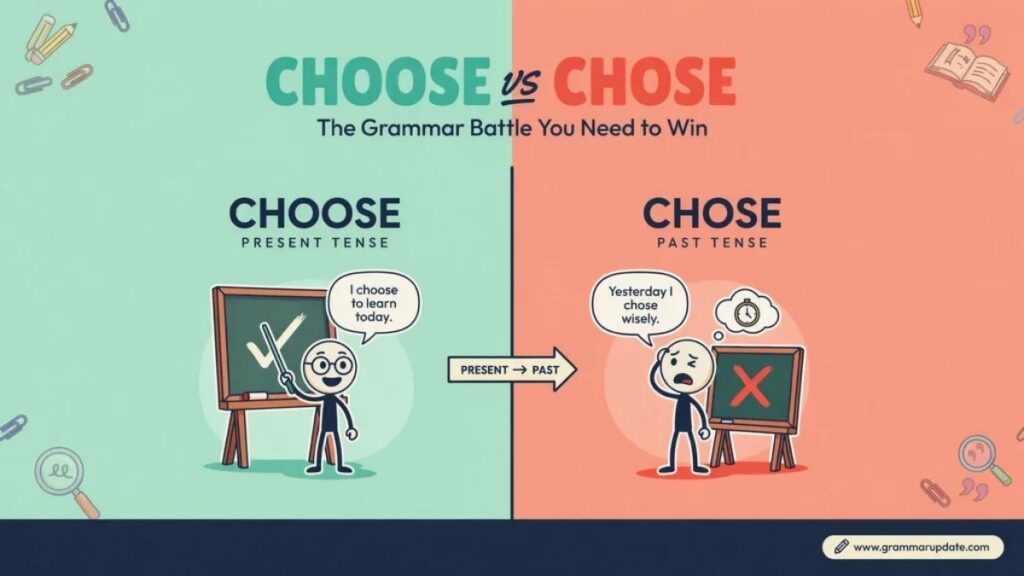
Have you ever stopped while writing because you weren’t sure whether to use “Choose vs Chose” ? You’re not alone. These two words confuse many people because they look almost the same, but they are used at different times. The good news is that the rule is easy to learn. Simply use “choose” when you’re talking about the present or future, and use “chose” when you’re talking about the past. In this guide, you’ll learn the difference between choose or chose with simple explanations, helpful examples, easy grammar tips, and memory tricks that make the correct word easy to remember every time.
Choose vs Chose Quick Answer
The easiest way to remember the difference is this:
| Word | Verb Tense | Meaning | Example |
|---|---|---|---|
| Choose | Present tense | To select something now or in the future | I always choose healthy food. |
| Chose | Past tense | Selected something in the past | Yesterday, I chose healthy food. |
In simple terms:
- Choose is the present tense.
- Chose is the simple past tense.
- Chosen is the past participle.
This means the action’s time determines which word you should use.
Quick Examples
Present tense
- I choose my clothes every morning.
- You should choose your words carefully.
- We choose quality over quantity.
Past tense
- I chose the blue shirt yesterday.
- She chose a different college.
- They chose to stay home.
Notice how every sentence with “chose” talks about something that already happened.
Learn the difference between confusing word pairs
Exercise vs Exorcise Differences and Correct Usage
What Does “Choose” Mean?
The choose meaning is simple. It means to pick, select, or decide between two or more options.
Whenever you’re making a decision now or talking about a future decision, use choose.
In English grammar, choose is the base form of an irregular verb. Since it’s an action verb, it describes someone making a decision.
Choose Meaning in Simple English
Choose means:
- To select one option from several choices.
- To make a decision.
- To pick something because you prefer it.
Think of it like standing in front of an ice cream shop.
You see chocolate, vanilla, strawberry, and mint.
You haven’t decided yet.
At that moment, you choose your favorite flavor.
When to Use Choose
Knowing when to use choose is easier than many people think.
Use choose when you’re talking about:
- Present actions
- Habits
- General truths
- Future actions after helping verbs
- Commands and instructions
Examples include:
Present action
- I choose honesty every time.
Habit
- She always chooses fresh fruit.
Future
- You will choose your classes next week.
Instruction
- Choose the correct answer.
Advice
- Always choose kindness.
These examples show that the action has not already happened. Either it is happening now, happens regularly, or will happen later.
Choose in a Sentence
Here are more choose in a sentence examples.
- I choose coffee instead of tea every morning.
- Please choose one answer.
- Students can choose their favorite project.
- We choose our goals carefully.
- They choose quality products because they last longer.
- You’ll need to choose a password before creating your account.
- Many travelers choose window seats.
- Parents often choose schools based on location.
- Writers choose words that make their message clear.
- Customers usually choose products with better reviews.
These choose vs chose examples show how naturally the word fits into everyday English.
Common Phrases That Use Choose
You’ll hear “choose” in many common expressions.
Some examples include:
- Choose wisely.
- Choose your battles.
- Choose your words carefully.
- Choose your future.
- Choose happiness.
- Choose your path.
- Choose a career.
- Choose a winner.
- Choose an option.
- Choose a seat.
These phrases appear frequently in conversations, books, advertisements, and business communication.
Choose Present Tense Explained
One of the easiest grammar rules for choose is remembering that it belongs to the present tense.
Here is its present tense conjugation.
| Subject | Present Tense |
|---|---|
| I | choose |
| You | choose |
| We | choose |
| They | choose |
| He | chooses |
| She | chooses |
| It | chooses |
Notice something important.
Only third-person singular subjects add “s.”
Correct examples
- He chooses the fastest route.
- She chooses healthy meals.
- It chooses the lowest setting automatically.
Incorrect examples
- He choose pizza.
- She choose the red dress.
This small rule helps you write more accurately.
Learn the difference between confusing word pairs
Then vs Than difference which one is correct ?
What Does “Chose” Mean?
Now let’s look at the chose meaning.
Chose is the simple past tense of choose.
It tells readers that the decision already happened.
Whenever the action is finished and occurred yesterday, last week, last year, or any time in the past, use chose.
Chose Meaning in Simple English
Chose means:
- Selected
- Picked
- Decided
Unlike choose, chose always refers to completed actions.
Imagine you’re telling a friend what happened yesterday.
You might say:
“I chose the Italian restaurant.”
The decision is complete.
Nothing about it is happening now.
When to Use Chose
Many learners ask when to use chose.
The answer is simple.
Use chose whenever you’re talking about something already completed in the past.
Examples include:
- Yesterday
- Last night
- Last week
- Last month
- Last year
- Earlier today
- Five minutes ago
Here are examples.
- I chose the red backpack yesterday.
- She chose engineering as her major.
- They chose the safest route.
- We chose a hotel near the beach.
- The company chose a new CEO.
Every decision happened before the present moment.
Chose in a Sentence
Here are additional chose in a sentence examples.
- He chose the winning answer.
- They chose different careers.
- We chose this apartment because it was affordable.
- My parents chose this neighborhood years ago.
- The teacher chose three volunteers.
- I chose to stay home during the storm.
- She chose honesty over convenience.
- Our team chose a better strategy.
- The judges chose the final winner.
- They chose quality instead of price.
These examples make the choose and chose difference much easier to understand.
Chose Past Tense Explained
One of the most important facts in choose vs chose grammar is understanding verb tense.
Choose becomes chose when talking about completed actions.
Here is the simple past conjugation.
| Subject | Past Tense |
|---|---|
| I | chose |
| You | chose |
| We | chose |
| They | chose |
| He | chose |
| She | chose |
| It | chose |
Unlike the present tense, every subject uses exactly the same form.
Examples
- I chose.
- You chose.
- He chose.
- They chose.
That makes the past tense easier than the present tense.
Learn the difference between confusing more English words
Noisy vs Noisey Which is Correct and Usage?
Choose, Chose, or Chosen What’s the Difference?
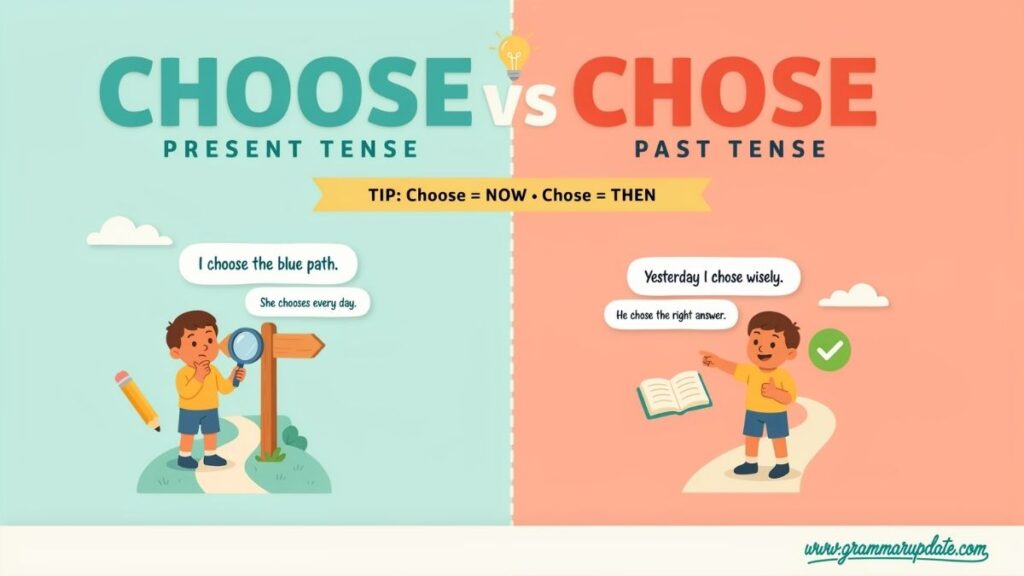
Many people understand choose vs chose, but then another word appears.
Chosen.
This creates even more confusion.
Fortunately, all three words belong to the same verb.
They simply represent different verb forms.
Choose Verb Forms
Here are the complete choose verb forms.
| Verb Form | Word | Example |
|---|---|---|
| Base Form | Choose | I choose carefully. |
| Simple Past | Chose | I chose carefully yesterday. |
| Past Participle | Chosen | I have chosen carefully. |
| Present Participle | Choosing | I am choosing carefully. |
A helpful way to remember them is this sequence:
Choose → Chose → Chosen
Many English teachers use this pattern because it helps students remember irregular verbs more easily.
Choose Verb Conjugation
Here is the complete verb conjugation.
| Tense | Example |
|---|---|
| Present | I choose wisely. |
| Present Continuous | I am choosing wisely. |
| Simple Past | I chose wisely. |
| Past Continuous | I was choosing wisely. |
| Present Perfect | I have chosen wisely. |
| Past Perfect | I had chosen wisely. |
| Future | I will choose wisely. |
| Future Perfect | I will have chosen wisely. |
Learning this chart makes English verb tenses much easier.
Why Is Choose an Irregular Verb?
Most English verbs form the past tense by adding “-ed.”
Examples include:
- Walk → Walked
- Play → Played
- Watch → Watched
Choose doesn’t follow that rule.
Instead, it changes completely.
Choose → Chose → Chosen
This makes it an irregular verb.
English contains many irregular verbs, including:
| Present | Past | Past Participle |
|---|---|---|
| Begin | Began | Begun |
| Break | Broke | Broken |
| Drink | Drank | Drunk |
| Drive | Drove | Driven |
| Speak | Spoke | Spoken |
| Write | Wrote | Written |
| Choose | Chose | Chosen |
Learning irregular verbs together helps you remember them more easily.
Why Do People Confuse Choose and Chose?
This question appears often among English learners.
Several reasons explain the confusion.
First, the words look almost identical.
Only one letter changes.
Second, their pronunciation changes along with their spelling.
Third, both words have exactly the same basic meaning.
The only difference is time.
Finally, many languages don’t change verb forms the same way English does.
That makes choose vs chose English grammar challenging for beginners.
Quick Memory Trick
Here’s a simple trick that works.
Choose has extra letters.
Think of those extra letters as meaning “more time is left.”
The action hasn’t happened yet.
Chose is shorter.
The action is already finished.
Another easy way to remember is this:
- Today, I choose.
- Yesterday, I chose.
- I have chosen.
Learn the difference between confusing more English words
Dammit vs Damn It Which One Is Correct?
Choose vs Chose Grammar Rules Made Easy
If you’ve ever paused while writing because you weren’t sure whether to use “choose” or “chose,” you’re in good company. This is one of the most common grammar mistakes in English because both words come from the same verb. The difference isn’t their meaning. It’s the time when the action happens.
Once you understand the grammar rules for choose, the confusion disappears.
Use “Choose” for the Present and Future
Use choose when you’re talking about something happening now, something you do regularly, or something that will happen later.
Examples
- I choose to exercise every morning.
- We choose fresh ingredients whenever possible.
- Please choose your favorite color.
- You will choose your classes next semester.
- They can choose any seat in the room.
Notice that every decision is happening now or hasn’t happened yet.
Use “Chose” for the Past
Use chose only when the decision already happened.
Examples
- I chose the blue jacket yesterday.
- She chose science as her major.
- We chose that restaurant because of the great reviews.
- They chose a different route during the trip.
- The manager chose the most experienced candidate.
Every action is complete.
Choose vs Chose Tense Differences
The easiest way to remember the choose vs chose tense differences is by looking at a timeline.
| Time | Correct Word | Example |
|---|---|---|
| Present | Choose | I choose healthy snacks. |
| Yesterday | Chose | I chose healthy snacks yesterday. |
| Tomorrow | Choose | I will choose healthy snacks tomorrow. |
| Present Perfect | Chosen | I have chosen healthy snacks before. |
The timeline makes one thing clear.
Choose belongs to the present or future.
Chose belongs to the past.
Chosen follows helping verbs such as have, has, or had.
Grammar Patterns You Should Remember
These sentence patterns appear frequently in English.
Present tense
- I choose…
- You choose…
- We choose…
- They choose…
- He chooses…
- She chooses…
Simple past
- I chose…
- You chose…
- We chose…
- They chose…
- He chose…
- She chose…
Present perfect
- I have chosen…
- She has chosen…
- They have chosen…
Learning these patterns makes writing much easier.
Learn the difference between confusing more English words
Firey vs Fiery difference Which one Is Correct?
Choose vs Chose Pronunciation
Many learners also struggle with choose vs chose pronunciation because the words look alike but sound different.
The spelling changes only slightly, yet the vowel sound changes completely.
Choose Pronunciation
choose (chooz)
The word choose uses a long “oo” sound.
It rhymes with:
- Shoes
- News
- Cruise
- Blues
Examples
- Choose wisely.
- Choose one answer.
- I choose this option.
Chose Pronunciation
chose (chohz)
The word chose uses a long “o” sound.
It rhymes with:
- Hose
- Nose
- Rose
- Goes
Examples
- I chose the red shirt.
- She chose another school.
- They chose the cheaper option.
Choose vs Chose Pronunciation Guide
| Word | Sound | Rhymes With |
|---|---|---|
| Choose | Long “oo” | Shoes, news, cruise |
| Chose | Long “o” | Hose, nose, rose |
A simple trick is to say both words aloud.
- Choose… shoes.
- Chose… rose.
The rhyming words make the pronunciation much easier to remember.
Learn the difference between confusing more English words
Pose vs Poise Difference and Which one is correct ?
Choose vs Chose Meaning Comparison
The choose vs chose meaning difference is based entirely on time.
Both words describe selecting or deciding.
The tense tells readers when that decision happened.
Choose vs Chose Comparison
| Feature | Choose | Chose |
|---|---|---|
| Meaning | Select or decide | Selected or decided |
| Tense | Present | Simple past |
| Action | Happening now or later | Already finished |
| Verb Form | Base verb | Past tense |
| Example | I choose pizza. | I chose pizza yesterday. |
This simple chart answers one of the most common questions in English grammar.
What is the difference between choose and chose?
The answer is simple.
Choose is present tense.
Chose is past tense.
Learn the difference between confusing more English words
Fistulogram vs Fistulagram which is correct and Difference ?
Choose vs Chose Synonym
Many readers search for choose vs chose synonym to understand both words better.
Although the tense changes, the basic meaning stays the same.
Synonyms for Choose
Depending on the sentence, choose can mean:
- Pick
- Select
- Decide
- Prefer
- Elect
- Adopt
- Determine
- Name
- Settle on
Examples
- Please select one answer.
- I prefer coffee.
- They decided to stay home.
Synonyms for Chose
Since chose is already in the past tense, its synonyms should also be in the past tense.
- Picked
- Selected
- Decided
- Preferred
- Elected
- Adopted
- Determined
Examples
- She selected the winning design.
- We decided to leave early.
- They preferred the quieter hotel.
Remember that synonyms don’t always fit every sentence perfectly.
Context always matters.
Learn the difference between confusing more English words
Peice vs Piece Which Spelling Is Correct?
Common Mistakes With Choose and Chose
Even advanced English speakers occasionally mix these words up.
Here are the mistakes that appear most often.
Mistake One Using “Choose” for Yesterday
Incorrect
- Yesterday I choose a new phone.
Correct
- Yesterday I chose a new phone.
The word yesterday tells you the action happened in the past.
Mistake Two Using “Chose” for Today
Incorrect
- Every morning I chose coffee.
Correct
- Every morning I choose coffee.
Because “every morning” describes a habit, use the present tense.
Mistake Three Confusing Chose and Chosen
Incorrect
- I have chose the blue car.
Correct
- I have chosen the blue car.
Whenever you use have, has, or had, the correct word is chosen.
Mistake Four Forgetting Third-Person Singular
Incorrect
- He choose basketball.
Correct
- He chooses basketball.
The verb changes in the present tense when the subject is he, she, or it.
Mistake Five Mixing Verb Tenses
Incorrect
- Last week I choose a different laptop because it was cheaper.
Correct
- Last week I chose a different laptop because it was cheaper.
Consistency makes writing clearer.
Learn the difference between confusing more English words
Mold vs Mould Which Spelling Is Correct?
Choose vs Chose Examples in Everyday English
Learning grammar rules is helpful.
Seeing real examples is even better.
Daily Conversation
Present
- I choose the window seat every time.
- We choose homemade meals whenever possible.
Past
- I chose the window seat yesterday.
- We chose homemade meals during our vacation.
Business Writing
Present
- Our company chooses sustainable materials.
Past
- Our company chose a new supplier last month.
School
Present
- Students choose electives in the spring.
Past
- Students chose their electives last week.
Family
Present
- We choose family movie night every Friday.
Past
- We chose a comedy for movie night.
Travel
Present
- Travelers often choose direct flights.
Past
- We chose a direct flight to save time.
Learn the difference between confusing more English words
Defense vs Defence Which Spelling Is Correct?
Choose vs Chose in Questions
Questions follow the same grammar rules as statements.
Present
- Which color do you choose?
- Why do they choose that brand?
- What do you choose for breakfast?
Past
- Which color did you choose?
- Why did they choose that hotel?
- What did she choose yesterday?
Notice something important.
After the helping verb “did,” the main verb returns to its base form.
Correct
- Did you choose wisely?
Incorrect
- Did you chose wisely?
This is another common grammar mistake.
Choose vs Chose in Negative Sentences
Negative sentences follow the same rule.
Present
- I don’t choose expensive products.
- She doesn’t choose unhealthy snacks.
Past
- I didn’t choose that option.
- They didn’t choose the cheapest hotel.
Again, after “didn’t,” always use choose instead of chose.
Correct
- I didn’t choose it.
Incorrect
- I didn’t chose it.
Real-Life Case Study
Imagine two students writing about the same event.
Student A writes:
“Yesterday I choose the science project because it looked interesting.”
Student B writes:
“Yesterday I chose the science project because it looked interesting.”
Only Student B uses the correct grammar.
The word yesterday clearly places the action in the past, so chose is the correct choice.
This simple example shows why understanding verb tense matters.
Quick Grammar Checklist
Before you write, ask yourself these questions.
- Is the action happening now?
- Is it a regular habit?
- Will it happen later?
If the answer is yes, use choose.
Ask another question.
- Did the action already happen?
If the answer is yes, use chose.
Finally, ask yourself one more question.
- Does the sentence include have, has, or had?
If it does, use chosen instead of choose or chose.
Learn the difference between confusing more English words
Trey vs Tray What’s the Difference?
Choose or Chose in Common Expressions
You don’t just see choose and chose in grammar exercises. These words appear every day in conversations, books, emails, advertisements, and news articles. Learning these common expressions helps you sound more natural when speaking and writing English.
Common Expressions With “Choose”
These phrases use the present tense because they describe current actions, future decisions, or general advice.
- Choose wisely.
- Choose your words carefully.
- Choose your battles.
- Choose happiness.
- Choose a career.
- Choose your own path.
- Choose the best option.
- Choose from the menu.
- Choose a winner.
- Choose your favorite.
Example sentences:
- Always choose wisely before signing a contract.
- You should choose your words carefully during an interview.
- Many people choose happiness over wealth.
- Students can choose any elective they like.
Common Expressions With “Chose”
These expressions describe decisions that have already happened.
- Chose the winner.
- Chose the right path.
- Chose a different direction.
- Chose the safer option.
- Chose to remain silent.
- Chose to continue.
- Chose another solution.
Example sentences:
- The judges chose the winner after several hours.
- She chose the safer option.
- We chose to stay home because of the weather.
- They chose another approach to solve the problem.
Learn the difference between confusing more English words
Intention vs Intension Which Is Correct?
He Chose or He Choose?
One of the most searched grammar questions is:
Is it he chose or he choose?
The answer depends entirely on the tense.
Use “He Chooses” in the Present
Present tense requires “chooses,” not “choose.”
Correct
- He chooses healthy meals.
- He chooses honesty every time.
- He chooses to work from home.
Incorrect
- He choose healthy meals.
Use “He Chose” in the Past
When talking about something that already happened, use chose.
Correct
- He chose the blue shirt.
- He chose engineering in college.
- He chose to leave early.
Incorrect
- He choose the blue shirt yesterday.
Subject Comparison
| Subject | Present | Past |
|---|---|---|
| I | choose | chose |
| You | choose | chose |
| We | choose | chose |
| They | choose | chose |
| He | chooses | chose |
| She | chooses | chose |
| It | chooses | chose |
Notice that only the present tense changes for he, she, and it.
Learn the difference between commonly mixed-up more words
Ladel vs Ladle Difference and Usage
How to Remember Choose vs Chose
Many English learners remember grammar better with simple memory tricks.
Fortunately, this pair is easy to remember once you know a few patterns.
Memory Trick One
Choose has extra letters.
Think of those extra letters as extra time.
The action hasn’t happened yet.
Chose is shorter.
The action is already finished.
Memory Trick Two
Remember this sentence:
Today I choose.
Yesterday I chose.
I have chosen.
Repeat it a few times and the correct verb form becomes much easier to remember.
Memory Trick Three
Connect each word to a rhyme.
Choose rhymes with:
- Shoes
- News
- Cruise
Chose rhymes with:
- Rose
- Nose
- Hose
Many students remember pronunciation faster through rhyming words.
Memory Trick Four
Think of a timeline.
Past ← Chose
Present → Choose
Future → Choose
Present Perfect → Chosen
Visual learners often remember verb tenses more easily when they picture time moving from left to right.
Choose vs Chose Chart
Here’s a quick reference chart you can revisit whenever you’re unsure.
| Feature | Choose | Chose | Chosen |
|---|---|---|---|
| Meaning | Select | Selected | Has selected |
| Tense | Present | Past | Past Participle |
| Verb Form | Base Verb | Simple Past | Past Participle |
| Example | I choose tea. | I chose tea. | I have chosen tea. |
Learn the difference between commonly mixed-up more words
Soo vs So Difference and Which One Is Correct?
Practice Session Choose vs Chose
Complete each sentence by writing the correct word: choose, chose, chooses, or chosen.
- Every morning, I ______ a healthy breakfast.
- Yesterday, we ______ the fastest route to the airport.
- Please ______ one answer before moving to the next question.
- She has ______ a new job in New York.
- My brother always ______ the window seat on airplanes.
- Last weekend, they ______ to spend the day at the beach.
- You should ______ your words carefully.
- The teacher ______ three students for the science project yesterday.
- We have ______ the best solution for the problem.
- I ______ coffee instead of tea every morning.
- He ______ to stay home because he wasn’t feeling well.
- They will ______ a new team leader next month.
- Sarah always ______ books that inspire her.
- The judges ______ the winner after a long discussion.
- Have you ______ your classes for next semester?
- The company ______ a new logo last year.
- You can ______ any color you like.
- My parents ______ this house twenty years ago.
- We have ______ a restaurant near the hotel.
- The coach ______ the strongest players for the final match yesterday.
- I usually ______ the easiest option when I’m in a hurry.
- She ______ to study engineering after high school.
- Please ______ your favorite picture from the collection.
- They have ______ to continue the project despite the challenges.
- Every student ______ a topic before starting the presentation.
Answers
- choose
- chose
- choose
- chosen
- chooses
- chose
- choose
- chose
- chosen
- choose
- chose
- choose
- chooses
- chose
- chosen
- chose
- choose
- chose
- chosen
- chose
- choose
- chose
- choose
- chosen
- chooses
Here’s a trusted source for clear word meanings:
FAQs
Should I use choose or chose?
Use “choose” for present or future actions and “chose” for actions completed in the past. For example, “I choose coffee every morning” is correct for a habit, while “I chose coffee yesterday” is correct for a past event.
Is it correct to say “I chose”?
Yes. “I chose” is grammatically correct because “chose” is the simple past tense of “choose.” Use it when talking about a decision you already made.
How do you use choose in a sentence?
Use “choose” to describe a present or future decision. For example:
- I choose healthy meals every day.
- Please choose your favorite book.
- You can choose any color you like.
Is it chose me or choose me?
Both can be correct depending on the sentence. Use “choose me” for a present or future request, such as “Please choose me for the team.” Use “chose me” for a past event, such as “They chose me as the captain.”
How can I remember choose vs. chose?
Remember this simple pattern:
- Today I choose.
- Yesterday I chose.
- I have chosen.
This timeline helps you use the correct verb every time.
How do Americans spell “choose”?
Americans spell it “choose.” The spelling is the same in both American English and British English.
What is a better way to say “I chose”?
Depending on the context, you can say:
- I selected.
- I picked.
- I decided on.
- I opted for.
- I went with.
What does “I choose” mean?
“I choose” means “I decide” or “I select.” It describes a decision happening now or a regular habit.
Is it I chose you or I choose you?
Both are correct in different situations.
- “I choose you” refers to a present or future decision.
- “I chose you” refers to a decision made in the past.
Is the word “choose” correct?
Yes. “Choose” is the correct base form of the irregular verb meaning “to select” or “to decide.”
What is a synonym of choose?
Common synonyms include:
- Select
- Pick
- Decide
- Elect
- Prefer
- Opt for
How do you use the word “chose”?
Use “chose” to describe a completed decision in the past. For example:
- She chose the blue dress.
- We chose a different hotel.
Is it correct to say “I chose you”?
Yes. “I chose you” is grammatically correct because it refers to a choice made in the past.
Is “I chose it” correct?
Yes. “I chose it” is a complete and correct sentence that means you selected something in the past.
What are the three forms of choose?
The three principal forms are:
- Choose (base form)
- Chose (simple past)
- Chosen (past participle)
Is “I have chose” grammatically correct?
No. “I have chose” is incorrect. The correct sentence is “I have chosen” because the present perfect tense requires the past participle.
Is it choosing me or chosing me?
The correct spelling is “choosing me.” The word “chosing” is a misspelling because the verb “choose” becomes “choosing” by dropping the final “e.”
What is a common misspelling of choose?
Common misspellings include:
- Chuse
- Chooze
- Chosing
- Choosed
The correct spellings are choose, choosing, chose, and chosen.
What is a fancy word for chose?
Formal alternatives include:
- Selected
- Elected
- Preferred
- Opted for
- Determined
- Designated
Is it I haven’t chose or chosen?
The correct phrase is “I haven’t chosen.” After “have” or “haven’t,” always use the past participle “chosen.”
What is a fancy word for choose?
Depending on the context, you can use:
- Select
- Elect
- Opt for
- Determine
- Prefer
- Designate
Is chose a proper word?
Yes. “Chose” is a proper English word and the simple past tense of the verb “choose.”
What is the opposite of choose?
Common opposites include:
- Reject
- Refuse
- Decline
- Ignore
- Avoid
The best opposite depends on the sentence.
What does choose mean in slang?
In modern slang, “choose” usually keeps its standard meaning of selecting or deciding. Unlike many English words, it does not have a widely accepted slang definition.
What does chose mean?
“Chose” means selected, picked, or decided. It describes an action that happened in the past.
Is it they choose or they chose?
Both are correct depending on the tense.
- “They choose” describes a present habit.
- “They chose” describes a completed action in the past.
Do you say “I chose” or “I choose”?
Use “I choose” for present actions or habits. Use “I chose” for past actions.
What is an example of choose?
Here are a few examples:
- I choose kindness every day.
- Please choose one answer.
- They choose local businesses whenever possible.
What is a fancy word for choosing?
Depending on the context, you can say:
- Selecting
- Deciding
- Electing
- Preferring
- Opting
- Determining
What is it called when you choose something?
The act of choosing is called making a decision or making a selection. In grammar, “choose” is an action verb.
What can I say instead of “chose”?
You can replace “chose” with:
- Selected
- Picked
- Decided on
- Preferred
- Opted for
- Elected
Learn the difference between commonly mixed-up more words
Bearable vs Bareable Which Spelling Is Correct?
Conclusion
The difference between choose and chose is easier than it looks. Simply remember that choose is used for the present or future, while chose is used for the past. If the decision is happening now or will happen later, use choose. If the decision already happened, use chose. When you use “have,” “has,” or “had,” the correct word is chosen.
If you’ve mixed these words up before, you’re not alone. It’s one of the most common grammar mistakes because the words look so similar. The good news is that once you understand the verb tense, the confusion quickly disappears.
Keep practicing with sentence examples, quizzes, and worksheets until the pattern feels natural. Before long, you’ll stop wondering whether to write choose or chose because you’ll know the correct answer every time. Good grammar isn’t about memorizing difficult rules. It’s about understanding simple patterns and using them with confidence.

Jhon AJS, the creative mind behind Grammar Update, is an experienced blogger passionate about simplifying English grammar. He focuses on explaining confusing word vs word differences, grammar rules, punctuation, and sentence structure in a clear and practical way. Through easy to understand guides and examples, Jhon helps readers improve their writing and communicate with confidence. With years of blogging experience, he continues to share helpful insights that make learning grammar simple, useful, and accessible for everyone.