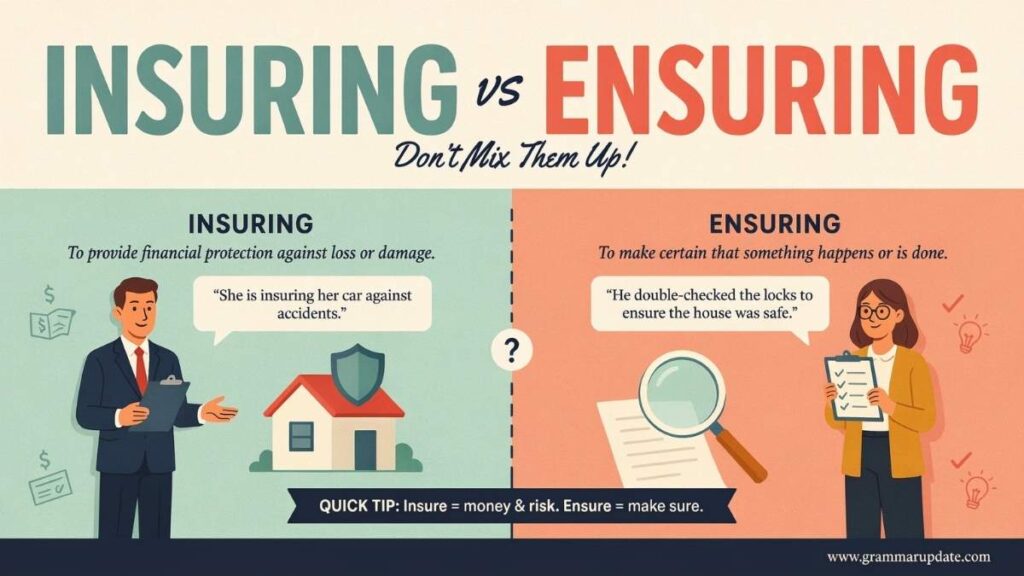
These two words look almost identical and sound very similar, so it’s easy to mix them up. However, they have different meanings. One is about insurance and financial protection, while the other means making sure something happens. Using the wrong one can completely change the meaning of your sentence. In this easy-to-follow guide to Insuring vs Ensuring, you’ll learn the difference, see real life examples, understand when to use each word, and discover simple memory tricks that will help you choose the correct word every time.
Insuring vs Ensuring Quick Answer
The simplest way to remember the difference is this:
- Insuring means providing insurance or financial protection against loss or damage.
- Ensuring means making certain that something happens or guaranteeing a result.
Although both words come from related historical roots, modern English uses them in different situations.
| Word | Meaning | Used For | Example |
|---|---|---|---|
| Insuring | Providing insurance coverage | Insurance policies, financial protection | The company is insuring the building against fire. |
| Ensuring | Making certain something happens | Results, safety, quality, accuracy | The manager is ensuring every employee completes the training. |
If your sentence involves an insurance company, an insurance policy, financial risk, or coverage against damage, use “insuring.”
If your sentence means “making sure,” “guaranteeing,” or “making certain,” use “ensuring.”
For example:
Correct:
- The family is insuring their new house against flood damage.
- The teacher is ensuring every student understands the lesson.
Incorrect:
- The family is ensuring their house against fire.
- The teacher is insuring everyone understands the lesson.
These examples clearly show the insuring vs ensuring grammar difference.
Learn the difference between tricky more English words
Choose vs Chose Difference which one is correct?
What Does “Insuring” Mean?
The insuring meaning refers to providing insurance coverage against financial loss. In simple terms, it means protecting a person, business, vehicle, property, or other valuable asset through an insurance policy.
The insure definition is straightforward: to provide or obtain insurance that protects against financial risk.
When discussing insurance terminology, “insuring” is the present participle of the verb “insure.”
Insure Meaning in English
Insure meaning in English is closely connected with financial protection. When you insure something, you purchase or arrange insurance coverage that helps cover losses if an unexpected event occurs.
People commonly insure:
- Cars
- Homes
- Businesses
- Health
- Life
- Property
- Commercial buildings
- Valuable jewelry
- Electronic equipment
In each case, the goal is to protect against loss through an insurance contract.
When to Use Insure
Many people ask, “When to use insure?”
Use insure whenever you’re talking about insurance coverage or financial protection.
Common situations include:
- Buying life insurance
- Purchasing health insurance
- Insuring a vehicle
- Insuring a business
- Protecting property
- Purchasing travel insurance
- Covering expensive equipment
Examples:
- We decided to insure our house before hurricane season.
- Every business should insure its equipment against theft.
- The company will insure the shipment during transportation.
- They insured the warehouse against fire damage.
- She wants to insure her jewelry before traveling overseas.
These examples demonstrate how to use insure correctly in everyday English.
How to Use Insure
If your sentence includes ideas such as:
- Insurance policy
- Insurance company
- Insurance provider
- Insurance premium
- Insurance claim
- Financial protection
- Coverage against damage
- Coverage against loss
- Protect against loss
- Buy insurance
then “insure” is almost always the correct choice.
For example:
Correct:
- The business purchased an insurance policy to insure its inventory.
- They insure every company vehicle.
Incorrect:
- They ensure every company vehicle against theft.
Because the sentence refers to insurance coverage, “insure” is required.
Is Insuring a Word?
Yes.
Many learners ask, “Is insuring a word?”
Absolutely. “Insuring” is the present participle and gerund form of “insure.”
Examples:
- Insuring expensive artwork requires specialized coverage.
- Insuring commercial property often costs more than residential coverage.
- Insuring your home helps reduce financial risk after disasters.
Common Collocations with “Insuring”
English speakers naturally pair “insuring” with certain words.
| Common Phrase | Meaning |
|---|---|
| Insuring a car | Purchasing vehicle insurance |
| Insuring a house | Protecting a home with insurance |
| Insuring property | Buying property coverage |
| Insuring equipment | Covering business equipment |
| Insuring against fire | Protecting against fire damage |
| Insuring against theft | Coverage for stolen property |
| Insuring your life | Purchasing life insurance |
| Insuring your health | Having health insurance |
Learning these natural combinations makes your English sound more fluent.
Learn the difference between tricky more English words
Leeched vs Leached Difference and which is correct ?
What Does “Ensuring” Mean?
Unlike insuring, ensuring has nothing to do with insurance.
The ensuring meaning is making certain that something happens or guaranteeing an outcome.
The ensure definition is simply “to make sure.”
Whenever your sentence could naturally be replaced with “make certain,” “guarantee,” or “make sure,” ensure is usually the correct verb.
Ensure Meaning in English
Ensure meaning in English focuses on results rather than financial protection.
People ensure:
- Safety
- Accuracy
- Success
- Compliance
- Quality
- Availability
- Proper operation
- Customer satisfaction
- Fairness
Instead of protecting something with insurance, they take steps to ensure that a desired outcome happens.
When to Use Ensure
Many writers wonder, “When to use ensure?”
Use ensure whenever you want to express certainty.
Examples include:
- ensuring success
- ensuring safety
- ensuring compliance
- ensuring quality
- ensuring accuracy
- ensuring an outcome
- ensuring proper operation
For example:
- Engineers are ensuring the bridge meets every safety standard.
- Teachers ensure that students understand the assignment.
- The company ensures quality through regular inspections.
- The software update ensures better security.
- Managers ensure compliance with company policies.
Each sentence describes making something certain rather than providing insurance.
How to Use Ensure
Whenever you could replace “ensure” with one of these expressions, you’re probably using it correctly:
- Make sure
- Make certain
- Guarantee
- Confirm
- Take steps to ensure
- Cause something to happen
Examples:
- We checked every detail to ensure accuracy.
- The new process ensures faster delivery.
- Parents ensure their children wear seat belts.
- Good planning helps ensure success.
- Daily maintenance ensures proper operation.
These examples of ensuring show how frequently the word appears in everyday communication.
Is Ensuring a Word?
Yes.
Just like insuring, ensuring is the present participle of its base verb.
Examples:
- Ensuring customer satisfaction takes continuous improvement.
- Ensuring workplace safety benefits everyone.
- Ensuring data accuracy reduces costly mistakes.
- Ensuring quality remains the company’s highest priority.
Common Collocations with “Ensuring”
Native speakers often use “ensuring” with these phrases.
| Common Phrase | Meaning |
|---|---|
| Ensuring safety | Making safety certain |
| Ensuring success | Helping success happen |
| Ensuring quality | Maintaining quality standards |
| Ensuring compliance | Following rules and regulations |
| Ensuring accuracy | Preventing errors |
| Ensuring availability | Making something available |
| Ensuring proper operation | Keeping systems working correctly |
| Ensuring protection | Making sure protection exists |
Recognizing these patterns makes it much easier to understand ensuring meaning in English.
Understand confusing English more words simply
Anyway vs Any Way Difference and which is Correct?
Insuring vs Ensuring Side-by-Side Comparison
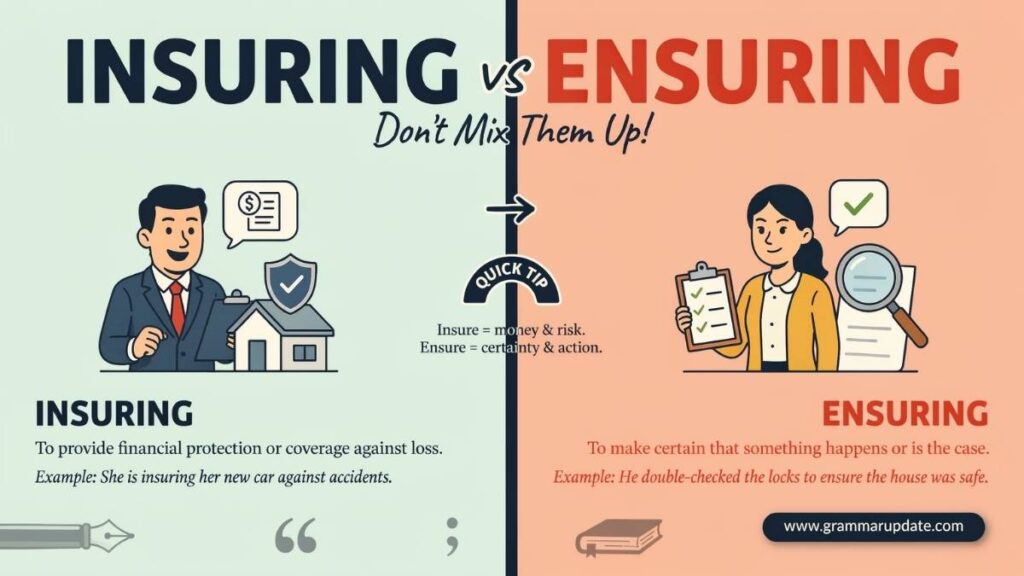
Now that you’ve learned each word separately, comparing them side by side makes the difference even clearer.
| Feature | Insuring | Ensuring |
|---|---|---|
| Basic meaning | Providing insurance coverage | Making certain something happens |
| Related to insurance | Yes | No |
| Related to guaranteeing results | No | Yes |
| Financial protection | Yes | No |
| Insurance policy | Yes | No |
| Insurance company | Yes | No |
| Making sure | No | Yes |
| Guaranteeing an outcome | No | Yes |
| Common workplace use | Insurance industry | Every industry |
| Everyday frequency | Less common | Much more common |
Another helpful way to remember the difference between ensure and insure is to focus on context.
If someone is buying an insurance policy, protecting property, filing an insurance claim, or discussing financial protection, use “insure.”
If someone wants to make sure something happens, improve quality, guarantee results, ensure safety, or confirm accuracy, use “ensure.”
Compare these sentence pairs:
Correct:
- The company is insuring its offices against earthquake damage.
- The company is ensuring employee safety during construction.
Correct:
- We insured the building with a reliable insurance provider.
- We ensured that every emergency exit remained unlocked.
Understand confusing English more words simply
Lint vs Lent Difference Which one is correct?
The Origin of Insuring vs Ensuring
At first glance, “insuring” and “ensuring” seem like they should mean the same thing. They share similar spellings, nearly identical pronunciation, and a common linguistic history. However, over time, English gave each word a distinct role.
Both verbs trace their roots to the Latin word securus, meaning “safe” or “secure.” As the language evolved through Old French and Middle English, the words gradually developed different meanings based on how people used them.
Today, standard English usage clearly separates the two:
- Insure focuses on financial protection through an insurance policy.
- Ensure focuses on making certain that something happens.
Understanding this history helps explain why these commonly confused English words are no longer interchangeable.
The Origin of “Insure”
The verb “insure” developed alongside the growth of the insurance industry. As merchants, travelers, and businesses looked for ways to protect themselves from financial loss, the word became closely associated with insurance contracts.
Today, the insure definition is tied directly to financial protection.
Examples include:
- Insure a car
- Insure a house
- Insure property
- Insure a business
- Insure against fire
- Insure against theft
- Insure your health
- Insure your life
Every one of these examples involves an insurance company, an insurance provider, or an insurance policy.
The Origin of “Ensure”
The word “ensure” followed a different path.
Instead of becoming linked with financial protection, it evolved to describe making something certain or guaranteeing a result.
The ensure definition has remained remarkably consistent in modern English.
Today, people use “ensure” when they want to:
- Ensure safety
- Ensure compliance
- Ensure quality
- Ensure success
- Ensure accuracy
- Ensure availability
- Ensure proper operation
Notice that none of these situations involve buying insurance.
Why the Meanings Became Different
English often creates specialized meanings from words with shared origins.
Over hundreds of years, “insure” became the preferred verb for insurance coverage, while “ensure” became the preferred verb for certainty and guaranteed outcomes.
Modern dictionaries and major style guides recommend keeping these meanings separate because doing so improves clarity and prevents confusion.
Understand confusing English more words simply
Then vs Than difference which one is correct ?
Ensure vs Insure vs Assure
Many English learners master the difference between insure and ensure only to encounter a third word: assure.
This trio causes confusion because all three verbs involve certainty in some way. The difference lies in what receives the action.
A simple rule can help:
- Ensure = make something certain.
- Assure = give confidence to a person.
- Insure = provide financial protection.
Learning this pattern makes choosing the correct word much easier.
What Does “Assure” Mean?
Assure means to remove doubt, give confidence, or reassure someone.
Unlike ensure, which focuses on results, assure focuses on people.
Examples:
- I assure you everything is under control.
- The doctor assured the patient that the surgery was successful.
- She assured her parents she would arrive safely.
- The manager assured employees that no jobs would be lost.
Notice that every sentence involves giving confidence to another person.
The Difference Between Ensure, Insure, and Assure
| Word | Main Meaning | Focus | Example |
|---|---|---|---|
| Ensure | Make certain | Result or situation | The company ensures customer satisfaction. |
| Assure | Reassure or convince | Person | The manager assured the employees. |
| Insure | Provide insurance | Property, life, business, financial risk | The company insured the warehouse. |
One helpful memory trick is to ask yourself a simple question.
What is receiving the action?
If the answer is:
- A person → assure
- A result or outcome → ensure
- Property or financial risk → insure
You have the correct verb.
Ensure vs Assure Meaning
Although these words are related, they are not interchangeable.
Correct:
- We ensured the project finished on time.
- She assured the client that the project was progressing well.
Incorrect:
- We assured the project finished on time.
- She ensured the client that everything was fine.
In the second incorrect sentence, “assured” is required because the action is directed toward a person.
Insure vs Assure Meaning
These two words are even easier to distinguish.
Assure deals with confidence.
Insure deals with insurance.
Correct:
- The family insured their vacation home.
- The insurance provider insured the commercial building.
- The lawyer assured the client that the paperwork was complete.
Ensure vs Assure vs Insure Examples
Compare these three sentences.
- We insured the building against flood damage.
- We ensured the building met every safety requirement.
- We assured the owner that the inspection was complete.
Each verb performs a completely different job.
Here are more examples.
| Correct Sentence | Why It Is Correct |
|---|---|
| The company insured its delivery trucks. | Financial protection |
| The company ensured timely deliveries. | Guaranteed result |
| The company assured customers of fast service. | Confidence given to people |
Understanding these differences greatly improves your word choice in both academic and professional writing.
Understand confusing English more words simply
Dammit vs Damn It Which One Is Correct?
Is “Insure” Ever Used Instead of “Ensure”?
Historically, some writers used “insure” to mean “ensure.”
Older books and legal documents occasionally contain sentences like:
- We insured that every requirement was met.
While this usage was once accepted, modern English strongly prefers “ensure” when the meaning is “make certain.”
Today, most dictionaries and professional editors recommend:
- Use ensure for certainty.
- Use insure only for insurance.
Following this distinction improves readability and eliminates unnecessary confusion.
British English vs American English Usage
One common misconception is that British English and American English use these words differently.
In reality, both varieties generally follow the same distinction.
Whether you’re writing for readers in the United States, Canada, Australia, or the United Kingdom, the recommended usage remains largely the same.
- Ensure means make certain.
- Insure means provide insurance.
This consistency makes these verbs easier to learn than many other commonly confused English words.
Do Both Dialects Use the Same Words?
Yes.
British and American dictionaries both define “ensure” as making certain and “insure” as providing insurance coverage.
Occasionally, you may encounter older British publications using “insure” where modern writers would choose “ensure.” Today, however, most publishers, universities, businesses, and government organizations prefer the modern distinction.
Regional Preferences
There are only minor stylistic differences.
For example:
- Some older legal documents use “insure” in the sense of “ensure.”
- Modern journalism almost always separates the meanings.
- Academic writing consistently distinguishes between the two.
- Business writing also treats them as separate verbs.
As a result, using “ensure” for certainty and “insure” for insurance is considered the safest and clearest approach.
Usage Comparison
| Situation | Correct Word |
|---|---|
| Buying life insurance | Insure |
| Purchasing health insurance | Insure |
| Covering a vehicle | Insure |
| Protecting property | Insure |
| Making sure employees follow safety rules | Ensure |
| Guaranteeing product quality | Ensure |
| Confirming accuracy | Ensure |
| Making certain customers receive support | Ensure |
Understand confusing English more words simply
Firey vs Fiery difference Which one Is Correct?
Common Mistakes People Make
Even experienced writers occasionally mix up insure and ensure because the words look and sound alike.
Fortunately, the mistakes follow predictable patterns.
Mistake 1 Using “Insure” Instead of “Ensure”
Incorrect:
- We insured everyone arrived safely.
Correct:
- We ensured everyone arrived safely.
The sentence refers to making something happen, not purchasing insurance.
Mistake 2 Using “Ensure” Instead of “Insure”
Incorrect:
- We ensured the office building against earthquakes.
Correct:
- We insured the office building against earthquakes.
The sentence concerns insurance coverage.
Mistake 3 Confusing Ensure with Assure
Incorrect:
- She ensured her friend that everything would be fine.
Correct:
- She assured her friend that everything would be fine.
The action is directed toward a person.
Mistake 4 Assuming the Words Are Interchangeable
This is perhaps the most common error.
Although the words share similar spellings and pronunciation, they perform different grammatical functions.
Replacing one with another can completely change the meaning of a sentence.
Learn the difference between confusing more English words
Focuses vs Focusses Which Spelling Is Correct?
Insuring vs Ensuring in Grammar Rules
Understanding the grammar difference between these verbs helps eliminate confusion.
Which Verb Takes Which Object?
Think about the object that follows the verb.
1.Use insure with:
- A house
- A car
- Property
- A business
- Equipment
- A shipment
- A life
2.Use ensure with:
- Success
- Safety
- Accuracy
- Compliance
- Quality
- Availability
- Proper operation
3.Use assure with:
- Customers
- Employees
- Parents
- Friends
- Clients
- Students
Choosing the right object naturally leads you to the correct verb.
Sentence Patterns
The verb “ensure” often appears before a clause beginning with “that.”
Examples:
- Please ensure that every form is signed.
- Engineers ensured that the bridge passed inspection.
- Teachers ensure that students understand the material.
The verb “insure” usually appears with nouns related to insurance.
Examples:
- The company insured every office building.
- They insured the equipment against theft.
- She insured her vehicle before driving it home.
Common Collocations
Here are some of the most natural word combinations used by native English speakers.
| Insure | Ensure |
|---|---|
| Insure a car | Ensure safety |
| Insure a house | Ensure accuracy |
| Insure property | Ensure compliance |
| Insure against damage | Ensure quality |
| Insure against theft | Ensure success |
| Insure your health | Ensure availability |
| Insure your life | Ensure proper operation |
| Provide insurance coverage | Make certain something happens |
Learn the difference between confusing more English words
Pose vs Poise Difference and Which one is correct ?
Insuring vs Ensuring in Real-Life Examples
Knowing the definitions is helpful, but seeing these words in real situations makes the difference much easier to remember. The following examples show how native English speakers use “insure” and “ensure” every day.
Business
Businesses frequently use both words, but each has a different purpose.
Examples with “insure”:
- Every company should insure its office building against fire.
- The business insured its delivery vehicles before expanding its fleet.
- Small businesses often insure expensive equipment to reduce financial risk.
Examples with “ensure”:
- Managers ensure employees receive proper training.
- The company ensures customer satisfaction through quality service.
- Regular audits ensure compliance with industry regulations.
- Daily inspections ensure workplace safety.
Notice that “insure” always relates to insurance coverage, while “ensure” focuses on making certain that something happens.
Insurance Industry
The insurance industry naturally uses “insure” far more often.
Examples:
- The insurance company agreed to insure the warehouse.
- The insurance provider offers policies to insure commercial property.
- Many homeowners insure against flood damage.
- Businesses insure valuable machinery before putting it into operation.
However, insurance companies also use “ensure.”
Example:
- Our team ensures every claim receives careful review.
The first verb relates to financial protection, while the second relates to service quality.
News Headlines
News organizations regularly use both words correctly.
Examples:
- City Officials Ensure Public Safety During Storm
- New Law Ensures Better Consumer Protection
- Company Insures Historic Building Against Fire Damage
- Farmers Insure Crops Before Hurricane Season
These headlines demonstrate how context determines the correct word.
Academic Writing
Universities and research papers often use “ensure.”
Examples:
- Researchers ensured the experiment followed ethical guidelines.
- Scientists ensure data accuracy through repeated testing.
- Universities ensure equal access to educational resources.
Because academic writing rarely discusses insurance, “ensure” appears much more frequently.
Government Documents
Government publications commonly include sentences such as:
- Agencies ensure compliance with federal regulations.
- Inspectors ensure public buildings meet safety standards.
- Emergency plans ensure essential services remain available.
When governments discuss public insurance programs, “insure” appears instead.
Example:
- The program helps insure eligible workers against certain financial risks.
Emails
Professional emails frequently include “ensure.”
Examples:
- Please ensure that every attachment is included before sending the email.
- Ensure all invoices are submitted by Friday.
- Let’s ensure everyone receives the updated schedule.
If the email discusses insurance, use “insure.”
Example:
- Please insure the shipment before dispatching it.
Social Media
Social media often reveals confusion between these words.
Incorrect:
- We insured everyone had a great time.
Correct:
- We ensured everyone had a great time.
Incorrect:
- Make sure you ensure your car.
Correct:
- Make sure you insure your car.
Many online discussions, including those found under searches like “Insuring vs ensuring Reddit,” show that writers often confuse these verbs because they sound alike. Fortunately, once you recognize the context, the correct choice becomes obvious.
Learn the difference between confusing more English words
Leary vs Leery Which Is Correct and Difference?
Insuring vs Ensuring Pronunciation
Many people wonder whether “insure” and “ensure” sound different.
In modern American English, they are usually pronounced almost exactly the same. Both are commonly pronounced as:
in-SHOOR or en-SHOOR
Because their pronunciation is so similar, people often rely on context rather than sound to understand which word is being used.
This explains why searches for “Insure vs ensure pronunciation” and “How to pronounce insure and ensure” are so common.
Although pronunciation rarely helps distinguish them, spelling and meaning do.
| Word | Typical Pronunciation | Meaning |
|---|---|---|
| Insure | in-SHOOR | Provide insurance |
| Ensure | en-SHOOR | Make certain |
The slight vowel difference at the beginning is often barely noticeable in everyday conversation.
Easy Memory Trick to Never Confuse Them Again
A simple memory trick can save you from making this mistake.
Think about the first two letters.
Insure starts with “ins.”
Think of “insurance.”
If your sentence involves an insurance policy, insurance coverage, financial protection, or protecting property, use “insure.”
Ensure begins with “en.”
Think of “enable” or “make sure.”
If your sentence means making certain that something happens, use “ensure.”
Another useful shortcut is to ask yourself one question:
“Am I talking about insurance?”
If the answer is yes, choose “insure.”
If the answer is no, and you mean “make sure,” choose “ensure.”
Quick Decision Guide
Use “insure” when talking about:
- Life insurance
- Health insurance
- Car insurance
- Property insurance
- Insurance contracts
- Insurance claims
- Insurance coverage
- Financial protection
- Protecting against loss
Use “ensure” when talking about:
- Ensuring success
- Ensuring safety
- Ensuring quality
- Ensuring compliance
- Ensuring availability
- Ensuring accuracy
- Ensuring proper operation
- Making certain
- Guaranteeing results
Insured vs Ensured
Another source of confusion involves the past tense and past participle forms.
| Word | Meaning | Example |
|---|---|---|
| Insured | Covered by insurance | The building was insured against fire. |
| Ensured | Made certain | Careful planning ensured success. |
Examples:
- The homeowner insured the property last year.
- Their insurance policy kept the building insured.
- Thorough preparation ensured the event ran smoothly.
- Extra testing ensured the software worked correctly.
Although these words differ by only one letter, their meanings remain completely separate.
Mini Case Study
Imagine a company opening a new warehouse.
Before opening day, management purchases an insurance policy covering the building, equipment, and delivery trucks.
The company has now insured its property.
Next, managers inspect every emergency exit, train employees, test fire alarms, and review safety procedures.
These actions ensure employee safety.
Finally, the director tells employees that the warehouse is fully prepared.
The director assures the staff that everything is ready.
One scenario demonstrates all three verbs working together correctly.
Learn the difference between confusing more English words
Fistulogram vs Fistulagram which is correct and Difference ?
Commonly Confused Sentences
Let’s compare several sentence pairs.
| Incorrect | Correct |
|---|---|
| We insured everyone arrived safely. | We ensured everyone arrived safely. |
| Please ensure your house before moving. | Please insure your house before moving. |
| She ensured me everything was fine. | She assured me everything was fine. |
| The company ensured the building against floods. | The company insured the building against floods. |
| They insured quality through testing. | They ensured quality through testing. |
Looking at both versions side by side makes the grammar difference much easier to recognize.
Learn the difference between confusing more English words
Flatform vs Platform Difference which is correct?
Practice Section Insuring vs Ensuring
Choose the correct word to complete each sentence. Insuring vs Ensuring
Options: insuring, ensuring, insure, ensure, insured, ensured, assure, assured
- The company is __________ all of its delivery trucks against accidents.
- Please __________ that every employee signs the attendance sheet.
- We decided to __________ our new house before moving in.
- The safety inspection is __________ that every machine operates correctly.
- The manager __________ the customers that their orders would arrive on time.
- My parents __________ our family car with a trusted insurance provider last week.
- Careful planning will __________ the project’s success.
- The business owner is __________ valuable equipment against theft.
- Daily quality checks help __________ product accuracy.
- The airline __________ passengers that the flight would depart as scheduled.
- Every homeowner should __________ their property against fire damage.
- The teacher checked every answer, __________ that no mistakes remained.
- The warehouse is fully __________ against flood damage.
- Regular maintenance helps __________ proper operation of the equipment.
- The company chose to __________ its employees with comprehensive health coverage.
- The supervisor is __________ everyone follows workplace safety rules.
- The insurance company __________ the commercial building after the inspection.
- Please __________ that all documents are attached before sending the email.
- The lawyer __________ the client that everything was under control.
- We purchased an insurance policy to __________ our business against financial loss.
- Double-check the calculations to __________ complete accuracy.
- The museum is __________ its priceless artwork against damage.
- Their preparation __________ a successful product launch.
- Good communication helps __________ customer satisfaction.
- The travel agency recommended that we __________ our luggage before our international trip.
Answers
| No. | Answer |
|---|---|
| 1 | insuring |
| 2 | ensure |
| 3 | insure |
| 4 | ensuring |
| 5 | assured |
| 6 | insured |
| 7 | ensure |
| 8 | insuring |
| 9 | ensure |
| 10 | assured |
| 11 | insure |
| 12 | ensuring |
| 13 | insured |
| 14 | ensure |
| 15 | insure |
| 16 | ensuring |
| 17 | insured |
| 18 | ensure |
| 19 | assured |
| 20 | insure |
| 21 | ensure |
| 22 | insuring |
| 23 | ensured |
| 24 | ensure |
| 25 | insure |
Here’s a trusted source for clear word meanings:
FAQs
Is it insuring vs ensuring?
It depends on the context. Use “insuring” when talking about insurance or financial protection. Use “ensuring” when you mean making certain or guaranteeing that something happens.
What does “ensuring” mean?
Ensuring means making certain that something happens or taking steps to guarantee a desired result. For example, “The manager is ensuring customer satisfaction.”
What is the meaning of insuring?
Insuring means providing insurance coverage or protecting someone or something against financial loss through an insurance policy.
Is ensure the same as insure?
No. Ensure means to make certain something happens, while insure means to provide insurance or financial protection against loss.
What is the difference between insure and ensure?
The difference between insure and ensure is simple. Insure relates to insurance coverage, while ensure means to make sure or guarantee an outcome.
When should you use ensure vs insure?
Use ensure when talking about certainty, safety, quality, or accuracy. Use insure when discussing insurance policies, financial protection, or covering property, vehicles, health, or life.
How do you use the word “ensuring”?
Use “ensuring” when describing actions that make something certain. Example: “Regular maintenance is ensuring the equipment operates safely.”
How do you use insure in a sentence?
Example: “The homeowner decided to insure the house against storm damage.” Here, insure refers to purchasing insurance coverage.
What does insuring something mean?
Insuring something means obtaining insurance coverage to protect it from financial loss caused by events such as accidents, theft, fire, or natural disasters.
Is there a word “ensuring”?
Yes. “Ensuring” is the present participle of the verb “ensure.” It is commonly used in both spoken and written English.
Is insuring a word?
Yes. “Insuring” is the present participle of “insure” and refers to providing or obtaining insurance coverage.
What does “ensuring” really mean?
Ensuring means making sure that something happens as intended. It involves preventing problems and helping achieve a successful outcome.
What does assured mean in simple words?
Assured means confident, certain, or reassured. It can also describe someone who has been given confidence or certainty by another person.
What’s the difference between assured and insured?
Assured relates to confidence or reassurance, while insured refers to someone or something protected by an insurance policy.
Are insure and ensure synonyms?
Not in modern English. Although both words share similar origins, they have different meanings and should not be used interchangeably.
What is another word for ensuring?
Depending on the context, alternatives include:
- Making sure
- Guaranteeing
- Confirming
- Securing
- Verifying
- Establishing
- Safeguarding
What is a better word than “ensuring”?
The best alternative depends on the sentence. Common replacements include “guaranteeing,” “confirming,” “making certain,” or “verifying.”
What is a professional way of saying “ensuring”?
Professional alternatives include:
- Guaranteeing
- Confirming
- Verifying
- Maintaining
- Securing
- Facilitating
- Establishing
What is a polite way to say ensure?
In formal writing, you can use phrases such as:
- Please make sure
- Kindly confirm
- Verify that
- Help ensure
- Please check that
What is a softer word than “ensure”?
If you want a less direct tone, consider:
- Help
- Support
- Encourage
- Promote
- Facilitate
- Aim to
Which word is similar to “ensure”?
Words with similar meanings include:
- Guarantee
- Confirm
- Verify
- Secure
- Establish
- Make certain
What is the synonym of ensuring?
Common synonyms include:
- Guaranteeing
- Confirming
- Verifying
- Securing
- Establishing
- Making certain
What is the synonym of insure?
Depending on the context, synonyms include:
- Cover
- Protect
- Underwrite
- Safeguard
- Provide insurance for
What is another word for insured?
Common alternatives include:
- Covered
- Protected
- Policyholder (when referring to a person)
- Covered by insurance
What is another word for insuring?
Depending on the sentence, alternatives include:
- Covering
- Protecting
- Underwriting
- Providing insurance for
What is the opposite of ensuring?
The opposite of ensuring includes:
- Preventing
- Neglecting
- Ignoring
- Endangering
- Jeopardizing
- Overlooking
How do you insure or ensure correctly?
Ask yourself one question:
- Are you talking about insurance? Use “insure.”
- Are you talking about making something certain? Use “ensure.”
This simple rule works in almost every situation.
Is “insure” commonly used today?
Yes. “Insure” is widely used in legal documents, insurance policies, business writing, and everyday conversations involving financial protection.
Who is the insurer and who is the insured?
The insurer is the insurance company that provides coverage.
The insured is the person, business, or property protected by the insurance policy.
What does “I assure you” mean?
“I assure you” means “I promise you” or “I want you to feel confident that what I’m saying is true.” It is used to reassure another person.
Why does the U.S. Constitution’s Preamble say “insure domestic Tranquility” instead of “ensure domestic Tranquility”?
When the U.S. Constitution was written in 1787, the word “insure” was commonly used to mean “make certain” as well as “provide insurance.” Over time, English usage changed, and modern style guides now distinguish “ensure” for making something certain and “insure” for financial protection. The wording in the Preamble reflects historical English, not modern grammar.
Conclusion
Do not let one little letter fool you. Although “Insuring vs Ensuring” look almost the same, they have very different jobs. “Insure” is all about insurance and financial protection. “Ensure” simply means to make sure something happens. Mix them up, and your sentence can go from protecting a house to guaranteeing homework gets finished!
Here’s an easy way to remember the difference: if you’re talking about an insurance policy, use “insure.” If you can replace the word with “make sure,” use “ensure.” It’s a quick trick that works almost every time.
Now that you understand the difference between insuring vs ensuring, you can use both words with confidence. The next time you write an email, report, school assignment, or social media post, you’ll know exactly which word belongs. Thats one less grammar mistake to worry about and one more way to make your writing clear, accurate, and professional.

Jhon AJS, the creative mind behind Grammar Update, is an experienced blogger passionate about simplifying English grammar. He focuses on explaining confusing word vs word differences, grammar rules, punctuation, and sentence structure in a clear and practical way. Through easy to understand guides and examples, Jhon helps readers improve their writing and communicate with confidence. With years of blogging experience, he continues to share helpful insights that make learning grammar simple, useful, and accessible for everyone.