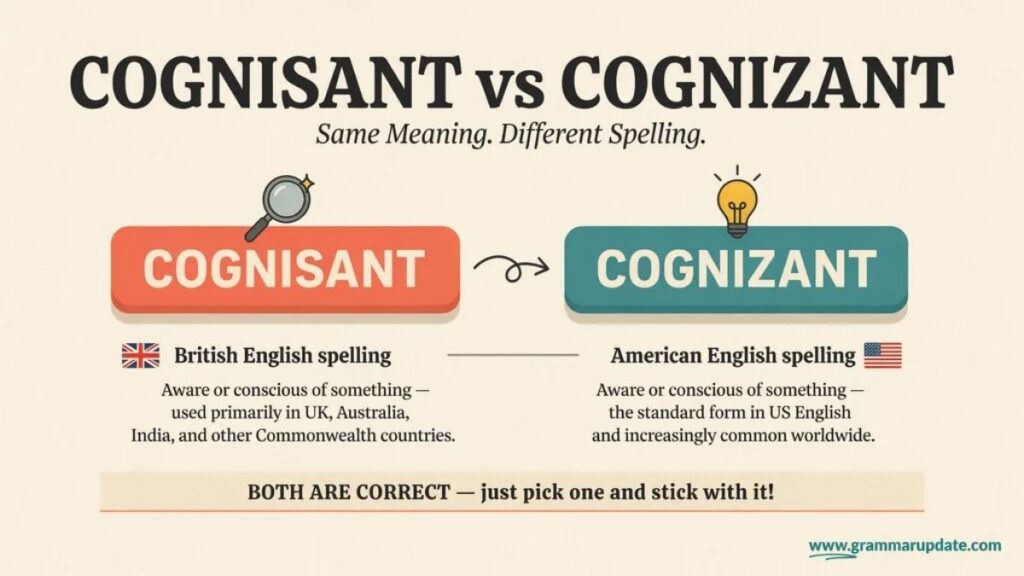
Ever found yourself typing cognisant vs cognizant, then wondering if spellcheck is judging you? Don’t worry this is one of those English spelling confusions that trips up plenty of writers. The good news is that the cognisant vs cognizant debate has a simple answer. Both spellings are correct. The only difference is where they’re used. Cognisant is the preferred spelling in British English, while cognizant is the standard spelling in American English. In this guide, you’ll learn what each word means, how to pronounce it, when to use each spelling, and how to avoid this common mistake with confidence every time.
Cognisant vs Cognizant Quick Answer
The short answer is simple:
- Cognisant is the preferred British spelling.
- Cognizant is the preferred American spelling.
- Both spellings are correct.
- They have exactly the same meaning, pronunciation, and grammatical function.
The only real difference is regional preference.
| Feature | Cognisant | Cognizant |
|---|---|---|
| Correct spelling | Yes | Yes |
| Meaning | Aware; informed | Aware; informed |
| British English | Preferred | Less common |
| American English | Rare | Preferred |
| Australian English | Common | Occasionally seen |
| Canadian English | Both accepted | Both accepted |
| New Zealand English | Preferred | Less common |
| Pronunciation | Same | Same |
Quick takeaway: If you’re writing for readers in the United States, use cognizant. If you’re writing for readers in the United Kingdom or most Commonwealth countries, use cognisant.
Cognisant
The word cognisant is the traditional British English spelling. You’ll commonly find it in UK newspapers, government documents, legal writing, universities, and professional publications.
Examples include:
- We are fully cognisant of our legal obligations.
- The committee remained cognisant of potential risks.
- Every employee should be cognisant of company policies.
Cognizant
Cognizant is the preferred American spelling. It appears in US newspapers, business communication, legal documents, academic journals, and corporate writing.
Examples include:
- Managers should remain cognizant of customer expectations.
- Investors became cognizant of changing market conditions.
- Students should be cognizant of the submission deadline.
Learn how to use confusing more words correctly
Writing vs Writting which is Correct Spelling
What Does Cognisant vs Cognizant Mean?
If you’ve searched what does cognisant mean or what does cognizant mean, the answer is straightforward.
Both words mean:
Being aware of something, informed about it, or having knowledge of it.
Someone who is cognisant or cognizant understands facts, circumstances, responsibilities, or possible consequences. The word often appears in formal English, especially in legal, academic, governmental, and business contexts.
Dictionary Definition
The cognisant definition and cognizant definition can be summarized as:
Aware of; informed about; having knowledge or understanding of something.
These definitions remain the same regardless of spelling.
Cognisant Meaning
The cognisant meaning refers to someone who is fully aware or informed.
Examples:
- She was cognisant of every detail before signing the contract.
- The doctor remained cognisant of the patient’s medical history.
- Good leaders stay cognisant of employee concerns.
In each sentence, cognisant means aware, knowledgeable, or fully informed.
Cognizant Meaning
The cognizant meaning is identical.
Examples:
- The company remained cognizant of industry regulations.
- Travelers should be cognizant of local customs.
- Teachers are cognizant of different learning styles.
Again, the word simply means aware or informed.
Cognisant Definition
The adjective cognisant describes a person who understands or recognizes a fact, situation, responsibility, or issue.
It commonly appears after the phrase:
Be cognisant of
Examples include:
- Be cognisant of your surroundings.
- Employees must be cognisant of workplace safety rules.
- Citizens should be cognisant of their legal rights.
Cognizant Definition
Likewise, cognizant functions as an adjective that describes someone who possesses awareness or understanding.
You’ll most often see:
Be cognizant of
Examples:
- Drivers should be cognizant of weather conditions.
- Investors need to be cognizant of financial risks.
- Parents should remain cognizant of online safety concerns.
Learn how to use confusing more words correctly
Laid vs Layed Difference and Usage in English Grammar
Cognisant vs Cognizant What’s the Difference?
Many people assume there’s a hidden difference between these spellings. There isn’t.
The difference between cognisant and cognizant comes down to regional spelling, not meaning or grammar.
| Feature | Cognisant | Cognizant |
|---|---|---|
| Meaning | Aware | Aware |
| Pronunciation | Identical | Identical |
| Grammar | Adjective | Adjective |
| Formality | Formal | Formal |
| Usage | British English | American English |
Both spellings belong to advanced English vocabulary and commonly appear in formal English, professional writing, business English, and academic texts.
Understand confusing English more words simply
Kindergarten vs Kindergarden which is Correct and Usage?
Meaning Comparison
Whether you write cognisant or cognizant, you’re expressing the same idea:
- Awareness
- Understanding
- Recognition
- Knowledge
- Mindfulness
- Attentiveness
These words often replace simpler terms like:
- Aware
- Informed
- Conscious
- Knowledgeable
- Alert
- Observant
- Perceptive
Spelling Comparison
The only visible difference is one letter.
British spelling:
Cognisant
American spelling:
Cognizant
This follows a familiar pattern found throughout English.
| British English | American English |
|---|---|
| Organise | Organize |
| Realise | Realize |
| Recognise | Recognize |
| Civilisation | Civilization |
| Cognisant | Cognizant |
Notice how British English often favors the letter “s,” while American English frequently prefers the letter “z.”
Usage Comparison
Both spellings appear in:
- Academic writing
- Legal documents
- Government reports
- Scientific research
- Business communication
- Professional vocabulary
Neither spelling is considered more formal than the other.
The only question is your audience.
If your readers are in London, cognisant will look natural.
If they’re in New York, cognizant is the expected spelling.
Understand confusing English more words simply
Receive vs Recieve Which is Correct and Usage?
Cognisant or Cognizant British vs American English
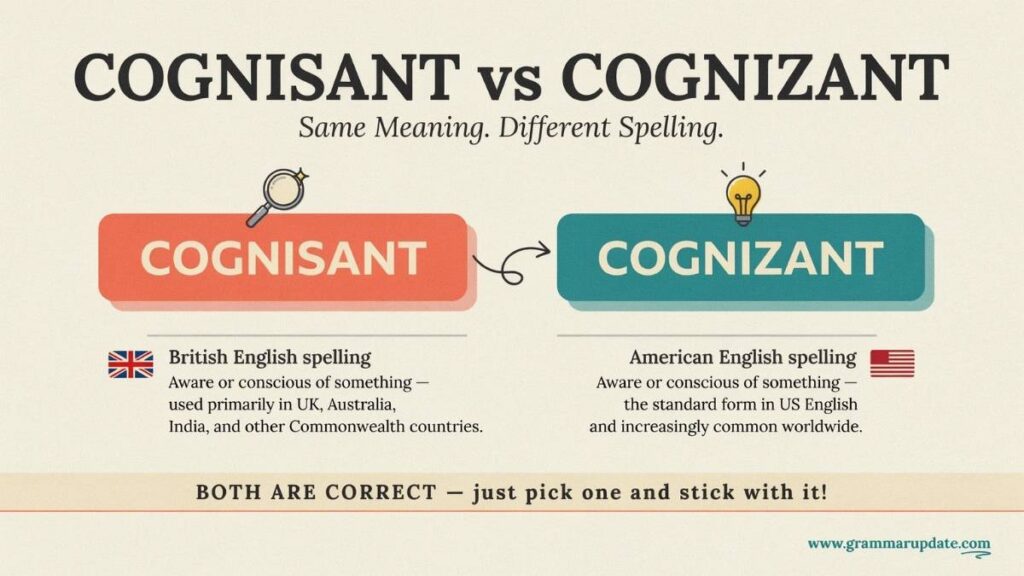
One of the biggest reasons people search cognisant or cognizant UK spelling or cognisant or cognizant US spelling is that English has developed regional spelling conventions over centuries.
Understanding those conventions helps you choose the correct spelling with confidence.
British English Preference
In British English, cognisant is the standard spelling.
You’ll frequently encounter it in:
- UK government publications
- British universities
- Legal documents
- Newspapers
- Educational materials
- Professional reports
British style guides generally recommend using cognisant consistently throughout a document.
American English Preference
In the United States, cognizant dominates.
American dictionaries, publishers, universities, and corporations overwhelmingly use the “z” spelling.
Examples include:
- Academic journals
- Corporate reports
- News publications
- Government agencies
- Business communication
- Professional writing
If you’re writing for an American audience, cognizant is the preferred choice.
Understand confusing English more words simply
Learn the difference between commonly mixed-up more words
Learn the difference between commonly mixed-up more words
Rumor vs Rumour Difference and Usage
Canadian, Australian, and New Zealand English
Regional English doesn’t stop with the UK and the US.
Here’s how other English-speaking countries generally treat the word.
| Country | Preferred Spelling |
|---|---|
| United Kingdom | Cognisant |
| United States | Cognizant |
| Australia | Cognisant |
| New Zealand | Cognisant |
| Canada | Both accepted, depending on publication style |
Canadian English often blends British and American spelling conventions. Because of that, both forms appear in Canadian publications. The important rule is consistency. Once you choose one spelling, use it throughout your document.
Learn how to use confusing more words correctly
Enquiries vs Inquiries Which Spelling Is Correct?
The Origin and History of Cognisant and Cognizant
The history of cognisant and cognizant stretches back several centuries and reflects the fascinating evolution of the English language.
Both spellings ultimately trace their roots to the Latin verb cognoscere, which means “to know,” “to learn,” or “to become acquainted with.” From Latin, the word passed into Old French before entering Middle English, where its spelling gradually evolved.
Early English writers adopted different spelling conventions because standardized dictionaries did not yet exist. As printing became more widespread, regional preferences developed. Britain gradually favored cognisant, while American English adopted cognizant, mirroring the broader trend of using “-ize” spellings in many words.
Cognisant vs Cognizant Pronunciation
One question many English learners ask is whether the two spellings sound different. The answer is no.
The cognisant or cognizant pronunciation is exactly the same. Although one uses the letter “s” and the other uses “z,” both are pronounced alike in everyday speech.
The most common pronunciation is:
/ˈkɒɡ.nɪ.zənt/ (British English)
/ˈkɑːɡ.nə.zənt/ (American English)
The slight difference comes from the natural accent differences between British and American English, not from the spelling itself.
British Pronunciation
In British English, cognisant is typically pronounced as:
KOG-ni-zuhnt
The first syllable sounds like the word “cog,” followed by “ni,” and ending with “zuhnt.”
Example:
- She remained cognisant of the legal requirements.
American Pronunciation
In American English, cognizant follows the same pronunciation pattern.
Example:
- The manager was cognizant of every customer’s concern.
Even though the spelling contains the letter “z,” the pronunciation is almost identical to the British version.
Learn how to use confusing more words correctly
Visiter vs Visitor Difference Which One Is Correct?
How to Pronounce Cognisant and Cognizant Easily
A simple way to remember the pronunciation is to divide the word into three parts:
Cog + ni + zant
Say each part slowly before combining them into one smooth word.
Practice these examples aloud:
- Be cognisant of your surroundings.
- Stay cognizant of changing market trends.
- Every driver should remain cognisant of road conditions.
- Investors must stay cognizant of financial risks.
The more you hear and speak the word, the more natural it becomes.
Cognisant vs Cognizant in Real Sentences
Understanding a definition is helpful. Seeing the word in context makes it much easier to remember.
Below are practical examples that show how cognisant and cognizant appear in different types of writing.
Cognisant in a Sentence
These examples follow British English spelling.
- She was fully cognisant of the project’s deadlines.
- We remain cognisant of customer expectations.
- The judge was cognisant of previous legal decisions.
- Every employee should be cognisant of company policies.
- Students need to be cognisant of plagiarism rules.
- Travelers should be cognisant of local customs.
- Parents are cognisant of online safety concerns.
- The committee stayed cognisant of budget limitations.
Cognizant in a Sentence
These examples use American English spelling.
- The CEO remained cognizant of market changes.
- Doctors are cognizant of patient privacy laws.
- Investors became cognizant of economic uncertainty.
- Teachers should be cognizant of different learning styles.
- Engineers stayed cognizant of safety regulations.
- Customers are increasingly cognizant of data privacy.
- Every manager should remain cognizant of workplace ethics.
- The company is cognizant of environmental responsibilities.
Workplace Examples
Business English frequently uses this word because professionals often discuss awareness, responsibility, and decision-making.
Examples include:
- Managers should remain cognizant of employee feedback.
- Successful leaders are cognisant of changing customer needs.
- Companies must be cognizant of legal obligations.
- Executives should stay cognisant of emerging technologies.
Academic Writing Examples
Universities and research papers often use cognisant or cognizant in formal discussions.
Examples:
- Researchers remained cognizant of ethical guidelines.
- Students should be cognisant of citation requirements.
- The study demonstrates that participants were cognizant of potential risks.
- Scholars remained cognisant of historical context throughout the research.
Legal and Professional Examples
Legal documents frequently use the phrase “be cognisant of” because it expresses awareness of rights, duties, and responsibilities.
Examples:
- Employers must be cognisant of labor laws.
- Both parties were cognizant of the contractual obligations.
- Citizens should remain cognisant of their legal rights.
- The organization is cognizant of regulatory requirements.
Everyday Conversation Examples
Although the word is formal, people still use it in everyday situations.
Examples:
- I’m cognisant of your concerns.
- She’s always cognizant of other people’s feelings.
- We should stay cognisant of our spending.
- He’s cognizant of how his decisions affect others.
Learn how to use confusing more words correctly
Resale vs Resell What’s the Difference?
When Should You Use Cognisant or Cognizant?
One of the most common questions is, “Is cognisant or cognizant correct?”
The answer depends on your audience.
Both spellings are correct. Choosing the right one simply means matching the regional spelling expected by your readers.
For UK Readers
Use cognisant if you’re writing for:
- The United Kingdom
- Australia
- New Zealand
- Many Commonwealth countries
This spelling matches British English conventions and looks natural to readers in those regions.
For US Readers
Choose cognizant when writing for:
- The United States
- American businesses
- US universities
- American publishers
- Most US government documents
American readers expect the “z” spelling.
For Global Audiences
If your audience comes from multiple countries, either spelling works.
However, choose one version and use it consistently throughout your article, report, or presentation.
Switching between cognisant and cognizant in the same document can distract readers and make your writing appear inconsistent.
For Academic Writing
Most universities recommend following the style guide assigned to your course.
For example:
- A UK university generally prefers cognisant.
- An American university generally prefers cognizant.
Always stay consistent once you’ve chosen a spelling style.
For Business Communication
Business writing should match your company’s preferred style guide.
For example:
- A British company usually writes cognisant.
- An American company usually writes cognizant.
International organizations often follow one style throughout all documents to maintain consistency.
Learn how to use confusing more words correctly
Advice vs Advise What’s the Difference?
Cognisant vs Cognizant vs Conscious
Many writers confuse cognisant with conscious because both relate to awareness. However, they are not identical.
Understanding the distinction helps you choose the most accurate word.
Cognisant vs Conscious
Cognisant means aware of facts, situations, responsibilities, or information.
Conscious usually means awake, mentally alert, or aware of your surroundings.
Compare these examples:
- She was cognisant of the company’s financial problems.
- She remained conscious after the accident.
In the first sentence, the focus is knowledge.
In the second, the focus is physical awareness.
Cognizant vs Aware
Aware is the simpler, everyday alternative.
Compare these examples:
- I’m aware of the deadline.
- I’m cognizant of the deadline.
Both are correct, but cognizant sounds more formal and professional.
Cognisant vs Mindful
Mindful emphasizes paying careful attention, often in a deliberate way.
Compare:
- Be mindful of your language.
- Be cognisant of company policies.
Mindful suggests thoughtful attention.
Cognisant emphasizes knowledge and awareness.
Learn the difference between confusing more English words
Entwined vs Intertwined What’s the Difference and usage?
Common Mistakes Writers Make with Cognisant and Cognizant
Even experienced writers sometimes misuse these spellings.
Fortunately, the mistakes are easy to avoid.
Mixing British and American Spellings
This is the most common error.
Incorrect example:
- The introduction uses cognisant.
- The conclusion switches to cognizant.
Choose one spelling and keep it consistent.
Thinking One Spelling Is Wrong
Many people believe cognisant is incorrect because they mostly encounter cognizant online.
Others assume cognizant is an American invention.
Neither belief is true.
Both spellings appear in respected dictionaries and have been accepted for many years.
Using the Wrong Regional Style
If you’re writing for a British publication, use cognisant.
If you’re writing for an American audience, choose cognizant.
Matching regional spelling improves professionalism and readability.
Learn the difference between confusing more English words
That’s Mean vs that means Difference and which one is correct?
Confusing Cognizant with the Technology Company
Many people recognize the word because of the multinational IT services company Cognizant.
Remember that the company’s official name always uses the American spelling with a “z.”
Even if you’re writing in British English, the company name should never be changed.
Correct examples:
- Cognizant announced new technology investments.
- Cognizant provides consulting and digital transformation services.
Do not change the company’s official branding to “Cognisant.”
Cognisant vs Cognizant Synonyms
If you want to avoid repeating the same word, several excellent alternatives can express a similar idea.
| Synonym | Meaning | Best Use |
|---|---|---|
| Aware | Having knowledge | Everyday writing |
| Informed | Possessing information | Business communication |
| Conscious | Mentally aware | General English |
| Mindful | Paying careful attention | Professional writing |
| Alert | Ready and attentive | Safety contexts |
| Observant | Notices details | Descriptive writing |
| Perceptive | Understands quickly | Formal writing |
| Knowledgeable | Well informed | Academic writing |
| Attentive | Paying close attention | Workplace communication |
| Familiar with | Having prior knowledge | Everyday English |
Which Synonym Should You Choose?
Each synonym carries a slightly different meaning.
- Use “aware” for everyday conversations.
- Use “mindful” when emphasizing careful attention.
- Use “knowledgeable” when describing expertise.
- Use “cognisant” or “cognizant” in formal English, legal writing, business communication, and academic documents where precision matters.
Learn the difference between confusing more English words
Smoothe vs Smooth Which is Correct and Usage?
Cognisant and Cognizant in Major Dictionaries
If you’re wondering whether both spellings are officially recognized, the answer is yes. Leading English dictionaries list both forms as correct. The main difference lies in regional preference rather than meaning or grammar.
Whether you search for “cognisant or cognizant Oxford Dictionary” or “cognisant or cognizant Cambridge Dictionary,” you’ll find that both spellings are accepted in modern English.
Oxford Dictionary
The Oxford English Dictionary recognizes both spellings.
- Cognisant is listed as the preferred British English spelling.
- Cognizant is also recognized and commonly associated with American English.
Both entries carry the same meaning: aware, informed, or having knowledge of something.
Cambridge Dictionary
Cambridge Dictionary primarily uses the American spelling, cognizant, while acknowledging the British variant, cognisant.
Like Oxford, Cambridge defines the word as being aware of or having knowledge of something.
Merriam-Webster Dictionary
Merriam-Webster is an American dictionary, so it naturally favors cognizant.
Its definition focuses on someone who is aware, informed, or understanding of facts or circumstances.
Collins Dictionary
Collins Dictionary recognizes both spellings and explains that the preferred version depends on regional English.
This reflects modern English usage, where both forms are considered correct.
Cognisant vs Cognizant in Published Writing
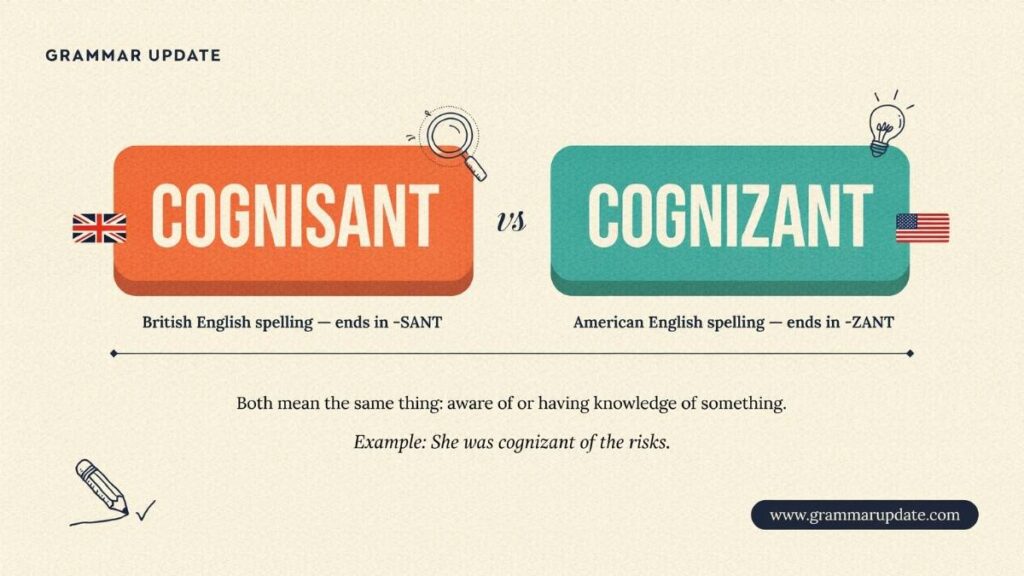
Real-world usage provides one of the best ways to understand spelling preferences.
Although both words carry the same meaning, publishers almost always follow the spelling style of their target audience.
UK Publications
British newspapers, universities, and government organizations generally use cognisant.
Examples include:
- Government reports
- Legal guidance
- University publications
- British newspapers
- Professional journals
US Publications
American publishers overwhelmingly prefer cognizant.
You’ll commonly see it in:
- Business magazines
- Academic journals
- Government documents
- Corporate reports
- News websites
Academic Writing
Academic institutions expect consistency more than anything else.
If you’re writing for a UK university, use cognisant throughout your paper.
If you’re writing for an American institution, use cognizant consistently.
Changing spellings midway through a document may distract readers and reduce professionalism.
Cognisant vs Cognizant Usage Statistics and Trends
Search behavior and published content reveal interesting patterns.
The American spelling, cognizant, appears more frequently online because of the size of the US publishing market and the global reach of American businesses.
However, cognisant remains the preferred spelling across much of the United Kingdom, Australia, and New Zealand.
Regional Usage Trends
| Region | Most Common Spelling |
|---|---|
| United States | Cognizant |
| United Kingdom | Cognisant |
| Australia | Cognisant |
| New Zealand | Cognisant |
| Canada | Both are widely used |
Publishing Trends
Several factors influence modern spelling preferences:
- American websites publish a larger volume of online content.
- British publishers continue to follow traditional spelling conventions.
- International businesses often adopt one style guide and use it consistently.
- Academic publishers generally follow the regional English requested by authors or institutions.
The increasing availability of digital content means readers regularly encounter both spellings, making them familiar with each version.
Fix common more word mistakes in English
Realist vs Realest Correct Usage
Cognisant vs Cognizant Comparison Table
| Feature | Cognisant | Cognizant |
|---|---|---|
| Meaning | Aware or informed | Aware or informed |
| Correct spelling | Yes | Yes |
| British English | Preferred | Less common |
| American English | Rare | Preferred |
| Canadian English | Both accepted | Both accepted |
| Australian English | Preferred | Occasionally used |
| New Zealand English | Preferred | Less common |
| Pronunciation | Same | Same |
| Grammar | Adjective | Adjective |
| Formal writing | Yes | Yes |
| Business English | Yes | Yes |
| Academic writing | Yes | Yes |
| Dictionary recognition | Yes | Yes |
Easy Trick to Remember Cognisant vs Cognizant
Fortunately, remembering the correct spelling isn’t difficult.
Use this simple rule:
- Think of the letter “S” as standing for Standard British Spelling. That will remind you to use cognisant in British English.
- Think of the letter “Z” as matching many American spellings such as organize, recognize, and realize. That will help you remember cognizant for American English.
Another helpful tip is to focus on your audience instead of the dictionary.
If your readers are British, choose cognisant.
If they’re American, choose cognizant.
Once you’ve made your choice, stick with it throughout your writing.
Cognizant Company Spelling
One common source of confusion comes from the multinational technology company Cognizant.
Many people search phrases such as:
- Cognizant company spelling
- Cognizant brand spelling
- Why is Cognizant spelled with a Z?
- Official Cognizant spelling
The answer is straightforward.
The company’s official name is Cognizant with a Z.
This spelling is part of the company’s registered brand identity and should never be changed, even when writing in British English.
For example:
- Cognizant provides consulting, digital engineering, cloud services, and AI solutions.
- Cognizant is one of the world’s leading technology consulting companies.
When referring to the business, always respect its official branding.
Learn the difference between tricky more English words
Encorporate vs Incorporate Correct Usage
Quick Reference Guide
| Question | Answer |
|---|---|
| Is cognisant a real word? | Yes |
| Is cognizant a real word? | Yes |
| Do they have different meanings? | No |
| Are they pronounced differently? | No |
| Which spelling is British? | Cognisant |
| Which spelling is American? | Cognizant |
| Which spelling should I use? | Match your audience |
| Are both accepted by dictionaries? | Yes |
Practice Session cognisant vs cognizan
Complete each sentence by filling in the blank with the correct spelling: cognisant vs cognizant. Choose the spelling that best matches the context or audience.
- The lawyer was fully __________ of the new regulations before presenting the case.
- Every employee should remain __________ of the company’s health and safety policies.
- Students must be __________ of the university’s plagiarism guidelines.
- Investors should stay __________ of changing market conditions.
- The committee remained __________ of the financial risks involved.
- Parents should be __________ of their children’s online activities.
- The manager was __________ of customer concerns and addressed them immediately.
- Travelers should remain __________ of local customs and traditions.
- The researchers were __________ of ethical standards throughout the study.
- Drivers must be __________ of changing weather conditions.
- The judge was __________ of previous court decisions before delivering the verdict.
- Healthcare professionals should be __________ of patient privacy regulations.
- The organization is __________ of its legal obligations under the new law.
- Teachers should remain __________ of different learning styles in the classroom.
- We became __________ of the problem after reviewing the latest report.
- Business leaders should stay __________ of industry trends and emerging technologies.
- The engineering team remained __________ of potential safety hazards during construction.
- Customers are increasingly __________ of how companies use their personal data.
- The company was __________ of the environmental impact of its operations.
- Every citizen should be __________ of their rights and responsibilities.
- The editor remained __________ of the publication’s style guide while reviewing the article.
- Before signing the agreement, both parties were fully __________ of the contract terms.
- Employees should be __________ of cybersecurity threats when using company devices.
- Successful project managers stay __________ of every stage of the project lifecycle.
- Anyone working in international business should be __________ of regional spelling differences in English.
Answers
- Cognisant / Cognizant
- Cognisant / Cognizant
- Cognisant / Cognizant
- Cognisant / Cognizant
- Cognisant / Cognizant
- Cognisant / Cognizant
- Cognisant / Cognizant
- Cognisant / Cognizant
- Cognisant / Cognizant
- Cognisant / Cognizant
- Cognisant / Cognizant
- Cognisant / Cognizant
- Cognisant / Cognizant
- Cognisant / Cognizant
- Cognisant / Cognizant
- Cognisant / Cognizant
- Cognisant / Cognizant
- Cognisant / Cognizant
- Cognisant / Cognizant
- Cognisant / Cognizant
- Cognisant / Cognizant
- Cognisant / Cognizant
- Cognisant / Cognizant
- Cognisant / Cognizant
- Cognisant / Cognizant
Here’s a trusted source for clear word meanings:
FAQs
What does cognisant mean?
Cognisant means being aware, informed, or having knowledge of something. It’s the preferred British English spelling of the adjective that describes someone who understands or recognizes a fact, situation, or responsibility.
What is the difference between cognizant and cognitive?
Cognizant means “aware” or “informed,” while cognitive relates to mental processes such as thinking, learning, reasoning, memory, and problem-solving. Although both words come from the same Latin root, they have different meanings and uses.
What does cognisant aware mean?
The phrase “cognisant aware” isn’t standard English because both words express a similar idea. Instead, say someone is “cognisant of” something or simply “aware of” it.
Which is correct, cognisant or cognizant?
Both are correct. Cognisant is the preferred British English spelling, while cognizant is the preferred American English spelling. Choose the spelling that matches your audience.
What is another word for cognisant?
Common synonyms include aware, informed, mindful, knowledgeable, observant, perceptive, attentive, conscious, and alert.
How do you use cognizant in a sentence?
Here’s an example:
“The manager remained cognizant of the project’s tight deadline.”
In this sentence, cognizant means aware of or informed about the deadline.
Is it better to say “be cognizant of” or “be aware of”?
Both are correct. “Be aware of” is more common in everyday conversation, while “be cognizant of” sounds more formal and is often used in legal, academic, and professional writing.
What are the four types of cognition?
The four core cognitive functions commonly include:
- Attention
- Memory
- Language
- Executive function (planning, reasoning, and decision-making)
These processes help people understand, learn, and respond to information.
How do you use the word cognisant?
Use cognisant to describe someone who is aware of something.
Example:
“Employees should be cognisant of workplace safety procedures.”
What is another name for cognizant?
Some of the best alternatives include aware, informed, knowledgeable, conscious, mindful, observant, attentive, and perceptive.
What is a nicer word for aware?
Depending on the context, you can use:
- Mindful
- Informed
- Perceptive
- Observant
- Attentive
- Knowledgeable
Each has a slightly different meaning.
What is the opposite of cognizant?
Common antonyms include:
- Unaware
- Ignorant
- Oblivious
- Uninformed
- Unconscious
- Incognizant
What does cognizant mean in simple words?
In simple terms, cognizant means “knowing about something” or “being aware of it.”
Is cognizant used differently in British English?
The meaning is the same, but British English usually prefers the spelling cognisant. American English prefers cognizant.
Is it spelled cognisant or cognizant?
Both spellings are correct. Use cognisant for British English and cognizant for American English.
What does it mean when a person is cognizant?
It means the person understands, recognizes, or is aware of a fact, situation, responsibility, or event.
Which preposition is used with cognizant?
The correct preposition is “of.”
Correct examples include:
- Cognizant of the risks
- Cognizant of the rules
- Cognizant of the consequences
What is a synonym for cognizant?
Common synonyms include aware, informed, conscious, alert, observant, perceptive, mindful, attentive, and knowledgeable.
Is Cognizant good or bad?
The word cognizant has a positive or neutral meaning because it describes awareness or understanding. If you’re referring to Cognizant, the technology company, opinions about the business vary depending on personal experiences and industry perspectives.
What should I say instead of “I’m aware”?
You can say:
- I’m cognizant of…
- I understand…
- I’m informed about…
- I recognize…
- I’m familiar with…
- I appreciate…
- I acknowledge…
What are five strong synonyms for cognizant?
Five excellent synonyms are:
- Aware
- Informed
- Knowledgeable
- Perceptive
- Mindful
What is a fancy word for self-aware?
Some sophisticated alternatives include:
- Self-conscious
- Self-reflective
- Introspective
- Self-perceptive
- Self-observant
What is a synonym for not cognizant?
Common alternatives include:
- Unaware
- Oblivious
- Ignorant
- Uninformed
- Incognizant
How is cognizant different from conscious?
Cognizant refers to being aware of facts or situations, while conscious usually means being awake, mentally alert, or not unconscious.
Is cognizant a synonym of conscious?
Sometimes, but not always. Both involve awareness, but conscious often refers to physical or mental wakefulness, while cognizant emphasizes knowledge or understanding.
How can you tell if someone is cognizant?
A cognizant person understands what’s happening around them, recognizes important information, responds appropriately, and demonstrates awareness of facts or responsibilities.
What does mentally cognizant mean?
It means someone is mentally aware, alert, and capable of understanding their surroundings, thoughts, or circumstances.
How is cognizant pronounced?
Cognizant is commonly pronounced:
“KOG-ni-zuhnt”
Both British and American English pronounce the word similarly despite the spelling differences.
Is being cognizant a legal term?
Yes. Legal documents often use cognizant or cognisant to indicate that someone is aware of their rights, obligations, or legal responsibilities.
How do you spell cognizant in Canada?
Canadian English accepts both cognisant and cognizant. The preferred spelling depends on the publication or organization’s style guide, but consistency is important.
Is it cognizant or cognoscente?
These words have different meanings.
- Cognizant means aware or informed.
- Cognoscente refers to someone with expert knowledge, especially in art, culture, or a specialized field.
Is it mindful or cognizant?
Both words are correct, but they aren’t identical. Mindful emphasizes careful attention, while cognizant emphasizes awareness or knowledge.
What does cognizant mean in Spanish?
Cognizant is commonly translated as:
- Consciente de
- Con conocimiento de
- Enterado de
The best translation depends on the context.
What does “I am cognizant” mean?
It means, “I am aware,” “I understand,” or “I know about the situation.”
What does cognizant mean in the UK?
In the UK, the preferred spelling is cognisant, but the meaning remains exactly the same: aware, informed, or knowledgeable.
What level of word is cognizant?
Cognizant is considered advanced or formal English vocabulary. It frequently appears in academic writing, legal documents, government publications, and professional communication.
Can you say “I am cognizant”?
Yes. It’s grammatically correct, although many native speakers simply say “I’m aware” in everyday conversation.
What is the literal meaning of the word cognizant?
The literal meaning is “having knowledge of” or “being aware of” something.
How do you use cognisant in a sentence?
Example:
“The committee remained cognisant of the financial implications before making its decision.”
What does cognizant of time mean?
It means being aware of the time or paying attention to how much time has passed or remains.
What is a word for not cognizant?
Suitable alternatives include unaware, oblivious, uninformed, ignorant, and incognizant.
What’s another way to say “please be aware”?
Depending on the tone, you can say:
- Please note
- Kindly note
- Keep in mind
- Be mindful of
- Please remember
- Take notice of
- Please consider
- We’d like to inform you
- Please pay attention to
- Be advised
Learn the difference between tricky more English words
Grately vs Greatly Differences and Correct Usage
Conclusion
The confusion between cognisant and cognizant is easier to solve than it first appears. Both spellings are correct, both have the same meaning, and both are recognized by major dictionaries. The only difference is regional spelling. Use cognisant when writing in British English and cognizant when writing in American English. Once you’ve chosen the spelling that matches your audience, use it consistently throughout your writing. If you can remember one simple rule, make it this: it’s not a question of right or wrong it’s a matter of location. Knowing that small difference will help you avoid a common spelling mistake and write with confidence every time.

Jhon AJS, the creative mind behind Grammar Update, is an experienced blogger passionate about simplifying English grammar. He focuses on explaining confusing word vs word differences, grammar rules, punctuation, and sentence structure in a clear and practical way. Through easy to understand guides and examples, Jhon helps readers improve their writing and communicate with confidence. With years of blogging experience, he continues to share helpful insights that make learning grammar simple, useful, and accessible for everyone.