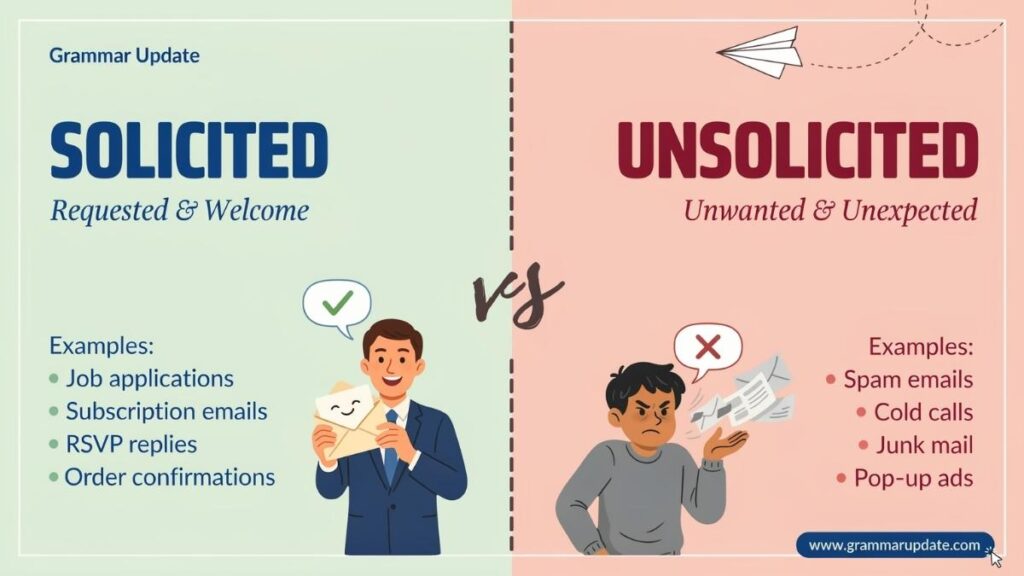
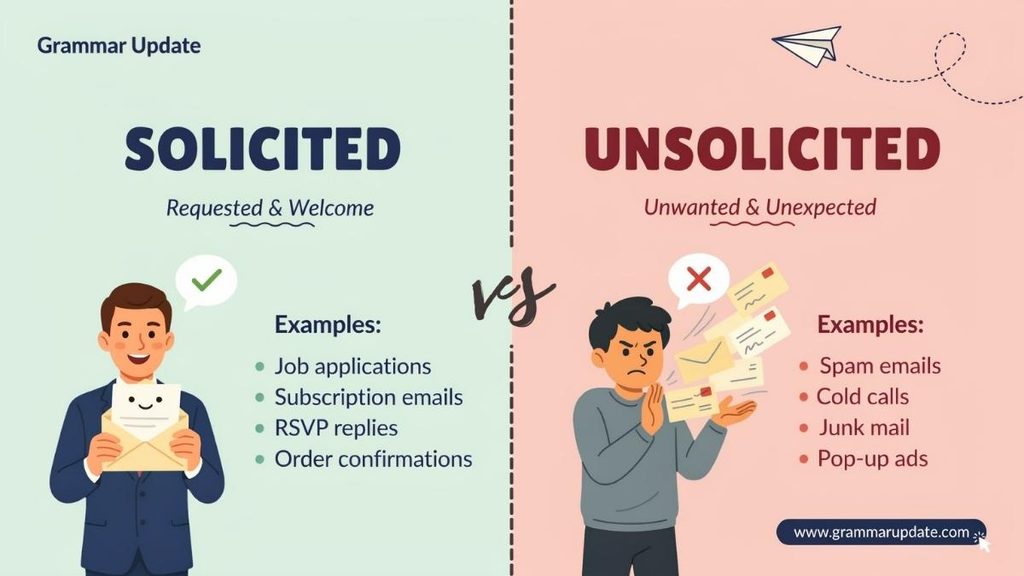
Ever given someone advice and heard, “I didn’t ask for that”? That little moment perfectly captures the difference between solicited vs unsolicited. Although these words sound formal enough for a business meeting, their meanings are surprisingly easy to understand. Solicited means something was requested, invited, or asked for. Unsolicited means it came without anyone asking for it. Still, there’s a catch: unsolicited doesn’t always mean unwanted, just as solicited doesn’t mean useful or correct. In this guide, you’ll learn how to tell these words apart, avoid common grammar mistakes, and use them naturally in conversations, business, proposals, applications, emails, and financial situations.
What Does Solicited Mean?
“Solicited” means requested, invited, sought, or asked for.
It comes from the verb “solicit,” which means to ask for or seek something. The word can appear in casual situations as well as formal business and professional settings.
For example:
- “I solicited feedback from my coworkers.”
- “The company solicited applications for the position.”
- “She solicited advice from her manager.”
- “The client solicited proposals from several vendors.”
In each example, someone actively wanted the other person to provide something.
The word can also function as an adjective.
Consider this sentence:
“The company reviewed all solicited feedback.”
Here, “solicited” describes the feedback because the company requested it.
So, when you ask, “What does solicited mean?” the short answer is: something is solicited when someone has requested, invited, or actively sought it.
Learn the difference between basic English word mistakes
Cocoon vs Cacoon Which one Is Correct?
What Does Unsolicited Mean?
“Unsolicited” means not requested or not invited.
The prefix “un-” helps create the opposite meaning. When something is unsolicited, nobody specifically asked for it before it arrived.
For example:
- “He gave me unsolicited advice.”
- “The company received an unsolicited proposal.”
- “She sent an unsolicited application.”
- “I received an unsolicited message.”
- “The customer received unsolicited information.”
The word often describes things that people offer voluntarily.
However, don’t confuse unsolicited with unwanted. Those words aren’t identical.
Suppose a company receives an unsolicited business idea from a vendor. The company didn’t ask for the idea, but it might find the idea useful.
The proposal was unsolicited. That doesn’t mean the company rejected it.
Solicited vs Unsolicited The Main Difference
The difference between the two words comes down to one question:
Did someone request it?
If the answer is yes, the thing is generally solicited.
If the answer is no, it’s generally unsolicited.
| Solicited | Unsolicited |
|---|---|
| Requested | Not requested |
| Invited | Not invited |
| Asked for | Not asked for |
| Sought | Not sought |
| Usually follows a request | Usually arrives without a request |
Consider two situations.
In the first, a manager asks an employee for feedback about a new project. The employee provides comments. That’s solicited feedback.
In the second, the employee sends a detailed critique even though the manager didn’t ask for one. That’s unsolicited feedback.
The content might be identical. The difference lies in how it started.
Learn the difference between basic English word mistakes
Covenant vs Contract What’s the Difference?
Solicited and Unsolicited Advice
Advice is one of the clearest examples because people use these terms in everyday conversation.
Solicited Advice
Suppose you ask a friend:
“Should I accept this job?”
Your friend gives you an opinion.
That’s solicited advice because you asked for it.
The advice doesn’t have to be correct. It doesn’t even have to be useful. You requested it, so it’s solicited.
Unsolicited Advice
Now imagine you’re telling a friend about your new job when they suddenly say:
“You should quit and find something better.”
You didn’t ask for that opinion.
That’s unsolicited advice.
This phrase often carries a slightly negative or humorous tone because people don’t always appreciate advice they never requested.
Still, the word itself remains neutral. “Unsolicited” tells you that nobody asked for the advice. It doesn’t tell you whether the advice was good.
Learn the difference between basic English word mistakes
Holistic vs Wholistic Which one Is Correct?
Solicited and Unsolicited Feedback
Feedback works in much the same way.
A teacher asks students to evaluate a lesson. The students respond. Their comments are solicited feedback.
A customer voluntarily contacts the company to complain about the same lesson or product without being asked. That response is unsolicited feedback.
The distinction can matter in workplaces, schools, customer service, and research.
For example:
- A manager asks an employee to evaluate a new workplace policy. The response is solicited.
- An employee independently sends the manager suggestions about the policy. The response is unsolicited.
- A company sends customers a survey. The resulting responses are solicited.
- A customer writes a review without receiving a survey or request. The review may be unsolicited.
Again, unsolicited doesn’t mean useless. Sometimes the most valuable feedback is the feedback nobody thought to request.
Yea vs Yeah Which Word Is Correct?
Solicited and Unsolicited Communication
Communication can also fall into these two categories.
Solicited communication occurs when someone has requested or invited the message.
Examples include:
- A customer asks a company for product information.
- A client requests a price quote.
- An employer invites an applicant to contact the hiring team.
- A business asks a vendor to provide more details.
- A subscriber signs up to receive updates.
Unsolicited communication arrives without such a request.
Examples include:
- An unexpected sales message.
- An unrequested business pitch.
- A cold email from a company.
- An unexpected promotional offer.
- A person contacting a business about a potential partnership without an invitation.
An unsolicited email isn’t automatically spam. A legitimate person can send an unexpected email without engaging in spam.
Likewise, an unsolicited message isn’t necessarily inappropriate. Context, purpose, frequency, and the relationship between the sender and recipient all matter.
Learn the difference between basic English word mistakes
Digraph vs Diphthong What’s the Difference?
Solicited vs Unsolicited Proposals
Business proposals provide another useful example.
A solicited proposal responds to a specific request from a client or organization.
An unsolicited proposal comes from a person or company without receiving a specific request.
Solicited Proposal
Imagine a company needs a new website. It sends a request for proposal to several web development firms.
The companies respond with proposals that explain their services, pricing, timeline, experience, and approach.
Those are solicited proposals because the client requested them.
A solicited proposal usually comes with clear requirements. The client may specify exactly what information vendors should provide.
Unsolicited Proposal
Now imagine a web development company notices that a local business has an outdated website.
The development company contacts the business and proposes a complete redesign even though the business hasn’t asked for one.
That’s an unsolicited proposal.
It may be a smart business move. It may even lead to a contract. But the proposal remains unsolicited because the potential client didn’t request it.
Comparing Business Proposals
| Feature | Solicited Proposal | Unsolicited Proposal |
|---|---|---|
| Client request | Yes | No |
| Typical starting point | RFP or invitation | Vendor initiative |
| Requirements | Usually provided | Usually created by the proposer |
| Recipient expectation | Usually expects proposals | May not expect one |
| Main challenge | Meet the stated requirements | Create interest in the idea |
The difference also changes how you write the proposal.
When responding to a request, focus on the client’s stated needs. When making an unsolicited proposal, you first need to explain why the problem matters and why your solution deserves attention.
Learn the difference between basic English word mistakes
Towards vs Toward Which One Is Correct?
Solicited vs Unsolicited Applications
The same concept appears in employment.
A solicited application generally responds to a specific job opening or invitation.
For example, a company advertises a marketing position and asks candidates to apply through its careers page. Someone who applies for that position submits a solicited application.
An unsolicited application takes a different route.
Imagine someone contacts a company and says:
“I’m interested in working with your organization and would like to be considered for future opportunities.”
If the company hasn’t advertised a specific position or invited the application, the application is unsolicited.
This approach can sometimes be described as a speculative application, depending on the context.
The important point is simple:
- Advertised job plus invitation to apply = solicited application.
- No specific opening or invitation = potentially unsolicited application.
Learn the difference between basic English word mistakes
Farther vs Further Differences, Rules and Examples
Solicited vs Unsolicited Offers
An offer can also be solicited or unsolicited.
Suppose you’re buying a car. You ask a dealer:
“What price can you offer me?”
The dealer gives you a price.
That’s a solicited offer because you requested it.
Now imagine the dealer contacts you unexpectedly and says:
“We can give you a special price on this vehicle.”
If you never asked for the offer, it’s unsolicited.
Businesses encounter this distinction all the time. A company might invite vendors to submit pricing, while a vendor might approach the company independently with a commercial offer.
The word “solicited” doesn’t mean the offer is better. The word “unsolicited” doesn’t mean the offer is bad.
The words simply describe how the offer began.
Solicited vs Unsolicited Information
Information can be requested or volunteered too.
Solicited information is information someone asks for.
For example:
“Can you send me the product specifications?”
The specifications become solicited information because the person specifically requested them.
Unsolicited information arrives without such a request.
For example:
“Here are the product specifications in case you need them.”
Nobody asked for them, so the information is unsolicited.
Sometimes unsolicited information is helpful. Sometimes it creates unnecessary clutter. Its value depends on the circumstances rather than on the word “unsolicited” itself.
Learn the difference between basic English word mistakes
Judgment vs Judgement Which one Is Correct?
Solicited vs Unsolicited in Finance
The words take on a more specialized meaning in financial services.
Terms such as solicited trade, unsolicited trade, solicited order, and unsolicited order generally describe how a securities transaction originated.
In broad terms, a solicited transaction involves a broker or financial professional recommending or soliciting the transaction. An unsolicited transaction generally begins with the customer’s own instruction or independent decision.
The distinction can matter when firms document orders and transactions.
However, financial regulation isn’t quite as simple as labeling an order “solicited” or “unsolicited.” The applicable obligations can depend on the security, account, recommendation, customer relationship, and specific circumstances.
What Is a Solicited Trade?
A solicited trade generally occurs when a broker or financial professional recommends or encourages a customer to buy or sell a security and the customer follows that recommendation.
For example:
A broker recommends that a customer purchase shares of a particular company. The customer agrees and places the order.
The broker played a role in initiating the investment idea.
What Is an Unsolicited Trade?
An unsolicited trade generally begins with the customer.
For example:
A customer researches a company independently and tells the broker to buy 100 shares.
If the broker didn’t recommend the security and simply executes the customer’s instruction, the trade may be considered unsolicited.
The key issue is how the transaction originated.
Solicited Order vs Unsolicited Order
The distinction can be summarized simply:
| Term | General meaning |
|---|---|
| Solicited order | An order resulting from broker solicitation or recommendation |
| Unsolicited order | An order initiated independently by the customer |
| Solicited trade | A trade associated with broker solicitation or recommendation |
| Unsolicited trade | A trade initiated by the customer without broker solicitation |
This distinction shouldn’t be treated as a shortcut for deciding who bears responsibility for every aspect of a transaction.
A customer who independently places an order still faces investment risk. A broker still has applicable regulatory responsibilities.
Learn the difference between basic English word mistakes
Practice vs Practise Which one Is Correct?
Solicited and Unsolicited Investment Advice
Investment advice provides another useful distinction.
Suppose an investor asks a financial professional:
“Which investment might fit my objectives?”
The investor requested a recommendation. That makes the advice solicited in the ordinary sense of the word.
Now imagine a financial professional provides an investment recommendation without the investor asking for one.
That recommendation is unsolicited in the ordinary sense.
Financial services rules can become complicated at this point. Whether a particular interaction constitutes investment advice, a recommendation, or another regulated activity depends on the circumstances and applicable rules.
Therefore, the word “unsolicited” alone doesn’t determine the legal consequences.
Are Unsolicited Trades Allowed?
Generally, a customer can place an unsolicited securities order through a broker when the transaction is otherwise permitted.
However, unsolicited doesn’t mean risk-free.
A customer-initiated trade can still involve:
- Market risk.
- Price volatility.
- Liquidity risk.
- Concentration risk.
- Loss of principal.
- Lack of diversification.
- Limited understanding of the security.
- Poor timing.
Calling an order unsolicited describes its origin. It doesn’t describe whether the investment is safe.
Similarly, an unsolicited order doesn’t automatically eliminate every obligation a broker or financial firm may have.
Learn the difference between basic English word mistakes
HAVC vs HVAC? Which one Is Correct?
Common Mistakes With Solicited and Unsolicited
These words cause a few predictable misunderstandings.
Unsolicited Does Not Mean Unwanted
Something can be unsolicited without being unwanted.
For example, a company may receive an unsolicited business idea and decide that the idea is excellent.
Nobody asked for it. The company still wants it.
Solicited Does Not Mean Good
A person can ask for advice and receive terrible advice.
The advice remains solicited because someone requested it.
The words describe the request, not the quality.
Not Every Unexpected Email Is Spam
An unsolicited email is simply an email that the recipient didn’t request.
Spam involves additional characteristics. The two terms shouldn’t be treated as exact synonyms.
Solicited and Soliciting Are Different
“Solicit” is the base verb.
“Soliciting” describes the act of asking or seeking.
“Solicited” can describe something that someone requested or can function as the past tense of “solicit.”
“Solicitation” is the noun form.
For example:
“The company solicited feedback from customers.”
But:
“The company received unsolicited feedback.”
The first sentence describes an active request. The second describes feedback that arrived without one.
Learn the difference between basic English word mistakes
Deceive vs Decieve Which one Is Correct?
Solicited vs Unsolicited Grammar
Understanding the word forms makes these terms much easier to use.
| Word | Function | Meaning |
|---|---|---|
| Solicit | Verb | Ask for or seek |
| Solicited | Verb/adjective | Requested or sought |
| Soliciting | Verb form | Actively asking or seeking |
| Solicitation | Noun | The act of soliciting |
| Unsolicited | Adjective | Not requested |
“unsolicited” describes feedback that nobody requested.
Solicited vs Unsolicited Examples
The quickest way to test your understanding is to compare the situations.
Solicited Examples
- “I asked my brother for advice.”
- “The company requested customer feedback.”
- “The client invited vendors to submit proposals.”
- “The employer advertised the position and invited applications.”
- “The customer asked for more information.”
- “The investor requested an explanation of the investment.”
- “The broker recommended the security before the customer placed the order.”
Unsolicited Examples
- “My neighbor gave me unsolicited advice.”
- “The company received an unsolicited proposal.”
- “She submitted an unsolicited application.”
- “The vendor made an unsolicited offer.”
- “I received an unsolicited email.”
- “The customer sent unsolicited feedback.”
- “The investor independently instructed the broker to purchase the stock.”
Learn the difference between basic English word mistakes
Caribbean vs Carribean Which one Is Correct?
A Simple Way to Remember Solicited and Unsolicited
When you’re unsure which word to use, imagine a simple conversation.
Person A says:
“Can you help me?”
Person B responds:
“Sure.”
The help is solicited.
Now imagine Person B walks over and starts helping without being asked.
The help is unsolicited.
That’s the whole idea.
You can apply the same test to advice, information, proposals, applications, offers, emails, messages, and many financial transactions.
Ask yourself:
“Did someone request or invite this?”
If yes, “solicited” is usually the right word.
If no, “unsolicited” is usually the right word.
Quick Reference
| Situation | Solicited | Unsolicited |
|---|---|---|
| Advice | Asked-for advice | Unasked-for advice |
| Feedback | Requested feedback | Volunteered feedback |
| Proposal | Client-requested proposal | Independently submitted proposal |
| Application | Response to an advertised job | Application sent without a specific opening |
| Offer | Requested offer | Unexpected offer |
| Information | Requested information | Unrequested information |
| Requested communication | Unexpected communication | |
| Trade | Generally broker-recommended | Generally customer-initiated |
| Order | Generally follows solicitation | Generally independently initiated |
Learn the difference between basic English word mistakes
Diverse vs Divers Difference and which is correct?
Practice Session Solicited vs Unsolicited
Fill in each blank with the correct word or phrase: solicited or unsolicited.
Fill in the Blanks
- Maria asked her manager for career advice, so the advice was __________.
- Jake gave his coworker __________ advice about how to dress for an interview, even though nobody asked.
- The company asked customers to complete a survey, so the responses were __________.
- A vendor sent a business proposal without receiving a request from the company. The proposal was __________.
- The client invited several companies to submit bids. The resulting proposals were __________.
- Sarah received an __________ email from a company she had never contacted.
- The customer requested detailed information about the product. The information was __________.
- Tom offered his opinion about the project without being asked. His opinion was __________.
- The employer advertised a position and invited qualified candidates to apply. The applications were __________.
- An applicant contacted a company about possible work even though the company had not advertised an opening. The application was __________.
- The investor asked the financial advisor for an investment recommendation. The recommendation was __________.
- A broker recommended that a customer purchase a particular security. The resulting trade may be described as a __________ trade.
- A customer independently instructed a broker to purchase shares without receiving a recommendation. The trade may be described as an __________ trade.
- The manager specifically requested employee comments about the new policy. The comments were __________ feedback.
- An employee voluntarily sent criticism about a policy that the manager had not asked about. The criticism was __________ feedback.
- The customer asked the dealer for a price quote. The resulting offer was __________.
- A salesperson contacted a potential customer with an offer that the customer had never requested. It was an __________ offer.
- The organization issued a request for proposal before vendors submitted their bids. The proposals were __________.
- Someone sent a detailed message without the recipient requesting any information. It was an __________ message.
- The company asked a researcher to provide specific information. The resulting information was __________ information.
Answers
- Solicited
- Unsolicited
- Solicited
- Unsolicited
- Solicited
- Unsolicited
- Solicited
- Unsolicited
- Solicited
- Unsolicited
- Solicited
- Solicited
- Unsolicited
- Solicited
- Unsolicited
- Solicited
- Unsolicited
- Solicited
- Unsolicited
- Solicited
Here’s a trusted source for clear word meanings:
FAQs
What does solicited mean in a sentence?
Solicited means requested or asked for. For example, “The manager requested her employee’s opinion, so the feedback was solicited.”
Does solicited always mean requested directly?
Not necessarily. Something can be solicited through a formal invitation, an open request, or an established process. The key point is that the person or organization invited or sought the response.
Does unsolicited always have a negative meaning?
No. Unsolicited simply means something was not requested. An unsolicited suggestion, offer, or piece of information can still be useful or welcome.
Can advice be both solicited and unsolicited?
Not in the same situation. Advice is solicited when someone asks for it. It is unsolicited when someone offers it without being asked.
Can feedback be unsolicited but still valuable?
Yes. Unsolicited feedback can provide useful information that the recipient hadn’t considered requesting. Its value depends on its accuracy, relevance, and usefulness rather than whether someone requested it.
How can you remember the difference between solicited and unsolicited?
Use the word “request” as your shortcut. If someone requested or invited something, it is solicited. If it arrived without a request, it is unsolicited.
Is “unrequested” the same as “unsolicited”?
They are close in meaning, but “unsolicited” often sounds more natural when describing advice, proposals, offers, communications, applications, or information. “Unrequested” simply emphasizes that nobody asked for something.
Is solicited a positive word?
“Solicited” is generally neutral. It indicates that someone requested or invited something. It doesn’t tell you whether the result was good, bad, useful, or successful.
Is unsolicited a negative word?
Not inherently. “Unsolicited” is also neutral in its literal meaning. However, it can sound negative in expressions such as “unsolicited advice” because people sometimes view unrequested opinions as intrusive.
Can a gift be unsolicited?
Yes. If someone gives you a gift without you requesting it, the gift is unsolicited. That doesn’t mean you don’t appreciate it.
What is a solicited response?
A solicited response is an answer or reaction provided because someone specifically requested it. Surveys, interviews, questionnaires, and requests for comments commonly produce solicited responses.
What is an unsolicited response?
An unsolicited response is a reply or reaction that someone provides without being specifically asked for it. For example, a customer might voluntarily send comments to a company without receiving a feedback request.
What is the difference between a request and a solicitation?
A request is a general act of asking for something. A solicitation is also a request but often carries a more formal or purposeful sense of seeking something, particularly in business, fundraising, sales, or professional settings.
Can a business receive an unsolicited proposal?
Yes. A vendor or other organization can approach a business with a proposal even when the business hasn’t issued a request for proposals. The proposal is unsolicited because the recipient didn’t specifically ask for it.
Can an unsolicited proposal become a solicited proposal later?
Yes. A proposal can begin as unsolicited and later lead to a formal request. Once the potential client specifically invites a proposal, subsequent submissions may become solicited.
Is a cold email considered unsolicited communication?
Usually, yes, if the recipient didn’t request the email or invite the sender to contact them. Whether it qualifies as spam or violates a particular rule depends on additional circumstances.
What makes an application unsolicited?
An application is generally unsolicited when a person applies to an organization without responding to a specific advertised position or invitation to apply. The applicant takes the initiative rather than responding to an existing recruitment request.
What makes an offer unsolicited?
An offer is unsolicited when someone presents it without the recipient first asking for that particular offer. A company approaching a potential customer with a sales offer is a common example.
Can an unsolicited offer still be legitimate?
Yes. “Unsolicited” describes how the offer originated. It doesn’t determine whether the offer is legitimate, valuable, or trustworthy. You should evaluate the actual terms and the person or organization making the offer.
Why do businesses distinguish between solicited and unsolicited proposals?
The distinction helps businesses understand how an opportunity originated. A solicited proposal normally responds to defined requirements, while an unsolicited proposal requires the proposer to establish the need, value, and business case.
Is unsolicited communication always illegal?
No. Whether unsolicited communication is lawful depends on the type of communication, the parties involved, the jurisdiction, and applicable rules. The word “unsolicited” alone doesn’t establish illegality.
Can a customer initiate an unsolicited transaction?
Yes. In financial contexts, a customer can generally initiate a transaction independently. Whether a transaction qualifies as unsolicited depends on the facts surrounding the recommendation and order.
Why does the solicited or unsolicited distinction matter in finance?
It can help establish how an investment idea or transaction originated. Financial firms may need to document whether a recommendation or customer instruction led to a transaction, while the specific regulatory consequences depend on the circumstances and applicable rules.
Does an unsolicited transaction remove all broker responsibilities?
No. An unsolicited transaction doesn’t automatically eliminate every obligation a broker or financial firm may have. Applicable rules can still cover areas such as order handling, supervision, disclosures, recordkeeping, and other regulatory requirements.
Can the same transaction be described differently depending on the circumstances?
Yes. The classification depends on how the transaction originated and what occurred between the customer and financial professional. A broker’s recommendation can create a very different context from an independent customer instruction.
Conclusion
The difference between solicited vs unsolicited becomes much easier once you ask one simple question: “Did someone ask for it?” If the answer is yes, it’s solicited. If the answer is no, it’s unsolicited. No grammar detective required.
Keep in mind that unsolicited doesn’t automatically mean unwanted or useless. An unexpected suggestion could be exactly what someone needed. On the other hand, solicited advice isn’t automatically good just because someone asked for it.
Whether you’re discussing advice, feedback, emails, proposals, job applications, offers, or financial transactions, the same basic rule applies. If someone requested it, use solicited. If it arrived without a request, use unsolicited. Once you remember that distinction, these two words become much easier to use correctly—and far less likely to cause a grammatical headache.

Jhon AJS, the creative mind behind Grammar Update, is an experienced blogger passionate about simplifying English grammar. He focuses on explaining confusing word vs word differences, grammar rules, punctuation, and sentence structure in a clear and practical way. Through easy to understand guides and examples, Jhon helps readers improve their writing and communicate with confidence. With years of blogging experience, he continues to share helpful insights that make learning grammar simple, useful, and accessible for everyone.