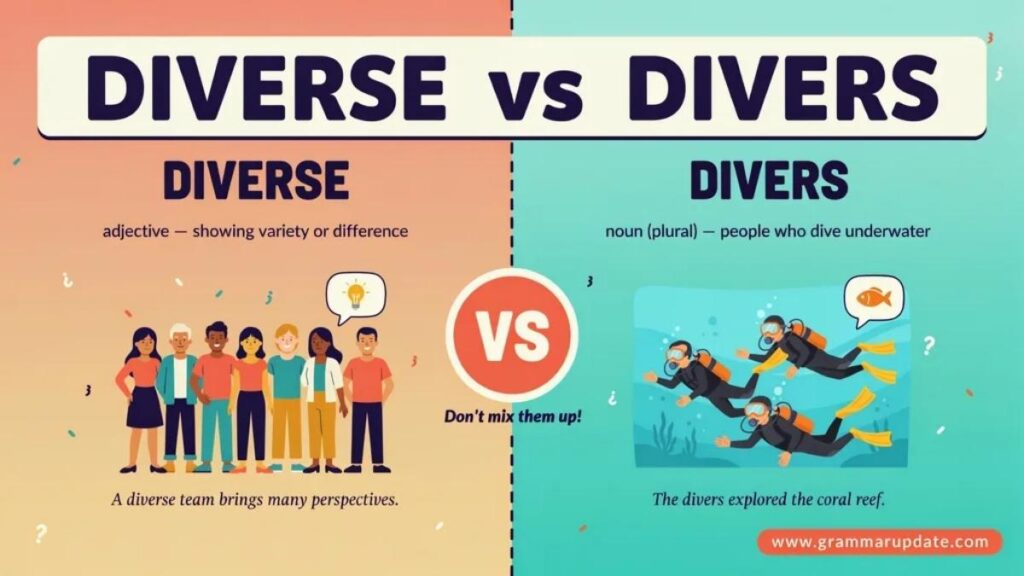
The words diverse vs divers look almost identical, but their meanings can send a sentence in completely different directions. Diverse means varied, different, or made up of different types. Divers usually means people who dive. Here’s where things get tricky: in older English, divers could also mean “various” or “several.” That history can make this pair surprisingly confusing, especially when you come across it in older books or formal writing. Don’t worry. This guide clears up the confusion with simple explanations, clear examples, and practical grammar tips. By the end, you’ll know exactly when to use diverse and divers without second-guessing your word choice.
Diverse vs Divers Quick Answer
The easiest way to remember the difference is this:
- Diverse is a modern adjective meaning varied, different, or made up of different kinds.
- Divers is usually the plural noun of diver, meaning more than one person who dives.
- Divers can also work as an old-fashioned adjective meaning various or several.
Compare these examples:
| Word | Meaning | Example |
|---|---|---|
| Diverse | Varied or different | The university has a diverse student population. |
| Divers | More than one diver | The divers explored the reef. |
| Divers | Various or several in older English | The document discusses divers subjects. |
So, diverse vs divers isn’t simply a spelling issue. The two words have different meanings and grammatical functions in modern English.
If you mean “different kinds,” choose diverse. If you mean “people who dive,” choose divers.
Learn the difference between tricky grammar more words
Unfazed vs Unphased difference and which one is correct?
Diverse vs Divers Meaning What Does Diverse Mean?
Diverse definition
The diverse definition is simple: diverse means very different from one another or made up of different kinds.
For example, a diverse group contains people with different backgrounds, experiences, skills, opinions, or characteristics. A diverse collection contains different types of objects or works.
Consider these sentences:
The city has a diverse population.
The library has a diverse collection of books.
The team brings together people with diverse skills.
In each sentence, diverse describes variety.
The word doesn’t mean that every single item or person must differ from every other one. Instead, it highlights the presence of meaningful differences within a group or collection.
What does diverse mean in English?
What does diverse mean? In modern English, it generally means varied, different, or consisting of many different types.
For example:
The museum has a diverse collection of paintings.
This tells you that the collection includes different types of paintings. Perhaps they come from different periods, artists, styles, or cultures.
The same idea applies to people:
The company has a diverse workforce.
Here, diverse describes the variety within the workforce. The exact differences depend on the context.
Diverse meaning and usage
The diverse meaning and usage extends far beyond discussions about people and culture.
You can describe:
- diverse interests
- diverse opinions
- diverse cultures
- diverse species
- diverse landscapes
- diverse industries
- diverse skills
- diverse traditions
- diverse sources
- diverse approaches
- diverse perspectives
For example:
Her diverse interests include astronomy, photography, cooking, and history.
The sentence emphasizes the wide range of things she enjoys.
Likewise:
The region supports diverse wildlife.
Here, diverse means that the region contains many different kinds of wildlife.
Divers Meaning What Does Divers Mean?
The word divers has two separate uses. That’s where things get interesting.
Divers definition as a plural noun
In everyday modern English, divers is commonly the plural form of diver.
A diver is someone who dives. Depending on the context, that person might dive underwater for recreation, work, research, rescue operations, or competition.
For example:
One diver entered the water.
The plural version becomes:
Three divers entered the water.
Here, divers is simply a plural noun.
You might see it in sentences such as:
The divers checked their equipment.
Several divers explored the underwater cave.
Rescue divers searched the lake.
The scuba divers returned to the boat.
Professional divers trained for the competition.
This is the most important modern use of divers.
Divers as an old-fashioned adjective
There is another use that modern readers encounter far less often.
Divers can also function as an adjective meaning various, several, or of different kinds. This use belongs mainly to older English and can sound archaic or old-fashioned today.
For example:
The document mentions divers subjects.
In modern English, you would normally write:
The document mentions various subjects.
Another example is:
The writer gave divers reasons for his decision.
A modern version would be:
The writer gave several reasons for his decision.
The older form isn’t necessarily grammatically incorrect. It simply doesn’t sound natural in most contemporary American English.
Learn the difference between tricky grammar more words
Favour vs Favor Which Spelling Is Correct?
Difference Between Diverse and Divers
The difference between diverse and divers becomes much clearer when you look at their grammatical roles.
| Feature | Diverse | Divers |
|---|---|---|
| Main modern role | Adjective | Plural noun |
| Additional role | None commonly used | Old-fashioned adjective |
| Modern meaning | Varied or different | More than one diver |
| Older adjective meaning | — | Various or several |
| Common modern use | Very common | Common as a noun |
| Adjective use today | Standard | Rare and old-fashioned |
| Example | a diverse population | several divers |
| Meaning involving variety | Yes | Only in the old adjective sense |
The key difference is context.
Consider:
The school has a diverse curriculum.
Here, diverse describes the curriculum. It tells you that the curriculum includes a variety of subjects.
Now compare:
The school hired several divers.
Here, divers refers to people who dive.
One word describes variety. The other identifies people.
That’s the central difference between diverse and divers.
Learn the difference between tricky grammar more words
Of vs Off difference and which one is correct?
Diverse vs Divers Grammar and Parts of Speech
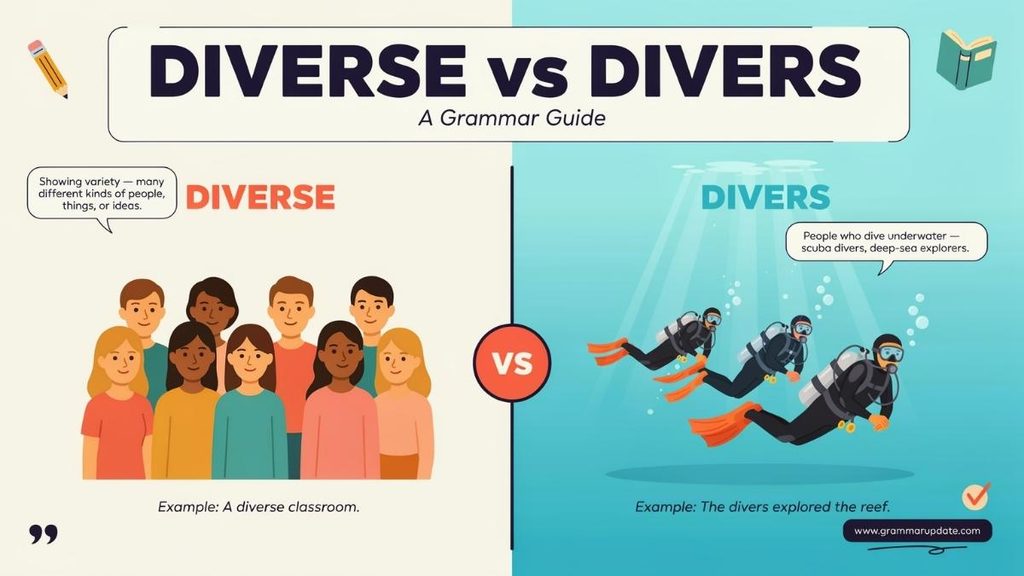
Grammar gives you another reliable way to tell these words apart.
Diverse is an adjective
Diverse normally functions as an adjective.
It can modify a noun:
a diverse group
diverse opinions
diverse cultures
diverse interests
It can also follow a linking verb:
The population is diverse.
Her interests are diverse.
In each case, the word describes the subject’s variety or differences.
Divers is a plural noun
In modern English, divers often functions as a plural noun.
The divers surfaced after twenty minutes.
The word identifies more than one person who dives.
You can think of the relationship this way:
diver → divers
Just as:
swimmer → swimmers
and:
runner → runners
The spelling is completely normal. Nothing archaic is happening here.
Divers can also be an old-use adjective
The older adjective divers works differently:
divers subjects
divers reasons
divers occasions
In these examples, divers appears before a noun and means various or several.
For a modern reader, however, various or several will usually sound much more natural.
Learn the difference between tricky grammar more words
Invokes vs Evokes which one is correct?
Diverse vs Divers Usage in Modern English
The diverse vs divers usage distinction becomes especially important when you’re writing for a modern audience.
1.Use diverse when you’re describing variety:
The conference attracted a diverse audience.
2.Use divers when you’re talking about people who dive:
The divers inspected the damaged vessel.
3.Use the adjective divers mainly when you’re discussing older English or deliberately using an archaic style:
The historical document refers to divers occasions.
A modern writer would usually say:
The historical document refers to several occasions.
The meaning stays almost the same. The word choice simply becomes clearer and more natural.
When to use diverse vs divers
Ask yourself one question:
What does the sentence need to describe?
1.If it needs an adjective meaning varied, choose diverse.
2.If it needs a plural noun meaning people who dive, choose divers.
3.If you’re reading an old document and see divers before a noun, don’t assume it’s a spelling mistake. It may be using the older meaning of various or several.
Learn the difference between tricky grammar more words
Poopie vs Poopy difference and Which Is Correct
Why Do People Confuse Diverse and Divers?
The confusion is easy to understand. The words look almost identical.
Diverse
Divers
Only the final e separates them.
But spelling isn’t the only reason people mix them up. The words also have a historical connection, and their older meanings overlap.
The older word divers was used with the sense of various or different. Over time, diverse became the normal modern adjective for describing variety, while divers developed and retained its everyday noun use as the plural of diver.
That’s why you might see divers in an old text and wonder whether the writer meant diverse.
In modern English, the distinction is much stronger:
diverse → varied or different
divers → people who dive
The older adjective sense of divers still exists, but it mostly belongs to historical, archaic, or deliberately old-fashioned writing.
Diverse vs Divers Pronunciation
Pronunciation can add another layer to the diverse vs divers pronunciation question.
Diverse pronunciation
Diverse has more than one pronunciation in American English. You may hear it pronounced with either a short or long first vowel sound.
Common American pronunciations include:
- di-VURSS
- dye-VURSS
Both pronunciations occur in standard American English.
So, don’t assume that one pronunciation automatically makes a speaker correct or incorrect.
Divers pronunciation
Divers can also vary somewhat depending on its grammatical use and the speaker’s accent.
When divers means people who dive, its pronunciation follows the word diver in the plural.
The old adjective divers can have a pronunciation that sounds different from what some readers expect.
The important point is that pronunciation doesn’t usually cause the main confusion. Context does.
Learn the difference between commonly mixed-up more words
Sleeve vs Sleave difference and Which Is Correct?
Diverse Definition and Examples
The best way to understand the diverse definition and examples is to see the word in several situations.
Diverse examples involving people
The organization has a diverse team with experience in engineering, design, and marketing.
The city attracts a diverse population from around the world.
A diverse group of students joined the discussion.
These examples all describe variety within a group of people.
Diverse examples involving ideas
The researchers considered diverse perspectives before reaching a conclusion.
The committee received diverse opinions about the proposal.
The book presents diverse interpretations of the historical event.
Here, diverse describes differences in thought rather than differences between people.
Diverse examples involving things
The store sells a diverse range of products.
The island has diverse plant life.
The festival features diverse musical traditions.
In these examples, diverse highlights different types within a larger category.
Diverse in a sentence
Here are several natural diverse in a sentence examples:
The university offers a diverse selection of courses.
Her diverse interests make every conversation interesting.
The region has a diverse economy.
The research team includes people with diverse professional backgrounds.
The library contains a diverse collection of books.
In every example, diverse points to variety.
Learn the difference between commonly mixed-up more words
Buoyant vs Bouyant Which one Is Correct?
Divers Definition and Examples
The divers definition and examples require a little more care because the word has two meanings.
Divers as people who dive
The divers descended into the clear water.
Several divers examined the shipwreck.
The scuba divers surfaced before sunset.
Rescue divers searched the area.
The professional divers practiced their routines.
Here, divers means more than one diver.
These are completely ordinary examples of modern English vocabulary.
Divers as an old adjective
Historical English may use divers before a noun:
The writer mentioned divers reasons for his decision.
Today, a writer would normally say:
The writer mentioned various reasons for his decision.
Another example:
The records contain references to divers occasions.
A modern version would be:
The records contain references to several occasions.
This older use can still appear in historical documents, legal texts, older literature, or writing that intentionally imitates an earlier style.
Does Divers Mean Several or Various?
Can divers mean several?
Yes.
Can divers mean various?
Yes.
But there’s an important qualification.
When divers means several or various, it functions as an old-fashioned adjective. In modern English, you would normally use several, various, or different instead.
For example:
The author mentioned divers reasons.
Modern English:
The author mentioned several reasons.
Or:
The author mentioned various reasons.
The older word isn’t wrong simply because it sounds unusual. It belongs to an older form of English that most modern readers don’t use in everyday writing.
What does “on divers occasions” mean?
What does “on divers occasions” mean?
It means on several occasions or on various occasions.
For example:
The witnesses had met on divers occasions.
A modern writer would probably say:
The witnesses had met on several occasions.
The expression may look strange today, but its meaning becomes clear once you recognize the older use of divers.
Learn the difference between commonly mixed-up more words
Height vs Hight difference and Which one Is Correct?
Diverse vs Divers Synonyms
The diverse vs divers synonyms also show how different the two words are.
Diverse synonyms
Depending on context, diverse synonyms include:
- varied
- different
- assorted
- mixed
- multifaceted
- heterogeneous
- wide-ranging
- manifold
These words aren’t interchangeable in every sentence.
For example, heterogeneous is more technical than diverse. Assorted often works well when discussing objects. Wide-ranging emphasizes breadth.
So, choose the synonym that matches your exact meaning.
Divers synonyms
When divers means people who dive, possible alternatives include:
- scuba divers
- underwater swimmers
- deep-sea divers
- professional divers
- rescue divers
The best choice depends on the situation.
When the old adjective divers means several or various, suitable alternatives include:
- several
- various
- different
- many
- numerous
- assorted
Again, context matters.
Learn the difference between commonly mixed-up more words
Camouflage Vs Camoflage Which one Is Correct?
Diverse vs Divers Common Mistakes
Using divers when you mean diverse
Incorrect:
The company has a divers workforce.
Correct:
The company has a diverse workforce.
The word workforce needs an adjective describing its variety. Diverse fits perfectly.
Treating divers as a shorter spelling of diverse
Divers isn’t simply a shortened version of diverse.
Compare:
diverse opinions
with:
divers opinions
The first is normal modern English. The second is an old-fashioned construction meaning something like various opinions.
Assuming divers is always wrong
That’s another common mistake.
This sentence is completely correct:
The divers returned to the boat.
Here, divers is the plural noun of diver.
Changing it to diverse would destroy the meaning:
The diverse returned to the boat.
That sentence doesn’t work because diverse is an adjective, not the plural noun of diver.
Assuming every old use of divers is a mistake
If you encounter:
on divers occasions
in an old book or historical document, don’t automatically mark it as an error.
The writer may be using the older adjective meaning several or various.
Learn the difference between commonly mixed-up more words
To Small vs Too Small Which one Is Correct?
Diverse vs Divers Real Sentence Fixes
The quickest way to understand diverse vs divers usage is to compare sentences.
| Confusing sentence | Better sentence | Explanation |
|---|---|---|
| The company has a divers workforce. | The company has a diverse workforce. | Diverse describes variety. |
| The school welcomes divers students. | The school welcomes diverse students. | Diverse is the modern adjective. |
| The divers explored the reef. | The divers explored the reef. | Divers correctly refers to people who dive. |
| The researchers considered divers viewpoints. | The researchers considered diverse viewpoints. | Diverse describes different viewpoints. |
| The divers entered the cave. | The divers entered the cave. | Divers is the plural of diver. |
| The contract mentions divers matters. | The contract mentions various matters. | Divers here has an old-fashioned adjective use. |
These examples show why spelling alone won’t solve the problem. Meaning and grammar must work together.
Diverse vs Divers in Professional and Academic Writing
Modern professional and academic writing usually favors diverse when the writer means varied or different.
For example:
The study included participants from diverse backgrounds.
The report examines diverse approaches to the problem.
The university supports a diverse academic community.
These sentences sound natural because diverse remains a common part of modern English.
Now consider:
The study included participants from divers backgrounds.
A reader can probably work out what the sentence means, but it sounds outdated.
In contemporary writing, clarity usually wins.
Choose:
- diverse when you mean varied
- various when you mean different kinds or categories
- several when you mean more than two but don’t need an exact number
- different when emphasizing contrast
- divers when referring to people who dive
Is Divers Formal or Informal?
Is divers formal English?
The answer depends on which meaning you’re using.
As the plural noun of diver, divers is standard English:
The divers surfaced safely.
There’s nothing formal or informal about it. It’s simply the correct plural.
As an adjective meaning various or several, divers is old-fashioned.
That distinction is worth remembering because unusual vocabulary can sometimes look more formal than it really is.
A sentence such as:
The parties entered into divers agreements.
sounds legal or highly formal.
But modern English would usually say:
The parties entered into several agreements.
The simpler version communicates the same idea without making the reader wrestle with an old-fashioned word.
Is Divers a Real Word?
Is divers a real word?
Absolutely.
It has two legitimate uses.
As a modern plural noun:
The divers entered the water.
As an older adjective:
The writer referred to divers matters.
The important question isn’t whether divers is a real word. It is.
The important question is which meaning the context requires.
Is Divers an Archaic Word?
Is divers an archaic word?
Not entirely.
The plural noun divers remains completely normal in modern English:
The divers returned safely.
The adjective divers meaning various or several is the part that sounds archaic or old-fashioned.
So, saying that “divers” is always archaic would be inaccurate.
Its grammatical role matters.
Learn the difference between commonly mixed-up more words
Taylored vs Tailored Which one Is Correct?
Practice Session Diverse vs Divers
Fill in each blank with either diverse vs divers. Use the context to choose the correct word.
- The university has a ______ student population with people from many different backgrounds.
- The ______ explored the underwater cave for nearly two hours.
- The company encourages employees to share ______ ideas and perspectives.
- Several professional ______ participated in the underwater rescue.
- The museum displays a ______ collection of paintings from different periods.
- The ______ carefully checked their equipment before entering the water.
- The city is known for its ______ cultures, traditions, and languages.
- The research team includes scientists with ______ areas of expertise.
- The scuba ______ returned to the boat before sunset.
- The organization serves a ______ group of customers.
- The oceanographers worked with experienced ______ during the expedition.
- The library contains a ______ range of books and other resources.
- The company benefits from having employees with ______ skills and experiences.
- The rescue team sent several ______ into the flooded tunnel.
- The festival celebrates the ______ musical traditions of the region.
- The ______ searched the shipwreck for signs of damage.
- The school offers students a ______ selection of courses.
- The marine researchers observed several ______ swimming near the reef.
- The committee considered ______ opinions before making its decision.
- The professional ______ trained for several weeks before the expedition.
- The region has a ______ ecosystem containing many types of plants and animals.
- The ______ surfaced after completing their underwater survey.
- The company attracts people with ______ professional backgrounds.
- The underwater photographers worked alongside several experienced ______.
- The conference brought together a ______ group of researchers, educators, and industry professionals.
Answers
- diverse
- divers
- diverse
- divers
- diverse
- divers
- diverse
- diverse
- divers
- diverse
- divers
- diverse
- diverse
- divers
- diverse
- divers
- diverse
- divers
- diverse
- divers
- diverse
- divers
- diverse
- divers
- diverse
Here’s a trusted source for clear word meanings:
FAQs
What is the difference between “divers” and “diverse”?
“Diverse” is a modern adjective meaning varied, different, or made up of different types. “Divers” usually refers to more than one person who dives. In older English, “divers” could also mean “various” or “several.”
Is “divers” the same as “diverse”?
No. Although the words look similar and share a historical connection, they have different uses in modern English. Use “diverse” for variety and “divers” for people who dive.
What does “divers” mean?
“Divers” usually means more than one diver. For example, “The divers explored the cave.” In older English, “divers” could also mean “various” or “several.”
Is “divers” a real word?
Yes. “Divers” is a standard English word. It is the plural of “diver,” and it also has an older adjective use meaning “various” or “several.”
Is “divers” an old-fashioned word?
Only one of its uses is old-fashioned. “Divers” remains completely normal when it means more than one diver. Its adjective meaning “various” or “several” is the older, less common use.
What did “divers” mean in Old English?
In older forms of English, “divers” could mean “various,” “several,” or “different.” This meaning appears in older literature, historical documents, and religious texts. It should not be confused with the modern plural noun “divers,” meaning people who dive.
What does “divers” mean in the Bible?
In older English Bible translations, “divers” often means “various,” “different,” or “several.” The meaning depends on the phrase and surrounding context. It usually doesn’t refer to people who dive.
What are “divers temptations” in the Bible?
“Divers temptations” means “various trials” or “different kinds of trials.” Here, “divers” uses its older adjective meaning rather than referring to underwater divers.
What does “divers manners” mean in the Bible?
“Divers manners” means “various ways” or “different ways.” This wording reflects older English usage, where “divers” could function as an adjective meaning “various.”
What does “divers” mean in the King James Bible?
In the King James Bible, “divers” generally means “various,” “several,” or “different kinds of,” depending on the passage. Modern readers may find the word confusing because its most familiar meaning today is the plural of “diver.”
What is the archaic meaning of “divers”?
The archaic meaning of “divers” is “various,” “several,” or “of different kinds.” Modern English normally uses words such as “various,” “several,” or “different” instead.
Can “divers” mean “several”?
Yes. In its older adjective use, “divers” can mean “several.” For example, “divers occasions” means “several occasions.”
Can “divers” mean “various”?
Yes. “Divers” can mean “various” when it functions as an old-fashioned adjective. In contemporary English, “various” is usually the clearer choice.
What does “on divers occasions” mean?
“On divers occasions” means “on several occasions” or “on various occasions.” The phrase comes from older English and may appear in historical, religious, or legal writing.
What is the plural of “diver”?
The plural of “diver” is “divers.”
For example:
One diver entered the water.
Several divers entered the water.
Who is called a diver?
A diver is someone who dives into or underwater. The term can describe recreational scuba divers, professional underwater workers, competitive divers, rescue divers, and other people who dive.
What does it mean to be a diver?
Being a diver means participating in an activity that involves diving. Depending on the context, a diver might use scuba equipment, dive competitively, work underwater, conduct research, or perform rescue operations.
What is another word for “divers”?
If “divers” means people who dive, possible alternatives include “scuba divers,” “professional divers,” “rescue divers,” or “underwater divers,” depending on the context. If “divers” means “various,” use “various,” “several,” or “different.”
What is a better word for “diverse”?
Depending on the sentence, simple alternatives include “varied,” “different,” “mixed,” “various,” or “wide-ranging.” The best synonym depends on exactly what kind of variety you want to express.
What does “diverse” mean in simple words?
“Diverse” means “different kinds of” or “having a lot of variety.”
For example:
The school has a diverse student population.
This means the students come from different backgrounds or have different characteristics.
What is the difference between “diverse” and “various”?
Both words can describe variety, but they don’t always carry the same emphasis. “Diverse” often highlights differences within a group or range, while “various” commonly means several different items or types.
What should you use: “diverse” or “divers”?
Use “diverse” when you mean varied or different:
The company has a diverse workforce.
Use “divers” when you mean more than one person who dives:
The divers entered the water.
Conclusion
The diverse vs divers confusion is a perfect example of how one small spelling difference can change the whole meaning of a sentence. Diverse means varied, different, or made up of different types. Divers usually means more than one person who dives. However, older English sometimes used divers to mean “various” or “several,” which is why you may see phrases such as “on divers occasions” in older books or religious texts.
The easiest way to remember the difference is simple: use diverse when you mean variety and divers when you mean people who dive. If you come across divers in an older sentence, check the context before assuming it’s a mistake. Once you understand the meaning and grammatical role of each word, choosing between diverse and divers becomes straightforward.

Jhon AJS, the creative mind behind Grammar Update, is an experienced blogger passionate about simplifying English grammar. He focuses on explaining confusing word vs word differences, grammar rules, punctuation, and sentence structure in a clear and practical way. Through easy to understand guides and examples, Jhon helps readers improve their writing and communicate with confidence. With years of blogging experience, he continues to share helpful insights that make learning grammar simple, useful, and accessible for everyone.