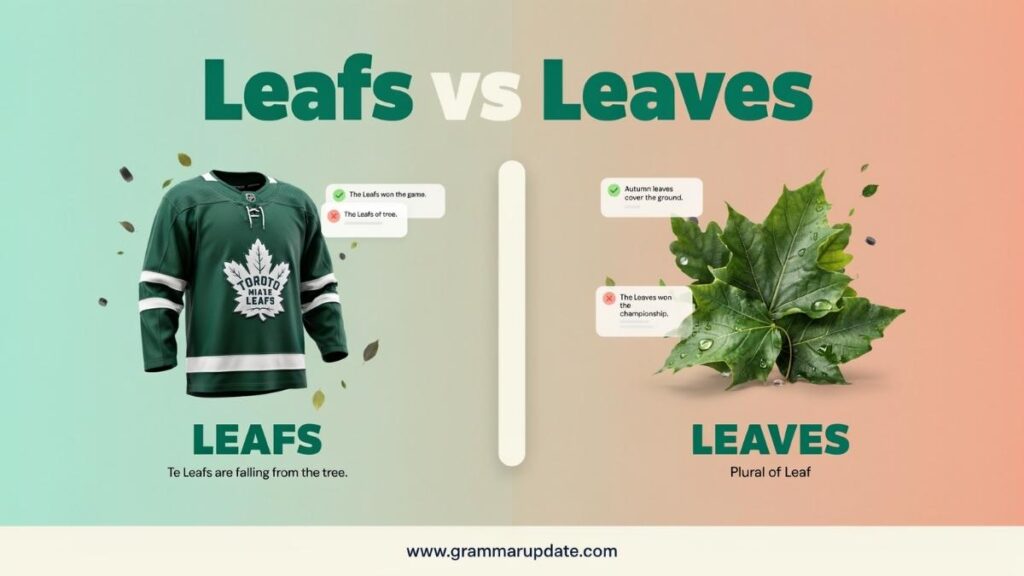
Have you ever wondered whether to write “leafs vs leaves”? You’re not alone! English spelling can be confusing, and these two words are a perfect example. They look similar, but using the wrong one can turn a simple sentence into a grammar mistake. The good news is that the difference between “Leafs vs Leaves” is easy to understand once you know the rule. “Leaves” is the plural of “leaf,” while “leafs” is used as a verb and appears in the name of the Toronto Maple Leafs hockey team. In this guide, you’ll learn the difference, avoid common mistakes, and use both words with confidence.
Quick Comparison
| Word or phrase | Meaning or grammatical role | Example |
|---|---|---|
| Leaf | Singular noun | A leaf fell from the tree. |
| Leaves | Plural noun | The tree has green leaves. |
| Leaves | Verb form of “leave” | She leaves for work at eight. |
| Leafs | Verb form of “leaf” | He leafs through the magazine. |
| Toronto Maple Leafs | Official team name | The Toronto Maple Leafs played last night. |
The main rule is simple: use “leaves” when you mean more than one leaf. Use “leafs” when the sentence calls for the verb form or the official name of a team.
Learn the difference between often confused words
Suing vs Sueing Which Spelling Is Correct?
What Is the Correct Plural of Leaf?
The correct plural of “leaf” is “leaves.” Use this spelling whenever you mean two or more leaves from a tree, plant, flower, or another object described by the noun “leaf.”
For example:
- One leaf fell from the branch.
- Two leaves landed on the sidewalk.
- The gardener removed the dry leaves.
- New leaves appeared after the rain.
- The maple tree has broad, green leaves.
The rule also applies when “leaf” refers to something other than a plant part. A page in a book can be called a leaf, and an extension panel on a table can also be called a leaf. Their standard plural form is still “leaves.”
Is Leaf Singular or Plural?
“Leaf” is a singular countable noun. It refers to one individual plant part, sheet, or panel. When you talk about more than one, change “leaf” to “leaves.”
| Singular | Plural | Example |
|---|---|---|
| Leaf | Leaves | One leaf fell; three leaves remained. |
| Maple leaf | Maple leaves | The maple leaves turned red. |
| Book leaf | Book leaves | Several leaves of the old book were damaged. |
| Table leaf | Table leaves | The table has two removable leaves. |
Remember that “leaf” and “leaves” can refer to several things, not just foliage. The meaning depends on the context, but the standard plural spelling stays the same.
Why Is Leaves the Correct Plural?
English has several plural patterns. Most nouns form the plural by adding “-s” or “-es.” For example, “tree” becomes “trees,” and “box” becomes “boxes.”
However, some nouns change their spelling before taking a plural ending. “Leaf” belongs to this group.
Instead of writing “leafs” for the plural noun, English uses “leaves.” This is an established spelling pattern that you should learn as part of English vocabulary.
Learn the difference between often confused words
Provider vs Providor Which Word Is Correct?
What Does Leaves Mean?
The word “leaves” has more than one grammatical use. It can be the plural noun of “leaf,” or it can be a verb form of “leave.” Although both uses have the same spelling, they have different meanings.
Leaves as a Plural Noun
As a noun, “leaves” means more than one leaf. The word most often describes the parts of plants that grow from stems or branches.
Examples include:
- The leaves on the oak tree are turning brown.
- Wet leaves covered the garden path.
- Some plants have thick, waxy leaves.
- The wind blew the leaves across the road.
- Fresh mint leaves added flavor to the tea.
In each example, “leaves” names things. It does not describe an action.
The word can also refer to sheets in a book or extra sections of a table. For instance, “The book’s leaves were fragile” uses “leaves” to mean sheets or pages. Similarly, “The carpenter added two leaves to the dining table” refers to table extensions.
Leaves as a Verb
“Leaves” can also be the third-person singular present-tense form of the verb “leave.” In this case, it means goes away, departs, or allows something to remain.
Consider these examples:
- She leaves home at seven every morning.
- The bus leaves the station in ten minutes.
- He leaves his keys on the kitchen counter.
- My brother leaves for college next week.
- The teacher leaves the door open.
Here, “leaves” does not refer to plant parts. It describes an action or situation involving the verb “leave.”
To choose the right meaning, look at the words around it. If “leaves” names plant parts or sheets, it is a plural noun. If it describes someone departing or leaving something somewhere, it is a verb.
Learn the difference between often confused words
Theater vs Theatre Which one Is Correct usage ?
What Does Leafs Mean?
“Leafs” is a real English word, but it is not the standard plural noun of “leaf” in ordinary writing. It appears mainly as a verb form or within a proper name.
This distinction matters because the spelling can be correct in one sentence and incorrect in another.
Leafs as a Verb Meaning to Turn Pages
The verb “to leaf” means to turn through the pages of a book, magazine, document, or similar item. It often suggests looking through pages quickly or casually.
When the subject is “he,” “she,” or “it,” the present-tense form is “leafs.”
Examples:
- She leafs through the magazine while waiting.
- He leafs through the old family album.
- The student leafs through the textbook before class.
- My father leafs through the newspaper every morning.
- The librarian leafs through the damaged book carefully.
In these sentences, “leafs” describes an action. The person is turning pages rather than talking about several plant leaves.
You can also use other forms of the verb:
| Verb form | Example |
|---|---|
| Leaf | I like to leaf through old books. |
| Leafs | She leafs through the catalog. |
| Leafed | He leafed through the report yesterday. |
| Leafing | They are leafing through the photographs. |
Notice that the verb follows the regular pattern. The spelling changes to “leafs” for the third-person singular present tense, just as “read” becomes “reads” in the sentence “She reads every night.”
Leafs as a Verb for Plant Growth
The verb “leaf” can also describe a plant developing or producing leaves. In this sense, “leafs” is a valid form, although expressions such as “comes into leaf” or “puts out leaves” may sound more natural in everyday conversation.
Examples:
- The plant leafs out in early spring.
- The young tree leafs out after the weather warms.
- The shrub leafs out later than the plants around it.
These uses are less common than the plural noun “leaves.” Still, they show why “leafs” should not be treated as an incorrect word in every situation.
The important point is that “leafs” describes an action in these sentences. It does not serve as the normal plural of the noun “leaf.”
Learn the difference between confusing more English words
Habit vs Habbit Which Spelling Is Correct ?
Why Does Leaf Change to Leaves?
The plural form “leaves” follows a long-established English spelling pattern in which some nouns ending in “-f” or “-fe” change that ending to “-ves.”
This pattern can seem unusual if you expect every plural to follow the same rule. However, English has several irregular plural forms, and “leaf” is one of the common examples.
The F-to-VES Plural Rule
Many nouns ending in “-f” or “-fe” form their plural by changing the ending to “-ves.” Here are some familiar examples.
| Singular noun | Plural noun |
|---|---|
| Leaf | Leaves |
| Knife | Knives |
| Wolf | Wolves |
| Shelf | Shelves |
| Loaf | Loaves |
| Wife | Wives |
| Life | Lives |
| Calf | Calves |
| Half | Halves |
The pattern makes “leaves” the standard plural of “leaf.” Instead of adding only “s,” the spelling changes to reflect the established plural form.
However, not every noun ending in “-f” or “-fe” follows this pattern. English also has regular plurals such as “roofs,” “chiefs,” “beliefs,” “cliffs,” and “chefs.”
Therefore, it is helpful to learn common word pairs rather than assume every word ending in “f” must change to “ves.”
Why Isn’t the Plural Leafs?
The spelling “leafs” may seem logical because many English nouns form their plurals by adding “s.” For example, “book” becomes “books,” and “cup” becomes “cups.”
However, the standard plural of “leaf” developed as “leaves.” Modern English preserves that form, even though it differs from the simplest plural pattern.
For everyday writing, the distinction is straightforward:
- One leaf, two leaves.
- One knife, two knives.
- One shelf, two shelves.
- One roof, two roofs.
The best approach is to learn each word’s accepted plural form. This will help you avoid applying a regular pattern to a noun that uses an irregular one.
Learn the difference between confusing more English words
Enrol vs Enroll Which one Is Correct and usage ?
When Is Leafs Correct?
Although “leaves” is the correct plural noun in ordinary contexts, “leafs” is appropriate in certain situations. Understanding these exceptions will help you avoid correcting a word that is already right.
The Toronto Maple Leafs
The Toronto Maple Leafs is the official name of a professional hockey team based in Toronto, Canada. The name uses “Leafs,” not “Leaves,” and you should preserve that spelling whenever you refer to the team.
Examples:
- The Toronto Maple Leafs played a home game last night.
- My cousin supports the Maple Leafs.
- She bought a Toronto Maple Leafs jersey.
- The Maple Leafs have a long history in professional hockey.
This is a proper name, so its spelling does not need to follow the standard plural form of the common noun “leaf.”
Compare these sentences:
- The maple tree has green leaves.
- The Toronto Maple Leafs have a game tonight.
The first sentence refers to plant parts, so “leaves” is correct. The second names a sports team, so “Leafs” is correct.
Leafs in Other Proper Names
A proper name may preserve an unusual spelling for historical, cultural, or branding reasons. Therefore, if “Leafs” appears in an official name, use the spelling that the name itself requires.
However, this does not mean you should use “leafs” as the ordinary plural of “leaf.” The standard rule still applies when you are talking about multiple plant leaves, book leaves, or table leaves.
Learn the difference between confusing more English words
Endure vs Indure Which Spelling Is Correct?
Leafs vs Leaves Examples in Everyday English
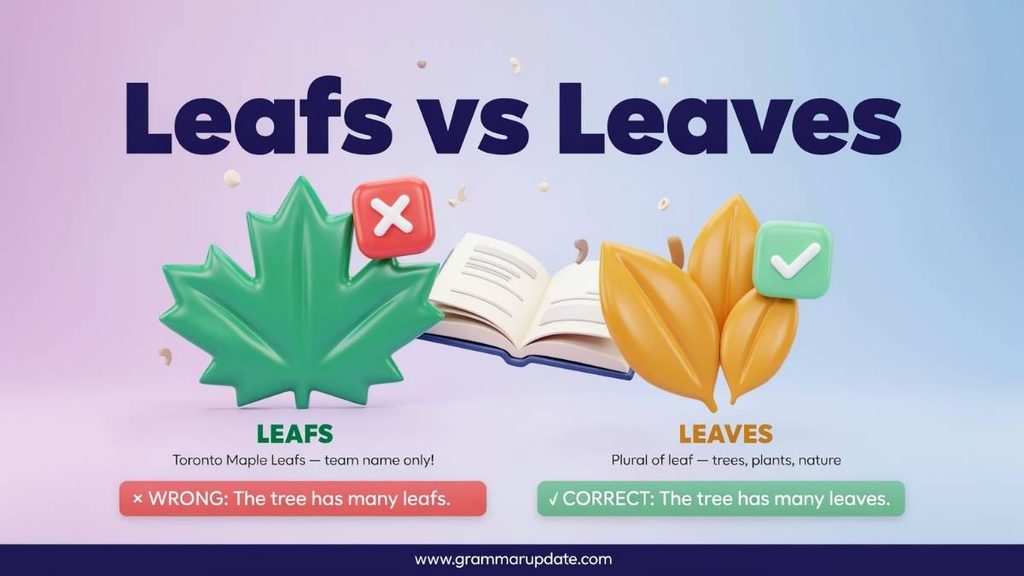
Examples make the difference easier to recognize. In each sentence, identify whether the word names something or describes an action.
Examples Using Leaves
Use “leaves” when you mean several leaves or when you need the verb form of “leave.”
- The tree loses its leaves during autumn.
- Several yellow leaves lay on the wet pavement.
- The gardener watered the plant’s leaves.
- Fresh leaves grow on the branches in spring.
- The book’s leaves were yellow with age.
- The dining table has two extra leaves.
- My sister leaves for school at eight.
- The train leaves in five minutes.
The first six examples use “leaves” as a plural noun. The final two use it as a verb.
Examples Using Leafs
Use “leafs” when the sentence calls for the verb form of “leaf” or refers to the official team name.
- He leafs through the magazine during lunch.
- She leafs through her notes before the exam.
- The child leafs through a picture book.
- The plant leafs out when spring arrives.
- The Toronto Maple Leafs are a well-known hockey team.
The spelling changes according to the word’s grammatical role. The verb “leafs” does not replace “leaves” whenever you need a plural noun.
A Short Comparison Table
| Sentence | Correct choice | Reason |
|---|---|---|
| The tree has many ___ . | Leaves | Plural noun |
| She ___ through the book. | Leafs | Verb meaning turns pages |
| The team is called the Toronto Maple ___ . | Leafs | Official name |
| The ___ are falling from the branches. | Leaves | Plural noun |
| The shrub ___ out in spring. | Leafs | Verb describing plant growth |
| He ___ his office at six. | Leaves | Verb meaning departs |
A quick way to check your choice is to ask what the word is doing in the sentence. If it names multiple objects, use the appropriate plural noun. If it describes an action, check which verb you need.
Understand confusing English more words simply
Accommodate vs Accomodate Which one Is Correct?
What Is the Difference Between Leaf and Leave?
“Leaf” and “leave” look similar, but they have different meanings. The difference becomes especially important when you use “leaves,” because that spelling can belong to either word.
Leaf: A Noun or Verb
As a noun, “leaf” usually means a flat part of a plant. It can also refer to a sheet in a book or a removable extension on a table.
Examples:
- A single leaf rested on the windowsill.
- The plant has one damaged leaf.
- He decided to leaf through the book.
In the last example, “leaf” acts as a verb meaning to turn through pages.
Leave: A Verb or Noun
The verb “leave” means to go away, depart, or allow something to remain. It can also refer to time away from work or other duties when used as a noun.
Examples:
- Please leave your shoes by the door.
- I leave home early on weekdays.
- She requested two days of leave.
- He leaves his phone in the car.
The key difference is meaning, not just spelling. “Leaf” relates to plant parts, sheets, or turning pages. “Leave” relates to departing, allowing something to remain, or time away from work.
Leaf vs Leave vs Leaves
| Word | Meaning | Example |
|---|---|---|
| Leaf | One plant part or a sheet | The leaf is turning yellow. |
| Leave | To depart or let something remain | Please leave the room quietly. |
| Leaves | Plural of leaf | The leaves are dry. |
| Leaves | Present-tense form of leave | She leaves at noon. |
| Leafs | Present-tense form of leaf | He leafs through the book. |
Because “leaves” has two common grammatical uses, context is essential. In “the leaves are falling,” it names plant parts. In “she leaves early,” it describes an action.
Understand confusing English more words simply
Occurring vs Occuring Which one Is Correct?
Common Mistakes When Using Leafs vs Leaves
Writers often confuse these spellings because they look similar and share the same base word. Fortunately, a few simple checks can prevent most errors.
Using Leafs as the Plural of Leaf
Incorrect: The garden was covered with fallen leafs.
Correct: The garden was covered with fallen leaves.
Why? “Leaves” is the standard plural noun for plant leaves. “Leafs” does not normally serve this purpose in standard English.
Confusing Leaves With Leafs Through a Book
Incorrect: She leaves through the magazine while waiting.
Correct: She leafs through the magazine while waiting.
Why? The sentence describes turning pages, so it needs the verb “leafs.” The word “leaves” would usually suggest departing or leaving something behind, not browsing through a magazine.
Changing the Toronto Maple Leafs Name
Incorrect: The Toronto Maple Leaves won the game.
Correct: The Toronto Maple Leafs won the game.
Why? The team has an official name. Keep the spelling “Maple Leafs” even though the usual plural of the plant noun is “leaves.”
Assuming Every Word Ending in F Uses the Same Rule
English has irregular plural patterns, but not every noun ending in “f” changes to “ves.”
For example:
- Leaf becomes leaves.
- Knife becomes knives.
- Roof becomes roofs.
- Chief becomes chiefs.
- Cliff becomes cliffs.
Because these patterns vary, check the standard plural when you are unsure. Do not apply one spelling rule to every word with the same ending.
Understand confusing English more words simply
Coozie vs Koozie Which one Is Correct and usage ?
How to Remember Leafs vs Leaves
A simple memory trick can help you choose the right word quickly.
Think of it this way:
- Leaves: things you see on a tree.
- Leafs: an action, such as turning through pages, or part of an official name.
You can also remember this sentence:
A tree has leaves, but a reader leafs through a book.
The sentence uses both words correctly and highlights their different roles. With a little practice, the spelling should become much easier to remember.
Another useful tip is to check the subject and verb in your sentence. If you are describing what someone does, “leafs” may be correct. If you are counting plant parts, use “leaves.”
Understand confusing English more words simply
Whoa vs Woah which one is correct and usage ?
practice session Leafs vs Leaves
Fill in each blank with the correct word: “leaf,” “leaves,” “leafs,” “leave,” or “leaves” as appropriate. Pay attention to the meaning and grammar of each sentence.
- The tree loses its _____ every autumn.
- A single _____ fell onto the garden path.
- She _____ through the magazine while waiting for her appointment.
- The Toronto Maple _____ are a professional hockey team.
- Several dry _____ covered the ground.
- My brother _____ home at seven every morning.
- The gardener removed the dead _____ from the flower bed.
- He _____ through the old photo album.
- New _____ appeared on the branches in spring.
- Please _____ your shoes near the door.
- The plant _____ out when the weather becomes warmer.
- The book’s _____ were yellow with age.
- One _____ was stuck to the wet window.
- The bus _____ the station at nine o’clock.
- She carefully examined the green _____ on the plant.
- He likes to _____ through books at the library.
- The Toronto Maple _____ have many loyal fans.
- My father _____ his keys on the kitchen counter.
- The wind blew the _____ across the road.
- Please don’t _____ any food on the table.
- The tree has broad, green _____.
- The student _____ through her textbook before the exam.
- The gardener noticed that the plant had several new _____.
- We should _____ early to avoid traffic.
- The shrub _____ out later than the other plants.
Answers
- leaves
- leaf
- leafs
- Leafs
- leaves
- leaves
- leaves
- leafs
- leaves
- leave
- leafs
- leaves
- leaf
- leaves
- leaves
- leaf
- Leafs
- leaves
- leaves
- leave
- leaves
- leafs
- leaves
- leave
- leafs
Here’s a trusted source for clear word meanings:
FAQs
Which is correct, leaves or leafs?
“Leaves” is the correct plural of “leaf” when referring to plant parts, book leaves, or table extensions. “Leafs” is correct as a verb, as in “She leafs through a magazine,” and in proper names such as the Toronto Maple Leafs.
Do Canadians say Leafs vs leaves?
Canadians use “leaves” as the standard plural of “leaf.” However, “Leafs” appears in the official name of the Toronto Maple Leafs hockey team. The correct spelling depends on the meaning, not the speaker’s nationality.
Why is it called the Toronto Maple Leafs instead of the Toronto Maple Leaves?
The Toronto Maple Leafs use “Leafs” as their official team name. Proper names can preserve a spelling that differs from the usual rules for common nouns. When referring to the foliage of maple trees, however, the correct plural is “maple leaves.”
What does “leafs” mean?
“Leafs” has two main uses. It is the present-tense form of the verb “leaf,” meaning to turn through pages, as in “He leafs through a magazine.” It also appears in proper names, including the Toronto Maple Leafs.
Can I use “leafs” in a sentence?
Yes. “Leafs” is correct when used as a verb or as part of a proper name. For example, “She leafs through her notes before class” is grammatically correct. However, use “leaves” when referring to multiple plant leaves.
What do you call a bunch of leaves?
A group of leaves can be called a bunch, cluster, or pile of leaves, depending on how they are arranged. Leaves growing close together on a branch form a cluster, while leaves gathered on the ground form a pile.
Is it Toronto Maple Leafs or Maple Leaves?
“Toronto Maple Leafs” is the team’s official name. “Maple leaves” is the correct phrase for multiple leaves from a maple tree. Use “Leafs” when referring to the hockey team and “leaves” when discussing the tree.
Is it leafs vs leaves in a table?
“Leaves” is the correct plural when referring to removable or foldable sections that extend a table’s surface. For example, “The dining table has two extra leaves” is correct.
Is “leaves” grammatically correct?
Yes. “Leaves” is grammatically correct as both the plural noun of “leaf” and the third-person singular present-tense form of “leave.” For example, “The leaves are falling” uses the noun, while “She leaves early” uses the verb.
What is the plural of “leaf”?
The plural of “leaf” is “leaves.” For example, “One leaf fell from the tree” becomes “Several leaves fell from the tree.” This spelling follows an established English plural pattern in which the “f” changes to “v” before “-es.”
What is the word for multiple leaves?
The word is “leaves.” Use it when referring to multiple plant parts, book leaves, or table extensions. “Leafs” is not the standard plural noun in these contexts.
What is a stack of leaves called?
A stack of leaves gathered outdoors is usually called a “pile of leaves.” If you mean sheets in a book, you can refer to them as “book leaves,” although “pages” is more common in everyday conversation.
Why are table extensions called leaves?
Table extensions are called “leaves” because the word refers to flat sections that expand a table’s surface. These sections may fold out or attach to the table when extra space is needed. The plural form is “leaves.”
Is it door leaves or door leafs?
“Door leaves” is the standard plural form in construction and architecture. A door leaf is an individual movable panel within a door assembly. When referring to multiple panels, use “door leaves,” not “door leafs.”
How do you spell “leaves” when it means going away?
The spelling is “leaves.” It is the third-person singular present-tense form of “leave.” For example, “He leaves the office at five” means he departs at that time. Although it has the same spelling as the plural noun, its meaning depends on the sentence.
What are the two meanings of “leaves”?
“Leaves” has two common grammatical uses. It is the plural of “leaf,” as in “The leaves are turning yellow.” It is also the present-tense form of “leave,” as in “She leaves for work at eight.” The surrounding words help identify the intended meaning.
Is it leafs vs leaves on a tree?
“Leaves” is correct when referring to the parts of a tree. For example, “The tree has green leaves.” Use “leafs” only in specific contexts, such as the verb meaning to turn through pages or the official name of the Toronto Maple Leafs.
What are the leaves of a door called?
An individual movable panel in a door assembly is called a “door leaf.” The plural is “door leaves.” This terminology is common in architecture, construction, and technical descriptions.
What is the middle of a leaf called?
The main central vein of a leaf is called the “midrib.” Smaller veins branch from it and help transport water and nutrients through the leaf. The structure can vary depending on the plant species.
What are large leaves called?
Large leaves are generally called “large leaves” or “broad leaves.” The term “broadleaf” also describes plants with relatively wide, flat leaves, especially when distinguishing them from plants with needle-like foliage. The best term depends on the context.
How many leaves does a clover have?
A typical clover leaf has three leaflets, which give the plant its familiar three-part appearance. Rare four-leaf clovers have four leaflets. The total number of leaves on a clover plant varies with its size, age, and growing conditions.
What are the leaves of a maple tree called?
They are called “maple leaves.” For example, “The maple leaves turn red and orange in autumn” is correct. When referring to the hockey team, use its official name, the Toronto Maple Leafs.
Which leaf is famous in Canada?
The maple leaf is one of Canada’s most recognizable national symbols. It appears on the Canadian flag and represents Canadian identity. The maple leaf also features in the name and branding of the Toronto Maple Leafs hockey team.
Learn how to use confusing more words correctly
Elude vs Allude which one is correct and usage ?
Conclusion
Still confused about “leafs” and “leaves”? Here’s the easiest way to remember the difference: one leaf, two leaves. When you talk about leaves on a tree, plants in your garden, or extra sections of a table, “leaves” is the correct plural. However, “leafs” is correct when someone leafs through a book or when you’re talking about the Toronto Maple Leafs hockey team.
The trick is to look at what the word means in your sentence. If you’re counting plant parts, choose “leaves.” If you’re describing someone turning pages, use “leafs.” And if you’re cheering for Toronto’s hockey team, keep the official spelling as “Maple Leafs.”
English spelling can sometimes feel like a pile of fallen leaves, but this rule is easier than it looks. Remember the difference, check the context, and you’ll know which word to use without getting tangled up in a grammar mess.

Jhon AJS, the creative mind behind Grammar Update, is an experienced blogger passionate about simplifying English grammar. He focuses on explaining confusing word vs word differences, grammar rules, punctuation, and sentence structure in a clear and practical way. Through easy to understand guides and examples, Jhon helps readers improve their writing and communicate with confidence. With years of blogging experience, he continues to share helpful insights that make learning grammar simple, useful, and accessible for everyone.