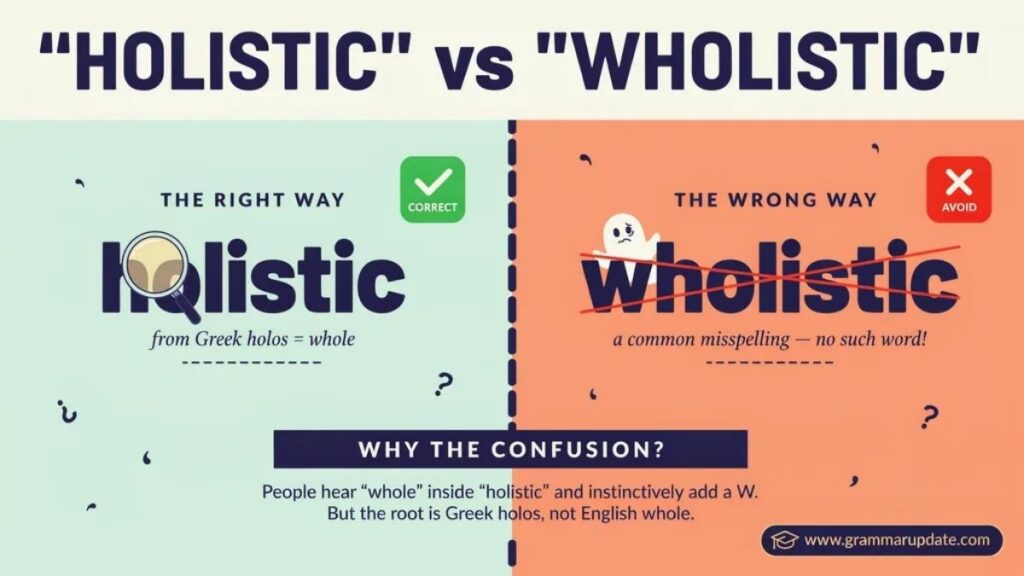
Ever typed a word, stared at it for five seconds, and suddenly wondered whether you invented it? English loves creating those little moments of doubt, and “holistic” vs “wholistic” is a perfect example. Both spellings may look reasonable, especially because “whole” seems to fit the meaning. But which one should you actually use? In this guide to holistic vs wholistic, we’ll clear up the confusion without making grammar feel like a courtroom trial. You’ll learn what each spelling means, whether both are considered words, which form works best in formal writing, and how to use holistic naturally in sentences. By the end, this spelling mystery should feel much simpler.
Holistic vs Wholistic quick Answer
Holistic is the preferred spelling in standard English.
Wholistic does exist, but most readers are more familiar with holistic. Therefore, if you’re writing a report, article, school assignment, business document, or professional communication, holistic is normally the safest choice.
For example:
“The doctor took a holistic approach to the patient’s care.”
“The company needs a holistic view of its operations.”
“The school follows a holistic approach to student development.”
In each case, holistic means looking at the larger picture instead of focusing on only one part.
Wholistic can communicate essentially the same idea. Nevertheless, because it is uncommon, some readers may assume it is a spelling mistake.
So, when there is no specific reason to use the variant, choose holistic.What Does Holistic Mean?
The word holistic describes an approach that considers something as a complete whole rather than examining only one part.
In other words, it asks you to step back and look at how different parts connect.
For example, imagine that a business is losing customers. A narrow approach might look only at the sales team’s performance. A broader approach would examine product quality, pricing, customer service, marketing, competition, delivery times, and customer expectations.
That broader way of thinking is holistic.
The same idea applies to people. Instead of looking at one isolated issue, a whole-person approach considers the different factors that may influence someone’s overall situation.
These factors can include physical health, mental well-being, emotions, lifestyle, relationships, environment, and other relevant circumstances.
Therefore, the central idea is simple: consider the whole instead of treating one piece as if it exists on its own.
What Does Wholistic Mean?
Wholistic generally means the same thing as holistic.
The spelling looks different because it has been influenced by the familiar English word whole. That makes wholistic seem intuitive, especially to someone encountering the word for the first time.
For example:
“The organization takes a wholistic approach to community care.”
The meaning is understandable and essentially the same as:
“The organization takes a holistic approach to community care.”
However, the second version is much more common in standard English.
That distinction is important. Wholistic isn’t simply a meaningless spelling error. It is a recognized variant. Still, being a real variant doesn’t make it equally common or equally preferred.
Learn the difference between confusing more English words
Focussed vs Focused Which Spelling Is Correct?
Why Does Wholistic Have a W?
The spelling question becomes easier to understand when you look at how the word developed.
Holistic is connected to the word holism, which comes from a root associated with the idea of being whole. The English word whole also expresses that same basic concept.
Because of that close connection in meaning, some speakers and writers naturally added a w to holistic.
The result was wholistic.
In a sense, the spelling follows a logical visual pattern:
whole → wholistic
The standard form follows a different word-building path:
holism → holistic
So although wholistic looks as though it should come directly from whole, the history of the standard spelling is different.
This is one reason English can be confusing. A spelling may look logical while still not being the conventional form.
Is Holistic a Word?
Yes. Holistic is a well-established English word.
What Does Holistic Mean?
It functions primarily as an adjective and describes something that considers an entire person, system, situation, or subject rather than focusing on one isolated element.
Common Phrases With Holistic
You might see it used in expressions such as:
- A holistic approach
- Holistic care
- Holistic education
- Holistic planning
- Holistic development
- Holistic thinking
- Holistic problem-solving
- Holistic healthcare
- Holistic living
- Holistic decision-making
Is Holistic Only Used in Healthcare?
Although the word appears frequently in health-related discussions, its meaning extends far beyond healthcare.
For instance, a manager can take a holistic approach to employee performance. A teacher can use a holistic approach to student development. A planner can take a holistic view of a city’s transportation system.
What Is the Basic Idea Behind Holistic?
In each case, the basic idea remains the same: holistic describes an approach that considers the whole rather than concentrating on just one part.
Learn the difference between everyday English mistakes
Eying vs Eyeing Which Spelling Is Correct?
Is Wholistic a Word?
Yes, wholistic is a real word.
However, it isn’t the usual form.
This distinction often causes confusion because people tend to divide words into two categories: correct and incorrect. English doesn’t always work that way. Some words exist as variants even though one form is much more widely accepted or preferred.
Wholistic falls into that category.
If you encounter it in a document, you don’t necessarily need to assume that the writer made a mistake. The writer may be using the variant intentionally, following the terminology of an organization, or preserving the wording of a source.
Even so, if you’re choosing the spelling yourself, holistic is normally the better option.
What Is the Difference Between Holistic vs Wholistic?
The difference between holistic vs wholistic is mainly related to spelling and usage rather than meaning.
Holistic is the established standard form. Wholistic is a less common variant.
The two words generally express the idea of considering something as a whole.
For clarity, consider this comparison:
| Feature | Holistic | Wholistic |
|---|---|---|
| Meaning | Considering the whole | Generally the same |
| Common usage | Very common | Less common |
| Standard form | Yes | Variant |
| Formal writing | Preferred | Usually avoided |
| Academic writing | Preferred | Uncommon |
| Professional writing | Preferred | Less common |
| Proper names | May be used | May be used |
| General recommendation | Use it | Use only when appropriate |
Therefore, there isn’t usually a major difference in what the two words mean.
The more meaningful difference is what readers expect to see.
When most readers encounter holistic, the spelling looks familiar. When they see wholistic, they may pause because the form is less familiar.
Learn the difference between commonly misused words
Aswell vs As Well Which is Correct and Difference?
Which Is Correct Holistic vs Wholistic?
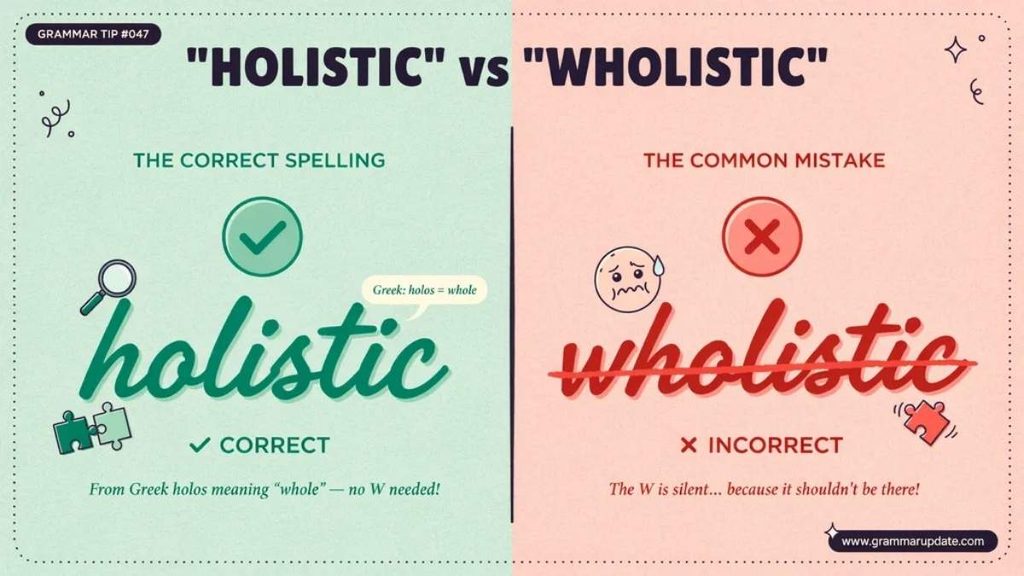
If you’re asking which spelling you should use, the answer is holistic.
That doesn’t mean wholistic has no place in English. Instead, it means holistic is the preferred form for normal writing.
For example, write:
“The company needs a holistic strategy.”
rather than:
“The company needs a wholistic strategy.”
Both sentences communicate the same general idea. However, the first follows standard usage and will look more natural to most readers.
Therefore, if you’re unsure, don’t overthink it.
Choose holistic.
Should You Use both in Formal Writing?
In formal writing, holistic is usually the better choice.
This includes school assignments, research papers, business reports, workplace documents, professional articles, educational materials, and general informational writing.
Why Is Holistic Preferred in Formal Writing?
There is a practical reason for this preference.
Formal writing should normally favor familiar standard forms unless there is a specific reason to use a variant. Doing so reduces distractions and makes the writing easier to read.
Example of Holistic in Formal Writing
For example:
“The researchers used a holistic framework to examine the problem.”
This sounds natural and professional.
Can You Use Wholistic in Formal Writing?
Using wholistic isn’t necessarily impossible, but it can draw attention to the spelling rather than the message.
Consequently, holistic is the safer choice when you want your writing to sound standard, familiar, and professional.
Learn the difference between basic English word mistakesLearn the difference between commonly misused words
Instalments vs Installments Which Is Correct and Use It?
When Is Wholistic Appropriate?
There are situations where keeping wholistic makes sense.
First, it may appear in the official name of an organization, program, service, or initiative. In that situation, changing the spelling could change the established name.
Second, you may need to preserve the wording of a quotation. If someone wrote wholistic, editing it to holistic would change the original wording.
Third, a particular group may intentionally use wholistic because it wants to emphasize the connection with the word whole.
In those situations, the unusual spelling may serve a purpose.
Otherwise, however, holistic is usually the cleaner choice.
Holistic in Health and Medicine
The word appears frequently in discussions about health because health involves many interconnected factors.
A narrow approach might focus on one symptom or condition. A broader approach may consider the person’s overall circumstances.
That can include physical health, mental well-being, emotional factors, lifestyle, sleep, nutrition, environment, and other relevant considerations.
This is why phrases such as holistic care and holistic healthcare are common.
However, there’s an important distinction to remember.
Calling something holistic doesn’t automatically mean that a particular treatment is effective. The word describes the approach rather than proving the results of a treatment.
For example, a healthcare professional may consider several aspects of a patient’s situation when planning care. That broader perspective can be described as holistic, regardless of whether a particular therapy is conventional, complementary, or otherwise.
The word describes the scope of consideration. It doesn’t serve as proof of medical effectiveness.
Learn the difference between often confused words
Click vs Clique Which is Difference and usage?
Holistic in Education
Education provides another clear example of how the word works.
A narrow view of education might focus almost entirely on grades or test results. A broader view may consider academic learning alongside social, emotional, physical, and creative development.
That broader perspective is often described as holistic education.
For example, a school might consider:
- Academic progress
- Communication skills
- Social development
- Emotional development
- Creativity
- Physical well-being
- Critical thinking
- Personal responsibility
The goal is to recognize that students aren’t simply test scores.
Therefore, holistic development describes a broader view of learning and personal growth.
If someone uses the phrase wholistic education, the intended meaning will usually be similar. Nevertheless, holistic education remains the more familiar spelling.13. Holistic in Business
Businesses also use the word when they want to describe a broad and connected approach.
Consider a company that wants to improve customer satisfaction.
A narrow strategy might focus only on customer-service scripts. A holistic strategy would examine the entire customer experience.
That could include:
- Product quality
- Pricing
- Website usability
- Customer support
- Delivery
- Returns
- Communication
- Employee training
- Customer expectations
- Long-term loyalty
This illustrates the basic concept of holistic thinking.
Instead of asking, “Which single department is responsible?” the organization asks, “How do all the relevant parts work together?”
That broader question can reveal problems that a narrow analysis might miss.
Holistic Financial Planning
Financial planning can also involve a holistic perspective.
Rather than looking at investments alone, a comprehensive financial review may consider income, spending, savings, debt, insurance, taxes, retirement goals, risk, and long-term priorities.
For example, someone may have a strong investment portfolio but significant high-interest debt. Looking only at the investments could give an incomplete picture.
A broader assessment considers the financial situation as a whole.
That is why the phrase holistic financial planning can be useful when describing a comprehensive approach.
Again, though, holistic is the normal spelling.
Holistic Lifestyle and Wellness
The same principle appears in discussions about lifestyle and wellness.
A holistic lifestyle generally refers to considering several parts of daily life together rather than treating well-being as one isolated goal.
Depending on the context, that can involve:
- Physical activity
- Nutrition
- Sleep
- Stress management
- Relationships
- Work-life balance
- Mental well-being
- Personal goals
- Social connection
- Personal habits
The idea is not that every area must receive equal attention at every moment. Instead, the focus is on understanding how different aspects of life interact.
For example, poor sleep can affect concentration. Stress can influence eating habits. Work demands can affect exercise and relationships.
A broader perspective recognizes those connections.
Learn the difference between confusing word pairs
Granddad vs Grandad which spelling is Correct and Usage?
How to Use Holistic in a Sentence
Holistic as an Adjective
Holistic works naturally when it modifies a noun. It describes an approach, plan, strategy, view, or understanding that considers the whole rather than just one part.
Holistic in Everyday and Professional Sentences
Here are several examples:
- The team developed a holistic plan for improving the organization.
- The teacher takes a holistic approach to student development.
- The doctor considered the patient’s situation from a holistic perspective.
- The project requires a holistic understanding of the entire system.
- The company adopted a holistic strategy for improving customer experience.
- The program focuses on holistic development rather than one narrow skill.
- The consultant provided a holistic assessment of the business.
- The policy takes a holistic view of environmental and social concerns.
Holistic Does Not Only Refer to Health
Notice that the word doesn’t have to refer to health.
You can use holistic when discussing education, business, planning, personal development, environmental issues, organizational management, and many other subjects.
Holistic Means Considering the Complete Picture
Its broader meaning is simply about considering the complete picture. Instead of examining one isolated part, a holistic approach looks at how different parts connect and affect the whole.
Learn the difference between tricky grammar more words
Connector vs Connecter Which Spelling Is Correct?
How to Use Wholistic in a Sentence
Wholistic can also appear naturally in a sentence when a writer intentionally chooses that variant.
For example:
- The organization promotes a wholistic approach to community support.
- The program follows a wholistic model of personal development.
- The group describes its services as wholistic care.
- The school uses a wholistic approach to learning.
These sentences are understandable because the intended meaning is clear.
However, if you’re writing your own content and don’t have a specific reason to use the variant, replacing wholistic with holistic will generally produce the more conventional result.
Common Mistakes With These Spellings
One common mistake is assuming that wholistic must always be wrong.
That isn’t accurate. It is a recognized variant.
Another mistake is assuming that the two spellings must have completely different meanings. In ordinary English usage, they generally don’t.
A third mistake is believing that holistic refers only to alternative health practices. The word has a much wider meaning and can describe approaches in education, business, planning, problem-solving, and many other areas.
A fourth mistake is changing an official name simply because its spelling looks unusual.
If an organization deliberately uses wholistic in its name, preserve the name as written.
Finally, avoid switching between the two forms randomly within the same piece of writing. Consistency makes your writing look deliberate and polished.
Learn the difference between commonly mixed-up more words
Counselor vs Councilor Which is the Difference and Usage?
Holistic vs Wholistic A Practical Writing Rule
When you’re sitting in front of a blank page and wondering which form to use, ask one question:
“Do I have a specific reason to use wholistic?”
If the answer is no, write holistic.
That’s the simplest rule.
Use holistic for ordinary prose, formal writing, academic work, business communication, educational material, and most professional contexts.
Use wholistic when you’re preserving a proper name, quotation, established terminology, or intentional stylistic choice.
This approach gives you the best of both worlds. You follow standard English without pretending that the variant doesn’t exist.
Practice Session
Fill in each blank with the correct word: holistic vs wholistic.
- The doctor takes a ________ approach to patient care.
- The school focuses on ________ development rather than academics alone.
- A ________ view of the problem can reveal issues that a narrow analysis misses.
- The company needs a ________ strategy to improve customer satisfaction.
- She believes in a ________ approach to personal wellness.
- The therapist uses a ________ approach that considers the person’s broader needs.
- The organization promotes a ________ model of community support.
- A ________ perspective considers how different parts of a system interact.
- The teacher uses ________ education to support students’ academic and emotional growth.
- The financial adviser recommended a ________ review of the client’s finances.
- The program describes its services as ________ care.
- A ________ approach can help managers understand problems across an entire organization.
- The article discusses ________ health and well-being.
- The company adopted a ________ method for solving the problem.
- The school takes a ________ approach to student learning.
- The consultant provided a ________ assessment of the business.
- The program uses a ________ lifestyle model that considers several areas of well-being.
- The organization uses the spelling “________” in its official program name.
- If you’re writing a formal report, ________ is usually the preferred spelling.
- The researcher examined the issue from a ________ perspective.
- The word “________” is a less common variant of “holistic.”
- When you’re unsure which spelling to choose, ________ is normally the safer option.
- The manager wanted a ________ understanding of the company’s challenges.
- The phrase “________ approach” means considering the bigger picture rather than one isolated part.
- Although “wholistic” exists, “________” is the standard spelling.
Answers
- holistic
- holistic
- holistic
- holistic
- holistic
- holistic
- wholistic
- holistic
- holistic
- holistic
- holistic
- holistic
- holistic
- holistic
- holistic
- holistic
- holistic
- wholistic
- holistic
- holistic
- wholistic
- holistic
- holistic
- holistic
- holistic
Here’s a trusted source for clear word meanings:
FAQs
Is holistic the correct spelling?
Yes. Holistic is the standard spelling in modern English. It is the form you should normally use in academic, professional, formal, and everyday writing.
Is wholistic a real word?
Yes. Wholistic is a recognized variant of holistic. However, it is far less common, so most writers should use holistic unless they have a specific reason to choose the variant.
What is the difference between holistic vs wholistic?
The main difference is their spelling and frequency of use. Both generally describe an approach that considers something as a whole rather than focusing on one part. Holistic is the standard form, while wholistic is an uncommon variant.
Why is wholistic spelled with a W?
Wholistic developed partly because people naturally connect the word with whole. That connection makes the added W seem logical. However, the standard form holistic developed through a different word history.
Which spelling is more common: holistic vs wholistic?
Holistic is much more common. It is also the form most readers expect to see, which makes it the better choice for general writing.
Should you use holistic vs wholistic in formal writing?
Use holistic in most formal situations. It fits naturally in academic papers, business documents, professional communication, educational materials, and other standard forms of writing.
Can wholistic be used in a sentence?
Yes. For example, “The organization takes a wholistic approach to community support.” The sentence is understandable, but holistic approach is the more conventional wording.
Do holistic vs wholistic have different meanings?
Generally, they do not. Both words communicate the idea of considering the whole rather than concentrating on an isolated part. A particular organization may give wholistic a special meaning, but that distinction isn’t universal.
Is holistic only used for health and medicine?
No. Holistic can describe many types of approaches. You can use it when discussing education, business, planning, personal development, problem-solving, relationships, and other subjects.
What does holistic mean in simple terms?
Holistic means looking at the bigger picture. Instead of examining one part on its own, a holistic approach considers how different parts connect and affect the whole.
Is “holistic approach” correct?
Yes. Holistic is an adjective that naturally describes approach. For example, “The team took a holistic approach to solving the problem.”
Is “wholistic approach” correct?
Wholistic approach is understandable and does appear in English. However, holistic approach is the established form and is usually the better choice when you’re writing standard English.
Should you change wholistic to holistic when editing?
Usually, yes, if you’re editing ordinary prose and want to follow standard usage. However, keep wholistic when it appears in an official name, established terminology, or a quotation that you need to reproduce accurately.
How can you remember the spelling of holistic?
Remember that the standard spelling is holistic without a W. Connecting it with the related word holism can also help you remember the spelling.
Which spelling should you use in academic writing?
Use holistic. It is the conventional choice for essays, research papers, reports, and other academic work.
Which spelling should you use in business writing?
Holistic is normally the best choice. For example, you can write “a holistic business strategy” or “a holistic view of the organization.” Keep wholistic only when a specific company, brand, or program deliberately uses that spelling.
Can holistic vs wholistic appear in the same document?
They can, but switching between them without a clear reason can make your writing look inconsistent. Use holistic for normal prose and retain wholistic only when the context specifically requires it.
What does holistic care mean?
Holistic care refers to an approach that considers a person’s broader needs rather than focusing exclusively on one isolated concern. Depending on the context, that can include physical, emotional, mental, social, or other relevant factors.
What does holistic education mean?
Holistic education takes a broad view of learning and development. Rather than concentrating only on grades or academic performance, it may also consider social, emotional, creative, physical, and personal development.
What is the easiest way to choose between holistic vs wholistic?
Choose holistic unless you have a specific reason to use wholistic. Holistic is the standard, familiar, and widely preferred form, while wholistic is a less common variant.
Conclusion
The holistic vs wholistic debate may look like a tiny spelling puzzle, but it can make even confident writers stop and squint at the screen. The good news is that the confusion is easy to clear up. Holistic is the standard and more widely preferred spelling, especially in formal, academic, professional, and general writing. Wholistic does appear as a variant, but it’s less familiar and may distract readers from your actual message.
So, when you’re wondering which spelling to choose, remember the safer option: holistic. Think of it as the spelling that keeps the whole picture clear. No grammar panic, no dictionary drama—just smoother, more confident writing.

Jhon AJS, the creative mind behind Grammar Update, is an experienced blogger passionate about simplifying English grammar. He focuses on explaining confusing word vs word differences, grammar rules, punctuation, and sentence structure in a clear and practical way. Through easy to understand guides and examples, Jhon helps readers improve their writing and communicate with confidence. With years of blogging experience, he continues to share helpful insights that make learning grammar simple, useful, and accessible for everyone.