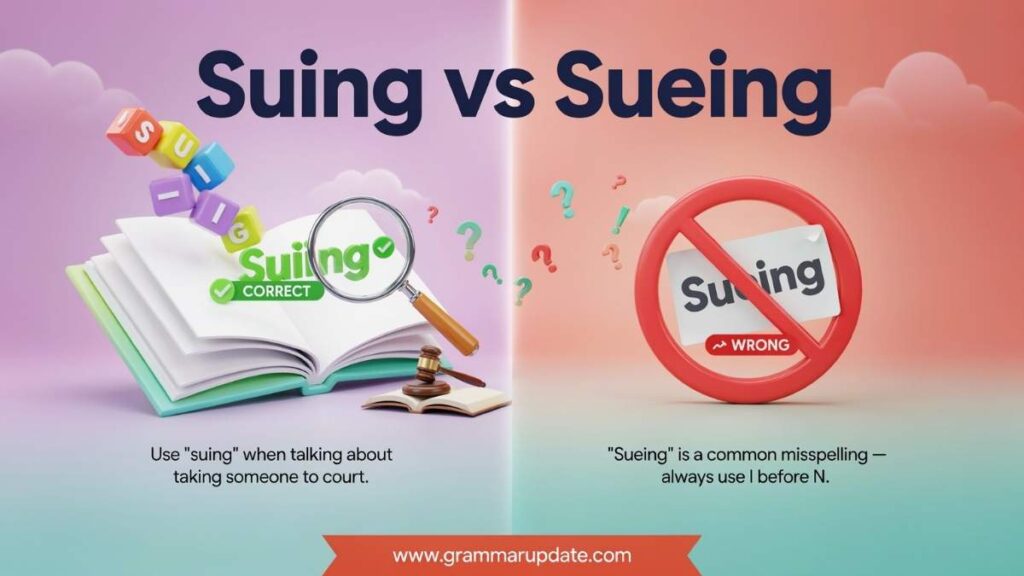
The difference between “suing vs sueing” may seem small, but choosing the wrong spelling can make your writing look less professional. The good news is that the rule is easy to understand. When it comes to suing vs sueing, “suing” is the correct spelling, while “sueing” is a common mistake. But why does the final “e” disappear, and how should you use “suing” in a sentence? This guide explains the meaning, spelling rule, grammar, and real-life examples in simple terms. By the end, you’ll know exactly which spelling to use and how to avoid this mistake in your writing.
auick answer
| Topic | Suing | Sueing |
|---|---|---|
| Correct spelling | Yes | No |
| Base verb | Sue | Sue |
| Word formation | Sue + ing, with the final e removed | Incorrectly retains the final e |
| Meaning | Taking legal action against someone | Intended to express the same meaning, but misspelled |
| Example | She is suing the company. | She is sueing the company. |
| Standard English usage | Accepted in American and British English | Not accepted for this verb form |
Learn the difference between tricky grammar more words
Provider vs Providor Which Word Is Correct?
Suing vs Sueing The Correct Spelling
Suing is the correct spelling in standard American English, British English, Canadian English, and Australian English. Sueing is not an accepted alternative spelling when you mean taking legal action against someone.
The confusion comes from the final e in the base verb. Many English verbs end in e, and writers sometimes assume they should keep that letter when adding a suffix. However, the usual spelling rule tells us to remove a silent final e before adding -ing.
Consider these examples:
- Sue becomes suing.
- Make becomes making.
- Write becomes writing.
- Dance becomes dancing.
- Hope becomes hoping.
In each case, the verb loses its final e before taking the -ing ending. The meaning stays connected to the original verb, but the spelling changes.
Is Suing a Word?
Yes, suing is a standard English word. It is the present participle of the verb sue and can also function as a gerund, which is a verb form that acts as a noun.
For example:
- Present participle: She is suing her former employer.
- Gerund: Suing a company can be expensive.
In the first sentence, suing helps form the present continuous tense. In the second, it names an activity.
Both sentences use the word correctly, even though it serves a different grammatical purpose in each one.
Is Sueing a Word?
Sueing is a common spelling mistake rather than the standard form of the verb. When you want to describe someone taking legal action, use suing.
For example:
Incorrect: The customer is sueing the manufacturer.
Correct: The customer is suing the manufacturer.
The same correction applies to formal documents, casual messages, academic assignments, and business emails. The spelling does not change based on the level of formality.
Learn the difference between tricky grammar more words
Mentioned vs Mentionned difference and usage ?
What Does Suing Mean?
The suing meaning refers to taking legal action against a person, business, or organization. People commonly use the word when someone brings a legal claim to seek a remedy for an alleged wrong.
For example, a customer might sue a company over a defective product, or an employee might sue an employer over unpaid wages. Whether either person has a valid claim depends on the facts and the applicable law.
Suing Definition in Simple English
A simple suing definition is taking legal action against someone, usually by bringing a case before a court.
The word comes from the base verb sue. Adding -ing creates a form that can describe an ongoing action or name the activity itself.
Here are a few examples:
- The family is suing the manufacturer.
- He is suing his former business partner.
- Suing over a contract dispute can take time.
- The customer considered suing after several unsuccessful attempts to resolve the problem.
Each sentence describes legal action or the possibility of pursuing it.
Suing Meaning in Law
In legal terminology, suing generally means pursuing a legal claim against another party. In many civil court systems, the person who brings the claim is called the plaintiff, while the person or organization responding to it is called the defendant.
Imagine a contractor who completes a project but does not receive the payment promised in the contract. The contractor may consider suing the client to recover the money. If the contractor brings a case, the court will consider the evidence, the contract, and the relevant legal rules.
Several related terms help explain the process:
- Lawsuit: A legal case brought before a court.
- Plaintiff: The party bringing a civil claim in jurisdictions that use this term.
- Defendant: The party against whom the claim is brought.
- Legal action: Steps taken to assert or enforce a legal right.
- Damages: Money a court may award as compensation when the law permits it.
However, suing does not automatically mean the person bringing the case will win. A court must consider the relevant evidence and legal arguments before reaching a decision.
It is also important to distinguish suing from threatening to sue. Someone who says, “I will sue if this problem continues,” is describing possible future action. That statement alone does not establish that a lawsuit has been filed.
Learn the difference between tricky grammar more words
Foodie vs Foody Which One Is Correct?
Why Is Sueing Incorrect?
The main reason sueing is incorrect is that it breaks a common English spelling pattern. When a verb ends in a silent e, writers generally drop that letter before adding -ing.
Because sue follows this pattern, the correct form is suing.
The Drop the Final E Rule
The drop the final e rule explains how many English verbs change when they take certain suffixes. When a verb ends in a silent e, you usually remove that letter before adding a suffix that begins with a vowel, such as -ing.
| Base verb | Suffix | Correct form |
|---|---|---|
| Sue | -ing | Suing |
| Make | -ing | Making |
| Write | -ing | Writing |
| Dance | -ing | Dancing |
| Hope | -ing | Hoping |
| Bake | -ing | Baking |
| Use | -ing | Using |
These examples demonstrate the same basic pattern. The final e disappears, and the verb takes the new ending.
However, English spelling has exceptions. For instance, see becomes seeing, and agree becomes agreeing. These verbs retain the final e because their spelling patterns differ from those of verbs such as sue and make.
Therefore, don’t assume that every verb ending in e follows exactly the same pattern. Learn the common rule and pay attention to familiar exceptions.
Why Does Sue Become Suing Instead of Sueing?
The final e in sue disappears when you add -ing. The word doesn’t need to retain the original e before the suffix.
Think of the change as a spelling adjustment rather than a change in meaning:
- Sue is the base verb.
- Suing is the present participle or gerund.
- Sued is the simple past tense and past participle.
The same rule applies across major varieties of English. Sueing isn’t a regional spelling that becomes correct in another English-speaking country.
Common Spelling Mistakes With Similar Verbs
Writers often make the same mistake with other words that end in a silent e. They keep the original letter and add -ing without making the required spelling change.
| Incorrect spelling | Correct spelling |
|---|---|
| Sueing | Suing |
| Makeing | Making |
| Writeing | Writing |
| Hopeing | Hoping |
| Danceing | Dancing |
| Useing | Using |
| Comeing | Coming |
These mistakes often happen because writers focus on the original word rather than the spelling adjustment required by the suffix.
A useful habit is to check the complete word after adding -ing. That quick check can prevent many common spelling errors.
Learn the difference between often confused words
Theater vs Theatre Which one Is Correct usage ?
The Grammar Rule Behind Suing
Understanding the spelling is only half the job. You also need to know how suing functions in a sentence. Depending on its role, it can act as a present participle or a gerund.
Suing as the Present Participle of Sue
The present participle of sue is suing. A present participle often works with a form of the verb be to describe an action in progress.
For example:
- She is suing her former employer.
- They are suing the company for damages.
- He was suing his business partner when the parties reached an agreement.
In each sentence, suing combines with a helping verb to form a continuous tense.
Notice that suing doesn’t tell you by itself whether the action happens now or in the past. The helping verb provides that information. Is suing usually describes an ongoing situation, while was suing places the action in the past.
Suing as a Gerund
A gerund is a verb form ending in -ing that functions as a noun. It still expresses an action, but it fills a noun-like role in the sentence.
Consider these examples:
- Suing can be expensive.
- She considered suing after the dispute.
- The lawyer discussed the risks of suing without enough evidence.
In the first sentence, suing acts as the subject. In the other examples, it follows a verb or forms part of a phrase.
This distinction matters because not every word ending in -ing performs the same grammatical job. The surrounding sentence determines how the word functions.
Sue, Sued, and Suing: Verb Forms Explained
The verb sue follows a regular pattern in its main forms, although the -ing form requires dropping the final e.
| Verb form | Grammatical use | Example |
|---|---|---|
| Sue | Base form | They plan to sue. |
| Sues | Third-person singular present | She sues when necessary. |
| Sued | Simple past | He sued the company last year. |
| Sued | Past participle | The company has been sued before. |
| Suing | Present participle | She is suing the company. |
| Suing | Gerund | Suing takes time and money. |
These forms aren’t interchangeable. The correct choice depends on the sentence structure and the time of the action.
For instance, “She is suing the company” is correct because the present continuous tense uses is plus a present participle. “She is sued the company” is incorrect because it combines the helping verb with the wrong form.
Likewise, “She sued the company” describes a past action, while “She will sue the company” refers to a possible future action.
Sue or Suing: Which Form Should You Use?
Choose sue when the sentence requires the base verb, sued when you need the past tense or past participle, and suing when you need the -ing form.
Compare these examples:
- Correct: They want to sue the contractor.
- Correct: They are suing the contractor.
- Correct: They sued the contractor last year.
- Incorrect: They are sueing the contractor.
The final example contains a spelling mistake, not a different grammatical form.
Learn the difference between often confused words
Habit vs Habbit Which Spelling Is Correct ?
Suing vs Sueing Examples
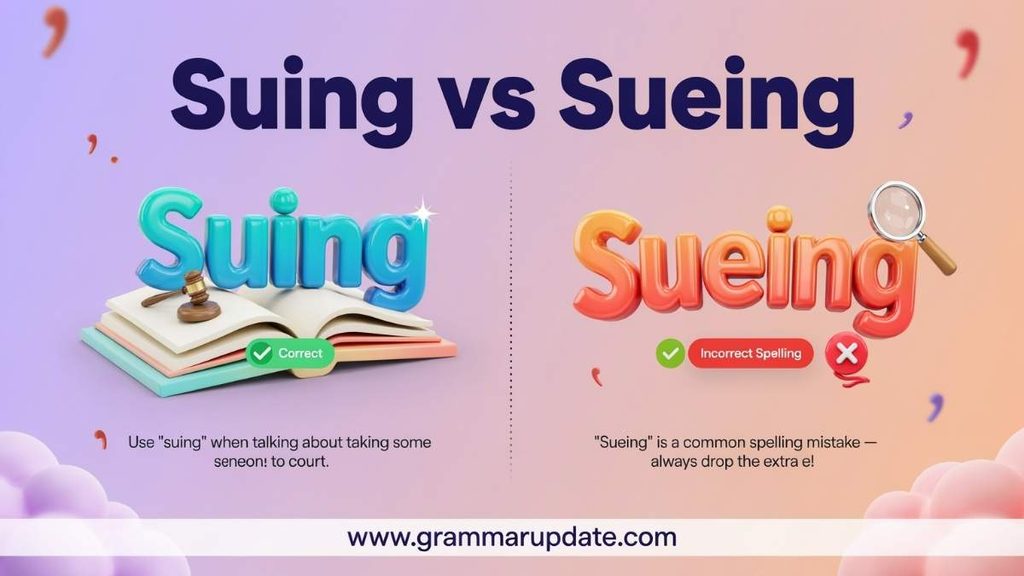
Realistic examples make spelling rules easier to remember. Whether you’re writing a text message, a workplace email, or a formal report, the correct spelling remains suing.
Suing in Everyday Conversation
People often use suing when discussing a disagreement that may lead to legal action.
- He is suing his landlord over the security deposit.
- They are considering suing after the contract dispute.
- She mentioned suing the company, but she hasn’t filed a case.
The last example highlights an important difference: considering or mentioning a lawsuit doesn’t necessarily mean someone has started one.
Suing in Workplace and Business Writing
Business disputes sometimes involve unpaid invoices, employment claims, contract disagreements, or alleged financial losses.
Examples include:
- The supplier is suing the retailer over unpaid invoices.
- She is suing her former employer over alleged discrimination.
- The company is facing a lawsuit from a former business partner.
- They discussed suing for breach of contract.
These examples show how suing fits into professional writing. When discussing a real legal matter, describe the allegations accurately and avoid presenting disputed claims as established facts.
Suing in Emails and Formal Documents
Formal writing calls for clear wording. If you use suing in an email, make sure the sentence accurately reflects the situation.
For example:
“Our client is considering suing the contractor over the alleged breach of contract.”
This sentence states that the client is considering legal action. It doesn’t claim that a lawsuit has already begun.
Compare it with this sentence:
“Our client has sued the contractor over the alleged breach of contract.”
This version says the client has already taken that step. The difference is both grammatical and factual.
Suing in News Reports
Journalists often use suing to describe legal disputes that are underway.
Examples include:
- The family is suing the manufacturer over an alleged product defect.
- Several employees are suing the company over unpaid wages.
- The customer is suing the retailer after a disputed transaction.
In news writing, the spelling rule stays the same, but accuracy becomes especially important. A report should distinguish between allegations, court filings, and proven findings.
A Short Illustrative Case Study
Imagine a customer buys a refrigerator that repeatedly stops working. After several repair attempts, the customer believes the manufacturer failed to meet its legal obligations and consults an attorney.
The customer might describe the situation in different ways:
- Before taking legal action: “I am considering suing the manufacturer.”
- After starting a lawsuit: “I am suing the manufacturer.”
- When describing a past action: “I sued the manufacturer last year.”
- When describing the case’s history: “I have sued the manufacturer.”
All four sentences use the correct spelling or verb form. The wording changes to reflect the stage of the situation.
This is an illustrative example, not a report about an actual court case. Its purpose is to show how verb tense communicates meaning.
Learn the difference between often confused words
Endure vs Indure Which Spelling Is Correct?
How to Use Suing in a Sentence
The easiest way to learn correct word usage is to see how the word behaves in different sentence structures. Suing usually appears with a helping verb when it describes an action in progress. It can also follow certain verbs or prepositions when it functions as a gerund.
Here are several examples:
| Sentence | How suing works |
|---|---|
| She is suing her employer. | Present participle in the present continuous tense |
| They were suing the company when negotiations began. | Present participle in the past continuous tense |
| Suing a business can be costly. | Gerund used as the subject |
| He considered suing for damages. | Gerund after considered |
| The family is suing the hospital over alleged negligence. | Present participle describing ongoing legal action |
| They discussed suing over the contract dispute. | Gerund after discussed |
| The business is suing for breach of contract. | Present participle in a continuous construction |
Common Sentence Errors and Their Corrections
A few small changes can make a sentence grammatically correct.
| Incorrect | Correct | Reason |
|---|---|---|
| She is sueing the company. | She is suing the company. | Drop the final e before -ing. |
| He is sued the landlord. | He is suing the landlord. | The intended continuous tense requires a present participle. |
| They are sue the contractor. | They are suing the contractor. | The helping verb are requires the -ing form here. |
| She has sue the company. | She has sued the company. | The present perfect tense requires the past participle. |
| He was sueing his employer. | He was suing his employer. | Correct the spelling while retaining the past continuous tense. |
One detail deserves attention: “He is sued” can be grammatical in a different context, such as “He is sued whenever a dispute arises.” However, it has a different meaning. The problem with “He is sued the landlord” is its sentence structure, not simply the presence of the word sued.
Learn the difference between often confused words
Accommodate vs Accomodate Which one Is Correct?
Suing Meaning in Law What Does Suing Someone Mean?
The phrase suing someone means bringing a legal claim against that person or organization. People may sue over alleged harm, unpaid debts, contract disputes, property issues, or other matters recognized by the relevant legal system.
However, suing isn’t the same as automatically winning a case. Filing a claim begins or advances a legal process, and the outcome depends on the facts, applicable law, evidence, and court procedure.
Common Reasons for Suing Someone
The following examples illustrate situations in which someone might consider legal action. Whether a valid claim exists depends on the circumstances and local law.
- Breach of contract: One party alleges that another failed to meet a contractual obligation.
- Negligence: Someone claims that another party’s failure to exercise reasonable care caused harm.
- Property disputes: A person seeks a legal remedy over property damage or a disagreement about rights.
- Unpaid wages: An employee pursues a claim over compensation they believe their employer owes.
- Defamation: Someone alleges that a false statement harmed their reputation and meets the applicable legal requirements.
The appropriate legal route differs by jurisdiction and claim type. Some disputes require administrative procedures or other steps before a person can file a lawsuit.
Suing vs Filing a Lawsuit
These phrases overlap, but they don’t always emphasize the same thing.
| Phrase | Meaning | Example |
|---|---|---|
| Suing | Taking legal action against someone | She is suing the contractor. |
| Filing a lawsuit | Submitting the documents required to initiate a court case | She filed a lawsuit against the contractor. |
| Threatening to sue | Warning that legal action may follow | He threatened to sue over the unpaid invoice. |
| Settling a lawsuit | Resolving a legal dispute through an agreement | The parties settled the lawsuit. |
In everyday English, people may use suing broadly to describe legal action. Filing a lawsuit focuses more specifically on formally initiating a case.
Learn the difference between confusing more English words
Occurring vs Occuring Which one Is Correct?
Suing Synonyms What Is Another Word for Suing?
If you need a synonym for suing, choose a phrase that fits the sentence. Some alternatives are close in meaning, while others describe a particular part of the legal process.
| Alternative | Meaning or use | Example |
|---|---|---|
| Bringing a lawsuit | Starting or pursuing a court case | She is bringing a lawsuit against the company. |
| Taking legal action | Seeking a legal remedy or using legal procedures | They are taking legal action over the dispute. |
| Filing a lawsuit | Formally submitting a claim to court | He is filing a lawsuit against the contractor. |
| Litigating | Pursuing a dispute through legal proceedings | The parties are litigating the contract dispute. |
| Pursuing a legal claim | Seeking a remedy through the legal system | She is pursuing a legal claim for damages. |
These expressions aren’t perfect substitutes in every situation. For example, threatening legal action means warning that a person may take action, while suing generally describes legal action being pursued.
The best choice depends on whether you mean a possible lawsuit, a filed case, or an ongoing legal dispute.
How to Pronounce Suing
The pronunciation of suing can vary slightly across English accents. The base verb sue has a long oo sound, and the -ing form adds another syllable.
A few points will help you pronounce it correctly:
- The word has two syllables in ordinary pronunciation.
- The first syllable carries the main stress.
- The ending sounds like the familiar -ing ending in words such as making and writing.
- Pronunciation doesn’t determine whether the final e stays in the written word.
Although spelling and pronunciation work together, they aren’t identical systems. The fact that a word starts from sue doesn’t mean you must preserve every letter of the base form.
Learn the difference between confusing more English words
Coozie vs Koozie Which one Is Correct and usage ?
Suing Across American and British English
Some English words have different spellings in American and British English. For instance, American English typically uses “color,” while British English uses “colour.” The difference between suing vs sueing doesn’t follow that pattern.
Suing is the standard spelling in both American and British English. The same applies to the usual forms sue, sues, and sued.
You don’t need to change the spelling based on your audience’s location. Whether you’re writing for an American business, a British newspaper, or an international audience, use suing.
The same spelling also applies in Canadian and Australian English.
Learn the difference between confusing more English words
Elude vs Allude which one is correct and usage ?
practice session Suing vs Sueing
Complete each sentence with the correct form of the word. Choose between Suing vs Sueing, sue, sues, sued, or another appropriate form when needed.
1. The customer is ______ the company for selling a defective product.
2. ______ is the correct spelling, not “sueing.”
3. She plans to ______ her former employer over unpaid wages.
4. The family ______ the hospital last year for medical negligence.
5. He is considering ______ the landlord for failing to repair the apartment.
6. The company is ______ a competitor for copying its trademark.
7. They decided against ______ the contractor after reaching an agreement.
8. My neighbor threatened to ______ me over the property dispute.
9. The athlete is ______ the sports organization for breach of contract.
10. The business owner ______ the supplier after receiving damaged goods.
11. The lawyer advised her to consider ______ the manufacturer.
12. He ______ the airline for canceling his flight without providing a refund.
13. The phrase “is ______” describes an ongoing legal action when the correct verb is used.
14. The correct present participle of “sue” is ______.
15. The company is not interested in ______ its former business partner.
16. She will ______ the restaurant if it refuses to compensate her for the injury.
17. The workers are ______ their employer over unpaid overtime.
18. Last month, the musician threatened to ______ the website for copyright infringement.
19. The customer has already ______ the company for breach of contract.
20. Instead of ______ the seller, he requested a refund first.
21. Which spelling is correct: “suing” or “______”?
22. The parents are considering ______ the school after the incident.
23. The employee ______ his employer two years ago.
24. If negotiations fail, the company may start ______ its former distributor.
25. Remember that when you add “-ing” to “sue,” you drop the final “e,” creating the word ______.
Answers
- suing
- Suing
- sue
- sued
- suing
- suing
- suing
- sue
- suing
- sued
- suing
- sued
- suing
- suing
- suing
- sue
- suing
- sue
- sued
- suing
- sueing
- suing
- sued
- suing
- suing
Here’s a trusted source for clear word meanings:
FAQs
Which Is Correct Suing vs Sueing?
The difference between Suing vs Sueing the Suing is the correct spelling. Sueing is incorrect because the final “e” in “sue” drops before adding “-ing.” For example, “The customer is suing the company.”
Why Is Suing Spelled Without the Final E?
The final “e” drops when “-ing” is added to “sue.” This spelling rule gives us “suing,” not “sueing.” The same pattern appears in words such as “write” and “writing.”
What Does Suing Mean?
Suing means taking legal action against a person, business, or organization through the court system. For example, “The residents are suing the builder over property damage.”
Is Suing a Verb or a Noun?
Suing is the “-ing” form of the verb “sue.” It functions as part of a verb phrase in “She is suing the company” and as a gerund in “Suing can be expensive.”
What Is the Difference Between Sue and Suing?
Sue is the base form of the verb, while suing is its “-ing” form. Use “sue” after words such as “will,” “may,” and “to.” Use “suing” in sentences such as “They are suing the contractor.”
What Is the Past Tense of Sue?
The past tense of “sue” is “sued.” The past participle is also “sued.” For example, “The employee sued the company last year” and “The employee has sued the company.”
Is Sueing Ever an Acceptable Spelling?
No. Sueing is not the standard spelling in modern English. Use “suing” in everyday writing, professional documents, and legal contexts.
How Do You Use Suing in a Sentence?
Use “suing” when describing an ongoing legal action or when the word functions as a gerund. For example, “The family is suing the hospital” describes an ongoing case, while “Suing the company was their last option” uses “suing” as a gerund.
Is Suing the Same as Filing a Lawsuit?
Suing and filing a lawsuit are closely related, but they emphasize different aspects of legal action. “Suing” describes taking legal action against someone, while “filing a lawsuit” often refers to formally starting a case by submitting a complaint to the court.
What Are Some Synonyms for Suing?
Common alternatives include “taking legal action,” “bringing a lawsuit,” and “pursuing legal action.” The best choice depends on the context, as these expressions may have different meanings in specific legal situations.
Is Suing Spelled the Same Way in American and British English?
Yes. Suing is the standard spelling in both American and British English. The spelling does not change between the two varieties.
What Is the Easiest Way to Remember the Spelling of Suing?
Remember this pattern: “sue” becomes “suing” when you add “-ing.” Drop the final “e” before adding the suffix, and avoid writing “sueing.”
Learn the difference between confusing more English words
Whoa vs Woah which one is correct and usage ?
conclusion
When comparing suing vs sueing, the correct spelling is suing. Although sueing may look right, it is a common spelling mistake. The rule is simple: when adding ing to sue, drop the final e. That is why suing is correct, not sueing.
To understand suing vs sueing, remember that sue is the base form, sued is the past tense, and suing describes an ongoing action. For example, she plans to sue the company, she sued the company last year, or she is suing the company now.
The easiest way to avoid confusion in suing vs sueing is to remember one simple rule: drop the final e before adding ing. Once you learn this pattern, you can use the correct spelling with confidence. After all, your writing should make a strong case for your ideas, not create a spelling dispute of its own!

Jhon AJS, the creative mind behind Grammar Update, is an experienced blogger passionate about simplifying English grammar. He focuses on explaining confusing word vs word differences, grammar rules, punctuation, and sentence structure in a clear and practical way. Through easy to understand guides and examples, Jhon helps readers improve their writing and communicate with confidence. With years of blogging experience, he continues to share helpful insights that make learning grammar simple, useful, and accessible for everyone.