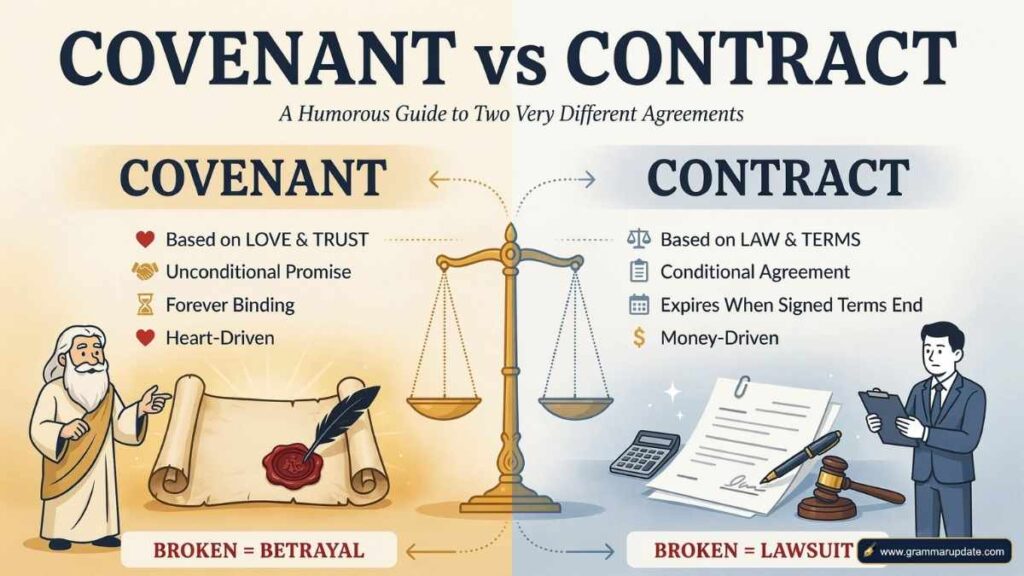
covenant vs contract debate, you’re not alone. These two words often get treated like identical twins, even though they have different jobs. A contract usually creates legally enforceable obligations, while a covenant can describe a serious promise, relationship, or legal undertaking. The confusion grows when the discussion moves into the Bible, marriage, or real estate, where each word can carry a different meaning. Instead of turning the distinction into a vocabulary maze, this guide breaks it down in plain English. You’ll learn the key differences, explore real-life and biblical examples, and see exactly where the two concepts overlap.
Covenant vs Contract The Basic Difference
In simple terms, a contract generally focuses on an agreement that creates legal rights and obligations. A covenant can describe a formal promise or commitment that may be legal, religious, personal, or relational.
The distinction becomes easier to understand when you compare the two concepts directly.
| Feature | Covenant | Contract |
|---|---|---|
| Basic meaning | A formal promise, undertaking, or commitment | An agreement that can create legally enforceable obligations |
| Main emphasis | Commitment, responsibility, relationship, or undertaking | Rights, duties, promises, and performance |
| Legal status | Depends on the circumstances | Depends on whether legal requirements for enforceability are satisfied |
| Religious use | Common | Generally uncommon in theological language |
| Personal use | Common | Less common |
| Property use | Common | Common |
| Business use | Can appear as a specific obligation | Common as the overall agreement |
| Can involve conditions? | Yes | Yes |
| Can involve long-term obligations? | Yes | Yes |
| Can be legally enforced? | Sometimes | Yes, when legally enforceable |
Even so, these categories aren’t completely separate. A covenant can appear inside a contract, and a contract can establish obligations that feel deeply personal or long-lasting.
That overlap is one reason the subject can be confusing.
What Is a Contract?
A contract is an agreement that creates legal obligations between parties when the requirements of applicable law are satisfied.
In everyday life, contracts are everywhere. You might sign a lease before moving into an apartment and You might agree to employment terms before starting a job or You might sign a purchase agreement when buying a home.
In each situation, the agreement establishes expectations.
For example, suppose you hire a contractor to remodel your kitchen for $20,000. You agree to pay the agreed amount, while the contractor agrees to complete specific work within the agreed terms. The written agreement might describe the materials, price, schedule, payment arrangements, and procedures for handling disputes.
That is the basic idea behind a contract.
What Makes an Agreement a Contract?
Although the exact rules vary depending on the jurisdiction and type of agreement, several concepts commonly appear in contract law.
- Offer: One party proposes specific terms.
- Acceptance: The other party accepts those terms.
- Mutual assent: The parties must generally demonstrate that they agreed to the same essential arrangement.
- Consideration: In traditional common-law contracts, each side generally provides or promises something of legal value.
- Capacity: The parties generally must have the legal ability to enter into the agreement.
- Legality: The purpose of the agreement must be lawful.
- Definite terms: The agreement normally needs sufficiently clear terms so the parties and a court can determine what was promised.
These principles provide a useful framework, but contract law contains many exceptions and specialized rules. For instance, certain transactions may require a written agreement, while the sale of goods can involve rules under commercial law.
Consequently, you shouldn’t assume that every agreement follows exactly the same legal formula.
Examples of Contracts
Contracts appear in ordinary transactions as well as complicated commercial relationships.
- An employment agreement establishes the terms of a person’s work.
- A residential lease establishes the rights and responsibilities of a landlord and tenant.
- A home purchase agreement sets out the terms for transferring property.
- A construction agreement explains the work a contractor must perform and the compensation involved.
- A business services agreement explains what one company will provide to another.
- A loan agreement establishes repayment obligations and other requirements.
- A licensing agreement gives someone permission to use intellectual property under specified conditions.
In each case, the agreement can create legal responsibilities.
Furthermore, a contract doesn’t have to be short-lived. Some contracts last months, while others continue for many years. Therefore, describing a contract as merely a temporary arrangement would be inaccurate.
Learn the difference between often confused words
Spicey vs Spicy Which Spelling Is Correct?
What Is a Covenant?
A covenant is a formal promise, undertaking, or commitment. Unlike the word contract, it doesn’t always describe a legal agreement.
The meaning changes according to the setting.
In a religious context, a covenant can describe a sacred commitment between God and peopleor In marriage, it can describe a serious commitment between spouses and In property law, it can describe an obligation connected with land In business law, it can describe a particular promise contained within a larger agreement.
Consequently, there isn’t one definition that explains every use of the word.
Covenant as a Solemn Promise
In ordinary language, covenant often carries a stronger sense of commitment than an everyday promise.
For example, telling a friend that you’ll call tomorrow is a simple promise. A covenant, by contrast, traditionally suggests a more formal and serious undertaking.
However, that doesn’t mean every covenant is permanent or legally enforceable.
A religious covenant may create spiritual responsibilities without giving anyone the right to sue in court. A personal covenant may create a powerful moral obligation without creating a legal one.
At the same time, a legal covenant can create genuine legal obligations.
That difference is important.
Learn the difference between often confused words
Alot vs A Lot vs allot Which is Correct and Usage
Covenant in Law
The legal use of covenant provides one of the clearest examples of how the two concepts overlap.
A covenant in a legal document can require someone to do something or refrain from doing something. It may appear in a contract, lease, deed, financing agreement, or another legal instrument.
For example, a loan agreement might require a borrower to maintain certain financial conditions. That requirement may be called a financial covenant.
Similarly, a lease may contain obligations concerning maintenance, property use, or other responsibilities.
Therefore, a covenant can function as a specific promise within a broader legal agreement.
This is why saying that a covenant and a contract are completely different legal concepts would be misleading.
Learn the difference between often confused words
Girlie vs Girly Which Spelling Is Correct?
The Main Differences
The most useful way to understand the difference is to examine what each term emphasizes covenant vs contract.
Commitment and exchange
Contracts often organize an exchange.
One party agrees to provide something, while another agrees to provide something in return.
For example, a customer pays a company to provide a service.
A covenant often places greater emphasis on commitment or undertaking. The person making the covenant accepts particular responsibilities as part of that commitment.
Still, this distinction isn’t absolute. Contracts can involve loyalty, trust, and long-term relationships. Likewise, legal covenants can exist within highly transactional arrangements.
Therefore, commitment and exchange are useful ways to compare the concepts, but they aren’t strict dividing lines.
Relationship and transaction
A contract often facilitates a transaction.
A company might agree to sell products to another company. A landlord might agree to rent property to a tenant. An employer might agree to provide compensation in exchange for work.
A covenant can instead emphasize an ongoing obligation.
For example, a property covenant may restrict how land can be used after ownership changes.
Even so, a contract can create continuing responsibilities as well. The distinction therefore depends on the context and purpose of the arrangement.
Consideration
Consideration plays an important role in traditional common-law contract formation.
In simple terms, covenant vs contract consideration involves something of legal value exchanged between the parties. It helps distinguish a contractual bargain from a statement that someone merely intends to make a gift or keep a personal promise.
A religious covenant doesn’t depend on consideration in this contractual sense.
That is one reason a covenant shouldn’t automatically be treated as a contract.
Legal enforcement
Legal enforcement creates another important difference covenant vs contract.
If an enforceable contract is breached, the injured party may have access to legal remedies. Depending on the circumstances, those remedies can include monetary damages or, in limited situations, an order requiring a party to perform a particular obligation.
A personal or religious covenant usually doesn’t operate that way.
Breaking a religious covenant may have spiritual consequencesorBreaking a personal covenant may damage trust and Breaking a legal covenant may result in legal consequences.
Thus, the consequences depend on the nature of the covenant.
Learn the difference between often confused words
Molding vs Moulding Which Spelling Is Correct and Usage?
Covenant vs Contract in the Bible
The biblical discussion requires particular care because the word covenant carries a theological meaning that doesn’t perfectly match modern contract law.
Throughout the Bible, covenant language describes major relationships involving God and people.
These relationships can include promises, commands, obligations, signs, blessings, consequences, and expectations of faithfulness.
As a result, describing every biblical covenant as a contract can make the concept seem narrower than it actually is.
What Does Covenant Mean in the Bible?
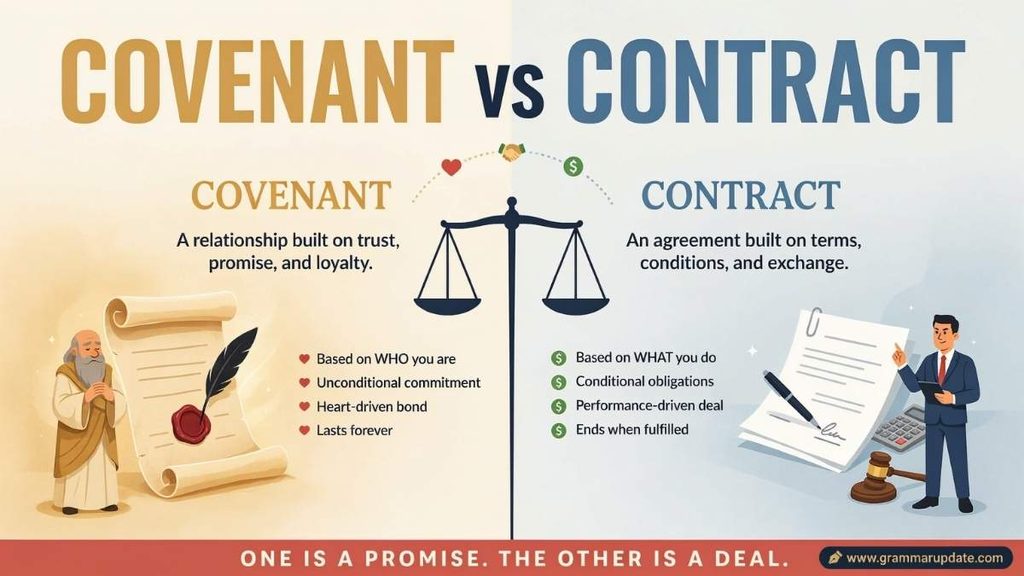
In the Bible, covenant generally describes a solemn relationship established through promises and obligations.
The Old Testament contains several important covenant relationships involving God, individuals, families, kings, and the nation of Israel.
The concept becomes one of the major ways the biblical story explains God’s relationship with people.
Rather than functioning simply as a commercial bargain, covenant can establish identity, responsibility, loyalty, worship, and hope.
That broader meaning explains why covenant occupies such an important place in biblical theology.
Learn the difference between often confused words
Muscle vs Mussel Which is Difference and usage?
Major Biblical Covenants
Several covenants stand out in the biblical narrative.
Noahic Covenant
The Noahic Covenant appears after the flood.
In Genesis 9, God establishes a covenant with Noah and his descendants and gives the rainbow as its associated sign.
The passage connects the covenant with God’s promise concerning the earth and future judgment by flood.
This example demonstrates that a biblical covenant can center heavily on divine promise.
Abrahamic Covenant
The Abrahamic Covenant develops through several passages in Genesis.
God calls Abraham and makes promises involving descendants, blessing, and the nations.
Later passages develop the covenant further and connect it with Abraham’s descendants and the promised land.
The covenant therefore becomes an important part of the biblical story of Israel.
Mosaic Covenant
The Mosaic Covenant, associated especially with Mount Sinai, establishes the covenant relationship between God and Israel.
Unlike a simple promise with no responsibilities, this covenant includes extensive commands and obligations.
Israel receives laws governing worship, community life, justice, morality, and religious practice.
Therefore, the idea that biblical covenant always means an unconditional promise isn’t accurate.
Some biblical covenants contain conditions, responsibilities, warnings, and consequences.
Davidic Covenant
The Davidic Covenant concerns God’s promises involving David’s royal line and kingdom.
It becomes significant throughout the Old Testament because later biblical writings connect these promises with expectations surrounding Israel’s future king.
The covenant therefore contributes to the larger biblical theme of kingship and redemption.
New Covenant
The New Covenant becomes especially important in the prophetic writings and the New Testament.
Jeremiah speaks of a future new covenant involving a transformed relationship between God and his people.
The New Testament connects this covenant with Jesus and develops the concept extensively, particularly in Hebrews.
Consequently, the New Covenant is central to Christian discussions about salvation and the relationship between God and believers.
Learn the difference between often confused words
Emigrate vs Immigrate Difference and usage
Is a Biblical Covenant the Same as a Contract?
No.
The two concepts overlap in the sense that both can involve promises, obligations, and defined relationships. However, a biblical covenant carries theological meaning that a modern commercial contract doesn’t capture.
A contract typically operates within a legal system.
A biblical covenant operates within a theological story involving God, people, promises, worship, faithfulness, and divine purposes.
For that reason, translating covenant into the modern idea of a contract can be useful for explaining certain similarities, but it shouldn’t be treated as a perfect equivalence.
Covenant vs Promise in the Bible
A promise and a covenant are closely related, but they aren’t identical.
A promise is an assurance that someone will do something or refrain from doing something.
A covenant can contain promises while also establishing a broader relationship with particular responsibilities.
Think of the difference this way:
A promise describes something someone commits to do.
A covenant can describe the larger relationship or formal commitment within which those promises operate.
This distinction makes biblical passages easier to understand because it prevents every promise from being treated as a covenant.
Learn the difference between often confused words
Imbed vs Embed Which Spelling Should You Use?
Covenant vs Contract in Marriage
Marriage provides perhaps the most familiar modern example of the distinction.
People often hear the statement that marriage is a covenant rather than a contract. The idea usually comes from a religious understanding of marriage.
However, marriage also has a clear legal dimension.
Therefore, covenant vs contract both perspectives can describe different parts of the institution.
Is Marriage a Covenant vs Contract?
Legally, marriage creates a recognized status accompanied by rights and responsibilities.
Religiously, many Christian traditions describe marriage as a covenant involving faithfulness, lifelong commitment, mutual responsibility, and promises made before God.
These descriptions aren’t necessarily competing with each other.
One explains the legal structure. The other explains the religious and relational meaning.
Marriage Covenant Meaning
The marriage covenant meaning focuses on the relationship between spouses.
Marriage vows often express commitments such as:
- Faithfulness
- Loyalty
- Mutual care
- Support during difficult circumstances
- Commitment to the relationship
- Long-term responsibility
- Respect and love
This explains why many religious communities use covenant language when discussing marriage.
The emphasis isn’t simply on what each spouse receives. Instead, the focus is on what each person promises to give and how the relationship should be maintained.
Marriage Contract Meaning
The legal side of marriage involves rights and responsibilities established by civil law.
Depending on the jurisdiction, marriage can affect property, inheritance, taxation, benefits, medical decisions, divorce proceedings, and other areas of family law.
Consequently, calling marriage a covenant doesn’t mean that marriage has no legal dimensions.
It simply highlights a different aspect of the relationship.
What Is a Covenant Marriage?
The phrase covenant marriage can also have a specific legal meaning.
Some U.S. states recognize a special form of marriage in which couples agree to additional requirements concerning the marriage and divorce process.
Arizona, Arkansas, and Louisiana recognize covenant marriage laws.
For example, Arizona law provides a specific statutory framework for couples who choose covenant marriage. The process includes additional requirements, including premarital counseling and a declaration concerning the nature of the commitment.
Therefore, someone discussing covenant marriage should first determine whether they mean a religious concept or a specific legal form of marriage.
Those are related ideas, but they’re not identical.
Learn the difference between often confused words
Planing vs Planning Difference and Correct Usage
Covenant vs Contract in Real Estate
Property law provides another important example of how covenant terminology works.
A property covenant can impose obligations or restrictions relating to land.
For example, a property document might restrict certain uses of the property or require an owner to maintain particular features.
Restrictive Covenants
A restrictive covenant limits what a property owner can do with the property.
Depending on the circumstances and applicable law, restrictions may address matters such as:
- Building structures
- Property use
- Fences
- Landscaping
- Commercial activity
- Architectural requirements
- Development restrictions
Homeowners may encounter these provisions in recorded property documents or community rules.
However, not every restriction is automatically enforceable. Courts may examine the wording, legal requirements, notice, the nature of the restriction, and other factors.
Covenants That Run With the Land
Some property covenants can run with the land.
In practical terms, this means a covenant may affect later owners rather than remaining merely a personal promise between the original parties.
The exact requirements vary by jurisdiction.
That is why someone buying property should review recorded documents and applicable restrictions rather than assuming that a particular covenant does or doesn’t bind future owners.
Learn the difference between often confused words
Licence vs License Which Spelling Is Correct?
Covenant vs Contract in Business
Business agreements demonstrate the overlap particularly well.
A company might enter into a loan agreement that establishes the overall contractual relationship. Within that agreement, the borrower may accept several financial covenants.
For example, the borrower might agree to:
- Maintain a particular financial ratio.
- Provide regular financial statements.
- Maintain required insurance.
- Avoid taking on certain additional debts.
- Obtain approval before selling particular assets.
The overall document is a contract.
The individual promises can be called covenants.
This example shows why contract and covenant shouldn’t always be treated as competing categories.
Sometimes one sits inside the other.
Covenant VS Contract Similarities and Differences
Although they have different meanings, covenants and contracts share several characteristics.
Similarities
Both can involve:
- Parties
- Promises
- Obligations
- Responsibilities
- Terms
- Conditions
- Performance
- Breach
- Consequences
- Long-term commitments
Both can also be written formally and can establish clear expectations between people or organizations.
Differences
The biggest difference is context.
A contract is fundamentally connected with legal enforceability.
A covenant can exist in legal, religious, personal, relational, or property settings.
That distinction matters because the consequences of breaking each type can be very different.
Learn the difference between often confused words
Canon vs Cannon Difference and Usage
Covenant Breach vs Contract Breach
Breaking either type of commitment can have consequences, but those consequences aren’t necessarily the same.
Covenant Breach
A covenant breach may involve different consequences depending on the setting.
1.Breaking a religious covenant can create spiritual or moral consequences.
2.Breaking a personal covenant can damage trust and a relationship.
3.Breaking a legal covenant can result in legal remedies or other consequences established by the governing agreement or law.
Contract Breach
A breach of contract occurs when a party fails to perform an obligation required by an enforceable contract.
Common examples include:
- Failing to make a required payment.
- Failing to deliver agreed goods.
- Refusing to perform promised services.
- Providing work that doesn’t meet contractual requirements.
- Violating an express provision of the agreement.
The available remedies depend on the circumstances.
In some cases, damages may compensate the injured party. In other circumstances, a court may provide equitable relief or another remedy.
Therefore, the phrase “breaking a promise” doesn’t tell you enough by itself. You need to know whether the promise forms part of an enforceable legal agreement.
Learn the difference between often confused words
Exercise vs Exorcise Differences and Correct Usage
Covenant vs Contract Examples
Real-life examples make the distinction much easier to remember.
Buying a Home
The purchase agreement is a contract because it establishes the terms of the property transaction.
A recorded restriction affecting the property may function as a covenant.
Thus, one property transaction can involve both a contract and a covenant.
Renting a Home
The lease is a contract.
Inside that lease, the tenant and landlord may have several continuing obligations.
Some of those obligations may be described as covenants depending on the wording and applicable law.
Taking Out a Business Loan
The loan agreement establishes the contractual relationship.
Financial requirements within the agreement can operate as covenants.
If the borrower violates one of those provisions, the agreement may specify what happens next.
Marriage
Civil marriage establishes legal rights and responsibilities.
A religious marriage ceremony may also describe the relationship as a covenant.
Therefore, marriage can have both legal and covenantal dimensions.
Biblical Covenant
A biblical covenant involves a theological relationship that can include promises, obligations, signs, responsibilities, and expectations of faithfulness.
It shouldn’t automatically be treated as a modern commercial agreement.
Common Misconceptions About Covenant VS Contract
Several popular explanations sound convincing but don’t hold up in every situation.
A covenant is always permanent
Not necessarily.
Some covenants may have a defined duration or may operate under particular legal conditions.
Likewise, some religious covenants emphasize permanence while others involve specific commitments within a defined context.
A contract is only about money
That’s also incorrect.
Contracts can regulate employment, services, intellectual property, confidentiality, property, technology, insurance, licensing, and many other relationships.
Money may be part of the arrangement, but it isn’t what makes something a contract.
A covenant is never legally binding
This is another common mistake.
Legal covenants can create enforceable obligations.
Property covenants are one example. Covenants within commercial agreements provide another.
The word covenant alone doesn’t determine whether a court will enforce it.
A contract is always temporary
Contracts can continue for years.
Some establish continuing obligations, automatic renewal provisions, or duties that survive termination.
Therefore, duration doesn’t reliably separate contracts from covenants.
Covenants and contracts are completely different
They aren’t.
The concepts have different meanings and uses, but they can overlap significantly.
A covenant can be contained in a contract. A contract can establish long-term commitments. A legal covenant can be enforceable. A religious covenant can exist outside the legal system.
The context determines the relationship between the terms.
How to Tell Whether Something Is a Covenant vs Contract
When you encounter either word, look beyond the label.
First, identify the context.
Is the discussion about religion, marriage, property, business, employment, or personal relationships?
Next, identify the parties.
Who is making the commitment? Who receives the benefit or accepts the responsibility?
Then examine the obligations.
What exactly does each party promise to do or avoid doing?
After that, consider enforceability.
Does the arrangement create legal rights that a court could enforce, or is it primarily religious, moral, or personal?
Finally, identify the governing rules.
A property covenant may depend on property law. A business agreement may depend on contract law. A religious covenant should be interpreted within its theological and historical context.
This approach is far more reliable than assuming that every use of covenant has the same meaning.
Practice Session Covenant vs Contract
- A __________ generally creates legally enforceable obligations between parties.
- A __________ can describe a serious promise, commitment, relationship, or legal undertaking.
- The exact meaning of covenant depends heavily on its __________.
- In traditional common-law contract formation, __________ refers to something of legal value exchanged between the parties.
- A contract may establish specific rights and __________ for each party.
- A legal covenant may appear within a larger __________.
- A __________ covenant can limit how a property may be used.
- The Noahic Covenant appears in the book of __________.
- The covenant associated with Abraham is known as the __________ Covenant.
- The __________ Covenant established a significant relationship between God and Israel through laws and obligations.
- The __________ Covenant concerns God’s promises involving David’s royal line.
- The __________ Covenant is an important concept in Christian theology and is discussed extensively in the New Testament.
- A __________ is an assurance that someone will do something or refrain from doing something.
- A breach of contract occurs when a party fails to perform an obligation required by an __________ contract.
- A covenant can have religious, personal, relational, property-related, or __________ meaning.
- In marriage, covenant language often emphasizes faithfulness, responsibility, and lifelong __________.
- A business loan may contain financial __________ that require the borrower to meet specific financial standards.
- A contract is often associated with a transaction, while a covenant can place greater emphasis on __________ and commitment.
- Marriage can have both legal and __________ dimensions.
- A property covenant may sometimes affect __________ owners of the property.
- Breaking a religious covenant may have moral or __________ consequences rather than legal ones.
- A contract can contain several promises, responsibilities, and specific __________.
- A covenant should not automatically be treated as the same thing as a modern commercial __________.
- Before agreeing to a legal covenant, you should carefully read its exact __________.
- The best way to distinguish a covenant from a contract is to examine its purpose, obligations, context, and ____
Answers
- Contract
- Covenant
- Context
- Consideration
- Obligations
- Contract
- Restrictive
- Genesis
- Abrahamic
- Mosaic
- Davidic
- New
- Promise
- Enforceable
- Legal
- Commitment
- Covenants
- Relationship
- Religious
- Future
- Spiritual
- Terms
- Contract
- Wording
- Enforceability
Here’s a trusted source for clear word meanings:
FAQs
What is the difference between a covenant and a contract?
A covenant is a formal promise or commitment that may have religious, personal, relational, property, or legal meaning. A contract is generally an agreement that creates legally enforceable obligations. The two can overlap because a legal covenant may appear as part of a contract.
Is a covenant legally binding?
Sometimes. A covenant can create legal obligations when it appears in a legally enforceable document, such as a deed, lease, or commercial agreement. However, a personal or religious covenant may carry moral or spiritual obligations without creating a legal claim.
Is a covenant the same as an agreement?
Not exactly. An agreement is a broad term for a mutual understanding between parties. A covenant can be an agreement, but it often carries a stronger sense of formal commitment, responsibility, or obligation.
Can a contract contain a covenant?
Yes. A contract can include one or more covenants that require a party to take a specific action or avoid certain conduct. For example, a loan agreement may require a borrower to maintain certain financial standards.
What is a covenant in simple terms?
A covenant is a serious promise or formal commitment. Its meaning depends on the context. It may describe a religious commitment, personal relationship, property restriction, or legally recognized obligation.
What is a contract in simple terms?
A contract is an agreement that creates legally recognized obligations between parties. It usually sets out what each party must do, what each party receives, and what may happen if someone fails to meet the agreed terms.
What is the difference between a covenant and a promise?
A promise is an assurance that someone will do something or refrain from doing something. A covenant is generally broader and can establish an ongoing relationship or formal commitment that includes promises, responsibilities, and obligations.
Can a covenant be broken?
Yes. A covenant can be broken when someone fails to honor its terms or commitments. The consequences depend on its nature. A legal covenant may lead to legal remedies, while a personal or religious covenant may have moral, spiritual, or relational consequences.
What is a restrictive covenant?
A restrictive covenant is a legal restriction on the use of property. For example, it may limit certain types of construction, business activity, or other uses of land. Whether the restriction remains enforceable depends on the wording and applicable law.
What does covenant mean in the Bible?
In the Bible, a covenant generally describes a significant relationship established through promises, commitments, and obligations. Biblical covenants can involve God and individuals, families, or communities. They have theological meaning that goes beyond the modern idea of a commercial contract.
What are the major covenants in the Bible?
The major biblical covenants commonly discussed in Christian theology include the Noahic Covenant, Abrahamic Covenant, Mosaic Covenant, Davidic Covenant, and New Covenant. Each appears in a different biblical context and carries its own promises, responsibilities, and significance.
Is a biblical covenant the same as a modern contract?
No. Biblical covenants can include promises and obligations, but they exist within a religious and historical framework that differs from modern contract law. Describing them simply as contracts can overlook their theological meaning and the role of relationship, faithfulness, worship, and divine promises.
Why is marriage sometimes called a covenant?
Many religious traditions call marriage a covenant because the term emphasizes the spouses’ commitment, faithfulness, responsibility, and enduring relationship. It focuses on the promises made between the spouses rather than only on the legal rights and duties created by marriage.
Is marriage legally a contract?
Marriage has legal consequences and creates rights and responsibilities under civil law. However, describing marriage only as a contract doesn’t capture its religious or relational dimensions. In many traditions, marriage also represents a covenant between spouses.
What is the difference between a marriage covenant and a marriage contract?
A marriage covenant generally emphasizes the commitment and relationship between spouses, particularly in a religious setting. A marriage contract refers to the legal arrangements and obligations associated with marriage. These ideas can describe different aspects of the same relationship.
What is a covenant in real estate?
A real-estate covenant is a promise or restriction connected to property. It may require an owner to take certain actions or restrict how the property can be used. Some covenants can affect future owners when the applicable legal requirements are satisfied.
What is a covenant in a business agreement?
A business covenant is a specific promise or obligation contained in a commercial agreement. For example, a loan agreement may include financial covenants requiring the borrower to maintain certain financial ratios or meet other conditions.
What is the difference between a covenant breach and a contract breach?
A covenant breach occurs when someone violates a covenant. A contract breach occurs when a party fails to perform an obligation required by an enforceable contract. Because a covenant can be part of a contract, one action can sometimes amount to both.
Can a covenant be unconditional?
Yes, depending on the covenant. Some covenants involve unconditional promises, while others contain specific conditions or responsibilities. The actual wording determines what each party has agreed to do.
Why do legal documents use the word covenant?
Legal documents use the term covenant to identify a formal promise or undertaking. It commonly appears in deeds, leases, financing agreements, and commercial contracts where a party takes on an ongoing obligation or agrees to avoid particular conduct.
What should you check before agreeing to a covenant?
Read the exact wording carefully. Then check who must follow it, what actions are required or prohibited, how long it lasts, whether it can affect future property owners or other parties, and what happens if someone violates it. When the obligation could have significant legal consequences, a qualified attorney can explain how the covenant applies to your situation.
Conclusion
Covenants vs contracts may seem like linguistic twins, but they don’t quite wear the same shoes. A contract generally creates legally enforceable obligations, while a covenant can describe a serious promise, lasting commitment, relationship, or legal undertaking. The context determines which meaning applies.
In the Bible, covenant carries a rich theological meaning that goes well beyond a modern business agreement. Or in marriage, it can emphasize faithfulness, responsibility, and lifelong commitment and In property and business law, however, a covenant can create specific legal obligations with real consequences.
So, when these two terms start causing a little vocabulary trouble, don’t rely on the label alone. Look at the purpose, promises, obligations, and surrounding context. Once you do, the difference becomes much easier to understand—and considerably less confusing.

Jhon AJS, the creative mind behind Grammar Update, is an experienced blogger passionate about simplifying English grammar. He focuses on explaining confusing word vs word differences, grammar rules, punctuation, and sentence structure in a clear and practical way. Through easy to understand guides and examples, Jhon helps readers improve their writing and communicate with confidence. With years of blogging experience, he continues to share helpful insights that make learning grammar simple, useful, and accessible for everyone.