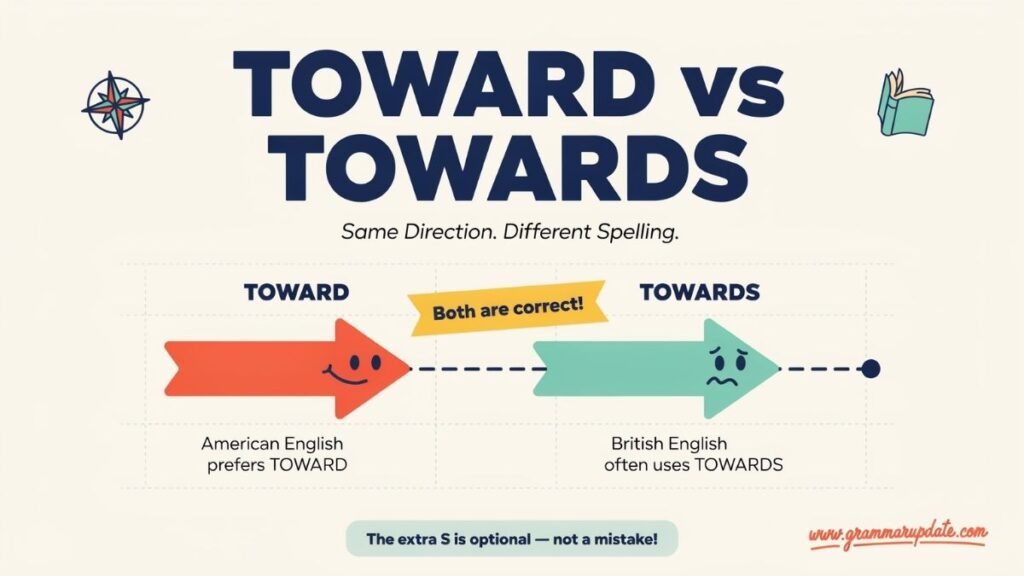
Choosing between “toward vs towards” can turn a perfectly simple sentence into a tiny grammar mystery. You write one version, glance at it again, and suddenly wonder whether that extra “s” belongs there at all. Thankfully, there’s no grammatical crime scene here. Both forms are correct. The real difference comes from regional usage, with “toward” more common in American English and “towards” more common in British English. In this guide, you’ll learn the meaning, grammar, usage, pronunciation, and practical examples behind toward or towards. By the end, you’ll know exactly which form to choose and when, without second-guessing every sentence.
Towards vs Toward Quick Answer
Toward vs towards are both standard English forms. They commonly express movement or direction toward a person, place, object, goal, or point in time. They can also describe an attitude or relationship.
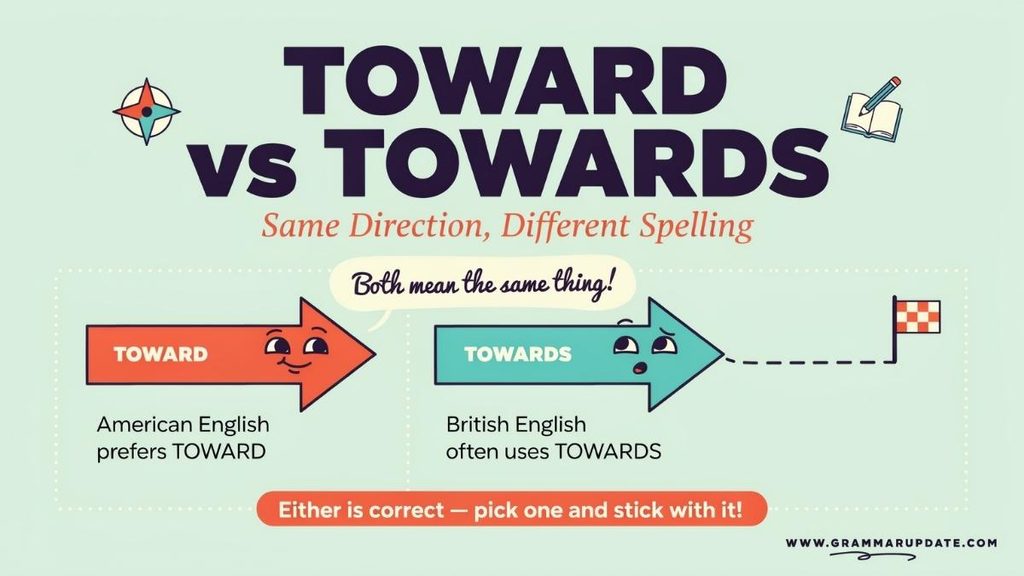
The main difference is regional preference.
| Word | Correct? | Common preference |
|---|---|---|
| Toward | Yes | American English |
| Towards | Yes | British English |
| Meaning | Generally the same | Depends on context |
| Grammatical role | Preposition | Preposition |
If you’re writing in American English, toward is usually the better choice. If you’re writing in British English, towards often sounds more natural.
That doesn’t mean American speakers never use towards or British speakers never use toward. English doesn’t work quite that neatly. Both forms appear in different varieties of English.
So, if you’re asking for the correct spelling toward or towards, the answer is that both spellings are correct.
Toward Definition and Meaning
The basic toward definition is “in the direction of” someone or something.
Consider this sentence:
“Maria walked toward the door.”
The word toward tells you the direction of Maria’s movement. It doesn’t necessarily tell you that she reached the door. She could have stopped, changed direction, or turned around.
That distinction becomes important when you compare toward with to.
“Maria walked to the door.”
Here, the door functions as the destination.
“Maria walked toward the door.”
Here, the door provides the direction.
The difference can be subtle, but it gives the writer more control over meaning.
The word toward also has several other uses.
Toward Can Describe Physical Movement
This is probably the use you encounter most often.
“The dog ran toward the gate.”
“She moved toward the window.”
“The hikers headed toward the mountain.”
In each sentence, toward identifies the general direction of movement.
Toward Can Describe Progress
You don’t have to physically move anywhere to use toward.
For example:
“The company is working toward profitability.”
“The researchers are moving toward a solution.”
“The team has taken another step toward its goal.”
In these examples, toward describes progress or advancement. The destination is an idea, result, or objective rather than a physical location.
Toward Can Describe Time
Toward can also refer to a point in time.
“Sales increased toward the end of the year.”
“The weather became colder toward midnight.”
“Toward the end of the meeting, everyone became more engaged.”
Here, toward means approaching a particular point in time.
Toward Can Describe Attitude or Behavior
The word can also describe someone’s relationship, attitude, or behavior toward another person or thing.
“She has a positive attitude toward change.”
“His behavior toward his coworkers improved.”
“The public’s attitude toward the proposal changed.”
In these examples, toward doesn’t describe physical movement. Instead, it describes a relationship or attitude.
Toward Can Describe a Contribution
Another common use appears when money, effort, or resources contribute to a particular purpose.
“She put $500 toward a new computer.”
“The donation will go toward repairing the building.”
“Every contribution goes toward the project.”
Again, the word connects an action or resource with a goal.
Learn the difference between more words people mix up
Fourteen vs Forteen Which Spelling Is Correct?
Towards Definition and Meaning
The towards definition is essentially the same as the definition of toward.
Towards can describe movement:
“He walked towards the station.”
It can describe progress:
“The project is moving towards completion.”
It can describe time:
“Towards the end of the year, demand increased.”
It can describe an attitude:
“She developed a more positive attitude towards the changes.”
It can also describe a contribution:
“They donated money towards the renovation.”
This is why the toward vs towards difference usually has nothing to do with meaning. In most situations, the two forms are interchangeable.
The main distinction is which form sounds more natural within a particular variety of English.
Toward vs Towards Difference What Changes?
The toward vs towards difference is mainly a matter of regional usage rather than grammar.
Compare these sentences:
“She walked toward the station.”
“She walked towards the station.”
The meaning remains the same.
Now compare:
“We are working toward an agreement.”
“We are working towards an agreement.”
Once again, the meaning doesn’t change.
The extra s doesn’t suddenly give the word a new definition. Instead, it reflects a usage preference.
| Feature | Toward | Towards |
|---|---|---|
| Meaning | Generally the same | Generally the same |
| Function | Preposition | Preposition |
| American English | More common | Less common |
| British English | Less common | More common |
| Formal writing | Correct | Correct |
| Academic writing | Correct | Correct |
This explains why asking “Which one is grammatically correct?” doesn’t quite capture the issue.
A better question is, “Which form fits the English variety and writing style I’m using?”
Learn the difference between more words people mix up
Favs vs Faves Difference Which Is Correct?
Toward vs Towards in American English
American English generally prefers toward.
That preference appears in everyday speech, professional writing, academic work, journalism, and general published content.
For example:
“The car moved toward the intersection.”
“She looked toward the door.”
“We’re working toward a solution.”
“The project is moving toward completion.”
“His attitude toward the issue has changed.”
These sentences all sound natural in American English.
So, if you’re wondering, “Do Americans use toward or towards?” the answer is both, but toward is generally more common.
This also answers another common question: “How do Americans spell towards?”
Americans can write towards. The spelling isn’t inherently wrong. However, toward is the usual American preference.
That distinction matters. A less common form isn’t automatically an incorrect form.
Toward vs Towards in British English
British English generally favors towards.
For example:
“She walked towards the station.”
“The company is moving towards a new strategy.”
“He turned towards the window.”
“They are working towards an agreement.”
“Towards the end of the meeting, the discussion became more focused.”
These sentences are completely standard.
However, British English also uses toward. You shouldn’t assume that British writers must always add the s.
This is a good example of how regional English works. A particular form can be strongly associated with one variety without becoming exclusive to that variety.
So, if you’re asking, “Do Brits say toward or towards?” both occur, but towards is generally the more common British preference.
Learn the difference between more words people mix up
Cognisant vs Cognizant difference which is correct ?
Toward vs Towards Grammar
From a grammatical standpoint, both words work as prepositions.
A preposition can show relationships involving direction, location, time, movement, or other circumstances.
Look at these examples:
“She walked toward the building.”
“The train moved towards the city.”
“His attitude toward criticism changed.”
“The event took place towards the end of June.”
In each sentence, the preposition connects the rest of the sentence to a noun or noun phrase.
The word can therefore appear in a variety of prepositional phrases, including:
“toward the door”
“towards the city”
“toward the future”
“towards the end”
“toward a goal”
“towards someone”
“toward something”
There isn’t a separate grammar rule that makes toward correct and towards incorrect. Both have established grammatical uses.
Learn the difference between more words people mix up
Enquiries vs Inquiries Which Spelling Is Correct?
Common Uses of Toward and Towards
Understanding the main uses makes the choice much easier.
Direction of Movement
When something moves in the direction of another thing, you can use either form.
“The child ran toward his mother.”
“The child ran towards his mother.”
“The bird flew toward the trees.”
“The bird flew towards the trees.”
The word identifies the direction without necessarily confirming arrival.
Progress Toward a Goal
Both forms can describe advancement toward an objective.
“The team is working toward a common goal.”
“The team is working towards a common goal.”
“The company is progressing toward profitability.”
“The company is progressing towards profitability.”
This construction appears frequently in business and academic writing.
Movement Toward the Future
You can also use the word metaphorically when discussing development or change.
“The country is moving toward a more sustainable energy system.”
“The industry is moving towards greater automation.”
Here, the word connects present circumstances with an anticipated future state.
Direction of Attention
Toward can also describe where someone directs their attention.
“She looked toward the horizon.”
“He turned towards the speaker.”
“The audience shifted its attention toward the stage.”
The movement may be physical, but the emphasis can also fall on attention or focus.
Attitudes and Relationships
You can use either form to describe someone’s feelings or behavior.
“Her attitude toward her colleagues was respectful.”
“His feelings towards the proposal remained uncertain.”
“The company’s approach toward customers has changed.”
These uses are common in formal and everyday English.
Learn the difference between more words people mix up
Crain vs Crane difference Which one Is Correct?
Toward in a Sentence Examples
If you’re looking for a clear example of toward in a sentence, consider these:
“The cyclist moved toward the finish line.”
“She turned toward the sound.”
“We are taking steps toward a better solution.”
“He looked toward the horizon.”
“The conversation shifted toward education.”
“They saved money toward a new home.”
Each example uses toward to express direction, movement, progress, focus, or purpose.
How to Use Toward in a Sentence
A simple pattern is:
Subject + verb + toward + noun or noun phrase.
For example:
“She walked toward the house.”
“The dog ran toward the gate.”
“The company moved toward a new strategy.”
You can also use toward before abstract nouns:
“The research points toward a possible explanation.”
“The policy represents a step toward reform.”
The noun after toward doesn’t need to be a physical location. It can represent a goal, result, change, or idea.
Learn the difference between more words people mix up
Visiter vs Visitor Difference Which One Is Correct?
Towards in a Sentence Examples
The same sentence structures work with towards.
“He walked towards the house.”
“The dog ran towards the gate.”
“The company moved towards a new strategy.”
“The research points towards a possible explanation.”
“The policy represents a step towards reform.”
Again, the meaning remains essentially unchanged.
The difference is the regional form.
Toward You or Towards You?
Both phrases are correct.
“Is it correct to say toward us or towards us?” Yes.
You can say:
“She walked toward you.”
“She walked towards you.”
“He turned toward us.”
“He turned towards us.”
“The dog ran toward us.”
“The dog ran towards us.”
For American English, toward is generally the preferred choice. For British English, towards is usually more natural.
The same principle applies to toward me, towards me, toward him, towards him, toward them, and towards them.
Toward the End or Towards the End?
Both phrases are correct.
“Toward the end of the movie, the mystery becomes clear.”
“Towards the end of the movie, the mystery becomes clear.”
The phrase means that something happens as the final part approaches.
You can use it with many periods or events:
1“toward the end of the day”
2“toward the end of the week”
3“toward the end of the month”
4“toward the end of the year”
5“toward the end of the meeting”
6“toward the end of the book”
For American English, toward the end is generally the preferred form.
For British English, towards the end is generally more common.
Working Toward or Working Towards?
Both forms are correct.
American English commonly uses:
“We’re working toward a solution.”
British English commonly uses:
“We’re working towards a solution.”
The same pattern appears with many other verbs:
“move toward” and “move towards”
“progress toward” and “progress towards”
“advance toward” and “advance towards”
“head toward” and “head towards”
“go toward” and “go towards”
The choice usually depends on regional convention rather than the verb itself.
So, if you’re asking, “Do you say working toward or working towards?” either works.
Walk Toward or Walk Towards?
It is correct to say both walk toward and walk towards.
“She walked toward the station.”
“She walked towards the station.”
Neither sentence has a grammatical problem.
The same applies to other movement verbs:
“He ran toward the car.”
“He ran towards the car.”
“She moved toward the door.”
“She moved towards the door.”
“They headed toward the city.”
“They headed towards the city.”
When writing American English, toward is generally the more natural default.
Go Toward or Go Towards?
Both are correct.
“Which is correct go toward or go towards?” Both.
For example:
“We decided to go toward the northern entrance.”
“We decided to go towards the northern entrance.”
The important distinction comes when you compare go toward with go to.
“We went to the station.”
“We went toward the station.”
The first sentence presents the station as the destination. The second emphasizes the direction.
That difference can affect the meaning of a sentence.
Learn the difference between more words people mix up
Resale vs Resell What’s the Difference?
Toward vs To Direction and Destination
Toward and to can sometimes appear in similar sentences, but they don’t always communicate the same thing.
“To” often identifies a destination.
“She drove to the airport.”
This tells you the airport was her destination.
“Toward” identifies direction.
“She drove toward the airport.”
This tells you she traveled in the airport’s direction. It doesn’t necessarily tell you that she arrived there.
Think of a road sign pointing north. If you travel north, you’re moving toward a destination even if you haven’t reached it yet.
That is the basic idea behind the distinction.
Toward vs Towards Pronunciation
Pronunciation varies across English accents.
In general, toward is commonly pronounced with one syllable in many forms of American English, while British pronunciations can vary. Towards typically adds a final z sound because of its spelling.
For English learners, it’s useful to understand that pronunciation doesn’t follow one universal model. American English, British English, Canadian English, Australian English, and other varieties can pronounce the same word somewhat differently.
How Do You Pronounce Toward in British English?
British pronunciation varies by accent. Some speakers pronounce toward with a more noticeable initial “tuh” sound, while others use a shorter form.
The important point is that British English doesn’t have only one accent. A speaker from London may sound quite different from someone from Scotland, Wales, or northern England.
Is Towards One or Two Syllables?
The pronunciation of towards can vary by accent. Many speakers use one syllable, while some pronunciations may be perceived as having two.
For English learners, listening to native speakers from the variety of English you’re studying is more useful than trying to force every speaker into one pronunciation pattern.
Learn the difference between more words people mix up
Allusion vs Illusion Difference and which is correct ?
Toward vs Towards in Formal Writing
Neither form is inherently more formal.
That’s worth remembering because writers sometimes assume that one sounds more professional than the other. The real issue is regional convention and consistency.
Both forms can appear in:
- Academic writing
- Business reports
- Professional emails
- Journalism
- Technical documents
- Everyday writing
- Formal correspondence
If you’re writing for an American university, toward will generally fit the expected American English style.
If you’re writing for a British institution, towards may fit better.
When a specific publication or organization has a style guide, follow its preference.
Learn the difference between more words people mix up
Advice vs Advise What’s the Difference?
Toward vs Towards Style Guide and Consistency
Consistency helps readers focus on your ideas rather than your wording choices.
Suppose an American company’s report says:
“The company is working toward its sustainability goals.”
A few pages later, it says:
“The company is moving towards cleaner production.”
Neither sentence is grammatically incorrect. Still, the switch can look unnecessary.
A consistent version would be:
“The company is working toward its sustainability goals and moving toward cleaner production.”
A British organization might reasonably make the opposite choice:
“The company is working towards its sustainability goals and moving towards cleaner production.”
This isn’t about changing grammar. It’s about creating a consistent writing style.
There is one important exception: quotations.
If someone actually said “towards,” you shouldn’t automatically change the word to “toward” simply because you’re writing in American English. Quoted language should normally preserve the speaker’s original wording unless the editorial context calls for another treatment.
Toward vs Towards in Canadian English
Canadian English uses both forms.
Because Canadian English has developed with influences from both American and British English, you may encounter toward and towards in Canadian writing.
Neither should automatically be treated as an error.
For professional or academic work, follow the style convention expected by the organization, publication, school, or employer.
The same principle applies to other regional varieties of English. Usage can overlap, and language rarely respects perfectly drawn borders.
Toward vs Towards in Australian English
Australian English also uses both forms, with towards being a common choice.
If you’re writing for an Australian audience, check the preferred style of the publication or organization when consistency matters.
For general communication, either form will usually be understood without difficulty.
Learn the difference between more words people mix up
That’s Mean vs that means Difference and which one is correct?
Common Mistakes With Toward and Towards
Assuming Towards Is Wrong
This is the most common misunderstanding.
Towards is a standard English word. It isn’t an incorrect version of toward.
Calling it a spelling mistake simply because American English often prefers toward confuses regional preference with grammatical correctness.
Assuming Toward Is Only American
Toward is strongly associated with American English, but British speakers and writers use it too.
The British preference for towards doesn’t make toward unacceptable.
Treating the Two Forms as Different in Meaning
In most ordinary contexts, they mean the same thing.
“The train moved toward London.”
“The train moved towards London.”
The direction hasn’t changed.
Switching Forms Without a Style Reason
Using both isn’t automatically wrong. However, consistency generally makes formal writing cleaner.
If you’re writing in American English, using toward throughout will usually produce a more natural result.
Writing Toward To
Avoid sentences such as:
“She walked toward to the door.”
Use:
“She walked toward the door.”
Or:
“She walked to the door.”
The extra to serves no useful purpose in the first construction.
Learn the difference between more words people mix up
Smoothe vs Smooth Which is Correct and Usage?
Is Towards a Word?
Yes. Towards is a standard English word.
It functions mainly as a preposition and can express direction, movement, progress, time, position, attitude, relationship, and purpose.
Examples include:
“He walked towards the door.”
“She worked towards her goal.”
“Towards the end of the year, sales improved.”
“His attitude towards the issue changed.”
There is no grammatical problem with any of these constructions.
Is Toward a Word?
Yes. Toward is also a standard English word.
It has been part of English for centuries and continues to serve several grammatical and semantic functions.
Examples include:
“She walked toward the door.”
“He worked toward his goal.”
“Toward the end of the year, sales improved.”
“Her attitude toward the issue changed.”
So the question isn’t whether one word exists and the other doesn’t. Both exist.
Learn the difference between more words people mix up
Swap vs Swop Difference which one is coorrect ?
Toward vs Towards Regional Differences
Regional variation explains most of the confusion.
| Variety of English | Common preference |
|---|---|
| American English | Toward |
| British English | Towards |
| Canadian English | Both |
| Australian English | Both, with towards commonly used |
| International English | Depends on audience and style |
These are tendencies, not absolute rules.
English speakers don’t all follow the same linguistic habits simply because they live in the same country. Personal preference, education, publishing conventions, and exposure to other varieties can all influence word choice.
Toward vs Towards Preference Which Should You Choose?
If you’re unsure, use this simple approach.
- If you’re writing American English, choose toward.
- If you’re writing British English, choose towards.
- If you’re writing for a specific organization, follow its style guide.
- If you’re writing academic or professional material, remain consistent.
- If you’re quoting someone, preserve their original wording when appropriate.
- If you’re learning English, recognize both forms even if you use only one as your default.
This approach keeps things simple without turning a regional difference into an unnecessary grammar rule.
Toward vs Towards Quick Reference
| Question | Answer |
|---|---|
| Is toward grammatically correct? | Yes |
| Is towards grammatically correct? | Yes |
| Are toward and towards interchangeable? | Usually |
| Do they have different meanings? | Usually no |
| Which is more common in American English? | Toward |
| Which is more common in British English? | Towards |
| Can Americans use towards? | Yes |
| Can British speakers use toward? | Yes |
| Is towards formal English? | Yes |
| Is toward formal English? | Yes |
| Can toward describe movement? | Yes |
| Can towards describe movement? | Yes |
| Can toward refer to time? | Yes |
| Can towards refer to time? | Yes |
| Can toward describe an attitude? | Yes |
| Can towards describe an attitude? | Yes |
| Should you keep one form consistent? | Usually, especially in formal writing |
| Does toward always mean arrival? | No |
| Is toward the same as to? | Not always |
Practice Session Toward vs Towards
Fill in each blank with either “toward” or “towards.” Choose the form that best fits standard English usage. Remember that both are correct, although “toward” is more common in American English and “towards” is more common in British English.
- The children ran ______ the playground.
- She walked ______ the front door.
- The company is working ______ a more sustainable future.
- He looked ______ the mountains in the distance.
- The dog suddenly moved ______ its owner.
- We are moving ______ the final stage of the project.
- She turned ______ the sound of music.
- The train was heading ______ the city center.
- His attitude ______ his coworkers has improved.
- They made significant progress ______ their goal.
- The road curves ______ the coast.
- The discussion shifted ______ the main issue.
- She saved money ______ buying a new laptop.
- The weather became colder ______ the end of the evening.
- He took a few steps ______ the window.
- The students are working ______ completing their assignment.
- The bird flew ______ the trees.
- Her feelings ______ the proposal changed over time.
- The team is making steady progress ______ success.
- As we moved ______ the end of the year, sales increased.
- The child reached ______ his mother when he became frightened.
- The boat slowly moved ______ the shore.
- They are taking steps ______ improving customer service.
- He glanced ______ the person standing near the entrance.
- The project is gradually moving ______ completion.
Answers
- toward
- toward
- toward
- toward
- toward
- toward
- toward
- toward
- toward
- toward
- toward
- toward
- toward
- toward
- toward
- toward
- toward
- toward
- toward
- toward
- toward
- toward
- toward
- toward
- toward
Here’s a trusted source for clear word meanings:
FAQs
When should I use towards?
Use “towards” when you want to show movement, direction, progress, time, or an attitude in relation to something. It’s especially common in British English. For example, “She walked towards the station.”
Is it correct to say “walk toward” or “walk towards”?
Yes. Both are grammatically correct. “Walk toward” is more common in American English, while “walk towards” is more common in British English.
Do Americans use toward or towards?
Americans use both, but “toward” is generally the preferred form in American English. For example, “He walked toward the entrance.”
What does “toward” mean?
“Toward” means “in the direction of” something or someone. It can also describe progress, time, attitude, or movement toward a goal.
Is it better to say toward or towards?
Neither is universally better. Use “toward” for a typical American English style and “towards” for a typical British English style. Both are standard English.
Is it correct to say “toward us” or “towards us”?
Yes. Both “toward us” and “towards us” are correct. The choice usually depends on regional preference.
Do you say working toward or working towards?
Both expressions are correct. “Working toward” is more common in American English, while “working towards” is widely used in British English.
Do you say leaning toward or leaning towards?
Both are correct. The phrase can describe a physical position or a preference. For example, “She is leaning toward the window” can describe position, while “I’m leaning toward the second option” can express a preference.
Do Brits say toward or towards?
British speakers use both forms, but “towards” is generally more common in British English.
Which is the correct spelling: “go toward” or “go towards”?
Both spellings are correct. “Go toward” is generally preferred in American English, while “go towards” is more common in British English.
Where can you use “towards” in a sentence?
You can use “towards” before a noun or noun phrase to express direction, movement, progress, time, attitude, or purpose. For example, “The company is moving towards a new strategy.”
What part of speech is “toward”?
“Toward” is primarily a preposition. It can introduce a phrase that shows direction, movement, relationship, time, or an intended goal.
What is another word for “toward”?
Depending on the context, alternatives include “in the direction of,” “approaching,” “heading to,” “moving toward,” “regarding,” “concerning,” and “in relation to.” The best alternative depends on the meaning of the sentence.
What is a “towards”?
“Towards” is not normally used as a noun. It is primarily a preposition that expresses direction, movement, progress, time, or relationship.
Is “towards” a preposition?
Yes. “Towards” functions as a preposition in standard English. In “She walked towards the door,” it introduces the prepositional phrase “towards the door.”
How do you pronounce “toward”?
“Toward” can have different pronunciations depending on the speaker’s accent. In many varieties of American English, it commonly sounds like “tord” or “tword.” British pronunciations vary by accent.
When should I use toward and towards?
Use either form when expressing direction, movement, progress, time, or an attitude. Your main consideration should be regional English. American writing generally favors “toward,” while British writing generally favors “towards.”
Which is correct: “work toward” or “work towards”?
Both are correct. “Work toward” is a common American English construction, while “work towards” is common in British English.
What is the difference between the prepositions “to” and “towards”?
“To” often identifies a destination, while “towards” usually indicates direction. “She walked to the store” suggests the store was her destination. “She walked towards the store” focuses on the direction she traveled.
What can I say instead of “towards”?
You can replace “towards” with a context-appropriate phrase such as “in the direction of,” “approaching,” “heading toward,” “regarding,” or “in relation to.” However, “towards” itself is perfectly correct.
What does the phrase “leaning towards something” mean?
“Leaning towards something” can mean physically tilting in its direction. It can also mean favoring an option or developing a preference. For example, “I’m leaning towards the blue jacket” means the blue jacket is currently the preferred choice.
conclusion
The great “toward vs towards” debate turns out to be much less dramatic than it first appears. No grammar police are waiting around the corner to issue a ticket for that extra “s.” Both forms are correct, and both generally carry the same meaning. The real difference comes down to regional preference.
American English typically favors “toward,” while British English commonly prefers “towards.” Neither choice makes your sentence grammatically wrong. What matters most is knowing your audience and keeping your writing consistent.
So, if you’re writing for an American audience, “toward” is usually the natural choice. If you’re following British English, “towards” fits comfortably. Once you understand the difference, this little grammar confusion can finally stop walking circles in your head.

Jhon AJS, the creative mind behind Grammar Update, is an experienced blogger passionate about simplifying English grammar. He focuses on explaining confusing word vs word differences, grammar rules, punctuation, and sentence structure in a clear and practical way. Through easy to understand guides and examples, Jhon helps readers improve their writing and communicate with confidence. With years of blogging experience, he continues to share helpful insights that make learning grammar simple, useful, and accessible for everyone.