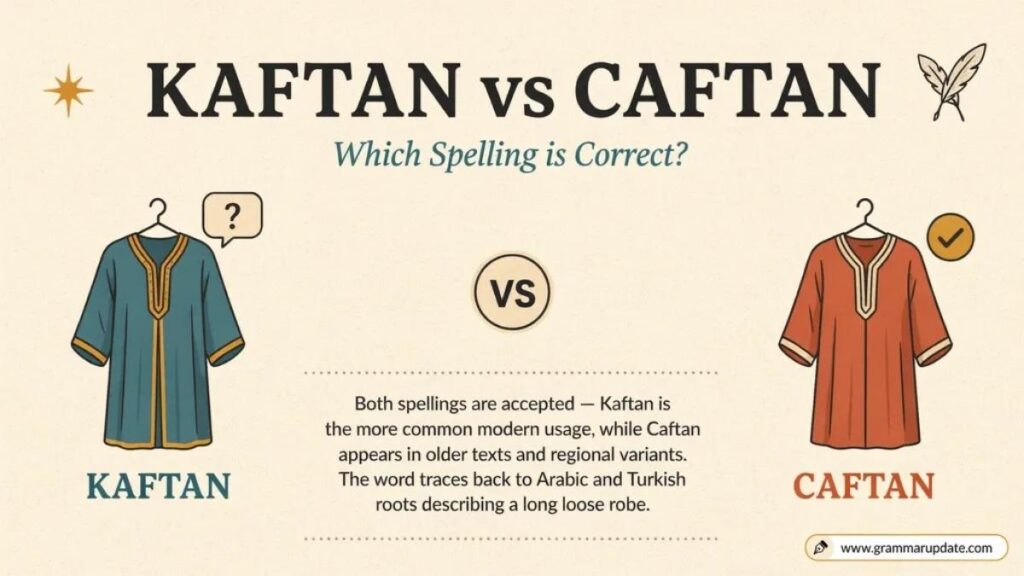
Kaftan vs caftan can make a simple clothing word feel surprisingly complicated. One starts with a “K,” the other with a “C,” so you might wonder whether they describe different garments or whether one is simply misspelled. The good news is that the answer is much easier than it looks. Both spellings are used in English, and they generally refer to the same type of long, loose-fitting garment. In this guide, we’ll clear up the kaftan vs caftan difference, explain their meanings, pronunciation, spelling, and history, and show you which form to use. By the end, you’ll have no reason to let these two spellings dress up your confusion.
Kaftan vs Caftan Quick Answer
The kaftan vs caftan difference is mainly a spelling difference. Both words can refer to a long, loose-fitting garment that may resemble a robe, tunic, or flowing dress.
Kaftan is a widely used English spelling, particularly in modern fashion writing. Caftan is also an established English spelling and appears in dictionaries and historical and contemporary sources.
Here’s the basic comparison:
| Feature | Kaftan | Caftan |
|---|---|---|
| English word | Yes | Yes |
| Standard spelling | Yes | Yes |
| Basic meaning | Long, loose garment | Long, loose garment |
| Historical use | Yes | Yes |
| Modern fashion use | Yes | Yes |
| Can describe a dress? | Yes | Yes |
| Can describe a robe? | Yes | Yes |
| Automatically a misspelling? | No | No |
| Pronunciation | Generally the same | Generally the same |
| Used in American English | Yes | Yes |
| Used in British English | Yes | Yes |
So, which spelling should you use?
In most situations, either form can work. Your best choice depends on the publication style, source, cultural context, or terminology used by the designer or institution you’re discussing.
Learn the difference between commonly mixed-up more words
Solicited vs Unsolicited Differences and Usage
What Is a Kaftan?
The kaftan definition describes a long, loose garment. Traditionally, kaftans have appeared in different forms across parts of Asia, the Middle East, and North Africa.
A traditional kaftan could serve as everyday clothing, formal wear, court clothing, or a ceremonial garment. Its construction varied considerably. Some examples were simple and practical, while others used expensive fabrics and elaborate decoration.
The modern meaning has become broader.
Today, a kaftan might mean a long flowing robe, a loose-fitting dress, a lightweight beach cover-up, or an elegant piece of resort wear. Some modern designs barely resemble historical examples except for their relaxed shape and flowing silhouette.
For example:
- She wore a cotton kaftan over her swimsuit.
- The museum displayed an embroidered Ottoman kaftan.
- The designer created a silk kaftan for the evening collection.
- Her loose kaftan kept her comfortable in the summer heat.
Each sentence uses the word naturally, but each describes a slightly different context.
Kaftan Meaning
The kaftan meaning depends heavily on context.
In historical writing, kaftan may refer to a particular style of robe associated with a specific culture or period. In modern fashion, however, the word can describe a much wider range of garments.
A modern kaftan can be short or long. It can have narrow sleeves, wide sleeves, or no sleeves at all. It can feature embroidery, beads, prints, metallic details, or almost no decoration.
The common thread is usually the loose, flowing design.
Learn the difference between commonly mixed-up more words
Cocoon vs Cacoon Which one Is Correct?
What Is a Caftan?
The caftan definition is closely related to the definition of kaftan.
A caftan is generally a long, loose garment. Depending on the historical or modern context, it may function as a robe, dress, or other flowing piece of clothing.
The word appears in both historical and modern English. It isn’t simply a typo created when someone accidentally replaced “k” with “c.”
That distinction matters because people sometimes assume that kaftan is the only correct spelling.
It isn’t.
Caftan has a legitimate place in English.
Caftan Meaning
The caftan meaning is essentially the same as the basic meaning of kaftan.
A traditional caftan could be made from rich textiles and worn as formal or ceremonial clothing. A modern caftan might be a lightweight dress designed for a vacation.
The word can therefore cover a surprisingly broad range of clothing.
Consider these examples:
- She chose a white caftan for the summer celebration.
- The exhibition included a richly decorated historical caftan.
- The designer’s new caftan collection used flowing silk.
- A loose caftan makes an easy beach cover-up.
The spelling changes, but the basic garment category remains.
Learn the difference between commonly mixed-up more words
Farther vs Further Differences, Rules and Examples
Kaftan and Caftan Difference Are They the Same?
If you’re asking, “Is kaftan the same as caftan?” the short answer is yes in ordinary English usage.
Likewise, if someone asks, “Are kaftan and caftan the same?” the answer is generally yes.
The two spellings normally refer to the same broad garment tradition. They don’t automatically represent two separate types of clothing.
However, that doesn’t mean every kaftan or caftan looks identical.
This is where context becomes important.
A Turkish kaftan may differ dramatically from a Moroccan caftan. A historical court garment may look nothing like a modern beach dress. A heavily embroidered formal garment may share little visually with a lightweight cotton cover-up.
The spelling doesn’t create those differences. Culture, history, design, and purpose do.
The Difference Between Kaftan and Caftan Is Not a Design Rule
You shouldn’t assume that a kaftan has one particular neckline while a caftan has another.
You also shouldn’t assume that one must be men’s clothing while the other belongs to women’s fashion.
There is no general English rule that divides the garments that way.
The distinction is primarily linguistic.
If a clothing designer calls a garment a caftan, that doesn’t mean it suddenly belongs to a completely different clothing category from a garment another designer calls a kaftan.
Learn the difference between commonly mixed-up more words
Poopie vs Poopy difference and Which Is Correct?
Kaftan vs Caftan Spelling Why Are There Two Forms?
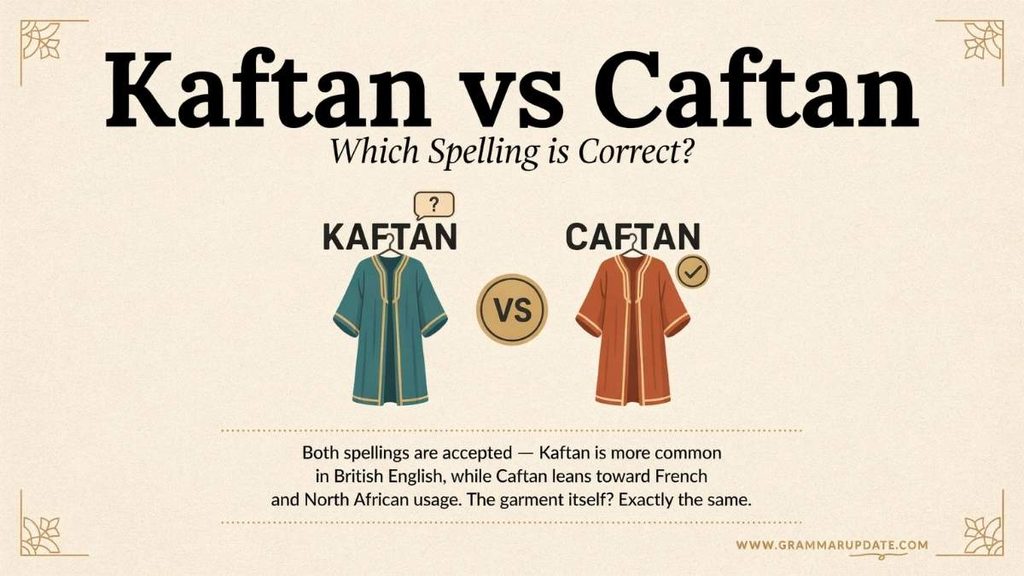
The kaftan caftan spelling variation has a long linguistic history.
The word entered English through a chain of languages and spelling traditions. English ultimately connects the term with Persian qaftān, with forms of the word also passing through languages such as Turkish and Russian.
When words travel from one language to another, their spelling can change.
That happens for several reasons. Different languages use different alphabets. Transliteration systems vary. Speakers adapt unfamiliar sounds to their own writing systems. Over time, more than one form can become established.
That is exactly the sort of process that can produce spelling variation.
Is Caftan a Misspelling of Kaftan?
No.
Caftan is an established English word.
Calling it a misspelling simply because kaftan looks more familiar ignores the history of the word. Major English dictionaries recognize caftan as a legitimate form.
The reverse is also true.
Kaftan isn’t a misspelling of caftan.
Both forms have a documented place in English.
Learn the difference between often confused words
Of vs Off difference and which one is correct?
Kaftan vs Caftan Origin
The kaftan vs caftan origin question becomes complicated when people try to attach the garment to one modern country.
The history doesn’t fit that neatly.
The word has a documented connection with Persian qaftān, while the garment tradition spread across a broad region. Historical forms appeared in Persia, the Ottoman Empire, Central Asia, and other parts of the Middle East and North Africa.
As people, textiles, ideas, and clothing styles moved between regions, garments changed as well.
That history makes the kaftan more than a single national costume.
It represents a broad clothing tradition that developed different regional forms.
Persian Kaftan
The phrase Persian kaftan often appears in discussions of historical Persian clothing.
Persian clothing traditions included several different garments, so it would be inaccurate to treat every historical Persian robe as a kaftan. Still, the word itself has a documented connection to Persian.
That linguistic connection is one reason the origin story cannot be separated completely from the history of Persia.
Turkish Kaftan
The Turkish kaftan has an especially important place in Ottoman clothing history.
Ottoman kaftans could be highly elaborate. Court garments used luxurious fabrics and detailed patterns, and some surviving examples feature silk, brocade, velvet, embroidery, and metallic thread.
These garments could communicate wealth and status.
A richly decorated kaftan wasn’t merely something to throw on before heading outside. In court settings, clothing could become a visual language of rank, wealth, and ceremony.
Moroccan Kaftan
The Moroccan kaftan developed its own distinctive tradition.
Museum collections contain Moroccan examples made with materials such as silk and cotton and decorated with brocade and metallic thread. The history of the garment in Morocco reflects earlier connections with Persian and Ottoman clothing traditions.
Over time, Moroccan designers and artisans developed regional forms with their own construction, decoration, and cultural meaning.
That is why “Moroccan kaftan” should be treated as a specific cultural expression rather than simply another name for every historical kaftan.
Learn the difference between often confused words
Judgment vs Judgement Which one Is Correct?
Kaftan vs Caftan History How the Garment Traveled
The history of the kaftan stretches far beyond the modern fashion industry.
Historical examples show that related garments appeared across a wide geographical area. Some were designed for everyday wear, while others belonged to wealthy households, military settings, or royal courts.
One particularly interesting historical example comes from the Caucasus region. A surviving garment dating from roughly the seventh to ninth century has been identified as a coat or caftan with silk decoration and fur lining. Its construction included openings that made it suitable for riding.
That example shows why the word shouldn’t make you imagine only a modern flowing dress.
Historical kaftans could be practical.
They could also be spectacular.
The materials used depended on the wearer, location, climate, social position, and purpose of the garment.
Silk, wool, linen, cotton, fur, brocade, and metallic threads all appear in different historical clothing traditions associated with the term.
Kaftan vs Caftan Pronunciation
The kaftan caftan pronunciation is generally the same in ordinary English speech.
The difference between the letters “k” and “c” doesn’t normally produce a difference in the initial sound here because the “c” in caftan represents the same hard sound.
In American English, the word is commonly pronounced with the first syllable receiving the main stress.
Some pronunciation differences can occur between speakers, particularly in stress and regional speech patterns. However, you don’t normally need to pronounce kaftan and caftan as two completely different words.
So if you’re wondering, “Are kaftan and caftan pronounced the same?” the practical answer is yes.
Kaftan vs Caftan in American English
The idea of American English kaftan versus American English caftan can be misleading if it suggests that one spelling belongs exclusively to the United States.
Both forms occur in American English.
Kaftan is particularly familiar in contemporary fashion writing. You’ll often see it used for resort wear, beach clothing, flowing dresses, and designer collections.
Caftan also appears in American English, especially in fashion, historical, and cultural contexts.
Therefore, “kaftan US spelling” and “caftan US spelling” don’t represent a simple either-or rule.
Both can appear in US English.
The safest approach is consistency.
If your publication uses kaftan, stick with kaftan. If you’re discussing a source that uses caftan, preserve that spelling when appropriate.
Kaftan vs Caftan in British English
The same principle applies to British English.
It would be inaccurate to say that kaftan is strictly American while caftan is strictly British.
Both spellings have been used in English across regions.
This makes kaftan vs caftan different from obvious American and British spelling pairs such as color and colour.
There isn’t a simple rule that says British writers must use one form and American writers must use the other.
Instead, usage depends on the dictionary, publisher, writer, historical source, or cultural context.
Learn the difference between often confused words
Unfazed vs Unphased difference and which one is correct?
Kaftan vs Caftan Dress What’s the Difference?
When comparing kaftan vs caftan dress, the spelling usually isn’t the important part.
A kaftan dress is generally a modern dress inspired by the loose and flowing kaftan silhouette.
A caftan dress follows the same basic idea.
Modern versions can range from casual clothing to formal wear.
Common features include:
- A relaxed silhouette
- Long or flowing fabric
- Wide sleeves
- A loose-fitting body
- Decorative embroidery
- Beading or other embellishment
- Lightweight or luxurious fabrics
- Long or mid-length hems
- Sashes or belts in some designs
Not every garment with these features qualifies as a traditional kaftan, though.
Modern fashion often borrows names from historical clothing and adapts them for new purposes.
A beach cover-up may borrow the flowing shape of a traditional garment without reproducing its historical construction.
Traditional Kaftan vs Modern Kaftan
A traditional kaftan can carry cultural and historical significance that a modern fashion version doesn’t necessarily share.
Historical garments could indicate social position, wealth, occupation, or ceremonial status.
Modern versions often prioritize comfort, style, versatility, and visual appeal.
That doesn’t make one “real” and the other “fake.”
They simply belong to different contexts.
A historical kaftan might use elaborate brocade and metallic thread. A modern summer kaftan might use lightweight cotton.
One may belong in a museum.
The other may belong in a suitcase.
Both can legitimately carry the name.
Traditional Caftan vs Modern Caftan
The same distinction applies to a traditional caftan.
A historical caftan could involve carefully constructed panels, luxurious fabric, embroidery, or elaborate ornamentation.
A modern caftan might be mass-produced and sold as casual wear.
Modern fashion has stretched the meaning of the term without completely disconnecting it from the original garment tradition.
That’s common in clothing vocabulary.
Words survive while styles evolve.
Learn the difference between tricky grammar more words
Diverse vs Divers Difference and which is correct?
Kaftan vs Caftan Across Different Cultures
The broad history of the garment reaches across several regions.
However, it’s important not to flatten those traditions into one category.
Middle Eastern Clothing
The kaftan has a strong connection with the history of Middle Eastern clothing.
Long robes and flowing garments have served practical and social purposes across the region. However, Middle Eastern clothing includes many distinct garments, each with its own name, history, and construction.
A kaftan shouldn’t become a catch-all term for every long robe.
North African Clothing
The garment also became important in North African clothing, particularly in Morocco.
The Moroccan tradition developed its own distinctive forms, decorative techniques, and social meanings.
That regional development illustrates how clothing changes as it moves between cultures.
A borrowed garment isn’t frozen in time.
People adapt it.
Central Asia
The broader clothing tradition also has connections with Central Asia and neighboring regions.
Historical clothing in this area often responded to climate, mobility, trade, and local textile production. Long coats and robes could provide warmth and protection while also serving social and ceremonial purposes.
This wider context helps explain why the kaftan has never been a single fixed design.
Kaftan vs Kimono
Kaftans and kimonos can look similar at first because both can have flowing fabric and wide sleeves.
They are not the same garment, however.
A kimono belongs to a specific Japanese clothing tradition with its own construction, terminology, symbolism, and wearing methods.
A kaftan belongs to a different historical clothing tradition.
Visual similarity isn’t enough to make two garments interchangeable.
Kaftan vs Dashiki
A dashiki belongs to a different African clothing tradition.
Some modern dashikis and kaftans can share loose silhouettes, colorful patterns, or flowing shapes. Yet they have different cultural histories and typical design features.
Calling one the other simply because they look somewhat similar would create unnecessary confusion.
Kaftan vs Muumuu
A muumuu developed in Hawaii and has its own cultural and historical background.
Like a kaftan, it can have a loose and flowing shape. That doesn’t make the garments identical.
The distinction lies in their histories, construction, cultural context, and terminology.
Caftan vs Robe
Robe is a much broader term.
A caftan robe can be described as a robe because a caftan can function as a robe-like garment. However, not every robe is a caftan.
The same applies to a kaftan robe.
Think of “robe” as a large umbrella and “kaftan” as one type of clothing that may fall underneath it in certain contexts.
Kaftan vs Tunic
A tunic is another related clothing term.
Generally, a tunic refers to a garment worn over the upper body that extends below the waist. A kaftan can also have a tunic-like structure, but traditional kaftans are often longer and more robe-like.
Again, clothing terminology doesn’t always follow perfectly rigid boundaries.
Historical terms change meaning over time, and different cultures classify garments differently.
Learn the difference between tricky grammar more words
Caribbean vs Carribean Which one Is Correct?
Common Mistakes With Kaftan and Caftan
The most common mistakes aren’t spelling errors at all. They’re assumptions about the words.
Mistake 1 Calling Caftan Wrong
Caftan is a legitimate English spelling.
It isn’t an accidental variation created by careless typing.
Mistake 2 Calling Kaftan Wrong
Kaftan is also legitimate.
You don’t need to “correct” it to caftan.
Mistake 3 Treating One as American and the Other as British
The two spellings don’t follow a strict US-versus-UK division.
Mistake 4 Assuming They Describe Different Garments
The spelling alone doesn’t establish a different garment.
Mistake 5 Calling Every Long Dress a Kaftan
A long flowing dress isn’t automatically a kaftan.
The term has historical and stylistic meaning.
Mistake 6 Ignoring Cultural Context
A historical Turkish kaftan and a modern Moroccan caftan shouldn’t be described as though they’re identical garments.
Their relationship may be historical, but their regional forms can differ considerably.
Learn the difference between tricky grammar more words
Practice vs Practise Which one Is Correct?
Kaftan vs Caftan in Everyday Examples
Clear examples make the difference easier to understand, remember, and use correctly.
Examples With Kaftan
- She wore a blue kaftan at the beach.
- The exhibition featured an Ottoman kaftan.
- Her silk kaftan looked elegant enough for dinner.
- The designer added embroidery around the sleeves.
- He chose a lightweight kaftan for the summer trip.
Examples With Caftan
- She bought a white caftan for her vacation.
- The collection featured brightly colored caftans.
- The historical caftan included intricate embroidery.
- A loose caftan works well as resort wear.
- The designer used silk and brocade for the formal caftan.
Both sets of sentences are grammatically correct.
The spelling doesn’t change the basic meaning.
Learn the difference between tricky grammar more words
Deceive vs Decieve Which one Is Correct?
Practice Session Kaftan vs Caftan
- The word ______ refers to a long, loose garment with long sleeves.
- ______ and caftan are both established English spellings for the garment.
- In English, “kaftan” is generally considered a variant spelling of ______.
- A traditional ______ may be made from silk, cotton, velvet, or brocade.
- The word “caftan” ultimately traces back through Turkish to the Persian word ______.
- The spelling ______ is commonly listed as the main dictionary form in Merriam-Webster.
- “Kaftan” and “caftan” generally have the same basic ______.
- A Moroccan ______ can feature elaborate embroidery and decorative details.
- You can write “kaftan dress” or “______ dress” when referring to this type of clothing.
- The two spellings are not simply a case of one being a spelling ______.
- A kaftan is typically described as a long and ______ garment.
- In historical contexts, kaftans were worn in parts of the Middle East, Central Asia, and ______ Africa.
- The spelling “kaftan” is recognized in both American and ______ English.
- “Caftan” and “kaftan” are generally pronounced ______ in modern English.
- A traditional Turkish ______ could be made from richly decorated silk textiles.
- The plural of “kaftan” is usually ______.
- The plural of “caftan” is usually ______.
- When writing for a general English-speaking audience, ______ spelling is acceptable.
- A kaftan may function as a traditional garment, formal clothing, or a modern fashion ______.
- The difference between “kaftan” and “caftan” is mainly a difference in ______ rather than meaning.
- The phrase “______ or caftan” asks which spelling a writer should choose.
- A loose-fitting kaftan can also resemble a long ______ or robe.
- The Moroccan kaftan became an important part of traditional ______ clothing.
- If a dictionary lists “kaftan” as a variant of “caftan,” that means both forms are ______ in English.
- The simplest answer to “Which is correct, kaftan or caftan?” is that ______ spellings are accepted.
Answers
- kaftan
- Kaftan
- caftan
- kaftan
- qaftān
- caftan
- meaning
- kaftan
- caftan
- mistake
- loose-fitting
- North
- British
- similarly
- kaftan
- kaftans
- caftans
- either
- style
- spelling
- kaftan
- dress
- North African
- accepted
- both
Here’s a trusted source for clear word meanings:
FAQs
Is kaftan the same as caftan?
Yes. In English, kaftan and caftan generally refer to the same type of long, loose-fitting garment. The main difference is the spelling, not the basic meaning. Both forms are recognized in English.
Which spelling is correct kaftan vs caftan?
Both spellings are correct. Caftan is commonly treated as the standard dictionary form, while kaftan is an established variant. You can use either spelling when referring to this type of garment.
Is kaftan a misspelling of caftan?
No. Kaftan is not simply a misspelling of caftan. It is an accepted variant spelling that has been used in English for many years.
Why does kaftan have two spellings?
The variation comes from the word’s history as it passed through different languages and regions. Forms related to the Persian word qaftān and the Turkish kaftan contributed to the different spellings used in English.
Is caftan more common than kaftan?
Caftan is generally the more common main dictionary form, but kaftan remains widely recognized and frequently appears in fashion, historical, and cultural writing. Neither spelling should automatically be treated as an error.
Are kaftan and caftan pronounced the same way?
Yes, they are generally pronounced the same way in modern English. The spelling changes from k to c, but that difference doesn’t normally create a different pronunciation.
What does kaftan mean?
Kaftan means a long, loose-fitting garment, traditionally worn in various parts of the Middle East and surrounding regions. Modern kaftans can also appear as dresses, robes, resort wear, or other fashion garments.
What does caftan mean?
Caftan has essentially the same meaning as kaftan. It refers to a long, usually loose-fitting garment that can have long sleeves and may be worn as traditional clothing or modern fashion.
What is the difference between kaftan and caftan?
The main difference is spelling. Both words generally describe the same broad type of garment. The choice between them usually depends on dictionary preference, regional usage, historical context, or personal style.
Can kaftan and caftan be used interchangeably?
Yes. In most contexts, you can use kaftan and caftan interchangeably when referring to the same type of garment. However, keeping one spelling consistent throughout your writing makes your text cleaner and easier to read.
What is a kaftan dress?
A kaftan dress is a dress based on the loose, flowing shape associated with a traditional kaftan. Modern versions can be simple and casual or highly decorated for formal occasions.
What is a caftan dress?
A caftan dress is a modern dress designed in the loose, flowing style of a caftan. Depending on the design, it may be worn casually, as resort wear, or for a more formal event.
Is a kaftan a robe or a dress?
It can be either, depending on the garment and context. Traditionally, kaftans often had a robe-like form. In modern fashion, designers also use kaftan styles for dresses and other types of clothing.
Is a caftan the same as a robe?
Not exactly. A caftan can have a robe-like shape, but robe is a broader term. A caftan specifically refers to a particular style of loose-fitting garment with a long history across several regions.
Is a kaftan the same as a tunic?
No. Kaftans and tunics can both have loose-fitting designs, but they aren’t identical. A tunic is usually shorter and has its own range of styles, while a kaftan typically has a longer, more flowing silhouette.
Is a kaftan the same as a kimono?
No. A kimono is a distinct traditional Japanese garment with its own construction and cultural history. A kaftan comes from a different clothing tradition, even though both can have loose and flowing designs.
Is a kaftan the same as a muumuu?
No. A muumuu is a separate type of loose-fitting garment associated with Hawaii. A kaftan has a different historical and cultural background, although both garments can have relaxed silhouettes.
What is a Moroccan kaftan?
A Moroccan kaftan is a traditional garment associated with Moroccan clothing culture. It can feature rich fabrics, embroidery, decorative details, and a belt or other elements that give the garment a distinctive formal appearance.
What is a Persian kaftan?
A Persian kaftan refers to historical kaftan-style clothing associated with Persia. Persian clothing traditions form an important part of the wider history of the kaftan and related garments.
What is a Turkish kaftan?
A Turkish kaftan is a traditional garment associated with Turkish and especially Ottoman clothing. Historical examples could use luxurious textiles, intricate patterns, and elaborate decoration.
Are kaftans only traditional clothing?
No. Kaftans have a long traditional history, but modern designers have adapted the style for contemporary fashion. Today, you may see kaftans as dresses, beach cover-ups, resort wear, casual clothing, or formal garments.
Can men wear kaftans?
Yes. Kaftans have historically been worn by men in several regions. Modern fashion also includes kaftan-style garments designed for men.
Can women wear kaftans?
Yes. Women have worn kaftans in various cultural traditions, and modern women’s fashion offers many kaftan-inspired designs. These range from simple everyday dresses to elaborate formal garments.
Is kaftan an American spelling?
No. Kaftan isn’t exclusively an American spelling. It is an established English variant used in both American and British English.
Is caftan a British spelling?
No. Caftan isn’t exclusively British either. Both caftan and kaftan occur in American and British English, so the distinction isn’t a simple US-versus-UK spelling rule.
Which spelling should I use in American English?
You can use either kaftan or caftan in American English. If you’re following a particular dictionary, publication style, or brand guide, use its preferred form and keep that spelling consistent.
Which spelling should I use in British English?
Both forms are recognized in British English. Caftan is a standard form, while kaftan is also accepted. Your choice can depend on the dictionary or style guide you’re following.
What is the plural of kaftan?
The usual plural is kaftans. For example: “The boutique displayed several colorful kaftans.”
What is the plural of caftan?
The usual plural is caftans. For example: “The collection included several traditional caftans.”
Why do some writers prefer kaftan while others use caftan?
Writers may choose a spelling based on regional habits, historical context, dictionary preference, fashion terminology, or editorial style. Neither choice automatically signals a different garment.
Can I use both kaftan and caftan in the same article?
You can, but it’s usually better to choose one as your main spelling and introduce the other as a variant. Switching back and forth without a reason can make your writing feel inconsistent.
What is the easiest way to remember kaftan vs caftan?
Think of them as two accepted spellings for the same general garment. Caftan is a common dictionary form, and kaftan is a recognized variant. When in doubt, check the style guide or dictionary you’re following and stay consistent.
Learn the difference between tricky grammar more words
HAVC vs HVAC? Which one Is Correct?
Conclusion
The kaftan vs caftan confusion is easier to settle than it first appears. Both kaftan and caftan are accepted English spellings for the same general type of loose, flowing garment. Caftan is commonly used as the main dictionary form, while kaftan is a recognized variant. So, if you’ve been wondering whether one of them is simply a spelling mistake, you can relax. Your red pen can stay in the drawer.
The easiest way to remember the difference is this: the spelling changes, but the basic meaning doesn’t. Whether you write kaftan or caftan, you’re generally talking about a long, loose-fitting garment that can be traditional or modern.
You also shouldn’t assume that kaftan is strictly American English or that caftan is strictly British English. Both spellings appear in English on both sides of the Atlantic. Your best choice depends on the dictionary, style guide, audience, or publication you’re writing for.
And here’s the grammar lesson worth remembering: not every spelling variation creates a different word. English has borrowed vocabulary from many languages, and some borrowed words developed more than one accepted form. Kaftan and caftan are a perfect example.
So, which should you use? Pick one, use it correctly, and stay consistent. If your article begins with kaftan, there’s no need to suddenly switch to caftan halfway through unless you’re specifically discussing the spelling difference.
In short, kaftan and caftan are not rivals fighting for the fashion crown. They are two spellings of essentially the same word. Once you understand that, the confusion disappears, the grammar gets clearer, and your writing can move on to more important things like deciding whether that kaftan needs pockets.

Jhon AJS, the creative mind behind Grammar Update, is an experienced blogger passionate about simplifying English grammar. He focuses on explaining confusing word vs word differences, grammar rules, punctuation, and sentence structure in a clear and practical way. Through easy to understand guides and examples, Jhon helps readers improve their writing and communicate with confidence. With years of blogging experience, he continues to share helpful insights that make learning grammar simple, useful, and accessible for everyone.