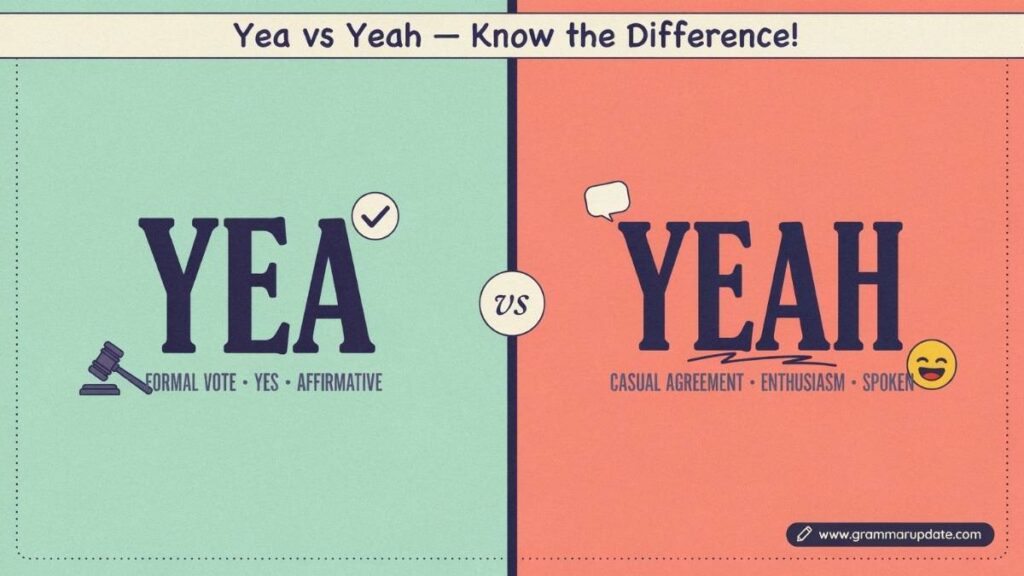
Yea vs yeah? They may look like linguistic twins, but they don’t always belong in the same sentence. Type “Yeah, I agree,” and nobody bats an eye. Write “Yea, I agree,” however, and your sentence suddenly sounds like it wandered out of an old parliamentary debate. To make matters more confusing, “yay” joins the party whenever excitement enters the room. So, which word should you choose? The answer depends on what you mean and where you’re using it. This guide to yea vs yeah clears up the confusion with simple explanations, natural examples, and practical rules that make the difference easy to remember.
Yea vs Yeah Quick Answer
Both “yea” vs “yeah” are correct English words. The important difference is how people use them.
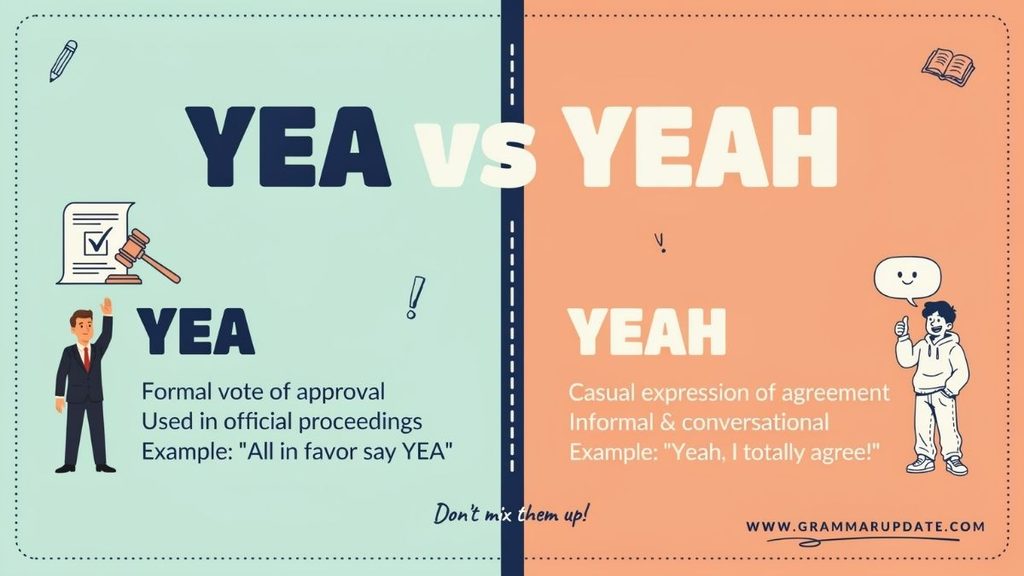
Yeah is an informal way to say “yes.” It’s common in everyday speech and casual writing.
Yea can also mean “yes,” but modern English mainly uses it in voting and other formal or traditional contexts.
For a quick reference, look at the comparison below.
| Word | Main meaning | Typical context | Example |
|---|---|---|---|
| Yeah | Informal “yes” | Conversation, texting, casual writing | “Yeah, I’ll come.” |
| Yea | Yes; affirmative vote | Voting, formal or traditional language | “The motion received 20 yeas.” |
| Yes | Affirmative response | Formal and everyday English | “Yes, I can help.” |
So if you’re chatting with a friend, yeah will usually sound right. If you’re describing how people voted, yea is the better choice. For a professional email, yes will normally fit best.
What Does “Yeah” Mean?
“Yeah” means “yes,” but it sounds more relaxed.
You hear it constantly in everyday conversations. Someone might use it to answer a question, agree with a statement, confirm something, or simply show that they’re following along.
For example:
“Are you coming with us?”
“Yeah, I’ll be there.”
Or:
“That restaurant was packed last night.”
“Yeah, I know. We had to wait forever.”
In the second example, “yeah” doesn’t simply answer a question. It acknowledges what the other person said and keeps the conversation moving.
That’s one reason the word feels so natural in spoken English.
Learn the difference between often confused words
Copyright vs Copywrite Differences, Usage and Mistakes
How “Yeah” Works in Conversation
The meaning of “yeah” can shift slightly depending on the speaker’s tone.
A cheerful “Yeah!” might show excitement:
“Did we win?”
“Yeah!”
A quieter “yeah” might simply acknowledge information:
“Your package arrived.”
“Yeah, I saw it.”
You might also hear it when someone agrees strongly with another person:
“That’s exactly what I was thinking.”
“Yeah, me too.”
So although “yeah” basically means “yes,” real conversations give it plenty of room to express attitude and emotion.
“Yeah” for Excitement
“Yeah!” can express excitement as well as agreement.
For example:
“Yeah! We finally finished!”
“Yeah! Let’s go!”
Here, the word carries energy. The exclamation mark helps, but the situation and tone matter just as much.
Still, there’s another word that is more directly associated with excitement: yay.
“Yay! We won!”
That sentence celebrates the good news rather than simply agreeing with it.
Learn the difference between often confused words
Coma vs Comma which is Difference?
What Does “Yea” Mean?
“Yea” is a real English word, but you’ll rarely hear it used as an ordinary “yes” in modern conversation.
Today, its clearest use appears in voting language.
For example:
“The proposal received 30 yeas and 12 nays.”
In this sentence, “yeas” means votes in favor of the proposal.
You can also find “yea” in older books, historical writing, religious texts, and language that intentionally sounds traditional. Outside those settings, it can feel a little old-fashioned.
That’s why writing “Yea, I’ll meet you at seven” can sound strange. The reader understands it, but the word doesn’t match the casual situation.
Yea in Voting
Voting is where “yea” earns its place in modern English.
A yea represents an affirmative vote, while a nay represents a negative vote.
For example:
“The committee voted yea on the proposal.”
“The bill passed with 42 yeas and 18 nays.”
This wording is common when discussing legislative decisions and other formal votes.
If you’re reporting how people voted, “yea” is the natural term. “Yeah” doesn’t perform the same job.
Learn the difference between often confused words
Presant vs Present which is Correct Spelling and Usage?
What Does “Yea or Nay” Mean?
The expression “yea or nay” means “yes or no.”
It’s traditionally used when someone needs an affirmative or negative decision.
For example:
“We need a yea or nay by Friday.”
In ordinary conversation, you could simply say:
“We need a yes or no by Friday.”
“Yea or nay” sounds more formal and traditional. It can also be used playfully when someone wants a definite answer.
Yea vs Yeah The Main Difference
The simplest way to understand the difference between Yea vs yeah is to think about where you would naturally hear each word.
Yeah belongs in everyday conversation.
Yea belongs mainly in voting and traditional language.
Consider these sentences:
“Yeah, I’ll come with you.”
“Yeah, that sounds good.”
“The committee voted yea.”
“The proposal received 25 yeas and 8 nays.”
All four sentences make sense, but they belong to different situations.
Now switch the words:
“Yea, that sounds good.”
“The proposal received 25 yeahs and 8 nays.”
The first sounds old-fashioned. The second doesn’t use the standard voting term.
That’s the real distinction. The words aren’t simply two spellings of the same everyday expression.
Learn the difference between often confused words
Payed vs Paid Difference and Which One is Correct?
When to Use “Yeah”
Use “yeah” when you’re saying “yes” in a relaxed setting.
It works naturally in:
- Casual conversations
- Text messages
- Friendly emails
- Social media conversations
- Informal dialogue
- Everyday speech
For example:
1“Yeah, I’m free tonight.”
2“Yeah, that works for me.”
3“Yeah, I already sent it.”
4“Yeah, no problem.”
There’s nothing wrong with any of these sentences. In fact, replacing “yeah” with “yea” would make them sound noticeably less natural.
Yeah in Text Messages
Texting is probably one of the easiest places to see the difference.
Imagine this exchange:
“Are you still coming tonight?”
“Yeah, I’ll be there around eight.”
That’s completely ordinary.
Now imagine:
“Are you still coming tonight?”
“Yea, I’ll be there around eight.”
The meaning is clear, but the spelling feels unusual. It may even sound like the person is joking or deliberately trying to sound old-fashioned.
That’s why yeah is the natural choice for most casual messages.
Learn the difference between often confused words
Straight vs Strait Difference and Which Is Correct and Usage?
When to Use “Yea”
Use “yea” when the context specifically calls for it.
The clearest situation is a formal vote.
For example:
“The members voted yea.”
“The motion received 18 yeas and 5 nays.”
“The chair asked the members to vote yea or nay.”
You may also encounter the word in historical or traditional writing.
What you shouldn’t do is assume that “yea” is simply a more formal version of “yeah.”
Suppose someone writes:
“Yeah, I agree.”
If you want to make that sentence more formal, the natural version is:
“Yes, I agree.”
Not:
“Yea, I agree.”
That’s an important distinction. Yes is the neutral formal alternative. “Yea” has its own particular uses.
Yea, Yeah, and Yes
The difference becomes even clearer when you put all three words side by side.
| Word | Tone | Main use | Example |
|---|---|---|---|
| Yeah | Casual | Informal agreement or confirmation | “Yeah, I agree.” |
| Yea | Formal, traditional, or specialized | Voting and traditional expressions | “She voted yea.” |
| Yes | Neutral or formal | General affirmative response | “Yes, I agree.” |
Think of them as three different choices rather than three spellings of the same word.
1.If you’re talking to a friend, “yeah” sounds natural.
2.If you’re answering a professional email, “yes” usually works better.
3.If you’re reporting the result of a vote, “yea” has the right meaning.
Learn the difference between often confused words
Mobil vs Mobile Which Is Correct and Usage?
Yea vs Yeah in Formal Writing
Formal writing doesn’t automatically call for “yea.”
In fact, if you’re writing a professional email or academic paper, yes is usually the better choice.
Compare these sentences:
“Yeah, I can attend the meeting.”
“Yes, I can attend the meeting.”
“Yea, I can attend the meeting.”
The first is casual. The second is professional and neutral. The third sounds unnecessarily old-fashioned.
The goal of formal writing isn’t to make ordinary words sound grander than they need to be. Good writing usually does the opposite. It chooses the clearest word that fits the situation.
Professional Emails
In workplace communication, “yes” is generally the safest choice.
For example:
1.“Yes, I can send the revised document today.”
2.“Yes, I’ll attend the meeting.”
3.“Yes, we can make those changes.”
“Yeah” isn’t necessarily wrong in every workplace. If you’re writing to a close colleague in a very relaxed environment, it may fit. However, “yes” gives you a more polished and professional tone.
“Yea” usually belongs nowhere in a standard business email unless you’re actually discussing a vote.
Academic Writing
Academic writing tends to favor neutral language.
If you need an affirmative response, “yes” will usually work better than “yeah” or “yea.”
For example:
“Yes, the evidence supports this conclusion.”
“Yeah, the evidence supports this conclusion.”
The second sentence sounds like spoken conversation. The first fits formal writing much better.
Learn the difference between often confused words
Rancor vs Rancour Difference and Which Spelling Is Correct?
Yea vs Yeah Pronunciation
Pronunciation is another reason these words can cause confusion.
Yea is pronounced like “yay.”
Yeah has a different vowel sound and is closer to “yeh” in ordinary American speech.
In simple terms:
| Word | Approximate sound |
|---|---|
| Yea | “yay” |
| Yeah | “yeh” |
| Yay | “yay” |
The similarity between “yea” and “yay” is especially important because those two words sound alike but have different meanings.
Yea Pronunciation
The standard pronunciation of “yea” is /jeɪ/.
It rhymes with words such as:
- Day
- Say
- Way
- Play
So when you say:
“The member voted yea.”
the final sound is the same basic sound you hear in “day.”
Yeah Pronunciation
“Yeah” has a different vowel sound. In American English, it is commonly pronounced somewhere around /jæə/ or /jeə/, depending on the speaker.
The difference may seem small, especially when someone speaks quickly. That’s one reason people sometimes confuse the spelling when they only hear the word.
Learn the difference between often confused words
Gray vs Grey Which Spelling Is Correct and Difference?
Yea vs Yay
1.“Yea” and “yay” are pronounced alike, but their meanings are completely different.
2.Yea relates to agreement or voting.
3.Yay expresses happiness, excitement, or celebration.
Compare:
“The senator voted yea.”
“Yay! We won!”
The first sentence describes a vote. The second expresses joy.
This distinction is especially useful when you’re writing informal messages.
If you’re celebrating good news, use yay.
If you’re describing an affirmative vote, use yea.
Yeah vs Yay
“Yeah” and “yay” are also easy to mix up because both appear frequently in casual communication.
A simple question can help:
Are you agreeing, or are you celebrating?
If you’re agreeing, use “yeah.”
“Do you want to come?”
“Yeah!”
If you’re celebrating, use “yay.”
“We got tickets!”
“Yay!”
The words may sound energetic in both situations, but their meanings aren’t the same.
Yea, Yeah, and Yay Examples
| Situation | Best word | Example |
|---|---|---|
| Casual agreement | Yeah | “Yeah, I agree.” |
| Answering a casual question | Yeah | “Yeah, I’ll come.” |
| Texting a friend | Yeah | “Yeah, no problem.” |
| Affirmative vote | Yea | “She voted yea.” |
| Reporting voting results | Yea | “The bill received 40 yeas.” |
| Expressing excitement | Yay | “Yay! We won!” |
| Formal response | Yes | “Yes, I agree.” |
Once you connect each word with its purpose, the difference becomes much easier to remember.
Learn the difference between often confused words
Propose vs Purpose Which Is Correct?
Common Mistakes With Yea vs Yeah
Most mistakes come from treating “yea” vs “yeah” as interchangeable spellings.
Using “Yea” as a Casual “Yeah”
Consider:
“Yea, I’ll call you later.”
The reader can understand the sentence, but it doesn’t sound like normal modern conversation.
A more natural version is:
“Yeah, I’ll call you later.”
Using “Yeah” for a Vote
Now consider:
“The proposal received 20 yeahs and 10 nays.”
That’s not the standard way to describe affirmative votes.
A better version is:
“The proposal received 20 yeas and 10 nays.”
Assuming “Yea” Is the Formal Version of “Yeah”
This is probably the most important mistake to avoid.
If “yeah” is too casual for your situation, don’t automatically replace it with “yea.”
Instead, use yes.
For example:
Casual:
“Yeah, I agree.”
Neutral or formal:
“Yes, I agree.”
Voting:
“The member voted yea.”
Each sentence uses a different word because each situation calls for something different.
Thinking “Yeah” Is Incorrect
“Yeah” isn’t a spelling mistake.
It’s a recognized informal English word. Its casual tone simply makes it less suitable for some situations.
For example:
“Yeah, that sounds great.”
works perfectly in a conversation with a friend.
The same sentence might feel too relaxed in a formal business document. That’s a matter of style and register, not grammar.
Learn the difference between often confused words
Envolved vs Involved Which Is Correct?
Yea vs Yeah in Social Media
Online communication often makes language more flexible.
People write the way they speak, shorten words, stretch spellings, and use punctuation to show emotion.
You might see:
“Yeah, that’s true.”
“Yay! Finally!”
“Yeahhh, let’s go!”
“Yea or nay?”
These forms aren’t necessarily evidence that the traditional distinctions have disappeared. Online writing simply gives people more freedom to play with language.
If someone writes “yea” when they mean casual “yeah,” readers will often understand the intended meaning. However, standard usage still favors “yeah” for informal “yes.”
Context remains king.
A Simple Case Study
Imagine three people using an affirmative response in three completely different situations.
A Friend Invites You to Dinner
“Are you free tonight?”
“Yeah, I’d love to come.”
The casual setting makes “yeah” a natural choice.
A Manager Asks for Confirmation
“Can you attend tomorrow’s meeting?”
“Yes, I’ll be there.”
Here, “yes” sounds clear and professional.
A Committee Votes on a Proposal
“How did the members vote?”
“The proposal received 16 yeas and 5 nays.”
Here, “yea” is appropriate because the sentence describes an affirmative vote.
The underlying idea is similar in all three situations: agreement. The context determines which word sounds right.
Different Ways to Say Yes
English has many expressions for agreement, and each one brings a slightly different tone.
| Expression | Tone | Example |
|---|---|---|
| Yes | Neutral or formal | “Yes, that’s correct.” |
| Yeah | Casual | “Yeah, that’s right.” |
| Yep | Very casual | “Yep, I’m ready.” |
| Sure | Casual acceptance | “Sure, no problem.” |
| Absolutely | Strong agreement | “Absolutely.” |
| Definitely | Strong certainty | “Definitely.” |
| Yea | Traditional or voting use | “The member voted yea.” |
| Yay | Excitement | “Yay! We won!” |
This is why choosing an alternative to “yes” isn’t always a matter of spelling. You’re also choosing a tone.
Learn the difference between often confused words
It’s Called vs It Called Which Phrase Is Grammatically Correct?
Yea vs Yeah Which One Should You Use?
When you’re unsure, think about the situation first.
Choose “Yeah” When:
- You’re having a casual conversation.
- You’re texting a friend.
- You’re writing informal dialogue.
- You’re chatting online.
- You want a relaxed way to say “yes.”
Example:
“Yeah, I’ll meet you there.”
Choose “Yea” When:
- You’re describing an affirmative vote.
- You’re using “yea or nay.”
- You’re discussing legislative or formal voting.
- You’re deliberately using traditional language.
Example:
“The bill received 35 yeas and 11 nays.”
Choose “Yes” When:
- You’re writing professionally.
- You’re writing academically.
- You’re preparing a formal document.
- You want a neutral response.
- You aren’t talking about a vote.
Example:
“Yes, I can provide the information by Friday.”
Choose “Yay” When:
- You’re celebrating.
- You’re showing happiness.
- You’re reacting enthusiastically.
- You’re expressing excitement.
Example:
“Yay! We finally finished!”
Yea vs Yeah The Easy Rule
If you still find the words confusing, remember four simple associations:
Yeah = casual yes
Yea = affirmative vote
Yes = neutral yes
Yay = excitement
That’s really all you need for most situations.
You don’t have to turn every sentence into a grammar puzzle. Ask yourself what you mean, consider the setting, and choose the word that sounds natural there.
Practice Session Yea vs Yeah
- ______, I’d be happy to help.
- The committee voted ______ on the proposal.
- ______! We finally won the game!
- She gave an enthusiastic ______ to the plan.
- The final vote included 24 ______ and 9 nays.
- “Are you coming with us?” “______.”
- The members were asked to vote ______ or nay.
- ______, that sounds like a great idea.
- “______! We’re going on vacation!”
- The senator cast a ______ vote.
- “Did you finish your homework?” “______.”
- The motion passed after receiving 18 ______.
- ______, I understand what you mean.
- “______! We got front-row seats!”
- The chair recorded 31 ______ and 14 nays.
- “Do you want some coffee?” “______.”
- The representative voted ______ on the bill.
- ______, no problem. I can handle it.
- “______! School is finally over!”
- The proposal received more ______ than nays.
- “Are you sure about this?” “______.”
- The members could respond with either yea or ______.
- ______, I’ll send the document this afternoon.
- The official record showed 27 ______ and 6 nays.
- “______! That’s exactly what I was hoping for!”
Answers
- Yeah
- yea
- Yay
- yes
- yeas
- Yeah
- yea
- Yeah
- Yay
- yea
- Yeah
- yeas
- Yeah
- Yay
- yeas
- Yeah
- yea
- Yeah
- Yay
- yeas
- Yeah
- nay
- Yes
- yeas
- Yay
Here’s a trusted source for clear word meanings:
FAQs
Can “yea” be used in everyday conversation?
It can, but it isn’t the usual modern choice for a casual “yes.” In everyday conversation, “yeah” sounds much more natural. “Yea” may sound formal, traditional, or connected to voting.
Is “yea” appropriate in a business email?
Usually, no. If you simply want to express agreement in a professional email, “yes” is a better choice. Use “yea” when you’re discussing an affirmative vote or a traditional expression such as “yea or nay.”
Why does “yea” appear with “nay”?
“Yea” and “nay” form a traditional pair for affirmative and negative votes. In voting language, “yea” means a vote in favor, while “nay” means a vote against.
Can “yeah” appear in formal writing?
Yes, but it depends on the purpose of the writing. “Yeah” works naturally in dialogue, interviews, quotations, and informal content. In most formal prose, “yes” provides a more neutral tone.
What is the plural of “yea”?
The plural of “yea” is “yeas.” For example, “The proposal passed with 28 yeas and 12 nays.” The word refers to affirmative votes.
What is the plural of “yeah”?
“Yeah” normally works as an informal response rather than a countable noun. In unusual contexts where people discuss individual responses, “yeahs” can appear, but it isn’t the standard voting term.
Can “yea” mean agreement outside voting?
Yes. “Yea” has historically meant “yes” or expressed agreement. However, that use now sounds formal, literary, or old-fashioned compared with everyday “yeah.”
Is “yeah” a shortened form of “yes”?
“Yeah” developed as an informal variant of “yes,” rather than simply serving as a modern spelling mistake or abbreviation. It has become a well-established part of conversational English.
Why does “yea” sound different from “yeah”?
The spellings represent different words with different standard pronunciations. “Yea” rhymes with “say,” while “yeah” has the vowel sound heard in ordinary expressions such as “yeah, sure.”
Can “yea” and “yay” be used interchangeably?
No. Although “yea” and “yay” are pronounced alike, their meanings differ. “Yea” relates to agreement or an affirmative vote, while “yay” expresses happiness or excitement.
Is “yea” appropriate when cheering?
No. When you’re cheering or celebrating, “yay” is normally the correct word. For example, “Yay! We won!” expresses excitement, while “yea” refers to agreement or an affirmative vote.
Can “yeah” express disagreement?
Not by itself in its basic meaning. However, expressions such as “yeah, but…” can introduce disagreement or a qualification. The word still starts with acknowledgment or agreement before the speaker adds a different point.
Why do people write “yeah” instead of “yes”?
“Yeah” sounds more relaxed and conversational than “yes.” People naturally use it in speech, texting, social media, and friendly conversations because it creates a less formal tone.
Does punctuation change the meaning of “yeah”?
It can change the tone significantly. “Yeah.” may sound flat or reluctant, while “Yeah!” can show enthusiasm. “Yeah?” can signal a question or ask someone to continue speaking.
Is “yeah” suitable for dialogue in fiction?
Yes. Writers often use “yeah” in dialogue because it reflects natural speech. Whether it fits depends on the character, setting, and tone of the conversation.
Can “yea” be used as an adjective?
No. “Yea” primarily functions as an adverb, interjection, or noun in contexts involving affirmation or voting. It doesn’t work as a general adjective meaning “yes.”
What does a “yea vote” mean?
A “yea vote” means an affirmative vote in favor of a proposal, motion, bill, or decision. If someone votes yea, they support the measure being considered.
Is “yea” more formal than “yeah”?
In some contexts, yes, but the distinction is more specific than simply formal versus informal. “Yea” has traditional and voting uses, while “yeah” serves as the ordinary informal form of “yes.”
Which word is safest when you’re unsure yea, yeah, or yes?
Yes is usually the safest choice when you want a neutral response. Choose “yeah” for casual conversation, “yea” for affirmative voting or traditional language, and “yay” for excitement.
conclusion
Yea vs yeah? They may look like close cousins, but each word has its own place. Yeah is the natural choice when you casually mean “yes,” while yea mainly appears in voting language or traditional expressions. And when you’re celebrating, yay takes the spotlight.
A simple way to remember the difference is this: yeah is for everyday agreement, yea is for an affirmative vote, and yay is for excitement. Once you connect each word with its purpose, the confusion disappears. So before you let these three little words turn into a grammar headache, pause and ask what you actually mean. The right choice will usually become obvious.

Jhon AJS, the creative mind behind Grammar Update, is an experienced blogger passionate about simplifying English grammar. He focuses on explaining confusing word vs word differences, grammar rules, punctuation, and sentence structure in a clear and practical way. Through easy to understand guides and examples, Jhon helps readers improve their writing and communicate with confidence. With years of blogging experience, he continues to share helpful insights that make learning grammar simple, useful, and accessible for everyone.