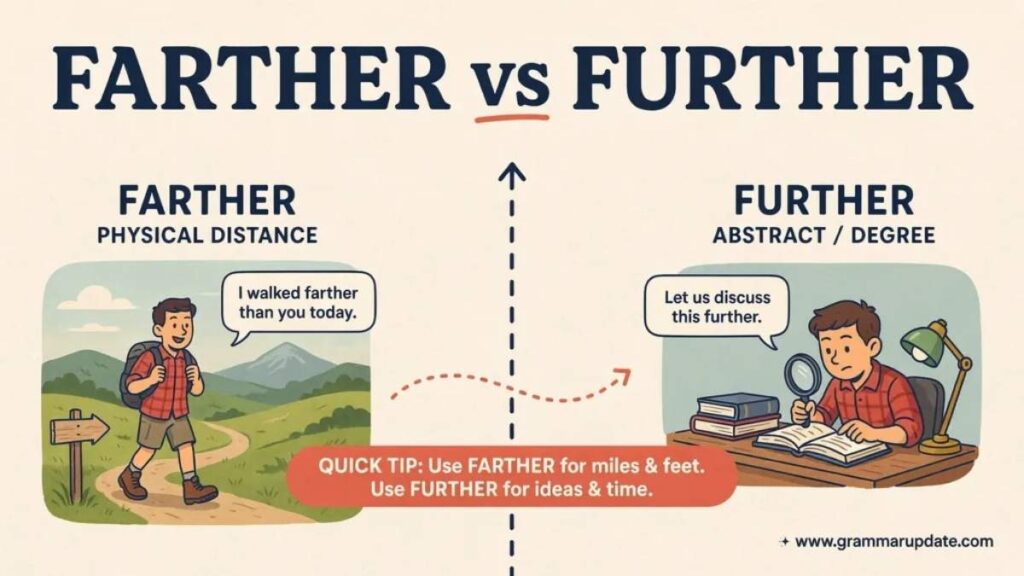
Farther vs further can turn a perfectly simple sentence into a tiny grammar roadblock. You might know exactly what you want to say, yet suddenly wonder whether you should go farther down the road or further down the road. Then comes “further information,” where farther clearly takes the wrong turn. The confusion gets even trickier because both words can describe distance. So, is there really a rule? Yes, but it’s not as rigid as many grammar lessons suggest. This guide clears up the confusion with simple explanations, practical examples, and useful tips. By the end, choosing farther or further should feel much easier and far less mysterious.
Farther vs Further The Quick Answer
Farther and further can both describe a greater distance.
Farther is commonly used for physical distance, especially in American English.
Further has a wider range of meanings. It can refer to distance, but it can also mean additional, more, to a greater degree, or to advance something.
| Meaning | Common choice | Example |
|---|---|---|
| Physical distance | Farther | The next town is farther away. |
| Additional information | Further | Please send further information. |
| More details | Further | We need further details. |
| Progress | Further | The project needs further development. |
| Advancement | Further | She wants to further her education. |
| Greater distance | Farther or further | We walked farther/further down the road. |
| Fixed expression | Further | Until further notice. |
| Figurative distance | Further | Nothing could be further from the truth. |
The important thing to remember is that farther and further overlap when they describe distance. They aren’t completely interchangeable, though, because further has meanings that farther doesn’t have.
What Does Farther Mean?
Farther means “to or at a greater distance.” It most often describes physical space, movement, or location.
For example:
“The airport is farther than I expected.”
“We drove farther than we planned.”
“How much farther do we have to walk?”
“The house is farther down the road.”
In each sentence, you can picture an actual distance. You could measure it with a map, a ruler, a measuring device, or simply compare two locations.
That connection with physical distance makes farther a natural choice in American English.
Farther and Physical Distance
Farther works especially well when you’re talking about actual physical space.
Consider this sentence:
“The second gas station is farther from the highway.”
The word farther tells you that the gas station sits at a greater physical distance from the highway.
The same idea appears in sentences such as:
“The runner traveled farther than the other competitors.”
“The cabin is farther into the forest.”
“The school is farther north.”
“The finish line is farther down the track.”
You can imagine measuring each distance. That’s the classic use of farther.
Farther as an Adjective
Farther can also describe something that lies at a greater distance.
For example:
“We chose the farther entrance.”
“The farther side of the building was quieter.”
“The farther end of the road was blocked.”
Here, farther describes a location that is more distant.
Learn the difference between confusing word pairs
Ironic vs Unironic which one is correct and usage?
What Does Further Mean?
Further has a much broader meaning.
It can describe distance, but it can also mean additional, more, to a greater degree, or advancement.
For example:
“We walked further down the road.”
“We need further information.”
“The discussion went further than expected.”
“She wants to further her education.”
“No further action is required.”
These sentences show why further appears so often in everyday, academic, and professional English. It can do much more work than farther.
Further and Physical Distance
Here’s where the traditional grammar rule causes trouble.
Many people learn that further should never describe physical distance. That isn’t true.
You can say:
“We walked further down the street.”
“The boat moved further away from the shore.”
“Keep going further along the path.”
“We can’t go any further.”
All of these sentences use further to describe literal physical distance.
So, is further used for physical distance? Yes.
In many cases, farther and further are both acceptable when they mean “to a greater distance.”
Learn the difference between confusing word pairs
Rehireable vs Rehirable Which Spelling Is Correct?
The Main Difference Between Farther and Further
The easiest way to understand the distinction is to look at the meanings that only further can express.
Farther mainly deals with distance.
Further can deal with distance, but it also means additional, more, greater, or advancement.
Compare these examples:
“The store is farther away.”
“Please provide further information.”
The first sentence deals with physical distance. The second means additional information.
You couldn’t replace further with farther in the second sentence:
“Please provide farther information.”
That doesn’t work because the sentence isn’t talking about distance.
A useful test is to replace further with “additional” or “more.”
If the sentence still makes sense, further is probably the right choice.
“Further information” becomes “additional information.”
“Further details” becomes “more details.”
“Further discussion” becomes “more discussion.”
That little test can save you from a lot of second-guessing.
Is Farther Only for Physical Distance?
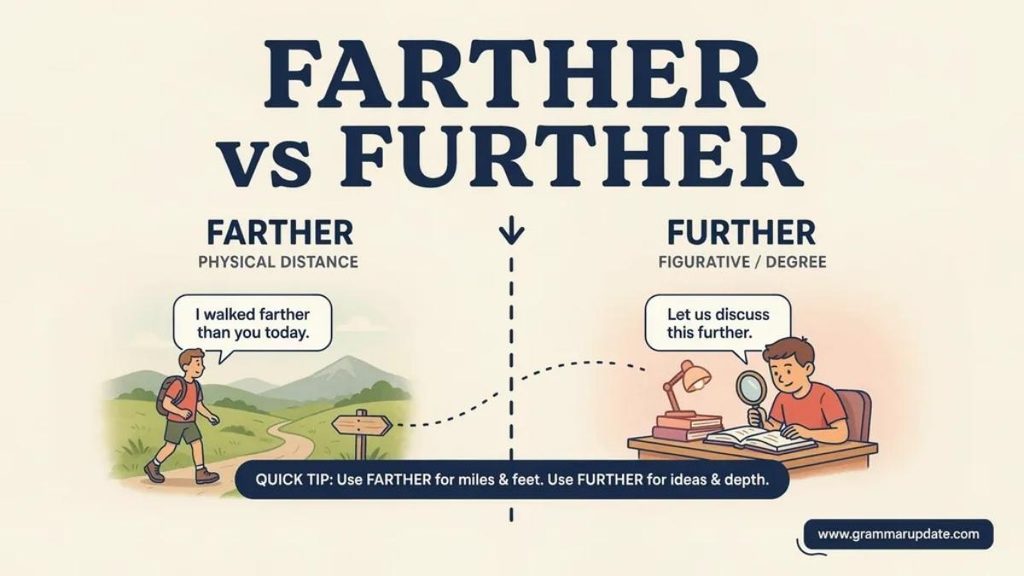
Not quite.
Farther is strongly associated with physical distance, especially in American English. However, the traditional rule that completely separates farther and further is too strict.
Modern English allows overlap between the two words when they refer to distance.
For example:
“We walked farther down the road.”
“We walked further down the road.”
Both sentences can be correct.
The choice may depend on regional preference, style, and context.
For clear physical distance in American English, farther often makes the distinction easier to understand. However, further remains perfectly natural in many distance expressions.
Further for Additional Meaning
One of the clearest differences appears when further means “additional” or “more.”
Consider these expressions:
“Further information”
“Further details”
“Further discussion”
“Further explanation”
“Further consideration”
“Further action”
“Further research”
In all of these examples, further means something like “additional” or “more.”
For example:
“We need further information before making a decision.”
The sentence means:
“We need additional information before making a decision.”
Now try farther:
“We need farther information before making a decision.”
The meaning falls apart because farther doesn’t mean “additional.”
That’s one distinction worth remembering.
Further as a Verb
Further has another important use that farther doesn’t have. It can function as a verb.
As a verb, further means to advance, promote, develop, or help something progress.
For example:
“She took the course to further her career.”
“The research could further our understanding of the problem.”
“The organization wants to further its goals.”
“The program aims to further public awareness.”
You can’t use farther this way.
“She took the course to farther her career.”
That sentence is incorrect.
The correct word is further because the sentence means that the course will help advance her career.
Learn the difference between confusing word pairs
Cancell vs Cancel Which One Is Correct?
Farther vs Further for Distance
When the two words describe distance, things become more flexible.
Farther is often preferred when the distance is clearly physical.
For example:
“The next town is farther away.”
“We drove farther than expected.”
“The runner jumped farther than last year.”
“The trail continues farther into the forest.”
However, further also works:
“The next town is further away.”
“We drove further than expected.”
“The trail continues further into the forest.”
This overlap is one reason the two words cause so much confusion.
The difference isn’t always about right versus wrong. Sometimes it’s simply about which word sounds more natural in the particular variety of English being used.
Farther vs Further Away
Both “farther away” and “further away” appear in standard English.
For example:
“The new office is farther away.”
“The new office is further away.”
If you’re writing American English and clearly describing physical distance, farther away is often the more straightforward choice.
Still, further away isn’t automatically wrong.
The same principle applies to similar expressions:
“farther from the station”
“further from the station”
Both can work when the meaning involves distance.
The surrounding sentence matters.
Farther vs Further Along
The phrase “farther along” can describe physical location.
For example:
“The pharmacy is farther along the road.”
You’re describing where the pharmacy is located.
Further along can also describe physical location:
“The pharmacy is further along the road.”
But further along has another common meaning: progress.
For example:
“The project is further along than we expected.”
Here, nobody is talking about a road. The sentence means that the project has progressed to a more advanced stage.
That difference gives you a useful clue:
“The store is farther along the road.”
Physical location.
“The project is further along.”
Progress.
Same phrase. Different meaning.
Farther vs Further in Time
Time creates another gray area.
Both farther and further can describe temporal distance.
For example:
“The records go farther back than we expected.”
“The records go further back than we expected.”
Both can work.
Further is particularly common when the idea involves looking deeper into the past or extending into the future.
For example:
“We need to look further into the past.”
“The discussion moved further into the future.”
“The research goes further back than previously believed.”
The old idea that farther must describe space while further must describe time is too simplistic. English doesn’t divide
distance that neatly.
Learn the difference between confusing word pairs
Favour vs Favor Which Spelling Is Correct?
Farther vs Further From the Truth
“Nothing could be further from the truth” is one of the most familiar expressions involving further.
Here, the word describes figurative distance.
The statement isn’t physically located miles away from the truth. Instead, it is completely opposed to reality.
For example:
“His explanation could not be further from the truth.”
“Nothing could be further from the truth.”
You may also see “farther from the truth.” The meaning is understandable because farther can express comparative distance.
However, “further from the truth” is the more familiar expression.
That’s a good example of why idiomatic usage matters. Grammar isn’t always just about building a sentence that technically works. Natural English also depends on which expressions people commonly use.
Learn the difference between confusing word pairs
Invokes vs Evokes which one is correct?
Farther vs Further in American English
American English often gives farther a strong role when describing physical distance.
For example:
“The restaurant is farther from downtown.”
“The next exit is farther away.”
“How much farther do we have to drive?”
At the same time, Americans regularly use further for physical distance:
“We walked further down the road.”
“We can’t go any further.”
So American English doesn’t completely separate the two words.
A practical approach is to use farther when physical distance is the clear focus and further when you mean additional, more, progress, or figurative extent.
That approach keeps your writing natural without forcing an artificial rule onto every sentence.
Learn the difference between confusing word pairs
Drily vs Dryly Which One Is Correct?
Farther vs Further in British English
British English tends to use further more broadly for distance.
A British speaker may naturally say:
“We walked further down the road.”
An American speaker might choose:
“We walked farther down the road.”
Neither sentence needs to be treated as a grammar disaster.
British English commonly uses further for literal distance as well as figurative meanings.
The important point is that the difference between American and British usage is mostly one of preference and frequency rather than a simple rule saying one form is correct and the other is wrong.
Farther vs Further Pronunciation
The two words have similar endings, but their first vowel sounds differ.
Farther sounds approximately like:
“FAR-thər”
Further sounds approximately like:
“FUR-thər”
The first part is the easiest way to hear the difference.
Farther begins with the same vowel sound associated with “far.”
Further begins with the sound found in words such as “fur” and “first.”
The “th” in both words uses the voiced sound heard in “mother.”
Learn the difference between confusing word pairs
Chief vs Chef difference and Which One Is Correct?
Common Mistakes With Farther and Further
Using Farther With Information
Incorrect:
“Please provide farther information.”
Correct:
“Please provide further information.”
The intended meaning is additional information, not information at a greater physical distance.
Assuming Further Never Means Physical Distance
Incorrect assumption:
“Further can only describe ideas.”
Correct understanding:
Further can describe both literal and figurative distance.
For example:
“We walked further down the road.”
Using Farther for Additional Meaning
Incorrect:
“We need farther details.”
Correct:
“We need further details.”
Farther doesn’t mean “additional.”
Treating the Words as Completely Interchangeable
They overlap, but they aren’t identical.
You can often choose either word for distance:
“We walked farther.”
“We walked further.”
But you can’t use farther in expressions such as:
“further information”
“further research”
“further discussion”
“further action”
“further education”
In these expressions, further has a meaning that farther doesn’t possess.
Learn the difference between confusing word pairs
Costumer vs Customer difference and Which One Is Correct?
Common Expressions With Further
Some expressions are so familiar that choosing further becomes automatic.
“Further information” means additional information.
“Further details” means more details.
“Further discussion” means additional discussion.
“Further explanation” means more explanation.
“Further consideration” means additional consideration.
“Further action” means additional action.
“Until further notice” means until additional notice is given.
“Further education” refers to education beyond an earlier stage.
“Further development” refers to additional development or continued progress.
These expressions show how broad the word further has become.
A Simple Memory Trick
A memory trick can help, as long as you don’t turn it into an absolute grammar rule.
Think of farther this way:
Far → farther → distance.
If you can picture a road, map, running track, ruler, building, or physical location, farther may be the clearest choice.
For further, think:
Further → more or additional.
That gives you:
Further information.
Further details.
Further discussion.
Further research.
Further action.
Then remember the important exception: further can also describe physical distance.
That last point keeps the memory trick useful without making it misleading.
Learn the difference between confusing word pairs
Scrapped vs Scraped difference Which One Is Correct?
Farther vs Further in Real-Life Writing
The difference becomes especially clear when you look at everyday situations.
In Emails
Professional emails often use further because they deal with additional information or action.
“Please provide further details.”
“Let me know if you need further assistance.”
“We can discuss this further during the meeting.”
“No further action is required.”
These sentences have nothing to do with physical distance.
In Academic Writing
Academic writing frequently uses further to describe additional study or deeper analysis.
“Further research may be necessary.”
“The findings require further investigation.”
“Further analysis revealed several differences.”
Again, further means additional or deeper.
In Travel
Travel writing naturally uses farther for physical distance.
“The hotel is farther from the airport.”
“How much farther is the next town?”
“We drove farther than expected.”
Further can also work:
“We continued further down the highway.”
Both words can describe the physical journey.
Learn the difference between confusing word pairs
Bases vs Basis difference and Which One Is Correct?
Farther vs Further When Can Both Work?
Both words can work when they mean a greater distance.
Consider:
“We walked farther down the road.”
“We walked further down the road.”
The basic meaning remains the same.
Another example:
“The boat moved farther from shore.”
“The boat moved further from shore.”
Again, both can describe increasing physical distance.
The distinction becomes stronger when further takes on one of its other meanings.
For example:
“We need further discussion.”
There is no physical distance here.
“We need farther discussion.”
That doesn’t work.
Likewise:
“She wants to further her career.”
Farther cannot replace further because the word functions as a verb.
Practice Session Farther vs Further
- How much __________ do we have to drive before we reach the next town?
- Please provide __________ information about the new policy.
- The blue house is __________ away from the school than the white house.
- We need __________ details before we can make a decision.
- The hikers walked __________ into the forest than they had planned.
- She decided to __________ her education by taking another course.
- Nothing could be __________ from the truth.
- The discussion went __________ than anyone expected.
- The train station is __________ down the road.
- No __________ action is required at this time.
- The researchers need __________ evidence before reaching a conclusion.
- We couldn’t walk any __________ because the trail was closed.
- The project is __________ along than it was last month.
- The boat moved __________ away from the shore.
- The runner managed to jump __________ than his previous record.
- The company plans to __________ develop its new technology.
- Please contact the office if you require __________ assistance.
- The village is __________ north than the town we visited yesterday.
- The teacher offered __________ explanation after several students asked questions.
- We traveled __________ than expected because of the clear roads.
- The investigation may go __________ into the matter before reaching a conclusion.
- The store is __________ away than I originally thought.
- The organization hopes to __________ its environmental goals through the new program.
- We walked __________ along the beach until we reached the old lighthouse.
- The report recommends __________ research before the final decision is made.
Answer Session
- Farther
- Further
- Farther
- Further
- Farther
- Further
- Further
- Further
- Farther
- Further
- Further
- Farther
- Further
- Farther
- Farther
- Further
- Further
- Farther
- Further
- Farther
- Further
- Farther
- Further
- Farther
- Further
Here’s a trusted source for clear word meanings:
FAQ
What is the easiest way to remember farther and further?
Use “farther” as your first choice for clear physical distance. Use “further” when you mean additional, more, greater degree, progress, or advancement. Remember that both can describe distance, so this is a practical guide rather than an absolute rule.
Can further be used for physical distance?
Yes. Further can describe literal physical distance, especially in phrases such as “further down the road,” “further away,” and “go further.” The choice often depends on regional preference and context.
Is “further information” always correct?
Yes. Use “further information” when you mean additional information. “Farther information” is not standard because farther doesn’t carry the meaning “additional.”
Can farther mean more or additional?
No. Farther primarily relates to distance. When you mean “more,” “extra,” or “additional,” use further.
Is “until further notice” the correct expression?
Yes. “Until further notice” means until additional notice is given. “Until farther notice” is not the standard expression.
Can further be used as a verb?
Yes. Further can mean to advance, promote, develop, or help something progress. For example, “The program will further her career.”
Can farther be used as a verb?
No. Farther doesn’t have the same verb use as further. You can “further your education,” but you can’t “farther your education.”
Why is “further education” correct?
“Further education” means additional or continued education. Because further means “additional” in this phrase, farther cannot replace it.
Is “further down the road” literal or figurative?
It can be either. Literally, it can describe a location farther along a road. Figuratively, it can refer to a later stage or point in a process.
Is “further along” used for progress?
Yes. “Further along” commonly describes progress or development. For example, “The project is further along than expected.”
Can farther and further describe geographical distance?
Yes. Both words can describe geographical distance. “Farther” often feels more natural when the distance is clearly physical, particularly in American English, but “further” is also widely used.
Is “further discussion” different from “farther discussion”?
Yes. “Further discussion” means additional or continued discussion. “Farther discussion” doesn’t work because the sentence doesn’t describe physical distance.
What does “further consideration” mean?
“Further consideration” means additional thought or review. It suggests that someone needs to examine or think about something more carefully before making a decision.
What does “go further” mean?
“Go further” can mean travel to a greater distance, continue to a later point, or take something to a greater degree. The exact meaning depends on the sentence.
What does “take something further” mean?
It means to develop, continue, expand, or pursue something beyond its current stage. For example, “The team decided to take the investigation further.”
Is “further action” correct?
Yes. “Further action” means additional action or another step that needs to happen. It commonly appears in professional and formal writing.
What does “further from” mean?
“Further from” can describe greater physical distance or a greater figurative separation. For example, “The house is further from the station” describes location, while “The claim is further from reality” describes figurative distance.
Is “farther from” also correct?
Yes. “Farther from” is correct when describing greater distance. For example, “The second hotel is farther from the airport.”
What does “farther” mean in simple English?
Farther means at or to a greater distance. For example, “The store is farther away” means the store is at a greater distance.
What does “further” mean in simple English?
Further can mean at a greater distance, but it can also mean additional, more, to a greater degree, or to advance something.
Is “further research” or “farther research” correct?
“Further research” is correct because it means additional or continued research.
Is “further explanation” correct?
Yes. “Further explanation” means more explanation or additional clarification.
Is “further action required” grammatically correct?
Yes. “No further action is required” is a standard expression meaning that no additional steps are necessary.
conclusion
Farther vs further may look like grammar twins, but they don’t always do the same job. Farther usually points to physical distance, especially in American English, while further can travel much farther into the world of language. It can mean additional, more, greater degree, progress, or advancement. That’s why you need further information but may drive farther down the highway. The tricky part? Both words can describe distance, so the old “physical versus figurative” rule isn’t quite as strict as it sounds. When in doubt, look at the meaning. If you’re measuring distance, farther often fits. If you mean “more” or “additional,” further is usually the clear winner. Grammar confusion? Consider it officially left behind.

Jhon AJS, the creative mind behind Grammar Update, is an experienced blogger passionate about simplifying English grammar. He focuses on explaining confusing word vs word differences, grammar rules, punctuation, and sentence structure in a clear and practical way. Through easy to understand guides and examples, Jhon helps readers improve their writing and communicate with confidence. With years of blogging experience, he continues to share helpful insights that make learning grammar simple, useful, and accessible for everyone.