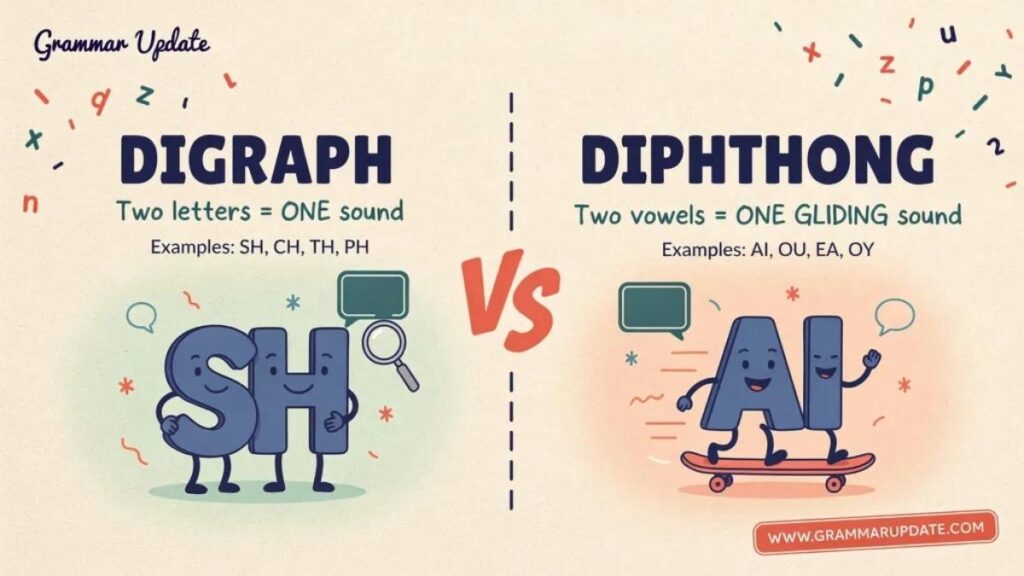
Two letters walk into a word, and suddenly English asks a tricky question: are they a digraph vs diphthong? If that sounds like the beginning of a grammar joke, you’re not far off. These terms are easy to mix up because both involve sounds and letter combinations. However, they describe different things. A digraph refers to two letters working together to represent one sound, while a diphthong describes a vowel sound that glides from one position to another. Once you know whether you’re looking at letters or listening to sounds, the confusion starts to fade. Let’s make the difference between digraph or diphthong simple, clear, and easy to remember.
Digraph vs Diphthong at a Glance
A digraph is a pair of letters that work together to represent one phoneme. A diphthong, on the other hand, is a vowel sound that moves from one vowel position toward another within the same syllable.
| Feature | Digraph | Diphthong |
|---|---|---|
| Main focus | Written letters and spelling | Spoken vowel sound |
| Basic idea | Two letters represent one sound | One vowel sound changes as it is pronounced |
| Common example | sh in ship | oy in boy |
| Can involve consonants? | Yes | No |
| Requires two letters? | Yes | Not necessarily |
| Depends on pronunciation? | Partly | Yes |
A quick way to remember the difference is this: a digraph concerns the letters you see, while a diphthong concerns the vowel sound you hear.
However, the two ideas can overlap. A pair of letters can represent a diphthong while also being described as a particular spelling pattern in phonics.
What Is a Digraph?
A digraph is two letters that work together to represent one phoneme. The word comes from Greek roots associated with “two” and “writing,” which reflects the basic idea of two written symbols working as a unit.
For example, consider the word ship. The letters s and h appear separately on the page, but together they represent the sound /sh/. The word contains four letters but only three phonemes: /sh/, /i/, and /p/.
This difference between letters and sounds is important because written language doesn’t always have a one-to-one relationship with speech sounds.
How Digraphs Work
When you encounter a digraph, you shouldn’t automatically pronounce each letter separately. Instead, you need to recognize that the two letters can function together.
For example:
- sh in ship represents /sh/.
- ch in chair represents /ch/.
- th in thin represents /th/.
- ph in phone represents /f/.
- ng in sing represents /ng/.
These examples show why phonics instruction pays close attention to letter combinations. A beginning reader who understands common patterns can recognize familiar sound relationships instead of trying to decode every letter independently.
At the same time, English contains many exceptions and variations. Therefore, learning a spelling pattern doesn’t always guarantee one pronunciation in every word.
Consonant Digraphs
Consonant digraphs are particularly common in English. They contain two letters that work together to represent a consonant sound.
| Digraph | Example | Typical sound |
|---|---|---|
| ch | chair | /tʃ/ |
| sh | ship | /ʃ/ |
| th | thin | /θ/ |
| th | this | /ð/ |
| ph | phone | /f/ |
| ng | sing | /ŋ/ |
| wh | when | Varies by accent |
| ck | back | /k/ |
The th pattern deserves special attention because it can represent two different sounds.
In thin, it represents /θ/. In this, it represents /ð/.
Even though the pronunciation changes, th still functions as a two-letter spelling pattern in both words.
This is a good example of why spelling and pronunciation need to be considered separately.
Digraphs in Different Parts of Words
Digraphs can appear at the beginning, middle, or end of words.
At the beginning, you might see:
- ship
- chair
- thin
- phone
In the middle, examples include:
- fishing
- teacher
- weather
- dolphin
At the end, examples include:
- fish
- much
- bath
- graph
As a result, recognizing these patterns can make unfamiliar words easier to approach during reading.
Vowel Digraphs
A vowel digraph is generally a pair of vowel letters that work together to represent a vowel sound. However, different phonics programs don’t always use this term in exactly the same way.
Common examples include:
- ee in see
- ea in team
- oa in boat
- ai in rain
- oo in moon
Many teachers also use the broader term vowel team for patterns like these.
The distinction is useful because vowel team is often used to describe several letters working together to represent a vowel sound, while digraph can have a more specific meaning.
Therefore, if one textbook calls ai a vowel digraph and another calls it a vowel team, the two resources aren’t necessarily disagreeing about the word itself. They may simply be using different teaching terminology.
Learn the difference between basic English word mistakes
Insue vs Ensue Which One Is Correct?
What Is a Diphthong?
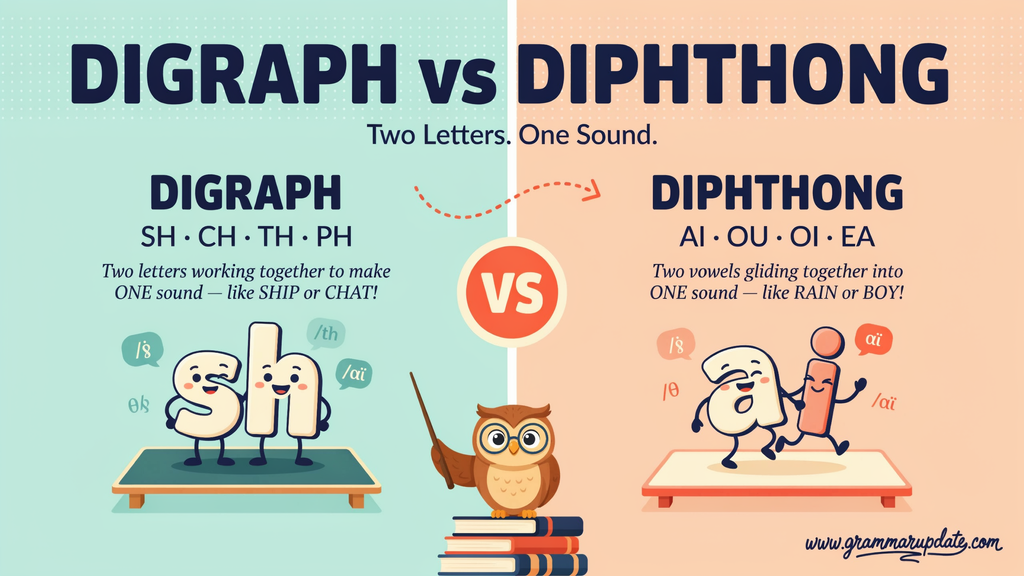
A diphthong is a vowel sound that changes in quality as you pronounce it. Instead of maintaining one steady vowel position, your tongue and mouth move toward another vowel position during the same syllable.
This movement is why diphthongs are sometimes described as gliding vowel sounds.
For example, the vowel sound in boy begins in one position and moves toward another as the word is pronounced. The sound /ɔɪ/ therefore has a noticeable movement within one syllable.
This is different from simply seeing two vowel letters next to each other.
A diphthong is defined by the sound, not by the appearance of the spelling.
What Happens When You Pronounce a Diphthong?
Your mouth doesn’t remain completely still during a diphthong. Your tongue and other parts of your vocal tract adjust as the sound moves from one vowel quality toward another.
A simplified representation looks like this:
Starting vowel position
          ↓
       vowel
          ↘
            ↘
              second vowel position
          ↓
      gliding sound
The exact movement varies according to the speaker’s accent and the particular vowel.
For language learners, however, the most useful point is simple: a diphthong is a changing vowel sound within one syllable.
Common Diphthongs in English
Several diphthong sounds occur frequently in American English.
| Sound | Example words | Common spellings |
|---|---|---|
| /aɪ/ | time, my, pie | i, y, ie, igh |
| /aʊ/ | house, cow, out | ou, ow |
| /ɔɪ/ | boy, coin, choice | oy, oi |
| /eɪ/ | day, rain, eight | ay, ai, eigh |
| /oʊ/ | go, boat, snow | o, oa, ow |
Pronunciation can vary between accents. Consequently, not every speaker produces these sounds in exactly the same way.
Furthermore, linguists sometimes analyze certain English vowel sounds differently. For that reason, it’s better to think of the table as a practical guide rather than a rule that applies identically to every English variety.
Diphthong Examples in Everyday Words
The sound /aɪ/ appears in words such as time, light, five, my, pie, and sky. Although the spelling changes from word to word, the vowel sound has a similar gliding quality.
Likewise, /aʊ/ appears in house, mouse, brown, cow, out, and cloud. The spellings ou and ow frequently represent this sound.
The sound /ɔɪ/ occurs in boy, toy, coin, point, choice, and noise. Here, oi and oy are common spelling patterns.
The sound /eɪ/ appears in day, rain, play, great, and eight. English uses several different spelling patterns for this sound.
Finally, /oʊ/ appears in go, home, boat, snow, and road. Once again, several different spellings can represent the same general vowel sound.
These examples show an important feature of English spelling: one sound can have several written forms.
Learn the difference between often confused words
Awful vs Awfull Which one Is Correct?
The Difference Between Digraph and Diphthong
The difference between digraph and diphthong becomes much clearer when you ask what each word describes.
A digraph describes a relationship between written letters and a phoneme.
A diphthong describes the quality and movement of a vowel sound.
For example, look at ship.
The letters sh work together to represent the consonant sound /ʃ/. Therefore, sh is a consonant digraph.
Now look at boy.
The letters oy represent the vowel sound /ɔɪ/. That sound is a diphthong because the vowel quality changes during pronunciation.
So, the two terms answer different questions.
The first question is: what are these letters doing?
The second question is: what kind of vowel sound am I hearing?
Once you approach words this way, the distinction becomes much easier.
Diphthong vs Digraph Can Something Be Both?
Yes, depending on the terminology being used.
Consider coin. The letters oi form a spelling pattern, and they represent the diphthong /ɔɪ/.
Therefore, you can describe the word from two perspectives.
From the spelling perspective, you are looking at the letter pair oi.
From the pronunciation perspective, you are hearing the diphthong /ɔɪ/.
Some phonics programs may describe oi as a vowel digraph. Others may call it a vowel team. A linguist discussing pronunciation may simply focus on the diphthong /ɔɪ/.
These descriptions can coexist because they refer to different features of the word.
Vowel Digraph vs Diphthong
The distinction becomes especially useful with vowel combinations.
Consider rain.
The letters ai form a spelling pattern. In many varieties of English, they represent the vowel sound /eɪ/.
Therefore, ai describes the written pattern, while /eɪ/ describes the spoken vowel.
Similarly, in coin, oi is the written pattern and /ɔɪ/ is the diphthong sound.
This separation helps prevent a common mistake: assuming that every pair of vowel letters automatically represents a diphthong.
It doesn’t.
You need to listen to the pronunciation and identify what the letters represent.
Digraph vs Diphthong Examples Side by Side
The following table makes the distinction easier to see.
| Word | Letter pattern | Sound | Main classification |
|---|---|---|---|
| ship | sh | /ʃ/ | Consonant digraph |
| chair | ch | /tʃ/ | Consonant digraph |
| thin | th | /θ/ | Consonant digraph |
| phone | ph | /f/ | Consonant digraph |
| coin | oi | /ɔɪ/ | Diphthong sound |
| boy | oy | /ɔɪ/ | Diphthong sound |
| house | ou | /aʊ/ | Diphthong sound |
| cow | ow | /aʊ/ | Diphthong sound |
| rain | ai | /eɪ/ | Vowel spelling pattern |
| snow | ow | /oʊ/ | Vowel spelling pattern |
Notice how the same two letters can have different pronunciations.
That fact becomes particularly important when studying English because spelling patterns aren’t always predictable.
Common Digraphs vs Diphthongs
A useful reference should keep spelling patterns and sounds separate.
1.Common consonant digraphs
- ch in chair
- sh in ship
- th in thin and this
- ph in phone
- wh in when
- ng in sing
- ck in back
2.Common vowel spelling patterns
- ai in rain
- ay in play
- ee in green
- ea in team
- oa in boat
- oe in toe
- oo in moon
- oi in coin
- oy in boy
- ou in house
- ow in cow and snow
3.Common diphthong sounds
- /aɪ/ as in my and time
- /aʊ/ as in cow and house
- /ɔɪ/ as in boy and coin
- /eɪ/ as in day and rain
- /oʊ/ as in go and boat
The first two groups concern spelling. The final group concerns pronunciation.
Learn the difference between confusing word pairs
Ingenuine vs Ungenuine Which one Is Correct?
Is OW a Digraph VS Diphthong?
The question is often asked because ow can represent more than one sound.
In cow, ow represents /aʊ/.
In snow, ow represents /oʊ/.
Therefore, ow is a two-letter spelling pattern, while the sounds it represents can be diphthongs.
This gives us an important lesson about English: you can’t always identify a sound simply by looking at the letters.
Instead, consider both the spelling pattern and the pronunciation.
The same pattern may behave differently in different words.
Why Two Vowels Don’t Automatically Make a Diphthong
It may seem logical to assume that two vowel letters must produce two vowel sounds. However, English doesn’t follow that simple rule.
Consider rain, book, create, and quiet.
Each contains multiple vowel letters, but the vowels don’t all behave in the same way.
A vowel combination can represent one sound, a changing vowel sound, or separate sounds in different syllables.
For example, create contains vowels across more than one syllable. Therefore, simply seeing two vowels doesn’t tell you that you’re looking at one diphthong.
Pronunciation always deserves attention.
Digraph, Diphthong, or Vowel Team?
The term vowel team appears frequently in phonics instruction.
A vowel team generally refers to a group of letters that work together to represent a vowel sound. Depending on the teaching system, the term can include patterns that another resource might call vowel digraphs.
For example:
- ai in rain
- ee in feet
- oa in boat
- oi in coin
- ou in house
These patterns don’t all represent exactly the same type of vowel sound.
Some represent relatively steady vowel qualities, while others represent diphthongs.
Consequently, vowel team and diphthong shouldn’t be treated as synonyms.
One describes a spelling or phonics pattern. The other describes a sound.
How to Tell Whether Something Is a Digraph vs Diphthong
When you’re unsure, use a simple process.
Look at the letters
First, identify the letter pair.
For example, ship contains sh, while boy contains oy.
Say the word aloud
Next, listen carefully to the word pronunciation.
Don’t rely only on what the spelling looks like.
Identify the sounds
Ask how many phonemes the letters represent.
In ship, sh represents one consonant phoneme.
Listen to the vowel
If you’re examining a vowel, pay attention to whether the sound changes during the syllable.
A noticeable movement from one vowel quality toward another indicates a diphthong.
Separate spelling from pronunciation
Finally, ask what you’re trying to identify.
If you’re describing the written letters, you’re discussing a spelling pattern.
If you’re describing the changing vowel sound, you’re discussing a diphthong.
That small shift in perspective makes the whole topic easier.
Learn the difference between tricky grammar more words
Ironic vs Unironic which one is correct and usage?
A Simple Digraph VS Diphthong Decision Guid
Start with the word
        ↓
Find the letter pair
        ↓
What sound does it represent?
       / \
      /   \
Consonant  Vowel
   ↓         ↓
Possible   Listen to
digraph    the vowel
             ↓
       Does the sound
          glide?
         /     \
       Yes      No
        ↓        ↓
   Diphthong   Steady
                vowel
This guide provides a practical starting point. However, detailed linguistic analysis can be more complicated because pronunciation varies across dialects and spelling systems contain many historical patterns.
Common Mistakes When Learning Digraphs vs Diphthongs
Confusing letters with sounds
Two letters don’t necessarily represent two sounds.
For example, ship has four written letters but three phonemes.
This is why phonemic awareness matters during early reading instruction.
Calling every vowel pair a diphthong
Two adjacent vowels don’t automatically create a diphthong.
Instead, listen to the vowel sound and consider whether it changes within the syllable.
Calling every two-letter combination a digraph
Two neighboring letters don’t automatically form a digraph either.
For example, st in stop represents two separate consonant sounds: /s/ and /t/.
The letters appear together, but they don’t form one consonant phoneme.
Assuming one spelling always has one pronunciation
The pattern ow provides a clear example.
Cow contains /aʊ/, while snow contains /oʊ/.
The spelling remains the same, yet the pronunciation changes.
Treating phonics terminology as universal
Different educational systems may define vowel digraph, vowel team, and related terms somewhat differently.
Therefore, always check how a particular curriculum defines its terms.
Learn the difference between commonly mixed-up more words
Rehireable vs Rehirable Which Spelling Is Correct?
Why Digraphs vs Diphthongs Matter for Reading
Understanding these concepts isn’t just about learning technical vocabulary.
They help explain how written language connects to spoken language.
During early literacy, children learn that letters and letter groups represent speech sounds. As their phonics knowledge develops, they begin recognizing recurring patterns instead of treating every word as completely new.
For example, a child who recognizes sh can approach ship more efficiently.
Likewise, recognizing familiar vowel patterns can help with words such as rain, coin, and house.
This becomes particularly useful during decoding and spelling.
Why This Matters for Young Readers
Strong phonics instruction can help children develop several related skills:
- Recognizing beginning sounds.
- Identifying individual phonemes.
- Blending sounds into words.
- Breaking words into smaller sound units.
- Recognizing common spelling patterns.
- Connecting graphemes with phonemes.
- Developing accurate word recognition.
- Improving spelling and decoding.
These abilities work together. One skill supports another.
A Practical Example Teaching SH and OI
Imagine a child learning the patterns sh and oi.
Start with ship.
The teacher points to sh and explains that two letters work together to represent one consonant sound.
Next, introduce coin.
The child sees oi and hears /ɔɪ/.
At this stage, the teacher can explain that /ɔɪ/ is a diphthong because the vowel sound changes during pronunciation.
The student has now learned two different ideas.
The first concerns a written letter pair.
The second concerns a spoken vowel sound.
This approach is more useful than simply telling the child that both patterns involve “two letters.”
The important lesson is that letters and sounds don’t always behave in the same way.
Digraph vs Diphthong Practice
Good practice activities should ask learners to pay attention to both spelling and sound.
Consider these words:
- ship
- chair
- thin
- phone
- coin
- boy
- house
- cow
- rain
- snow
For each word, ask:
- What letter pattern do you see?
- How many sounds does the pattern represent?
- Is the sound a consonant or vowel?
- If it’s a vowel, does the sound glide?
- Is the pattern inside one syllable?
This approach builds both sound identification and spelling awareness.
| Word | Pattern | Sound | What to notice |
|---|---|---|---|
| ship | sh | /ʃ/ | Consonant digraph |
| chair | ch | /tʃ/ | Consonant digraph |
| thin | th | /θ/ | Consonant digraph |
| phone | ph | /f/ | Consonant digraph |
| coin | oi | /ɔɪ/ | Diphthong sound |
| boy | oy | /ɔɪ/ | Diphthong sound |
| house | ou | /aʊ/ | Diphthong sound |
| cow | ow | /aʊ/ | Diphthong sound |
| rain | ai | /eɪ/ | Vowel spelling pattern |
| snow | ow | /oʊ/ | Different pronunciation of ow |
Digraph VS Diphthong Examples to Practice
Try analyzing these words before reading the explanations.
| Word | Pattern | What should you identify? |
|---|---|---|
| ship | sh | Letter combination and sound |
| boy | oy | Vowel sound |
| chat | ch | Consonant sound |
| coin | oi | Diphthong |
| house | ou | Diphthong |
| thin | th | Consonant sound |
| rain | ai | Vowel pattern |
| snow | ow | Pronunciation |
| phone | ph | Consonant digraph |
| time | i_e | Vowel sound |
The goal isn’t simply to memorize labels. Instead, focus on the relationship between the written pattern and the spoken sound.
Learn the difference between confusing more English words
Cancell vs Cancel Which One Is Correct?
Practice Session Digraph vs Diphthong
Fill in each blank with the correct word or term. The answer key appears at the end.
- A __________ is a combination of two letters that represents one phoneme.
- A __________ is a vowel sound that glides from one vowel position toward another within a single syllable.
- The letters “sh” in the word “ship” form a __________.
- The sound /ɔɪ/ in the word “boy” is a __________.
- The letters “ch” in “chair” represent a __________ sound.
- The letters “ph” in “phone” represent the sound __________.
- The word “coin” contains the spelling pattern “oi,” which represents the diphthong __________.
- The spelling pattern “ow” represents /aʊ/ in the word __________.
- The spelling pattern “ow” represents /oʊ/ in the word __________.
- A digraph focuses mainly on __________ letters and their relationship to sounds.
- A diphthong focuses mainly on the __________ of a vowel sound.
- The letters “th” in “thin” represent the sound __________.
- The letters “th” in “this” represent the sound __________.
- The word “rain” contains the vowel spelling pattern __________.
- The vowel sound /aɪ/ occurs in the word __________.
- The vowel sound /aʊ/ occurs in the word __________.
- The vowel sound /ɔɪ/ occurs in the word __________.
- Two adjacent vowel letters do not automatically form a __________.
- The term __________ is often used in phonics to describe groups of letters that work together to represent a vowel sound.
- The word “ship” contains four letters but only __________ phonemes.
- The letters “st” in “stop” represent two separate consonant sounds, so they are not a consonant __________.
- A diphthong is identified primarily by its __________ rather than by the number of letters used to spell it.
- The letters “ng” in “sing” form a __________.
- The main difference between a digraph and a diphthong is that a digraph describes a spelling pattern, while a diphthong describes a __________ sound.
- The easiest way to remember the distinction is: digraph relates to letters, while diphthong relates to __________.
Answers
- Digraph
- Diphthong
- Digraph
- Diphthong
- Consonant
- /f/
- /ɔɪ/
- Cow
- Snow
- Written
- Quality
- /θ/
- /ð/
- ai
- Time
- House
- Boy
- Diphthong
- Vowel team
- Three
- Digraph
- Pronunciation
- Digraph
- Vowel
- Sounds
Here’s a trusted source for clear word meanings:
FAQs
What is the difference between a digraph vs a diphthong?
A digraph is a pair of letters that work together to represent one phoneme, such as sh in ship. A diphthong is a vowel sound that glides from one vowel position toward another within the same syllable, such as /ɔɪ/ in boy. Put simply, a digraph describes a spelling pattern, while a diphthong describes a vowel sound.
Can a digraph contain vowels?
Yes. Some phonics programs use the term vowel digraph for two vowel letters that represent one vowel sound. Common examples include ee in see, ea in team, and oa in boat. Other programs use the broader term vowel team for these patterns.
Can the same letter combination have different sounds?
Yes. English spelling doesn’t always give one letter combination one fixed pronunciation. For example, ow represents /aʊ/ in cow but /oʊ/ in snow. As a result, you need to consider the pronunciation of the whole word.
Do two letters next to each other always make a digraph?
No. Two letters form a digraph only when they work together to represent a single phoneme. For example, st in stop represents two separate consonant sounds, /s/ and /t/, so it isn’t a consonant digraph.
Does a diphthong always have two vowel letters?
No. A diphthong is identified by its pronunciation, not by the number of letters used to spell it. For example, the /aɪ/ sound occurs in my, time, and pie, even though each word uses a different spelling pattern.
How can I tell if a word contains a diphthong?
Say the word aloud and focus on the vowel. If the vowel sound moves from one vowel quality toward another within the same syllable, you’re hearing a diphthong. Since spelling can be misleading, listening to the pronunciation is often the best approach.
How can I recognize a digraph?
Look for two letters that work together to represent one phoneme. For example, sh in ship represents one consonant sound. Therefore, sh functions as a consonant digraph.
Can the same spelling pattern relate to both a digraph and a diphthong?
Yes. These terms describe different features of language. For example, oi in coin represents the diphthong /ɔɪ/. In some phonics programs, oi may also be described as a vowel digraph or vowel team.
Why do phonics resources use different terms?
Phonics programs don’t always define terms such as vowel digraph and vowel team in exactly the same way. Linguistics also uses more specific terminology for speech sounds and spelling systems. Therefore, a pattern may receive different labels depending on the teaching approach.
Why does this distinction matter when learning to read?
Understanding the difference helps learners connect written letters with spoken sounds more accurately. Digraph knowledge supports decoding and spelling, while understanding vowel sounds helps learners recognize pronunciation patterns. Together, these skills strengthen reading and word recognition.
What’s the simplest way to remember the difference?
Think of it this way: a digraph is about the letters you see, while a diphthong is about the vowel sound you hear. If you’re examining a spelling pattern, think digraph. If you’re listening for a vowel that glides within a syllable, think diphthong.
In conclusion, digraphs and diphthongs may sound like complicated linguistic monsters, but they are much easier to understand once you know their secrets! A digraph is a pair of letters that work together to produce one sound, such as “sh” in ship or “ch” in chair. A diphthong, on the other hand, occurs when two vowel sounds glide smoothly together within a single syllable, as in “oy” in boy or “ou” in house.
Conclusion
The confusion often begins because English spelling and pronunciation do not always play by the same rules. Two letters can represent one sound, while two vowel sounds can blend so smoothly that they seem like one. That is why understanding the difference is more useful than simply memorizing complicated definitions.
The easiest rule to remember is: a digraph is about two letters making one sound, while a diphthong is about two vowel sounds gliding together. With careful listening, plenty of examples, and a little practice, these terms become far less intimidating. So, don’t let their fancy names fool you digraphs vs diphthongs are simply two more examples of English making something surprisingly interesting out of a few ordinary letters and sounds!

Jhon AJS, the creative mind behind Grammar Update, is an experienced blogger passionate about simplifying English grammar. He focuses on explaining confusing word vs word differences, grammar rules, punctuation, and sentence structure in a clear and practical way. Through easy to understand guides and examples, Jhon helps readers improve their writing and communicate with confidence. With years of blogging experience, he continues to share helpful insights that make learning grammar simple, useful, and accessible for everyone.