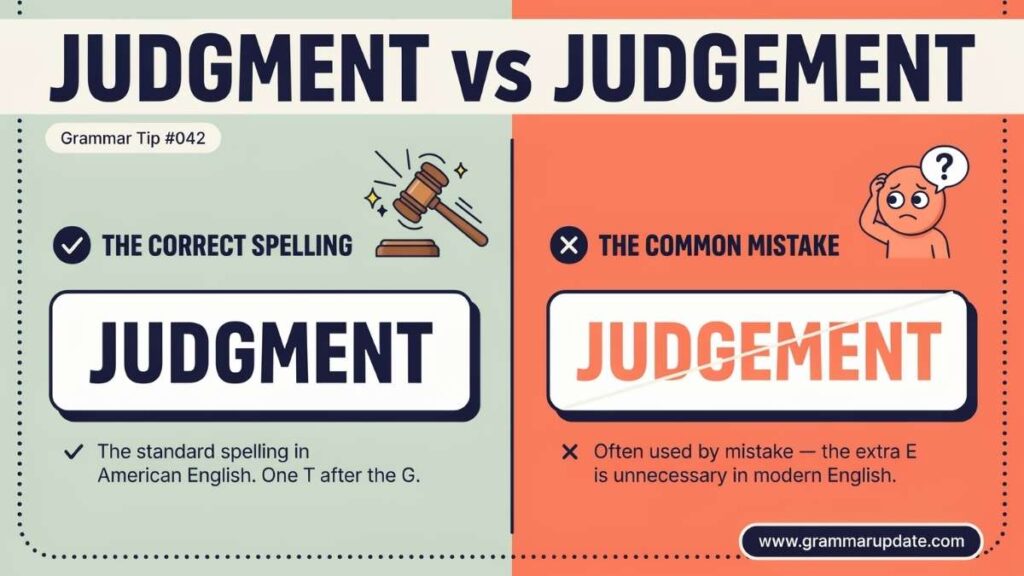
Few spelling debates cause as much confusion as judgment vs judgement. One word drops the e, the other proudly keeps it, and suddenly a simple sentence feels like an English exam. So, which spelling should you use? The good news is that neither is a mistake. Judgment is the standard form in American English, while judgement is widely used in British English. The tricky part is that legal writing can follow different conventions, which makes the choice even less obvious. This guide explains the difference clearly, shows where each spelling belongs, and helps you avoid common mistakes without second-guessing every sentence you write.
The Quick Answer
Both spellings are correct.
American English normally uses judgment, while British English commonly uses judgement. Neither form should automatically be treated as a spelling mistake.
| Spelling | Common usage | Example |
|---|---|---|
| Judgment | American English | She showed good judgment. |
| Judgement | British English | She showed good judgement. |
The meaning stays the same in both sentences. Only the spelling changes.
Therefore, when you’re writing for an American audience, judgment is usually the better choice. On the other hand, if you’re writing in general British English, judgement will usually feel more natural.
There is one important qualification. Legal writing can follow established terminology that doesn’t always match general spelling preferences. Because of that, legal writers should follow the conventions of the relevant court or legal system.
What Does Judgment vs Judgement Mean?
At its core, judgment means forming an opinion, reaching a conclusion, or making a decision after considering information.
The word can describe a person’s ability to make sensible decisions. It can also describe an opinion about a person or situation. In law, it has a more specific meaning because a judgment can refer to a formal decision made by a court.
For example:
“She showed excellent judgment during the difficult negotiation.”
Here, judgment refers to her ability to make a sensible decision.
Similarly:
“The committee reached its judgment after reviewing all the evidence.”
In this sentence, judgment refers to the conclusion reached after an assessment.
The British spelling works in exactly the same way:
“She showed excellent judgement during the difficult negotiation.”
The spelling changes, but the underlying meaning does not.
Judgment Definition and Judgement Definition
The word has several related meanings, so its precise meaning depends on context.
First, judgment can mean the ability to make sensible decisions. Someone with good judgment usually thinks carefully before acting and considers the possible consequences of a decision.
For example:
“His good judgment prevented a serious mistake.”
Second, judgment can mean an opinion or assessment. In this sense, a person examines information and forms a view about something.
For example:
“The teacher’s judgment of the student’s work was fair.”
Third, judgment can refer to a formal legal decision.
For example:
“The court issued its judgment after hearing the case.”
Finally, the word can appear in moral or religious contexts. Expressions such as “Judgment Day” refer to a formal or divine judgment.
Although these meanings differ slightly, they all connect to the same central idea: reaching an assessment, conclusion, or decision.
What Is the Difference Between Judgment VS Judgement?
The difference between judgment VS judgement is mainly a matter of spelling and regional usage.
Judgment is the preferred form in American English. Judgement is widely used in British English.
The two forms normally have the same pronunciation, meaning, grammatical function, and usage.
Consider these two sentences:
“She trusted her own judgment.”
“She trusted her own judgement.”
Both mean that she relied on her ability to make a sensible decision.
Consequently, there is no major difference in meaning between the two forms. The important question is which spelling fits the English variety you’re using.
Why Is Judgment Spelled Without the E?
One common question is why judgment does not retain the e found in judge.
At first glance, the spelling can seem unusual. After all, the base word is judge. Yet English doesn’t always create nouns by simply attaching a suffix to the complete spelling of the base word.
Both judgment vs judgement developed as established forms over time. The spelling without the e became especially common in American English, while the spelling with the e remained common in British English.
This is not unusual in English. The language contains many spelling differences that developed through historical usage and regional conventions.
For example, American English generally uses color, while British English uses colour. Similarly, American English commonly uses center, while British English uses centre.
Judgment vs judgement follow a comparable regional pattern, although the history of each spelling is different.
Therefore, judgment without the e isn’t an abbreviated or careless version of judgement. It is a standard spelling in its own right.
Why Does Judgement Have an Extra E?
Judgement with the e is a long-established spelling, particularly in British English.
The word has a long history in English and ultimately traces back through Middle English to French forms related to the verb judge. Over time, English speakers used different spelling forms, and regional preferences eventually became more noticeable.
As a result, British English retained judgement as a common general spelling, while American English settled more strongly on judgment.
This difference doesn’t mean British writers add an unnecessary letter or that American writers remove one incorrectly. Both spellings developed as accepted forms.
That distinction matters because spelling differences aren’t always governed by a single simple rule. Language develops through usage, history, pronunciation, publishing practices, education, and regional habits.
Learn the difference between confusing word pairs
Tweek vs Tweak Difference and Correct Usage
Judgment in American English
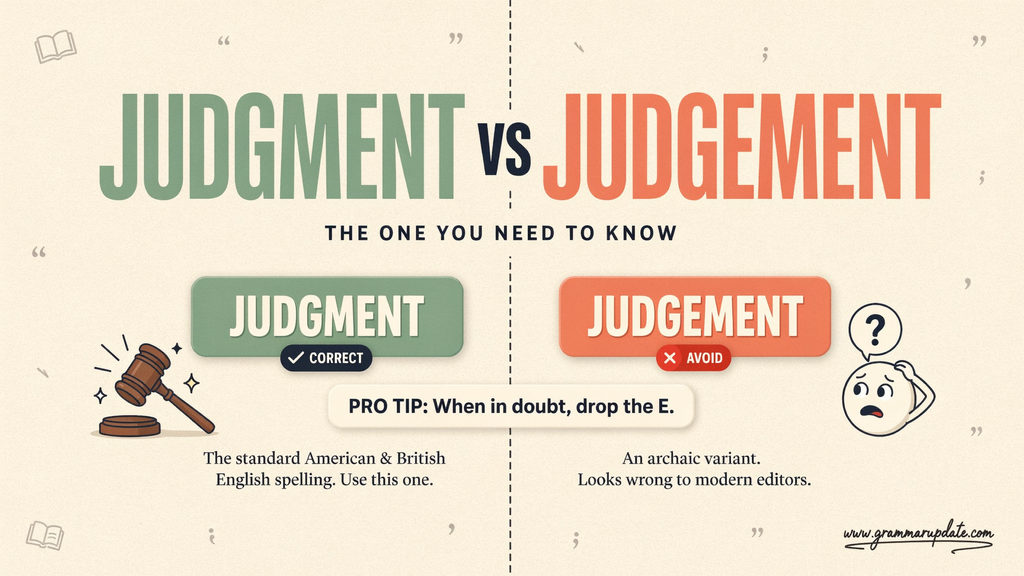
If you’re writing in American English, judgment is the standard choice.
You will commonly see it in everyday conversations, business writing, academic work, journalism, and legal documents.
For example:
“She demonstrated excellent judgment.”
“The manager trusted his professional judgment.”
“That was a serious error of judgment.”
“The court issued its judgment.”
“Against my better judgment, I agreed to help.”
In American writing, using judgement instead of judgment can make the text look as though it follows British spelling conventions.
That doesn’t necessarily make it incomprehensible or meaningless. Most American readers will understand it immediately. Still, if you’re deliberately writing in American English, judgment is the more natural choice.
Judgement in British English
In general British English, judgement is widely accepted and commonly used.
For example:
“She demonstrated excellent judgement.”
“The manager trusted his professional judgement.”
“That was a serious error of judgement.”
“Against my better judgement, I agreed to help.”
Again, the meaning remains unchanged.
However, British English does not use judgement exclusively. Judgment also appears in British writing, especially in legal contexts. Therefore, saying that British English always uses judgement would oversimplify the issue.
Language rarely fits into perfectly sealed categories.
Judgment vs Judgement in Legal Writing
Legal writing deserves special attention because the word judgment has a specific legal meaning.
A court judgment is a formal decision made by a court or judge. Depending on the legal system and type of case, a written judgment may explain the facts, identify the legal issues, discuss the relevant law, provide the judge’s reasoning, and state the final decision or orders.
For example:
“The judge delivered a written judgment explaining the reasons for the decision.”
Here, judgment is not simply an opinion. It is a formal judicial decision.
Similarly:
“The court entered judgment in favor of the defendant.”
This has a specific legal meaning that goes beyond the ordinary idea of making a choice.
Judgment, verdict, and decision are not always interchangeable
These terms are related, but they don’t mean exactly the same thing.
| Term | General meaning |
|---|---|
| Judgment | A formal court decision or an assessment or conclusion |
| Verdict | A formal finding, particularly one reached by a jury |
| Decision | A broad term for a choice or determination |
| Ruling | A decision made by a judge or court on a particular issue |
| Sentence | The punishment imposed after a criminal conviction |
For example, a jury may reach a verdict, while the court may later issue or enter a judgment.
Likewise, a judge can make a ruling on a particular legal question without that ruling necessarily being the final judgment in the case.
Therefore, replacing judgment with decision or verdict can sometimes change the meaning.
Learn the difference between confusing word pairs
Grately vs Greatly Differences and Correct Usage
Which spelling should appear in court documents?
That depends on the jurisdiction and the applicable legal conventions.
In American legal writing, judgment is the standard form.
British legal writing also uses judgment as an established legal term, even though judgement is common in general British English.
Consequently, a legal writer shouldn’t simply assume that every British document must use judgement. Court terminology has its own traditions.
If you’re preparing an actual legal document, follow the spelling and terminology required by the relevant jurisdiction, court, organization, or legal style guide.
Judgment VS Judgement in Academic Writing
Academic writing benefits from consistency.
If you’re writing for an American institution, judgment will normally fit the expected form of American English.
For example:
“The researcher used professional judgment when evaluating the evidence.”
If you’re writing according to British English conventions, judgement may be preferred:
“The researcher used professional judgement when evaluating the evidence.”
Neither sentence is inherently better. The important thing is that the spelling matches the rest of the document.
For instance, an academic paper that uses color, center, organize, and judgment consistently follows American conventions. A paper that uses colour, centre, organise, and judgement follows British conventions.
Mixing the two systems without a reason can make the writing look inconsistent.
Common Expressions With Judgment VS Judgement
Some phrases occur frequently enough that it’s useful to recognize both forms.
| American English | British English |
|---|---|
| good judgment | good judgement |
| poor judgment | poor judgement |
| sound judgment | sound judgement |
| professional judgment | professional judgement |
| error of judgment | error of judgement |
| reserve judgment | reserve judgement |
| pass judgment | pass judgement |
| value judgment | value judgement |
| against my better judgment | against my better judgement |
| judgment call | judgement call |
The difference remains spelling rather than meaning.
For example, “use your judgment” and “use your judgement” communicate the same idea. The preferred form simply depends on the variety of English being used.
Learn the difference between everyday English mistakes
Dysregulated vs Disregulated Correct Usage Explained
Judgment Examples in Everyday Writing
Judgment appears in many ordinary situations.
Consider the sentence:
“She showed good judgment when she decided to wait.”
Here, judgment refers to sensible decision-making.
Now consider:
“His judgment of the situation was inaccurate.”
In this case, judgment means an assessment or opinion.
Another example:
“I questioned his judgment after he ignored the warning.”
This sentence suggests that the speaker doubts the quality of his decision-making.
The British spelling works in the same contexts:
“I questioned his judgement after he ignored the warning.”
Again, nothing about the meaning changes.
How Judgment Can Mean Discernment
Judgment isn’t always about making a major decision.
Sometimes it describes the ability to notice important differences and respond appropriately. This overlaps with ideas such as discernment, reasoning, discretion, and evaluation.
For example, an experienced editor needs judgment when deciding whether a sentence is clear enough for publication.
A manager needs judgment when deciding which employee should handle a sensitive assignment.
A driver needs judgment when deciding whether weather conditions make a journey unsafe.
In each case, judgment involves more than simply choosing between two options. It requires a person to interpret circumstances and consider consequences.
That’s why the phrase “good judgment” often carries a positive meaning.
Judgment Does Not Always Mean Criticism
People sometimes associate judgment with criticism, especially because of expressions such as “don’t judge me.”
However, judgment has a much broader meaning.
A person can make a judgment without criticizing anyone.
For example:
“The doctor used her professional judgment.”
“The engineer used his judgment to identify the safest option.”
“The editor exercised careful judgment before publishing the article.”
None of these sentences necessarily involves criticism.
Instead, judgment refers to thoughtful assessment and decision-making.
Learn the difference between more words people mix up
Conex or Connex Differences Explained
A Simple Example of the Difference in Context
Imagine that a company must decide whether to launch a new product.
The manager reviews sales figures, customer feedback, costs, and market conditions. After considering everything, she decides that the product isn’t ready.
That conclusion involves judgment.
Now imagine that a British manager describes the same process:
“The manager used her judgement to decide that the product wasn’t ready.”
The two sentences mean exactly the same thing.
The spelling reflects the variety of English rather than a difference in the manager’s reasoning.
However, if the sentence describes a court:
“The court issued its judgment.”
The word now carries a specific legal meaning.
That is why context matters as much as regional spelling.
Common Mistakes With Judgment VS Judgement
Treating judgement as a misspelling
This is one of the most common mistakes.
Judgement is a recognized English spelling. It is especially common in British English.
Therefore, an American writer should prefer judgment, but shouldn’t assume that judgement is universally wrong.
Treating judgment as exclusively American
The reverse claim is also too broad.
Judgment is strongly associated with American English, but it also occurs in British English. Legal terminology provides an especially clear example.
Mixing both spellings without a reason
Using judgment in one paragraph and judgement in another isn’t normally necessary.
For example:
“The report praised her good judgement. However, it questioned her professional judgment.”
If the writer is following one English variety, the change looks accidental.
Consistency makes the writing easier to read and signals that the spelling choice was deliberate.
Confusing judgment with verdict
A court judgment isn’t necessarily the same thing as a verdict.
A verdict generally represents a finding, particularly one reached by a jury. A judgment is a formal decision of a court.
These terms can occur in the same case, but they describe different parts of the legal process.
Assuming pronunciation changes
The two spellings are pronounced essentially the same.
The extra e in judgement doesn’t create a separate pronunciation.
Therefore, listening to someone say the word won’t tell you which spelling they use.
Learn the difference between confusing more English words
Atleast or At Least? Which One Is Correct?
Judgment vs Judgement A Useful Comparison
| Feature | Judgment | Judgement |
|---|---|---|
| Meaning | Opinion, assessment, decision, or court decision | Same |
| Pronunciation | Essentially the same | Essentially the same |
| Spelling | Without e | With e |
| American English | Preferred | Less common |
| British English | Used, especially in some contexts | Widely used in general English |
| Legal writing | Very common | Depends on jurisdiction and convention |
| Academic writing | Preferred in US English | Common in UK English |
| Informal writing | Common in US English | Common in UK English |
| Plural | judgments | judgements |
The table captures the central point: this is mainly a spelling variation rather than a difference in meaning.
How to Choose the Right Spelling
The easiest approach is to start with your audience.
1.If you’re writing for readers in the United States, choose judgment.
2.If you’re writing general British English, choose judgement.
3.If you’re writing for an international publication, follow its established writing conventions.
4.If you’re working on a legal document, follow the terminology used by the relevant jurisdiction.
5.If you’re writing an academic paper, check your institution’s preferred style.
Most importantly, don’t switch between the two forms without a reason.
A practical rule to remember
Think of it this way:
American English generally prefers judgment.
British English generally prefers judgement.
Legal writing may follow specialized conventions.
Practice Session Judgment vs Judgement
Choose the correct form, judgment vs judgement, for each sentence. Use the spelling that fits the English variety indicated in the sentence.
- In American English, she showed excellent __________ during the crisis.
- The British writer praised his good __________.
- The court issued its final __________ after hearing the case.
- He acted against his better __________ and accepted the offer.
- The editor used professional __________ when reviewing the article.
- In UK English, the committee decided to reserve __________ until it had more information.
- The manager’s poor __________ caused several problems.
- The American newspaper reported that the court had issued its __________.
- She trusted her own __________ when making the difficult decision.
- The British author described the decision as an error of __________.
- Good __________ often comes from experience and careful reasoning.
- The judge’s written __________ explained the reasons for the ruling.
- In American English, the standard spelling is __________.
- In general British English, the common spelling is __________.
- The teacher questioned his __________ after he ignored the instructions.
- The committee used careful __________ when evaluating the evidence.
- The British report praised the employee’s professional __________.
- The American lawyer discussed the court’s __________ with her client.
- She decided not to pass __________ on the situation until she knew the full story.
- His sound __________ helped the team avoid a serious mistake.
- In UK English, the manager relied on her professional __________.
- The court entered __________ in favor of the defendant.
- The two spellings have the same basic meaning, but their regional __________ differ.
- If you’re writing for a US audience, __________ is normally the preferred form.
- If you’re writing general British English, __________ is normally the preferred form.
Answers
- judgment
- judgement
- judgment
- judgment
- judgment
- judgement
- judgment
- judgment
- judgment
- judgement
- judgment
- judgment
- judgment
- judgement
- judgment
- judgment
- judgement
- judgment
- judgment
- judgment
- judgement
- judgment
- spelling
- judgment
- judgement
Here’s a trusted source for clear word meanings:
FAQs
Is judgment vs judgement the correct spelling?
Both spellings are correct. American English generally uses judgment, while British English commonly uses judgement in general writing. Your choice should match the English variety and writing context.
Is judgment the American spelling?
Yes. Judgment is the standard American spelling. For example, an American writer would normally say, “She showed good judgment.”
Is judgement the British spelling?
Yes. Judgement is widely used in general British English. A British writer might write, “She showed good judgement.”
Do judgment and judgement mean the same thing?
Yes. They generally have the same meaning and pronunciation. The main difference is the spelling convention used in different varieties of English.
Why is judgment spelled without an e?
Judgment became the standard spelling in American English through established usage. The spelling isn’t simply a careless version of judgement. Both forms have a long history in English, with different regional preferences developing over time.
Is judgement wrong in American English?
No. Judgement is a recognized English spelling, but American English normally prefers judgment. If you’re writing consistently in US English, judgment is the better choice.
Is judgment wrong in British English?
No. Although judgement is common in general British English, judgment also appears in British writing. It’s particularly familiar in legal terminology and certain established expressions.
Which spelling should I use in an American essay?
Use judgment unless your school, instructor, publisher, or style guide requires another form. More importantly, keep your spelling consistent throughout the essay.
Which spelling should I use in British English?
Use judgement for most general British English writing. However, specialized fields can follow their own conventions, so legal and professional documents may require a particular form.
Are judgment and judgement pronounced differently?
No. The two spellings are generally pronounced the same. The additional e in judgement doesn’t create a different pronunciation.
Does judgment only refer to a court decision?
No. Judgment has several meanings. It can describe the ability to make sensible decisions, an opinion or assessment, or a formal decision issued by a court.
What does good judgment mean?
Good judgment means making sensible decisions after considering the circumstances and possible consequences. Someone with good judgment usually evaluates a situation carefully before acting.
What is a judgment call?
A judgment call is a decision that requires personal assessment because the correct choice isn’t always obvious. For example, a manager may have to make a judgment call when deciding whether a project is ready to launch.
Is a court judgment the same as a verdict?
No. A verdict generally refers to a formal finding, particularly one reached by a jury. A judgment is a formal decision of a court and may determine the legal outcome of a case.
Should legal writing use judgment vs judgement?
It depends on the jurisdiction and the applicable legal conventions. Judgment is widely established in legal terminology, including American legal writing and British legal contexts. When preparing an actual legal document, follow the rules and terminology used by the relevant court or legal system.
Can judgment and judgement appear in the same article?
They can, but switching between them without a clear reason usually looks inconsistent. If you’re writing in American English, use judgment throughout. If you’re following general British English, judgement will usually be the appropriate choice.
What is the difference between judgment and opinion?
An opinion is a person’s view or belief about something. Judgment can include forming an opinion, but it also refers to decision-making ability and formal court decisions. Therefore, the two words overlap without being interchangeable in every situation.
What is the difference between judgment and decision?
A decision is a choice or determination. Judgment can also describe a decision, but it often emphasizes assessment, reasoning, or discretion. In legal contexts, judgment has a specific meaning as a formal court decision.
Are judgmental and judgemental spelled differently for the same reason?
Yes. Judgmental is common in American English, while judgemental is also used in British English. Both forms describe someone who tends to form or express critical opinions about other people.
How can you remember the difference between judgment and judgement?
A simple rule works in most situations: American English generally uses judgment, while British English commonly uses judgement. If you’re writing for a particular organization, publication, school, or profession, follow its preferred style.
Does changing judgment to judgement change the meaning?
No. In ordinary English, the spelling change doesn’t alter the meaning. Both forms can refer to decision-making ability, an assessment, or a formal court decision.
Which spelling is better for professional writing?
Neither spelling is universally better. Choose the form that matches your audience and the writing conventions you’re expected to follow. For US professional writing, judgment is normally preferred. For general UK professional writing, judgement is commonly used.
Are judgments and judgements both correct plural forms?
Yes. Judgments is the plural of judgment, while judgements is the plural of judgement. The spelling preference follows the same regional pattern as the singular form.
conclusion
So, what should you choose when judgment vs judgement start causing a little spelling panic? Fortunately, there’s no need to call the grammar police. Both spellings are correct. The difference mainly comes down to regional English and context.
American English generally prefers judgment, while British English commonly uses judgement in general writing. Legal writing can be a little more complicated because courts and legal systems may follow established terminology of their own.
The easiest rule is to match your spelling to your audience and remain consistent. Writing for readers in the US? Choose judgment. Writing general British English? Judgement is usually the natural choice.
Once you know that, the extra e stops being a mystery. It’s simply a small spelling difference in a very flexible language.

Jhon AJS, the creative mind behind Grammar Update, is an experienced blogger passionate about simplifying English grammar. He focuses on explaining confusing word vs word differences, grammar rules, punctuation, and sentence structure in a clear and practical way. Through easy to understand guides and examples, Jhon helps readers improve their writing and communicate with confidence. With years of blogging experience, he continues to share helpful insights that make learning grammar simple, useful, and accessible for everyone.