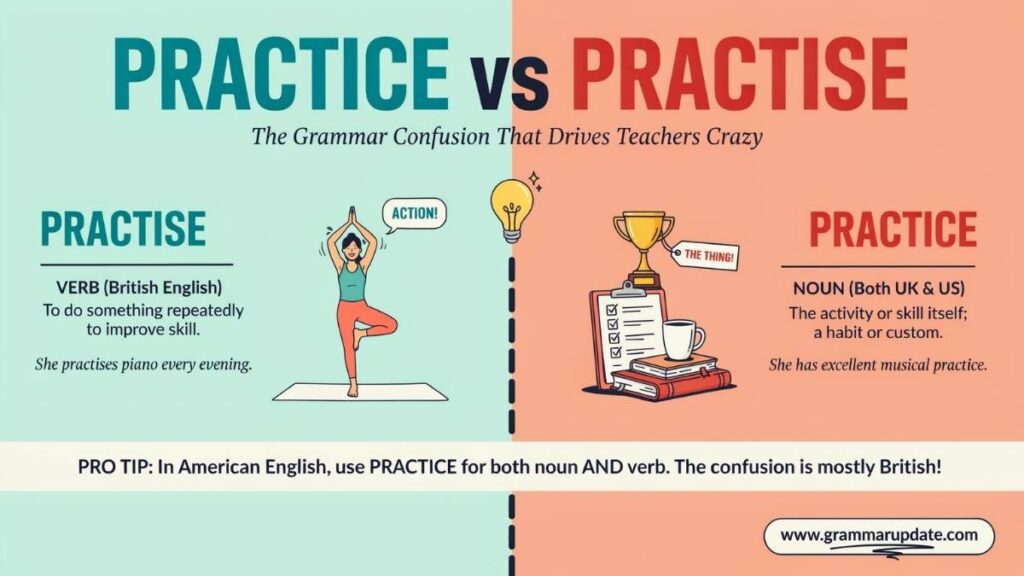
Practice vs practise can make even confident writers pause mid sentence. One tiny letter changes, and suddenly your grammar starts playing detective. The good news? The rule isn’t as mysterious as it looks. Both spellings are correct, but English varieties use them differently. American English uses practice for both the noun and verb. British English uses practice as a noun and practise as a verb. For example, Americans write “I practice every day,” while British writers use “I practise every day.” Once you understand this simple distinction, the confusion disappears. So, grab your imaginary red pen and let’s crack the case without breaking a sweat.
Practice vs Practise at a Glance
The simplest way to understand practice vs practise is to look at the word’s role in a sentence.
In British English, practice is generally a noun while practise is a verb.
For example:
- I need more practice before the concert.
- I need to practise before the concert.
In the first sentence, practice names an activity. Therefore, it functions as a noun.
In the second sentence, practise describes an action. Therefore, it functions as a verb.
American English does not normally make this spelling distinction. Instead, Americans use practice for both roles.
| English variety | Noun | Verb |
| American English | practice | practice |
| British English | practice | practise |
| Australian English | practice | practise |
| Canadian English | practice | practise is commonly used |
Therefore, when deciding between practice or practise, first identify which variety of English you are writing.
Learn the difference between confusing more English words
Humorous vs Humerous Which one Is Correct?
What Is the Practice vs Practise Meaning?
The practice or practise meaning becomes clearer when you separate the noun from the verb.
Practice can describe repeated activity that helps someone improve a skill. It can also describe a usual method, custom or professional activity.
For example:
- Piano practice requires patience.
- Regular practice improves your pronunciation.
- That company follows a common industry practice.
- She works at a medical practice.
In each sentence, practice acts as a noun.
Practise has a different grammatical role in British English. It describes the action of repeatedly doing something to improve a skill.
For example:
- She practises the piano every evening.
- You should practise your pronunciation.
- They practise speaking English at home.
- The team practises every afternoon.
Consequently, the main distinction concerns both grammar and regional spelling.
Practice Meaning
The practice meaning covers several related ideas.
First, practice can mean repeated activity designed to improve ability. A musician practices scales. A student practices mathematics. An athlete practices a particular skill.
Second, practice can describe an established way of doing something.
For example:
“Checking the equipment before use is standard practice.”
Third, practice can describe professional work.
For example:
“She owns a successful medical practice.”
Therefore, practice can refer to an activity, method or professional operation.
Practise Meaning
The practise meaning focuses on action in British English.
When someone practises something, they repeatedly perform it to improve their ability.
For example:
- She practises speaking English.
- He practises the guitar every morning.
- They practise football after school.
- I practise writing every day.
British English also uses practise when someone works professionally in a field.
For example:
“She practises law in London.”
American English uses practice in the same sentence:
“She practices law in New York.”
Learn the difference between commonly mixed-up more words
Awful vs Awfull Which one Is Correct?
Practice Definition and Practise Definition
The practice definition and practise definition are closely related because the words come from the same linguistic family.
Practice generally functions as a noun in British English. It can describe training, repeated activity, a method or professional work.
Practise functions as a verb in British English. It describes the action of repeatedly performing something or working professionally in a particular field.
| Word | Grammatical role in British English | Main use |
| practice | Noun | Activity, method or professional work |
| practise | Verb | Repeated action or professional activity |
American English simplifies this pattern by using practice for both the noun and verb.
The Difference Between Practice and Practise
The difference between practice and practise is easiest to understand through grammar.
In British English:
Practice = noun
Practise = verb
Consider these sentences:
- Her daily practice improved her performance.
- She practises every morning.
The first sentence refers to the activity itself. The second describes what she does.
This distinction becomes especially useful when you write about music, sports, education or professional work.
For example:
- His piano practice lasts two hours.
- He practises the piano for two hours.
The meaning remains closely connected. However, the grammatical function changes.
American English uses practice in both sentences:
- His piano practice lasts two hours.
- He practices the piano for two hours.
Practice as a Noun and Practise as a Verb
The phrase practice as a noun and practise as a verb summarizes the standard British English pattern.
Consider the following examples:
- We need more football practice.
- We practise football every Saturday.
The first sentence names the training activity. Therefore, practice is a noun.
The second sentence describes an action. Therefore, practise is a verb.
The same pattern appears in many areas.
| Context | Noun | Verb |
| Music | piano practice | practise the piano |
| Sports | football practice | practise football |
| Language | English practice | practise English |
| Writing | writing practice | practise writing |
| Pronunciation | pronunciation practice | practise pronunciation |
| Law | legal practice | practise law |
| Medicine | medical practice | practise medicine |
Therefore, the noun does not suddenly become practise simply because the subject involves an action.
Practice Noun or Verb?
The question practice noun or verb has different answers depending on the variety of English.
In British English, practice normally functions as a noun.
For example:
“I need more practice.”
In American English, practice can function as either a noun or a verb.
For example:
“I need more practice.”
“I practice every morning.”
Consequently, American English gives the word two grammatical jobs while British English normally distinguishes those jobs through spelling.
Practise Noun or Verb?
The question practise noun or verb has a simpler answer.
In standard British English, practise is a verb.
For example:
“I practise English every day.”
“I practise the piano after school.”
It is not normally used as the noun.
Therefore, if you are writing British English and the word names the activity itself, use practice.
If the word describes the action, use practise.
Learn the difference between tricky grammar more words
Buoyant vs Bouyant Which one Is Correct?
Practice vs Practise in American English
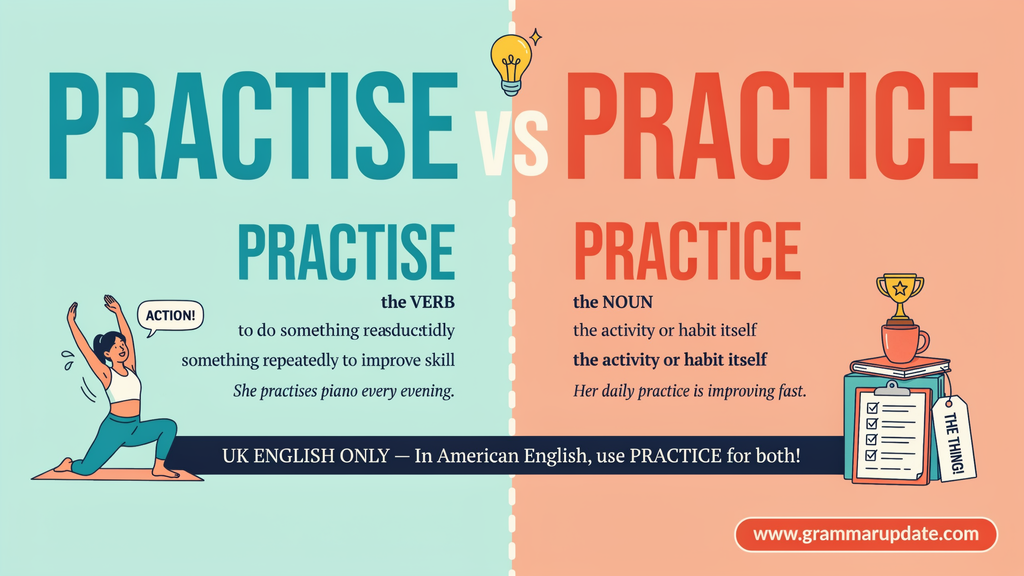
The practice vs practise in American English question has a straightforward answer.
American English normally uses practice for both the noun and verb.
For example:
- I need more practice.
- I practice every morning.
- She practices the piano.
- He practiced his speech.
- They are practicing for the competition.
Notice that the spelling remains consistent.
The forms are practice, practices, practiced and practicing.
Therefore, American writers generally do not need to switch to practise when the word becomes a verb.
Practice vs Practise in British English
The practice or practise in British English distinction is different.
British English normally uses practice as the noun and practise as the verb.
For example:
- I need more practice.
- I practise every morning.
- She practises the piano.
- He practised his speech.
- They are practising for the competition.
Therefore, the spelling changes when the grammatical role changes.
This pattern applies across everyday writing as well as professional communication.
When to Use Practice or Practise
Knowing when to use practice or practise becomes easier when you follow a simple process.
First, identify the English variety.
If you use American English, practice works for both noun and verb.
If you use British English, continue to the next step.
Second, identify the grammatical role.
If the word names an activity, use practice.
If it describes an action, use practise in British English.
For example:
“I need more practice.”
The word names an activity.
“I need to practise.”
The word describes an action.
Therefore, the sentence itself can often tell you which form you need.
How to Use Practice and Practise
The easiest way to understand how to use practice and practise is to focus on what the word does.
Consider this sentence:
“She needs more practice.”
You can replace practice with another noun such as training.
“She needs more training.”
That confirms that practice functions as a noun.
Now consider:
“She needs to practise.”
You can replace practise with another verb such as train.
“She needs to train.”
That confirms that practise functions as a verb.
This simple substitution method can help language learners recognize the correct form.
Practice VS Practise Examples in Sentences
American English:
- I practice English every morning.
- She practices the violin after school.
- The players practice every Tuesday.
- He practiced his presentation.
- They are practicing for the final.
British English:
- I practise English every morning.
- She practises the violin after school.
- The players practise every Tuesday.
- He practised his presentation.
- They are practising for the final.
However, noun examples remain the same:
- I need more practice.
- She gets plenty of piano practice.
- The team has football practice today.
- Regular practice improves your skills.
This shows why the distinction depends heavily on grammar.
Learn the difference between confusing word pairs
Taylored vs Tailored Which one Is Correct?
Why Do British People Spell Practise With an S?
Many learners ask why do British people spell practise with an s.
The answer comes from British spelling conventions that distinguish certain noun and verb forms.
The distinction is similar to familiar pairs such as advice and advise.
Advice is a noun.
Advise is a verb.
Likewise, in British English:
Practice is a noun.
Practise is a verb.
English spelling developed through centuries of linguistic change. French, Latin and other languages influenced English vocabulary and spelling. Later conventions helped establish patterns that distinguish related forms.
Therefore, the spelling difference is not simply a random British preference.
It reflects an established spelling convention.
Why Is Practice Spelled With C and Practise With S?
The question why is practice spelled with c and practise with s is particularly useful for understanding British English.
The spelling with c functions as the noun.
The spelling with s functions as the verb.
For example:
“The teacher recommended more practice.”
“The teacher told us to practise.”
The two forms are closely related in meaning. However, their written forms help readers identify their grammatical roles.
American English generally removes that distinction by using practice for both.
Practice and Practise Spelling
The practice and practise spelling difference also affects related verb forms.
In American English, you will normally see:
- practice
- practices
- practiced
- practicing
In British English, you will normally see:
- practise
- practises
- practised
- practising
The noun remains practice in both varieties.
| Form | American English | British English |
| Base verb | practice | practise |
| Third-person form | practices | practises |
| Past form | practiced | practised |
| Present participle | practicing | practising |
| Noun | practice | practice |
Therefore, learning only the base word isn’t enough. You also need to recognize the related verb forms.
Learn the difference between often confused words
Copys or Copies Which Is Correct?
Practice VS Practise in Football
Football vocabulary provides an excellent example of the difference.
Consider the phrase football practice.
Here, practice is a noun.
For example:
“We have football practice at six.”
British English uses the same noun:
“We have football practice at six.”
However, the verb changes.
British English:
“We practise football every afternoon.”
American English:
“We practice football every afternoon.”
The same principle applies to other sports.
Football Practice VS Practise
The correct choice depends on the grammatical role.
- football practice — noun
- practise football — British English verb
- practice football — American English verb
- football training — another noun phrase
Therefore, football practice or practise isn’t really a question about football. It is a question about whether the word functions as a noun or verb.
Learn the difference between basic English word mistakes
Favour vs Favor Which Spelling Is Correct?
Practice VS Practise in Fitness
Fitness writing follows the same grammatical pattern.
For example:
“Regular practice can improve movement skills.”
Here, practice is a noun.
British English would use practise when describing the action:
“She practises her routine every morning.”
Professional language also contains the phrase fitness to practise.
In British professional settings, fitness to practise can refer to whether someone meets the required professional standards to work safely and competently.
American English may use fitness to practice because practice serves as the verb.
Therefore:
British English: fitness to practise
American English: fitness to practice
The grammatical role remains the key.
Practice VS Practise in Legal English
Legal language creates another useful example.
Legal practice is a noun phrase.
For example:
“She works at a respected legal practice.”
The noun remains practice in both American and British English.
However, the verb changes.
British English:
“She practises law in London.”
American English:
“She practices law in New York.”
The same principle applies to legal professional writing.
Therefore, legal practice and legal practise are not interchangeable in every sentence.
Legal practice is the standard noun phrase.
Practise law is the standard British English verb phrase.
Practice law is the standard American English verb phrase.
Medical Practice and Professional Practice
The same distinction appears in medical English.
Consider:
“She owns a private medical practice.”
Here, practice is a noun.
Now change the sentence.
British English:
“She practises medicine.”
American English:
“She practices medicine.”
Again, the professional noun remains practice.
Common noun phrases include:
- medical practice
- private practice
- professional practice
- clinical practice
- general practice
- legal practice
Because these phrases use practice as a noun, the spelling remains the same in British English and American English.
Best Practice or Best Practise?
The phrase best practice is another common source of confusion.
Best practice is correct when the phrase refers to an effective or accepted method.
For example:
“Regular backups are best practice in data management.”
The word practice functions as a noun.
Therefore, British English also uses best practice.
Best practise is not the standard spelling for this noun phrase.
The same applies to:
- industry best practice
- professional best practice
- best practice examples
- standard practice
- recommended practice
Consequently, the spelling does not change merely because the surrounding sentence describes an action.
Practice Makes Perfect
The familiar expression practice makes perfect also uses practice as a noun.
Here, practice refers to repeated activity that helps improve ability.
For example:
“Keep working on your pronunciation. Practice makes perfect.”
The phrase remains practice in both American and British English.
The British verb practise does not belong here because the word names the activity rather than describing what
someone does.
Learn the difference between commonly misused words
Amateur vs Amatuer difference and Which one Is Correct?
Common Mistakes With Practice and Practise
Several mistakes appear repeatedly because writers focus on spelling instead of grammar.
Assuming Practise Is Always Wrong
Practise is not always wrong.
It is the standard British English verb spelling.
For example:
“You should practise your pronunciation.”
Therefore, calling practise incorrect without considering regional English creates another mistake.
Assuming Practice Is Only a Noun
Practice is not only a noun.
American English uses practice as a verb.
For example:
“I practice speaking English every morning.”
Therefore, American writers should not replace practice with practise.
Using Practise as a British Noun
A common mistake is writing:
“I need more practise.”
The standard British form is:
“I need more practice.”
The noun remains practice.
Mixing English Varieties
Consider:
“I practice every morning because I need more practise.”
The sentence mixes American and British verb spelling.
A consistent American version would be:
“I practice every morning because I need more practice.”
A consistent British version would be:
“I practise every morning because I need more practice.”
Therefore, consistency matters in formal writing.
Practice vs Practise Grammar Rules
The most useful practice vs practise grammar rules are simple.
First, American English uses practice as both noun and verb.
Second, British English uses practice as a noun.
Third, British English uses practise as a verb.
Fourth, professional nouns such as medical practice and legal practice use practice.
Fifth, British verb forms include practises, practised and practising.
Finally, choose one English variety and remain consistent.
These rules handle most everyday situations.
Easy Way to Remember Practice vs Practise
An easy way to remember practice vs practise is to think about the British English distinction.
Practice is a thing.
Practise is an action.
For example:
“I need more practice.”
The word identifies the thing or activity.
“I need to practise.”
The word identifies the action.
For American English, the memory trick becomes even easier:
Practice does both jobs.
Therefore:
US English: practice = noun + verb
UK English: practice = noun
UK English: practise = verb
How Spell Checkers Handle Practice and Practise
Spell checkers can sometimes make this distinction confusing.
If your document uses US English, the software will generally recognize practice as the normal spelling for both grammatical roles.
If your document uses UK English, the software should recognize practise as the standard verb spelling.
However, spell checkers depend on language settings. If the wrong regional dictionary is selected, a correct word may appear as an error.
Therefore, check your language settings before changing a spelling that looks unfamiliar.
This is particularly important when writing for an international audience.
Similar English Spelling Differences
Practice and practise belong to a wider group of related spelling patterns.
For example:
- advice is a noun.
- advise is a verb.
- device is a noun.
- devise is a verb.
- practice is a noun in British English.
- practise is a verb in British English.
These examples can help language learners recognize spelling conventions.
However, English doesn’t apply one rule to every word. Therefore, each commonly confused pair still needs to be learned according to its actual usage.
Practice vs Practise Examples
Here are several examples that show the difference clearly.
| Meaning | American English | British English |
| Need training | I need more practice. | I need more practice. |
| Train regularly | I practice daily. | I practise daily. |
| Train an instrument | She practices piano. | She practises piano. |
| Work as a doctor | He practices medicine. | He practises medicine. |
| Work as a lawyer | She practices law. | She practises law. |
| Training session | We have football practice. | We have football practice. |
| Professional organization | It is a medical practice. | It is a medical practice. |
The table reveals the central pattern. The noun stays the same while the verb changes according to regional spelling.
Is Practise a Word?
Yes, practise is a real English word.
In British English, it is the standard spelling of the verb.
For example:
“You should practise your speaking skills.”
Therefore, if a British English document contains practise, it isn’t necessarily a spelling mistake.
Instead, it may be exactly the spelling the writer needs.
Is Practice Correct?
Yes, practice is correct.
It functions as a noun in both British and American English.
It also functions as a verb in American English.
For example:
- She needs more practice.
- She practices every day.
Therefore, practice is one of those words that can perform different grammatical roles depending on the English variety.
Learn the difference between everyday English mistakes
Ingenuine vs Ungenuine Which one Is Correct?
Is It Practice VS Practise in the UK?
If you’re asking is it practice or practise in the UK, the answer is that British English uses both.
Use practice as the noun.
Use practise as the verb.
For example:
- Football practice begins at four.
- The players practise every afternoon.
Therefore, neither spelling replaces the other completely.
Is It Practice VS Practise in the US?
If you’re asking is it practice or practise in the US, use practice.
American English normally uses practice for both the noun and verb.
For example:
- Football practice begins at four.
- The players practice every afternoon.
The spelling remains practice in both sentences.
Do Americans Use Practise?
Standard American English normally uses practice instead of practise.
An American writer would typically write:
“I practice English every day.”
The spelling practise may appear when someone is quoting British English or discussing regional spelling. However, it isn’t the standard choice for ordinary US English writing.
Do British People Use Practice?
Yes, British writers use practice regularly.
They use it as a noun in expressions such as:
- best practice
- legal practice
- medical practice
- football practice
- practice session
- practice test
- practice makes perfect
Therefore, British English does not replace practice with practise everywhere.
The spelling depends on grammatical function.
Practice Session
Complete each sentence with the correct form of practice or practise. Questions 1–12 follow American English. Questions 13–25 follow British English.
Fill in the Blanks
- I need more ______ before my driving test.
- Sarah ______ the piano every evening.
- The football team has ______ after school.
- You should ______ your pronunciation before the presentation.
- He gets plenty of ______ before every competition.
- My brother ______ speaking English with his friends.
- The doctor has a private medical ______.
- She ______ her speech several times before the meeting.
- Regular ______ can improve your writing skills.
- The students ______ their spelling every morning.
- Our coach scheduled football ______ for Saturday.
- He ______ the guitar for an hour each day.
- I need more ______ before the final exam.
- She ______ the violin every afternoon.
- The players ______ football twice a week.
- You should ______ speaking English at home.
- He works at a well-known medical ______.
- The lawyer ______ law in Manchester.
- Regular ______ helps you develop new skills.
- They are ______ for the championship.
- She has a daily piano ______ routine.
- He ______ his pronunciation before giving a speech.
- The students need more writing ______.
- The doctor ______ medicine at a hospital in London.
- If you want to improve, you should ______ regularly.
Answers
- practice
- practices
- practice
- practice
- practice
- practices
- practice
- practiced
- practice
- practice
- practice
- practices
- practice
- practises
- practise
- practise
- practice
- practises
- practice
- practising
- practice
- practises
- practice
- practises
- practise
Here’s a trusted source for clear word meanings:
FAQs
Is practice or practise correct?
Both spellings are correct. American English uses practice for both the noun and verb. British English uses practice as a noun and practise as a verb.
What is the difference between practice and practise?
The main difference involves grammar and regional English. In British English, practice is a noun while practise is a verb. American English uses practice for both.
Is practise a word?
Yes. Practise is a standard British English verb. It means to repeatedly do something to improve a skill. It can also describe working professionally in a field such as law or medicine.
Is practice a noun or a verb?
Practice can be either a noun or a verb. In American English, it serves both roles. In British English, it generally functions as a noun.
When do I use practice?
Use practice when the word functions as a noun in both American and British English. American English also uses practice as a verb.
For example, “I need more practice” uses practice as a noun. “I practice every morning” uses it as a verb.
When do I use practise?
Use practise as a verb when writing in British English.
For example:
“She practises the piano every evening.”
Is practice correct in British English?
Yes. British English uses practice as a noun.
For example:
“The team has football practice today.”
Is practise correct in American English?
Standard American English normally uses practice instead of practise. Therefore, an American writer would write “She practices every day.”
Why does British English use practice and practise?
British English developed a spelling distinction between the noun and verb. Practice became the noun form while practise became the verb form.
Is “practice makes perfect” correct?
Yes. The expression “practice makes perfect” is correct in both American and British English because practice functions as a noun.
Is it “practice football” or “practise football”?
Both forms can be correct depending on the English variety. American English uses “practice football.” British English uses “practise football.”
Is it “legal practice” or “legal practise”?
Legal practice is correct when you mean the profession or professional activity. In British English, use practise when describing the action: “She practises law.”
Is it “medical practice” or “medical practise”?
Medical practice is correct when referring to a medical profession, clinic or professional activity. In British English, use practise as the verb: “He practises medicine.”
What is the easiest way to remember practice vs. practise?
For British English, remember one simple rule: practice is the noun and practise is the verb. American English uses practice for both roles.
Conclusion
Practice vs practise may look like two words fighting over one tiny letter, but the rule is surprisingly simple. In American English, practice works as both a noun and a verb. In British English, practice serves as the noun while practise takes the verb job. So, “I need more practice” works in both varieties, while “I practice daily” fits American English and “I practise daily” fits British English. The trick is to identify your English variety and then check the word’s grammatical role. Once that habit becomes second nature, practice vs practise won’t trip you up again. After all, grammar has enough plot twists without adding unnecessary spelling drama.

Jhon AJS, the creative mind behind Grammar Update, is an experienced blogger passionate about simplifying English grammar. He focuses on explaining confusing word vs word differences, grammar rules, punctuation, and sentence structure in a clear and practical way. Through easy to understand guides and examples, Jhon helps readers improve their writing and communicate with confidence. With years of blogging experience, he continues to share helpful insights that make learning grammar simple, useful, and accessible for everyone.