Deceive is one of those words that can make you stop mid-sentence and wonder, “Is it deceive vs decieve?” One quick vowel swap, and a perfectly good word becomes a spelling mistake. In this guide to Deceive vs Decieve, the confusion gets cleared up in a simple, practical way. You’ll learn which spelling is correct, what deceive means, how to use it in a sentence, and why the “ie” and “ei” pattern causes so much trouble. By the end, you’ll know the spelling confidently and never let those sneaky vowels fool you again.
Deceive vs Decieve Quick Answer
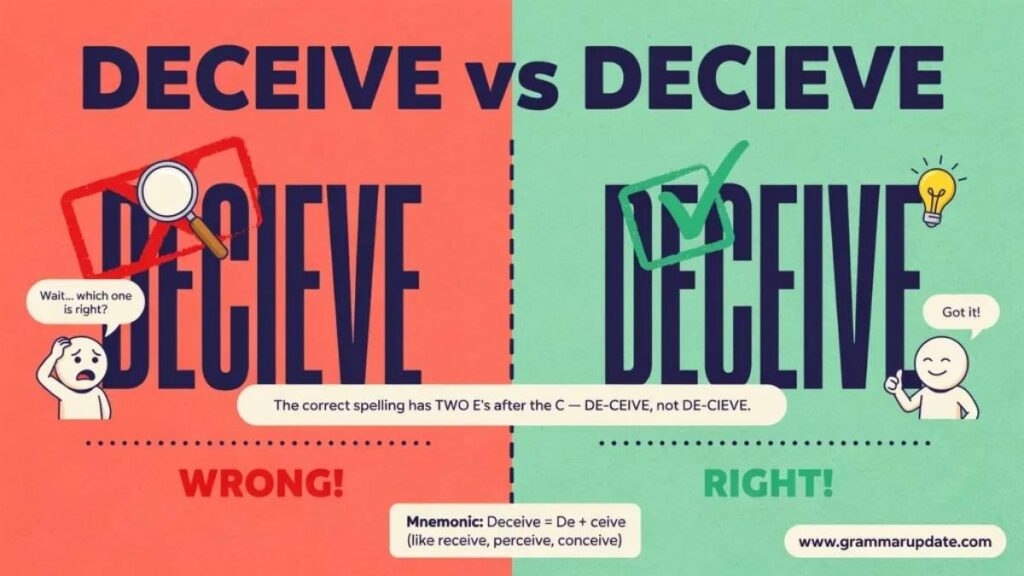
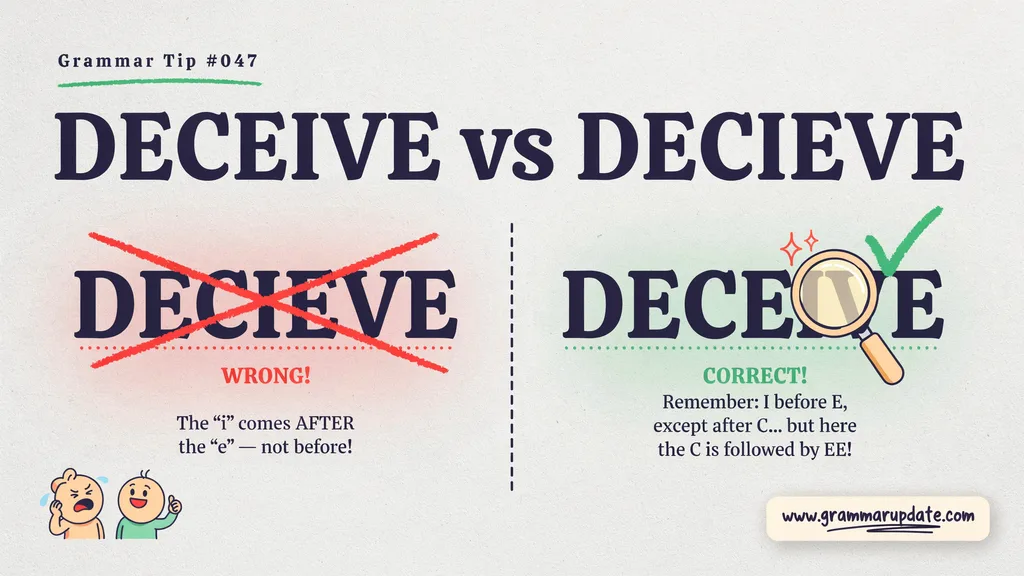
Deceive is the correct spelling, while decieve is incorrect.
The correct spelling is:
D-E-C-E-I-V-E
The incorrect spelling is:
D-E-C-I-E-V-E
The difference appears in the middle of the word. Deceive contains ei after the letter c. Decieve reverses those two vowels.
The word deceive is a verb. It means to make someone believe something that isn’t true, usually by misleading, lying, hiding information, or creating a false impression.
For example:
The advertisement was designed to deceive customers.
Here, deceive means that the advertisement deliberately tried to make customers believe something misleading or untrue.
Therefore, if you’re wondering whether to use deceive or decieve, choose deceive.
Deceive vs Decieve What Is the Difference?
The difference between deceive and decieve isn’t a difference in meaning. Instead, one is the standard spelling and the other is a spelling mistake.
Deceive is a real English verb.
Decieve is a misspelling of deceive.
This distinction matters because seeing an incorrect spelling repeatedly doesn’t make it correct. A misspelled word can appear in social media posts, online comments, messages, documents, and other forms of writing. However, standard English still uses deceive.
Consider these two sentences:
The salesman tried to deceive the customer.
The salesman tried to decieve the customer.
The first sentence uses the correct spelling. The second contains a spelling mistake.
So, when you search for deceive vs decieve meaning, there aren’t actually two meanings to compare. There is one standard word, deceive, and one incorrect spelling, decieve.
What Does Deceive Mean?
The word deceive means to make someone believe something that isn’t true.
The action can involve a direct lie, but deception doesn’t always require someone to say something false. A person can deceive someone by hiding important information, creating a misleading impression, pretending to be someone else, or manipulating facts.
For example:
The seller deceived the buyer about the condition of the car.
The seller may have hidden serious damage rather than making a direct false statement. Even so, the buyer received a false impression because of the seller’s actions.
The word can also describe self-deception.
You can deceive yourself by refusing to accept an unpleasant fact or by convincing yourself that something is true when the evidence suggests otherwise.
For example:
You can deceive yourself into thinking the problem will disappear.
In this sentence, the person isn’t necessarily misleading anyone else. Instead, the person is creating a false belief for themselves.
Learn the difference between confusing more English words
Favour vs Favor Which Spelling Is Correct?
Deceive vs Decieve Meaning in Simple English
The simplest deceive definition is this:
To deceive means to deliberately make someone believe something false or misleading.
The word often carries an idea of intention. If you accidentally give someone the wrong information, you may have confused or misinformed them. If you knowingly create a false impression, you may deceive them.
That difference becomes clearer in everyday situations.
Suppose someone accidentally tells you that a store closes at 8 p.m. when it actually closes at 7 p.m. They made a mistake.
Now imagine that the store employee knows it closes at 7 p.m. but tells you 8 p.m. because they want you to arrive after closing time. That action involves deliberate deception.
The context determines the exact meaning, but the central idea remains the same: deception causes someone to believe something that isn’t true.
Why Is Decieve Commonly Misspelled?
The spelling mistake usually comes from the confusing relationship between ie and ei in English.
Many English learners have heard the familiar spelling saying “i before e except after c.” While that phrase can help with some words, it doesn’t provide a perfect rule for English spelling.
Deceive uses ei.
Believe uses ie.
Receive uses ei.
Piece uses ie.
Perceive uses ei.
Chief uses ie.
Because both patterns occur frequently, writers sometimes reverse the vowels in deceive and produce decieve.
Pronunciation can make the problem worse. When you hear the word, you don’t clearly hear whether the written form contains ie or ei. As a result, spelling the word from sound alone can lead to the wrong vowel order.
The safest approach is to remember deceive as a complete word and recognize the spelling pattern in related words.
Deceive vs Decieve The Spelling Pattern
One useful way to remember deceive is to focus on the ending ceive.
Several familiar English words contain this pattern.
| Word | Correct spelling |
|---|---|
| deceive | d-e-c-e-i-v-e |
| receive | r-e-c-e-i-v-e |
| perceive | p-e-r-c-e-i-v-e |
| conceive | c-o-n-c-e-i-v-e |
These words don’t all have exactly the same meaning, of course. However, they share a useful spelling pattern.
Once you recognize ceive as a written pattern, deceive becomes easier to remember.
Instead of thinking about every individual vowel, think of the word in two parts:
de + ceive
That gives you:
deceive
rather than:
decieve
This method can be more reliable than trying to apply the i before e rule every time.
Learn the difference between tricky grammar more words
Taylored vs Tailored Which one Is Correct?
Deceive vs Decieve and the I Before E Rule
The old i before e except after c saying can be useful, but English contains many exceptions and special patterns.
Deceive is one of the words where the simple version of the rule doesn’t provide enough information.
The important point isn’t to memorize a long list of exceptions. Instead, learn common spelling patterns as complete units.
For deceive, the useful unit is ceive.
That same pattern appears in receive, perceive, and conceive.
Meanwhile, other common English words use ie, including believe, achieve, field, and piece.
Therefore, if you’re asking whether deceive contains ie or ei, remember that it contains ei.
Deceive.
Not decieve.
Deceive vs Decieve Word Forms
Once the base spelling becomes familiar, its related forms are easier to recognize.
| Word | Grammatical role | Example |
|---|---|---|
| deceive | Base verb | They deceive people. |
| deceives | Third-person singular verb | He deceives customers. |
| deceived | Past tense and past participle | She deceived him. |
| deceiving | Present participle | They are deceiving people. |
| deceiver | Noun | He was a skilled deceiver. |
| deception | Noun | The plan involved deception. |
| deceptive | Adjective | The advertisement was deceptive. |
| deceit | Noun | His deceit caused serious problems. |
| deceitful | Adjective | The company used deceitful tactics. |
Understanding the word family helps because you begin to recognize the spelling rather than recreate it from memory each time.
For example, if you already know deceive, then deceived and deceiving become much easier to spell correctly.
How to Spell Deceive
If you’re asking how to spell deceive, write:
D-E-C-E-I-V-E
The easiest visual reminder is:
de + ceive
The middle contains ei.
A useful memory sentence is:
A deceiver uses deceit to deceive.
That sentence connects several related words and reinforces the spelling pattern.
Another helpful method involves comparing deceive with receive.
Receive and deceive both contain ceive. Once that pattern becomes familiar, you’re less likely to reverse the vowels.
Learn the difference between confusing word pairs
Poopie vs Poopy difference and Which Is Correct?
How to Spell Deceived
The past tense and past participle of deceive is deceived.
For example:
The customer was deceived by the false advertisement.
The spelling changes when ed is added because the final e remains part of the word before the d.
Deceive becomes deceived.
This form is important because writers sometimes produce incorrect variations when they aren’t sure how the base word changes.
The same basic pattern appears in other words ending in a similar silent e.
How to Spell Deceiving
The present participle of deceive is deceiving.
For example:
The company was accused of deceiving its customers.
When ing is added, the final e disappears.
Deceive becomes deceiving.
The important spelling point is that the ei sequence remains intact:
deceiving
Not:
decieving
This is another reason learning the whole word family helps. Once you know the base spelling, you can apply normal English spelling changes to it.
How to Spell Deceiver
The noun form deceiver refers to someone or something that deceives.
For example:
The deceiver created a convincing story to gain the victim’s trust.
The word follows the same basic spelling pattern:
deceive → deceiver
The ei remains in the middle.
Learning this word alongside deceive can strengthen your memory because both words share the same core spelling.
Example Sentences
Seeing the word in different contexts makes its meaning easier to understand.
The magician used a clever trick to deceive the audience.
The company was accused of trying to deceive its customers.
Don’t let an attractive advertisement deceive you.
He tried to deceive his parents about where he had been.
The false information was intended to deceive investors.
She realized that appearances had deceived her.
You would only deceive yourself by ignoring the evidence.
The disguise was convincing enough to deceive the guards.
The seller attempted to deceive the buyer about the product’s condition.
The photograph created a deceptive impression.
These examples show that deceive works naturally in everyday, professional, academic, and formal contexts.
Learn the difference between often confused words
Sleeve vs Sleave difference and Which Is Correct?
Deceive in a Sentence
If you want a simple deceive example, consider this:
The dishonest seller tried to deceive the customer.
Here, deceive is a verb because it describes an action.
You can also use the common structure deceive someone into doing something.
For example:
The scammer deceived the victim into sending money.
This structure means the deception caused the victim to take an action they otherwise might not have taken.
Another useful structure is deceive yourself.
For example:
You can’t deceive yourself forever.
In that sentence, the verb describes creating or accepting a false belief about reality.
Deceive vs Decieve Common Mistakes
The most common mistake is simply reversing the vowels.
Incorrect:
The company tried to decieve customers.
Correct:
The company tried to deceive customers.
Another mistake involves assuming that pronunciation tells you the exact spelling. It doesn’t. English contains many words whose spelling can’t be predicted perfectly from their pronunciation.
Writers can also confuse deceive with related words such as deception and deceit.
For example:
They tried to deceive the public.
Their actions involved deception.
Their deceit was eventually exposed.
All three sentences are correct, but the words have different grammatical functions.
Deceive, Deceit, and Deception
Deceive is a verb.
Deceit is a noun.
Deception is also a noun.
Compare these sentences:
They tried to deceive the public.
Their deceit was obvious.
The entire plan relied on deception.
The meanings overlap, but the grammatical roles differ.
Deceive describes the act of misleading someone.
Deceit describes dishonest behavior intended to mislead.
Deception can describe the act, process, or practice of deceiving someone.
This distinction becomes especially useful in formal writing because choosing the right word helps you build clearer sentences.
What Is the Adjective Form?
The common adjective form is deceptive.
Something deceptive creates or is likely to create a false impression.
For example:
The advertisement made a deceptive claim.
The appearance of the building was deceptive.
The numbers gave a deceptive impression of the company’s performance.
Deceptive describes a quality, while deceive describes an action.
Compare:
The advertisement deceived customers.
The advertisement was deceptive.
Both sentences communicate a related idea, but their grammar differs.
Deceive vs Decieve Similar Words
Several words have meanings close to deceive, but they’re not always interchangeable.
To mislead someone means to cause them to develop a wrong idea or impression. Deception often involves misleading someone deliberately.
To trick someone usually means to use a clever method to make them believe or do something.
To fool someone means to make them believe something that isn’t true. The word can sound less serious depending on the situation.
1To cheat often involves dishonest behavior intended to gain an advantage.
2To misrepresent something means to describe or present it inaccurately.
3To manipulate someone means to influence their thoughts or behavior, often unfairly.
4To swindle someone usually involves deception for financial or material gain.
These words overlap, but the context determines which one fits best.
Deceive and Lie
Deceive and lie are closely related, but they don’t mean exactly the same thing.
A lie usually involves making a false statement.
Deception can involve much more than a spoken or written lie.
Imagine someone selling a used car. The seller doesn’t tell the buyer that the vehicle suffered serious damage. The seller may never say anything technically false. Yet by deliberately hiding important information, the seller can create a false impression.
That can amount to deception.
Therefore, deception is often broader than lying.
A lie can be one method of deceiving someone, but not every act of deception requires a direct lie.
Deceive vs Decieve American and British English
There is no spelling difference between American and British English for this word.
Both use:
deceive
Neither standard variety uses:
decieve
This makes the answer especially straightforward. You don’t need to choose between regional spellings.
American English: deceive
British English: deceive
The same spelling applies in both varieties.
Is Decieve a Word?
The question is common because decieve looks like it could be a legitimate English word.
However, standard English uses deceive.
If you see decieve in a text, treat it as a spelling mistake unless the context clearly involves a proper name or some unusual specialized usage.
For ordinary English writing, the correction is simple:
decieve → deceive
So, is decieve correct?
No.
Is decieve the correct spelling?
No.
Is deceive the correct spelling?
Yes.
Is Deceive a Word?
Yes. Deceive is a standard English verb.
It has a clear dictionary definition and appears throughout everyday and formal English.
The word can describe someone who deliberately misleads another person, creates a false impression, or causes someone to believe something untrue.
For example:
The false advertisement was created to deceive consumers.
The word can also appear in phrases such as deceive yourself, deceive someone into doing something, and deceive others.
Learn the difference between commonly misused words
To Small vs Too Small Which one Is Correct?
Deceive vs Decieve Pronunciation
The word deceive is pronounced approximately like dih-SEEV.
The final part sounds like the word seev.
Pronunciation can contribute to the spelling confusion because the sound doesn’t reveal the written order of the vowels.
When you hear the word, you don’t hear “ei” as two separate sounds. Instead, the letters work together as part of the word’s spelling and pronunciation.
Therefore, pronunciation alone isn’t a dependable guide.
Remember the spelling visually:
deceive
The important middle sequence is:
cei
Deceive vs Decieve Word History
The history of deceive helps explain why the word has such an established spelling.
The English word came through Old French from the Latin verb decipere, which carried meanings connected with taking in, deceiving, or misleading someone.
The English form developed over centuries before reaching its modern spelling.
That history also connects deceive with related words such as deception and deceit.
Although word history can make the spelling more interesting, you don’t need to memorize its entire etymology to spell the word correctly. The practical lesson is simpler: deceive is the established English form.
A Simple Memory Trick
When the spelling slips your mind, remember this sentence:
A deceiver uses deceit to deceive.
The three words share the same opening pattern:
decei…
That visual connection can help you remember the correct vowel order.
You can also connect deceive with receive:
receive
deceive
Both use ceive.
Then remember:
ceive contains ei.
That gives you a quick mental check whenever the spelling starts to look uncertain.
practice session Deceive vs Decieve
Complete each sentence by filling in the blank with the correct form of the word in parentheses. Pay attention to the spelling, tense, and grammatical form.
Fill in the Blanks
- The dishonest salesman tried to ______ the customer about the product’s quality.
- Don’t let a convincing story ______ you into making a quick decision.
- The company was accused of ______ its customers with false claims.
- She realized that she had been ______ by the misleading advertisement.
- A clever disguise can sometimes ______ even experienced observers.
- He tried to ______ his parents about where he had spent the evening.
- The scammer was skilled at ______ people into giving away sensitive information.
- The witness said that the suspect had ______ the investigators.
- You shouldn’t ______ yourself into believing that everything is fine.
- The advertisement was designed to ______ potential buyers.
- The fraudster had ______ several people before the police caught him.
- The company denied ______ its customers intentionally.
- The magician’s performance was convincing enough to ______ the entire audience.
- She didn’t want to ______ her friends by hiding the truth.
- The edited photograph could easily ______ viewers.
- The criminal used a false identity to ______ unsuspecting victims.
- He ______ his business partner by withholding important information.
- The seller attempted to ______ the buyer into paying more than the item was worth.
- The company was criticized for ______ investors with misleading financial information.
- They discovered that the organization had tried to ______ the public.
- Her friendly appearance ______ everyone into thinking she was trustworthy.
- The investigators found evidence that he had deliberately ______ the authorities.
- The false report was created to ______ people about what had really happened.
- He was accused of ______ customers by hiding important details.
- The story sounded believable, but it was designed to ______ the audience.
Answers
- Deceive
- Deceive
- Deceiving
- Deceived
- Deceive
- Deceive
- Deceiving
- Deceived
- Deceive
- Deceive
- Deceived
- Deceiving
- Deceive
- Deceive
- Deceive
- Deceive
- Deceived
- Deceive
- Deceiving
- Deceive
- Deceived
- Deceived
- Deceive
- Deceiving
- Deceive
Here’s a trusted source for clear word meanings:
FAQs
Is “deceive” or “decieve” correct?
Deceive is the correct spelling. Decieve is a common spelling mistake and isn’t accepted as the standard spelling of the word.
How do you spell “deceive”?
The correct spelling is deceive: D-E-C-E-I-V-E. The key is the “ei” in the middle, not “ie.”
Why do people spell “deceive” as “decieve”?
The mistake usually happens because English has many words with both ie and ei. Since the two spellings sound similar, it’s easy to put the vowels in the wrong order.
What does “deceive” mean?
Deceive means to make someone believe something that isn’t true. It can involve lying, hiding the truth, creating a false impression, or deliberately misleading someone.
Is “deceive” a verb?
Yes. Deceive is a verb because it describes an action.
For example: The company tried to deceive its customers.
What is the past tense of “deceive”?
The past tense is deceived.
For example: She realized that she had been deceived by the false story.
What is the present participle of “deceive”?
The present participle is deceiving.
For example: The advertisement was accused of deceiving customers.
What is the third-person singular form of “deceive”?
The third-person singular form is deceives.
For example: He deceives people by hiding important facts.
What is the noun form of “deceive”?
The main related nouns are deception and deceit. Deceiver is another noun that describes someone who deceives others.
What is the adjective form of “deceive”?
The common adjective is deceptive. It describes something that gives a false or misleading impression.
For example: The advertisement made a deceptive claim.
What is the difference between “deceive” and “deception”?
Deceive is a verb that describes the action of misleading someone. Deception is a noun that describes the act or practice of misleading someone.
For example:
They tried to deceive the public.
The investigation uncovered widespread deception.
What is the difference between “deceive” and “deceit”?
Deceive describes the action of misleading someone, while deceit refers to dishonest behavior used to mislead someone.
For example:
He tried to deceive his business partner.
His deceit eventually came to light.
Can you use “deceive” with “into”?
Yes. The common structure is deceive someone into doing something.
For example: The scammer deceived the victim into sending money.
This means the victim was misled and persuaded to take an action.
Can you “deceive yourself”?
Yes. Deceive yourself means convincing yourself that something is true when it isn’t.
For example: You can’t deceive yourself forever.
What is the difference between “deceive” and “mislead”?
Both words describe causing someone to believe something incorrect. However, deceive often suggests deliberate dishonesty, while mislead can have a broader meaning.
For example, a person can mislead someone through incomplete information, while deliberately creating a false impression may amount to deception.
Is “deceive” spelled with “ie” or “ei”?
Deceive is spelled with “ei.”
The correct middle sequence is:
cei
So the correct spelling is deceive, not decieve.
Is “decieve” a real English word?
Decieve isn’t the standard spelling of an English word. In ordinary English writing, it should be treated as a misspelling of deceive.
Is “deceive” pronounced differently from “decieve”?
No separate standard pronunciation exists for decieve because it isn’t the standard spelling. Deceive is pronounced approximately dih-SEEV.
What words are related to “deceive”?
The main related words include deceive, deceives, deceived, deceiving, deceiver, deception, deceptive, deceit, and deceitful.
Learning these together can make the spelling easier because you begin to recognize the same word family.
How can you remember the spelling of “deceive”?
A simple memory trick is:
“A deceiver uses deceit to deceive.”
You can also remember the -ceive pattern by connecting deceive with receive, perceive, and conceive.
Does “deceive” follow the “i before e” rule?
Not exactly. The familiar “i before e except after c” saying doesn’t work for every English word. Deceive uses ei, so it’s better to remember its spelling as part of the -ceive word pattern.
Is “deceive” spelled the same way in American and British English?
Yes. Deceive has the same spelling in both American and British English. Neither variety uses decieve as the standard spelling.
What is a simple sentence using “deceive”?
The seller tried to deceive the buyer.
Here, deceive means that the seller deliberately tried to make the buyer believe something that wasn’t true.
What is a good synonym for “deceive”?
Depending on the context, useful synonyms include mislead, trick, fool, dupe, con, and misrepresent. However, these words aren’t always interchangeable, so the best choice depends on the sentence.
Is “deceive” a formal word?
Deceive works in both everyday and formal English. You can use it in casual conversation, academic writing, business documents, news writing, and professional communication.
What is the easiest way to avoid the “decieve” spelling mistake?
Focus on the middle of the word: de-ceive.
Once you remember that “cei” belongs in deceive, the common decieve mistake becomes much easier to catch before you submit or publish your writing.
Conclusion
English spelling has a talent for turning two tiny letters into a full-blown headache. Deceive is one of those words. The vowels can easily switch places, especially when the familiar “i before e” rule pops into your head at the wrong moment. Fortunately, the solution is straightforward: deceive is correct, while decieve is a misspelling.
The easiest way to remember it is to focus on the -ceive pattern. Words such as receive, perceive, and conceive follow the same spelling pattern. So, when you find yourself asking, “Is it deceive or decieve?” don’t let those two vowels fool you. Choose deceive, check the spelling, and move on with confidence.

Jhon AJS, the creative mind behind Grammar Update, is an experienced blogger passionate about simplifying English grammar. He focuses on explaining confusing word vs word differences, grammar rules, punctuation, and sentence structure in a clear and practical way. Through easy to understand guides and examples, Jhon helps readers improve their writing and communicate with confidence. With years of blogging experience, he continues to share helpful insights that make learning grammar simple, useful, and accessible for everyone.