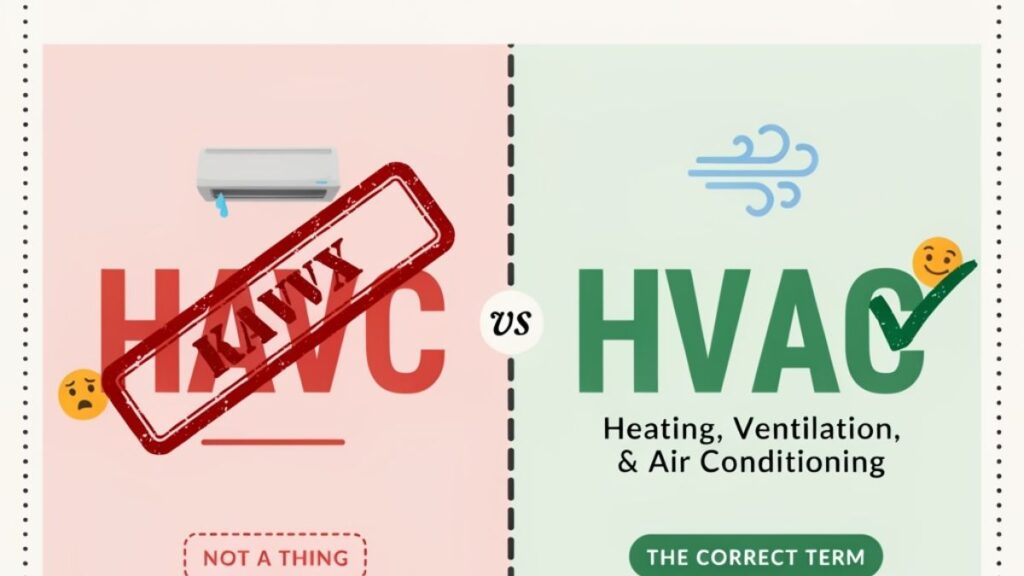
HAVC vs HVAC? One tiny letter swap can turn a perfectly sensible abbreviation into a head-scratcher. It’s an easy mistake to make, especially when V and A seem determined to trade places. But when it comes to heating, ventilation, and air conditioning, the correct form is HVAC. HAVC isn’t a different spelling or a regional variation. It’s simply a common mix-up. Whether you’re writing about an HVAC system, an HVAC technician, or HVAC services, getting those four letters in the right order matters. This quick guide clears up the confusion, explains the HVAC meaning, and helps you remember the correct spelling without turning grammar into a headache.
HAVC vs HVAC Quick Answer
If you’re looking for the short answer to “is it HAVC vs HVAC?”, use HVAC.
HVAC means heating, ventilation, and air conditioning.
HAVC is not the standard abbreviation for this term.
| Version | Correct? | Explanation |
|---|---|---|
| HVAC | Yes | Standard abbreviation for heating, ventilation, and air conditioning |
| HAVC | No | Common letter-order mistake |
| Hvac | No in standard professional writing | Incorrect capitalization |
| hvac | Sometimes seen informally | Standard professional form is HVAC |
So, if you’re writing an email, resume, article, report, or business document, choose HVAC.
What Does HVAC Stand For?
The most common question behind this spelling confusion is simple: what does HVAC stand for?
HVAC stands for heating, ventilation, and air conditioning.
Each letter represents the first letter of one word:
- H stands for heating.
- V stands for ventilation.
- A stands for air.
- C stands for conditioning.
Put them together and you get HVAC.
The order matters. Since ventilation comes before air in the full phrase, V must come before A.
That’s the easiest way to remember the correct spelling.
What Is HVAC?
HVAC refers to the systems and equipment used to control indoor temperature, airflow, ventilation, and other aspects of the indoor environment.
A typical HVAC system can involve several pieces of equipment working together. Depending on the building, that may include a furnace, air conditioner, heat pump, thermostat, ductwork, fans, filters, ventilation equipment, and various controls.
The system in a small house might be relatively simple. A hospital, office building, factory, or shopping center can have a much more complicated setup.
Despite those differences, the basic idea remains the same: HVAC systems help create and maintain a comfortable indoor environment.
Learn the difference between often confused words
Weighed vs Weighted Which One Is Correct?
HAVC vs HVAC What’s the Difference?
At first glance, HAVC vs HVAC look almost identical. That’s exactly why people mix them up.
The difference comes down to the middle two letters.
HVAC follows the correct phrase:
Heating → Ventilation → Air → Conditioning
HAVC follows this incorrect order:
Heating → Air → Ventilation → Conditioning
The second version doesn’t match the standard name of the field of HAVC vs HVAC.
| Comparison | HVAC | HAVC |
|---|---|---|
| Letter order | H-V-A-C | H-A-V-C |
| Standard abbreviation | Yes | No |
| Meaning | Heating, ventilation, and air conditioning | No standard meaning in this context |
| Professional use | Correct | Incorrect |
| Common cause | Standard abbreviation | Letter transposition |
The difference between HAVC vs HVAC isn’t a difference in meaning. It’s a difference between the correct abbreviation and a common mistake.
Why Do People Spell HVAC as HAVC?
There’s nothing strange about making this mistake. In fact, the error is easy to understand.
The phrase “heating and air conditioning” often comes to mind first because those are the services most people notice. Ventilation doesn’t always receive the same attention, even though it forms an important part of HVAC.
When someone remembers the general idea but not the exact phrase, they may mentally arrange the letters as H-A-V-C.
Typing quickly can make the problem worse.
The two versions are almost mirror images:
HVAC
HAVC
Only V and A have changed places.
That makes HAVC a classic transposition error. Your brain recognizes the overall pattern and may not stop to check every letter.
The best solution isn’t to memorize HAVC as a separate term. Instead, remember the full phrase:
Heating, ventilation, air conditioning.
Once you know that order, the abbreviation takes care of itself.
Is HAVC a Word?
If you’re asking, “Is HAVC a word?”, the answer is no when you’re referring to heating, ventilation, and air conditioning.
You may still see HAVC online. Someone might type it into a search engine, use it in a social media post, include it in an advertisement, or accidentally write it in a document.
That doesn’t make it a recognized alternative to HVAC.
Search engines often receive misspellings. People search for words and abbreviations in many different forms, especially when they aren’t sure how something is written.
So the fact that “HAVC” appears in searches doesn’t mean HAVC is correct.
For this topic, the standard form remains HVAC.
Learn the difference between often confused words
Insue vs Ensue Which One Is Correct?
HAVC Meaning and HAVC Definition
People sometimes search for “HAVC meaning” or “HAVC definition” because they’ve encountered the abbreviation and aren’t sure what it represents.
In the context of heating, ventilation, and air conditioning, HAVC doesn’t have a standard meaning.
If you see phrases such as “HAVC technician,” “HAVC system,” or “HAVC repair,” the writer almost certainly means:
1. HVAC technician
2.HVAC system
3.HVAC repair
The mistake comes from switching V and A.
That’s why it’s better to think of HAVC as a misspelling rather than as a separate abbreviation.
HVAC Meaning More Than Just Air Conditioning
The HVAC meaning becomes clearer when you look at each part of the abbreviation.
Heating handles indoor warmth. Depending on the building, this can involve furnaces, boilers, heat pumps, radiant systems, or other heating equipment.
Ventilation deals with the movement and replacement of air. It can help bring outdoor air into a building and remove stale indoor air.
Air conditioning provides cooling by removing heat from indoor spaces. Many air-conditioning systems also affect humidity and air movement.
Together, these functions create a broader system for indoor climate control.
That’s why calling every HVAC system simply an “air conditioner” isn’t always accurate. An air conditioner handles cooling, while HVAC covers heating, ventilation, and air conditioning as a whole.
Learn the difference between often confused words
Costumer vs Customer difference and Which One Is Correct?
HVAC Spelling Why the Letter Order Matters
The correct spelling of HVAC comes directly from the words it represents.
Think of it as a simple formula:
Heating + Ventilation + Air + Conditioning = HVAC
There’s no need to memorize a complicated rule.
Just remember that V comes before A.
If you ever hesitate between these two:
HAVC
HVAC
look at the middle letters.
HVAC contains VA.
HAVC contains AV.
Because “ventilation” comes before “air,” VA is the correct order.
It’s a small trick, but it can save you from repeatedly making the same mistake.
HVAC Pronunciation How Do You Pronounce HVAC?
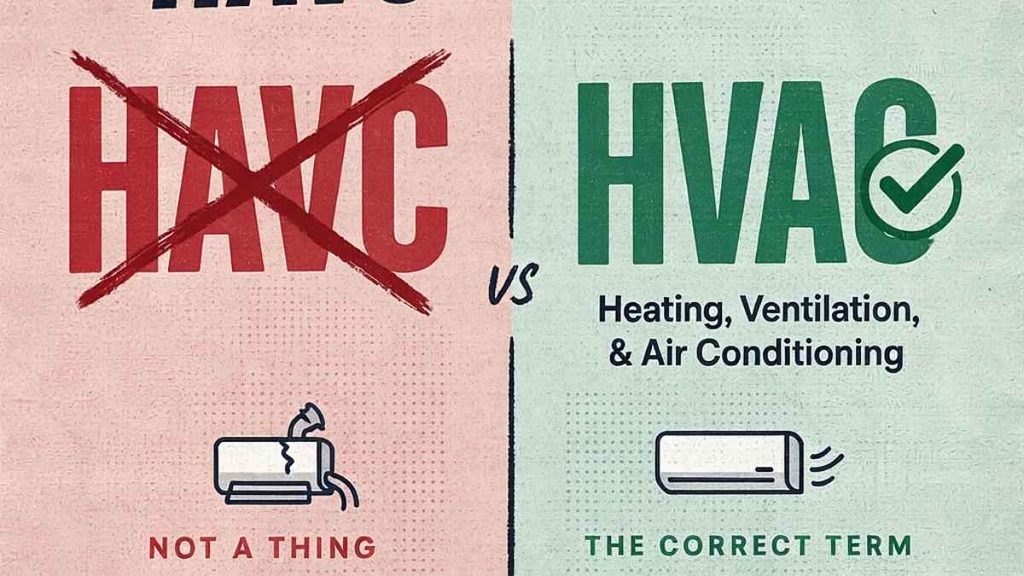
The standard HVAC pronunciation in American English is straightforward about HAVC vs HVAC.
You generally pronounce the letters separately:
H-V-A-C.
It sounds like:
“aitch-vee-ay-see”
If someone asks, “How do you pronounce HVAC?”, saying the four letters individually is the clearest choice.
HVAC isn’t normally pronounced as one ordinary English word.
You might hear casual variations in conversation, but H-V-A-C is the standard pronunciation to use when you want to be clear.
Is HVAC Pronounced H-V-A-C?
Yes.
HVAC is normally pronounced H-V-A-C.
For example:
“The HVAC technician will arrive this afternoon.”
When spoken naturally, HVAC is read as the names of its four letters.
Can You Pronounce HVAC as One Word?
Not usually.
Unlike abbreviations such as NASA, which people commonly pronounce as a word, HVAC is generally pronounced letter by letter.
If you’re ever unsure, use H-V-A-C. Nobody has to guess what you mean.
Learn the difference between often confused words
Pretty vs Prety difference and Which Spelling Is Correct ?
HVAC and American English
HVAC doesn’t have a different spelling in American English.
This point is worth making because many English words change between American and British usage. For example, American English uses “color,” while British English uses “colour.”
HVAC isn’t one of those cases.
The standard abbreviation remains HVAC when the full phrase is heating, ventilation, and air conditioning.
You shouldn’t use HAVC for one country and HVAC for another.
Regional terminology can vary when people talk about particular types of heating or cooling equipment. The abbreviation itself, however, doesn’t change.
HVAC in Everyday Writing
You probably see HVAC more often than you realize.
Consider these natural examples:
- “Our HVAC system needs maintenance.”
- “The HVAC technician checked the furnace.”
- “The company specializes in HVAC installation and repair.”
- “The building has a modern HVAC system.”
- “Regular HVAC maintenance can help keep equipment operating properly.”
- “The contractor replaced the old HVAC unit.”
- “She works for an HVAC contractor.”
- “The office recently upgraded its HVAC equipment.”
Now compare them with the incorrect version:
“ Our HAVC system needs maintenance.”
The intended meaning is obvious, but the abbreviation is still wrong.
In professional writing, small errors like this can make a document look less polished than it should.
Learn the difference between often confused words
Absorption vs Absorbsion difference and Which Is Correct?
HVAC System What Equipment Does It Include?
An HVAC system isn’t one particular machine.
It can be a combination of equipment designed to heat, cool, ventilate, and control a building’s indoor environment.
A residential HVAC system may include:
| Equipment | Main purpose |
|---|---|
| Furnace | Provides heat |
| Air conditioner | Provides cooling |
| Heat pump | Provides heating and cooling |
| Thermostat | Controls temperature settings |
| Ductwork | Moves conditioned air |
| Filter | Captures airborne particles |
| Fan or blower | Moves air through the system |
| Ventilation equipment | Helps move or replace indoor air |
Not every HVAC system contains every item in this table.
For example, a home with a heat pump may not need a separate furnace and conventional air conditioner. A commercial building may use equipment that looks completely different from a residential setup.
The design depends on the building, climate, size, occupancy, energy requirements, and desired level of temperature and ventilation control.
HVAC and Indoor Air Quality
The V in HVAC is easy to overlook.
People often focus on heating and cooling because those functions are immediately noticeable. You feel a furnace warming a room. You notice an air conditioner cooling it.
Ventilation works more quietly in the background.
Good ventilation can help manage indoor air by bringing in outdoor air and removing or diluting indoor pollutants. Indoor air quality can also depend on filtration, moisture control, building materials, maintenance, and the sources of pollutants inside the building.
That means an HVAC system is an important part of indoor air quality, but it isn’t the entire story.
A well-designed system still needs proper operation and maintenance.
Learn the difference between often confused words
Ether vs Either which is correct and Difference?
Residential HVAC vs Commercial HVAC
Residential HVAC usually refers to systems used in homes and other residential properties.
Commercial HVAC serves buildings such as:
- Offices
- Schools
- Hospitals
- Hotels
- Restaurants
- Retail stores
- Warehouses
- Industrial facilities
The basic principles remain similar, but commercial systems can be far more complex.
A small home might use a single thermostat and one heating and cooling system. A large commercial building may have multiple zones, extensive ductwork, sophisticated controls, large air-handling units, boilers, chillers, cooling towers, or other mechanical systems.
So when someone says “HVAC,” the term can describe anything from a relatively small residential setup to a huge commercial building system.
What Is an HVAC Technician?
An HVAC technician is a skilled professional who works with heating, ventilation, air conditioning, and related equipment.
Depending on the job, an HVAC technician may install new equipment, perform maintenance, troubleshoot problems, test components, repair systems, or replace damaged parts.
Common HVAC technician responsibilities include:
- Installing heating and cooling equipment.
- Inspecting HVAC systems.
- Diagnosing equipment problems.
- Repairing or replacing components.
- Performing preventive maintenance.
- Testing system performance.
- Working with electrical and mechanical components.
- Checking controls and thermostats.
- Explaining equipment problems to customers.
- Keeping service and maintenance records.
The exact work varies by employer and specialization.
Some technicians focus heavily on residential heating and cooling. Others work with commercial HVAC systems, refrigeration, industrial equipment, or specialized building systems.
Learn the difference between often confused words
In-Person vs In Person What’s the Difference?
HVAC Jobs and the HVAC Industry
The spelling question doesn’t require a full career guide, but HVAC appears frequently in searches about jobs, training, salaries, and skilled trades.
The U.S. Bureau of Labor Statistics reported about 425,200 jobs in the broader occupation of heating, air conditioning, and refrigeration mechanics and installers in 2024.
The median annual wage for that occupation was $59,810 in May 2024. BLS also projects 8% employment growth from 2024 to 2034, with about 40,100 openings expected each year on average.
| Career fact | U.S. figure |
|---|---|
| Jobs in 2024 | 425,200 |
| Median annual wage in May 2024 | $59,810 |
| Projected growth, 2024–2034 | 8% |
| Average projected annual openings | About 40,100 |
These numbers cover the broader heating, air conditioning, and refrigeration occupation. They don’t mean every HVAC worker earns the same amount HAVC vs HVAC .
Pay can vary based on location, experience, specialization, employer, industry, and level of responsibility.
For people considering an HVAC career, training can come through technical schools, community colleges, apprenticeships, and employer-based instruction HAVC vs HVAC.
The trade also involves practical skills. You don’t simply memorize how a furnace or heat pump works. You learn how to inspect equipment, identify faults, work safely, understand electrical and mechanical systems, and solve problems in real buildings.
Is HVAC a Good Career?
Whether HVAC is a good career depends on what you want from your work.
For someone who enjoys practical problem-solving, mechanical systems, hands-on work, and working with tools, HVAC can be a strong career option.
The occupation also offers several possible directions. Someone might start in residential service and later move into commercial systems, refrigeration, controls, installation, project management, or business ownership.
BLS currently projects continued employment growth for heating, air conditioning, and refrigeration mechanics and installers through 2034.
That doesn’t guarantee a particular salary or career path. It simply shows that the occupation has continued demand in the U.S. labor market.
Learn the difference between often confused words
Take Effect vs Take Affect Which one Is Correct?
Is HVAC Hard to Learn?
HVAC involves real technical knowledge, so it can be challenging at first.
You may encounter electrical circuits, airflow, pressure, refrigeration principles, temperature measurements, mechanical components, controls, safety procedures, and troubleshooting.
However, “hard” doesn’t mean impossible.
Good HVAC training breaks complicated systems into smaller parts. Once you understand what each component does, the larger system starts to make much more sense.
Hands-on practice also helps. A diagram can explain how a system should work, but working on real equipment teaches you how quickly things can become less predictable.
Is HVAC a Lot of Math?
HVAC does involve math, but you don’t need advanced mathematics for every HVAC job.
Technicians may work with measurements, temperature differences, airflow, electrical values, pressure, equipment capacity, and other calculations.
The amount of math depends on the specific role.
A service technician may use practical calculations regularly, while an engineer designing large mechanical systems may deal with much more advanced mathematics.
The important skill is being comfortable with measurements and learning how to apply formulas accurately.
Is HVAC a 9-to-5 Job?
Not necessarily.
HVAC work can involve regular daytime hours, but technicians may also work evenings, weekends, overtime, or on-call shifts.
The demand for heating and cooling doesn’t politely check the clock before a breakdown occurs.
Extreme weather can also increase demand for service. During very hot or very cold periods, HVAC companies may become particularly busy.
So anyone considering an HVAC career should expect that schedules can vary.
Learn the difference between often confused words
Rosin vs Resin Difference and Which is Correct?
Will HVAC Technicians Be Replaced by AI?
AI can change how HVAC businesses operate, but replacing the entire job is a different matter.
AI and automation can assist with scheduling, monitoring, diagnostics, documentation, energy analysis, and system controls.
Physical work remains another story.
Someone still needs to inspect equipment, access mechanical spaces, replace components, connect systems, diagnose unusual problems, and work safely in real buildings.
HVAC technicians also deal with situations that don’t always match a neat textbook example. A technician might arrive at a building and find several problems happening at once.
Technology can help with that work. It doesn’t automatically eliminate the need for skilled people.
A Simple Case Study HAVC vs HVAC
Imagine a small company preparing a job advertisement.
The first draft says:
“We are looking for an experienced HAVC technician.”
The company probably means HVAC technician. A reader will understand the intention, but the spelling error makes the advertisement look careless.
Now change one detail:
“We are looking for an experienced HVAC technician.”
The message immediately looks cleaner and more professional.
The same issue appears in resumes, invoices, service agreements, maintenance reports, and business websites.
The lesson is simple: the wrong abbreviation may not stop people from understanding you, but the correct one removes unnecessary doubt.
Learn the difference between often confused words
Waving vs Waiving Which is correct and Difference?
Common HVAC Mistakes
Writing HAVC
This is the main error.
Remember that ventilation comes before air.
Correct:
HVAC
Incorrect:
HAVC
Writing Hvac
HVAC is normally written in uppercase because it is an initialism.
Use:
HVAC technician
rather than:
Hvac technician
Calling HVAC the Same Thing as AC
AC means air conditioning.
HVAC covers heating, ventilation, and air conditioning.
So an air conditioner can be part of an HVAC system, but HVAC is the broader term.
Assuming HAVC Is a Regional Variation
It isn’t.
HAVC isn’t the British version of HVAC. It isn’t an Australian spelling either.
The standard abbreviation remains HVAC.
HVAC vs HVACR
You may occasionally encounter HVACR.
HVACR stands for:
Heating, ventilation, air conditioning, and refrigeration.
The extra R matters because refrigeration can involve equipment and applications beyond standard building heating and cooling.
For example, commercial refrigeration can serve restaurants, grocery stores, food-processing facilities, and other businesses.
So HVAC and HVACR overlap, but they’re not identical terms.
Learn the difference between often confused words
Performing vs Preforming difference and Which One Is Correct?
“A HVAC” or “An HVAC”?
This is a small grammar question with a surprisingly simple answer.
Use:
an HVAC system
not:
a HVAC system
Why?
Because HVAC is pronounced H-V-A-C, and the letter H begins with the vowel sound “aitch.”
The same pattern applies to:
- an HVAC technician
- an HVAC contractor
- an HVAC unit
- an HVAC system
English articles depend on sound rather than simply looking at the first written letter.
How to Remember the Correct Spelling of HVAC
If HAVC keeps sneaking into your writing, don’t memorize four random letters.
Remember the phrase.
Heating, Ventilation, Air Conditioning
Then take the first letter of each word.
H-V-A-C
You can also remember one simple phrase:
Ventilation comes before air.
That’s enough.
Whenever you see “HAVC,” pause for a second and ask yourself which word comes first: ventilation or air?
Ventilation comes first.
Therefore, HVAC is correct.
Practice Session HAVC vs HVAC
Fill in each blank with the correct word, letter, or phrase. These exercises focus on the spelling, meaning, pronunciation, and everyday use of HVAC.
- The correct abbreviation for heating, ventilation, and air conditioning is ________.
- The incorrect spelling that switches the V and A in HVAC is ________.
- In HVAC, the letter H stands for ________.
- In HVAC, the letter V stands for ________.
- In HVAC, the letter A stands for ________.
- In HVAC, the letter C stands for ________.
- HVAC stands for heating, ________, and air conditioning.
- The correct order of the letters is H-V-______-C.
- “HAVC” is a common spelling ________ of HVAC.
- A professional who installs, maintains, and repairs heating and cooling systems is an ________ technician.
- The standard professional spelling is ________, not HAVC.
- A system that controls indoor heating, ventilation, and cooling is called an ________ system.
- The phrase “an ________ system” is grammatically correct because the letter H begins with a vowel sound when pronounced.
- HVAC is usually pronounced by saying the four ________ separately.
- The standard American pronunciation of HVAC is ________-V-A-C.
- Air conditioning is one ________ of HVAC.
- Ventilation helps manage the movement and replacement of indoor ________.
- A ________ can provide heating and cooling as part of an HVAC system.
- The equipment that moves conditioned air through many ducted systems includes a fan or ________.
- The word “ventilation” comes ________ “air” in the full phrase “heating, ventilation, and air conditioning.”
- HVACR adds ________ to HVAC.
- A company that installs and repairs heating and cooling systems may be called an HVAC ________.
- “HAVC technician” should be corrected to “________ technician.”
- When you’re unsure about HVAC spelling, expand the abbreviation to “heating, ventilation, ________ conditioning.”
- Between HAVC and HVAC, ________ is the correct abbreviation.
Answers
- HVAC
- HAVC
- Heating
- Ventilation
- Air
- Conditioning
- ventilation
- A
- mistake
- HVAC
- HVAC
- HVAC
- HVAC
- letters
- H
- part
- air
- heat pump
- blower
- before
- refrigeration
- contractor
- HVAC
- air
- HVAC
Here’s a trusted source for clear word meanings:
FAQ
Is HAVC a correct abbreviation for heating and air conditioning?
No. HAVC isn’t the standard abbreviation for heating, ventilation, and air conditioning. The correct abbreviation is HVAC.
Why is HVAC spelled with V before A?
HVAC follows the word order of “heating, ventilation, and air conditioning.” Since ventilation comes before air, V comes before A.
Is HAVC a different HVAC term?
No. When HAVC appears in this context, it usually represents a spelling or typing mistake rather than a different HVAC term.
How do you remember the spelling of HVAC?
Remember the full phrase: “heating, ventilation, and air conditioning.” Taking the first letter of each word gives H-V-A-C.
What is the difference between HVAC and air conditioning?
HVAC covers heating, ventilation, and air conditioning. Air conditioning refers specifically to cooling and related conditioning of indoor air, so it represents only one part of HVAC.
Is HVAC an abbreviation or an acronym?
HVAC is commonly called an acronym, although technically it functions as an initialism because people usually pronounce its letters individually: H-V-A-C.
Should HVAC always be written in capital letters?
In professional and technical writing, HVAC is normally written in all capital letters because it represents the initial letters of the four words in the full term.
Is it “a HVAC system” or “an HVAC system”?
“An HVAC system” is correct because the letter H is pronounced “aitch,” which begins with a vowel sound.
Is HVAC used only for residential systems?
No. HVAC can describe systems in homes, offices, schools, hospitals, stores, factories, warehouses, and other buildings.
Does HVAC include ventilation?
Yes. Ventilation is one of the three parts represented by the V in HVAC. It concerns the movement and replacement of indoor and outdoor air.
Does HVAC include refrigeration?
Not necessarily. Standard HVAC means heating, ventilation, and air conditioning. When refrigeration is included, the broader term HVACR is often used.
What is the correct way to write HVAC technician?
The standard form is “HVAC technician.” Writing “HAVC technician” reverses the V and A and creates a spelling error.
Is “HVAC system” grammatically correct?
Yes. “HVAC system” is the standard phrase for a system that provides or manages heating, ventilation, air conditioning, or a combination of these functions.
What is the plural of HVAC system?
The plural is “HVAC systems.” The abbreviation itself doesn’t need to change.
Can HVAC be used as an adjective?
Yes. HVAC commonly modifies nouns in phrases such as “HVAC equipment,” “HVAC services,” “HVAC contractor,” and “HVAC maintenance.”
Is HVAC the same as climate control?
Not exactly. HVAC refers to the systems and technology used for heating, ventilation, and air conditioning. Climate control is a broader description of managing indoor environmental conditions.
What does HVAC stand for in construction?
In construction, HVAC still stands for heating, ventilation, and air conditioning. The term often refers to the mechanical systems installed to control temperature, airflow, and indoor conditions within a building.
What does HVAC mean on a job application?
On a job application, HVAC usually refers to the heating, ventilation, and air-conditioning field. For example, “HVAC experience” means experience working with related equipment, systems, installation, maintenance, or repair.
What does HVAC mean in a job title?
In a job title, HVAC identifies work related to heating, ventilation, and air conditioning. Examples include HVAC technician, HVAC installer, HVAC service technician, and HVAC mechanic.
What is the correct spelling of HVAC services?
The standard form is “HVAC services.” “HAVC services” is an incorrect spelling caused by switching the middle letters.
Is “HVAC repair” or “HAVC repair” correct?
“HVAC repair” is correct. HAVC is a common misspelling of HVAC.
Why does HAVC appear in Google searches?
People often search for HAVC because they aren’t sure about the letter order or type the abbreviation incorrectly. Search results can contain common misspellings without making those spellings correct.
Does HAVC have a meaning in English?
Not as the standard abbreviation for heating, ventilation, and air conditioning. In this context, HAVC is generally a misspelling of HVAC.
Is HVAC spelled differently in British English?
No. HVAC remains the standard abbreviation when referring to heating, ventilation, and air conditioning. It isn’t a British-versus-American spelling difference.
What is the correct way to spell HVAC in a resume?
Use “HVAC” in uppercase. For example: “Experienced HVAC technician with residential installation and maintenance experience.”
What is the difference between HVAC and HVACR?
HVAC stands for heating, ventilation, and air conditioning. HVACR adds refrigeration, making it useful for work that includes refrigeration systems as well as traditional HVAC equipment.
Is HVAC the correct term for heating and cooling systems?
Yes, although HVAC covers more than heating and cooling because the V represents ventilation. The term describes a broader group of systems used to manage indoor environmental conditions.
What does the V in HVAC stand for?
The V stands for ventilation.
What does the A in HVAC stand for?
The A stands for air.
Why isn’t the abbreviation HAVC?
Because the standard phrase puts “ventilation” before “air.” The correct sequence is heating, ventilation, air conditioning, which produces HVAC.
What is the easiest way to check whether HVAC is spelled correctly?
Expand the abbreviation. If the phrase is “heating, ventilation, and air conditioning,” the first letters give H-V-A-C. That confirms the correct spelling.
Conclusion
The HAVC vs HVAC confusion may look like a tiny spelling problem, but those two letters can still cause a surprisingly big mix-up. The correct form is HVAC, which stands for heating, ventilation, and air conditioning. HAVC simply switches the positions of V and A, making it a common spelling mistake rather than a legitimate alternative.
Here’s the easiest way to remember it: ventilation comes before air. So the letters follow the same order: H-V-A-C. Once that clicks, HAVC has nowhere left to hide. Whether you’re writing about an HVAC system, technician, repair, or career, stick with HVAC and keep your writing accurate, clear, and professional. No thermostat required for HAVC vs HVAC.

Jhon AJS, the creative mind behind Grammar Update, is an experienced blogger passionate about simplifying English grammar. He focuses on explaining confusing word vs word differences, grammar rules, punctuation, and sentence structure in a clear and practical way. Through easy to understand guides and examples, Jhon helps readers improve their writing and communicate with confidence. With years of blogging experience, he continues to share helpful insights that make learning grammar simple, useful, and accessible for everyone.