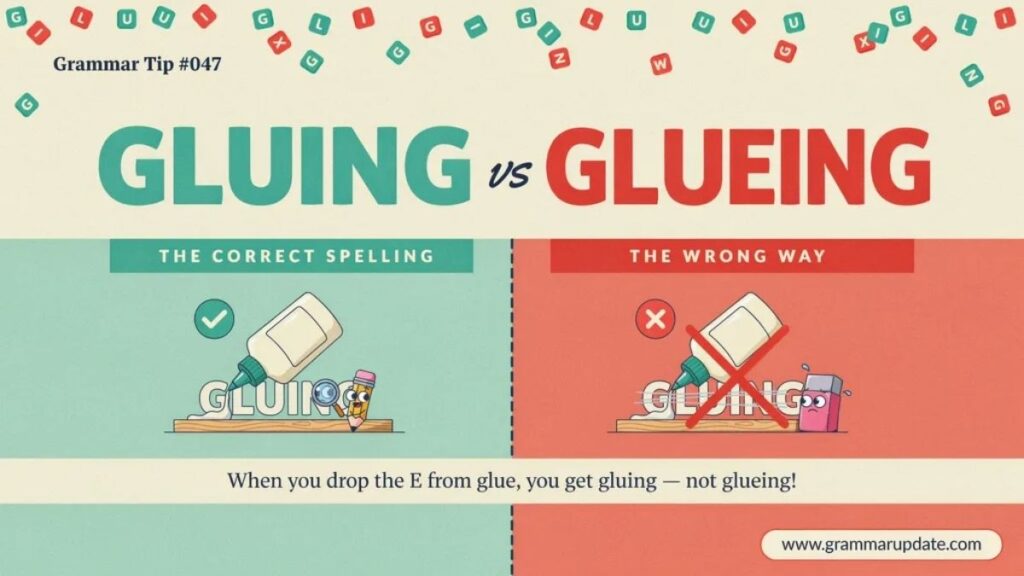
Have you ever typed glueing, watched your spell checker complain, and wondered who was actually right? The confusion surrounding gluing vs glueing catches students, professionals, teachers, and native English speakers alike because the spelling doesn’t seem to follow common sense. Since glue ends with the letter e, keeping it feels perfectly reasonable. However, English spelling follows a different rule. This guide clears up the confusion by explaining why gluing is the correct spelling, how the silent e rule works, when to use the word correctly, and how to avoid this common grammar mistake with confidence in everyday writing.
Gluing vs Glueing Quick Comparison
Gluing is the correct spelling in modern English.
Glueing is generally considered a misspelling in standard English. While it may appear in older texts or informal online content, it isn’t accepted in modern dictionaries or recommended for formal writing.
Whether you’re writing an academic paper, a business email, a blog post, or even a social media caption, gluing is the standard spelling used in both American and British English. Major dictionaries, grammar references, and style guides consistently recognize gluing as the correct form of the verb glue when adding the -ing suffix.
Quick Comparison
| Feature | Gluing | Glueing |
|---|---|---|
| Standard English spelling | Correct | Incorrect |
| American English | Yes | No |
| British English | Yes | No |
| Accepted by major dictionaries | Yes | No |
| Recommended in formal writing | Yes | No |
| Common in professional publishing | Yes | Avoid |
Quick Answer
If you’ve ever asked is it gluing vs glueing, the answer is simple.
- Gluing is the correct spelling of gluing in both British and American English.
- Glueing is not the accepted spelling in modern standard English.
- Every major dictionary, including Oxford, Cambridge, Merriam-Webster, and Collins, recognizes gluing as the correct present participle of glue.
- Professional editors, teachers, publishers, and proofreading tools consistently recommend gluing.
Although glueing occasionally appears in old books or on websites, that doesn’t make it correct by today’s English spelling rules. Many historical spellings have changed over time, and this is one of them.
Learn the difference between often confused words
Openned vs Opened Which Spelling Is Correct?
Why Is There So Much Confusion?
At first glance, glueing appears logical.
After all, the base word is glue, so many writers naturally think they should simply add -ing to create the new word.
That’s exactly where the confusion begins.
English doesn’t always form words by adding letters without making changes. Instead, it follows established spelling conventions that determine how verbs change when suffixes such as -ing, -ed, or -er are added.
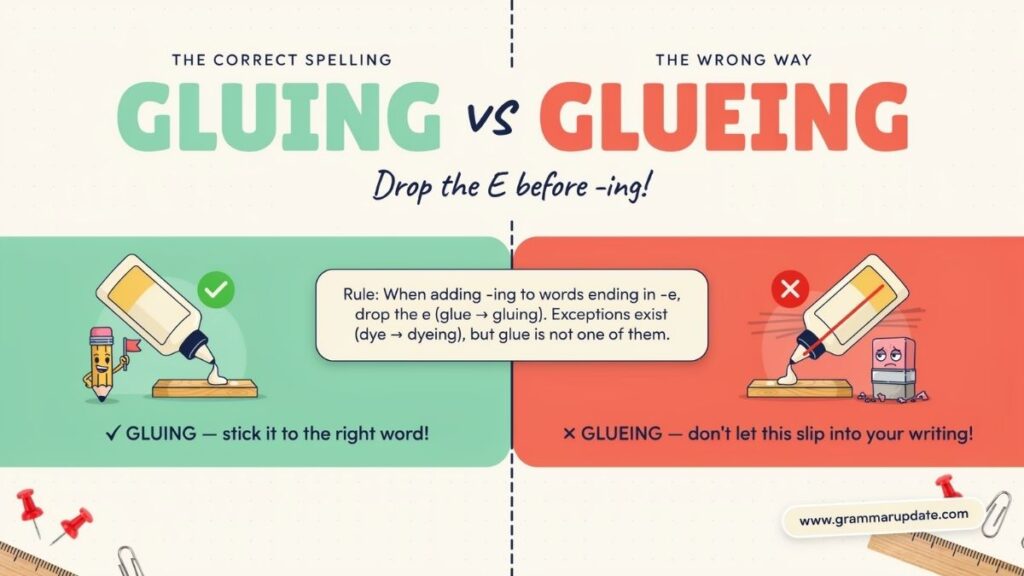
For verbs ending with a silent e, the final e is usually dropped before adding -ing.
That simple rule changes:
- Glue → Gluing
- Not Glue → Glueing
This is the same pattern used in many everyday words.
| Base Verb | Correct -ing Form |
|---|---|
| Make | Making |
| Write | Writing |
| Drive | Driving |
| Smile | Smiling |
| Bake | Baking |
| Use | Using |
| Glue | Gluing |
Once you understand this silent e rule, the spelling becomes much easier to remember.
Why “Gluing” Is the Standard Spelling
Modern English values consistency.
Rather than keeping unnecessary letters, standard spelling removes silent letters whenever grammar rules allow. The final e in glue doesn’t affect pronunciation after -ing is added, so English simply drops it.
That gives us:
Glue + ing → Gluing
Not:
Glue + ing → Glueing
This spelling follows the same word formation pattern taught in schools and used in professional writing around the world.
Because of this rule, gluing spelling has remained consistent across dictionaries, educational materials, newspapers, academic publications, and professional style guides.
Whether you’re writing in the United States, the United Kingdom, Canada, Australia, or New Zealand, you’ll find the same standard spelling:
Gluing
Learn the difference between tricky grammar words
Useing vs Using Which Spelling Is Correct?
Key Facts About Gluing vs Glueing
Before exploring the grammar in detail, keep these essential facts in mind.
| Question | Answer |
|---|---|
| Is gluing correct? | Yes. It is the accepted modern spelling. |
| Is glueing correct? | No. It is considered a misspelling in standard English. |
| Is gluing vs glueing correct? | Gluing is correct. |
| How do you spell gluing correctly? | Remove the silent e and add -ing. |
| Why is gluing spelled without the e? | English drops the silent e before adding -ing to most verbs ending in e. |
| What is the present participle of glue? | Gluing. |
| Can I use glueing in formal writing? | No. Use gluing instead. |
These answers reflect current dictionary spelling, accepted English grammar, and modern writing conventions used by educators, publishers, and professional editors worldwide.
Why Learning the Correct Spelling Matters
At first, the difference between gluing and glueing may seem minor. After all, both spellings are easy to understand. However, spelling accuracy plays an important role in effective communication.
A single spelling mistake can affect how readers view your writing. In academic papers, business documents, resumes, reports, and professional emails, incorrect spelling may reduce credibility and distract from your message.
Using the correct spelling of gluing also helps you:
- Write with greater confidence.
- Improve your grammar and vocabulary.
- Avoid common proofreading errors.
- Follow accepted English writing rules.
- Produce polished, professional documents.
For students, writers, teachers, and anyone learning English, mastering small grammar rules like this builds stronger writing skills over time.
Think of it this way: strong writing isn’t just about using impressive words. It’s about choosing the right words—and spelling them correctly every tim
What You’ll Learn in This Guide
This guide goes far beyond answering is it gluing VS glueing. You’ll gain a complete understanding of the grammar, spelling, and usage behind this commonly confused word.
Throughout the article, you’ll learn:
- The gluing definition and how it’s used in everyday English.
- Whether glueing meaning differs from gluing meaning.
- Why glueing is considered incorrect in modern English.
- The gluing vs glueing grammar rule explained in simple language.
- Why English drops the silent e before adding -ing.
- Whether gluing in British English differs from gluing in American English.
- What major dictionaries and style guides recommend.
- Real-world sentence examples that demonstrate correct usage.
- Practical memory tricks to help you avoid this spelling mistake in the future.
By the end, you’ll not only know how to spell gluing correctly but also understand why the rule exists, making it much easier to apply the same principle to hundreds of other English verbs.
Learn the difference between tricky grammar words
Stolen vs Stollen Difference and usage?
What Does Gluing Mean?
To understand gluing vs glueing, you first need to understand the verb glue and how it changes when used in different grammatical forms.
The word gluing comes from the verb glue, which means to join, bond, or attach two or more objects with an adhesive. When you add the suffix -ing, the word becomes the present participle or gerund form of the verb.
In simple terms, gluing describes the action of sticking things together using glue or another adhesive.
Whether you’re repairing a broken mug, assembling furniture, creating a school project, or manufacturing products in a factory, gluing refers to the process of making separate pieces become one through adhesion.
This is the accepted gluing definition in modern English and the spelling recognized by dictionaries, educators, publishers, and grammar experts.
Gluing Meaning
The gluing meaning is straightforward:
Gluing is the act or process of joining materials together by applying glue or another adhesive.
Depending on the context, gluing can describe everyday activities, industrial manufacturing, arts and crafts, woodworking, packaging, construction, bookbinding, or engineering.
For example:
- A student may spend an afternoon gluing photos into a scrapbook.
- A carpenter may be gluing wooden boards before securing them with clamps.
- A factory worker may oversee automated gluing machines that assemble thousands of boxes every hour.
- An artist may use careful gluing techniques to create a detailed collage.
Although the situations vary, the meaning remains the same: joining materials together with adhesive.
Gluing as a Verb
Most often, gluing functions as part of a verb phrase. It describes an action that is happening now or is in progress.
Examples of gluing in a sentence:
- She is gluing the broken picture frame back together.
- The technician is gluing the plastic panels before installing them.
- We’re gluing the model pieces carefully to avoid gaps.
- The children are gluing colored paper onto their classroom posters.
- He’s gluing ceramic tiles onto the kitchen wall.
In each example, gluing forms part of the present continuous tense and tells the reader what action is taking place.
Gluing as a Gerund
The word gluing can also act as a noun. When a verb ends in -ing and functions as a noun, it is called a gerund.
Examples include:
- Gluing requires patience and precision.
- Gluing is often the strongest method for joining lightweight materials.
- Proper gluing improves the durability of wooden furniture.
- Good gluing techniques reduce waste during manufacturing.
Here, gluing refers to the activity itself rather than an ongoing action.
This dual role is common in English and appears in many everyday words.
For example:
| Verb | Present Participle | Gerund Example |
|---|---|---|
| Read | Reading | Reading improves vocabulary. |
| Paint | Painting | Painting helps people relax. |
| Swim | Swimming | Swimming is excellent exercise. |
| Write | Writing | Writing develops communication skills. |
| Glue | Gluing | Gluing requires a steady hand. |
Understanding this distinction makes it easier to recognize the present participle of glue in different sentences.
Gluing Pronunciation
Many learners worry that removing the final e changes how the word sounds.
It doesn’t.
The standard pronunciation of gluing is:
/ˈɡluː.ɪŋ/
You can think of it as:
GLOO-ing
Dropping the silent e affects only the spelling—not the pronunciation.
This is another reason the silent e rule works so well in English. The written form becomes shorter while the spoken form stays exactly the same.
Gluing Synonyms
Although gluing has a specific meaning, several related words can replace it depending on the situation.
| Synonym | Best Used For |
|---|---|
| Bonding | Creating a strong connection between materials |
| Joining | Connecting two or more objects |
| Attaching | Fastening one object to another |
| Adhering | Sticking firmly to a surface |
| Fastening | Securing parts together |
| Fixing | Repairing broken objects |
| Securing | Holding materials firmly in place |
Each synonym carries a slightly different meaning, but all describe forms of connecting objects.
Glue Verb Forms
Learning the different glue verb forms helps you use the word correctly in every tense.
| Verb Form | Example |
|---|---|
| Base form | Glue |
| Third-person singular | Glues |
| Past tense | Glued |
| Past participle | Glued |
| Present participle | Gluing |
Notice that the only form requiring a spelling change is the present participle, where the final silent e disappears before adding -ing.
Learn the difference between confusing more English words
Trouper vs Trooper Which One Is Correct?
Is Glueing a Word?
One of the most searched grammar questions is:
Is glueing a word?
The short answer is not in modern standard English.
Today, glueing is regarded as a misspelling rather than an accepted spelling. If you type it into most word processors, grammar checkers, or proofreading tools, it will usually be flagged as incorrect.
Modern dictionaries consistently list gluing as the proper spelling.
So if you’re asking:
- Is gluing correct?
Yes.
- Is glueing correct?
No.
- Is glueing accepted in English?
Not in current standard English.
This answers one of the most common questions about gluing vs glueing spelling.
Why Do People Still Write “Glueing”?
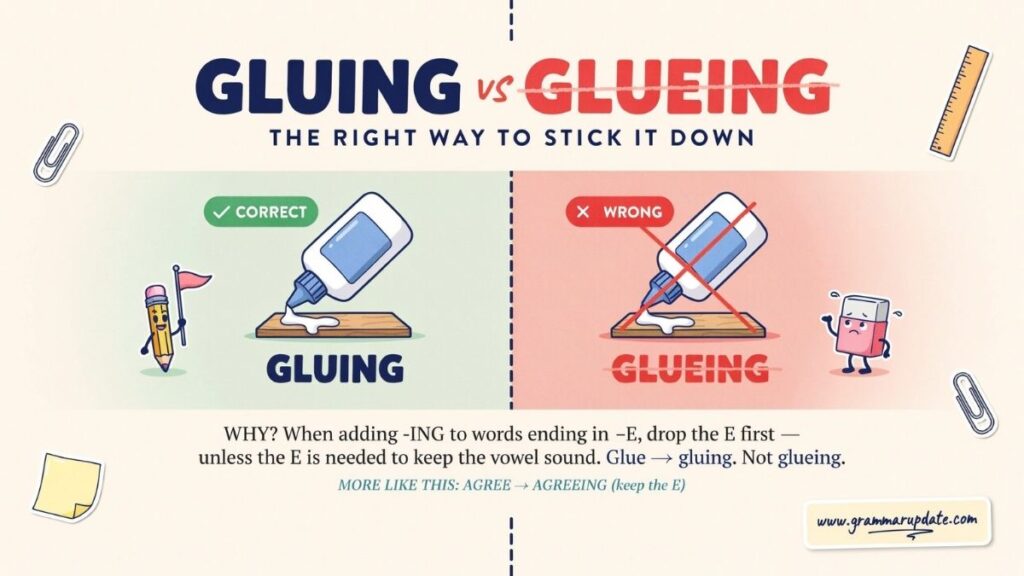
Even though glueing incorrect is the accepted modern rule, the spelling still appears online from time to time.
There are several reasons for this common confusion.
People Naturally Add “-ing”
Many writers assume that forming a present participle is as simple as attaching -ing to the end of the original word.
They think:
Glue → Glueing
While this seems logical, English spelling isn’t always that straightforward.
Instead, it follows established English spelling rules that determine when letters are added, removed, or doubled.
The Silent E Rule Is Easy to Forget
One of the most common grammar mistakes with glue involves forgetting to remove the silent e.
Many English learners memorize vocabulary but overlook spelling patterns.
As a result, they correctly remember the word glue but incorrectly create:
Glueing
instead of:
Gluing
Understanding the glue spelling rule eliminates this confusion.
The Extra “E” Looks More Natural
For many people, glueing simply looks right.
Because the base word ends with e, keeping every letter feels more intuitive than removing one.
However, English spelling often prioritizes grammatical consistency over visual appearance.
The same rule applies to many familiar verbs.
| Base Verb | Incorrect | Correct |
|---|---|---|
| Make | Makeing | Making |
| Write | Writeing | Writing |
| Hope | Hopeing | Hoping |
| Move | Moveing | Moving |
| Bake | Bakeing | Baking |
| Glue | Glueing | Gluing |
Once you recognize this pattern, spelling glue with ing becomes much easier.
Older Publications Sometimes Used “Glueing”
If you’ve searched old books, scanned newspapers, or historical archives, you may have encountered glueing.
That’s because English spelling was less standardized in earlier centuries. Writers and publishers occasionally used different forms before modern dictionaries established consistent spelling conventions.
Language evolves over time.
Many spellings that appeared in nineteenth- and early twentieth-century publications are no longer considered correct today.
This historical usage explains why some people believe glueing is acceptable, even though modern grammar references recommend gluing.
Spell Checkers and Dictionaries Agree
Today, virtually every major spelling authority recognizes gluing as the standard form.
That includes dictionaries, educational institutions, grammar textbooks, proofreading software, and professional editors.
Whether you’re writing for school, work, publishing, or everyday communication, choosing gluing ensures your writing follows standard English, reflects correct English spelling, and avoids one of the most common spelling mistakes in English.
Simply put, if you’re deciding should you write gluing vs glueing, the answer is always the same:
Write gluing. It is the correct, modern, and universally accepted spelling.
Learn the difference between confusing more English words
Socialise vs Socialize Which One Is Correct?
Gluing vs Glueing What’s the Difference?
At first glance, gluing and glueing appear to mean the same thing. Both attempt to describe the action of joining objects with glue. However, when it comes to correct English usage, only one spelling is accepted.
The difference between the two words is not their meaning. Instead, it lies in spelling, grammar, and modern English conventions.
If you’re wondering about the gluing vs glueing difference, here’s the simple answer:
- Gluing is the correct present participle and gerund form of the verb glue.
- Glueing is considered a spelling mistake in modern English, even though it may occasionally appear in historical texts or informal writing.
This distinction applies everywhere, whether you’re writing an academic paper, a business email, a technical manual, or a casual message.
Side-by-Side Comparison
| Feature | Gluing | Glueing |
|---|---|---|
| Meaning | Joining materials with adhesive | Intended to mean the same thing |
| Modern spelling | Correct | Incorrect |
| Dictionary spelling | Listed | Not listed as the standard form |
| Grammar | Correct | Incorrect |
| Professional writing | Recommended | Avoid |
| School assignments | Use | Avoid |
| Business documents | Use | Avoid |
| Published books and articles | Standard | Rare or historical |
Why Gluing Is the Correct Spelling
Many learners ask:
Why is gluing spelled without the e?
The answer comes from one of the most important English spelling rules.
English doesn’t always keep every letter when suffixes are added. Instead, words often change slightly to make spelling more consistent and easier to read.
The verb glue follows this pattern perfectly.
When the suffix -ing is added, the final silent e is dropped.
The result is:
Glue → Gluing
Not:
Glue → Glueing
This rule has been part of standard English for generations and appears in dictionaries, grammar books, classrooms, and professional writing around the world.
The Silent E Rule Explained
One of the first spelling patterns English learners study is the silent e rule.
The rule states:
When a verb ends with a silent “e,” drop the final “e” before adding “-ing.”
This rule applies to hundreds of common English verbs.
Consider these examples.
| Base Verb | Correct -ing Form |
|---|---|
| Make | Making |
| Bake | Baking |
| Smile | Smiling |
| Drive | Driving |
| Use | Using |
| Arrive | Arriving |
| Love | Loving |
| Move | Moving |
| Write | Writing |
| Glue | Gluing |
Notice the pattern.
Every word removes the silent e before -ing is added.
The spelling becomes shorter, but the pronunciation stays almost exactly the same.
This consistent pattern is one reason English remains relatively predictable despite its many exceptions.
Why Does Glue Follow This Rule?
At first, gluing may look unusual.
Because glue ends with the letters u and e, many writers expect both letters to remain.
That’s understandable.
However, the important letter isn’t the u—it’s the silent e.
The final e doesn’t contribute a separate sound once -ing is added. Since it serves no purpose in the new word, English removes it.
This follows the same principle used in countless other verbs.
For example:
- Hope → Hoping
- Shape → Shaping
- Dance → Dancing
- Save → Saving
- Glue → Gluing
Although the spellings look different, they all follow the same spelling rule for verbs.
Why Glueing Breaks the Rule
Now let’s look at the opposite spelling.
Why is glueing incorrect?
Simply because it keeps the silent e where English grammar says it should disappear.
Adding -ing without dropping the silent e creates a form that doesn’t match modern English spelling conventions.
Think about these examples.
| Incorrect | Correct |
|---|---|
| Makeing | Making |
| Hopeing | Hoping |
| Writeing | Writing |
| Moveing | Moving |
| Bakeing | Baking |
| Glueing | Gluing |
If makeing looks wrong, glueing follows the same incorrect pattern.
Once you recognize this, remembering how to spell gluing correctly becomes much easier.
Learn the difference between confusing more English words
Persue vs Pursue Which Spelling Is Correct?
When Do You Drop the Final E Before Adding -ing?
The drop the final e rule is one of the most reliable spelling patterns in English.
Whenever a verb ends with a silent e, you usually remove that letter before adding -ing.
This creates the present participle or gerund form.
Common Examples
| Base Verb | Present Participle |
|---|---|
| Come | Coming |
| Drive | Driving |
| Bake | Baking |
| Smile | Smiling |
| Hope | Hoping |
| Save | Saving |
| Use | Using |
| Love | Loving |
| Move | Moving |
| Glue | Gluing |
Notice how every verb follows exactly the same pattern.
Learning this single rule helps you spell hundreds of English words correctly.
It also reduces many common spelling mistakes made by English learners.
Important Exceptions to the Rule
Like many grammar rules, this one has exceptions.
Certain verbs keep the final e before adding -ing because removing it would change pronunciation or make the word confusing.
Common examples include:
| Verb | Present Participle |
|---|---|
| Be | Being |
| See | Seeing |
| Flee | Fleeing |
| Agree | Agreeing |
| Knee | Kneeing |
Notice something these words have in common.
Most end with double e.
Keeping both letters preserves pronunciation and prevents awkward spellings.
This is why:
- See → Seeing
- Not Seing
Likewise:
- Agree → Agreeing
- Not Agreing
These words belong to a different spelling pattern than glue.
Why Glue Is Not an Exception
Many people assume glue belongs with words like see or agree because it ends with e.
It doesn’t.
The difference is important.
In see and agree, the ee forms part of the vowel sound.
In glue, the final e is silent.
Since the e contributes no additional sound, English removes it before adding -ing.
That’s why:
Glue → Gluing
is correct.
Understanding this small distinction clears up one of the biggest areas of common confusion between gluing and glueing.
Learn how to use confusing more words correctly
Eventhough vs Even Though Which Is Correct?
the Grammar Behind Gluing
From a grammatical perspective, gluing is the present participle of the verb glue.
It also functions as a gerund, depending on how it’s used in a sentence.
As a Present Participle
When paired with a helping verb, gluing forms continuous verb tenses.
Examples:
- The engineer is gluing the protective panels together.
- They are gluing the labels onto every package.
- She was gluing photographs into her scrapbook yesterday.
- The workers have been gluing components since early morning.
Here, gluing describes an action in progress.
As a Gerund
When gluing functions as a noun, it names an activity.
Examples:
- Gluing requires patience.
- Careful gluing improves the strength of the finished product.
- Gluing is one of the final steps in furniture assembly.
- Proper gluing prevents parts from separating over time.
In these examples, gluing behaves like a noun rather than a verb.
Recognizing this difference helps improve both grammar and sentence structure.
Why Learning This Rule Improves Your Writing
The question isn’t just is gluing correct.
It’s also about becoming a stronger writer.
Small spelling rules have a surprisingly large impact on writing quality. Readers often notice spelling mistakes immediately, especially in professional or academic documents.
Mastering rules like adding ing to verbs, dropping the silent e, and using the correct present participle of glue helps you:
- Write with greater confidence.
- Improve your proofreading skills.
- Avoid embarrassing grammar mistakes.
- Follow accepted English writing standards.
- Produce cleaner, more professional documents.
Strong writing comes from mastering small details. Understanding gluing vs glueing grammar rule is one of those details that makes your English more accurate, polished, and credible.
Learn how to use confusing more words correctly
Weak vs Week Difference which one is correct?
Gluing vs Glueing What’s the Difference?
At first glance, gluing vs glueing appear to mean the same thing. Both attempt to describe the action of joining objects with glue. However, when it comes to correct English usage, only one spelling is accepted.
The difference between the two words is not their meaning. Instead, it lies in spelling, grammar, and modern English conventions.
If you’re wondering about the gluing vs glueing difference, here’s the simple answer:
- Gluing is the correct present participle and gerund form of the verb glue.
- Glueing is considered a spelling mistake in modern English, even though it may occasionally appear in historical texts or informal writing.
This distinction applies everywhere, whether you’re writing an academic paper, a business email, a technical manual, or a casual message.
Side-by-Side Comparison
| Feature | Gluing | Glueing |
|---|---|---|
| Meaning | Joining materials with adhesive | Intended to mean the same thing |
| Modern spelling | Correct | Incorrect |
| Dictionary spelling | Listed | Not listed as the standard form |
| Grammar | Correct | Incorrect |
| Professional writing | Recommended | Avoid |
| School assignments | Use | Avoid |
| Business documents | Use | Avoid |
| Published books and articles | Standard | Rare or historical |
The key point is simple: both spellings aim to express the same action, but only one follows today’s English grammar rules.
Why Gluing Is the Correct Spelling
Many learners ask:
Why is gluing spelled without the e?
The answer comes from one of the most important English spelling rules.
English doesn’t always keep every letter when suffixes are added. Instead, words often change slightly to make spelling more consistent and easier to read.
The verb glue follows this pattern perfectly.
When the suffix -ing is added, the final silent e is dropped.
The result is:
Glue → Gluing
Not:
Glue → Glueing
This rule has been part of standard English for generations and appears in dictionaries, grammar books, classrooms, and professional writing around the world.
The Silent E Rule Explained
One of the first spelling patterns English learners study is the silent e rule.
The rule states:
When a verb ends with a silent “e,” drop the final “e” before adding “-ing.”
This rule applies to hundreds of common English verbs.
Consider these examples.
| Base Verb | Correct -ing Form |
|---|---|
| Make | Making |
| Bake | Baking |
| Smile | Smiling |
| Drive | Driving |
| Use | Using |
| Arrive | Arriving |
| Love | Loving |
| Move | Moving |
| Write | Writing |
| Glue | Gluing |
Notice the pattern.
Every word removes the silent e before -ing is added.
The spelling becomes shorter, but the pronunciation stays almost exactly the same.
This consistent pattern is one reason English remains relatively predictable despite its many exceptions.
Why Does Glue Follow This Rule?
At first, gluing may look unusual.
Because glue ends with the letters u and e, many writers expect both letters to remain.
That’s understandable.
However, the important letter isn’t the u it’s the silent e.
The final e doesn’t contribute a separate sound once -ing is added. Since it serves no purpose in the new word, English removes it.
This follows the same principle used in countless other verbs.
For example:
- Hope → Hoping
- Shape → Shaping
- Dance → Dancing
- Save → Saving
- Glue → Gluing
Although the spellings look different, they all follow the same spelling rule for verbs.
Why Glueing Breaks the Rule
Now let’s look at the opposite spelling.
Why is glueing incorrect?
Simply because it keeps the silent e where English grammar says it should disappear.
Adding -ing without dropping the silent e creates a form that doesn’t match modern English spelling conventions.
Think about these examples.
| Incorrect | Correct |
|---|---|
| Makeing | Making |
| Hopeing | Hoping |
| Writeing | Writing |
| Moveing | Moving |
| Bakeing | Baking |
| Glueing | Gluing |
If makeing looks wrong, glueing follows the same incorrect pattern.
Once you recognize this, remembering how to spell gluing correctly becomes much easier.
When Do You Drop the Final E Before Adding -ing?
The drop the final e rule is one of the most reliable spelling patterns in English.
Whenever a verb ends with a silent e, you usually remove that letter before adding -ing.
This creates the present participle or gerund form.
Common Examples
| Base Verb | Present Participle |
|---|---|
| Come | Coming |
| Drive | Driving |
| Bake | Baking |
| Smile | Smiling |
| Hope | Hoping |
| Save | Saving |
| Use | Using |
| Love | Loving |
| Move | Moving |
| Glue | Gluing |
Notice how every verb follows exactly the same pattern.
Learning this single rule helps you spell hundreds of English words correctly.
It also reduces many common spelling mistakes made by English learners.
Important Exceptions to the Rule
Like many grammar rules, this one has exceptions.
Certain verbs keep the final e before adding -ing because removing it would change pronunciation or make the word confusing.
Common examples include:
| Verb | Present Participle |
|---|---|
| Be | Being |
| See | Seeing |
| Flee | Fleeing |
| Agree | Agreeing |
| Knee | Kneeing |
Notice something these words have in common.
Most end with double e.
Keeping both letters preserves pronunciation and prevents awkward spellings.
This is why:
- See → Seeing
- Not Seing
Likewise:
- Agree → Agreeing
- Not Agreing
These words belong to a different spelling pattern than glue.
Why Glue Is Not an Exception
Many people assume glue belongs with words like see or agree because it ends with e.
It doesn’t.
The difference is important.
In see and agree, the ee forms part of the vowel sound.
In glue, the final e is silent.
Since the e contributes no additional sound, English removes it before adding -ing.
That’s why:
Glue → Gluing
is correct.
Understanding this small distinction clears up one of the biggest areas of common confusion between gluing and glueing.
Learn the difference between similar more English words
Seal vs Seel Difference and Correct Usage
Understanding the Grammar Behind Gluing
From a grammatical perspective, gluing is the present participle of the verb glue.
It also functions as a gerund, depending on how it’s used in a sentence.
As a Present Participle
When paired with a helping verb, gluing forms continuous verb tenses.
Examples:
- The engineer is gluing the protective panels together.
- They are gluing the labels onto every package.
- She was gluing photographs into her scrapbook yesterday.
- The workers have been gluing components since early morning.
Here, gluing describes an action in progress.
As a Gerund
When gluing functions as a noun, it names an activity.
Examples:
- Gluing requires patience.
- Careful gluing improves the strength of the finished product.
- Gluing is one of the final steps in furniture assembly.
- Proper gluing prevents parts from separating over time.
In these examples, gluing behaves like a noun rather than a verb.
Recognizing this difference helps improve both grammar and sentence structure.
Learn the difference between tricky grammar more words
Comming vs Coming Difference and Correct Usage
Why Learning This Rule Improves Your Writing
The question isn’t just is gluing correct.
It’s also about becoming a stronger writer.
Small spelling rules have a surprisingly large impact on writing quality. Readers often notice spelling mistakes immediately, especially in professional or academic documents.
Mastering rules like adding ing to verbs, dropping the silent e, and using the correct present participle of glue helps you:
- Write with greater confidence.
- Improve your proofreading skills.
- Avoid embarrassing grammar mistakes.
- Follow accepted English writing standards.
- Produce cleaner, more professional documents.
Strong writing comes from mastering small details. Understanding gluing vs glueing grammar rule is one of those details that makes your English more accurate, polished, and credible.
History of Glueing Why It Appeared in Older Texts
If gluing is the correct modern spelling, why do some old books, newspapers, and scanned documents use glueing?
The answer lies in the history of English spelling.
For centuries, English had few standardized spelling rules. Before dictionaries and editorial style guides became widely accepted, writers often spelled the same word in different ways. Regional preferences, publishing practices, and personal habits all influenced how words appeared in print.
As English became more standardized during the nineteenth and twentieth centuries, dictionaries and grammar references began promoting consistent spelling patterns. One of those patterns was the silent e rule, which recommends dropping the final e before adding -ing to most verbs.
Because of this shift, gluing gradually replaced glueing in modern writing.
Today, you’ll still find glueing in historical books, archived newspapers, handwritten letters, and digitized documents. These examples reflect older spelling practices rather than current English standards.
That historical usage explains why some people believe glueing is correct, even though it is no longer accepted in standard English.
Timeline of the Spelling
| Time Period | Common Usage |
|---|---|
| Before standardized dictionaries | Both spellings occasionally appeared |
| Early modern publishing | Glueing became less common |
| Mid-20th century onward | Gluing became the accepted standard |
| Modern English | Gluing is the only recommended spelling |
The evolution of gluing spelling shows how English continues to simplify and standardize over time.
Real Examples of Gluing in Sentences
Learning grammar is much easier when you see words used naturally. The following examples show the correct use of gluing in everyday communication.
Everyday Examples
These sentences reflect situations you might encounter at home, school, or work.
- I’m gluing the handle back onto my favorite coffee mug.
- She’s gluing family photos into a scrapbook.
- They’re gluing decorations onto the classroom bulletin board.
- We’re gluing the broken toy before giving it back to our child.
- He’s gluing the loose sole back onto his shoe.
In each sentence, gluing describes an action that is happening now.
School and Academic Examples
Teachers and students frequently use the word when discussing arts, crafts, science projects, and classroom activities.
- The students are gluing labels onto their science models.
- Our teacher demonstrated the correct way of gluing paper without creating wrinkles.
- The art class spent the afternoon gluing recycled materials into sculptures.
- She’s gluing pictures beside each vocabulary word.
- The project isn’t finished because we’re still gluing the final pieces together.
These examples show how naturally gluing fits into educational writing.
DIY and Home Improvement Examples
The word is also common in woodworking, repairs, and home improvement.
- The carpenter is gluing the wooden panels before clamping them overnight.
- They’re gluing ceramic tiles onto the bathroom wall.
- The technician is gluing rubber seals around the window frame.
- She’s gluing decorative trim around the mirror.
- We’re gluing the cracked tabletop before refinishing it.
Here, gluing describes practical tasks involving adhesives.
Manufacturing and Industrial Examples
Many industries rely on specialized adhesives instead of screws, nails, or welding.
Examples include:
- The factory is gluing cardboard boxes on an automated production line.
- Workers are gluing protective foam inside the packaging.
- The packaging company uses robotic systems for gluing shipping cartons.
- The assembly line stopped because the gluing machine required maintenance.
- Manufacturers are gluing lightweight composite materials to reduce overall product weight.
These examples demonstrate that gluing is widely used in technical and professional writing.
Common Mistakes People Make with Gluing
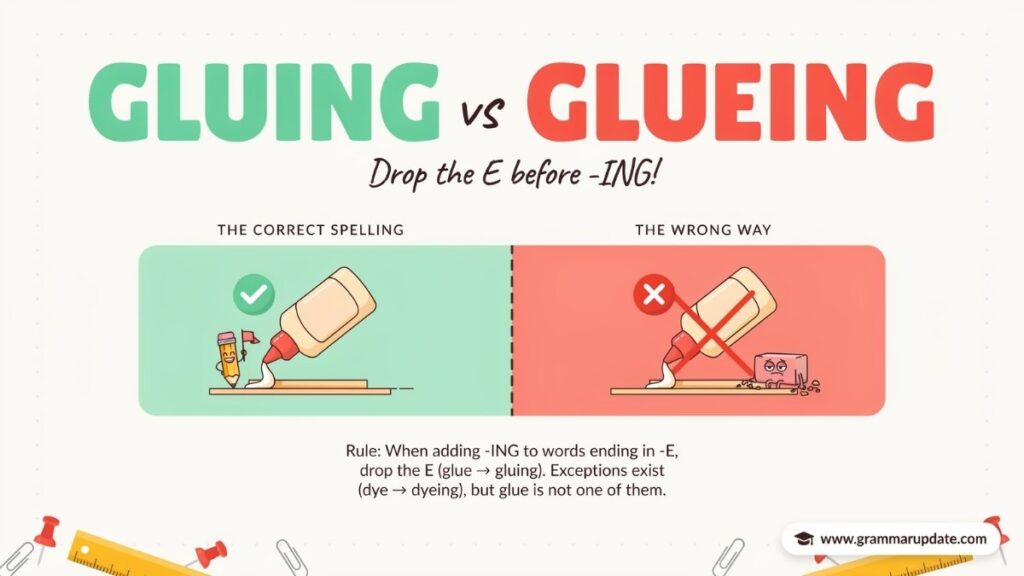
The confusion surrounding gluing vs glueing usually comes from misunderstanding a simple spelling rule rather than the meaning of the word itself.
Recognizing these mistakes makes them much easier to avoid.
Keeping the Silent E
The most common mistake is writing:
Glueing
instead of:
Gluing
Many people simply add -ing without dropping the silent e.
However, this breaks one of the most common English spelling conventions.
Correct:
Glue → Gluing
Incorrect:
Glue → Glueing
Assuming British English Uses “Glueing”
Another widespread misconception is that gluing in British English differs from American English.
It doesn’t.
Some words change spelling between the two varieties of English.
Examples include:
| British English | American English |
|---|---|
| Colour | Color |
| Centre | Center |
| Organise | Organize |
However, gluing is not one of those words.
Both British and American English use exactly the same spelling.
Trusting Old Sources Without Checking Modern Usage
Some writers discover glueing in old books or scanned documents and assume it remains correct.
Historical evidence is useful for understanding language development, but modern writing follows current dictionary standards.
Whenever you encounter an unfamiliar spelling, verify it using a recent dictionary rather than relying solely on historical publications.
Ignoring Spell Check
Modern spelling tools catch many writing errors instantly.
If your word processor highlights glueing, don’t ignore the suggestion without checking why it was flagged.
Spell check isn’t perfect, but it correctly identifies glueing as a misspelling in standard English.
Combined with careful proofreading, these tools help eliminate many writing mistakes before publication.
Confusing Pronunciation with Spelling
Some writers think removing the final e should also change the pronunciation.
It doesn’t.
Compare the two forms.
| Spelling | Pronunciation |
|---|---|
| Glue | GLOO |
| Gluing | GLOO-ing |
The pronunciation remains the same even though the spelling changes.
Understanding this prevents another common source of confusion.
Learn the difference between tricky grammar more words
Shute vs Chute Differences and Correct Usage
A Real-World Example Why Correct Spelling Matters
Imagine two job applicants submitting nearly identical resumes.
One resume says:
Experienced in glueing packaging materials for commercial manufacturing.
The other says:
Experienced in gluing packaging materials for commercial manufacturing.
The difference is just one letter.
Yet many hiring managers, editors, and recruiters immediately notice spelling mistakes. While a single typo may not determine the outcome, consistent accuracy creates a stronger impression of professionalism and attention to detail.
The same principle applies to:
- Academic essays
- Business proposals
- Technical documentation
- Product manuals
- Marketing materials
- Website content
Correct spelling strengthens credibility and makes your writing easier to trust.
Why This Confusion Is So Common
English contains many spelling patterns that appear inconsistent at first.
That’s why learners often struggle with words such as:
- judgment or judgement
- aging or ageing
- canceling or cancelling
- traveling or travelling
Unlike those examples, however, gluing vs glueing has a much clearer answer.
Modern dictionaries and style guides overwhelmingly support gluing.
Understanding the silent e rule, checking trusted references, and proofreading carefully will help you avoid this mistake in every piece of writing.
The more you practice applying these English writing rules, the more natural the correct spelling becomes. Eventually, you’ll write gluing automatically without stopping to question whether the extra e belongs.
Learn the difference between tricky grammar more words
Icycle vs Icicle Differences and Correct Usage
Related Words That Follow the Same Spelling Pattern
One of the easiest ways to remember gluing vs glueing is to recognize that glue isn’t the only verb that changes spelling before -ing is added.
English contains hundreds of verbs that follow the same spelling rule for verbs. Once you understand the pattern, you’ll find it much easier to spell similar words correctly.
The general rule is simple:
If a verb ends with a silent e, drop the final e before adding -ing.
This rule creates consistent word formation throughout the English language.
Common Examples
| Base Verb | Incorrect Form | Correct Form |
|---|---|---|
| Make | Makeing | Making |
| Bake | Bakeing | Baking |
| Drive | Driveing | Driving |
| Write | Writeing | Writing |
| Smile | Smileing | Smiling |
| Hope | Hopeing | Hoping |
| Use | Useing | Using |
| Move | Moveing | Moving |
| Love | Loveing | Loving |
| Shape | Shapeing | Shaping |
| Arrive | Arriveing | Arriving |
| Glue | Glueing | Gluing |
Notice that every correct spelling removes the silent e before -ing is added.
Learning this single pattern can help you avoid dozens of common spelling mistakes in English.
Verbs That Keep the Final E
Not every verb follows the same rule. Some words keep the final e because removing it would change pronunciation or make the word difficult to recognize.
Here are a few common exceptions.
| Base Verb | Correct Form |
|---|---|
| Be | Being |
| See | Seeing |
| Flee | Fleeing |
| Agree | Agreeing |
| Knee | Kneeing |
These verbs usually contain a double e, so they follow a different spelling pattern.
This explains why glue becomes gluing, while see becomes seeing.
Understanding these exceptions helps you apply English spelling rules more confidently.
Learn the difference between tricky grammar more words
Ingage vs Engage Which Spelling Is Correct?
Gluing Machine What the Term Means
The phrase gluing machine refers to equipment designed to apply adhesive quickly, accurately, and consistently.
Instead of workers applying glue by hand, these machines automate the process. They improve speed, reduce waste, and produce stronger, more uniform bonds.
Gluing machines are widely used in manufacturing because they increase productivity while maintaining consistent quality.
Industries That Use Gluing Machines
Many industries depend on automated gluing systems every day.
Examples include:
- Packaging and cardboard manufacturing
- Furniture production
- Bookbinding and printing
- Automotive assembly
- Electronics manufacturing
- Textile production
- Construction materials
- Medical device manufacturing
Modern gluing machines often use computer-controlled systems that measure the exact amount of adhesive needed for each product.
This improves efficiency and reduces production costs.
Types of Gluing Machines
Different industries require different types of adhesive application.
Some of the most common machines include:
| Machine Type | Typical Use |
|---|---|
| Hot melt gluing machine | Packaging and cartons |
| Cold glue machine | Paper products and labels |
| Automatic glue applicator | High-speed manufacturing |
| Roller gluing machine | Woodworking |
| Spray gluing system | Large surface areas |
| Precision dispensing machine | Electronics and medical devices |
Although the technology varies, the process is still described as gluing because adhesive joins separate materials together.
Learn the difference between tricky grammar more words
Home Made vs Homemade Which Is Correct?
Gluing LEGO Bricks Together Should You Do It?
Many hobbyists eventually ask whether they should permanently glue LEGO bricks together.
The answer depends on your goal.
If you’re building a display model that will never be taken apart, permanent gluing may provide additional stability.
However, for most LEGO enthusiasts, gluing isn’t recommended.
One of LEGO’s greatest strengths is that bricks are designed to connect securely without adhesive. Adding glue removes the ability to rebuild, modify, or reuse pieces.
Advantages of Gluing LEGO Models
Permanent bonding can be useful in certain situations.
- Display models become more stable.
- Large sculptures are less likely to separate.
- Public exhibits withstand repeated handling.
- Museum displays remain intact during transportation.
Disadvantages of Gluing LEGO Models
Permanent adhesives also have significant drawbacks.
- Bricks cannot be separated without damage.
- Collectible pieces lose value.
- Future redesigns become impossible.
- Excess glue can damage the appearance of the model.
For most builders, careful construction provides enough strength without using glue.
Learn the difference between similar more English words
Either vs Eather Which is Correct Spelling and Usage
Gluing Paper Best Practices
Gluing paper is one of the earliest adhesive skills children learn, yet doing it well still requires proper technique.
Whether you’re creating greeting cards, classroom projects, scrapbooks, posters, or professional paper crafts, the right adhesive makes a noticeable difference.
Choosing the Right Adhesive
Different projects require different products.
| Adhesive | Best For |
|---|---|
| Glue stick | Schoolwork and lightweight paper |
| White craft glue | Arts and crafts |
| Spray adhesive | Large posters and displays |
| Rubber cement | Temporary positioning |
| Double-sided adhesive sheets | Precision paper crafts |
Selecting the appropriate adhesive helps prevent wrinkles, bubbles, and weak bonds.
Tips for Better Paper Gluing
A few simple habits produce cleaner results.
- Apply a thin, even layer of adhesive.
- Cover the edges as well as the center.
- Remove excess glue before it dries.
- Press the paper gently from the middle outward.
- Allow enough drying time before handling the project.
These techniques create stronger bonds while keeping the finished project neat and professional.
Learn the difference between similar more English words
Thats vs That’s diffrance and Which Is Correct?
Why Understanding This Rule Improves Your Writing
The lesson behind gluing vs glueing extends beyond one word.
It teaches you how English forms verbs, builds new words, and maintains consistent spelling patterns.
Once you understand adding ing to verbs, you’ll recognize the same rule in hundreds of other words.
Instead of memorizing every spelling individually, you begin applying a predictable pattern.
That makes proofreading faster, improves writing accuracy, and reduces common grammar mistakes.
Professional writers rarely rely on memory alone. They understand spelling patterns, recognize exceptions, and verify uncertain words using trusted dictionaries.
Developing those same habits will strengthen every piece of writing you produce.
Whether you’re a student, teacher, editor, blogger, ESL learner, or business professional, mastering these small grammar rules builds greater confidence and clearer communication.
More importantly, it helps ensure your writing reflects proper English usage, spelling accuracy, and the conventions readers expect in modern English.
Easy Tricks to Remember Gluing
Even after learning the grammar rule, you may still pause before typing gluing. That’s perfectly normal. English contains many spelling patterns that can feel confusing until they become second nature.
Fortunately, a few simple memory techniques can help you remember the correct spelling of gluing every time.
Remember the Silent E Rule
The easiest trick is to remember one sentence:
Drop the silent e before adding -ing.
This rule applies to many common verbs, not just glue.
For example:
| Base Verb | Correct -ing Form |
|---|---|
| Make | Making |
| Bake | Baking |
| Write | Writing |
| Smile | Smiling |
| Use | Using |
| Love | Loving |
| Move | Moving |
| Glue | Gluing |
Whenever you see a verb ending with a silent e, ask yourself whether the e should disappear before adding -ing. Most of the time, the answer is yes.
Think About Pronunciation
Another helpful trick is to say the word aloud.
You pronounce gluing as:
GLOO-ing
Notice that you never pronounce the final e from glue.
Since the silent e isn’t spoken, English doesn’t keep it when -ing is added.
This pronunciation clue makes it easier to understand why do we drop the e in gluing.
Compare It With Familiar Words
Instead of treating gluing as a unique spelling, compare it with words you already know.
| Correct Word | Uses the Same Rule |
|---|---|
| Making | Drop the silent e |
| Writing | Drop the silent e |
| Baking | Drop the silent e |
| Smiling | Drop the silent e |
| Using | Drop the silent e |
| Gluing | Drop the silent e |
The more examples you recognize, the easier it becomes to remember the pattern.
Let Proofreading Help You
Even experienced writers occasionally mistype words.
Before submitting an assignment, publishing an article, or sending an email, spend a few minutes proofreading your work.
Look specifically for verbs ending in -ing.
Ask yourself:
- Did I follow the silent e rule?
- Does this spelling match the dictionary?
- Would my spell checker flag this word?
Developing this habit improves spelling accuracy and reduces common spelling mistakes across all of your writing.
Learn the difference between similar more English words
Wait vs Weight Difference and usage?
Gluing vs Glueing Quick Reference Table
The following table summarizes everything covered in this guide.
| Question | Answer |
|---|---|
| Is gluing correct? | Yes |
| Is glueing correct? | No |
| Is it gluing vs glueing? | Gluing |
| What is the correct spelling of gluing? | Gluing |
| What is the present participle of glue? | Gluing |
| What is the gerund form of glue? | Gluing |
| Why is gluing spelled without e? | Because English drops the silent e before adding -ing to most verbs ending in e. |
| Does British English use glueing? | No |
| Does American English use glueing? | No |
| Do dictionaries recommend glueing? | No |
| Should I use gluing in formal writing? | Yes |
Learn the difference between similar more English words
Due To vs Do To What’s the Difference and Which One Is Correct?
Practice Session gluing vs glueing
Test your understanding of gluing vs glueing by choosing the correct word to complete each sentence. Write gluing vs glueing in the blank. (Remember, only one is correct in modern English.)
- Sarah is __________ the broken flowerpot back together.
- The carpenter spent the afternoon __________ wooden panels for the new cabinet.
- We are __________ colorful paper onto the classroom poster.
- The technician is __________ the rubber seal around the window.
- My little brother enjoys __________ pictures into his scrapbook.
- They finished __________ the labels onto hundreds of boxes.
- The artist is __________ small beads onto the greeting card.
- She practiced __________ fabric onto the canvas before starting the final project.
- The workers are __________ insulation panels inside the building.
- He’s __________ the loose handle back onto the coffee mug.
- The students are __________ their science project pieces together.
- Our teacher showed us the correct way of __________ paper without creating wrinkles.
- The packaging company uses robots for __________ cardboard cartons.
- We’re __________ decorative stones around the garden border.
- She spent the evening __________ family photos into an old album.
- The engineer is __________ protective foam inside the shipping boxes.
- They are __________ ceramic tiles onto the kitchen wall.
- Dad is __________ the cracked chair before painting it.
- The museum staff are __________ damaged display pieces together.
- The craft club enjoyed __________ recycled materials into creative artwork.
- He avoided using too much glue while __________ the model airplane.
- The factory specializes in __________ packaging for food products.
- I’m __________ the edges first to create a stronger bond.
- She learned that gluing, not glueing, is the correct spelling before submitting her essay.
- After reading this guide, you’ll never confuse __________ with glueing again.
Answers
- Gluing
- Gluing
- Gluing
- Gluing
- Gluing
- Gluing
- Gluing
- Gluing
- Gluing
- Gluing
- Gluing
- Gluing
- Gluing
- Gluing
- Gluing
- Gluing
- Gluing
- Gluing
- Gluing
- Gluing
- Gluing
- Gluing
- Gluing
- Gluing
- Gluing
Here’s a trusted source for clear word meanings:
FAQs
Is gluing the correct spelling?
Yes. Gluing is the correct spelling in modern English. It is the accepted present participle and gerund of the verb glue. Major dictionaries and style guides recommend gluing for both formal and informal writing.
Why is gluing spelled without the e?
English follows the silent e rule. When most verbs end with a silent e, you drop the final e before adding -ing. That’s why glue becomes gluing, not glueing.
Is glueing ever correct?
In modern standard English, glueing is not considered correct. Although it may appear in historical books or archived documents, today’s dictionaries and grammar references use gluing.
Is there a difference between gluing and glueing?
No. Both spellings are intended to express the same meaning joining objects with adhesive. The only difference is that gluing is the correct modern spelling, while glueing is a misspelling.
Is gluing used in both British and American English?
Yes. Both British English and American English use gluing. Unlike words such as colour/color or centre/center, there is no regional spelling difference.
How do you spell gluing correctly?
Start with the verb glue, remove the silent e, and then add -ing. The correct spelling is gluing.
What part of speech is gluing?
Gluing can function as both a present participle and a gerund. As a present participle, it forms continuous verb tenses. As a gerund, it acts as a noun referring to the activity of joining materials with glue.
Can gluing be used as a noun?
Yes. When used as a gerund, gluing functions as a noun. For example: Gluing requires patience and careful attention to detail.
What is the past tense of glue?
The past tense and past participle of glue are glued. For example: She glued the broken handle back onto the mug.
How can I avoid spelling glueing by mistake?
Remember the simple rule: drop the silent e before adding -ing. Comparing glue → gluing with make → making or write → writing makes the pattern easier to remember. Proofreading your work and using a reliable spell checker can also help catch mistakes before you publish or submit your writing.
key points
| Key Point | Explanation |
|---|---|
| Gluing is the standard spelling. | It follows modern English grammar rules. |
| Glueing is a misspelling. | It is not accepted in current standard English. |
| The silent e rule applies. | Drop the final e before adding -ing. |
| British and American English agree. | Both use gluing. |
| Major dictionaries agree. | Oxford, Cambridge, Merriam-Webster, and Collins all use gluing. |
| Style guides agree. | APA, MLA, Chicago, and AP recommend gluing. |
Learn the difference between similar more English words
To Many vs Too Many Difference and Which is Correct?
Conclusion
The debate over gluing vs glueing may seem small, but getting it right makes your writing clearer, more accurate, and more professional. Although glueing looks like it should work, modern English follows the silent e rule, making gluing the only correct spelling. Once you understand this pattern, you’ll find it much easier to spell similar verbs with confidence. Think of it as one less grammar trap waiting to catch you. The next time someone asks, “Is it gluing or glueing?”, you’ll have the answer and maybe even a smile. After all, it’s always better for your ideas to stick together than for your spelling mistakes to do the sticking.

Jhon AJS, the creative mind behind Grammar Update, is an experienced blogger passionate about simplifying English grammar. He focuses on explaining confusing word vs word differences, grammar rules, punctuation, and sentence structure in a clear and practical way. Through easy to understand guides and examples, Jhon helps readers improve their writing and communicate with confidence. With years of blogging experience, he continues to share helpful insights that make learning grammar simple, useful, and accessible for everyone.