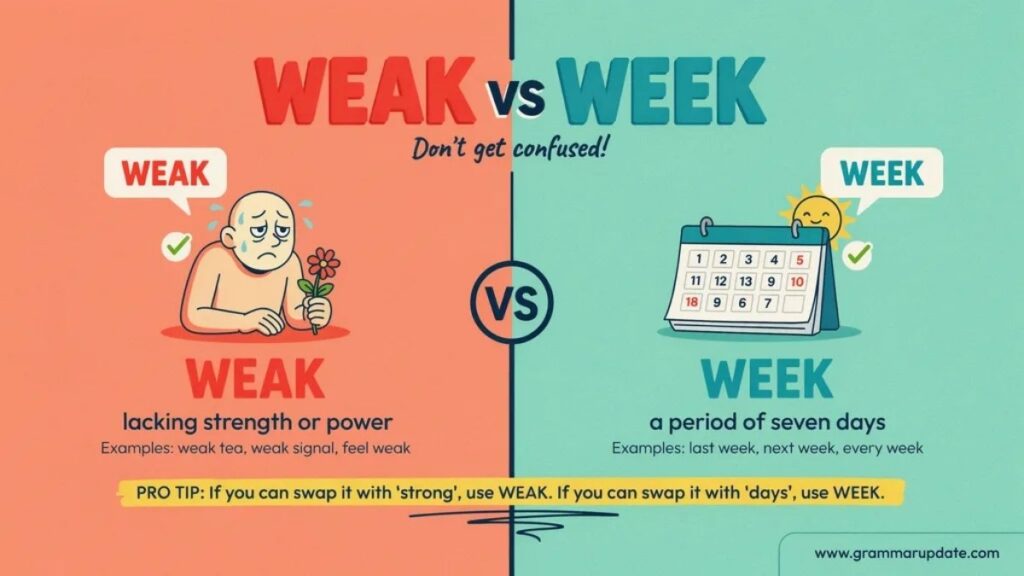
Have you ever written weak instead of week and realized the mistake a little too late? It happens more often than you might think. The weak vs week confusion catches students, professionals, and even native English speakers because these words sound exactly alike but mean completely different things. One describes a lack of strength, while the other refers to a period of seven days. Just one wrong letter can completely change your message. Don’t worry, though. This guide makes everything easy to understand with clear grammar explanations, practical examples, helpful memory tricks, and everyday usage tips, so you’ll choose the right word with confidence every time.
Why Do People Confuse Weak and Week?
Some English words look different but sound exactly the same. These words are called homophones in English, and weak and week are among the most commonly confused examples.
When someone says these words aloud, they sound identical. Your ears can’t tell the difference. Only the sentence’s meaning tells you which spelling is correct.
Compare these examples:
- She felt weak after the workout.
- She’ll return next week.
The first sentence talks about physical strength. The second refers to a seven day period.
That’s the key difference.
Because English has many confusing words in English, even fluent speakers sometimes type the wrong word, especially when writing quickly. Spell-checkers don’t always catch the mistake either because both weak vs week are correctly spelled words.
Understanding the difference between week vs weak helps you write more accurately and communicate with confidence.
Did You Know? English contains thousands of homophones. That’s one reason spelling can be challenging, even for native speakers.
Week vs Weak at a Glance
If you only have a minute, this table gives you the essential differences.
| Feature | Weak | Week |
|---|---|---|
| Part of Speech | Adjective | Noun |
| Meaning | Lacking strength, power, or effectiveness | A period of seven consecutive days |
| Pronunciation | Same as week | Same as weak |
| Used For | Strength, health, quality, emotions, technology | Time, calendars, schedules |
| Example | My phone has a weak signal. | I’ll finish the project next week. |
Quick Comparison
| Question | Answer |
|---|---|
| Are week and weak homophones? | Yes. |
| Do they have the same pronunciation? | Yes. |
| Do they have the same meaning? | No. |
| Can they replace each other? | No. |
| Is weak an adjective? | Yes. |
| Is week a noun? | Yes. |
The easiest way to remember the week and weak difference is this:
- Weak describes strength or quality.
- Week names a period of seven days.
Whenever you’re unsure about week vs weak which is correct, ask yourself one simple question:
Am I talking about strength or time?
If you’re talking about strength, use weak.
If you’re talking about time, use week.
That simple habit will help you avoid one of the most common grammar mistakes week vs weak.
Openned vs Opened Which Spelling Is Correct?
Weak Meaning
Let’s start with the easier word to recognize in context.
The weak meaning always relates to a lack of strength, power, energy, effectiveness, or intensity. Unlike week, which refers to time, weak describes the condition or quality of someone or something.
In English grammar, weak is an adjective. That means it describes a noun. It tells you what someone or something is like rather than naming a person, place, thing, or period of time.
You can describe a person as weak after an illness, a battery as weak when it no longer holds enough charge, or an argument as weak when it lacks convincing evidence. Although the situations are different, the central idea remains the same something is not as strong or effective as it should be.
Weak Definition
The weak definition is straightforward:
Weak means lacking strength, power, energy, effectiveness, or force.
The exact meaning depends on the sentence, but it always suggests that something falls short of the expected level of strength or quality.
For example:
- A person may feel weak after recovering from the flu.
- A bridge may be considered weak if it cannot safely support heavy traffic.
- A student may write a weak argument if there isn’t enough evidence to support a claim.
- A phone may show a weak signal when the network connection is poor.
Although these examples describe different situations, the idea of reduced strength or effectiveness stays the same.
Learn the difference between commonly mixed-up more words
Useing vs Using Which Spelling Is Correct?
Weak Pronunciation
One reason week vs weak pronunciation causes confusion is that both words are pronounced exactly alike.
Pronunciation: /wiːk/
Even native English speakers can’t tell which spelling you mean just by hearing the word. That’s why context matters far more than pronunciation.
For instance, if someone says:
“I’ll see you next week.”
and
“I feel weak.”
Both words sound identical. Only the surrounding words reveal the intended meaning.
Common Synonyms of Weak
Instead of repeating weak, you can choose a synonym that better matches the context.
| Context | Synonyms |
|---|---|
| Physical strength | Frail, feeble, delicate |
| Energy | Exhausted, tired |
| Power | Powerless, ineffective |
| Quality | Poor, inferior |
| Sound or flavor | Mild, faint |
Each synonym carries a slightly different meaning, so choose the one that best fits your sentence.
Common Antonyms of Weak
The opposite of weak usually depends on what you’re describing.
| Weak | Opposite |
|---|---|
| Weak muscles | Strong muscles |
| Weak argument | Strong argument |
| Weak signal | Strong signal |
| Weak battery | Fully charged battery |
| Weak immune system | Strong immune system |
Learning opposites is one of the fastest ways to expand your English vocabulary and improve your writing skills.
Fix common more word mistakes in English
Stolen vs Stollen Difference and usage?
Different Meanings of Weak with Examples
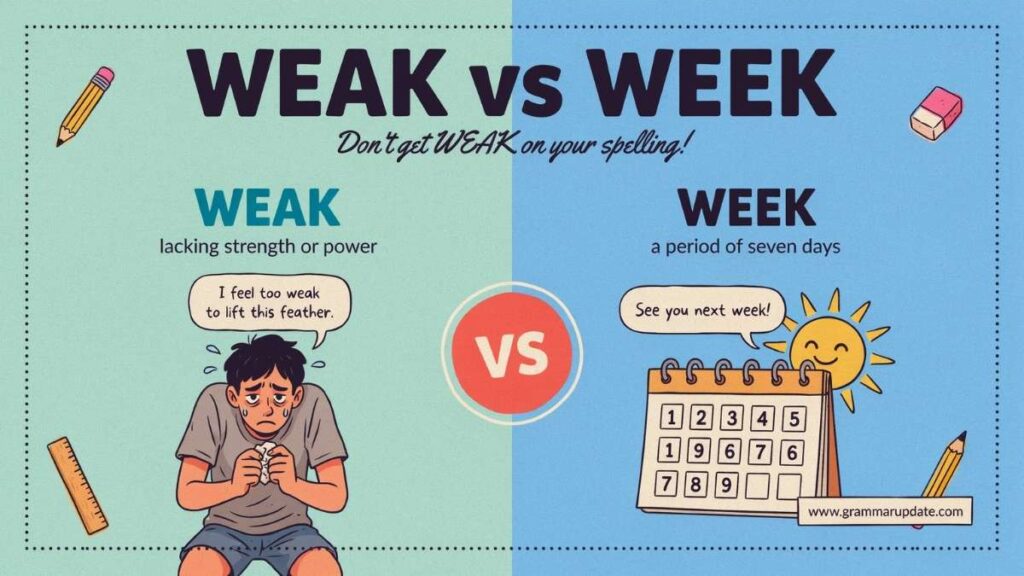
Although weak has one core definition, it appears in many everyday situations.
Physical Weakness
This is the most common use of the word.
When someone lacks physical power or feels tired because of illness, exercise, or age, they’re described as weak.
Examples:
- After running the marathon, Emma felt weak and needed to rest.
- The patient looked weak after surgery.
- His weak muscles made climbing the stairs difficult.
Here, weak describes physical strength.
Emotional Weakness
People also use weak to describe emotional states.
Examples:
- She felt emotionally weak after losing her pet.
- Stress can leave anyone feeling weak for a while.
- Crying doesn’t make someone weak. It simply shows they’re human.
In these examples, the word refers to emotional resilience rather than physical ability.
Mental Weakness
Mental strength involves concentration, memory, and decision-making.
Examples:
- Lack of sleep left him mentally weak during the exam.
- Long hours without a break can make anyone feel mentally weak.
This meaning relates to thinking rather than physical power.
Weak Argument
Not every use of weak involves people.
Ideas can also be weak.
A weak argument lacks facts, evidence, or logical reasoning.
Examples:
- The essay contained a weak argument because it offered no supporting evidence.
- The lawyer strengthened her case by removing several weak arguments.
Strong writing depends on strong evidence. That’s why avoiding weak arguments is essential in academic and professional writing.
Weak Signal
Technology gives us another common example.
Examples:
- My phone has a weak signal inside this building.
- The video kept buffering because the Wi-Fi signal was weak.
Here, weak measures the quality of a network connection rather than physical strength.
Weak Battery
You’ve probably seen this warning on an electronic device.
Examples:
- The remote stopped working because of a weak battery.
- Replace the weak battery before your trip.
The battery still works, but it doesn’t provide enough power.
Weak Tea
Even food and drinks can be described as weak.
Examples:
- This tea tastes weak because it didn’t steep long enough.
- He prefers strong coffee instead of weak coffee.
In this case, weak refers to flavor intensity rather than strength.
Weak Immune System
Healthcare professionals often use this expression.
Examples:
- Older adults may have a weak immune system.
- Good nutrition helps support a healthy immune system.
Week Meaning
Now let’s look at the other half of week vs weak.
Unlike weak, which describes a quality, week names a unit of time. Every time you talk about schedules, appointments, calendars, deadlines, vacations, or routines, you’re talking about a week.
This simple difference is what separates these two commonly confused words. If your sentence involves time, week is almost always the correct choice.
Understanding the week meaning makes it much easier to avoid spelling mistakes in everyday writing.
Week Definition
The week definition is simple and consistent.
A week is a period of seven consecutive days. It is one of the most common units of time used around the world for planning work, school, travel, meetings, and personal schedules.
Unlike many English words that have several unrelated meanings, week always refers to a period of time.
Examples:
- The project will be finished next week.
- We go grocery shopping every week.
- She’ll begin her new job next week.
In each example, week refers to a seven day period.
Week Pronunciation
One reason people confuse these words is their pronunciation.
Week and weak are pronounced exactly the same.
Pronunciation: /wiːk/
This is why week vs weak pronunciation can be tricky. You can’t rely on sound to choose the correct spelling. Instead, pay attention to the meaning of the sentence.
For example:
- I felt weak yesterday.
- I’ll call you next week.
Although the highlighted words sound identical, they have completely different meanings.
Related Words and Expressions
The word week appears in many common expressions.
Some of the most frequently used include:
- This week
- Next week
- Last week
- Every week
- Once a week
- Twice a week
- Week after week
- Calendar week
- Workweek
- Weekdays
- Weekend
You’ll see these phrases in conversations, business emails, calendars, school assignments, and travel plans.
Calendar Week
A calendar week is one complete seven-day period shown on a calendar.
Many businesses, schools, and organizations organize projects using calendar weeks.
Example:
- The marketing campaign begins during the third calendar week of August.
Workweek Meaning
The workweek meaning refers to the days employees normally work.
For many people, the workweek runs from Monday through Friday, although this can vary depending on the country, employer, or profession.
Examples:
- Her workweek starts on Monday.
- The company introduced a four-day workweek.
- Learn the difference between tricky more English words
Fix common more word mistakes in English
Trouper vs Trooper Which One Is Correct?
Weekend and Weekdays
A week is usually divided into weekdays and the weekend.
| Term | Meaning |
|---|---|
| Weekdays | Monday through Friday |
| Weekend | Saturday and Sunday |
These words are part of everyday English and appear in countless conversations.
Examples:
- I work during the weekdays.
- We usually travel on the weekend.
Week vs Weak Side-by-Side Comparison
Now that you understand both words individually, comparing them becomes much easier.
Although they sound the same, they belong to different parts of speech and perform different jobs in a sentence.
| Feature | Weak | Week |
|---|---|---|
| Meaning | Lack of strength or power | A period of seven days |
| Part of Speech | Adjective | Noun |
| Describes | A noun | A unit of time |
| Used For | Health, emotions, quality, technology | Time, schedules, calendars |
| Pronunciation | /wiːk/ | /wiːk/ |
| Spelling | Weak | Week |
This table clearly shows the week and weak difference.
Whenever you’re unsure about week or weak which is correct, ask yourself one question:
Am I talking about time or strength?
If your sentence refers to time, choose week.
If it refers to strength, quality, or effectiveness, choose weak.
That simple habit will eliminate most grammar mistakes week vs weak.
Week vs Weak Pronunciation
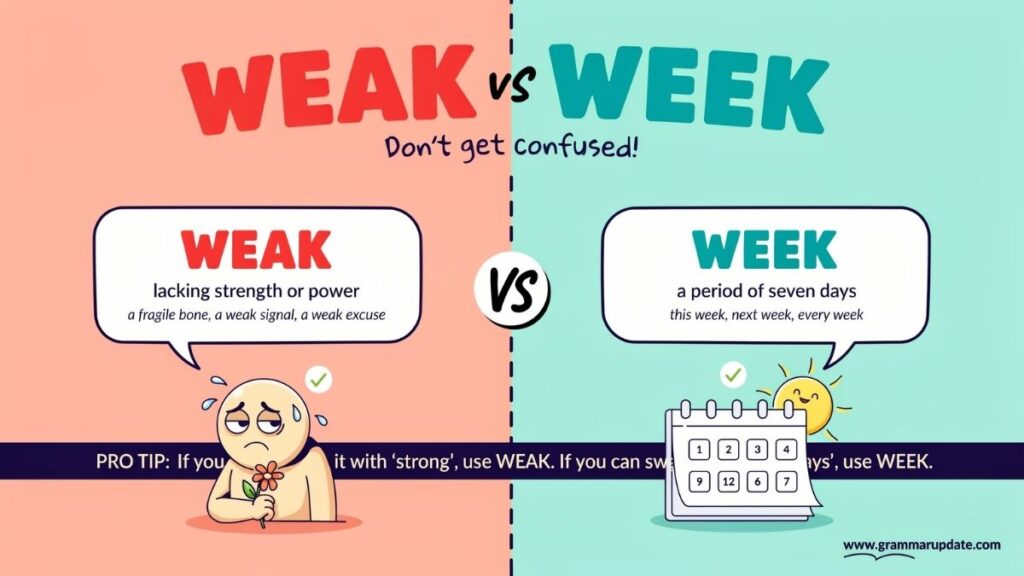
Many English learners expect different spellings to have different pronunciations. That’s not always true.
The words week and weak are perfect examples.
Both are pronounced:
/wiːk/
This makes them week and weak homophones.
A homophone is a word that has the same pronunciation as another word but a different meaning and spelling.
Other common homophones in English include:
| Word 1 | Word 2 |
|---|---|
| Their | There |
| Right | Write |
| Sea | See |
| Pair | Pear |
| Flour | Flower |
| Knight | Night |
Like week and weak, these pairs require you to understand the context before choosing the correct spelling.
American and British Pronunciation
Good news there’s almost no difference here.
Both American English and British English pronounce week and weak nearly the same way.
That means pronunciation won’t help you identify the correct spelling in either variety of English.
Instead, focus on the sentence’s meaning.
Are Week and Weak Homophones?
Yes.
Week and weak are homophones.
That means they:
- Sound exactly alike.
- Have different spellings.
- Have different meanings.
- Belong to different parts of speech.
Because they’re homophones, they’re also among the most commonly confused words in English.
For many English language learners, these words become easier once they stop focusing on pronunciation and start paying attention to context
Learn the difference between tricky more English words
Socialise vs Socialize Which One Is Correct?
Week vs Weak Grammar Rules
Understanding grammar makes choosing the correct word much easier.
This section explains week vs weak grammar, weak vs week grammar, and week or weak grammar in simple language.
How Weak Functions in a Sentence
The word weak is an adjective.
An adjective describes a noun.
Examples:
- The athlete looked weak after the race.
- The coffee tastes weak.
- We have a weak internet connection.
- Her explanation was weak.
Notice that weak always describes someone or something.
It never names a period of time.
How Week Functions in a Sentence
The word week is a noun.
A noun names a person, place, thing, or idea. In this case, it names a period of time.
Examples:
- Next week will be busy.
- We met last week.
- The meeting lasted one week.
- She travels every week.
Because week is a noun, it often follows words like:
- this
- next
- last
- every
- one
- each
Parts of Speech Explained
Understanding noun vs adjective makes the difference much easier to remember.
| Word | Part of Speech | Function |
|---|---|---|
| Weak | Adjective | Describes a noun |
| Week | Noun | Names a seven-day period |
Whenever you identify the part of speech first, choosing the correct spelling becomes much easier.
Sentence Position and Usage
The position of each word also provides clues.
Weak often appears:
- Before a noun
- After linking verbs such as is, was, seems, feels, and becomes
Examples:
- The battery is weak.
- That’s a weak excuse.
- She became weak after surgery.
Week usually appears:
- After words like next, last, this, and every
- With numbers
- When discussing schedules or calendars
Examples:
- Next week
- Last week
- Every week
- One week
- Two weeks
Recognizing these patterns is one of the easiest ways to improve your English grammar rules and make better word choices while writing.
Fix common more word mistakes in English
Icycle vs Icicle Differences and Correct Usage
Week vs Weak Examples
The fastest way to master week vs weak is to see both words in real sentences. Reading examples helps you recognize patterns and understand how each word fits naturally into everyday English.
Remember this simple rule before you begin:
- Use weak when talking about strength, quality, health, power, or effectiveness.
- Use week when talking about time or a seven-day period.
Once you understand that distinction, choosing the correct spelling becomes much easier.
Weak in Sentences
The following examples show how weak functions as an adjective.
- I felt weak after recovering from the flu.
- The bridge looks weak, so engineers will inspect it.
- His weak handshake surprised everyone.
- The Wi-Fi has a weak signal in the basement.
- The team’s defense looked weak throughout the game.
- The doctor said her weak immune system needed extra care.
- That essay presents a weak argument because it lacks evidence.
- The flashlight stopped working because of a weak battery.
- This soup tastes weak and needs more seasoning.
- She became weak from dehydration.
- The company released a weak financial report.
- His voice sounded weak after speaking for hours.
- The plant appears weak because it hasn’t received enough sunlight.
- A weak economy often affects consumer spending.
- The coffee tastes weak this morning.
- He felt mentally weak after staying awake all night.
- The old chair became weak with age.
- The athlete looked weak after completing the marathon.
- Their explanation was weak and failed to answer the question.
- The engine produced weak performance during testing.
Each sentence describes the condition or quality of someone or something, which is exactly how an adjective should function.
Week in Sentences
Now compare those examples with sentences that use week correctly.
- I’ll finish the report next week.
- We meet every week to discuss new ideas.
- Last week was extremely busy.
- She plans to travel next week.
- The conference lasts one week.
- We exercise five days each week.
- This week feels much calmer than the last one.
- School starts next week.
- He spends one week with his grandparents every summer.
- The package should arrive within a week.
- We received excellent news this week.
- Every week, the team reviews its progress.
- She completed the project in one week.
- The weather changed dramatically during the week.
- Our vacation begins next week.
- They work six days a week.
- The meeting has been moved to next week.
- This week has gone by quickly.
- We publish new articles every week.
- The training program continues for four weeks.
Notice that every example refers to a period of time.
Week vs Weak Sentence Pairs
Seeing both words side by side makes the week and weak difference much easier to understand.
| Weak | Week |
|---|---|
| I feel weak today. | I’ll return next week. |
| The battery is weak. | The repair will take one week. |
| His argument sounds weak. | We meet every week. |
| She became weak after surgery. | The conference starts this week. |
| The signal is weak. | Last week was productive. |
| The tea tastes weak. | The course lasts one week. |
| He looks weak today. | We travel every week. |
| That’s a weak excuse. | She’ll call next week. |
Reading these sentence pairs helps reinforce the correct word usage.
Learn the difference between confusing more English words
Shute vs Chute Differences and Correct Usage
Week and Weak Homophone Sentences
Because week and weak homophones sound exactly alike, context becomes essential.
Read these carefully.
- After feeling weak all morning, she finally returned to work the following week.
- My phone had a weak signal for most of the week.
- He looked weak, so he took the entire week off.
- The battery became weak during the first week of our trip.
- She spent the week recovering because she felt weak after the race.
These examples demonstrate why context matters much more than pronunciation.
Learn the difference between tricky more English words
Persue vs Pursue Which Spelling Is Correct?
Common Mistakes with Weak and Week
Although the difference seems simple, many writers still confuse these words.
Here are the mistakes that appear most often.
Using “Weak” Instead of “Week”
❌ I’ll see you next weak.
✅ I’ll see you next week.
The sentence discusses time, so week is correct.
Using “Week” Instead of “Weak”
❌ My phone has a week signal.
✅ My phone has a weak signal.
The sentence describes signal strength, so weak is correct.
Trusting Pronunciation
Many learners rely on pronunciation.
Unfortunately, that strategy doesn’t work because both words sound identical.
Instead, ask yourself:
Does this sentence describe strength or time?
The answer usually tells you which spelling to choose.
Depending Only on Spell Check
Spell-check software may not detect mistakes like these because both weak and week are correctly spelled English words.
For example:
I’ll be weak next Monday.
The spelling is correct, but the sentence probably should say week.
That’s why proofreading is still important.
Learn the difference between tricky more English words
Eventhough vs Even Though Which Is Correct?
When to Use Weak
Choose weak whenever you’re describing the condition, quality, or effectiveness of someone or something.
Common situations include:
- Physical health
- Emotional health
- Mental health
- Sports
- Technology
- Food and drinks
- Business
- Science
- Education
Examples:
- She has weak muscles after surgery.
- We received a weak signal.
- That’s a weak argument.
- The tea tastes weak.
- His immune system became weak.
If the sentence describes something, weak is probably the correct word.
Fix common more word mistakes in English
Present vs Presant Differences and Correct Usage
When to Use Week
Use week whenever the sentence refers to time.
You’ll commonly use it when discussing:
- Calendars
- Schedules
- School
- Business
- Holidays
- Travel
- Deadlines
- Meetings
Examples:
- Next week is my vacation.
- The project ends this week.
- We meet every week.
- Last week was exciting.
- She’ll arrive in one week.
Whenever you discuss a seven-day period, choose week.
When You Should NOT Use Weak vs Week
Here are some incorrect sentences and their corrected versions.
| Incorrect | Correct |
|---|---|
| I’ll visit next weak. | I’ll visit next week. |
| The Wi-Fi has a week signal. | The Wi-Fi has a weak signal. |
| She felt week after surgery. | She felt weak after surgery. |
| Last weak was stressful. | Last week was stressful. |
| That’s a week excuse. | That’s a weak excuse. |
| We traveled every weak. | We traveled every week. |
These are among the most common English mistakes to avoid.
Learn the difference between confusing more English words
Stellar vs Steller Differences and Usage
Easy Memory Tricks to Remember Week vs Weak
You don’t need to memorize long grammar rules.
These simple memory tricks work surprisingly well.
Think About Time
If the sentence mentions:
- Monday
- Friday
- Weekend
- Calendar
- Schedule
- Vacation
The answer is almost certainly week.
Think About Strength
If the sentence mentions:
- Power
- Health
- Muscles
- Battery
- Signal
- Argument
- Energy
The correct word is weak.
Visual Memory Trick
Picture a calendar whenever you see week.
Picture someone lifting heavy weights whenever you see weak.
Your brain remembers images much faster than definitions.
Ask One Question
Before writing either word, ask yourself:
Am I talking about time or strength?
That single question prevents most spelling errors.
Learn the difference between confusing more English words
Seing vs Seeing Difference and Usage
Week vs Weak in Everyday English
These words appear constantly in daily conversations.
Here are a few examples.
1 At Work
Let’s finish the report next week.
The internet connection is weak today.
2 At School
We have exams next week.
His conclusion was weak because it lacked evidence.
3 At Home
We’ll clean the house this week.
My phone has a weak battery.
4 While Traveling
We’re leaving next week.
The GPS has a weak signal in this area.
5 On Social Media
❌ Can’t wait until next weak.
✅ Can’t wait until next week.
Even small spelling mistakes can make your writing appear less polished.
Learn the difference between confusing more English words
Nitch vs Niche Difference and Which Is Correct?
Weak vs Week in Idioms and Common Expressions
Once you understand the basic meanings, the next step is learning how these words appear in everyday expressions. Native English speakers use many of these phrases naturally in conversations, books, news articles, and business communication.
Knowing these expressions will improve your English vocabulary, strengthen your writing skills, and help you sound more natural.
Common Expressions with Weak
Although weak usually describes a lack of strength, it appears in many idioms and fixed expressions.
| Expression | Meaning | Example |
|---|---|---|
| Weak link | The least reliable or strongest point of failure in a group | The outdated software was the weak link in the security system. |
| Weak point | A disadvantage or vulnerable area | Time management is his only weak point. |
| Weak spot | A particular area of weakness or a personal fondness | She has a weak spot for rescue animals. |
| Weak at the knees | Feeling shaky because of excitement, fear, or attraction | The surprise announcement left everyone weak at the knees. |
| Strong vs weak | A comparison between power and lack of power | The coach compared the team’s strong vs weak performances throughout the season. |
These expressions don’t always refer to physical strength. In many cases, weak describes quality, confidence, or vulnerability.
Common Expressions with Week
The word week appears in many everyday phrases related to time.
| Expression | Meaning | Example |
|---|---|---|
| This week | During the current seven-day period | We have three meetings this week. |
| Next week | During the following week | The project starts next week. |
| Last week | During the previous week | I visited my grandparents last week. |
| Every week | Once each week | We publish new articles every week. |
| Week after week | Repeatedly over many weeks | She practiced week after week until she mastered the skill. |
| Calendar week | One complete week on a calendar | Sales increased during the first calendar week of July. |
| Workweek | The regular working days | His workweek ends on Friday. |
These expressions appear in almost every form of everyday English, from casual conversations to professional writing.
Fix common more word mistakes in English
Manor vs Manner Which One Is Correct?
Practice session
Fill in the Blank
- My internet connection is ______ today.
- We’ll leave for vacation next ______.
- She felt ______ after running the marathon.
- We have meetings every ______.
- The baby’s immune system is still ______.
- Last ______ was incredibly busy.
- The coffee tastes too ______.
- The conference lasts one ______.
- His explanation was ______ because it lacked evidence.
- I’ll call you later this ______.
- The remote has a ______ battery.
- We exercise three days each ______.
- The athlete looked ______ after the race.
- School begins next ______.
- That’s a ______ excuse.
- They worked six days a ______.
- The Wi-Fi signal is ______ upstairs.
- She became ______ from dehydration.
- We publish a newsletter every ______.
- The project will finish next ______.
- The team’s defense looked ______.
- We spent the entire ______ at the beach.
- His voice sounded ______ after the speech.
- They review progress every ______.
- The old bridge looks ______.
Take your time before checking the answers.
Answer
| Question | Correct Answer | Explanation |
|---|---|---|
| 1 | weak | Describes signal strength. |
| 2 | week | Refers to time. |
| 3 | weak | Describes physical condition. |
| 4 | week | Indicates a recurring period of time. |
| 5 | weak | Describes the immune system. |
| 6 | week | Refers to a seven-day period. |
| 7 | weak | Describes flavor. |
| 8 | week | A duration of time. |
| 9 | weak | Describes an argument or explanation. |
| 10 | week | Refers to time. |
| 11 | weak | Describes battery strength. |
| 12 | week | A period of seven days. |
| 13 | weak | Describes physical strength. |
| 14 | week | Refers to time. |
| 15 | weak | Describes the quality of an excuse. |
| 16 | week | Refers to a work schedule. |
| 17 | weak | Describes signal quality. |
| 18 | weak | Describes physical condition. |
| 19 | week | Refers to frequency. |
| 20 | week | Refers to time. |
| 21 | weak | Describes performance. |
| 22 | week | Refers to seven days. |
| 23 | weak | Describes voice strength. |
| 24 | week | Refers to a regular schedule. |
| 25 | weak | Describes the bridge’s condition. |
Here’s a trusted source for clear word meanings:
FAQs
Is it weak or week?
Both words are correct, but they have different meanings. Weak describes a lack of strength or effectiveness, while week refers to a period of seven days.
What is the difference between week and weak?
The difference between week and weak is their meaning and grammar. Weak is an adjective that describes strength or quality. Week is a noun that names a period of seven consecutive days.
Is weak a noun or an adjective?
Weak is an adjective because it describes a noun.
Is week a noun?
Yes. Week is a noun because it names a unit of time.
Why do weak and week sound the same?
They’re homophones words with the same pronunciation but different spellings and meanings.
Are week and weak homophones?
Yes. Week and weak homophones are a classic example taught in English grammar.
What does weak mean?
The weak meaning is lacking strength, power, energy, effectiveness, or intensity.
What does week mean?
The week meaning is a period of seven consecutive days.
How do you use weak in a sentence?
Example:
The phone has a weak signal inside the building.
How do you use week in a sentence?
Example:
We’ll start the project next week.
What is the plural of week?
The plural form is weeks.
Example:
The training lasts four weeks.
Can weak describe a person?
Yes. It can describe someone’s physical, mental, or emotional condition.
Can week be used as an adjective?
No. Week is a noun, not an adjective.
What is the opposite of weak?
The most common opposite is strong.
What are synonyms of weak?
Common synonyms include frail, feeble, powerless, delicate, and ineffective, depending on the context.
What are common expressions with week?
Some common expressions include this week, next week, last week, every week, calendar week, workweek, weekdays, and weekend.
How can I remember the difference between week and weak?
Remember this simple rule:
- Week = Time
- Weak = Strength
If the sentence discusses seven days, choose week. If it describes strength or quality, choose weak.
Why do English learners confuse week and weak?
They sound exactly the same. Since pronunciation doesn’t help, learners must rely on grammar and context to choose the correct spelling.
Fix common more word mistakes in English
Workday vs Work Day Which One Is Correct?
Conclusion
Confusing weak and week is easy, but fixing the mistake is even easier once you know what each word means. Think of it this way: if you’re talking about strength, choose weak. If you’re talking about a seven-day period, choose week. That’s the whole secret. A single misplaced letter can make your sentence unintentionally funny unless, of course, your vacation really does last a “weak!” The more you read, write, and practice, the more natural the correct choice will become. Keep these simple grammar rules in mind, pay attention to context, and you’ll avoid this common mix-up while writing with greater accuracy and confidence every time.

Jhon AJS, the creative mind behind Grammar Update, is an experienced blogger passionate about simplifying English grammar. He focuses on explaining confusing word vs word differences, grammar rules, punctuation, and sentence structure in a clear and practical way. Through easy to understand guides and examples, Jhon helps readers improve their writing and communicate with confidence. With years of blogging experience, he continues to share helpful insights that make learning grammar simple, useful, and accessible for everyone.