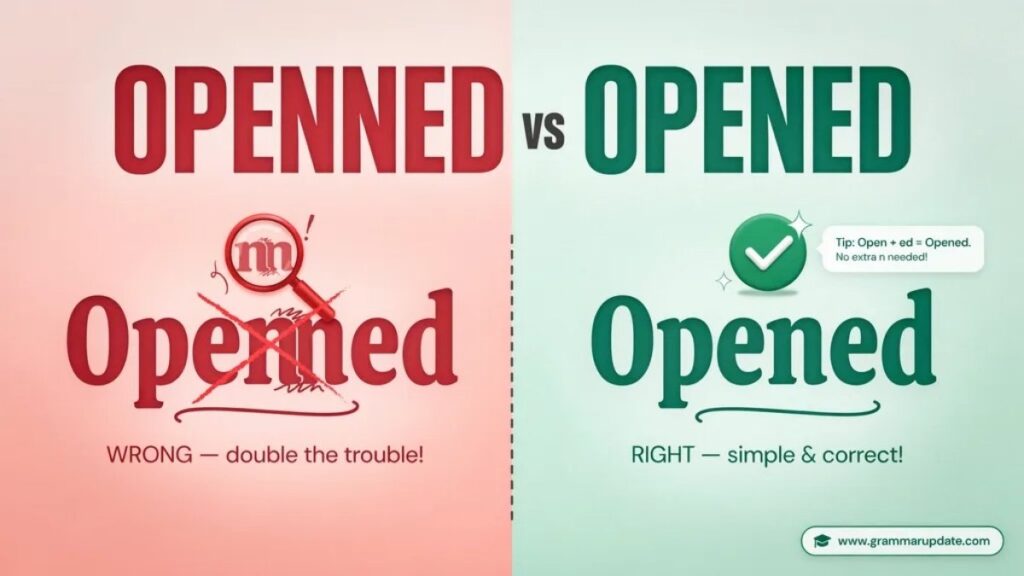
Have you ever stopped while writing because you could not choose between Openned vs Opened? Many people make this mistake because openned looks right at first glance. English spelling can trick you, but this word follows a simple rule. You only need opened because openned is incorrect. In this article, you’ll learn why many writers confuse these spellings, understand the grammar rule, and see clear examples that make the difference easy to remember. You’ll also discover simple tips to improve your spelling and avoid this common error in school, work, emails, and everyday writing. After that, you’ll choose opened with confidence every time.
Quick Answer Openned vs Opened?
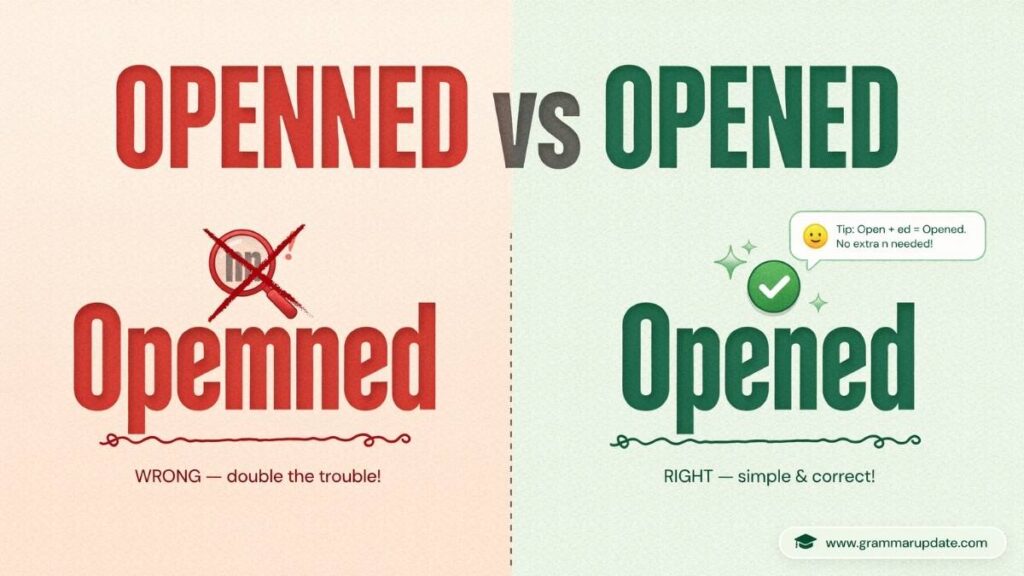
If you’re short on time, here’s the answer Openned vs Opened
Opened is the correct spelling.
Openned is not a standard English word. It is a common misspelling that appears because many writers mistakenly apply the wrong spelling rule.
Whether you’re writing a school assignment, business email, article, social media post, or text message, you should always use opened.
Quick Facts
| Question | Answer |
|---|---|
| Is opened correct? | Yes. |
| Is openned a word? | No. |
| Correct spelling of opened | Opened |
| Accepted in British English | Yes |
| Accepted in American English | Yes |
| Past tense of open | Opened |
| Past participle of open | Opened |
Whenever you’re choosing between openned or opened, the correct answer is always opened.
Understanding the Confusion Between Openned vs Opened
The confusion between opened or openned is completely understandable.
English spelling isn’t always predictable. Some verbs double their final consonant before adding -ed, while others don’t. Unless you know the grammar rule, it’s easy to second-guess yourself.
That’s exactly why so many people write openned.
Why Does “Openned” Look Correct?
Your brain naturally looks for familiar spelling patterns.
Think about words like:
- Plan → Planned
- Stop → Stopped
- Admit → Admitted
- Prefer → Preferred
Since these verbs double their final consonant, many people assume open should become openned as well.
It seems logical but English doesn’t work that way.
Spelling depends on pronunciation and grammar rules, not simply on what “looks right.”
Why This Mistake Is So Common
Several factors make this one of the most common English spelling mistakes.
- People confuse the consonant-doubling rule.
- They copy incorrect spellings from websites or social media.
- Fast typing often leads to an extra n.
- Many English learners haven’t learned the rules for adding -ed to regular verbs.
The good news is that once you understand the rule, you’ll never have to guess again.
What Does “Opened” Mean?
Before learning why opened is spelled with one n, let’s understand what the word actually means.
The opened meaning is straightforward.
Opened is the past tense and past participle of the verb open. It describes an action that has already happened.
Depending on the sentence, opened can mean to unlock, uncover, unseal, begin, reveal, or make something available.
Opened Definition
The word opened can mean:
- To unlock or unfasten something.
- To make something no longer closed.
- To begin an event, meeting, or activity.
- To make something available for use.
- To reveal or uncover information.
Although the context changes, the basic idea remains the same: something that was closed or unavailable becomes open or accessible.
Examples of “Opened”
Here are a few everyday examples.
- She opened the window to let fresh air inside.
- The restaurant opened at 11 o’clock.
- They opened a new office in London.
- I opened your email this morning.
- The teacher opened the lesson with an interesting question.
Each example shows opened describing a completed action.
Fix common more word mistakes in English
Conex or Connex Differences Explained
Verb Forms of “Open”
Understanding verb forms makes English grammar much easier.
The verb open is a regular verb, which means it follows a predictable pattern.
| Verb Form | Word |
|---|---|
| Base form | Open |
| Third-person singular | Opens |
| Present participle | Opening |
| Past tense | Opened |
| Past participle | Opened |
Because open is a regular verb, it simply adds -ed to form the past tense.
Compare it with irregular verbs, which change completely.
| Regular Verb | Past Tense | Irregular Verb | Past Tense |
|---|---|---|---|
| Open | Opened | Go | Went |
| Walk | Walked | Write | Wrote |
| Clean | Cleaned | Speak | Spoke |
| Start | Started | See | Saw |
This regular pattern makes opened grammar much easier to understand than many irregular verbs.
How Do You Pronounce “Opened”?
Pronunciation can sometimes make spelling confusing, but opened is relatively easy to say.
It has two syllables, and the ending -ed is pronounced with a d sound rather than as a separate syllable.
Here are a few examples:
- The store opened early this morning.
- She opened the package carefully.
- We opened the document before the meeting.
Hearing native speakers pronounce the word can also help reinforce the correct spelling.
Is “Openned” a Word?
One of the most frequently searched questions is:
Is openned a word?
The answer is simple.
No. Openned is not a recognized English word.
It does not appear as the accepted spelling in standard dictionaries because it doesn’t follow English spelling rules.
If you type openned into most grammar or spell-checking tools, you’ll usually be asked to replace it with opened.
Why Don’t Dictionaries Accept “Openned”?
Dictionaries include words that are widely accepted in standard English.
Professional writers, editors, publishers, teachers, and educational institutions all use opened, so that’s the spelling you’ll find in trusted dictionaries.
The extra n has never been part of the standard spelling.
Is “Openned” Ever Correct?
No.
Unlike words such as colour/color or travelling/traveling, there is no British or American spelling difference here.
Whether you’re writing in:
- British English
- American English
- Australian English
- Canadian English
the correct spelling is always opened.
Understand confusing English more words simply
Atleast or At Least? Which One Is Correct?
Why “Opened” Is Correct and “Openned” Is Incorrect
Now let’s answer the question that causes all the confusion.
Why is it opened instead of openned?
The answer lies in a simple English spelling rule.
The verb open is a regular verb. To form its past tense and past participle, you simply add -ed.
Open + ed = Opened
No extra n is needed.
Many writers assume every verb ending in a consonant should double the final letter before adding -ed, but that’s not how English works. The consonant-doubling rule only applies in specific situations, and open doesn’t meet those conditions.
Once you understand that rule, choosing between opened or openned becomes easy.
Instead of memorizing a single spelling, you’ll understand the pattern behind many regular English verbs. In the next section, you’ll learn exactly why open doesn’t double the n, explore the consonant-doubling rule in detail, compare similar words, and discover practical examples that will help you remember the correct spelling with confidence.
Why “Opened” Is Correct and “Openned” Is Incorrect
If you’ve ever stopped mid-sentence and wondered, “Why is it opened instead of openned?”, you’re not alone. This is one of the most common spelling questions English learners ask. At first glance, openned looks perfectly reasonable. After all, many English verbs double their final consonant before adding -ed.
However, open follows a different spelling rule.
Once you understand that rule, you’ll know exactly why opened is correct, why openned is incorrect, and how to avoid this mistake every time you write.
Fix common more word mistakes in English
Offered vs Offerred The Complete Guide to Correct Spelling
The Grammar Rule Behind “Opened”
The verb open is a regular verb, which means it follows the standard pattern for forming the past tense and past participle.
To create the past tense, you simply add -ed to the base verb.
Open → Opened
That’s it.
There is no extra n, no special exception, and no alternative spelling. The correct spelling of opened is simply opened.
Understanding this rule also helps with many other regular verbs, making your English writing more accurate and confident.
When Do We Double the Final Consonant?
Many spelling mistakes happen because writers apply the consonant-doubling rule where it doesn’t belong.
In English, the final consonant is doubled only when all of these conditions are true:
- The word ends with one vowel followed by one consonant.
- The final syllable is stressed, or the word has only one syllable.
- A suffix beginning with a vowel, such as -ed or -ing, is added.
Here are some common examples:
| Base Word | Correct Form | Why It Doubles |
|---|---|---|
| Stop | Stopped | One syllable ending in vowel + consonant |
| Plan | Planned | One syllable ending in vowel + consonant |
| Admit | Admitted | Stress falls on the last syllable |
| Prefer | Preferred | Stress falls on the last syllable |
These words meet the rule, so the final consonant is doubled.
Learn how to use confusing more words correctly
Mama vs Momma Correct Spelling and Differenc
Why Doesn’t “Open” Become “Openned”?
Here’s where the confusion disappears.
The word open is pronounced O-pen, with the stress on the first syllable.
Because the final syllable is not stressed, English does not double the final n when adding -ed or -ing.
That means:
Open → Opened
Open → Opening
Not:
- Openned
- Openning
This simple grammar rule answers several common questions at once:
- Why is opened spelled with one n?
- Why doesn’t open become openned?
- Why is there no double n in opened?
- Is openned correct English?
Once you remember where the stress falls, the correct spelling becomes much easier to remember.
Understand confusing English more words simply
Taught vs Tought Correct Spelling and Usage
Openned vs Opened Comparison Table
If you’re still unsure which spelling to use, this quick comparison makes the answer clear.
| Feature | Opened | Openned |
|---|---|---|
| Correct spelling | Yes | No |
| Standard English | Yes | No |
| Found in major dictionaries | Yes | No |
| Accepted in British English | Yes | No |
| Accepted in American English | Yes | No |
| Suitable for academic writing | Yes | No |
| Suitable for professional writing | Yes | No |
| Accepted by grammar checkers | Yes | No |
The table leaves no room for confusion.
Whenever you’re deciding between openned or opened, always choose opened.
Opened Vs Openned Meaning
Many people search for openned meaning because they assume both spellings exist.
In reality, they don’t.
Both spellings are intended to express the same idea, but only one is correct.
| Word | Meaning | Correct? |
|---|---|---|
| Opened | Past tense and past participle of open | Yes |
| Openned | Misspelling of opened | No |
Whenever you want to describe unlocking a door, opening a file, starting a meeting, or launching a business, opened is the only correct choice.
Learn how to use confusing more words correctly
Shinning vs Shining Correct Spelling and Usage
Open vs Opened What’s the Difference?
Another common source of confusion is open vs opened.
Although they are closely related, they don’t always have the same grammatical function.
Understanding the difference will help you write more naturally.
“Open” Describes a State
The word open often functions as an adjective. It describes the current condition of something.
Examples:
- The door is open.
- The restaurant is open.
- The window is open.
- The bank is open today.
In each sentence, open describes a state rather than an action.
Understand confusing English more words simply
Inclosed vs Enclosed Which Spelling Is Correct?
“Opened” Describes an Action
The word opened is a verb. It tells us that someone performed the action of opening something in the past.
Examples:
- Sarah opened the door.
- The restaurant opened at 10 a.m.
- They opened a new branch last year.
- I opened your email yesterday.
Here, opened tells us what happened.
The Store Is Open or Opened?
This question appears frequently because both words seem possible.
The answer depends on what you’re trying to say.
If you’re describing the store’s current condition, say:
The store is open.
If you’re describing the action that happened earlier, say:
The store opened at 9 a.m.
Both sentences are correct, but they express different ideas.
The Door Is Open or Opened?
The same rule applies here.
If you’re talking about the door’s condition:
The door is open.
If you’re describing an action:
She opened the door.
This small distinction makes your writing sound much more natural.
Learn how to use confusing more words correctly
Speach vs Speech Which Spelling Is Correct in English?
Related Forms of “Open”
Learning related word forms helps you expand your vocabulary while avoiding common grammar mistakes.
| Word | Part of Speech | Example |
|---|---|---|
| Open | Verb / Adjective | Please open the window. |
| Opens | Verb | She opens the shop every morning. |
| Opening | Verb / Noun | They’re opening a new office next month. |
| Opened | Verb | They opened the museum yesterday. |
| Reopen | Verb | The café will reopen tomorrow. |
| Reopened | Verb | The airport reopened after repairs. |
| Openly | Adverb | He spoke openly about the issue. |
| Openness | Noun | Her openness earned everyone’s trust. |
Knowing these forms makes your writing more varied, natural, and precise.
Learn how to use confusing more words correctly
Targetted vs Targeted Which Spelling Is Correct?
Openned vs Opened Examples in Sentences
Reading the correct spelling in real situations is one of the best ways to remember it.
Everyday Conversation
- I opened the window because it was too warm.
- She opened her birthday present immediately.
- We opened the garage before leaving.
- He opened the front gate for the visitors.
Business and Professional Writing
- The company opened a new office in Singapore.
- Our support team opened your service request today.
- The manager opened the meeting with a short presentation.
- The organization opened applications for new positions.
Academic Writing
- The professor opened the lecture with an interesting question.
- Researchers opened new possibilities for future studies.
- The university opened admissions for international students.
Emails and Digital Communication
- I opened your email this morning.
- She accidentally opened the wrong attachment.
- The software opened without any issues.
- He opened the shared document before the meeting.
News and Media
- The city officially opened its newest public library.
- The museum opened to visitors on Saturday.
- Authorities opened an investigation into the incident.
These examples demonstrate that opened works naturally in everyday, professional, academic, and formal writing.
Learn the difference between tricky more English words
Reoccurrence vs Recurrence Which One Is Correct?
Common Mistakes to Avoid
Even confident writers make simple spelling mistakes from time to time. Here are the most common ones and how to fix them.
Mistake 1: Writing “Openned”
Incorrect: She openned the package.
Correct: She opened the package.
Mistake 2: Confusing “Open” and “Opened”
Incorrect: Yesterday I open the window.
Correct: Yesterday I opened the window.
Use opened when referring to a completed action in the past.
Mistake 3: Using “Opened” Instead of “Open”
Incorrect: The restaurant is opened.
Correct: The restaurant is open.
Remember, open describes a condition, while opened describes an action.
Mistake 4: Using the Wrong Verb Tense
Incorrect: Last week we open a new account.
Correct: Last week we opened a new account.
Always choose the correct tense based on when the action happened.
Understand confusing English more words simply
Insecure vs Unsecure Which One Is Correct?
British English vs American English Does It Matter?
Many English words have different spellings depending on the country.
For example:
- Colour → Color
- Centre → Center
- Travelling → Traveling
Fortunately, opened is not one of those words.
Whether you’re writing in British English, American English, Australian English, or Canadian English, the spelling remains exactly the same:
Opened
There is no accepted version spelled openned in any major variety of English.
So, if you’re searching for openned or opened UK, the answer is simple: British English uses opened, just like American English.
Synonyms for “Opened”
Repeating the same word too often can make your writing feel repetitive. Depending on the context, these synonyms may be a better fit.
| Synonym | Best Used For |
|---|---|
| Unlocked | Doors, gates, devices |
| Unsealed | Packages, envelopes, containers |
| Revealed | Information, secrets, results |
| Uncovered | Evidence, facts, discoveries |
| Began | Meetings, events, discussions |
| Started | Activities, businesses, projects |
| Initiated | Programs, procedures, operations |
| Launched | Products, campaigns, websites |
| Commenced | Formal or academic writing |
| Made available | Services, resources, opportunities |
Choosing the right synonym improves clarity, strengthens your vocabulary, and makes your writing more engaging without changing the meaning.
Learn the difference between tricky more English words
Enflamed vs Inflamed Which One Is Correct?
Real-Life Examples of “Opened”
One of the best ways to remember the correct spelling is to see opened used in real-life situations. The more often you read and write the word correctly, the more natural it becomes. Whether you’re writing an email, telling a story, preparing a business report, or completing a school assignment, opened is the spelling you’ll use every time.
Let’s look at some common examples.
Opened a Business
When someone starts a new company, store, or office, the verb opened describes the completed action.
Examples:
- Sarah opened her first bakery in 2025.
- The company opened a new branch in London.
- They opened another office to expand their services.
- Our family opened a small café near the university.
In each sentence, opened tells us that the action has already happened.
Opened a Bank Account
Banks, financial institutions, and official documents often use the word opened.
Examples:
- I opened a savings account yesterday.
- She opened her first bank account after graduating.
- The business opened a corporate account for international payments.
- They opened a joint account last month.
These examples show the correct past tense of open in everyday financial situations.
Opened a Door
This is one of the most familiar uses of the word.
Examples:
- He opened the front door for the guests.
- She opened the window to let in fresh air.
- The security guard opened the main gate.
- I opened the cupboard to look for my keys.
Whenever you’re describing an action completed in the past, opened is the correct choice.
Opened an Email or File
In today’s digital world, you’ll often use opened when talking about technology.
Examples:
- I opened your email this morning.
- She accidentally opened the wrong attachment.
- We opened the shared document before the meeting.
- The app opened instantly after the update.
This is another situation where opened is always the correct spelling.
Opened a Conversation
The verb opened can also mean to begin a discussion, speech, meeting, or presentation.
Examples:
- The manager opened the meeting with a warm welcome.
- She opened the conversation by thanking everyone.
- The professor opened the lecture with an interesting question.
- The speaker opened the presentation with a humorous story.
Although the context changes, the spelling never does.
Why Correct Spelling Matters
Some people think spelling is only important in school, but correct spelling matters wherever you write. Whether you’re sending an email, applying for a job, publishing a blog post, or posting on social media, accurate spelling helps your writing look clear, professional, and trustworthy.
Choosing opened instead of openned is a small change that makes a big difference.
Understand confusing English more words simply
Thats vs That’s diffrance and Which Is Correct?
It Makes Your Writing More Professional
Correct spelling creates a strong first impression.
Whether you’re writing a business proposal, client email, report, or resume, using opened shows attention to detail and good writing skills.
A simple spelling mistake like openned can distract readers and reduce your credibility.
It Improves Academic Writing
Teachers, professors, and examiners expect standard English.
Using the correct spelling of opened demonstrates that you understand English grammar, verb forms, and spelling rules.
Small improvements like this can make your writing more polished and easier to read.
It Helps Readers Understand You
Clear spelling makes communication easier.
Readers shouldn’t have to stop and wonder whether a word is correct. Using opened keeps your message clear and allows readers to focus on your ideas instead of your spelling.
It Strengthens Your Grammar Skills
Learning why opened is correct teaches more than one word.
It also helps you understand:
- Regular verb spelling
- The past tense of open
- The past participle of open
- English spelling rules
- How to add -ed correctly
- Common English spelling mistakes
Once you understand this grammar rule, you’ll find it easier to spell many other regular verbs correctly.
It Improves Online Writing
Whether you’re writing blog posts, website content, articles, or marketing copy, correct spelling builds trust with readers.
High-quality writing is easier to read, looks more professional, and reflects positively on both the writer and the content.
Fix common more word mistakes in English
Wait vs Weight Difference and usage?
Quick Recap Openned vs Opened
Let’s review the most important points before you move on.
| Question | Correct Answer |
|---|---|
| Is openned a word? | No. |
| Is opened correct? | Yes. |
| What is the past tense of open? | Opened |
| What is the past participle of open? | Opened |
| Is opened correct in British English? | Yes. |
| Is opened correct in American English? | Yes. |
| What is the correct spelling? | Opened |
| Why doesn’t open double the n? | The final syllable isn’t stressed, so the consonant-doubling rule doesn’t apply. |
Key Takeaways Openned vs Opened
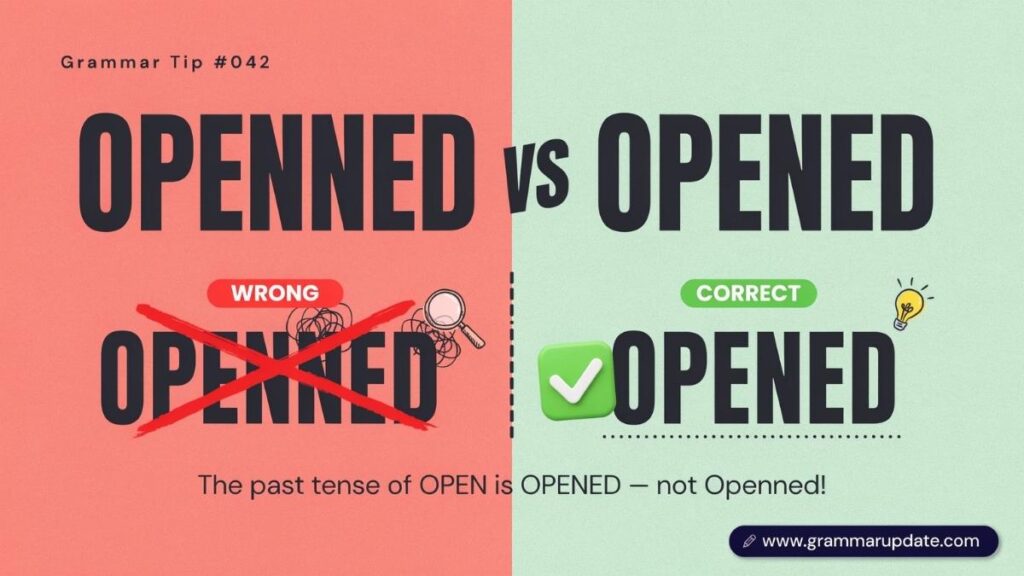
- Opened is the only correct spelling.
- Openned is a common misspelling.
- Open is a regular verb, so simply add -ed to form the past tense.
- The spelling is the same in British English, American English, Australian English, and Canadian English.
- If you can spell opening with one n, you’ll remember that opened also uses one n.
This simple rule will help you avoid one of the most common English spelling mistakes.
Quick Tip
If you’re ever unsure, remember this simple formula:
Open + ed = Opened
No extra n is needed. If opening is spelled with one n, then opened follows the same pattern every time.
Practice Session Openned vs Opened
Choose the correct word: opened vs openned.
- She __________ the window to let fresh air into the room.
- The company __________ a new office in Canada last year.
- I __________ your email before breakfast.
- The teacher __________ the lesson with an interesting question.
- They __________ a new restaurant near the city center.
- He __________ the gate for the delivery driver.
- The museum __________ to visitors at 10 a.m.
- We __________ the package carefully.
- The manager __________ the meeting on time.
- Sarah __________ a savings account yesterday.
- The software __________ without any problems.
- The doctor __________ the patient’s medical file.
- The police __________ an investigation into the accident.
- My brother __________ the gift immediately.
- The librarian __________ the reading room early.
- She __________ the conversation with a smile.
- They __________ registration for the new training program.
- The airline __________ a new international route.
- I accidentally __________ the wrong attachment.
- Our support team __________ a help ticket this morning.
- The school __________ a new science laboratory.
- The host __________ the ceremony with a short speech.
- We __________ the document before making changes.
- The shop __________ later than usual on Sunday.
- The engineer __________ the control panel before starting the inspection.
Answers
- opened
- opened
- opened
- opened
- opened
- opened
- opened
- opened
- opened
- opened
- opened
- opened
- opened
- opened
- opened
- opened
- opened
- opened
- opened
- opened
- opened
- opened
- opened
- opened
- opened
Here’s a trusted source for clear word meanings:
FAQs
Is opened or openned the correct spelling?
Opened is the correct spelling. Openned is a common misspelling and is not accepted in standard English. Whether you’re writing in British English, American English, Australian English, or Canadian English, always use opened.
Is openned a real word?
No. Openned is not a recognized English word. Standard dictionaries and grammar guides accept only opened as the correct past tense and past participle of open.
Why is it opened and not openned?
The verb open does not follow the consonant-doubling rule because the final syllable is unstressed. You simply add -ed, giving opened, not openned.
Why is it opening and not openning?
For the same reason. Since open does not double its final n, the correct present participle is opening. The spelling openning is incorrect.
What is the past tense of open?
The past tense of open is opened.
Example: She opened the window before the meeting began.
What is the past participle of open?
The past participle is also opened.
Example: The package has already been opened.
What are the V1, V2, and V3 forms of open?
The verb forms are:
| Verb Form | Word |
|---|---|
| V1 (Base Form) | Open |
| V2 (Past Tense) | Opened |
| V3 (Past Participle) | Opened |
Is opened a regular verb?
Yes. Open is a regular verb because it forms both the past tense and past participle by adding -ed.
What does opened mean?
Opened means something unlocked, unsealed, started, revealed, or made accessible. It describes an action that has already happened.
How do you use opened in a sentence?
Here are a few examples:
- She opened the door quietly.
- They opened a new office downtown.
- I opened your email this morning.
What is the difference between open and opened?
Open usually describes a current state or serves as the base verb, while opened describes an action completed in the past.
Examples:
- The door is open.
- She opened the door.
Do we say the door is open or the door is opened?
In most situations, the door is open is the natural and correct expression because it describes the door’s condition. The door is opened is used only in specific passive-voice constructions.
Is it I haven’t open or I haven’t opened?
The correct sentence is I haven’t opened because the verb have must be followed by a past participle.
Correct: I haven’t opened the package yet.
Is it correct to say we are opened?
Usually, no. In most situations, we are open is the correct expression.
Is will be opened grammatically correct?
Yes.
What is the past perfect tense of open?
The past perfect tense is had opened.
Example: They had opened the store before the customers arrived.
What are some synonyms for opened?
Depending on the context, common synonyms include unlocked, unsealed, revealed, started, began, launched, initiated, uncovered, and made available.
Is opened correct in British English?
Yes. Opened is the standard spelling in British English, American English, Australian English, and Canadian English. There is no accepted regional spelling openned.
What does opening mean?
Opening is the present participle of open. It can also be a noun meaning the beginning of an event, an available position, or an empty space.
What is the spelling rule for opened?
Because open ends with an unstressed syllable, you simply add -ed. The final n not doubled.
How can I remember the correct spelling of opened?
Use this simple memory trick:
Open + ed = Opened
If you can spell opening with one n, you’ll remember that opened also has just one n every time.
Conclusion
The confusion between Openned vs Opened ends with one simple rule: opened is always the correct spelling, and openned is always a misspelling. Many people add an extra n because they apply the wrong spelling rule, but open never doubles its final n before adding -ed or -ing.
The easiest way to remember it is this: open + ed = opened. If you can spell opening with one n, you can spell opened the same way.
English doesn’t have to feel like a puzzle with missing pieces. Once you understand the grammar rule, the correct spelling becomes easy to remember. Keep practicing, proofread your writing, and use opened with confidence in emails, assignments, reports, and everyday conversations. One small spelling habit can make your writing clearer, more professional, and mistake-free every time.

Jhon AJS, the creative mind behind Grammar Update, is an experienced blogger passionate about simplifying English grammar. He focuses on explaining confusing word vs word differences, grammar rules, punctuation, and sentence structure in a clear and practical way. Through easy to understand guides and examples, Jhon helps readers improve their writing and communicate with confidence. With years of blogging experience, he continues to share helpful insights that make learning grammar simple, useful, and accessible for everyone.