Ever found yourself stuck on comming vs coming, wondering why such a small word feels so confusing? You type “coming,” pause, and suddenly it looks wrong. So you try “comming”… and now that looks wrong too. Classic confusion. The problem isn’t you it’s how English mixes patterns with exceptions. Words like running and sitting make you expect a double letter, so your brain follows that habit. But here’s the truth: this isn’t one of those cases. Once you understand the simple rule behind it, the confusion clears instantly. No more guessing. No more second-guessing. Just clear, confident writing every single time.
Comming vs Coming The Clear and Correct Answer
Let’s begin with clarity.
- Coming → correct spelling
- Comming → incorrect spelling
If you’ve ever asked:
- comming or coming which is correct?
- is comming a word?
The answer is straightforward:
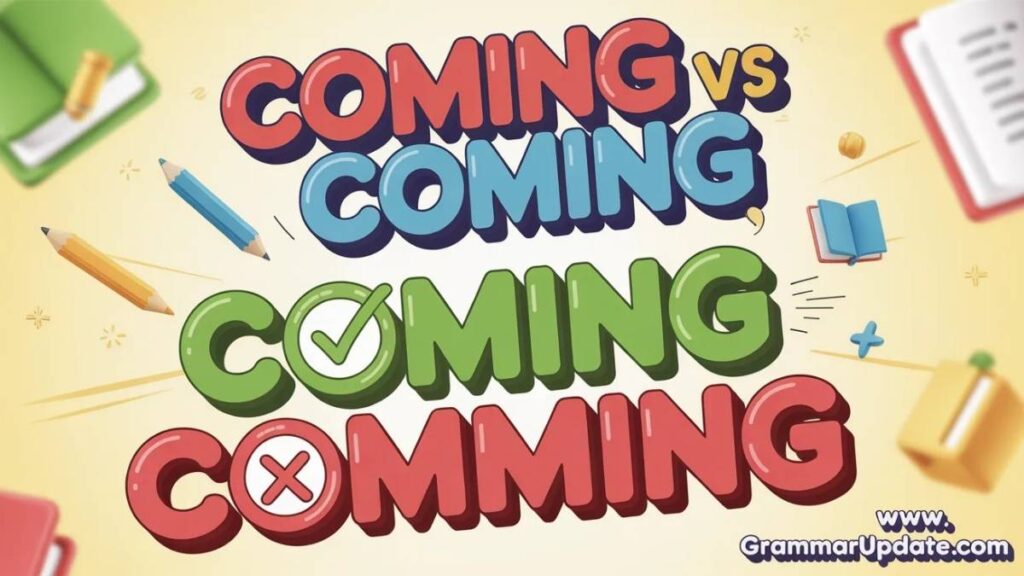
“Coming” is the correct spelling. “Comming” is a common misspelling and should not be used.
There are no exceptions in modern English. “Comming” does not appear in standard dictionaries as a valid word form.
What Is the Difference Between Comming and Coming?
Understanding the difference between comming and coming helps eliminate the confusion permanently.
Side-by-Side Comparison
| Word | Status | Meaning |
|---|---|---|
| coming | Correct | Present participle of “come” |
| comming | Incorrect | Spelling error |
The distinction is not about nuance or context. It is purely about correct vs incorrect spelling.
Is “Comming” a Word in English?
This question appears frequently in grammar discussions.
No, “comming” is not a correct word in English.
It does not exist as a standard form in dictionaries or grammar guides.
Why Does “Comming” Appear So Often?
Several factors explain its widespread use:
- Phonetic similarity: It sounds like it could include a double “m”
- Pattern confusion: Words like running and sitting reinforce doubling patterns
- Typing habits: Quick typing leads to repeated letters
- Lack of rule awareness: Many writers apply rules inconsistently
This makes comming a common misspelling, especially among learners and fast typists.
Coming Meaning Definition and Practical Use
To use a word correctly, you need a clear understanding of its meaning.
What Does “Coming” Mean?
“Coming” is the present participle of the verb “come.”
It expresses:
- Movement toward a place
- An action in progress
- Something that will happen soon
Dictionary Definition of Coming
Coming: approaching, arriving, or about to occur.
Coming in Real Sentences
- I am coming to meet you now.
- The train is coming soon.
- A major change is coming.
These examples show how the word functions naturally in both spoken and written English.
Come Verb Forms Structure and Usage
Understanding verb forms removes uncertainty.
| Form | Example |
|---|---|
| Base form | come |
| Past tense | came |
| Past participle | come |
| Present participle | coming |
👉 Notice:
None of these forms include “comming.”
The Grammar Rule Behind “Coming”
The correct spelling follows a simple but essential rule.
How to Spell Coming Correctly
Start with the base word:
come
Apply the rule:
- Drop the silent “e”
- Add -ing
Result:
- come → coming
Incorrect form:
- come → comming ❌
Doubling Consonants Rule (Explained Clearly)
Many errors come from misunderstanding this rule.
When Do You Double a Consonant?
You double the final consonant when:
- The word has one syllable, or
- The stress falls on the last syllable
Examples
| Word | Correct Form |
|---|---|
| run | running |
| sit | sitting |
| stop | stopped |
Why “Coming” Does NOT Follow This Rule
The word “come” ends with a silent e, so a different rule applies:
Drop the “e” before adding “-ing”
That’s why:
- coming ✔
- comming ❌
Comming vs Coming Grammar in Context
The word “coming” is often used in continuous tenses.
Present Continuous Tense Examples
- I am coming
- She is coming
- They are coming
This structure expresses ongoing action, which is a core part of English grammar.
Correct vs Incorrect Usage
Correct Usage
- I’m coming right now
- She is coming home
- We are coming to the event
Incorrect Usage
- I’m comming ❌
- He is comming ❌
More Confusing Words Made Simple
Seal vs Seel Difference and Correct Usage
How One Letter Changes Perception
Consider two messages:
Example A
“I’m comming now”
Example B
“I’m coming now”
The difference is small but noticeable.
- Example A appears careless
- Example B appears polished
Spelling accuracy directly affects how your writing is perceived.
Why Do People Write “Comming”?
Understanding the cause helps prevent the mistake.
Common Reasons
- Misapplied doubling rules
- Influence of similar words (running, sitting)
- Phonetic spelling habits
- Lack of proofreading
Key Insight
Your brain applies familiar patterns even when they don’t fit.
Does the Word “Coming” Have Two M’s?
This is one of the most searched questions.
No, “coming” has only one “m.”
If you’re asking:
- does coming have two m’s?
- does the word coming have two m’s?
The answer remains the same: one “m” only.
Common Spelling Mistakes in English (Similar Patterns)
“Comming” is part of a broader pattern of errors.
Examples
| Incorrect | Correct |
|---|---|
| runing | running |
| writting | writing |
| makeing | making |
| comming | coming |
These mistakes come from confusion between:
- doubling consonants rule
- silent “e” rule
More Confusing Words Made Simple
Shute vs Chute Differences and Correct Usage
Coming vs Come: Understanding the Difference
| Word | Function |
|---|---|
| come | Base verb |
| coming | Present participle |
Examples
- I come here often
- I am coming now
Common Phrases With “Coming”
“I’m Coming” Meaning
- Indicates movement toward someone
“Coming Soon” Meaning
- Something will happen shortly
“Coming Up” Meaning
- Refers to something happening next
More Confusing Words Made Simple
Icycle vs Icicle Differences and Correct Usage
How to Avoid Spelling Mistakes Like “Comming”
Accuracy improves with simple habits.
Practical Strategies
- Learn core English spelling rules
- Practice verb forms regularly
- Use proofreading techniques
- Avoid typing too quickly
Effective Proofreading Tips
- Read sentences slowly
- Check repeated letters
- Verify verb endings
Quick Comparison: Coming Spelling vs Comming
| Word | Correct? | Explanation |
|---|---|---|
| coming | Yes | Proper verb form |
| comming | No | Misspelling |
More Confusing Words Made Simple
Present vs Presant Differences and Correct Usage
Practice Section (Apply What You’ve Learned)
Fill in the Blank
Complete each sentence with the correct form (coming / come / came / sealing optional context avoided → focus on coming):
- I am ______ to the meeting
- She is ______ home now
- They are ______ to the party tonight
- We are ______ back after lunch
- He is ______ to fix the issue
- The train is ______ soon
- I’m ______ over in five minutes
- She is ______ with us this weekend
- The guests are ______ early today
- A big opportunity is ______ your way
Correct Answers
- I am coming to the meeting
- She is coming home now
- They are coming to the party tonight
- We are coming back after lunch
- He is coming to fix the issue
- The train is coming soon
- I’m coming over in five minutes
- She is coming with us this weekend
- The guests are coming early today
- A big opportunity is coming your way
Why These Work
Each sentence uses:
- “am / is / are” + verb-ing form
This structure forms the present continuous tense, which describes actions happening now or in the near future.
👉 That’s why coming is always the correct answer here.
Quick Pattern to Remember
I am / She is / They are → always use “coming” (not comming)
✔ I am coming
❌ I am comming
Mini Challenge (Test Yourself Again)
Fill in the blanks:
- He is ______ to the office
- We are ______ late today
- I am ______ right now
(Answers: coming, coming, coming)
Correct the Sentence
- He is comming
Corrected:
- He is coming
Rewrite for Clarity
- They are comming late
Improved:
- They are coming late
More Confusing Words Made Simple
Reference Cambridge Dictionary Definitions
Here’s a trusted source for clear word meanings:
FAQs
What is the difference between comming and coming?
“Coming” is correct. “Comming” is a spelling error.
Does the word “coming” have two m’s?
No. It has only one “m.”
Is comming a common misspelling?
Yes. It appears frequently in informal writing.
Why is comming incorrect spelling?
Because it violates the rule of dropping the silent “e” before adding “-ing.”
Is comming ever used in English?
No. It is only seen as a mistake.
How do you spell coming correctly?
Start with “come,” drop the “e,” and add “-ing.”
Conclusion
So here’s the clear takeaway on comming vs coming no confusion, no guesswork. If you ever feel tempted to add that extra “m,” it’s just your brain copying patterns from words like running or sitting. Nice try, brain… but not this time.
The rule is simple. Start with come, drop the silent “e,” add “-ing,” and you get coming. Clean. Correct. Done.
From now on, when “comming” tries to sneak in, you’ll spot it immediately. No hesitation, no second thoughts. Just smooth, confident writing that looks as good as it sounds.

Jhon AJS, the creative mind behind Grammar Update, is an experienced blogger passionate about simplifying English grammar. He focuses on explaining confusing word vs word differences, grammar rules, punctuation, and sentence structure in a clear and practical way. Through easy to understand guides and examples, Jhon helps readers improve their writing and communicate with confidence. With years of blogging experience, he continues to share helpful insights that make learning grammar simple, useful, and accessible for everyone.