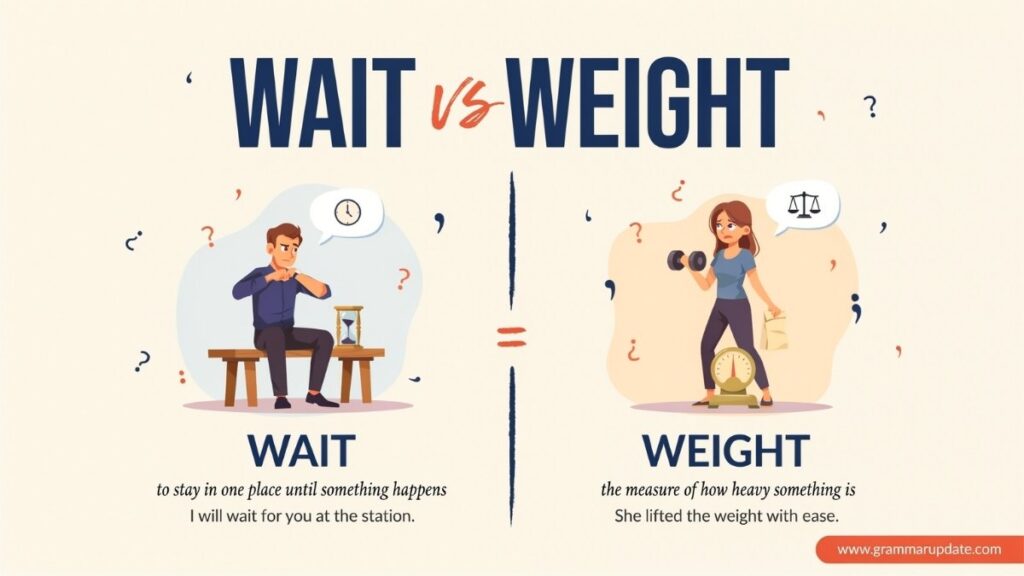
Have you ever typed “Please weight here” only to realize later that your sentence suddenly became much heavier than intended? You are certainly not the first. The wait vs weight mixed up is one of the most common mistakes in English because both words sound exactly alike but have completely different meanings. One refers to time and patience, while the other measures how heavy someone or something is. A single extra letter can change the meaning of an entire sentence and leave readers scratching their heads. This guide clears up the confusion with simple explanations, practical examples, grammar tips, and easy memory tricks you’ll actually remember.
Quick Answer Wait Vs Weight?
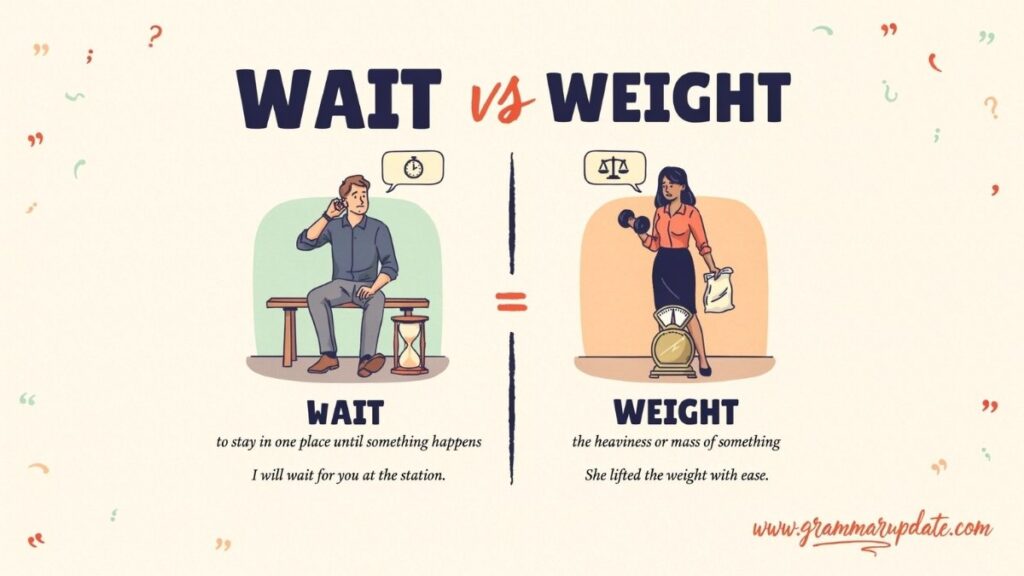
Need the answer fast? Here’s the simplest way to remember it.
- Wait means to stay until something happens or to delay taking action.
- Weight refers to how heavy a person or object is.
Although they sound identical, they have completely different meanings. One is connected to time, while the other is connected to measurement.
| Word | Part of Speech | Meaning | Example |
| Wait | Verb, noun | To stay until something happens | Please wait outside. |
| Weight | Noun, verb | The heaviness of a person or object | The suitcase exceeds the weight limit. |
A simple memory trick can help.
- If you’re talking about time, use wait.
- If you’re talking about how heavy something is, use weight.
For example:
- Please wait for me.
- The package weighs 15 pounds because of its weight.
This small distinction is all you need to answer the common question, “Wait vs weight which is correct?”
Learn the difference between tricky more English words
Manor vs Manner Which One Is Correct?
What Does “Wait” Mean?
The wait definition is straightforward.
Wait means to remain in place or delay an action until something happens. It often involves patience because you’re allowing time to pass before doing something else.
You wait for a friend to arrive, You wait until a traffic light turns green and You wait your turn in a queue. In every situation, the focus is on time, not on how heavy something is.
Wait Meaning
The wait meaning revolves around the idea of pausing rather than acting immediately.
You might:
- Stay until something happens.
- Delay action.
- Remain in place.
- Pause for a moment.
- Give someone time to arrive.
- Show patience during a waiting period.
Think of wait as pressing the pause button. Nothing has ended. You’re simply giving time a chance to move forward before taking the next step.
Here are a few everyday examples:
- Wait until everyone is ready.
- Please wait outside.
- We waited almost an hour for the train.
- I’ll wait for your reply before making a decision.
Every example involves the passage of time, making wait the correct word.
Workday vs Work Day Which One Is Correct?
Wait as a Verb
Most of the time, wait is used as a verb because it describes an action.
When you wait, you choose not to act immediately. Instead, you pause until the right moment arrives.
You’ll often see wait used with these sentence patterns:
| Pattern | Example |
| wait for + noun | Wait for the bus. |
| wait until + clause | Wait until the meeting begins. |
| wait to + verb | Wait to hear the results. |
| wait before + verb | Wait before making a decision. |
These patterns appear constantly in everyday English, business writing, academic papers, and conversations.
Examples of Wait
Looking at real sentences is one of the easiest ways to improve your understanding.
Here are some natural wait in a sentence examples:
- Please wait outside the classroom.
- I can’t wait to see the new movie.
- We waited nearly three hours at the airport.
- Wait for the light to turn green.
- The children waited patiently for dessert.
- She decided to wait another week.
- Always wait your turn.
- We had to wait because of the storm.
- I’ll wait until tomorrow before sending the email.
- They waited in a long queue for concert tickets.
Every example relates to patience, a waiting line, or allowing time to pass.
Learn the difference between tricky more English words
Oftentimes vs Often Times Which One Is Correct?
Wait as a Noun
Although it’s less common, wait can also be a noun.
In this form, it refers to the amount of time someone spends waiting.
For example:
- The wait wasn’t very long.
- We expected a thirty-minute wait.
- The restaurant had an hour-long wait.
- There was a long wait at the emergency room.
You’ll often hear this meaning in places where people regularly stand in line, including:
- Restaurants
- Hospitals
- Airports
- Theme parks
- Government offices
Imagine checking in at a restaurant and hearing the host say:
“The wait is about twenty minutes.”
Or visiting a clinic where a screen displays the current waiting time in the waiting room. In both situations, wait refers to the length of time before you’re served.
Common Expressions with “Wait”
The word wait appears in many everyday expressions. Learning them will help your English sound more natural.
| Expression | Meaning |
| Wait a minute | Pause for a moment. |
| Wait your turn | Be patient until it’s your chance. |
| Wait and see | Don’t decide too early. |
| Can’t wait | Feel excited about something. |
| Worth the wait | Something was valuable despite taking time. |
| Just wait | You’ll see what happens later. |
Examples
Wait a minute
You’re busy when someone asks for help.
“Wait a minute. I’ll be right with you.”
Can’t wait
You’re excited about an upcoming vacation.
“I can’t wait for summer to begin.”
Worth the wait
After standing in a long line at a popular restaurant, someone says:
“The food was definitely worth the wait.”
Wait and see
Someone asks whether the weather will improve.
“Let’s wait and see.”
You’ll hear these expressions in conversations, movies, podcasts, books, and social media posts almost every day.
Learn the difference between tricky more English words
What Kind of vs What Kinds of, Which One Should You Use?
What Does “Weight” Mean?
Now let’s look at the other half of the wait vs weight comparison.
The weight definition is how heavy a person, animal, or object is.
Unlike wait, which is connected to time, weight belongs to the world of measurement. It tells you how heavy something is and is usually measured in kilograms or pounds.
Whether you’re checking your body weight, mailing a package, or making sure your suitcase meets an airline weight limit, you’re talking about weight, not wait.
Weight Meaning
The weight meaning is the force created by gravity acting on an object. In everyday English, however, most people simply use it to describe how heavy something feels or measures.
You might hear it in conversations about:
- Body weight
- Weight loss
- Weight gain
- Luggage weight
- Package weight
- Weight measurement
- Heavy and light objects
Common units include:
| Measurement System | Units |
| Metric | Kilograms (kg), grams (g) |
| Imperial | Pounds (lb), ounces (oz) |
Here are a few examples:
- The suitcase weighs 18 kilograms.
- My backpack is lighter than yours.
- The airline has a strict weight limit.
- Please place the package on the weighing scale.
No matter the situation, weight is always connected to heaviness or measurement.
Weight as a Noun
In most cases, weight is a noun.
It names the heaviness of a person or thing and appears in countless everyday situations.
Here are several examples of weight in a sentence:
- The baby’s weight increased this month.
- This bridge has a maximum weight limit.
- The doctor recorded my body weight during the checkup.
- The package weighs twenty pounds.
- The heavy object requires two people to lift.
- Every airline has different luggage weight rules.
- The shipping company charges extra for additional weight.
- The elephant’s weight surprised everyone.
Each sentence focuses on body mass, object weight, or another form of mass measurement.
Learn the difference between tricky more English words
Reinforce vs Reenforce Which Spelling Is Correct?
Weight as a Verb
Many people don’t realize that weight can also be used as a verb, although this use is far less common.
As a verb, weight means to give something more importance or to adjust values in calculations, research, or statistics.
You’ll often see this meaning in academic, financial, and research settings.
For example:
- Researchers weighted the survey results by age.
- The scoring system weights accuracy more heavily than speed.
- Analysts weighted each factor before making a recommendation.
Don’t confuse this meaning with weigh, which means to measure how heavy something is using a weighing scale.
Understanding that distinction makes the difference between wait and weight even clearer. One word is about time, while the other is about heaviness and measurement.
In the next section, you’ll see wait vs weight explained side by side with grammar rules, pronunciation tips, comparison tables, and dozens of real-life examples that make choosing the correct word almost effortless.
Wait vs Weight What’s the Difference?
Now that you understand the wait meaning and weight meaning, let’s compare them side by side. This is the point where the confusion usually disappears.
The difference is surprisingly simple.
- Wait is about time.
- Weight is about how heavy someone or something is.
Although both words are pronounced the same, they have completely different meanings and grammatical roles. One belongs to conversations about patience and the passage of time. The other belongs to discussions about measurement, body mass, and heaviness.
A quick comparison makes the distinction much clearer.
| Feature | Wait | Weight |
| Main meaning | Stay until something happens | Measure how heavy someone or something is |
| Related to | Time | Heaviness |
| Most common part of speech | Verb | Noun |
| Less common use | Noun | Verb |
| Common phrases | Wait for, wait until, wait your turn | Body weight, weight limit, weight loss |
| Example | Please wait outside. | Check the luggage weight. |
Think about a typical day at the airport.
You wait at the boarding gate until your flight is called. At the same time, the airline checks the weight of your suitcase before loading it onto the plane.
One word describes an action. The other describes a measurement. Once you remember that simple difference, choosing the correct spelling becomes much easier.
Learn the difference between tricky more English words
To Many vs Too Many Difference and Which is Correct?
Wait vs Weight Examples
Reading complete sentences is one of the best ways to understand wait vs weight in English. Instead of memorizing definitions, you’ll see how each word naturally fits into everyday situations.
| Sentence | Why It’s Correct |
| Please wait here while I check your appointment. | Wait refers to staying until something happens. |
| The weight of the package is 12 pounds. | Weight refers to heaviness. |
| We had to wait nearly an hour for the bus. | The sentence is about time. |
| The suitcase exceeds the airline weight limit. | The sentence is about measurement. |
| I can’t wait for the weekend. | It expresses excitement and anticipation. |
| Her weight has remained stable this year. | It refers to body mass. |
| Wait until everyone arrives before starting. | You’re delaying an action. |
| The heavy object is over the recommended weight limit. | The sentence measures heaviness. |
Whenever you’re unsure, ask yourself one simple question:
Am I talking about time or about how heavy something is?
If the answer is time, choose wait.
If the answer is heaviness, choose weight.
That single question can prevent most writing mistakes.
Wait Vs Weight in Sentences
Context is everything in English. Even words that sound identical become easy to recognize once you see them used in real sentences.
Let’s look at each word separately.
Examples Using “Wait”
These examples show wait as a verb and wait as a noun in everyday English.
- Please wait outside until your name is called.
- We waited almost two hours for the concert to begin.
- I’ll wait for your answer before making a decision.
- She asked everyone to wait a few more minutes.
- They waited patiently in the queue.
- We couldn’t leave because we were waiting for the rain to stop.
- The doctor asked us to wait in the waiting room.
- There was a forty-minute wait at the restaurant.
- The children couldn’t wait for summer vacation.
- Always wait your turn before speaking.
Every sentence revolves around patience, remaining in place, or allowing the passage of time.
Examples Using “Weight”
Now compare those with these examples.
- The luggage weight exceeded the airline limit.
- My body weight has remained the same this year.
- This bridge has a maximum weight limit.
- Please place the package on the weighing scale.
- The heavy object weighs more than fifty pounds.
- Healthy weight loss takes time and consistency.
- Rapid weight gain can happen for many reasons.
- Shipping costs often depend on the package’s weight.
- The athlete records body weight every morning.
- Warehouse staff check each shipment’s weight before delivery.
Notice the pattern. Every sentence focuses on measurement, body mass, or how heavy something is.
Wait vs Weight Examples with Answers
Practice is one of the quickest ways to remember the difference.
Try filling in each blank before checking the answer.
| Sentence | Correct Answer |
| Please _____ until I finish the meeting. | wait |
| The airline has a strict baggage _____. | weight |
| I can’t _____ to watch the new movie. | wait |
| What’s the _____ of this package? | weight |
| We had to _____ in line for almost an hour. | wait |
| The doctor measured my _____. | weight |
| Everyone should _____ their turn. | wait |
| The bridge has a maximum _____ limit. | weight |
If you answered every question correctly, you’re already becoming more comfortable with this commonly confused word pair.
Understand confusing English more words simply
Uncollectible vs Uncollectable and How to Use Each Word
Why Do People Confuse Wait VS Weight?
If you’ve ever stopped mid-sentence wondering which spelling is correct, you’re in good company. This mix-up happens because wait vs weight belong to a group of words known as English homophones.
Homophones are words that sound the same but have different spellings and meanings.
When you hear someone say the word aloud, there’s no clue which spelling they mean. Only the context reveals the correct choice.
Several factors make this confusion especially common.
They Sound Exactly the Same
Both words share the exact same pronunciation in standard English.
For example, these two sentences sound identical when spoken:
“I’ll wait.”
“I’ll weight.”
Only the first sentence is correct because the speaker is talking about time rather than heaviness.
Their Spellings Look Similar
The only noticeable difference is the silent “gh” in weight.
When people type quickly, they often add or remove those letters without realizing it. Since both spellings are valid English words, the mistake can easily slip past unnoticed.
Spell Check Doesn’t Always Catch the Error
One of the biggest reasons these mistakes survive proofreading is that spell-check software usually checks spelling, not meaning.
Take this sentence:
Please weight here.
Every word is spelled correctly, so many spelling tools won’t flag it. The sentence is still wrong because the writer chose the wrong word for the context.
That’s why reading your work carefully is just as important as running a spell check.
English Is Full of Similar Word Pairs
Wait and weight aren’t the only words that cause confusion.
Here are a few other examples of commonly confused words.
| Word Pair | Difference |
| There / Their / They’re | Place, possession, contraction |
| Brake / Break | Stop a vehicle, damage something |
| Right / Write | Correct, put words on paper |
| Flour / Flower | Baking ingredient, plant |
| Principal / Principle | School leader, rule or belief |
Once you learn how to recognize homophones, you’ll find it much easier to avoid similar mistakes in your own writing.
Understand confusing English more words simply
Emaculate vs Immaculate Which One Is Correct?
Wait and Weight Grammar
Understanding wait and weight grammar helps you choose the right word naturally instead of relying on guesswork.
Grammar Rules for “Wait”
Most of the time, wait functions as a verb. It describes the action of delaying or remaining in place until something happens.
You’ll commonly see these sentence patterns.
| Structure | Example |
| wait for + noun | Wait for the train. |
| wait until + clause | Wait until class ends. |
| wait to + verb | Wait to hear the results. |
| wait before + verb | Wait before crossing the street. |
A mistake many English learners make is leaving out the preposition for.
Incorrect
I’ll wait you.
Correct
I’ll wait for you.
That single word makes the sentence grammatically correct.
Understand confusing English more words simply
Alot vs A Lot vs allot Which is Correct and Usage
Grammar Rules for “Weight”
In everyday English, weight is usually a noun.
You’ll often see it paired with descriptive words such as:
- Body weight
- Healthy weight
- Average weight
- Weight limit
- Luggage weight
- Shipping weight
- Birth weight
Although less common, weight can also work as a verb in technical writing.
For example:
- Researchers weighted the survey results.
- The scoring system weights accuracy more heavily than speed.
Outside research, finance, and statistics, you’ll rarely hear people use weight as a verb. Most conversations use it as a noun.
Wait vs Weight Pronunciation
Many people search for wait vs weight pronunciation because they’re surprised these words sound exactly alike.
They’re not imagining it.
Both wait and weight are pronounced /weɪt/ in standard American and British English. The silent “gh” in weight has no effect on pronunciation.
| Word | IPA | Sounds Like |
| Wait | /weɪt/ | wayt |
| Weight | /weɪt/ | wayt |
This identical pronunciation is exactly what makes them English homophones.
American English Pronunciation
In American English, both words are pronounced:
/weɪt/
Examples:
- Wait here.
- Check the package weight.
Even though the meanings are different, the pronunciation never changes.
British English Pronunciation
British English follows the same pronunciation:
/weɪt/
Across both major dialects, you’ll hear no noticeable difference between the two words.
Fix common more word mistakes in English
Spicey vs Spicy Which Spelling Is Correct?
Common Mistakes and How to Avoid Them
Even experienced writers occasionally confuse these words, especially when they’re typing quickly.
Here are some of the mistakes you’ll see most often.
| Incorrect | Correct |
| Please weight here. | Please wait here. |
| I can’t weight any longer. | I can’t wait any longer. |
| What’s your wait? | What’s your weight? |
| The wait limit is 20 pounds. | The weight limit is 20 pounds. |
| Weight for me outside. | Wait for me outside. |
Before choosing either word, pause for a second and ask yourself:
- Is this sentence about time? Use wait.
- Is it about heaviness or measurement? Use weight.
That quick habit catches almost every mistake before it reaches the page.
An Easy Memory Trick
If you still hesitate between wait and weight, here’s a simple trick that works.
Remember “Wait”
Think of the word await.
Both words are connected to time, patience, and allowing something to happen.
Wait = Time
Remember “Weight”
Now think of the word weigh or picture a weighing scale.
Whenever you think about kilograms, pounds, or measuring how heavy something is, the correct spelling is weight.
Weight = Heavy
Quick Visual Guide
TIME
↓
WAIT
HEAVINESS
↓
WEIGHT
It’s a simple association, but it’s remarkably effective. After a little practice, you’ll stop second-guessing yourself and instinctively choose the right word every time.
Fix common more word mistakes in English
Summarize vs Summarise Which Spelling Is Correct?
Real-Life Examples of Wait vs Weight
Understanding definitions is a great starting point, but nothing beats seeing words used in real situations. Once you recognize how wait and weight appear in everyday conversations, choosing the right one becomes much easier.
Let’s look at a few common scenarios.
At School
Students hear the word wait almost every day.
A teacher might say:
- “Please wait until everyone finishes the quiz.”
- “Wait your turn before answering.”
- “We’ll wait for the rest of the class.”
In science class, however, you’ll probably hear weight instead.
For example:
- “Measure the weight of the object using a weighing scale.”
- “Record the weight in kilograms.”
- “Compare the weight of these two objects.”
The difference is easy to spot. The first group of sentences is about time and patience. The second group is about measurement and heaviness.
At Work
In the workplace, wait usually relates to schedules, customers, or approvals.
For example:
- Please wait while I check your account.
- We’ll wait for the manager before making a decision.
- Customers waited because the system was temporarily offline.
On the other hand, weight often appears in warehouses, factories, shipping centers, and retail stores.
Examples include:
- Verify the package weight before printing the shipping label.
- The shipment exceeds the maximum weight limit.
- Record the total weight before loading the truck.
Different industries use different vocabulary, but the rule never changes. Wait involves time. Weight involves measurement.
While Traveling
Travel is one of the easiest places to see both words working together.
Imagine you’re checking in for a flight.
The airline employee says:
“Please wait in line while we check the weight of your luggage.”
That single sentence perfectly demonstrates the difference.
You’re waiting because you’re standing in line until it’s your turn. At the same time, the airline measures the weight of your suitcase to make sure it doesn’t exceed the baggage allowance.
It’s a simple example, but it’s one you’ll encounter at almost every airport.
In Healthcare
Hospitals and clinics regularly use both words as well.
A receptionist might say:
- “Please wait in the waiting room.”
A nurse, however, might say:
- “Let’s check your body weight before the appointment.”
You could also hear:
- We waited about twenty minutes before seeing the doctor.
- The patient’s weight has remained stable over the past six months.
Again, one word refers to time, while the other refers to body mass.
During Shopping and Shipping
Shopping online provides another practical example.
Before calculating delivery charges, many shipping companies measure the package first.
You might see a message like this:
“Please wait while we calculate the shipping cost based on your package’s weight.”
Even in one sentence, both words have completely different jobs.
Simple Ways to Remember the Difference Between Wait VS Weight
If you occasionally hesitate before writing one of these words, you’re not alone. Fortunately, there are a few easy tricks that make remembering the difference much simpler.
Think About Time
Whenever your sentence involves waiting, patience, or delaying an action, the correct word is wait.
Examples include:
- Wait for the bus.
- Wait until tomorrow.
- Please wait outside.
- We waited in line.
Think About Heaviness
If you’re talking about body mass, luggage, or measuring an object, you need weight.
Examples include:
- Body weight
- Weight loss
- Weight gain
- Weight limit
- Package weight
Picture the Situation
Visual memory is surprisingly powerful.
Imagine someone standing patiently in line.
They’re waiting.
Now picture someone stepping onto a weighing scale.
That’s weight.
Those simple mental images often help people remember the correct spelling long after they’ve forgotten the grammar rule.
A Real-World Example
Here’s a mistake that’s more common than you might think.
A traveler emailed an airline and wrote:
“Should I weight at the gate if my suitcase is too heavy?”
The airline understood the message because of the surrounding context, but the sentence wasn’t correct.
It should have been:
“Should I wait at the gate if my suitcase is too heavy?”
If the traveler wanted to ask about the suitcase itself, they could have written:
“What is the maximum baggage weight allowed?”
This example highlights why context matters more than pronunciation. Although the two words sound identical, only one makes sense depending on what you’re trying to say.
Practice Questions Wait vs Weight
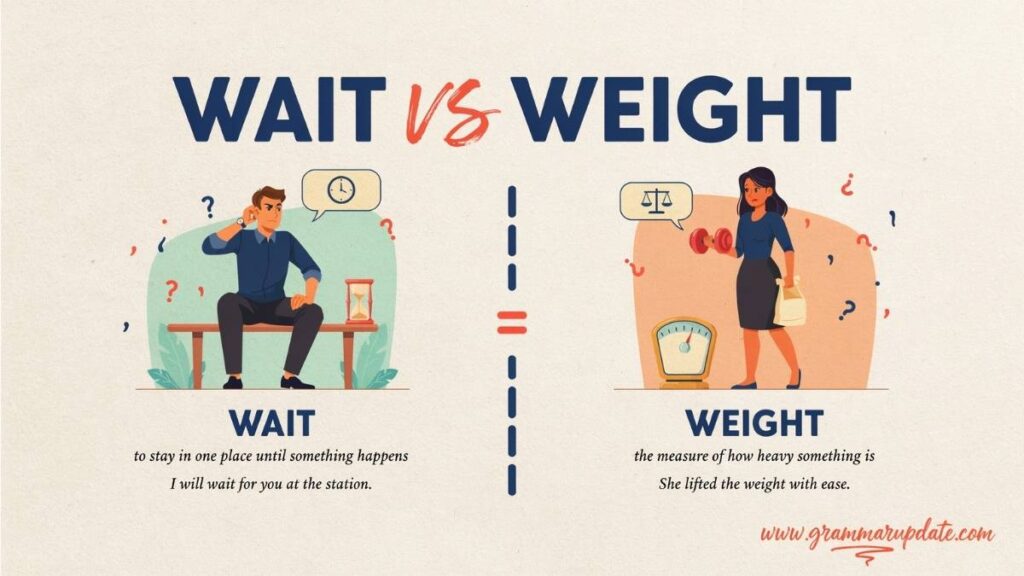
Ready to test what you’ve learned? Choose the correct word wait or weight to complete each sentence. Take your time, then check your answers at the end.
Fill in the Blanks
- Please ______ here while I make a phone call.
- The airline has a strict baggage ______ limit.
- I can’t ______ to see my family this weekend.
- The doctor recorded my ______ during the checkup.
- We had to ______ nearly an hour for the bus.
- The ______ of the package is listed on the label.
- Always ______ your turn before entering the room.
- The moving company charges based on the ______ of your furniture.
- Let’s ______ until the traffic clears.
- The athlete checks her body ______ every week.
- Can you ______ for me outside the building?
- The bridge has a maximum ______ limit.
- Don’t ______ until the last minute to finish your homework.
- The suitcase’s ______ exceeded the airline allowance.
- Everyone had to ______ in a long queue.
- The shipping fee depends on the ______ of the parcel.
- I’ll ______ until you finish your meeting.
- The baby’s ______ has increased since last month.
- Please ______ a moment while I look up your reservation.
- The warehouse uses a digital scale to measure ______.
- We decided to ______ out the storm before driving home.
- Every passenger’s luggage ______ is checked before boarding.
- You should ______ until the traffic light turns green.
- His healthy ______ is the result of regular exercise and a balanced diet.
- The customer didn’t mind the long ______ because the service was excellent.
Answers
| Question | Correct Answer |
| 1 | wait |
| 2 | weight |
| 3 | wait |
| 4 | weight |
| 5 | wait |
| 6 | weight |
| 7 | wait |
| 8 | weight |
| 9 | wait |
| 10 | weight |
| 11 | wait |
| 12 | weight |
| 13 | wait |
| 14 | weight |
| 15 | wait |
| 16 | weight |
| 17 | wait |
| 18 | weight |
| 19 | wait |
| 20 | weight |
| 21 | wait |
| 22 | weight |
| 23 | wait |
| 24 | weight |
| 25 | wait |
Here’s a trusted source for clear word meanings:
FAQs
Is it “wait it out” vs “weight it out”?
The correct phrase is “wait it out.” It means to stay patient until a difficult or unpleasant situation passes. For example, We’ll wait it out until the rain stops. “Weight it out” isn’t a correct English expression.
What’s the difference between wait and weight?
The difference is simple. Wait relates to time, patience, or delaying an action, while weight refers to how heavy someone or something is. If you’re talking about time, choose wait. If you’re talking about heaviness or measurement, choose weight.
Which is correct weigh vs weight?
Both words are correct, but they serve different purposes. Weigh is a verb that means to measure how heavy something is. Weight is usually a noun that refers to the heaviness itself.
How do you use weigh in a sentence?
Use weigh when measuring heaviness. For example:
- The suitcase weighs 18 pounds.
- Please weigh the vegetables before placing them in your cart.
Is “weigh in” a correct expression?
Yes. Weigh in is a common English expression. It can mean to have your weight measured or to share your opinion about a topic.
For example:
- The athletes weighed in before the competition.
- Several experts weighed in during the discussion.
Is weight a noun or a verb?
In everyday English, weight is almost always a noun. It refers to how heavy a person or object is. In technical fields such as research and statistics, it can also be used as a verb to mean giving more importance to certain data or results.
Is wait a verb or a noun?
Wait is most commonly used as a verb, meaning to remain in place until something happens. It can also be a noun, as in There was a twenty-minute wait before we were seated.
Are wait and weight homophones?
Yes. Wait and weight are classic English homophones because they’re pronounced exactly the same but have different spellings and meanings.
Are wait and weight homonyms?
Yes. They can also be classified as homonyms because they share the same pronunciation while having different meanings. More specifically, they’re homophones, which are words that sound alike but are spelled differently.
What does wait mean?
Wait means to stay where you are or delay doing something until another event happens. It’s closely connected to time, patience, and the passage of time.
What does weight mean?
Weight is the measurement of how heavy a person, animal, or object is. It’s usually measured in kilograms (kg) or pounds (lb).
What does “wait it out” mean?
Wait it out means to stay patient until a problem or temporary situation ends instead of reacting immediately.
For example:
“Let’s wait it out until the traffic clears.”
What are the three forms of wait?
The verb wait has three common forms:
| Verb Form | Word |
| Base Form | wait |
| Past Tense | waited |
| Past Participle | waited |
How do you use weight in a sentence?
Here are a few natural examples:
- The airline checked the weight of every suitcase.
- Her doctor monitors her weight during each visit.
- The package exceeded the maximum weight limit.
What’s the difference between weight and weigh?
Weight is the noun that describes how heavy something is. Weigh is the verb that means to measure that heaviness.
For example:
- The package’s weight is 10 pounds.
- Please weigh the package before shipping it.
What’s the easiest way to remember wait vs weight?
Use this simple memory trick:
- Wait = Time
- Weight = Heavy
Whenever you’re unsure, ask yourself one question: Am I talking about time or about how heavy something is? The answer will tell you which word to use.
What are some other commonly confused English homophones?
English is full of words that sound alike but have different meanings. Some of the most common examples include:
- There / Their / They’re
- Right / Write
- Brake / Break
- Flour / Flower
- Peace / Piece
- Hear / Here
Learning these word pairs will improve your spelling, strengthen your vocabulary, and make your writing much more accurate.
Final Thoughts
Mixing up wait vs weight happens more often than you might think, and there’s no need to feel embarrassed if you’ve made the mistake before. After all, these two words sound exactly alike, making them one of the trickiest pairs in English. The good news is that the difference is easy to remember. If you’re talking about time, patience, or delaying an action, choose to wait. If you’re talking about heaviness or measurement, choose weight. Before you click Send or hand in your assignment, take a moment to proofread. That quick check can turn “Please weight here” into “Please

Jhon AJS, the creative mind behind Grammar Update, is an experienced blogger passionate about simplifying English grammar. He focuses on explaining confusing word vs word differences, grammar rules, punctuation, and sentence structure in a clear and practical way. Through easy to understand guides and examples, Jhon helps readers improve their writing and communicate with confidence. With years of blogging experience, he continues to share helpful insights that make learning grammar simple, useful, and accessible for everyone.