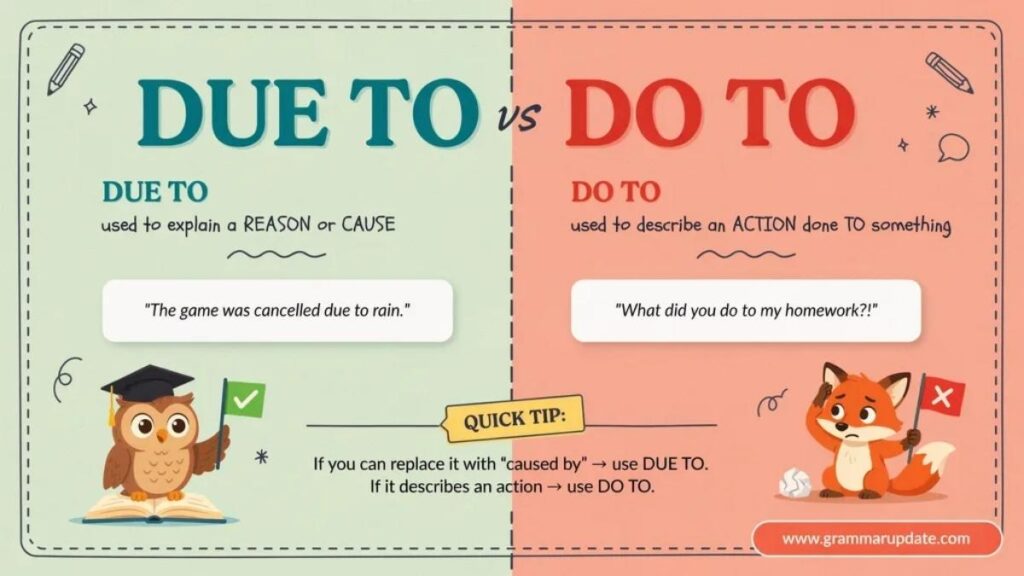
Have you ever stopped while writing and wondered, “Is it due to vs do to?” If so, you’re not alone. These two phrases sound almost the same, which is why many people mix them up. However, they have different meanings and different grammar rules. Due to explains the reason something happened, while do to describes an action done to someone or something. Knowing the difference can make your writing clearer, more professional, and free from common grammar mistakes. In this complete guide, you’ll learn simple rules, easy examples, helpful tips, and quick memory tricks to use the correct phrase with confidence every time.
Due To vs Do To Quick Comparison
If you only need a quick answer, here it is.
Use due to when you mean “because of” or “caused by.”
Use do to only when you’re talking about performing an action toward someone or something.
Although they sound the same in conversation, they are not interchangeable.
| Phrase | Meaning | Correct Usage | Example |
|---|---|---|---|
| Due to | Because of; caused by | Explains the reason for something | The flight was delayed due to fog. |
| Do to | Perform an action toward | Describes an action | What did you do to my laptop? |
Quick Rule
Here’s a simple trick to remember the difference between due to and do to.
If you can replace the phrase with because of and the sentence still makes sense, you should use due to.
Correct
- The event was canceled due to heavy rain.
- The event was canceled because of heavy rain.
Incorrect
- The event was canceled do to heavy rain.
Why It Works:
Due to means because of or caused by, so the two phrases often have the same meaning. Do to describes an action, so it cannot replace due to when you’re explaining the reason something happened. This simple substitution test is one of the easiest ways to catch mistakes during proofreading.
Learn how to use confusing more words correctly
Useing vs Using Which Spelling Is Correct?
Is It Due To vs Do To?
The question “Is it due to vs do to?” appears frequently in grammar forums, search engines, and proofreading software. The reason is simple: both expressions share the same pronunciation in standard English. When people write from memory instead of thinking about meaning, they often choose the wrong spelling.
The difference becomes obvious once you understand the role each phrase plays in a sentence.
Due to introduces a cause or reason.
Do to introduces an action directed at someone or something.
Compare these examples.
| Incorrect | Correct |
|---|---|
| The meeting ended do to bad weather. | The meeting ended due to bad weather. |
| School closed do to snow. | School closed due to snow. |
| What did you due to the printer? | What did you do to the printer? |
Notice how changing only one letter completely changes the grammar.
In the first two examples, the sentence needs a phrase that explains why something happened. Only due to can do that.
In the third example, the sentence asks about an action. The verb do is required, so do to is correct.
Understanding this distinction is the foundation of due to vs do to in English.
Learn the difference between commonly mixed-up more words
Oftentimes vs Often Times Which One Is Correct?
Definition of “Due To”
Understanding the due to meaning makes it much easier to avoid this common writing error.
What Does “Due To” Mean?
The standard due to definition is:
Because of.
Caused by.
As a result of.
Attributable to.
In other words, due to introduces the reason something happened.
It answers questions such as:
- Why was the meeting postponed?
- Why did sales increase?
- Why did the road close?
- Why was the project delayed?
For example:
- The concert was canceled due to severe weather.
- Traffic slowed due to an accident.
- The company expanded due to growing demand.
- The patient remained home due to illness.
Each sentence explains the cause of an event rather than an action.
This is the heart of the due to phrase meaning.
Is “Due To” a Preposition?
One of the most debated topics in due to grammar is whether due to is an adjective phrase or a preposition.
The answer depends on whether you’re discussing traditional grammar or modern English usage.
Traditionally, grammar books taught that due to functioned as an adjectival phrase because it described a noun.
For example:
The cancellation was due to rain.
Here, the phrase modifies cancellation.
Over time, English evolved.
Today, respected dictionaries and modern style references recognize that due to commonly functions much like a prepositional phrase, especially in everyday writing.
For example:
The flight was delayed due to heavy fog.
This construction appears regularly in newspapers, business communication, academic articles, and professional writing.
That doesn’t mean every sentence beginning with due to is automatically perfect. Good writers still pay attention to sentence clarity and structure.
How “Due To” Functions in a Sentence
The easiest way to understand how to use due to correctly is to look at its grammatical role.
Most often, due to introduces a noun or noun phrase that identifies the reason behind another event.
The most common structure looks like this:
Due to + noun

Due to traffic
Due to illness
Due to weather
Due to equipment failure
Due to unexpected circumstances
You can also use longer noun phrases.
Examples include:
- due to a scheduling conflict
- due to technical difficulties
- due to insufficient funding
- due to increased customer demand
- due to rising fuel prices
Notice that due to is always followed by a thing, event, condition, or situation—not by a bare verb.
Learn how to use confusing more words correctly
Stolen vs Stollen Difference and usage?
Common Synonyms for “Due To”
Sometimes repeating due to makes your writing sound repetitive.
In those situations, a suitable due to synonym can improve flow while keeping the meaning intact.
Common alternatives include:
| Expression | Best Used When |
|---|---|
| Because of | Everyday writing |
| Owing to | Formal writing |
| As a result of | Explanatory writing |
| Caused by | Scientific or technical writing |
| Resulting from | Reports and research |
| Attributable to | Academic and medical writing |
| Thanks to | Usually for positive outcomes |
For example:
- The game ended because of rain.
- Production slowed owing to equipment failure.
- The delay occurred as a result of road construction.
- The increase was caused by higher demand.
Although these expressions are similar, they are not always interchangeable in every sentence. Choosing the right one depends on tone, style, and context.
Learn how to use confusing more words correctly
Trouper vs Trooper Which One Is Correct?
Definition of “Do To”
Unlike due to, the phrase do to is built around the verb do.
Understanding the do to meaning removes almost every source of confusion.
What Does “Do To” Mean?
The standard do to definition is straightforward.
It means:
To perform an action toward someone or something.
Rather than explaining a reason, do to describes what someone does.
For example:
- What did you do to my phone?
- What have they done to the building?
- Don’t do to others what you wouldn’t want done to yourself.
- What did the storm do to the coastline?
Every sentence focuses on an action rather than a cause.
That’s the key difference between due to vs do to.
Why “Do To” Is a Verb Phrase
Many learners mistakenly assume do to is simply a misspelled version of due to.
It isn’t.
The word do is one of the most common verbs in English.
The word to functions as a preposition introducing the object that receives the action.
Its basic pattern looks like this:
Do + to + objectExamples:
- do to me
- do to him
- do to the machine
- do to your homework
- do to the environment
Because do is a verb, the phrase always expresses an action.
When Is “Do To” Correct?
A surprising number of people ask, “Is do to grammatically correct?”
Yes it is.
However, it’s correct only when you literally mean performing an action.
Correct examples include:
- What did you do to the computer?
- What has pollution done to the river?
- Never do to others what you wouldn’t accept yourself.
- What did the fire do to the building?
Now compare those with incorrect examples.
❌ The meeting ended do to rain.
❌ School closed do to snow.
❌ Flights were canceled do to fog.
In every case above, the sentence needs a phrase meaning because of, so due to is the correct choice.
Learn how to use confusing more words correctly
Socialise vs Socialize Which One Is Correct?
Due To vs Do To The Main Difference
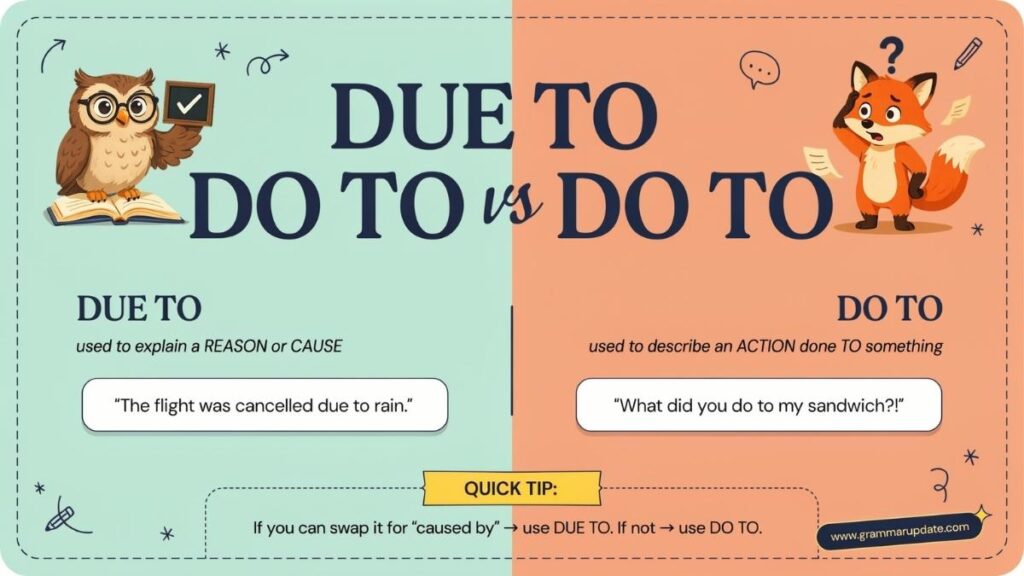
Now that you understand the due to meaning and do to meaning, it’s time to compare them side by side. This is where many grammar mistakes disappear.
Although due to vs do to sound almost identical, they belong to different parts of speech and perform completely different jobs in a sentence.
Think of them this way:
- Due to explains why something happened.
- Do to explains what someone did.
If you remember only one rule from this guide, remember that one.
Learn the difference between commonly mixed-up more words
What Kind of vs What Kinds of, Which One Should You Use?
Due To vs Do To Comparison Table
| Feature | Due To | Do To |
|---|---|---|
| Primary function | Explains a reason or cause | Describes an action |
| Meaning | Because of; caused by | Perform an action toward someone or something |
| Part of speech | Commonly functions as a prepositional phrase in modern English | Verb (do) + preposition (to) |
| Answers which question? | Why did it happen? | What happened to someone or something? |
| Common in formal writing | Yes | Only when describing an action |
| Frequently misspelled? | Yes | Yes |
| Can replace because of? | Often | No |
| Example | The flight was delayed due to fog. | What did you do to my car? |
This table summarizes the due to vs do to difference in a way that’s easy to remember.
Learn how to use confusing more words correctly
Persue vs Pursue Which Spelling Is Correct?
The One-Question Test
Whenever you’re unsure which phrase to use, ask yourself one question:
Am I explaining a reason or describing an action?
If you’re explaining why something happened, use due to.
If you’re describing what someone did, use do to.
Examples
Reason
- The meeting was postponed due to bad weather.
- The website crashed due to high traffic.
- Production slowed due to a power outage.
Action
- What did you do to the printer?
- What has salt water done to the metal?
- Don’t do to others what you wouldn’t accept yourself.
This simple question works almost every time and is one of the easiest due to writing tips you can apply.
When to Use Due To
Knowing when to use due to correctly improves your grammar almost immediately because the phrase appears in everyday conversation, academic writing, journalism, business communication, and professional documents.
The phrase introduces the cause, reason, or source of an event.
Instead of describing an action, it tells the reader why something happened.
Due To Grammar Rules
Understanding a few basic due to grammar rules eliminates most mistakes.
Use due to when the phrase introduces:
- A cause
- A reason
- A circumstance
- A condition
- An event that explains another event
For example:
- The concert ended early due to lightning.
- Sales increased due to stronger demand.
- The bridge closed due to structural damage.
- Classes moved online due to severe weather.
Every sentence answers the same question:
Why did it happen?
That is the core idea behind due to grammar.
Understand confusing English more words simply
Eventhough vs Even Though Which Is Correct?
The Most Common Sentence Patterns
Although English offers flexibility, due to usually appears in a few predictable sentence structures.
Understanding these patterns helps you write naturally.
Pattern One
Subject + verb + due to + noun
Examples:
- Flights were canceled due to snow.
- Traffic slowed due to construction.
- Prices increased due to inflation.
- The company expanded due to higher demand.
This is by far the most common pattern in modern English.
Pattern Two
Noun + be + due to + noun
Examples:
- The delay was due to mechanical failure.
- The mistake was due to human error.
- The cancellation was due to severe weather.
- The improvement was due to better training.
This construction often appears in academic and business writing because it clearly connects an event with its cause.
Pattern Three
Due to + noun, independent clause
Examples:
- Due to heavy rain, several roads closed.
- Due to high demand, tickets sold out.
- Due to maintenance, the website remained unavailable.
- Due to staffing shortages, service slowed.
Older grammar books sometimes discouraged beginning a sentence with due to, but modern dictionaries and leading style references generally accept it when the sentence is clear and unambiguous.
Learn the difference between commonly mixed-up more words
Reinforce vs Reenforce Which Spelling Is Correct?
Due To vs Because Of
One of the most common grammar questions is due to vs because of.
The good news is that these expressions often share the same meaning.
Both introduce the reason something happened.
Compare them.
| Due To | Because Of |
|---|---|
| The flight was delayed due to fog. | The flight was delayed because of fog. |
| School closed due to snow. | School closed because of snow. |
| Production stopped due to equipment failure. | Production stopped because of equipment failure. |
Both versions sound natural.
However, there are subtle differences.
Because Of
Usually sounds more conversational.
Example:
We stayed home because of the storm.
Due To
Often sounds more formal and appears frequently in reports, business documents, news articles, and academic writing.
Example:
Operations were suspended due to safety concerns.
Neither phrase is inherently better. The best choice depends on your audience and writing style.
Understand confusing English more words simply
Weak vs Week Difference which one is correct?
Can “Because Of” Replace “Due To”?
Many grammar teachers recommend a quick proofreading trick.
Replace due to with because of.
If the sentence still makes sense, you’ve probably used due to correctly.
Example:
The event was canceled due to heavy rain.
Replace it:
The event was canceled because of heavy rain.
The meaning stays the same.
Now look at another sentence.
What did you do to the computer?
Replacing do to with because of makes no sense.
❌ What did you because of the computer?
That’s an easy sign you’ve confused an action with a cause.
Learn the difference between commonly mixed-up more words
Success vs Sucess Which is Correct? Complete Guide
Real-World Due To Examples
Studying authentic due to examples in English helps you recognize natural sentence patterns.
Academic Writing
The research project was delayed due to insufficient funding.
Business Writing
Customer satisfaction improved due to faster response times.
Healthcare
The appointment was postponed due to illness.
Government Communication
The highway remains closed due to flooding.
Journalism
Flights across the region were canceled due to severe thunderstorms.
Everyday Conversation
We arrived late due to traffic.
These examples all follow the same principle.
The phrase explains why something happened.
Learn the difference between commonly mixed-up more words
Party’s vs Parties Basic Difference
Due To Sentence Examples
Here are additional due to in a sentence examples covering different situations.
Education
- The exam was postponed due to a power outage.
- Several classes moved online due to severe weather.
Workplace
- The deadline changed due to client feedback.
- Production slowed due to equipment maintenance.
Travel
- Our train stopped due to track repairs.
- The airport experienced delays due to heavy fog.
Healthcare
- Surgery was rescheduled due to an unexpected emergency.
- The clinic closed early due to electrical problems.
Daily Life
- The picnic ended early due to rain.
- We stayed indoors due to strong winds.
These examples demonstrate proper due to vs do to in a sentence usage across a variety of contexts.
Common Mistakes With Due To
Even experienced writers occasionally make mistakes with due to. Since due to and do to sound almost the same, they’re easy to confuse. Fortunately, these mistakes follow predictable patterns, and once you understand them, they’re simple to avoid.
Mistake 1: Writing “Do To” Instead of “Due To”
This is the most common mistake. Many people spell the phrase the way it sounds instead of thinking about its meaning. If you’re explaining the reason something happened, due to is the correct phrase.
Incorrect
- The meeting ended do to bad weather.
- School was closed do to heavy snowfall.
- Our flight was delayed do to thick fog.
Correct
- The meeting ended due to bad weather.
- School was closed due to heavy snowfall.
- Our flight was delayed due to thick fog.
Writing Tip: If you can replace the phrase with because of, use due to.
Mistake 2: Writing “Due Too”
Another common error is writing due too instead of due to. This usually happens when typing quickly or relying on autocorrect. While too is a correctly spelled word, it has a different meaning and doesn’t belong in this phrase.
Incorrect
- The delay happened due too traffic.
- The event was canceled due too heavy rain.
- The store closed early due too a power outage.
Correct
- The delay happened due to traffic.
- The event was canceled due to heavy rain.
- The store closed early due to a power outage.
Writing Tip: The correct expression is always due to. If you see due too, it’s a typo.
Mistake 3: Confusing a Cause With an Action
Another common mistake is using due to when the sentence actually needs do to. Remember, due to explains a reason, while do to describes an action performed on someone or something.
Incorrect
- What did you due to my bicycle?
- What have you due to my laptop?
- What did the storm due to the roof?
Correct
- What did you do to my bicycle?
- What have you done to my laptop?
- What did the storm do to the roof?
Writing Tip: If the sentence asks what someone did, use do to or done to, depending on the tense.
Mistake Four: Using “Do To” in Every Situation
Some English learners believe do to works whenever they hear the sound “due to.” However, do to is only correct when describing an action. It cannot replace due to when you’re explaining a reason.
| Incorrect | Correct |
|---|---|
| The game ended do to rain. | The game ended due to rain. |
| Flights were canceled do to snow. | Flights were canceled due to snow. |
| School closed do to flooding. | School closed due to flooding. |
| What did you due to the printer? | What did you do to the printer? |
| What has pollution due to the river? | What has pollution done to the river? |
u catch these mistakes before publishing.
Learn the difference between similar more English words
Present vs Presant Differences and Correct Usage
Due To Proofreading Tips
Good proofreading catches small grammar errors before readers do.
Use this simple checklist whenever you edit your writing.
- Ask whether the phrase explains a reason or an action.
- Replace due to with because of. If the sentence still works, your usage is probably correct.
- Look for the spelling do to. Make sure you actually mean an action.
- Check whether a noun or noun phrase follows due to.
- Run your document through a trusted grammar checker, then review every suggestion instead of accepting changes automatically.
These due to proofreading habits reduce grammar mistakes in essays, reports, emails, and professional documents.
When to Use “Do To”
Many people assume do to is always wrong because they usually encounter it as a misspelling of due to. In reality, do to is a perfectly valid phrase in English. The problem is that it serves a completely different purpose.
If due to explains a reason, do to describes an action.
Understanding this distinction is the key to mastering due to vs do to correct usage.
The Grammar Rule
Use do to when the verb do describes an action that affects a person, place, object, or idea.
The basic structure looks like this:
Do + to + noun/pronounThe verb may appear in different forms depending on the tense.
| Tense | Example |
|---|---|
| Present | What do you do to stay healthy? |
| Past | What did you do to my laptop? |
| Present Perfect | What have they done to the building? |
| Future | What will this update do to the system? |
Although the verb changes, the meaning remains the same. Someone or something performs an action that affects another person or thing.
Learn the difference between similar more English words
Icycle vs Icicle Differences and Correct Usage
How “Do To” Functions in a Sentence
Unlike due to, which introduces a cause, do to always centers on an action.
Ask yourself this question:
Who is doing something, and what are they doing it to?
If your sentence answers that question, do to is probably the correct choice.
Examples:
- What did you do to my glasses?
- What has pollution done to the river?
- Don’t do to others what you wouldn’t want them to do to you.
- What did the storm do to the coastline?
- What will this decision do to small businesses?
Notice that every sentence focuses on the result of an action rather than the reason for an event.
Learn the difference between similar more English words
Seal vs Seel Difference and Correct Usage
Real-World “Do To” Examples
Seeing do to in a sentence examples helps reinforce the difference.
Everyday Conversation
What did you do to your hair?
Family
What did the puppy do to the couch?
Technology
What did the latest update do to my settings?
Environment
Scientists continue to study what pollution has done to marine ecosystems.
Sports
The injury didn’t just affect the player. It changed what the season could do to the team’s chances.
Business
Rising costs can do to small companies what strong competition often cannot.
Every example describes an action or effect rather than a reason.
Learn the difference between similar more English words
Comming vs Coming Difference and Correct Usage
Common Mistakes When Using “Do To”
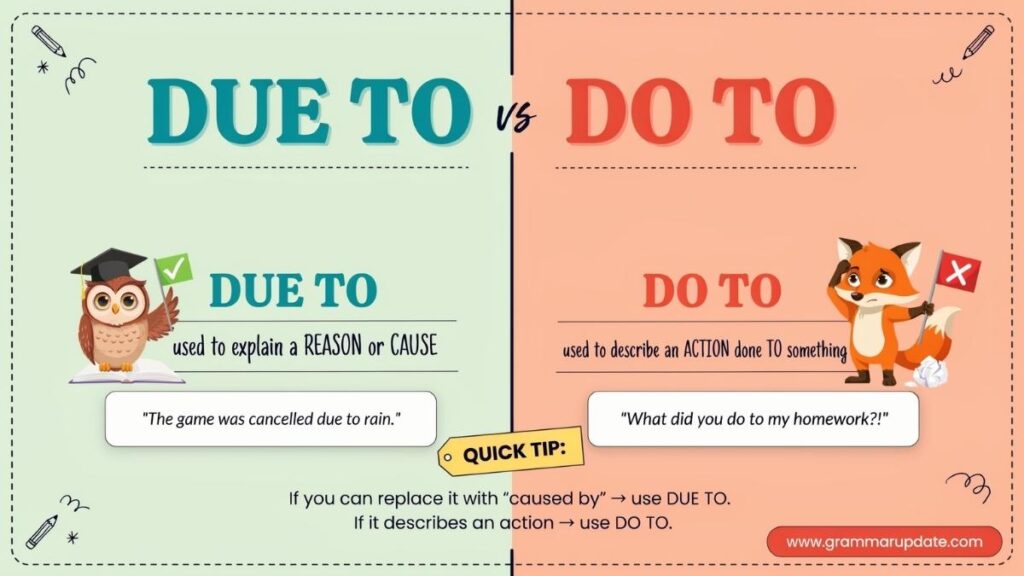
Even though do to is grammatically correct, writers often misuse it.
Mistake: Replacing “Due To” With “Do To”
One of the most common grammar mistakes is using do to when you actually mean due to. Since both phrases sound almost identical, it’s easy to choose the wrong spelling. However, due to explains a reason, while do to describes an action.
Incorrect
- The meeting ended do to bad weather.
Correct
- The meeting ended due to bad weather.
Why It’s Wrong: The meeting didn’t perform an action. The sentence explains why the meeting ended, so due to is the correct phrase.
Mistake: Confusing Similar Pronunciation
Many writers confuse due and do because they are pronounced almost the same in many English accents. As a result, they often type the wrong word even though they know the correct meaning.
Incorrect
- School closed do to snow.
- Flights were canceled do to fog.
- The event was postponed do to heavy rain.
Correct
The event was postponed due to heavy rain.
School closed due to snow.
Flights were canceled due to fog.
Learn the difference between similar more English words
Cheer vs Chear difference and Usage Guide
Due vs Do Understanding Their Root Meanings
Learning where these words come from makes the due to vs do to difference much easier to remember.
Meaning of “Due”
The word due is an adjective with several meanings, including:
- Expected
- Owed
- Appropriate
- Caused by
Examples:
- Your payment is due tomorrow.
- Respect is due to every employee.
- The delay was due to heavy rain.
Although the meanings differ slightly, they all relate to something that is expected, owed, or attributable to a particular cause.
Meaning of “Do”
The word do is one of the most common verbs in English.
It refers to performing an action.
Examples:
- Please do your homework.
- I need to do the dishes.
- What did you do yesterday?
- What did you do to my phone?
Whenever you see do, think about action.
Whenever you see due, think about reason or cause.
That simple mental connection prevents many writing mistakes.
Learn the difference between similar more English words
Togather vs Together Which Is the Correct Word to Use?
Why People Confuse “Due” and “Do”
Several factors make these words easy to confuse.
They Sound Alike
In everyday speech, due and do are often pronounced the same.
That makes spelling mistakes common, especially during fast typing.
Spell Check Doesn’t Always Help
Basic spell checkers usually verify spelling rather than meaning.
Both due and do are correctly spelled English words.
As a result, software may not recognize the mistake.
For example:
The meeting ended do to rain.
Every individual word is spelled correctly, yet the sentence contains a grammar error.
This is why context matters more than spelling alone.
Writers Focus on Sound Instead of Meaning
Many people write exactly what they hear.
Since due to vs do to sound nearly identical, the wrong version often slips into emails, essays, reports, and online posts.
The solution is simple.
Instead of thinking about pronunciation, ask yourself:
Am I describing a reason or an action?
British English vs. American English
A common question among learners is whether British English and American English treat these expressions differently.
The answer is no.
Both varieties follow the same grammar rules.
“Due To”
Both American and British English use due to to introduce a cause or reason.
Examples:
- The train was delayed due to engineering work.
- The flight was canceled due to severe weather.
These sentences are correct on both sides of the Atlantic.
“Do To”
Likewise, do to keeps the same meaning in both dialects.
Examples:
- What did you do to the computer?
- What has pollution done to the coastline?
The grammar does not change.
Differences You May Notice
Although the grammar stays the same, writing styles sometimes differ.
British publications may prefer expressions such as owing to in formal writing.
American publications often use because of or due to more frequently.
For example:
British Style
The match was postponed owing to heavy rain.
American Style
The game was postponed due to heavy rain.
Both are grammatically correct.
Learn the difference between similar more English words
Convertor vs Converter Which Spelling Is Correct?
What Grammar Checkers and Style Guides Say
Modern grammar checkers and leading style guides agree on one important point: both “due to” and “do to” are correct, but only when they’re used in the right context. Due to introduces a reason or cause, while do to describes an action performed on someone or something. The key is choosing the phrase that matches your sentence’s meaning.
Grammarly
Grammar checkers like Grammarly can identify contextual grammar mistakes, not just spelling errors. If you write do to when you mean due to, Grammarly will usually suggest the correct phrase.
Incorrect
The event ended do to rain.
Suggested Correction
The event ended due to rain.
This helps writers catch one of the most common English grammar mistakes before publishing or sending their work.
Microsoft Editor
Microsoft Editor also checks for contextual spelling and grammar errors. It recognizes that do to is a valid English phrase, but it recommends due to whenever the sentence is explaining a reason rather than describing an action.
For example, it will suggest changing:
- The meeting was canceled do to bad weather.
to:
- The meeting was canceled due to bad weather.
This makes Microsoft Editor a useful tool for proofreading emails, reports, essays, and other professional documents.
Merriam-Webster
Merriam-Webster recognizes due to as a standard English expression meaning because of, caused by, or attributable to. Modern dictionary guidance also reflects current usage, accepting due to in many situations that older grammar books once discouraged.
Today, you’ll regularly see due to in newspapers, academic writing, business communication, and professional publications.
The Chicago Manual of Style
The Chicago Manual of Style emphasizes clarity, accuracy, and natural writing. Rather than following outdated grammar myths, it supports using due to when it clearly expresses a cause and fits naturally within the sentence.
Writers should focus on whether the sentence is clear and easy to understand instead of worrying about unnecessary grammar restrictions.
AP Style
The Associated Press (AP) Stylebook encourages clear and concise writing. While it accepts due to, it often recommends replacing longer expressions such as due to the fact that with the simpler word because.
Wordy
The event was canceled due to the fact that it rained.
Preferred
The event was canceled because it rained.
Both sentences are grammatically correct, but the second is shorter, clearer, and easier to read. That’s why professional editors and journalists often prefer because when it communicates the same meaning without unnecessary words. is clearer and easier to read.
Due To Writing Tips
Professional writers avoid confusion by following a few simple habits.
- Think about meaning, not pronunciation.
- Use due to when explaining a cause.
- Use do to when describing an action.
- Replace due to with because of as a quick accuracy check.
- Read the sentence in context rather than focusing on individual words.
- Proofread carefully because spell check alone may miss contextual errors.
These habits strengthen your English writing skills, improve language accuracy, and reduce proofreading mistakes in academic, business, and everyday writing.
Memory Tricks to Never Confuse Due To vs Do To Again
Even after learning the grammar rules, you might still hesitate when writing. That’s normal. The good news is that a few simple memory tricks can help you choose the correct phrase almost instantly.
The goal isn’t to memorize dozens of grammar rules. Instead, focus on understanding the meaning behind each phrase.
Memory Trick One: Think “Reason” vs “Action”
This is the easiest trick to remember.
- Due to = Reason
- Do to = Action
Ask yourself one question:
Am I explaining why something happened or what someone did?
If you’re explaining why, use due to.
If you’re describing what happened to someone or something because of an action, use do to.
Examples:
Memory Trick Three Look at the Word After the Phrase
Another helpful clue is the word that follows.
Most of the time:
Due to is followed by a noun or noun phrase.
Examples:
- due to traffic
- due to illness
- due to equipment failure
- due to unexpected circumstances
On the other hand, do to is usually followed by the person or thing receiving an action.
Examples:
- do to me
- do to the building
- do to your phone
- do to the environment
Recognizing these patterns makes due to vs do to English grammar much easier.
Rewrite Answers
Incorrect
The game was canceled do to rain.
Correct
The game was canceled due to rain.
Commonly Confused Phrases Related to “Due To”
Readers often confuse due to with other expressions that have similar meanings. Understanding the differences improves your grammar and helps you choose the most natural wording.
Due To vs Because Of
Both phrases introduce a reason, but they differ slightly in tone.
| Due To | Because Of |
|---|---|
| More common in formal writing | More common in everyday conversation |
| Frequently used in reports and academic writing | Frequently used in casual speech and general writing |
| Slightly more formal | Slightly more conversational |
Examples:
- The conference was canceled due to severe weather.
- The conference was canceled because of severe weather.
Both sentences are correct, but the second sounds a little more conversational.
Due To vs Owing To
Another phrase that often appears in formal English is owing to.
Examples:
- The train was delayed due to maintenance.
- The train was delayed owing to maintenance.
Here’s a trusted source for clear word meanings:
Practice Session due to vs do to
Choose the correct phrase: due to vs do to.
- The flight was delayed ______ heavy fog.
- What did you ______ my laptop?
- The game was canceled ______ heavy rain.
- What has pollution ______ the river?
- School closed early ______ icy roads.
- What did the puppy ______ the new shoes?
- The meeting ended ______ a power outage.
- Don’t ______ others what you wouldn’t want done to you.
- Production stopped ______ equipment failure.
- What did the storm ______ the coastline?
- The concert was postponed ______ severe weather.
- What have you ______ my phone?
- The road remained closed ______ flooding.
- What did the software update ______ my computer?
- Several employees worked from home ______ the snowstorm.
- What did the children ______ the living room?
- The shipment arrived late ______ customs inspections.
- What has salt water ______ the metal fence?
- The event was moved indoors ______ strong winds.
- What did the mechanic ______ your car?
- The project was delayed ______ budget cuts.
- What did the fire ______ the old building?
- Our picnic ended early ______ unexpected rain.
- What did stress ______ your health?
- The store closed early ______ a citywide power failure.
Answers
| No. | Correct Answer |
|---|---|
| 1 | due to |
| 2 | do to |
| 3 | due to |
| 4 | do to (or done to, depending on tense: “What has pollution done to the river?”) |
| 5 | due to |
| 6 | do to |
| 7 | due to |
| 8 | do to |
| 9 | due to |
| 10 | do to |
| 11 | due to |
| 12 | done to |
| 13 | due to |
| 14 | do to |
| 15 | due to |
| 16 | do to |
| 17 | due to |
| 18 | done to |
| 19 | due to |
| 20 | do to |
| 21 | due to |
| 22 | do to |
| 23 | due to |
| 24 | do to |
| 25 | due to |
FAQs
Which is correct, do to or due to?
Due to is correct when you mean because of or caused by. Do to is only correct when referring to performing an action on someone or something.
How do you use due to in a sentence?
Use due to to introduce the reason for something.
- The flight was delayed due to bad weather.
- The event was canceled due to technical issues.
When should you use do or due?
Use due when explaining a reason or cause. Use do as a verb when describing an action.
- The delay was due to traffic.
- What did you do yesterday?
Is it ever correct to say “do to”?
Yes. Do to is grammatically correct when it means performing an action toward someone or something.
- What did you do to my laptop?
What should I say instead of “due to”?
Depending on the context, you can use:
- because of
- owing to
- as a result of
- caused by
- resulting from
- attributable to
What is a common mistake with due to?
The most common mistake is writing do to instead of due to because both phrases sound alike.
How do you use due to properly?
Use due to only when introducing the reason or cause of something. It should be followed by a noun or noun phrase.
- The meeting ended due to heavy rain.
Is it grammatically correct to say “due to the fact”?
Yes, but it is often considered wordy. In most cases, because is clearer and more concise.
- Wordy: The event was canceled due to the fact that it rained.
- Better: The event was canceled because it rained.
What do you use after due to?
Due to is usually followed by a noun or noun phrase.
- due to traffic
- due to illness
- due to equipment failure
What does “due to” actually mean?
Due to means because of, caused by, owing to, or as a result of.
Do to time or due to time?
The correct phrase is due to time.
- The meeting ended early due to time constraints.
Do I say due to vs do to?
Use due to when explaining a reason. Use do to only when describing an action.
- Correct: The delay was due to weather.
- Correct: What did you do to the car?
How do you professionally say “due to”?
Professional alternatives include:
- because of
- owing to
- as a result of
- resulting from
- attributable to
- in light of (depending on context)
What is the rule of due to?
The basic rule is simple: use due to to introduce the cause or reason for something, and follow it with a noun or noun phrase.
How do you say “due to” in a formal way?
Formal alternatives include owing to, attributable to, resulting from, and as a result of, depending on the sentence.
What is the meaning of due to?
Due to means because of or caused by and introduces the reason for an event or situation.
How do you rephrase due to?
You can replace due to with:
- because of
- owing to
- caused by
- resulting from
- as a result of
- thanks to (for positive situations)
How do you use due to in a sentence example?
Here are two examples:
- The school closed due to heavy snowfall.
- The project succeeded due to careful planning.
Can a sentence begin with “due to”?
Yes. Modern English accepts sentences beginning with due to when the meaning is clear.
- Due to strong winds, several flights were delayed.
What can I write instead of “due to”?
Good alternatives include because of, owing to, caused by, as a result of, resulting from, and attributable to.
What’s the difference between “due” and “do”?
Due is commonly used to express something owed, expected, or caused by something else. Do is a verb that means to perform an action.
Can due to be used in a positive way?
Yes. Due to can describe positive as well as negative causes.
- Profits increased due to higher customer demand.
- The team succeeded due to excellent preparation.
Conclusion
Congratulations! You’ve officially solved one of English grammar’s sneakiest little traps. Although due to vs do to sound almost identical, they couldn’t be more different in meaning. Remember the simple rule: if you’re explaining a reason, use due to. If you’re talking about an action someone performs, use do to. Whenever you’re unsure, replace due to with because of. If the sentence still makes sense, you’ve found the right phrase. With a little practice and careful proofreading, this common mistake will soon become a thing of the past. Your writing will be clearer, more confident, and your grammar checker might finally stop giving you the silent side-eye.

Jhon AJS, the creative mind behind Grammar Update, is an experienced blogger passionate about simplifying English grammar. He focuses on explaining confusing word vs word differences, grammar rules, punctuation, and sentence structure in a clear and practical way. Through easy to understand guides and examples, Jhon helps readers improve their writing and communicate with confidence. With years of blogging experience, he continues to share helpful insights that make learning grammar simple, useful, and accessible for everyone.