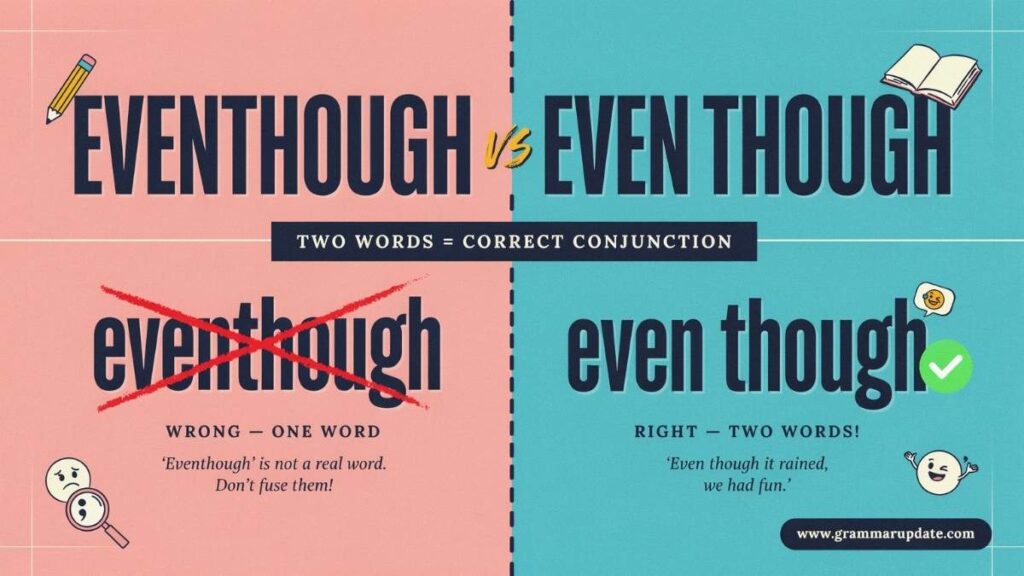
Have you ever paused while writing Eventhough vs Even Though and wondered which spelling is actually correct? You’re not alone. Many people mistakenly write eventhough as one word because it sounds that way in everyday speech. However, the pronunciation is misleading. In standard English, even though is always written as two separate words, while eventhough is simply a common spelling mistake. Knowing this small but important rule can improve your grammar and make your writing more professional. In this guide, you’ll learn the correct spelling, meaning, grammar, usage, and practical examples, so you’ll never confuse these two forms again.
Quick Answer Eventhough Vs Even Though?
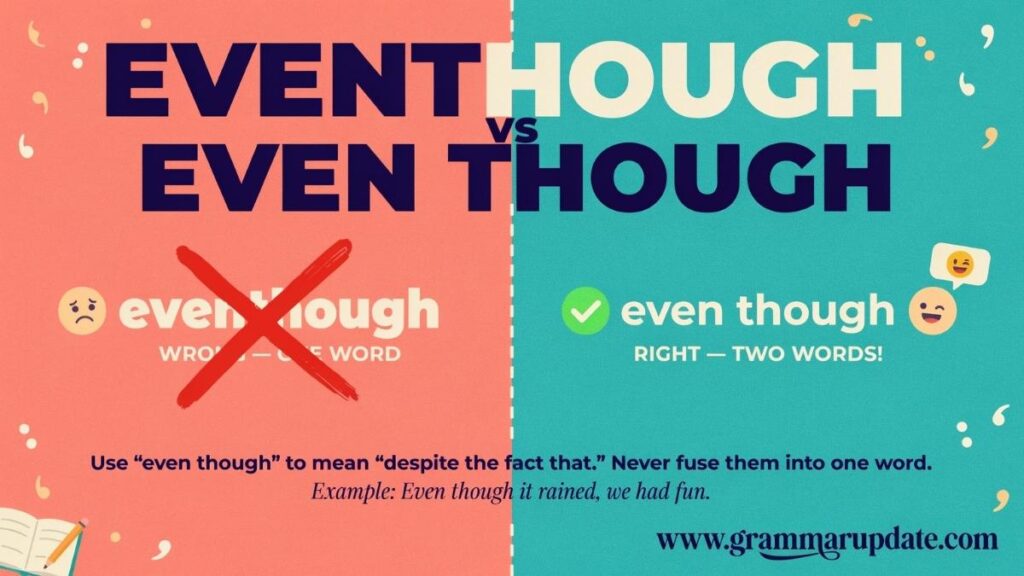
If you’re looking for a fast answer, here it is.
- Even though is the correct spelling.
- Eventhough is incorrect.
- Even though is always written as two separate words.
- This rule is the same in British English and American English.
Whenever you wonder eventhough vs even though, remember this simple rule:
Always write “even though.” Never write “eventhough.”
Correct Examples
- Even though it was raining, we went for a walk.
- She accepted the offer even though it paid less.
- Even though he was tired, he finished the project.
Incorrect Examples
- Eventhough it was raining, we went for a walk.
- She accepted the offer eventhough it paid less.
- Eventhough he was tired, he finished the project.
In every example above, eventhough should be replaced with even though.
Eventhough vs Even Though Explained
The confusion between eventhough vs even though is understandable. In everyday conversation, even though is often pronounced so quickly that it sounds like a single word. Because English includes many compound words, it’s easy to assume this phrase should also be written as one word. However, that assumption is incorrect.
Even though is the correct spelling. It is a two-word subordinating conjunction used to introduce a contrast between two ideas. Eventhough, by contrast, is a common spelling mistake. It is not recognized by standard English dictionaries, grammar guides, or style manuals and should never be used in formal or informal writing.
The comparison below highlights the difference.
| Feature | Even Though | Eventhough |
|---|---|---|
| Correct spelling | Yes | No |
| Recognized by dictionaries | Yes | No |
| Accepted in formal writing | Yes | No |
| Accepted in academic writing | Yes | No |
| Grammatically correct | Yes | No |
The rule is simple: always write “even though” as two separate words. If you accidentally write eventhough, add the missing space to correct the spelling.orrectly by using two separate words every time.
Understand confusing English more words simply
Channel vs Chanel Difference and Usage
Is Eventhough One Word?
One of the most common questions online is:
Is eventhough one word or two?
The answer is simple.
Eventhough is not one word because it isn’t a word at all.
The correct spelling of even though is always two separate words.
Unlike words such as although, therefore, or whenever, even though has never become a compound word in standard English.
Whether you’re writing an essay, email, report, blog post, or text message, always leave a space between even and though.
Is Eventhough Correct?
No.
If you’ve searched is eventhough correct, the answer is always no.
Major English dictionaries and grammar references recognize only even though.
Writing eventhough is considered an eventhough grammar mistake and an eventhough spelling error. Most grammar checkers automatically underline it because it doesn’t exist in standard English.
Using the correct spelling immediately makes your writing look more polished, accurate, and professional.
Understand confusing English more words simply
Less Than vs Less Then Difference and Usage with Examples
What Does Even Though Mean?
Understanding the even though meaning makes it much easier to use the phrase correctly.
Even though introduces a contrast between two ideas. It tells readers that one situation is true despite another situation that might make it seem unlikely.
In many cases, even though has a meaning similar to despite the fact that.
For example:
Even though it was snowing, the football match continued.
These are the two contrasting ideas:
- It was snowing.
- The match continued anyway.
The second event happened despite the first one.
Even Though Definition
The even though definition is:
A subordinating conjunction used to introduce a dependent clause that expresses contrast or concession.
That definition may sound technical, but the idea is simple.
Even though connects two facts that don’t seem to fit together at first.
For example:
- Even though she practiced every day, she still felt nervous.
- Even though the store was busy, the staff remained friendly.
- Even though we disagreed, we respected each other’s opinions.
Each sentence presents two contrasting ideas in a clear, natural way.
Even Though as a Conjunction
One of the most important even though grammar rules is understanding its grammatical role.
Even though is a subordinating conjunction.
A conjunction joins ideas together. A subordinating conjunction joins an independent clause with a dependent clause, showing the relationship between them.
With even though, that relationship is always one of contrast.
For example:
Even though she practiced every day, she didn’t win the competition.
The first part introduces the contrast.
The second part completes the thought.
Together, they create one complete sentence with a clear and logical meaning.
Understanding this rule is one of the easiest ways to improve your English grammar, strengthen your sentence structure, and avoid common writing mistakes.
Learn the difference between similar English words
Copyright vs Copywrite Differences, Usage and Mistakes
Why Understanding “Even Though” Matters
Learning the difference between eventhough vs even though isn’t just about fixing a spelling mistake. It also improves your grammar, strengthens your writing, and helps readers understand your ideas more easily.
Using even though correctly allows you to:
- Express contrasting ideas clearly.
- Build smoother, more natural sentences.
- Improve academic and professional writing.
- Avoid one of the most common spelling mistakes in English.
- Write with greater confidence and accuracy.
Why Is “Eventhough” Incorrect?
Many people assume eventhough is correct because it sounds like one word when spoken quickly. In everyday conversation, native English speakers often pronounce even though so smoothly that the space between the two words almost disappears. However, pronunciation doesn’t determine spelling.
The phrase even though has always been written as two separate words in standard English. Every major dictionary, grammar guide, and style manual recognizes even though as the correct form, while eventhough is considered an eventhough spelling mistake.
The reason is simple. Even and though are two separate words with different grammatical functions that work together to form a phrase. They do not combine into a single word.
Whenever you write eventhough, replace it with even though.
Why Do People Write “Eventhough”?
The difference between eventhough vs even though often confuses English learners and native speakers alike. Fortunately, the reasons behind this mistake are easy to understand.
Pronunciation Makes It Sound Like One Word
The biggest reason for the confusion is pronunciation.
When people speak naturally, even though often sounds like a single word. Because English speakers frequently connect words in conversation, many writers assume the spelling should match the pronunciation.
English doesn’t always work that way. Many expressions sound joined together when spoken but remain separate in writing.
Fast Typing Creates Spelling Errors
Typing quickly is another common cause.
When writing emails, messages, or social media posts, it’s easy to remove the space between even and though without noticing.
The same mistake happens with other expressions, including:
- alot → a lot
- atleast → at least
- infact → in fact
- aswell → as well
Like eventhough, these forms are considered incorrect in standard English.
Compound Words Cause Confusion
English includes thousands of compound words, such as:
- everyone
- everything
- however
- therefore
- whenever
Because these words are written together, many people expect even though to follow the same pattern.
It doesn’t.
Although the phrase expresses a single idea, it remains two separate words.
Skipping Proofreading
Sometimes the mistake isn’t caused by grammar at all.
It’s simply overlooked during proofreading.
A quick review before submitting your writing can help you catch this and many other common spelling mistakes.
Learn the difference between similar English words
Coma vs Comma which is Difference?
Eventhough vs Even Thoug Side-by-Side Comparison
A simple comparison makes it easy to understand the difference between eventhough vs even though.
| Feature | Even Though | Eventhough |
|---|---|---|
| Correct spelling | Yes | No |
| Recognized by dictionaries | Yes | No |
| Grammatically correct | Yes | No |
| Accepted in formal writing | Yes | No |
| Accepted in academic writing | Yes | No |
| Accepted in professional writing | Yes | No |
| Meaning | Introduces contrast between two ideas | No meaning; incorrect spelling |
The comparison makes the rule clear. Even though is the only correct spelling in standard English. Eventhough is a common spelling mistake and should never be used in formal, academic, professional, or everyday writing. Whenever you’re unsure, remember this simple rule: one expression, two words always write “even though.”
Even Though Grammar Rules
Understanding even though grammar is just as important as learning the correct spelling.
The phrase doesn’t simply connect words. It connects ideas that contrast with one another.
Even Though Is a Subordinating Conjunction
In English grammar, even though is classified as a subordinating conjunction.
A subordinating conjunction joins a dependent clause to an independent clause.
Its purpose is to introduce a contrast between two ideas.
Other common subordinating conjunctions include:
- because
- although
- while
- since
- unless
- after
- before
Like these conjunctions, even though helps create smoother, more logical sentences.
Understanding Dependent and Independent Clauses
To use even though correctly, it’s helpful to understand basic sentence structure.
A dependent clause cannot stand on its own because it doesn’t express a complete thought.
Example:
Even though she practiced every day…
This sentence feels incomplete because readers naturally expect more information.
An independent clause completes the idea.
Example:
Even though she practiced every day, she still felt nervous.
Now the sentence makes complete sense.
Clause Comparison
| Clause Type | Example |
|---|---|
| Dependent clause | Even though the weather was terrible |
| Independent clause | we enjoyed the trip. |
Combined sentence:
Even though the weather was terrible, we enjoyed the trip.
This structure is one of the most common patterns in English writing.
Punctuation with Even Though
Many learners wonder whether even though requires a comma.
The answer depends on where the phrase appears in the sentence.
When “Even Though” Starts the Sentence
If the dependent clause comes first, place a comma before the independent clause.
Examples
- Even though it was late, we finished the project.
- Even though she was nervous, she delivered an excellent speech.
- Even though they disagreed, they remained friends.
When “Even Though” Comes in the Middle
If the independent clause comes first, no comma is needed.
Examples
- We finished the project even though it was late.
- She delivered an excellent speech even though she was nervous.
- They remained friends even though they disagreed.
Following this simple punctuation rule makes your writing clearer and more professional.
Learn the difference between similar English words
Kinesthesiology vs Kinesiology difference Explained
How to Use Even Though Correctly
Learning how to use even though is easier when you focus on its purpose rather than memorizing grammar terms.
Use even though whenever you want to show that one fact did not prevent another action or result from happening.
In other words, it introduces an unexpected contrast.
Even Though at the Beginning of a Sentence
Starting a sentence with even though places immediate emphasis on the contrasting idea.
Examples
- Even though the traffic was heavy, we arrived on time.
- Even though she had little experience, she impressed the interview panel.
- Even though the exam was difficult, most students passed.
This structure is especially common in academic writing, reports, and formal communication because it creates a smooth transition between contrasting ideas.
Even Though in the Middle of a Sentence
You can also place even though after the main clause.
This structure sounds natural in everyday conversation and informal writing.
Examples
- We enjoyed the vacation even though it rained every afternoon.
- He accepted the position even though the salary was lower.
- I finished the assignment even though I was exhausted.
Both sentence patterns are grammatically correct. Choose the one that best fits your writing style.
Learn the difference between similar English words
maintained vs maintenanced Differences Explained
Even Though Examples in English
Studying even though examples in English is one of the fastest ways to master the phrase.
Everyday Conversation
- Even though I was tired, I went to the gym.
- Even though it looked expensive, it was affordable.
- Even though they moved away, we stayed in touch.
Academic Writing
- Even though the sample size was limited, the results were statistically significant.
- Even though previous studies reached different conclusions, this research supports the new findings.
Business Writing
- Even though demand increased, the company maintained stable prices.
- Even though the deadline was challenging, the team completed the project successfully.
These even though sentence examples show how the phrase naturally connects contrasting ideas in different types of writing
When to Use Even Though
Knowing when to use even though will make your writing more natural and precise.
Use even though when you want to express a contrast between two ideas that are both true.
Common situations include:
- describing unexpected results
- comparing contrasting facts
- explaining challenges or obstacles
- writing essays and reports
- business communication
- storytelling
- everyday conversations
Even Though vs Although
One of the most common grammar questions after eventhough vs even though is even though vs although. Both expressions connect two contrasting ideas, so many writers wonder whether they mean the same thing.
The short answer is almost.
Both are grammatically correct and often interchangeable, but even though usually expresses a stronger or more surprising contrast than although.
Consider these examples:
- Although it was raining, we went for a walk.
- Even though it was raining, we went for a walk.
Both sentences are correct. However, the second sentence places greater emphasis on the unexpected nature of the action.
Learn the difference between commonly misused words
Presant vs Present which is Correct Spelling and Usage?
Even Though vs Although Difference
The easiest way to understand the difference is to think about emphasis.
| Even Though | Although |
|---|---|
| Shows a stronger contrast | Shows a general contrast |
| Adds emphasis | Sounds slightly more neutral |
| Common in speech and writing | Common in formal writing |
| Means “despite the fact that” | Means “although” or “though” |
If you want readers to notice that something happened despite an obstacle, even though is usually the better choice.
When to Use Even Though Instead of Although
Choose even though when you want to emphasize that the second part of the sentence is surprising.
Examples
- Even though she was exhausted, she finished the marathon.
- Even though the restaurant was full, we found a table.
- Even though prices increased, customers continued buying the product.
In each sentence, the second event happened despite circumstances that suggested otherwise.
When Although Works Better
Although often sounds slightly smoother in formal reports, essays, and academic writing.
Examples:
- Although the evidence was limited, the researchers reached a reasonable conclusion.
- Although the proposal was expensive, it offered significant long-term benefits.
In most situations, both expressions are correct. The difference lies in emphasis rather than grammar.
Though vs Even Though
Another common comparison is though vs even though.
The word though is more flexible and often appears in informal English.
Examples:
- Though I was tired, I continued working.
- I liked the movie, though it was a little long.
Adding even creates stronger emphasis.
Compare these examples:
- Though it was cold, they went swimming.
- Even though it was cold, they went swimming.
The second sentence highlights the contrast more clearly.
Learn the difference between commonly misused words
Targetted vs Targeted Which Spelling Is Correct?
Even Though Synonym
If you want to avoid repeating the same phrase, several alternatives work well depending on the context.
Choosing the right even though synonym helps improve your vocabulary while keeping your writing natural.
Common Synonyms
- although
- though
- despite the fact that
- in spite of the fact that
- while
- whereas (in certain contexts)
Each alternative expresses contrast, but they aren’t always interchangeable.
Synonym Comparison
| Expression | Best Used For |
|---|---|
| Even though | Strong contrast |
| Although | Formal writing |
| Though | Informal writing |
| Despite the fact that | Formal emphasis |
| In spite of the fact that | Academic writing |
| While | Comparing two contrasting ideas |
Selecting the right expression depends on your sentence and writing style.
Eventhough vs Even Though in a Sentence
The best way to remember the correct form is to study even though in a sentence.
Correct Sentence Examples
- Even though I was nervous, I gave the presentation.
- She accepted the position even though it required relocating.
- Even though the exam was difficult, most students passed.
- We enjoyed the picnic even though the weather was windy.
- Even though he apologized, she remained upset.
These even though sentence examples show how naturally the phrase connects two contrasting ideas
Incorrect Sentence Examples
The following sentences show a common eventhough grammar mistake. In each case, eventhough is written as one word, which is incorrect. The correct form is always even though.
Incorrect:
Eventhough I was nervous, I gave the presentation.
Correct:
Even though I was nervous, I gave the presentation.
Incorrect:
She accepted the position eventhough it required relocating.
Correct:
She accepted the position even though it required relocating.
Incorrect:
Eventhough the weather was bad, they traveled anyway.
Correct:
Even though the weather was bad, they traveled anyway.
Remember This Simple Rule
If you’re ever unsure, check whether you’ve written even and though as two separate words. Even though is the only correct spelling in standard English. Eventhough is a spelling mistake and should never be used in formal, academic, professional, or everyday writing.
Learn the difference between commonly misused words
Persue vs Pursue Which Spelling Is Correct?
Even Though Examples
Reading more even though examples helps you recognize correct usage in different situations.
Everyday Conversation
- Even though I forgot my umbrella, I stayed dry.
- Even though he was busy, he called his parents.
- Even though we lost the match, we enjoyed playing.
Academic Writing
- Even though previous studies produced mixed results, the current research supports the hypothesis.
- Even though the experiment was repeated, the outcome remained consistent.
Business Writing
- Even though sales declined last quarter, the company remained profitable.
- Even though the project faced delays, the final results exceeded expectations.
Professional Emails
- Even though the meeting was postponed, our preparation continued.
- Even though your application was submitted late, it will still be reviewed.
These even though examples in English demonstrate how useful the phrase is across different types of writing.
Learn the difference between commonly misused words
Socialise vs Socialize Which One Is Correct?
Common Mistakes with Eventhough vs Even Though
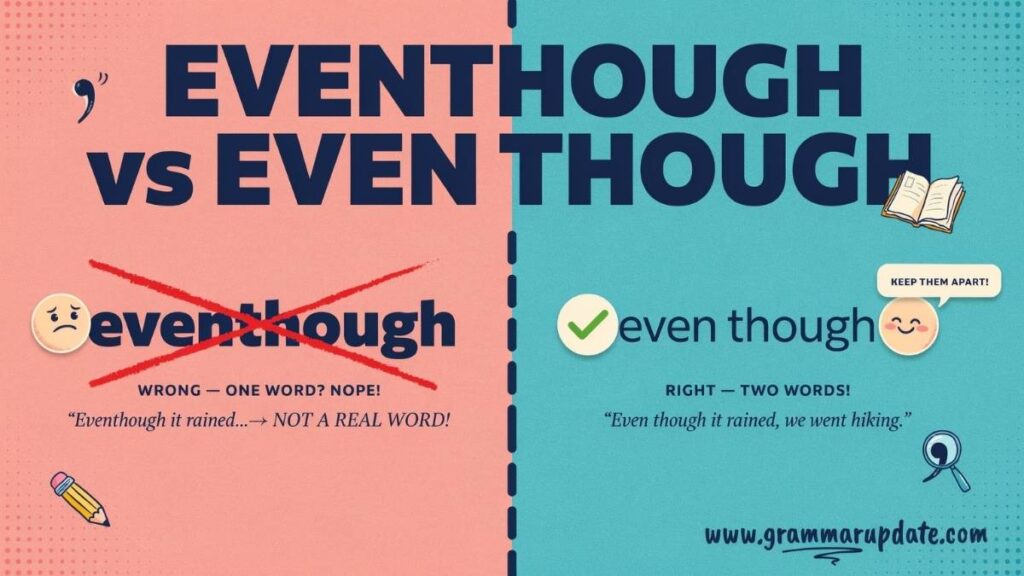
The confusion surrounding eventhough vs even though leads to several common writing mistakes.
Understanding these errors makes them much easier to avoid.
Writing Eventhough as One Word
The most common mistake is writing eventhough as a single word. This usually happens because even though is often pronounced quickly in everyday conversation, making it sound like one word. However, pronunciation does not determine spelling.
Incorrect:
Eventhough
Correct:
Even though
Always write even though as two separate words. This is the only spelling accepted in standard English and should be used in formal, academic, professional, and everyday writing.
Confusing Even Though with Even If
Many English learners mistakenly use even if instead of even though.
The difference is important.
Even though refers to a real fact.
Example:
- Even though it was raining, we went outside.
Even if refers to a possible or hypothetical situation.
Example:
- Even if it rains tomorrow, we’ll go outside.
One describes reality.
The other describes possibility.
Mixing Up Despite and Even Though
Another common grammar mistake is using despite before a complete clause. Although both despite and even though express contrast, they follow different grammar rules.
Incorrect:
Despite it was raining, we played football.
Correct:
Even though it was raining, we played football.
Also Correct:
Despite the rain, we played football.
Remember the Rule:
- Even though is followed by a clause (a subject and a verb).
- Despite is followed by a noun, pronoun, or noun phrase.
A simple way to remember the difference is this: if your sentence contains a complete idea with both a subject and a verb, use even though. If it is followed by a noun or noun phrase, use despite.
Forgetting the Comma
When even though begins a sentence, place a comma after the dependent clause.
Correct:
- Even though she was tired, she finished the report.
When it appears in the middle, no comma is usually needed.
Correct:
- She finished the report even though she was tired.
Learn the difference between commonly misused words
Trouper vs Trooper Which One Is Correct?
Why “Eventhough” Is Always Incorrect
If you’ve searched for eventhough vs even though correct spelling, the answer is straightforward: eventhough is always incorrect. It isn’t recognized as a standard English word and should never appear in formal or informal writing.
The phrase even though consists of two separate words that work together as a subordinating conjunction. Because each word has its own grammatical role, English keeps them separate.
Unlike compound words such as everyone, however, or therefore, even though has never become a single word in modern English.
Whether you’re writing an essay, email, report, article, or social media post, the correct spelling is always:
Even though
Never:
Eventhough
What Grammar Checkers and Dictionaries Say
If you’re unsure about correct spelling of even though, trusted dictionaries and grammar tools all agree.
The following references recognize even though as the correct form and identify eventhough as a spelling mistake.
| Grammar Authority | Recommendation |
|---|---|
| Cambridge Dictionary | Use even though |
| Merriam-Webster Dictionary | Use even though |
| Collins Dictionary | Use even though |
| Oxford Learner’s Dictionaries | Use even though |
| Grammarly | Flags eventhough as incorrect |
| Microsoft Editor | Suggests even though |
These trusted references all follow the same standard English grammar rule.
If your grammar checker highlights eventhough, it’s correcting a genuine spelling mistake not offering a stylistic suggestion.
Learn the difference between commonly misused words
Stolen vs Stollen Difference and usage?
British vs American English Does It Change “Even Though”?
Many spelling differences exist between British English and American English.
For example:
| British English | American English |
|---|---|
| colour | color |
| organise | organize |
| centre | center |
| travelled | traveled |
However, even though is not one of those differences.
Both varieties of English use the same spelling.
British English
Writers in the United Kingdom use:
- Even though
They never write:
- Eventhough
American English
Writers in the United States also use:
- Even though
The spelling remains exactly the same.
This means you never need to choose between British and American spelling for this expression.
Does Formal or Informal Writing Change the Rule?
No.
Whether you’re writing:
- a school assignment
- a university paper
- a business email
- a research article
- a resume
- a blog post
- a social media update
the rule never changes.
Always write:
Even though
The phrase is accepted in both formal English and informal English, making it one of the most versatile conjunctions in the language.
Learn the difference between similar English words
Useing vs Using Which Spelling Is Correct?
Why Correct Spelling Matters
Some people think writing eventhough instead of even though is a small mistake.
In reality, small spelling errors can affect how readers judge your writing.
Correct spelling helps you:
- communicate ideas clearly
- build credibility
- create a professional impression
- improve academic writing
- avoid unnecessary grammar corrections
Even a single spelling mistake can distract readers from your message.
Using the correct form shows attention to detail and strong writing skills.
How “Even Though” Improves Sentence Structure
Beyond correct spelling, even though helps create more natural and connected sentences.
Instead of writing two short ideas separately, you can combine them smoothly.
For example:
Without even though:
The weather was terrible. We went hiking.
With even though:
Even though the weather was terrible, we went hiking.
The second version flows better because it clearly expresses contrast.
Using conjunctions effectively is one of the easiest ways to strengthen your English writing and improve overall readability.
Writing Tips for Using Even Though Naturally
Learning grammar rules is important, but applying them naturally is even more valuable.
These practical tips will help you use even though with confidence.
Focus on Contrast
Use even though only when two ideas clearly contrast.
Correct:
- Even though he practiced every day, he didn’t win.
Incorrect:
- Even though he practiced every day, he practiced every day.
If there is no contrast, choose another connector.
Avoid Overusing the Phrase
Although even though is useful, repeating it too often can make your writing feel repetitive.
Instead, vary your sentence connectors when appropriate.
Alternative expressions include:
- although
- though
- despite the fact that
- while
Using different connectors creates smoother, more engaging writing.
Read Your Sentence Aloud
One of the easiest proofreading techniques is reading your work aloud.
If eventhough appears as one word, it usually stands out immediately.
Reading aloud also helps you identify awkward sentence structure and punctuation errors.
Let Grammar Checkers Help
Modern proofreading tools quickly detect common spelling mistakes.
Programs such as Grammarly and Microsoft Editor automatically identify eventhough and recommend the correct spelling.
These tools shouldn’t replace careful proofreading, but they provide an extra layer of protection against simple errors.
Learn the difference between similar English words
Openned vs Opened Which Spelling Is Correct?
Easy Memory Tricks to Remember “Even Though”
Simple memory techniques can help you avoid this mistake permanently.
Think “Two Words, One Idea”
Although even though expresses a single idea, it is made from two separate words.
Remember:
One meaning. Two words.
Expand the Phrase
Replace even though with:
despite the fact that
If the longer phrase works, even though is probably the correct choice.
For example:
- Even though she was tired, she kept studying.
Expanded:
- Despite the fact that she was tired, she kept studying.
The meaning stays the same.
Look for the Contrast
Ask yourself one simple question:
Am I comparing two contrasting ideas?
If the answer is yes, even though is probably the conjunction you need.
Practice Complete Sentences
The best way to remember grammar is through repetition.
Examples:
- Even though the meeting lasted two hours, everyone remained engaged.
- Even though prices increased, customer demand stayed strong.
- Even though she had never traveled abroad, she adapted quickly.
- Even though the deadline was tight, the team delivered excellent results.
Why Mastering This Rule Improves Your Writing
The difference between eventhough vs even though may seem small, but mastering it has a noticeable impact on your writing.
Correct spelling demonstrates professionalism, while accurate grammar improves clarity and readability. Readers can focus on your ideas instead of being distracted by avoidable mistakes.
Practice Session Eventhough vs Even Though
Test your understanding by completing each sentence with the correct spelling: eventhough vs even though.
Fill in the Blanks
- __________ it was raining, we continued our hike.
- She accepted the invitation __________ she was busy.
- __________ the test was difficult, most students passed.
- We enjoyed the vacation __________ it rained every day.
- He completed the project __________ he had very little time.
- __________ she felt nervous, she gave an excellent presentation.
- I bought the laptop __________ it cost more than I expected.
- __________ they disagreed, they remained close friends.
- She kept practicing __________ she was exhausted.
- __________ the road was closed, we arrived on time.
- He smiled __________ he was disappointed.
- __________ the restaurant was crowded, the service was quick.
- We finished the assignment __________ the deadline was tight.
- __________ the instructions were complicated, everyone understood the task.
- The company expanded __________ the economy slowed down.
- __________ many people doubted him, he achieved his goal.
- She helped her classmates __________ she had her own work to finish.
- __________ the weather was freezing, the children played outside.
- He stayed optimistic __________ the results were uncertain.
- __________ the journey was long, everyone enjoyed the trip.
- We went for a walk __________ the sky looked cloudy.
- __________ she missed the first train, she arrived on time.
- They approved the proposal __________ several concerns were raised.
- __________ the subject was challenging, he learned it quickly.
- I finished reading the book __________ I was feeling sleepy.
Answers
- Even though
- Even though
- Even though
- Even though
- Even though
- Even though
- Even though
- Even though
- Even though
- Even though
- Even though
- Even though
- Even though
- Even though
- Even though
- Even though
- Even though
- Even though
- Even though
- Even though
- Even though
- Even though
- Even though
- Even though
- Even though
Here’s a trusted source for clear word meanings:
FAQs
Which is correct, even though vs eventhough?
Even though is the correct spelling. Eventhough is a spelling mistake and is not recognized as a word in standard English. Always write even though as two separate words.
Is eventhough one word?
No. Eventhough is not a valid English word. The correct spelling is even though, written as two separate words in both British English and American English.
What does even though mean?
Even though is a subordinating conjunction that means despite the fact that. It introduces a contrast between two ideas while showing that both statements are true.
How do you use even though in a sentence?
Use even though to connect two contrasting ideas. For example: Even though it was raining, we still enjoyed the picnic.
Can you start a sentence with even though?
Yes. Even though can begin a sentence when it introduces a dependent clause followed by an independent clause. For example: Even though she was tired, she completed the project.
Is even though grammatically correct?
Yes. Even though is grammatically correct and is widely used in formal writing, academic papers, business communication, and everyday English.
What type of word is even though?
Even though is a subordinating conjunction. It joins a dependent clause to an independent clause and expresses contrast between the two ideas.
Do you put a comma after even though?
Use a comma when even though starts a sentence. For example: Even though it was cold, we went outside. When it appears in the middle of a sentence, a comma is generally not needed.
What comes after even though?
Even though is followed by a dependent clause containing a subject and a verb. It must be completed with an independent clause to form a complete sentence.
What is an example of even though?
A correct example is: Even though he practiced every day, he remained humble after winning the competition.
What is the difference between even though and although?
Both expressions show contrast, but even though usually emphasizes a stronger or more unexpected contrast than although. In many situations, both can be used correctly.
What is the difference between even though and even if?
Even though refers to a real or existing situation, while even if refers to a possible or hypothetical situation. This difference makes each expression suitable for different contexts.
What can I use instead of even though?
Depending on the context, you can use although, though, despite the fact that, or in spite of the fact that as alternatives to even though.
Is in spite of similar to even though?
Yes. Both express contrast, but they follow different grammar rules. Even though is followed by a clause, whereas in spite of is followed by a noun or noun phrase.
Is even though appropriate for formal writing?
Yes. Even though is suitable for formal, academic, professional, and everyday writing. It is widely accepted in all standard varieties of English.
Why do people write eventhough?
Many people write eventhough because the phrase sounds like one word in everyday speech. However, pronunciation does not change the spelling. The correct form is always even though.
What are the most common mistakes with even though?
The most common mistakes include writing eventhough as one word, confusing even though with even if, using it incorrectly with despite, and placing commas incorrectly.
Can I use even though in academic writing?
Yes. Even though is commonly used in essays, research papers, reports, and professional documents because it clearly connects contrasting ideas.
How can I remember the correct spelling of even though?
A simple memory trick is to remember: One idea, two words. Whenever you’re tempted to write eventhough, separate it into even though.
Does even though have the same spelling in British and American English?
Yes. Even though is spelled exactly the same in British English and American English. Neither variety accepts eventhough as the correct spelling.
Conclusion
The Eventhough vs Even Though confusion is more common than you might think, but it’s also one of the easiest grammar mistakes to fix. Although eventhough may look convincing, it isn’t a real English word. The only correct spelling is even though, written as two separate words. Think of the missing space as a tiny hero it may be small, but it saves your writing from a noticeable mistake. By understanding the grammar rule, practicing with real examples, and proofreading your work, you’ll use even though correctly in every situation. One simple space can make a big difference in writing clear, accurate, and professional English.

Jhon AJS, the creative mind behind Grammar Update, is an experienced blogger passionate about simplifying English grammar. He focuses on explaining confusing word vs word differences, grammar rules, punctuation, and sentence structure in a clear and practical way. Through easy to understand guides and examples, Jhon helps readers improve their writing and communicate with confidence. With years of blogging experience, he continues to share helpful insights that make learning grammar simple, useful, and accessible for everyone.