Have you ever typed to fast vs too fast and stopped to wonder which one is actually correct? Don’t worry you’ve just stumbled into one of English grammar’s most common mix-ups. Because to and too sound exactly the same, many people choose the wrong spelling without realizing it. The difference, however, is surprisingly simple. To fast means to abstain from food, while too fast means more quickly than is appropriate or safe. One talks about fasting. The other talks about excessive speed. In this guide, you’ll learn the rule, see plenty of real-life examples, avoid common mistakes, and remember the correct phrase with confidence every time.
Quick Comparison To Fast vs Too Fast
If you’re short on time, remember this simple rule.
- To fast means to abstain from food.
- Too fast means more quickly than is appropriate, safe, or desirable.
Although the phrases sound alike, they belong to different parts of speech and serve completely different purposes.
| Phrase | Meaning | Grammar Function | Example |
|---|---|---|---|
| To fast | Abstain from food | Infinitive + verb | I need to fast before my blood test. |
| Too fast | Excessively fast | Adverb phrase | You’re driving too fast. |
A Quick Memory Trick
Replace too with excessively.
If the sentence still sounds natural, too fast is the correct choice.
- You’re walking too fast.
- You’re walking excessively fast.
Now try the same trick here.
- I have to fast before surgery.
Replacing to with excessively makes no sense, which tells you that to is introducing a verb rather than describing speed.
One simple question often solves the entire problems
Understand confusing English more words simply
Gluing vs Glueing Which Spelling Is Correct?
What Is the Difference Between “To Fast” vs “Too Fast”?
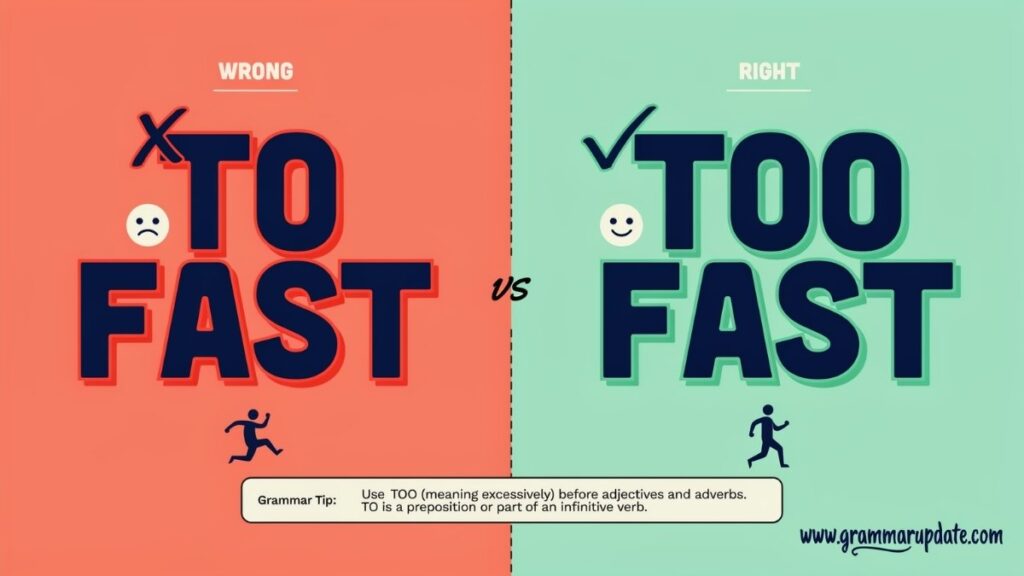
The difference between to fast vs too fast comes down to grammar and context, not pronunciation.
One phrase expresses an action. The other expresses a degree of speed.
That’s why these phrases can never replace one another, even though they sound nearly identical in everyday conversation.
Understanding this distinction helps you make better word choices, avoid embarrassing writing mistakes, and communicate more clearly.
To Fast Meaning
The to fast meaning is straightforward.
To fast means to voluntarily avoid eating or drinking for a specific period of time.
People fast for many different reasons, including:
- Religious fasting
- Medical fasting
- Intermittent fasting
- Personal wellness goals
- Cultural or ceremonial traditions
Grammatically, to acts as an infinitive marker, while fast functions as a verb.
Together, they form an infinitive verb phrase.
Consider these examples.
- I need to fast before surgery.
- She plans to fast tomorrow.
- Patients are often instructed to fast before certain medical tests.
- Many people choose to fast during religious observances.
In every sentence, fast names the action being performed. Nothing in the sentence relates to speed.
Too Fast Meaning
The too fast meaning is entirely different.
Here, too is an adverb that means excessively, overly, or more than necessary.
The too fast definition can be summarized like this:
Moving, happening, or being done at an excessive speed.
You’ll encounter this phrase whenever someone moves, speaks, thinks, eats, drives, or acts more quickly than they should.
For example:
- You’re driving too fast.
- She speaks too fast during presentations.
- Don’t eat too fast.
- The movie moves too fast for younger viewers.
Notice that fast doesn’t mean abstaining from food in any of these examples. Instead, it describes speed.
That’s why too fast functions as an adverb phrase rather than a verb phrase.
Learn the difference between confusing more English words
Due To vs Do To What’s the Difference and Which One Is Correct?
Why These Phrases Sound the Same but Mean Different Things
If you’ve ever searched “is it too fast or to fast?”, you’re far from alone.
The confusion exists because to and too are pronounced almost identically in standard spoken English. Linguists call words like these homophones—words that share the same pronunciation but differ in spelling and meaning.
English is full of similar word pairs.
| Commonly Confused Words | Correct Difference |
|---|---|
| To / Too / Two | Direction, excess, number |
| Their / There / They’re | Possession, location, contraction |
| Your / You’re | Possession, contraction |
| Then / Than | Time, comparison |
| Affect / Effect | Usually verb, usually noun |
Because these words sound alike, many mistakes slip into emails, essays, text messages, and even professional documents. Spellcheck may not catch them because both spellings are legitimate English words.
That makes proofreading especially important.
When to Use “To Fast”
Knowing when to use to fast is surprisingly simple once you recognize that fast is acting as a verb.
Whenever someone is talking about abstaining from food, to fast is the correct expression.
The reason doesn’t matter. Whether the fast is religious, medical, or personal, the grammar stays exactly the same.
“To” as an Infinitive Marker
One of the first concepts students learn in an English grammar guide is the infinitive.
An infinitive combines to with the base form of a verb.
Examples include:
- to eat
- to sleep
- to learn
- to travel
- to write
- to fast
In these examples, to isn’t functioning as a preposition. Instead, it introduces the verb.
That’s the foundation of to fast grammar.
| Infinitive | Action Expressed |
|---|---|
| to read | Reading |
| to swim | Swimming |
| to study | Studying |
| to fast | Abstaining from food |
Recognizing this structure immediately answers the question “Is to fast grammatically correct?”
Yes. It is completely correct whenever fast functions as a verb.
“Fast” as a Verb
Most people first learn fast as a word describing speed.
However, English has many words that belong to more than one part of speech.
Fast is one of them.
As a verb, it means to voluntarily abstain from food for a period of time.
This usage has existed for centuries and appears in religious writings, medical recommendations, historical records, and modern health discussions.
You might hear:
- Muslims fast during Ramadan.
- Patients fast before surgery.
- Some people fast before blood tests.
- Athletes occasionally fast under professional supervision.
Once you recognize fast as a verb, the phrase to fast becomes much easier to understand.
Learn the difference between confusing more English words
Weak vs Week Difference which one is correct?
Common Situations Where “To Fast” Is Correct
You’ll most often encounter to fast in four real-world situations.
Religious Fasting
Many faiths encourage fasting as an act of worship, discipline, or reflection.
Examples include:
- Ramadan in Islam
- Lent in Christianity
- Yom Kippur in Judaism
- Various fasting traditions in Hinduism and Buddhism
Example:
Many believers choose to fast during important religious observances.
Medical Fasting
Doctors frequently instruct patients to fast before medical procedures because food can affect test results or increase surgical risks.
Common situations include:
- Blood tests
- Surgery
- Endoscopy
- Imaging procedures requiring anesthesia
Example:
My doctor asked me to fast after midnight before my operation.
Intermittent Fasting
Intermittent fasting has become one of the world’s most widely discussed eating patterns.
Instead of focusing on specific foods, it limits when you eat.
Popular schedules include:
| Method | Eating Window | Fasting Window |
|---|---|---|
| 16:8 | 8 hours | 16 hours |
| 18:6 | 6 hours | 18 hours |
| 20:4 | 4 hours | 20 hours |
| OMAD | One meal | About 23 hours |
Example:
She decided to fast for sixteen hours each day.
Personal and Cultural Fasting
Not every fast has a medical or religious purpose.
Some people choose to fast for personal discipline, cultural traditions, charity events, or wellness routines.
Whatever the reason, the grammar never changes.
If fast means abstaining from food, to fast is the correct phrase.
Learn the difference between confusing more English words
Eventhough vs Even Though Which Is Correct?
Examples of “To Fast” in Sentences
The best way to master a grammar rule is to see it used naturally. These to fast sentence examples show how the phrase works in everyday English.
Everyday Examples
- I decided to fast until lunchtime.
- She plans to fast every Friday.
- They agreed to fast together.
- He learned to fast safely.
- Many beginners struggle to fast during their first week.
Medical Examples
- You’ll need to fast before your blood test.
- The nurse reminded me to fast after midnight.
- Patients are instructed to fast before receiving anesthesia.
- Your doctor may ask you to fast before certain imaging tests.
Religious Examples
- Our family plans to fast tomorrow.
- Many believers fast during sacred holidays.
- She chose to fast as part of her faith.
- They gathered to fast and pray together.
Health and Lifestyle Examples
- Some athletes choose to fast before morning workouts.
- He learned to fast gradually rather than skipping meals abruptly.
- She decided to fast after discussing the plan with her physician.
- Beginners should understand how to fast safely before changing their eating habits.
Grammar Tip: Whenever fast means abstaining from food, the correct phrase is to fast. If the sentence refers to excessive speed instead, you’ll almost certainly need too fast.
When to Use Too Fast
Knowing when to use too fast becomes simple once you understand the role of the word too.
In English, too is an adverb that means excessively, more than necessary, or beyond an acceptable limit. It adds the idea that something has crossed a line. In other words, the action isn’t merely quick it’s overly quick.
That’s why you’ll hear people say someone is driving too fast, talking too fast, or eating too fast. The speaker isn’t commenting on speed alone. They’re saying the speed has become a problem.
Understanding this small grammatical distinction answers one of the most common questions in English writing: when should you use too fast?
The answer is straightforward. Use too fast whenever you want to describe excessive speed or an action happening more quickly than it should.
“Too” Means “Excessively”
One of the easiest grammar rules to remember is this:
Too = more than enough.
Whenever too appears before an adjective or adverb, it signals excess.
Look at these examples.
- The soup is too hot.
- The suitcase is too heavy.
- The music is too loud.
- The room is too cold.
- The car is moving too fast.
Every sentence expresses the same basic idea: something exceeds a comfortable, safe, or reasonable limit.
The same rule applies regardless of whether you’re discussing movement, speech, work, or learning.
For example:
- You’re speaking too fast for me to follow.
- The children were running too fast near the swimming pool.
- She finished the exam too fast, which made her question whether she’d read every problem carefully.
If you can naturally replace too with excessively, you’ve almost certainly chosen the correct phrase.
Learn the difference between confusing more English words
Socialise vs Socialize Which One Is Correct?
“Fast” Can Function as an Adjective or an Adverb
Another reason this topic causes confusion is that fast serves more than one grammatical purpose.
Unlike many English words, its spelling never changes.
Fast as an Adjective
As an adjective, fast describes a noun.
Examples include:
- That’s a fast train.
- She owns a fast laptop.
- He’s one of the fast runners on the team.
Here, fast tells you something about the noun.
Fast as an Adverb
As an adverb, fast modifies a verb by describing how an action happens.
For example:
- She runs fast.
- They learned fast.
- The river flows fast after heavy rain.
Notice that English doesn’t use fastly.
Many learners assume it should, but fast already functions perfectly as an adverb.
Once too appears before it, the phrase becomes too fast, meaning the action happens at an excessive speed.
Examples include:
- You’re walking too fast.
- He answered too fast.
- The presentation moved too fast for beginners.
Everyday Situations Where Too Fast Is Correct
You’ll probably encounter too fast far more often than to fast because speed comes up constantly in everyday conversation.
The phrase applies whenever an action happens more quickly than is safe, effective, or comfortable.
Driving Too Fast
Traffic provides some of the clearest too fast examples.
Consider these sentences:
- You’re driving too fast for these road conditions.
- The driver entered the curve too fast.
- She was fined for driving too fast through a school zone.
Driving at excessive speed reduces reaction time and increases stopping distance, making accidents more likely.
Speaking Too Fast
Communication suffers when speech becomes difficult to follow.
For example:
- Please slow down. You’re talking too fast.
- The lecturer explained the topic too fast for new students.
- He speaks too fast whenever he’s nervous.
Slowing your pace often improves clarity more than speaking louder.
Eating Too Fast
Meals aren’t races.
People who eat quickly often don’t realize they’re full until they’ve already overeaten.
Examples include:
- Try not to eat too fast.
- Children often eat too fast when they’re excited.
- She realized she’d eaten too fast after feeling uncomfortable.
Reading Too Fast
Reading quickly isn’t always reading well.
Many students discover that slowing down improves comprehension.
Examples include:
- I was reading too fast and missed several important details.
- He skimmed the report too fast to catch the errors.
- Reading too fast can reduce retention.
Working Too Fast
Speed can improve productivity, but rushing often creates new problems.
Examples:
- She completed the report too fast and overlooked several mistakes.
- We moved too fast without testing the software.
- The project expanded too fast to maintain quality.
Sometimes slowing down saves time because fewer mistakes need correcting later.
Acting Too Fast
Not every example involves physical movement.
People can also make decisions too fast.
Examples include:
- They acted too fast without gathering enough information.
- He accepted the offer too fast and later regretted it.
- Investors sometimes react too fast during market uncertainty.
In these examples, too fast describes judgment rather than speed alone.
Learn how to use confusing more words correctly
Trouper vs Trooper Which One Is Correct?
Examples of Too Fast in Sentences
Studying authentic examples remains one of the most effective ways to strengthen your grammar.
These too fast sentence examples demonstrate how naturally the phrase fits into everyday English.
Everyday Conversation
- You’re walking too fast for me.
- She talks too fast when she’s excited.
- Slow down. You’re moving too fast.
- The movie ended too fast for my liking.
School
- The teacher explained the lesson too fast.
- I answered too fast and overlooked one question.
- He read too fast to understand the chapter completely.
- Students often write too fast during timed exams.
Workplace
- She typed too fast, which led to several spelling mistakes.
- The meeting moved too fast to address every issue.
- We expanded too fast without enough planning.
- The proposal was approved too fast to receive proper review.
Sports
- The runner started too fast and faded before the finish line.
- The cyclist approached the corner too fast.
- Beginners often swing too fast in golf.
- The team attacked too fast and left gaps in defense.
Travel
- We drove too fast through heavy rain.
- The boat reached the dock too fast.
- The train entered the station too fast.
- The pilot descended too fast during landing.
Learn how to use confusing more words correctly
Stolen vs Stollen Difference and usage?
Can Fast Be a Verb, Adjective, Adverb, and Noun?
Absolutely. That’s one reason this word appears in so many grammar questions.
Unlike most English words, fast changes its grammatical role without changing its spelling.
| Part of Speech | Meaning | Example |
|---|---|---|
| Verb | Abstain from food | They fast every year. |
| Adjective | Moving quickly | She drives a fast car. |
| Adverb | Quickly | He runs fast. |
| Noun | A period without eating | She completed a 24-hour fast. |
Recognizing the role fast plays in a sentence makes choosing the correct phrase much easier.
Fast as a Verb
As a verb, fast means to abstain from food.
Examples:
- Many people fast during religious holidays.
- Patients often fast before surgery.
- Some athletes occasionally fast under medical supervision.
Fast as an Adjective
When fast describes a noun, it’s functioning as an adjective.
Examples:
- That’s a fast computer.
- He’s a fast swimmer.
- It was a fast train.
Fast as an Adverb
As an adverb, fast modifies a verb.
Examples:
- She learns fast.
- They reacted fast.
- The river flowed fast after the storm.
Fast as a Noun
Less commonly, fast refers to the fasting period itself.
Examples:
- His three-day fast ended yesterday.
- The annual fast begins at sunrise.
- She completed the religious fast successfully.
Learn how to use confusing more words correctly
Reoccurrence vs Recurrence Which One Is Correct?
Why People Confuse To Fast vs Too Fast
If the meanings are so different, why do these phrases cause so much confusion?
The answer lies in the way English works.
They Sound Exactly Alike
In natural conversation, to and too are pronounced almost identically.
Because the ear can’t distinguish them, many writers rely on instinct when spelling them. That’s where mistakes happen.
Spellcheck Doesn’t Catch Every Error
Most writing tools recognize both to and too as valid English words.
As a result, a basic spellchecker may not flag the mistake because the problem isn’t spelling—it’s word choice.
Modern grammar checkers perform better, but proofreading remains your most reliable editor.
Writers Focus on Pronunciation Instead of Meaning
Choosing the correct phrase has nothing to do with sound.
Instead, ask yourself a simple question.
- Is someone abstaining from food? Use to fast.
- Is someone moving more quickly than they should? Use too fast.
Meaning—not pronunciation—always determines the correct spelling.
“Fast” Has More Than One Meaning
Finally, the word fast itself adds another layer of confusion.
It can describe:
- Speed
- The act of abstaining from food
- A period of fasting
Whenever one word carries several meanings, context becomes the deciding factor.
Learn the difference between commonly mixed-up more words
Insecure vs Unsecure Which One Is Correct?
Common Mistakes With To Fast vs Too Fast
These mistakes appear surprisingly often in emails, essays, blog posts, and social media.
Fortunately, they’re also among the easiest grammar errors to correct.
| Incorrect | Correct | Explanation |
|---|---|---|
| I drive to fast. | I drive too fast. | Too means excessively. |
| You’re talking to fast. | You’re talking too fast. | The speech is excessively quick. |
| My doctor asked me too fast. | My doctor asked me to fast. | To introduces the verb. |
| I need too fast before surgery. | I need to fast before surgery. | The sentence describes abstaining from food. |
| We walked to fast for the children. | We walked too fast for the children. | The pace exceeded what was comfortable. |
| She plans too fast tomorrow. | She plans to fast tomorrow. | Fast functions as the verb. |
Proofreading Tip: Before you move on, replace too with excessively. If the sentence still works, you’ve made the right choice. If it doesn’t, check whether fast is the verb. If it is, the correct phrase is to fast.
A Simple Trick to Remember the Difference Between To Fast vs Too Fast
Most grammar rules become much easier once you stop memorizing and start looking at meaning.
The same idea applies to to fast vs too fast. Although the phrases sound identical, a few quick checks can help you choose the correct one every time. You don’t need to remember dozens of rules or rely on a grammar checker. Instead, focus on what the sentence is actually saying.
These practical techniques work whether you’re writing an email, editing an essay, or simply trying to improve your everyday English.
Replace Too With “Excessively”
If there’s one proofreading trick worth remembering, it’s this one.
Whenever you’re unsure whether too fast is correct, replace too with excessively.
If the sentence still makes sense, you’ve found the right answer.
Consider these examples.
Correct
- You’re driving too fast.
- You’re driving excessively fast.
The meaning stays exactly the same.
Another example:
- She speaks too fast during presentations.
- She speaks excessively fast during presentations.
Again, nothing changes except the wording.
Now compare a different sentence.
- I need excessively fast before my blood test. ❌
The sentence no longer works because fast isn’t describing speed. It’s the action itself.
The correct version is:
- I need to fast before my blood test. ✅
Whenever the substitution sounds unnatural, you’re probably looking at to fast rather than too fast.
Ask Yourself What Fast Means
Instead of focusing on to or too, look at the word fast.
Ask one simple question:
Is “fast” the action, or is it describing speed?
If fast means abstaining from food, use to fast.
Examples:
- My doctor asked me to fast before surgery.
- She plans to fast tomorrow.
- Many people choose to fast during religious holidays.
In every sentence, fast is the verb.
Now compare these examples.
- You’re walking too fast.
- He’s talking too fast.
- The cyclist rode too fast around the corner.
Here, fast describes how the action happens rather than naming the action itself.
That distinction answers one of the most common grammar questions: what is the difference between too fast and to fast?
One refers to fasting.
The other refers to speed.
Remember the Two “O”s in Too
English teachers have used this memory trick for generations because it works.
The word too contains two O’s.
Think of the extra letter as representing something extra.
Whenever a sentence expresses too much, too many, or too quickly, you’ll usually need too.
Examples include:
- too loud
- too expensive
- too crowded
- too difficult
- too fast
By comparison, to contains only one O because it usually points toward something or introduces a verb.
Examples include:
- to write
- to learn
- to exercise
- to fast
It’s not an official grammar rule, but it’s an excellent proofreading shortcut.
Fix common more word mistakes in English
Comming vs Coming Difference and Correct Usage
Read the Whole Sentence Instead of One Word
Many common grammar mistakes happen because writers focus on individual words rather than the sentence as a whole.
Context almost always reveals the correct answer.
Compare these examples.
| Sentence | Correct Choice | Why It Works |
|---|---|---|
| My doctor told me ___ before surgery. | to fast | Fast is the action. |
| You’re driving ___ on icy roads. | too fast | The speed is excessive. |
| She plans ___ during Ramadan. | to fast | The sentence refers to fasting. |
| He answered ___ and misunderstood the question. | too fast | The action happened more quickly than it should have. |
Instead of asking which word looks right, ask which meaning fits the sentence.
The correct spelling usually becomes obvious.
Read Your Writing Aloud
Proofreading isn’t only about spotting spelling mistakes.
It’s also about hearing whether a sentence sounds natural.
Read these two examples aloud.
My doctor asked me too fast before surgery.
Most readers immediately sense that something is wrong, even before identifying the grammatical error.
Now compare it with:
My doctor asked me to fast before surgery.
The sentence flows naturally because the meaning is clear.
Reading aloud remains one of the simplest ways to catch awkward phrasing, improve sentence rhythm, and produce correct English writing.
Fix common more word mistakes in English
Seal vs Seel Difference and Correct Usage
To Fast vs Too Fast Comparison Table
Sometimes the quickest explanation is a side-by-side comparison.
The table below highlights the key differences between these commonly confused expressions.
| Feature | To Fast | Too Fast |
|---|---|---|
| Meaning | Abstain from food | Excessively fast |
| Grammar Function | Infinitive + verb | Adverb phrase |
| Describes | An action | The degree of speed |
| Refers To | Fasting | Movement or pace |
| Simple Test | Is fast the action? | Can too become excessively? |
| Example | I need to fast before surgery. | You’re driving too fast. |
Although the phrases sound alike, they perform completely different jobs in a sentence.
Keeping that distinction in mind eliminates most mistakes before they happen
Can To Fast vs Too Fast Appear in the Same Sentence?
Yes—and they often do.
Because the phrases have different meanings, there’s no grammatical reason they can’t appear together.
In fact, using both in the same sentence is a great way to reinforce the difference.
Consider these examples.
- You’ll need to fast before surgery, but don’t begin eating too fast afterward.
- She decided to fast during the holiday, yet she resumed eating too fast, which upset her stomach.
- Some athletes choose to fast, but returning to intense training too fast can increase the risk of injury.
- Patients may have to fast before a procedure, although drinking water too fast immediately afterward may still cause discomfort.
Each sentence contains both phrases, yet their meanings remain completely separate.
One describes abstaining from food.
The other describes excessive speed.
Once you understand that difference, you’ll never confuse them again.
Fix common more word mistakes in English
Shute vs Chute Differences and Correct Usage
Grammar Rules Behind To and Too
Many writing mistakes disappear once you understand the role each word plays.
Instead of memorizing phrases, learn the function of the words themselves.
That’s the foundation of proper grammar usage.
The Role of To
The word to serves two important purposes in English.
As an Infinitive Marker
This is the role it plays in to fast.
Examples include:
- to read
- to study
- to travel
- to exercise
- to fast
In each example, to introduces the base form of a verb.
That’s why to fast forms a verb phrase.
As a Preposition
To also expresses direction, destination, or relationship.
Examples include:
- We walked to the station.
- Please send the package to Emily.
- She traveled to Chicago.
Although the spelling is identical, this use has nothing to do with too fast.
The surrounding words determine its meaning.
Vender vs Vendor Which Spelling Is Correct?
The Role of Too
Unlike to, too always functions as an adverb.
It has two primary meanings.
It Expresses Excess
Examples include:
- too hot
- too noisy
- too expensive
- too fast
Here, too means more than is desirable or acceptable.
It Means “Also”
Examples include:
- I’d like to come, too.
- She’s attending the conference, too.
Only the first meaning relates to too fast.
The second simply means also.
Context Always Wins
One of the most valuable English language tips is surprisingly simple:
Don’t choose words by sound. Choose them by meaning.
Whenever you’re deciding between to fast vs too fast, ignore pronunciation and focus on the message.
Ask yourself:
- Is someone abstaining from food?
Use to fast.
- Is someone moving, speaking, or acting at an excessive speed?
Use too fast.
Context answers the question every single time.
Learn the difference between commonly mixed-up more words
Contractor vs Contractee Usage and Differences Explained
Synonyms and Alternatives
Repeating the same phrase throughout a piece of writing can make it feel mechanical.
Fortunately, both expressions have natural alternatives that preserve the original meaning while improving variety.
Alternatives to Too Fast
Depending on the situation, you can use:
- excessively fast
- overly quickly
- more rapidly than necessary
- at an unsafe speed
- faster than appropriate
- at an excessive pace
- moving too quickly
- recklessly fast
Examples:
- The vehicle was traveling at an unsafe speed.
- She completed the task more rapidly than necessary.
- He spoke overly quickly, making the presentation difficult to follow.
Choose the wording that best fits your audience and the level of formality.
Alternatives to To Fast
When discussing fasting, consider these alternatives:
- abstain from food
- observe a fast
- refrain from eating
- begin a fasting period
- avoid food temporarily
- participate in a fast
Examples:
- Patients should abstain from food before surgery.
- Many families observe a fast during religious celebrations.
- She chose to refrain from eating until sunrise.
Using these alternatives naturally expands your vocabulary while keeping your writing engaging.
Quick Takeaway: Don’t let pronunciation fool you. If the sentence is about fasting, the correct phrase is to fast. If it’s about excessive speed, use too fast. Focus on the meaning, and you’ll choose the right expression every time.
Here’s a trusted source for clear word meanings:
Practice Session To Fast vs Too Fast
Fill in each blank with the correct phrase: to fast vs too fast.
- My doctor told me ______ before my blood test.
- You’re driving ______ on this icy road.
- She decided ______ for 16 hours as part of her intermittent fasting routine.
- The speaker was talking ______ for the audience to follow.
- Patients usually need ______ before surgery.
- He answered the question ______ and made a careless mistake.
- Many people choose ______ during religious holidays.
- You’re walking ______. Please slow down.
- I have ______ before my medical procedure tomorrow.
- The movie moved ______, so I missed several important details.
- She plans ______ next Friday.
- The children were running ______ around the swimming pool.
- My dentist asked me ______ before the appointment.
- We finished the project ______ and overlooked several errors.
- Some athletes choose ______ under professional guidance.
- You’re eating ______. Slow down and enjoy your meal.
- The nurse reminded me ______ after midnight.
- He reacted ______ without thinking through the consequences.
- They agreed ______ together during the religious observance.
- The teacher explained the lesson ______ for beginners.
- I need ______ before my cholesterol test.
- She resumed eating ______ after completing her fasting period.
- Many believers continue ______ during important religious events.
- The cyclist entered the sharp turn ______ and nearly lost control.
- You’ll need ______ before the procedure, but don’t start eating ______ afterward.
Answers
| No. | Correct Answer |
|---|---|
| 1 | to fast |
| 2 | too fast |
| 3 | to fast |
| 4 | too fast |
| 5 | to fast |
| 6 | too fast |
| 7 | to fast |
| 8 | too fast |
| 9 | to fast |
| 10 | too fast |
| 11 | to fast |
| 12 | too fast |
| 13 | to fast |
| 14 | too fast |
| 15 | to fast |
| 16 | too fast |
| 17 | to fast |
| 18 | too fast |
| 19 | to fast |
| 20 | too fast |
| 21 | to fast |
| 22 | too fast |
| 23 | to fast |
| 24 | too fast |
| 25 | to fast, too fast |
FAQs
Do You Say To Fast vs Too Fast?
Both phrases are correct, but they have different meanings. To fast means to abstain from food, while too fast means more quickly than is appropriate or safe. Choose the phrase that matches the meaning of your sentence.
Which Is Correct Too Fast or To Fast?
Neither phrase is universally correct because they serve different grammatical purposes. Use to fast when referring to fasting, and use too fast when describing excessive speed.
What Is the Difference Between To Fast vs Too Fast?
The difference between to fast vs too fast is simple. To fast is an infinitive verb phrase that means to avoid eating for a period of time. Too fast is an adverb phrase that means at an excessive speed. Although they sound the same, their meanings are completely different.
Is Too Fast Grammatically Correct?
Yes. Too fast is grammatically correct whenever too means excessively or more than necessary.
Example: You’re driving too fast.
Is To Fast Grammatically Correct?
Yes. To fast is grammatically correct when fast is used as a verb meaning to abstain from food.
Example: You need to fast before your blood test.
What Does Too Fast Mean?
Too fast means moving, speaking, working, or doing something more quickly than is appropriate, safe, or comfortable.
Example: She was talking too fast for everyone to understand.
What Does To Fast Mean?
To fast means to voluntarily avoid eating or drinking for a specific period. People fast for medical procedures, religious observances, intermittent fasting, or personal reasons.
When Should You Use Too Fast?
Use too fast whenever an action happens at an excessive speed.
Examples:
- You’re driving too fast.
- He answered too fast.
- The presentation moved too fast.
When Should You Use To Fast?
Use to fast when referring to the action of abstaining from food.
Examples:
- Patients need to fast before surgery.
- She plans to fast tomorrow.
How Do You Use Too Fast in a Sentence?
Here are a few common examples:
- You’re walking too fast.
- She speaks too fast during meetings.
- We finished the project too fast and missed several details.
In each sentence, too fast describes excessive speed.
How Do You Use To Fast in a Sentence?
Here are some examples:
- I need to fast before my medical procedure.
- Many people choose to fast during religious holidays.
- My doctor instructed me to fast after midnight.
In every example, fast functions as a verb.
Is It Going Too Fast or Going To Fast?
It depends on the context.
Use going too fast when talking about excessive speed.
Example: The car is going too fast.
Use going to fast only when going to introduces the verb fast.
Example: I’m going to fast tomorrow.
Is It Way Too Fast or Way To Fast?
The correct phrase is way too fast because too means excessively.
Correct: You’re driving way too fast.
Is It Too Quickly or To Quickly?
The correct phrase is too quickly because too means more than necessary.
Example: She answered too quickly.
Use to only when it introduces a verb, such as to run or to write.
When Do You Use To and Too?
Use to as a preposition or before a verb in an infinitive.
Examples:
- I want to learn.
- We walked to the station.
Use too to mean also or excessively.
Examples:
- I’d like to come too.
- You’re speaking too fast.
Should You Use To or Too?
Choose to when introducing a verb or showing direction. Choose too when you mean also or more than necessary.
A quick way to remember the rule is this: if you can replace too with excessively, you’ve chosen the correct spelling.
Why Do People Confuse To and Too?
People confuse to and too because they are homophones—words that sound the same but have different meanings and spellings. Since both are valid English words, spellcheck doesn’t always catch the mistake. Understanding the sentence’s meaning is the easiest way to choose the correct one.
What Is Another Word for Too Fast?
Depending on the context, you can replace too fast with:
- excessively fast
- overly quickly
- more rapidly than necessary
- at an excessive speed
- faster than appropriate
- at an unsafe pace
Choose the alternative that best fits your sentence and writing style.
What Is a More Professional Way to Say Too Fast?
In formal or professional writing, consider these alternatives:
- at an excessive speed
- more rapidly than recommended
- overly quickly
- faster than appropriate
- excessively fast
Learn the difference between commonly mixed-up more words
Writing vs Writting which is Correct Spelling
Conclusion
Confusing to fast vs too fast is completely understandable because the two phrases sound identical, but they communicate very different ideas. Once you know that to fast refers to abstaining from food and too fast describes excessive speed, the choice becomes much easier. Instead of relying on pronunciation, let the meaning of the sentence guide you. That’s the secret to avoiding this mistake every time. And remember, one extra “o” may look small, but it can completely change what you’re trying to say. So before you hit Send, Submit, or Publish, give your writing one final read. Your readers will appreciate the clarity, and your grammar will thank you even if English occasionally enjoys playing practical jokes with us.

Jhon AJS, the creative mind behind Grammar Update, is an experienced blogger passionate about simplifying English grammar. He focuses on explaining confusing word vs word differences, grammar rules, punctuation, and sentence structure in a clear and practical way. Through easy to understand guides and examples, Jhon helps readers improve their writing and communicate with confidence. With years of blogging experience, he continues to share helpful insights that make learning grammar simple, useful, and accessible for everyone.