
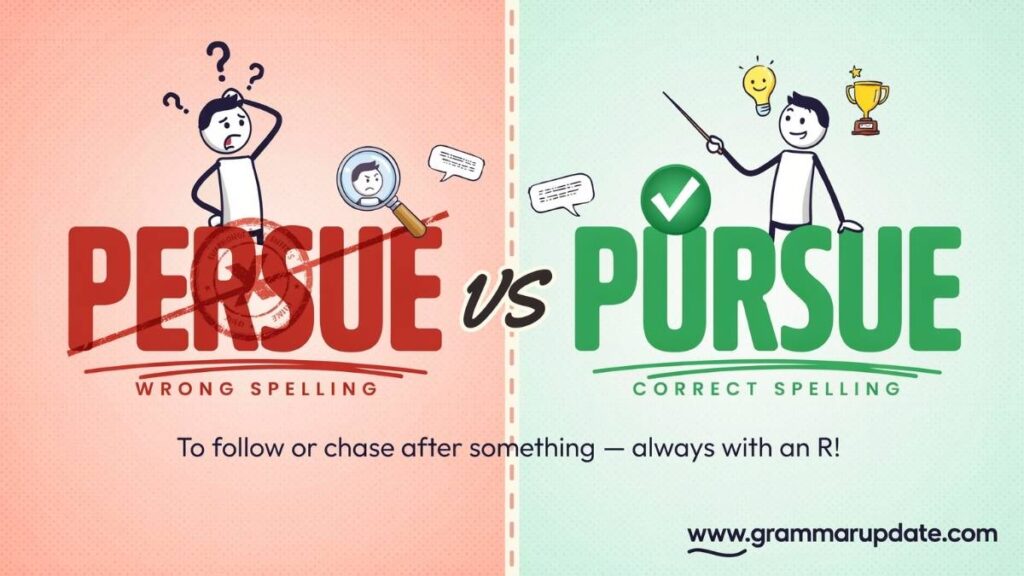
Have you ever stopped while writing Persue vs Pursue and wondered which spelling is actually correct? You are not alone. This is one of the most common spelling mistakes in English because persue looks convincing at first glance. The confusion often comes from the way pursue is pronounced, leading many people to spell it incorrectly. However, the rule is simple: pursue is the correct spelling, while persue is always a misspelling. In this guide, you’ll learn the correct meaning, pronunciation, grammar, usage, and practical examples, so you can avoid this mistake and write with confidence every time.
Persue vs Pursue The Short Answer
If you’re looking for a quick answer, here it is:
- Pursue is the correct spelling.
- Persue is a spelling mistake.
- Pursue is a standard English verb recognized by all major dictionaries.
- Persue is not accepted in standard English.
If you’re asking, “Is it pursue or persue?”, the answer is simple:
Always use “pursue.” Never use “persue” in formal or professional writing.
Correct Example
- She decided to pursue a career in medicine.
- We should pursue every opportunity to learn.
- They continue to pursue excellence in their work.
Incorrect Example
- She decided to persue a career in medicine.
- We should persue our dreams.
- They want to persue higher education.
Every major dictionary considers persue an incorrect spelling.
Why Do People Confuse Persue and Pursue?
Many people search for Persue vs pursue meaning because the two words look similar. However, only one of them is correct.
The confusion usually happens for three reasons:
Pronunciation Doesn’t Clearly Reveal the Spelling
One of the biggest reasons behind the persue spelling mistake is pronunciation.
When spoken quickly, pursue sounds like:
per-SOO
Because of this sound, many writers naturally assume the word begins with per- instead of pur-.
English pronunciation doesn’t always match spelling perfectly, which explains why this mistake is so common.
Similar English Words
English contains many words beginning with per-, such as:
- perfect
- perhaps
- perform
- persuade
- perceive
Since these words are familiar, many people instinctively write persue, even though pursue follows a different spelling pattern.
Typing Too Quickly
Sometimes the mistake isn’t caused by poor spelling.
It’s simply a typing error.
Fast typing often causes writers to rearrange letters or omit vowels.
That’s why spell checkers frequently correct:
- persue → pursue
- recieve → receive
- seperate → separate
- occured → occurred
These are among the most frequently misspelled words in English.
Learn how to use confusing more words correctly
Reoccurrence vs Recurrence Which One Is Correct?
Persue vs Pursue Meaning and Definition
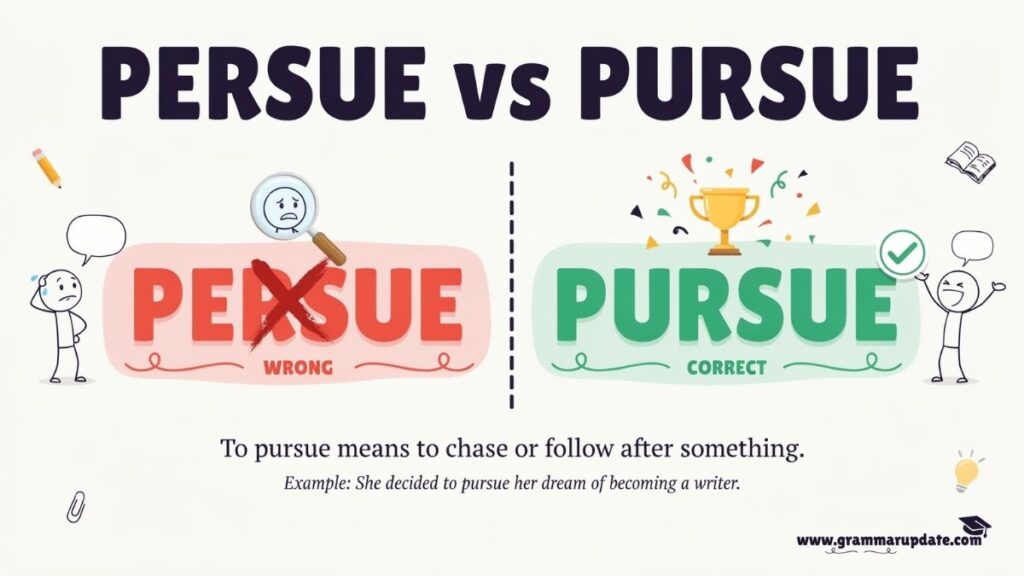
Understanding the difference between persue and pursue becomes much easier once you know the meaning of the correct word.
Pursue Meaning
The Pursue meaning is:
To follow, seek, continue, work toward, or try to achieve something.
The verb can describe both physical and abstract actions.
For example, you can pursue:
- a goal
- success
- education
- happiness
- knowledge
- justice
- a career
- someone
- an opportunity
In every case, the idea is the same: moving toward something with determination and effort.
This makes pursue an important action verb in English.
Pursue Definition
The Pursue definition can be summarized as:
To continue trying to achieve something, follow someone or something, or carry out an activity over time.
This definition appears consistently across major English dictionaries.
Examples include:
- pursue a dream
- pursue legal action
- pursue higher education
- pursue excellence
- pursue happiness
- pursue a business opportunity
Each phrase emphasizes persistence and purpose.
Persue Meaning
Many learners search for Persue meaning after seeing the word online.
The answer is simple.
Persue has no dictionary meaning because it isn’t a correctly spelled English word.
Whenever you see persue, it almost always represents a misspelling of pursue.
Is Persue a Real Word?
One of the most common questions online is:
Is persue a word?
No.
Persue is not recognized as a standard English word by major dictionaries.
It doesn’t appear as an accepted spelling in:
- Merriam-Webster Dictionary
- Cambridge Dictionary
- Oxford Learner’s Dictionaries
- Collins Dictionary
Instead, these dictionaries recognize only:
Pursue
If you’re writing an email, essay, report, or blog post, always choose pursue.
What Does Pursue Mean?
The Meaning of pursue changes slightly depending on the sentence, but the core idea remains the same.
It generally means:
- to chase
- to follow
- to seek
- to strive for
- to continue
- to work toward
- to attempt to achieve
Here are a few examples.
| Sentence | Meaning |
|---|---|
| She wants to pursue medicine. | Study medicine as a career. |
| Police pursued the suspect. | Chased the suspect. |
| They pursued justice. | Worked toward justice. |
| We should pursue excellence. | Strive for excellence. |
| He pursued his dreams. | Worked hard to achieve his dreams. |
This flexibility makes pursue one of the most useful verbs in the English language.
Fix common more word mistakes in English
Targetted vs Targeted Which Spelling Is Correct?
How to Pronounce Pursue
Correct pronunciation often helps improve spelling.
Pursue Pronunciation
The standard Pursue pronunciation is:
British English
/pəˈsjuː/
American English
/pɚˈsuː/
Although the accents differ slightly, both end with the same “soo” sound.
Common Pronunciation Mistakes
Some learners pronounce the word incorrectly as:
- per-sue
- purse-you
- pur-see
The correct pronunciation is closer to:
puh-SOO
Listening to native speakers and repeating the word aloud can make it much easier to remember the correct spelling.
Why Pronunciation Causes Misspellings
Many spelling mistakes happen because English isn’t completely phonetic.
People often write words exactly as they hear them.
Since pursue begins with a soft “per” sound, writers sometimes replace pur with per.
That’s why persue remains one of the most common spelling errors in English writing.
Fix common more word mistakes in English
Openned vs Opened Which Spelling Is Correct?
Persue vs Pursue Side-by-Side Comparison
The easiest way to understand Persue vs Pursue is to compare them directly.
| Feature | Persue | Pursue |
|---|---|---|
| Correct Spelling | ❌ No | ✅ Yes |
| Dictionary Status | Not recognized | Standard English word |
| Meaning | None | To follow, seek, or strive toward something |
| Part of Speech | None | Verb |
| Accepted in Formal Writing | No | Yes |
| Accepted in Academic Writing | No | Yes |
| Used in Professional Writing | No | Yes |
This comparison highlights an important point:
Only “pursue” is correct.
When to Use Pursue
Now that you know the correct spelling of pursue, the next step is learning when to use it.
Use pursue whenever you mean:
- to work toward a goal
- to follow someone or something
- to continue an activity
- to seek an opportunity
- to chase a dream
- to achieve success
The word works in both formal and informal English.
Pursue in Everyday English
In everyday conversation, pursue often refers to personal goals or interests.
Examples include:
- I’m going to pursue photography.
- She wants to pursue a healthier lifestyle.
- They decided to pursue new hobbies.
- We should pursue our passions.
These examples describe making a deliberate effort to achieve something meaningful.
Pursue in Academic Writing
Academic writing frequently uses pursue when discussing education, research, or intellectual goals.
Examples include:
- Researchers continue to pursue innovative solutions.
- Many students pursue postgraduate degrees.
- Scientists pursue new discoveries through careful experimentation.
- Universities encourage students to pursue lifelong learning.
Because the verb expresses determination and progress, it appears regularly in scholarly articles and research papers.
Pursue in Professional Writing
In business and workplace communication, pursue often describes goals, opportunities, negotiations, and strategic decisions.
Examples include:
- The company plans to pursue international expansion.
- We will pursue every opportunity for growth.
- The legal team decided to pursue further action.
- Our organization continues to pursue innovation and excellence.
Fix common more word mistakes in English
Useing vs Using Which Spelling Is Correct?
Common Uses of Pursue
The verb pursue is versatile and appears in everyday conversations, academic writing, business communication, legal documents, and literature. While its core meaning remains the same, the context determines exactly what it refers to.
Whether you’re chasing a dream, advancing your career, or following a legal process, pursue always suggests determination, persistence, and continuous effort.
Let’s explore the most common ways this verb is used.
Pursuing Goals
One of the most frequent uses of pursue is when talking about personal or professional goals.
In this context, pursue a goal meaning is to work consistently toward achieving a specific objective.
Examples:
- She decided to pursue her lifelong goal of becoming a doctor.
- Successful entrepreneurs pursue innovative ideas.
- Athletes pursue excellence through daily practice.
- Never stop pursuing goals that inspire you.
Here, pursue means to strive, work toward, or aim for something important.
Pursuing Dreams
The phrase pursue your dreams meaning refers to making a dedicated effort to achieve your ambitions despite challenges or setbacks.
Examples:
- He moved abroad to pursue his dream of becoming a filmmaker.
- Many artists pursue creative careers despite uncertainty.
- She refused to give up and continued to pursue her dreams.
This phrase often appears in motivational writing because it emphasizes determination and perseverance.
Pursuing a Career
Another common expression is pursue a career.
It means choosing a profession and actively working toward success in that field.
Examples:
- She plans to pursue a career in engineering.
- He’s pursuing a career in software development.
- Many graduates pursue careers in healthcare after university.
In professional writing, this phrase highlights long-term commitment rather than a temporary job.
Pursuing Education
Education is another area where pursue is frequently used.
Examples:
- Many students pursue higher education after high school.
- She pursued a master’s degree in psychology.
- Researchers continue to pursue advanced studies.
The verb emphasizes continuous learning and academic growth.
Pursuing Opportunities
The phrase pursue opportunities appears regularly in business, education, and career advice.
Examples:
- Always pursue opportunities that help you grow.
- Small businesses pursue new markets every year.
- Graduates should pursue internship opportunities early.
In these examples, pursue means actively seeking or taking advantage of beneficial situations.
Pursuing Success
Success rarely happens overnight.
That’s why writers often use pursue to describe consistent effort over time.
Examples:
- She continues to pursue success with determination.
- Every entrepreneur pursues growth differently.
- Hard work helps people pursue long-term success.
Pursuing Knowledge
Learning never stops.
Examples include:
- Scientists pursue knowledge through research.
- Curious people pursue answers by asking questions.
- Reading helps students pursue lifelong learning.
This usage is common in education and academic writing.
Pursuing Someone
The phrase pursue someone meaning can have more than one interpretation depending on the context.
It may refer to physically following someone.
Example:
- The police pursued the suspect through the city.
It can also describe making a romantic effort to win someone’s affection.
Example:
- He pursued her respectfully before they started dating.
The surrounding sentence usually makes the intended meaning clear.
Fix common more word mistakes in English
Stolen vs Stollen Difference and usage?
Pursue Meaning in a Relationship
Many readers search for Pursue meaning in relationship because the expression appears frequently in conversations about dating.
In a romantic context, pursue means making intentional efforts to build a relationship.
This may include:
- expressing romantic interest
- spending time together
- communicating regularly
- planning dates
- showing commitment
Example sentences:
- He pursued the relationship with honesty and respect.
- She appreciated that he pursued her patiently.
- They pursued a meaningful relationship before getting engaged.
Healthy pursuit should always involve mutual respect and consent.
Pursue Me Meaning
Another popular search is Pursue me meaning.
When someone says:
“Pursue me.”
they usually mean:
- show genuine interest
- make an effort to know me
- take initiative in building the relationship
The phrase doesn’t necessarily imply chasing someone physically.
Instead, it commonly refers to emotional interest and intentional effort in romantic relationships.
Understand confusing English more words simply
Trouper vs Trooper Which One Is Correct?
Persue vs Pursue Examples
Looking at real examples is one of the easiest ways to remember the correct spelling of pursue.
Correct Sentence Examples
These sentences use pursue correctly.
- She wants to pursue a career in law.
- We should pursue every learning opportunity.
- They continue to pursue excellence.
- Scientists pursue new discoveries every year.
- He decided to pursue higher education abroad.
- The company plans to pursue international expansion.
- Police pursued the suspect for several miles.
- She pursued her passion for music despite many challenges.
Each sentence demonstrates proper grammar and spelling.
Incorrect Sentence Examples
These examples contain the common persue spelling mistake.
- She wants to persue a career in law.
- We should persue our dreams.
- They continue to persue excellence.
- Students should persue higher education.
Replace persue with pursue in every case.
Real-Life Examples
You’ll frequently see pursue in newspapers, books, academic journals, and business communication.
Examples include:
- Governments pursue economic growth.
- Companies pursue sustainable practices.
- Athletes pursue Olympic success.
- Universities pursue academic excellence.
- Organizations pursue innovation.
These examples demonstrate how widely the verb is used across different fields.
Understand confusing English more words simply
Socialise vs Socialize Which One Is Correct?
Word Forms of Pursue
Learning related word forms improves both grammar and vocabulary.
| Base Form | Past Tense | Past Participle | Present Participle | Noun |
|---|---|---|---|---|
| pursue | pursued | pursued | pursuing | pursuit |
Example sentences:
| Word Form | Example |
|---|---|
| Pursue | I want to pursue medicine. |
| Pursued | She pursued her goals with determination. |
| Pursued | They have pursued every opportunity. |
| Pursuing | He’s pursuing a degree in engineering. |
| Pursuit | Knowledge is a lifelong pursuit. |
Understanding these forms makes it easier to write naturally and accurately.
Pursue vs Persuade
Many English learners confuse Pursue vs persuade because the words look and sound similar.
However, they have completely different meanings.
| Pursue | Persuade |
|---|---|
| To follow or work toward something | To convince someone to do or believe something |
| Action verb | Communication verb |
| Focuses on goals or objectives | Focuses on influencing people |
Examples:
Pursue
- She wants to pursue a career in medicine.
- They pursued justice.
Persuade
- She persuaded him to apply for the job.
- The teacher persuaded the students to participate.
A simple trick:
- Pursue = Follow
- Persuade = Convince
Never use these words interchangeably.
Understand confusing English more words simply
Straight vs Strait Difference and Which Is Correct and Usage?
Persue vs Pursue Synonyms
Although pursue is often the best choice, a synonym may sometimes fit your sentence better.
Formal Synonyms
Formal alternatives include:
- seek
- strive
- undertake
- continue
- conduct
- carry out
Example:
Researchers continue to seek innovative solutions.
Everyday Synonyms
In casual conversation, people often use:
- chase
- follow
- go after
- aim for
- work toward
- try for
Example:
She decided to go after her dream job.
Best Synonym by Context
| Context | Best Synonym |
|---|---|
| Career | pursue, seek |
| Goals | strive, work toward |
| Dreams | chase, follow |
| Opportunities | seek, explore |
| Education | continue, undertake |
| Legal matters | carry out, pursue |
Choosing the right synonym improves clarity and avoids repetition.
Learn the difference between confusing more English words
Payed vs Paid Difference and Which One is Correct?
Antonyms of Pursue
Knowing the opposite of a word strengthens your vocabulary.
Common Pursue antonym options include:
- abandon
- avoid
- ignore
- neglect
- surrender
- quit
- retreat
Examples:
- Rather than abandon your goals, continue to pursue them.
- Never ignore opportunities for growth.
- Successful people rarely quit when challenges appear.
Learn the difference between confusing more English words
Studder vs Stutter Difference Explained and Usage
Why “Persue” Is Incorrect
The answer is simple.
English dictionaries recognize only pursue.
The spelling persue developed because writers incorrectly replace the u with e after hearing the pronunciation.
Modern spell checkers immediately flag persue because it isn’t part of standard English vocabulary.
If you’re unsure, remember this simple rule:
Pursue always begins with “pur.”
Learn the difference between confusing more English words
Chris’s vs Chris’ Complete Grammar Guide and Explanations
Common Mistakes with Pursue
Although pursue is a common word, it’s also one of the most frequently misspelled verbs in English.
Switching the Vowels
The most common error is writing:
❌ persue
instead of:
✅ pursue
Pronunciation-Based Spelling
Many learners spell the word exactly as they hear it.
Unfortunately, English pronunciation doesn’t always match spelling.
That’s why pronunciation alone isn’t a reliable guide.
Typing Errors
Even experienced writers accidentally type:
- persue
- pursu
- pursure
Proofreading helps catch these simple mistakes.
Confusing Pursue with Persuade
Because the words begin similarly, writers sometimes choose the wrong one.
Remember:
- Pursue means to follow or strive for something.
- Persuade means to convince someone.
The meanings are completely different.
See the Mistake, Fix the Mistake
| Incorrect | Correct |
|---|---|
| She wants to persue medicine. | She wants to pursue medicine. |
| We should persue our dreams. | We should pursue our dreams. |
| They persued every opportunity. | They pursued every opportunity. |
| He persuaded a career in law. | He pursued a career in law. |
Learn the difference between confusing more English words
Encode vs Incode Correct Usage
British vs American English Does It Affect Pursue?
Unlike words such as color/colour, organize/organise, or center/centre, the spelling of pursue does not change between British and American English.
Whether you’re writing for readers in the United States, the United Kingdom, Canada, Australia, or New Zealand, the correct spelling is always pursue.
| English Variety | Correct Spelling |
|---|---|
| American English | Pursue |
| British English | Pursue |
| Canadian English | Pursue |
| Australian English | Pursue |
| New Zealand English | Pursue |
This means you never need to choose between regional spellings. Pursue is the accepted form everywhere English is spoken.
What Dictionaries and Grammar Guides Say
If you’re still wondering whether persue is acceptable, the answer from every major dictionary is the same.
| Dictionary or Grammar Guide | Accepted Spelling |
|---|---|
| Merriam-Webster Dictionary | Pursue |
| Cambridge Dictionary | Pursue |
| Oxford Learner’s Dictionaries | Pursue |
| Collins Dictionary | Pursue |
| Grammarly | Pursue |
| Microsoft Editor | Pursue |
All major dictionaries define pursue as a verb meaning to follow, seek, continue, or work toward something.
None recognize persue as a correct English word.
If you write persue, grammar and spell checking tools will almost always recommend changing it to pursue.
Learn the difference between commonly mixed-up more words
Kinesthesiology vs Kinesiology difference Explained
Common Phrases with Pursue
The verb pursue appears in many everyday expressions. Learning these phrases helps you use the word naturally in conversations and writing.
Pursue a Career
This phrase means choosing and developing a profession.
Examples
- She decided to pursue a career in architecture.
- Many graduates pursue careers in healthcare.
Pursue Excellence
This expression refers to continually improving your skills and performance.
Examples
- Great leaders pursue excellence every day.
- The company continues to pursue excellence in customer service.
Pursue Happiness
This common phrase means actively seeking a happy and fulfilling life.
Examples
- Everyone deserves the freedom to pursue happiness.
- She moved abroad to pursue happiness and new opportunities.
Pursue Justice
This phrase is common in legal and news contexts.
Examples
- Prosecutors decided to pursue justice for the victims.
- The organization continues to pursue justice through the courts.
Pursue Your Dreams
One of the most popular motivational expressions, it encourages people to work toward their ambitions.
Examples
- Never stop pursuing your dreams.
- He pursued his dream of becoming a pilot.
Pursue Higher Education
This phrase refers to continuing education after high school.
Examples
- Thousands of students pursue higher education every year.
- She pursued a doctorate in biology.
Pursue New Opportunities
People often use this phrase in business and career discussions.
Examples
- The company plans to pursue new opportunities overseas.
- Employees are encouraged to pursue leadership roles.
Learn the difference between commonly mixed-up more words
maintained vs maintenanced Differences Explained
How to Remember the Correct Spelling of Pursue
Even confident writers occasionally hesitate over Persue vs Pursue. Fortunately, a few simple memory tricks can help.
Remember the “PUR” Beginning
The correct spelling always starts with:
PUR
Whenever you write the word, pause for a second and remember:
PUR + SUE = PURSUE
If you begin with PER, you’ve already made a spelling mistake.
Think About “Purpose”
Both purpose and pursue begin with pur.
Since people often pursue a purpose, linking these words creates an easy memory connection.
Read More Correct English
The more often you read books, newspapers, and reputable websites, the more familiar the correct spelling becomes.
Repeated exposure naturally improves spelling accuracy.
Practice Writing Full Sentences
Writing complete sentences helps reinforce correct spelling.
Examples:
- I want to pursue my goals.
- She pursued excellence throughout her career.
- They are pursuing new opportunities.
The more you write the word correctly, the less likely you are to misspell it.
Learn the difference between commonly mixed-up more words
Present vs Presant Differences and Correct Usage
Quick Recap Persue vs Pursue
| Question | Answer |
|---|---|
| Which spelling is correct? | Pursue |
| Is persue a word? | No. It is a misspelling. |
| What does pursue mean? | To follow, seek, strive for, or work toward something. |
| Can I use persue? | No. Use pursue instead. |
| Is the spelling different in British and American English? | No. Both use pursue. |
| What is the noun form? | Pursuit |
| What is the past tense? | Pursued |
Practice Session Persue vs Pursue
Complete each sentence by writing the correct word: pursue or pursued.
- She wants to ________ a career in medicine.
- They ________ their dreams despite many challenges.
- We should ________ every opportunity to learn.
- The police ________ the suspect for several miles.
- He plans to ________ higher education next year.
- Our team will ________ new business opportunities.
- She ________ her passion for music from a young age.
- Never stop trying to ________ your goals.
- Scientists continue to ________ innovative solutions.
- The company ________ legal action against the supplier.
- Many students ________ scholarships to study abroad.
- He decided to ________ his lifelong dream.
- The detective ________ every possible lead.
- We should always ________ excellence in our work.
- She ________ a degree in computer science.
- They hope to ________ success through hard work.
- The lawyer will ________ the case in court.
- He ________ every opportunity to improve his skills.
- You should ________ your ambitions with confidence.
- The athlete ________ Olympic glory for many years.
- She continues to ________ knowledge through research.
- The organization will ________ meaningful partnerships.
- They ________ their objectives with determination.
- Never be afraid to ________ your dreams.
- We will ________ every chance to grow and succeed.
Answers
| # | Answer |
|---|---|
| 1 | pursue |
| 2 | pursued |
| 3 | pursue |
| 4 | pursued |
| 5 | pursue |
| 6 | pursue |
| 7 | pursued |
| 8 | pursue |
| 9 | pursue |
| 10 | pursued |
| 11 | pursue |
| 12 | pursue |
| 13 | pursued |
| 14 | pursue |
| 15 | pursued |
| 16 | pursue |
| 17 | pursue |
| 18 | pursued |
| 19 | pursue |
| 20 | pursued |
| 21 | pursue |
| 22 | pursue |
| 23 | pursued |
| 24 | pursue |
| 25 | pursue |
Here’s a trusted source for clear word meanings:
FAQs
Which is correct pursue vs persue?
Pursue is the correct spelling. Persue is a common spelling mistake and is not recognized as a standard English word. Whether you’re writing an email, essay, report, or social media post, always use pursue.
Is persue a word?
No. Persue is not a real English word. It is a misspelling of pursue and does not appear in major dictionaries such as Merriam-Webster, Cambridge Dictionary, Oxford Learner’s Dictionaries, or Collins Dictionary.
What does pursue mean?
Pursue means to follow, seek, strive for, or work toward achieving something. You can pursue a goal, career, education, dream, opportunity, or relationship. The word suggests determination and continuous effort.
What is the meaning of pursue in simple words?
In simple terms, pursue means to go after something you want or to keep working toward a goal until you achieve it. It often describes persistence, ambition, and commitment.
When should you use the word pursue?
Use pursue whenever you talk about following a goal, chasing an opportunity, continuing a course of action, or working toward success. It is appropriate for everyday conversations, academic writing, and professional communication.
How do you use pursue in a sentence?
Here is a simple example:
She decided to pursue a career in medicine because she wanted to help others.
What is an example of pursue?
Here are two common examples:
- The company plans to pursue new business opportunities next year.
- He continued to pursue his dream of becoming a professional musician.
What does pursue mean in a relationship?
In a relationship, pursue means showing genuine interest in someone by making a consistent effort to build trust, communicate openly, and develop a meaningful connection. Healthy pursuit is always respectful and mutual.
What does “pursue me” mean?
When someone says “pursue me,” they usually mean show genuine interest, take the initiative, and make an effort to build a relationship. It refers to emotional commitment rather than physically following someone.
What does it mean to pursue someone?
To pursue someone can have two meanings depending on the context. It may mean to chase or follow someone, such as in a police pursuit, or to express romantic interest by making thoughtful efforts to start or strengthen a relationship.
What is the difference between pursue and peruse?
Although they look similar, pursue and peruse have different meanings. Pursue means to follow or work toward something, while peruse means to read, examine, or study something carefully. They should never be used interchangeably.
What is the difference between pursue and persuade?
Pursue means to follow, seek, or strive for something, whereas persuade means to convince someone to do or believe something. Despite their similar spelling, they have completely different meanings and uses.
What is a synonym for pursue?
Common synonyms for pursue include seek, follow, chase, strive for, aim for, work toward, go after, endeavor, and aspire to. The best synonym depends on the context of your sentence.
What is the opposite of pursue?
Common antonyms of pursue include abandon, avoid, ignore, quit, withdraw, retreat, and give up. The most suitable opposite depends on the context in which the word is used.
What is the noun form of pursue?
The noun form of pursue is pursuit. It refers to the act of following, seeking, or striving toward a goal, ambition, opportunity, or objective.
What is the past tense of pursue?
The past tense and past participle of pursue are pursued.
Example: She pursued her goals with determination and never gave up.
How do you pronounce pursue?
Pursue is pronounced puh-SOO. While British and American accents differ slightly, the pronunciation is nearly identical in both varieties of English.
Is pursue the same in British and American English?
Yes. Unlike words such as colour/color or organise/organize, pursue has the same spelling in both British English and American English.
How can you remember the correct spelling of pursue?
A simple memory trick is to connect pursue with purpose because both words begin with pur-. If you’re working toward a purpose, you’ll remember to spell it pursue, not persue.
Why do people misspell pursue as persue?
Many people write persue because the pronunciation can make the word sound like it begins with per- instead of pur-. Fast typing, unfamiliarity with the spelling, and pronunciation-based guessing are the most common reasons for this mistake.
Conclusion
The Persue vs Pursue confusion is easier to solve than it first appears. Although persue may look correct, it is simply a common spelling mistake. Pursue is the only accepted spelling in standard English and is the form you should use in every situation. Think of persue as a wrong turn on the road to good writing easy to make but even easier to avoid once you know the correct path. By understanding the spelling rule, practicing with real examples, and proofreading your work, you’ll write pursue with confidence and leave this common mistake behind for good.

Jhon AJS, the creative mind behind Grammar Update, is an experienced blogger passionate about simplifying English grammar. He focuses on explaining confusing word vs word differences, grammar rules, punctuation, and sentence structure in a clear and practical way. Through easy to understand guides and examples, Jhon helps readers improve their writing and communicate with confidence. With years of blogging experience, he continues to share helpful insights that make learning grammar simple, useful, and accessible for everyone.