Have you ever typed thats and wondered if it should be that’s instead? You’re not alone. The confusion between Thats vs That’s is one of the most common grammar mistakes in English. Since the two words look almost the same, it’s easy to miss the small apostrophe. However, that tiny punctuation mark makes a big difference. One form is correct, and the other is simply a spelling mistake. The good news is that the rule is easy to understand. In this guide, you’ll learn the difference in Thats vs. That’s, discover when to use each form, and see simple examples that will help you write with confidence every time.
Thats vs That’s The Short Answer
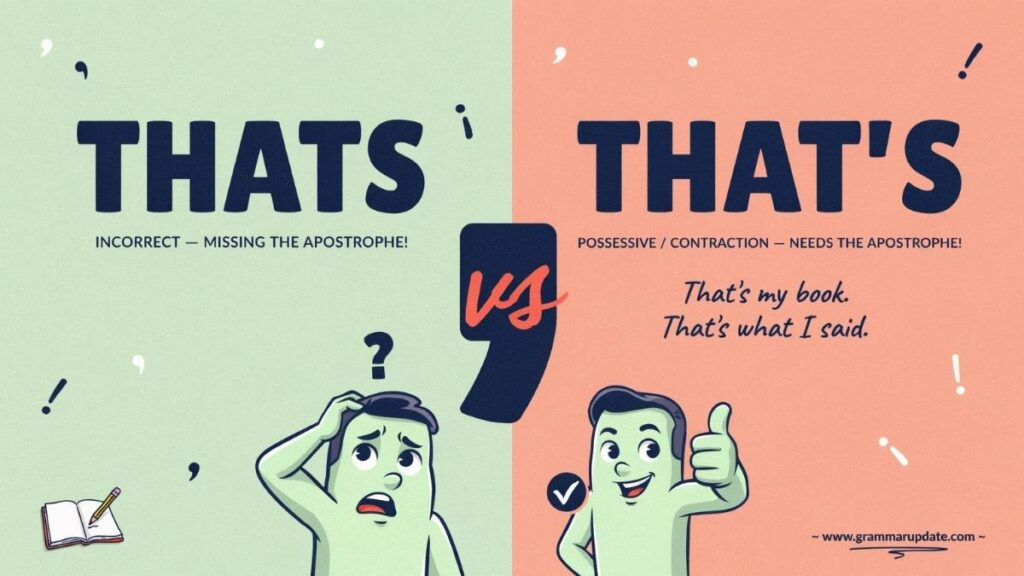
Here’s the simple answer:
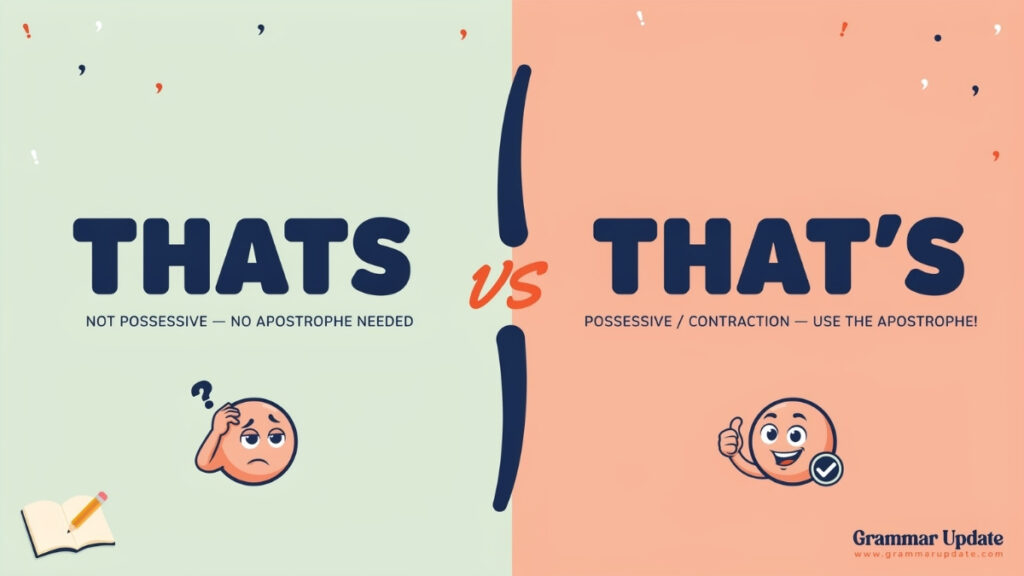
“That’s” is correct. “Thats” is not.
That’s is a contraction of that is or that has, while thats isn’t recognized as a word in standard English. If you omit the apostrophe, you’ve made a spelling mistake rather than chosen an alternative spelling.
The comparison below highlights the difference.
| Word | Correct? | Meaning |
|---|---|---|
| That’s | ✓ | A contraction of that is or that has |
| Thats | ✗ | Incorrect spelling |
For example:
| Incorrect | Correct |
|---|---|
| Thats my favorite movie. | That’s my favorite movie. |
| Thats been repaired. | That’s been repaired. |
| Thats exactly what I meant. | That’s exactly what I meant. |
You may come across thats in text messages, online comments, or hastily written drafts. However, it’s still considered a typo. In professional, academic, and formal writing, that’s is always the correct form.
Is “Thats” a Real Word?
A common question is, “Is thats a word?”
No. Thats isn’t a recognized word in modern English.
Every major dictionary accepts that’s, but none list thats as a standard spelling. The missing apostrophe is what makes the difference.
This mistake usually happens when someone types too quickly or overlooks punctuation during proofreading. Fortunately, it’s easy to fix once you understand the rule behind it.
English contractions replace omitted letters with an apostrophe. Remove the apostrophe, and the contraction is no longer correct.
Consider these examples:
| Incorrect | Correct |
|---|---|
| dont | don’t |
| cant | can’t |
| isnt | isn’t |
| thats | that’s |
Each corrected word follows the same grammatical pattern. The apostrophe marks the missing letters, making the contraction valid.
So, if you’re wondering whether you can write thats without an apostrophe, the answer is no. Standard English requires that’s every time.
Fix common more word mistakes in English
Workday vs Work Day Which One Is Correct?
What Does “That’s” Mean?
To understand Thats or that’s meaning, it’s helpful to know what a contraction is.
A contraction combines two words into a shorter form by omitting one or more letters. An apostrophe replaces the missing letters, making the expression shorter while preserving its meaning.
The that’s definition is straightforward:
That’s is a contraction that means either that is or that has.
Which meaning applies depends entirely on the context.
| Contraction | Expanded Form |
|---|---|
| That’s | That is |
| That’s | That has |
Although that’s has two possible meanings, readers rarely find it confusing because the surrounding words make the intended meaning clear.
“That’s” as the Contraction of “That Is”
Most of the time, that’s stands for that is.
A simple way to check your sentence is to replace that’s with that is. If the sentence still sounds natural, you’ve used the contraction correctly.
For example:
- That’s my office.
- That’s the answer.
- That’s exactly what I expected.
- That’s a smart decision.
- That’s why we left early.
Expanded, these become:
- That is my office.
- That is the answer.
- That is exactly what I expected.
- That is a smart decision.
- That is why we left early.
The meaning doesn’t change. The contraction simply creates a smoother, more conversational sentence.
Fix common more word mistakes in English
Oftentimes vs Often Times Which One Is Correct?
“That’s” as the Contraction of “That Has”
Less often, that’s functions as the contraction of that has.
You’ll usually recognize this form because it’s followed by a past participle, such as been, become, changed, happened, or gone.
Consider these examples:
- That’s been fixed.
- That’s happened before.
- That’s become much easier.
- That’s changed since last year.
- That’s gone surprisingly well.
Expanding each sentence confirms the meaning:
- That has been fixed.
- That has happened before.
- That has become much easier.
- That has changed since last year.
- That has gone surprisingly well.
This use is less common than that is, but it’s equally correct and follows the same grammatical rule.
Fix common more word mistakes in English
Parents’ vs Parent’s Differences and Correct Usage
Why Does “That’s” Have an Apostrophe?
The apostrophe in that’s signals that letters have been omitted.
When that is becomes that’s, the missing letter is replaced by an apostrophe. The same principle applies when that’s stands for that has.
This rule applies to contractions throughout English.
| Full Form | Contraction |
|---|---|
| It is | It’s |
| He is | He’s |
| She is | She’s |
| We are | We’re |
| They are | They’re |
| That is | That’s |
Is “That’s” Possessive?
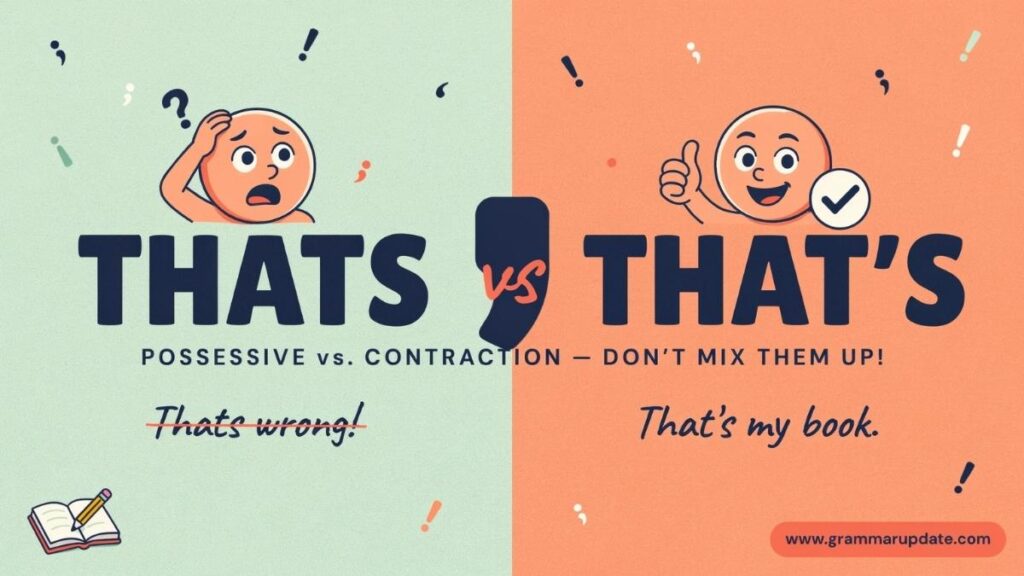
Many writers assume that’s is a possessive word because it contains an apostrophe. It’s an understandable mistake, but it’s not correct.
The apostrophe in that’s doesn’t indicate possession. Instead, it marks omitted letters, making that’s a contraction rather than a possessive form. Specifically, it stands for either that is or that has, depending on the context.
English apostrophes serve two distinct purposes. They can show ownership, as in the teacher’s desk or Emma’s notebook, or they can replace missing letters in contractions such as don’t, it’s, and that’s. Understanding the difference is essential for writing correctly.
Why “That’s” Never Shows Possession
Unlike nouns, pronouns follow different rules when expressing possession. Most possessive pronouns don’t use apostrophes at all.
The table below illustrates the difference.
| Word | Function | Example |
|---|---|---|
| its | Possessive pronoun | The company changed its policy. |
| it’s | Contraction of it is or it has | It’s raining outside. |
| whose | Possessive pronoun | Whose jacket is this? |
| who’s | Contraction of who is or who has | Who’s coming today? |
| that’s | Contraction of that is or that has | That’s the correct answer. |
As the table shows, that’s never functions as a possessive word. Whenever you see it, you can safely read it as that is or that has.
For example:
- That’s my favorite book.
- That’s been updated recently.
- That’s exactly what we needed.
In each sentence, the contraction expands naturally without changing the meaning.
Learn how to use confusing more words correctly
What Kind of vs What Kinds of, Which One Should You Use?
Thats vs That’s Side-by-Side Comparison
If you’re still unsure which form to use, this comparison provides a quick reference.
| Feature | Thats | That’s |
|---|---|---|
| Correct spelling | No | Yes |
| Recognized in standard English | No | Yes |
| Found in dictionaries | No | Yes |
| Meaning | None | That is or that has |
| Uses an apostrophe | No | Yes |
| Suitable for formal writing | No | Yes |
| Suitable for everyday writing | No | Yes |
The comparison reinforces a simple rule: that’s is the only correct spelling in standard English. If you write thats, you’ve simply omitted the apostrophe.
Learn how to use confusing more words correctly
Worshipped vs Worshiped Difference and Usage
When to Use “That’s”
Use that’s whenever you want to shorten that is or that has. It’s one of the most frequently used contractions in English because it makes sentences sound more natural and conversational.
For example:
- That’s exactly what I was looking for.
- That’s the best solution.
- That’s been fixed already.
- That’s why the project succeeded.
- That’s all you need to know.
In each example, replacing that’s with its full form produces the same meaning while making the sentence slightly more formal.
You’ll encounter that’s in everyday conversation, emails, blog posts, online articles, and most business communication. It’s also common in books, magazines, and journalism because contractions create a smoother reading experience.
Formal and Informal Writing
Although that’s is grammatically correct, some forms of writing favor expanded expressions.
| Writing Style | Recommended Usage |
|---|---|
| Conversation | Use that’s |
| Personal emails | Use that’s |
| Blogs and web content | Use that’s |
| Business communication | Usually acceptable |
| Academic papers | Often prefer that is |
| Legal documents | Usually prefer that is |
| Technical documentation | Depends on the style guide |
In academic and legal writing, authors often avoid contractions because the full forms appear more formal. Outside those settings, that’s is both natural and widely accepted.
Learn how to use confusing more words correctly
Reinforce vs Reenforce Which Spelling Is Correct?
When You Should Avoid “That’s”
There are occasions when spelling out the complete phrase is a better choice.
If you’re writing a research paper, legal document, or another highly formal text, replacing that’s with that is or that has creates a more formal tone.
Consider the difference:
Less Formal
That’s the primary reason for the delay.
More Formal
That is the primary reason for the delay.
Both versions are grammatically correct. The difference lies in style rather than accuracy.
Whenever you’re writing for a specific organization or publication, it’s worth checking the required style guide before deciding whether to use contractions.
Understand confusing English more words simply
To Many vs Too Many Difference and Which is Correct?
Common Mistakes Writers Make
Even though the grammar rule is straightforward, a few mistakes appear repeatedly.
Leaving Out the Apostrophe
The most common error is writing thats instead of that’s.
Incorrect
Thats my responsibility.
Correct
That’s my responsibility.
This small omission changes a correct contraction into a spelling mistake.
Confusing “That’s” With “Its”
Because both words involve apostrophes, they’re often mixed up. However, they serve completely different purposes.
| Correct Sentence | Explanation |
|---|---|
| That’s an excellent idea. | Contraction of that is. |
| Its engine needs servicing. | Possessive pronoun showing ownership. |
| It’s been repaired already. | Contraction of it has. |
A useful rule to remember is that possessive pronouns don’t take apostrophes, while contractions do.
Forgetting to Expand the Contraction
One of the easiest proofreading techniques is to expand the contraction mentally.
If replacing that’s with that is or that has still produces a natural sentence, you’ve used it correctly.
For example:
That’s been completed.
Expanded:
That has been completed.
The sentence still makes perfect sense.
Now consider this example:
That’s owner called yesterday.
Expanding the contraction gives:
That is owner called yesterday.
Since the sentence no longer works, that’s has been used incorrectly.
This simple test takes only a few seconds and helps eliminate one of the most common apostrophe errors in English.
Skipping the Final Proofread
Many instances of thats have nothing to do with grammar knowledge. They’re simply typing mistakes caused by speed, distraction, or mobile keyboards.
A careful proofread usually catches the missing apostrophe before your reader does. Modern grammar checkers can help, but they shouldn’t replace careful editing. Developing the habit of reviewing your work remains one of the most effective ways to improve your English writing skills.
Understand confusing English more words simply
Wait vs Weight Difference and usage?
How to Remember the Difference Between “Thats” vs “That’s”
Fortunately, this is one of the easiest grammar rules to remember.
Whenever you’re unsure, replace that’s with that is or that has. If the sentence still sounds natural, you’ve used the contraction correctly.
For example:
- That’s my notebook. → That is my notebook.
- That’s been updated. → That has been updated.
Both expanded versions make perfect sense, confirming that that’s is the correct choice.
Now compare that with:
Thats my notebook.
Without the apostrophe, the word isn’t a valid contraction. Since thats isn’t recognized in standard English, the sentence is incorrect.
A simple memory trick is to think of the apostrophe as a reminder that letters are missing. If the word is standing in for that is or that has, the apostrophe must be there.
With a little practice, you’ll stop thinking about the rule altogether. Using that’s correctly will become second nature.
Understand confusing English more words simply
Hustle vs Hussle Which is Correct Spelling and Usage?
“That’s” in a Sentence Examples
The best way to understand any grammar rule is to see it in context. The examples below show how that’s is used naturally in everyday English.
Everyday Conversation
In conversation, contractions make speech sound relaxed and natural.
Examples include:
- That’s exactly what I was thinking.
- That’s a wonderful idea.
- That’s my favorite café.
- That’s why we arrived early.
- That’s not the answer I expected.
- That’s enough for today.
- That’s incredible.
- That’s the one I wanted.
In each example, that’s can be expanded to that is without changing the meaning.
Professional Writing
Contractions are also common in workplace communication. They create a conversational tone while keeping the writing clear and approachable.
For example:
- That’s a great suggestion.
- That’s attached to this email.
- That’s already been approved.
- That’s the information you requested.
- That’s the next step in the process.
Most business emails and online communications accept contractions unless a company style guide states otherwise.
Academic Writing
Academic writing often favors complete word forms to maintain a formal tone.
Instead of writing:
That’s an important observation.
Many instructors and publishers prefer:
That is an important observation.
Neither version is grammatically wrong. The choice simply depends on the level of formality required.
Incorrect vs. Correct Examples
A side-by-side comparison makes the rule easy to remember.
| Incorrect | Correct |
|---|---|
| Thats my office. | That’s my office. |
| Thats been completed. | That’s been completed. |
| Thats exactly right. | That’s exactly right. |
| Thats why I called. | That’s why I called. |
| Thats the best option. | That’s the best option. |
If you notice thats while proofreading, simply add the missing apostrophe.
Learn the difference between confusing more English words
Appendices vs Appendixes Which is Correct and Usage?
Similar Grammar Mistakes You Should Know
The confusion surrounding that’s is part of a larger pattern. English contains several words that look alike but follow different grammar rules.
| Words | Difference |
|---|---|
| its / it’s | It’s means it is or it has. Its shows possession. |
| your / you’re | You’re means you are. Your is a possessive adjective. |
| whose / who’s | Who’s means who is or who has. Whose shows possession. |
| their / they’re / there | They’re means they are. Their shows possession. There refers to a place or introduces a sentence. |
A useful rule ties all of these together:
Contractions use apostrophes. Possessive pronouns don’t.
Keeping this principle in mind will help you avoid many of the most common punctuation mistakes in English.
Learn the difference between confusing more English words
Reining vs Reigning Which Is Difference?
ther that is or that has.
Key Takeaways
The rule is simple once you understand how contractions work.
| Rule | Explanation |
|---|---|
| That’s is the correct spelling. | It’s the contraction of that is or that has. |
| Thats is incorrect. | It’s a spelling mistake, not a valid English word. |
| The apostrophe matters. | It replaces omitted letters in a contraction. |
| That’s is never possessive. | It always functions as a contraction. |
| Use the expansion test. | Replace that’s with that is or that has to check your sentence. |
Practice Session Thats vs That’s
Ready to test your understanding? Complete each sentence by choosing the correct option: thats vs that’s.
Fill in the Blanks
- ________ the best movie I’ve seen this year.
- I think ________ exactly what the teacher meant.
- ________ been a long and challenging week.
- ________ my backpack by the front door.
- ________ why everyone was laughing.
- ________ already happened once before.
- ________ an excellent question.
- ________ not the answer I expected.
- ________ become much easier with practice.
- ________ the restaurant everyone recommends.
- ________ where we first met.
- ________ been updated since yesterday.
- ________ a beautiful painting.
- ________ all you need to know.
- ________ exactly how the process works.
- ________ one of my favorite books.
- ________ happened more than once.
- ________ impossible to predict the outcome.
- ________ the reason I called you.
- ________ changed significantly over the past decade.
- ________ the correct way to spell the word.
- ________ an interesting point to consider.
- ________ why proofreading is so important.
- ________ never been easier to learn English online.
- ________ the solution we’ve been looking for.
Answers
| Question | Correct Answer |
|---|---|
| 1 | That’s |
| 2 | That’s |
| 3 | That’s |
| 4 | That’s |
| 5 | That’s |
| 6 | That’s |
| 7 | That’s |
| 8 | That’s |
| 9 | That’s |
| 10 | That’s |
| 11 | That’s |
| 12 | That’s |
| 13 | That’s |
| 14 | That’s |
| 15 | That’s |
| 16 | That’s |
| 17 | That’s |
| 18 | That’s |
| 19 | That’s |
| 20 | That’s |
| 21 | That’s |
| 22 | That’s |
| 23 | That’s |
| 24 | That’s |
| 25 | That’s |
Here’s a trusted source for clear word meanings:
FAQs
Is thats a word?
No. Thats isn’t a recognized word in standard English. The correct spelling is that’s, which is a contraction of that is or that has.
Is that’s grammatically correct?
Yes. That’s is grammatically correct when it’s used as a contraction for that is or that has.
What’s the difference between thats vs that’s?
The only difference is the apostrophe, but it’s an important one. That’s is a correct contraction, while thats is a spelling mistake because it omits the apostrophe.
What does that’s mean?
That’s has two possible meanings. Depending on the sentence, it can mean that is or that has.
What is the full form of that’s?
The full form of that’s is either that is or that has. The surrounding words determine which meaning is intended.
Is that’s a contraction or a possessive?
That’s is always a contraction. It never indicates possession. Despite the apostrophe, it doesn’t function as a possessive word.
Why does that’s have an apostrophe?
The apostrophe replaces omitted letters when that is or that has is shortened to that’s. This follows the standard rules for English contractions.
Can that’s mean that has?
Yes. While that’s most commonly means that is, it can also mean that has, especially before words such as been, become, changed, or happened.
How do I know whether that’s means that is or that has?
Look at the word that follows it. If that’s is followed by a past participle, it usually means that has. In most other cases, it means that is.
When should I use that’s?
Use that’s whenever you can replace it with that is or that has without changing the meaning of the sentence.
Can I write thats without an apostrophe?
No. In standard English, thats is always incorrect. The apostrophe is required because that’s is a contraction.
How do you use that’s in a sentence?
Here are a few examples:
- That’s my favorite restaurant.
- That’s exactly what I meant.
- That’s been updated recently.
In each sentence, that’s expands naturally to that is or that has.
What is the difference between that’s and it’s?
Both are contractions, but they represent different words. That’s means that is or that has, while it’s means it is or it has.
Should I use that’s in formal writing?
Yes, although it depends on the writing style. That’s is grammatically correct, but academic, legal, and technical writing often prefers the expanded form that is.
How can I remember the difference between thats vs that’s?
Use the expansion test. If you can replace that’s with that is or that has and the sentence still makes sense, you’ve used it correctly. If you can’t, revise the sentence instead of removing the apostrophe.
Learn the difference between confusing more English words
Laser vs Lazer know the Difference
Conclusion
The difference between thats vs that’s comes down to one small but important punctuation mark. While that’s is a correct contraction of that is or that has, thats isn’t recognized in standard English and should always be corrected.
Whenever you’re in doubt, use the expansion test. If replacing that’s with that is or that has produces a natural sentence, you’ve used the word correctly. If neither option fits, it’s time to revise the sentence.
Once you understand this rule, you’ll avoid one of the most common apostrophe mistakes in English. More importantly, your writing will become clearer, more polished, and more professional whether you’re drafting an email, writing an essay, or publishing content online.

Jhon AJS, the creative mind behind Grammar Update, is an experienced blogger passionate about simplifying English grammar. He focuses on explaining confusing word vs word differences, grammar rules, punctuation, and sentence structure in a clear and practical way. Through easy to understand guides and examples, Jhon helps readers improve their writing and communicate with confidence. With years of blogging experience, he continues to share helpful insights that make learning grammar simple, useful, and accessible for everyone.