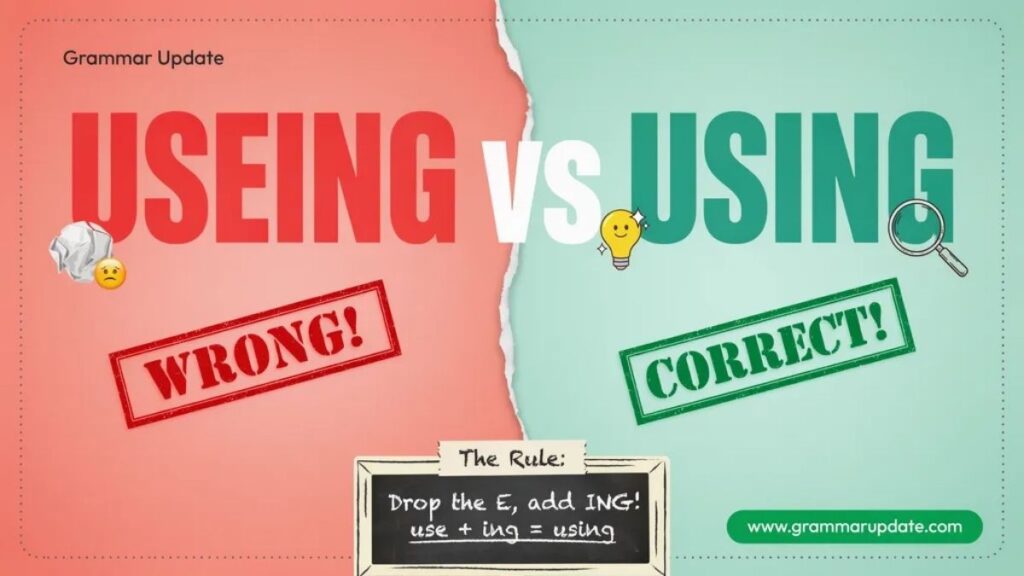
Have you ever stopped while writing and wondered, Useing vs Using which one is correct? You’re not alone. This common spelling mistake confuses many students, writers, and English learners because useing looks right at first. But don’t worry. The rule is simple and easy to remember. Once you understand it, you’ll know why using is always the correct spelling and useing is always wrong. In this guide, you’ll learn the difference between Useing vs Using, understand the spelling rule, see clear examples, avoid common mistakes, and gain the confidence to use the correct spelling every time you write.
Quick Answer Useing vs Using
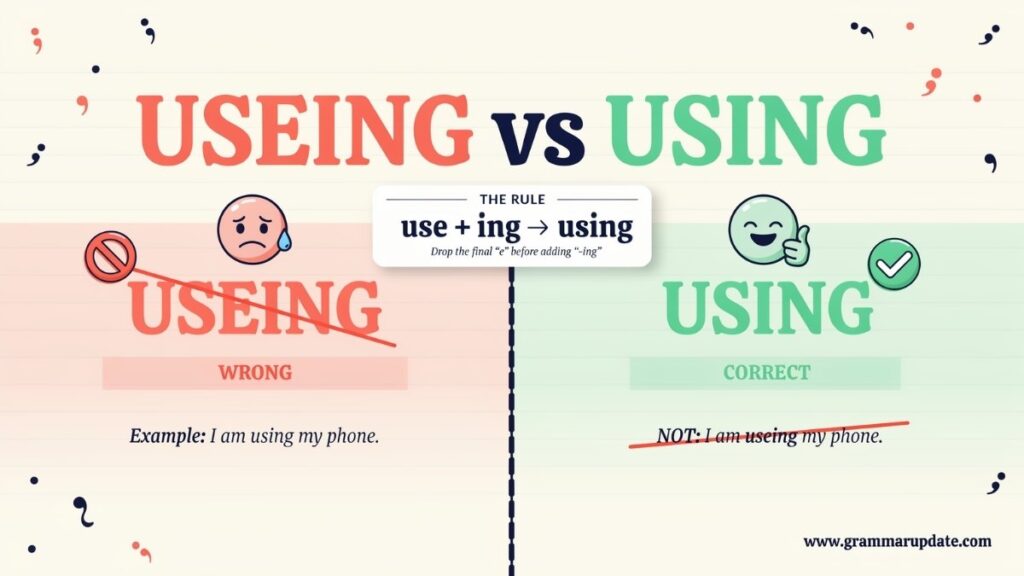
If you’re wondering which is correct useing or using, the answer is simple.
Using is the correct spelling.
Useing is incorrect and is not recognized in standard English. You won’t find it in trusted dictionaries, grammar guides, or professional writing because it breaks a basic English spelling rule.
No matter where you write whether in British English, American English, Canadian English, or Australian English the correct spelling is always using.
Quick Comparison
| Word | Correct? | Meaning |
|---|---|---|
| Using | Yes | The present participle and gerund form of use |
| Useing | No | Incorrect spelling |
Whenever you write, choose using with confidence.
Learn the difference between tricky more English words
Wait vs Weight Difference and usage?
What Does “Using” Mean?
Understanding the using meaning helps you understand why this spelling is correct.
The verb use means to employ, apply, operate, or make use of something for a purpose. When you add -ing, it becomes using, which can work as both a present participle and a gerund.
Although those grammar terms sound technical, they’re actually easy to understand.
Using as a Present Participle
A present participle helps describe an action that is happening now.
You’ll usually see using after helping verbs such as is, are, was, or were.
Examples:
- She is using her laptop to finish the report.
- They are using new software to manage projects.
- We were using the wrong password.
In each sentence, using shows that the action is in progress.
Using as a Gerund
A gerund is simply an -ing word that acts like a noun.
Examples:
- Using clear examples makes grammar easier.
- Using good study habits improves your results.
- Using simple words helps readers understand your message.
Here, using names an activity instead of describing an action.
Using Meaning in Everyday English
You probably use the word using dozens of times without thinking about it.
For example:
- Using a smartphone
- Using public transport
- Using a dictionary
- Using grammar correctly
- Using online banking
- Using safety equipment
From classrooms and offices to emails and social media, using appears everywhere because it describes actions people perform every day.
Learn the difference between tricky more English words
Thats vs That’s diffrance and Which Is Correct?
Useing vs Using What’s the Difference?
The difference between useing vs using is surprisingly simple.
One spelling follows English grammar.
The other doesn’t.
Many people write useing because they believe they should keep the final e from use before adding -ing. At first glance, that seems reasonable. However, English removes the silent e from many verbs before adding -ing.
That’s why we write:
- Use → Using
- Make → Making
- Take → Taking
- Move → Moving
- Write → Writing
The same spelling rule applies every time.
Once you learn this pattern, you’ll avoid dozens of similar spelling mistakes.
Useing vs Using Comparison Table
| Feature | Using | Useing |
|---|---|---|
| Correct English spelling | Yes | No |
| Found in dictionaries | Yes | No |
| Accepted in formal writing | Yes | No |
| Accepted in academic writing | Yes | No |
| British English | Yes | No |
| American English | Yes | No |
| Recommended by grammar checkers | Yes | No |
If you ever compare Using vs Useing, remember that only using follows standard English spelling.
Fix common more word mistakes in English
Enflamed vs Inflamed Which One Is Correct?
Why “Useing” Is Incorrect
Many spelling mistakes happen because English has many different patterns. Fortunately, this one is easy to understand.
The word use ends with a silent e. When you add the suffix -ing, English usually removes that silent e first.
Instead of writing:
Use + ing = Useing
The correct process is:
Use → Remove the silent e → Add -ing = Using
This simple rule explains why using is correct every time.
The Silent “E” Rule
One of the most useful English spelling rules says:
Drop the silent “e” before adding “-ing.”
This rule applies to hundreds of everyday verbs.
| Base Verb | Correct “-ing” Form |
|---|---|
| Use | Using |
| Make | Making |
| Come | Coming |
| Move | Moving |
| Write | Writing |
| Take | Taking |
| Save | Saving |
| Bake | Baking |
| Drive | Driving |
| Leave | Leaving |
Notice something?
Every verb loses its silent e before adding -ing.
Once you recognize this pattern, spelling becomes much easier.
Why English Drops the Silent “E”
English removes the silent e because it creates cleaner, simpler spellings.
Imagine if we kept the e in every word.
We would end up with spellings like:
- useing
- makeing
- moveing
- writeing
- driveing
These spellings look awkward because they don’t follow standard English word formation.
Removing the silent e keeps words shorter, easier to read, and consistent with English spelling rules.
Are There Any Exceptions?
Yes, English has a few exceptions, but use is not one of them.
Sometimes the language keeps the final e before adding -ing to avoid changing pronunciation or creating confusion.
For example:
- dye → dyeing (to avoid confusion with dying)
- age → ageing (a common British English spelling)
These are special cases.
The word use never follows those exceptions.
It always becomes using.
Learn the difference between tricky more English words
Insecure vs Unsecure Which One Is Correct?
How to Spell Using Correctly
If you ever forget the spelling, use this simple three-step method.
Step 1
Start with the base verb.
Use
Step 2
Remove the silent e.
Us
Step 3
Add -ing.
Using
Easy Formula to Remember
Use − e + ing = Using
This formula doesn’t just help with using.
It also works with many other common verbs that end in a silent e.
Fix common more word mistakes in English
Conex or Connex Differences Explained
Why This Rule Makes English Easier
The best part about learning this spelling rule is that you don’t have to memorize hundreds of words individually.
Instead, you learn one rule and apply it again and again.
When you understand why using is correct, you’ll also spell words like making, taking, writing, driving, saving, and coming correctly.
Think of it as learning one key that unlocks dozens of doors.
The next time someone asks, “Is useing correct?”, you’ll know the answer immediately.
Remember this simple rule:
Drop the silent “e” before adding “-ing.”
When Should You Use “Using”?
After learning that using is the correct spelling, the next question is simple: When should you use it?
You’ll use using whenever you want to show that someone is doing something now or to talk about an activity in general. It appears in everyday conversations, emails, business reports, school assignments, articles, and books.
Once you understand its purpose, you’ll find yourself using it naturally in almost every type of writing.
Using in Everyday Conversation
The word using is part of daily life. People say it when talking about tools, devices, methods, or anything they need to complete a task.
Examples:
- I’m using my phone to book a taxi.
- She’s using a map to find the museum.
- We’re using fresh vegetables for dinner.
- They’re using reusable bags when they shop.
These sentences describe actions happening right now, making using the perfect choice.
Using in Business Writing
Business communication values clear and correct language. The word using often explains how work gets done or which tools people rely on.
Examples:
- Our team is using new software to improve efficiency.
- The company is using customer feedback to improve its services.
- We’re using secure technology to protect customer information.
- The marketing team is using data to understand customer behavior.
Correct using spelling makes reports, emails, and presentations look more professional and trustworthy.
Using in Academic Writing
Schools, colleges, and universities expect accurate grammar and spelling.
You’ll often see using in textbooks, research papers, and classroom assignments because it clearly explains methods and processes.
Examples:
- Students completed the experiment using laboratory equipment.
- Researchers collected data using online surveys.
- The writer supports the argument using historical evidence.
- Scientists solved the problem using advanced technology.
Strong grammar helps readers focus on your ideas instead of your spelling.
Using in Emails and Digital Communication
Whether you’re writing an email, sending a message, or posting online, using appears frequently.
Examples:
- I’m using your document as a reference.
- Thank you for using our service.
- We’re using a new booking system this week.
- Are you using the latest version of the app?
Even in casual messages, correct spelling leaves a better impression.
Using in Creative Writing
Stories become more vivid when writers describe how characters complete actions.
Examples:
- She escaped using a hidden tunnel.
- He solved the mystery using only logic.
- The artist created the painting using bright colors.
- They crossed the river using an old wooden bridge.
No matter the style of writing, using remains the correct spelling.
Reoccurrence vs Recurrence Which One Is Correct?
Using in a Sentence
Reading real examples is one of the easiest ways to remember the correct spelling of using.
The more often you see the word in context, the more natural it becomes.
Everyday Examples
- She is using her laptop to finish today’s work.
- I’m using my umbrella because it’s raining.
- They’re using reusable water bottles.
- We’re using less electricity than last month.
Workplace Examples
- The manager is using a new reporting system.
- Our team is using cloud storage for important files.
- Employees are using updated security procedures.
- The company is using artificial intelligence to improve customer support.
School Examples
- The teacher is using pictures to explain the lesson.
- Students are using calculators during the math test.
- We’re using library books for our research.
- She improved her grammar by using online practice exercises.
Technology Examples
- I’m using wireless headphones today.
- They’re using a password manager for extra security.
- The app keeps using my location.
- He’s using video editing software to create tutorials.
Formal Writing Examples
- The organization reduced costs using modern equipment.
- Researchers analyzed the results using statistical methods.
- Engineers solved the issue using a new design.
- The report was prepared using verified information.
These examples show how naturally using fits into everyday, professional, and academic English.
Learn the difference between tricky more English words
Targetted vs Targeted Which Spelling Is Correct?
Common Mistakes with “Using”
Although the grammar rule is simple, many people still make the same spelling mistakes.
The good news is that once you know what to watch for, they’re easy to avoid.
Writing “Useing”
This is the most common mistake.
Many writers think they should keep the final e from use before adding -ing.
Incorrect:
I am useing my laptop.
Correct:
I am using my laptop.
Always remember to remove the silent e before adding -ing.
Forgetting to Drop the Silent “E”
The same grammar rule applies to many common verbs.
Correct Examples
| Base Verb | Correct Form |
|---|---|
| Use | Using |
| Make | Making |
| Move | Moving |
| Take | Taking |
| Write | Writing |
| Save | Saving |
Once you learn this pattern, dozens of English words become easier to spell.
Confusing “Use,” “Used,” and “Using”
These three words come from the same verb, but each has a different purpose.
| Word | Function | Example |
|---|---|---|
| Use | Base verb | I use a notebook every day. |
| Used | Past tense | I used a notebook yesterday. |
| Using | Present participle or gerund | I am using a notebook now. |
Knowing the difference helps you write more accurate and natural English.
Misspelling Other “-ing” Words
People who write useing often make similar spelling mistakes with other verbs.
| Incorrect | Correct |
|---|---|
| Useing | Using |
| Makeing | Making |
| Moveing | Moving |
| Writeing | Writing |
| Takeing | Taking |
| Comeing | Coming |
One simple grammar rule can help you avoid all of these mistakes.
Learn the difference between confusing more English words
Openned vs Opened Which Spelling Is Correct?
Other Words That Follow the Same Rule
The drop the e before adding ing rule appears throughout English.
Once you recognize it, spelling becomes much easier.
| Base Verb | Correct “-ing” Form |
|---|---|
| Use | Using |
| Make | Making |
| Take | Taking |
| Write | Writing |
| Move | Moving |
| Drive | Driving |
| Save | Saving |
| Leave | Leaving |
| Bake | Baking |
| Come | Coming |
Notice the pattern.
Each verb loses its silent e before adding -ing.
Learn the difference between confusing more English words
Seperate vs Separate Which Spelling Is Correct?
Similar Words People Commonly Misspell
The mistake doesn’t stop with useing.
Many verbs ending in a silent e confuse English learners.
| Incorrect | Correct |
|---|---|
| Useing | Using |
| Makeing | Making |
| Writeing | Writing |
| Moveing | Moving |
| Hopeing | Hoping |
| Saveing | Saving |
| Comeing | Coming |
| Liveing | Living |
If you remember one rule drop the silent e before adding -ing you’ll avoid all of these common spelling errors.
Learn the difference between confusing more English words
Verbiage vs Verbage Which Spelling Is Correct?
British English vs American English
Some English words change their spelling depending on the country.
For example:
- Colour → Color
- Centre → Center
- Travelling → Traveling
However, using never changes.
Whether you write British English, American English, Australian English, or Canadian English, the spelling stays exactly the same.
| English Variety | Correct Spelling |
|---|---|
| British English | Using |
| American English | Using |
| Australian English | Using |
| Canadian English | Using |
If you’ve searched for Useing or using UK, Useing or using American English, or Proper spelling of using, the answer never changes.
Using is correct everywhere.
Understand confusing English more words simply
Neighbour vs Neighbor Which Spelling Is Correct?
Synonyms for “Using”
Sometimes you may want to avoid repeating the word using.
In those situations, a synonym can make your writing smoother.
| Synonym | Best Used In |
|---|---|
| Employing | Professional writing |
| Utilizing | Academic and technical writing |
| Applying | Skills or methods |
| Operating | Machines and equipment |
| Handling | Tools or objects |
| Making use of | Everyday conversation |
| Adopting | New ideas or systems |
| Implementing | Business and project management |
| Practicing | Skills and techniques |
| Exercising | Rights or authority |
Examples
- She is using a new teaching method.
- She is employing a new teaching method.
- The company is using advanced technology.
- The company is utilizing advanced technology.
Choose a synonym only when it matches your meaning. In most situations, using remains the simplest, clearest, and most natural word.
Understand confusing English more words simply
Unkept vs Unkempt Difference and Usage
Why This Spelling Rule Matters
Learning the difference between Useing vs Using does more than fix one spelling mistake. It helps you understand an important English spelling rule that appears in hundreds of everyday words.
Once you know why using is correct, you’ll also spell words like making, taking, driving, writing, and saving with confidence. Instead of memorizing each word separately, you learn one simple rule that works again and again.
Better spelling leads to clearer writing, stronger grammar, and more confidence every time you write.
Better Academic Writing
Correct spelling helps teachers, classmates, and examiners focus on your ideas instead of your mistakes.
Whether you’re writing an essay, completing homework, or taking an exam, spelling using correctly shows that you understand basic English grammar and spelling rules.
More Professional Communication
Professional writing depends on accuracy.
A small spelling mistake like useing can make an email, report, proposal, or presentation look less polished. Choosing using helps your writing appear clear, reliable, and professional.
Clearer Everyday Writing
Correct spelling makes your message easier to understand.
Whether you’re sending a text message, posting online, or writing a social media caption, using helps readers focus on your message instead of your spelling.
Stronger Proofreading Skills
Understanding grammar rules makes proofreading much easier.
Instead of guessing, you’ll immediately recognize that useing is incorrect and replace it with using before anyone else notices the mistake.
Every grammar rule you learn improves your writing for years to come.
Learn the difference between commonly mixed-up more words
Noteable vs Notable Correct Spelling and Usage
Easy Memory Trick to Remember “Using”
You don’t need to memorize complicated grammar rules.
Just remember this simple formula:
Use − e + ing = Using
That’s it.
Whenever a verb ends with a silent e, remove the e before adding -ing.
A Simple Trick You’ll Remember
Imagine the silent e politely stepping aside to make room for -ing.
Use → Using
The e quietly leaves.
-ing takes its place.
The result is always using.
Another Quick Reminder
If you can spell making, taking, and driving, you can spell using too.
They all follow the same spelling pattern.
One grammar rule helps you spell dozens of English words correctly.
How Grammar Checkers and Dictionaries Treat “Useing”
Every trusted English dictionary recognizes using as the correct spelling.
Grammar checkers, spell checkers, teachers, editors, and proofreaders also mark useing as a spelling mistake because it doesn’t follow standard English spelling rules.
If you type useing in a word processor or grammar-checking tool, you’ll usually see a suggestion to replace it with using.
That’s because using is the only accepted spelling in standard English.
Whether you’re writing for school, work, or everyday communication, always choose using.
Understand confusing English more words simply
Breakroom vs Break Room Which Spelling Is Correct?
Quick Recap Useing vs Using
Let’s review everything you’ve learned.
| Question | Correct Answer |
|---|---|
| Correct spelling | Using |
| Incorrect spelling | Useing |
| Is useing a real word? | No |
| Is using correct? | Yes |
| British English | Using |
| American English | Using |
| Grammar rule | Drop the silent e before adding -ing |
Key Takeaways
- Using is always the correct spelling.
- Useing is always a spelling mistake.
- Remove the silent e before adding -ing.
- The rule is the same in British English and American English.
- The same spelling pattern applies to many common English verbs.
Whenever you feel unsure, remember this simple formula:
Use − e + ing = Using
Understand confusing English more words simply
Offered vs Offerred The Complete Guide to Correct Spelling
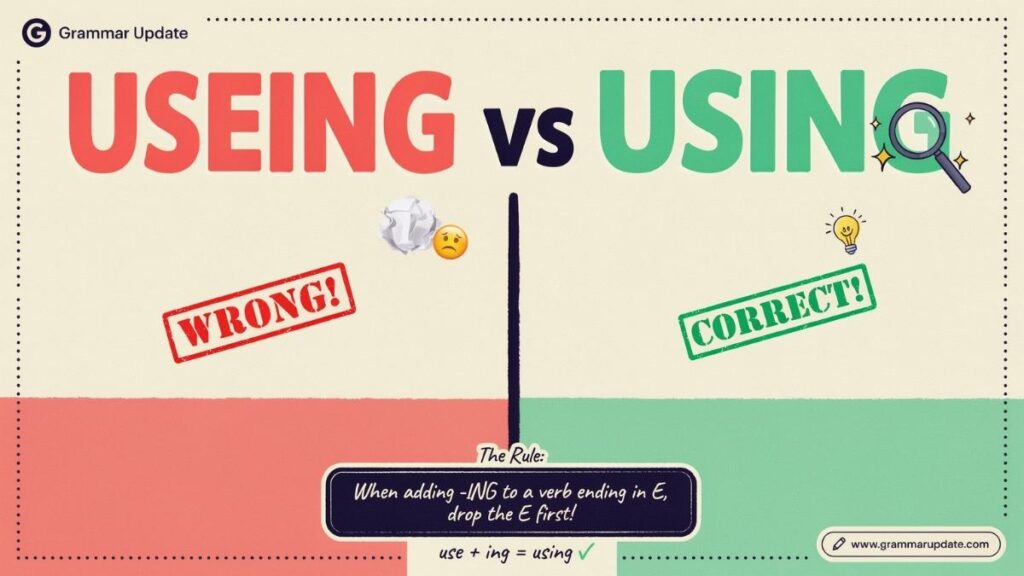
Practice Session Useing vs Using
Fill in the Blanks
Choose the correct word: using vs useing.
- She is __________ her laptop to finish the report.
- We are __________ a new learning platform this semester.
- They’re __________ recycled materials to build the project.
- I’m __________ my phone to pay the bill.
- The teacher is __________ real-life examples to explain grammar.
- He’s __________ online banking for the first time.
- The company is __________ customer feedback to improve its services.
- We’re __________ a map to find the museum.
- Sarah is __________ a dictionary to check the meaning.
- They’re __________ modern equipment in the factory.
- I’m __________ grammar exercises to improve my writing.
- The doctor is __________ advanced technology during surgery.
- She enjoys __________ simple words in her articles.
- We’re __________ renewable energy whenever possible.
- The students are __________ calculators during today’s exam.
- He’s __________ his experience to solve the problem.
- The chef is __________ fresh ingredients in every recipe.
- They’re __________ cloud storage to keep their files safe.
- I’m __________ this example to explain the grammar rule.
- The engineer is __________ special tools to repair the machine.
- She keeps __________ sticky notes to stay organized.
- We’re __________ public transportation to reduce pollution.
- The researchers are __________ official data for the study.
- He’s __________ a new teaching method this year.
- They are __________ their time wisely to finish the project early.
Answers
- using
- using
- using
- using
- using
- using
- using
- using
- using
- using
- using
- using
- using
- using
- using
- using
- using
- using
- using
- using
- using
- using
- using
- using
- using
Here’s a trusted source for clear word meanings:
FAQs
Which is correct using vs useing?
Using is the correct spelling. Useing is a common misspelling because English drops the silent e from use before adding -ing.
Is useing a correct English word?
No. Useing is not a correct English word. Standard dictionaries and grammar guides recognize only using.
Is using the correct spelling?
Yes. Using is the correct spelling in British English, American English, Canadian English, and Australian English.
How do you spell using correctly?
Spell it u-s-i-n-g. Start with use, remove the final silent e, and add -ing.
Why is useing incorrect?
Useing is incorrect because it breaks the English spelling rule for verbs ending in a silent e. Before adding -ing, you remove the e, so use becomes using.
Why do we drop the e before adding -ing?
English spelling rules usually remove the final silent e before adding -ing. For example, make → making, take → taking, drive → driving, and use → using.
What does using mean?
Using means employing, applying, operating, or making use of something to complete a task or achieve a purpose.
What is the difference between use and using?
Use is the base form of the verb, while using is the -ing form. You use using to describe an action in progress or an activity.
Is using a verb or a noun?
It can be both. Using acts as a verb in continuous tenses and as a noun when it functions as a gerund.
Can using be a gerund?
Yes. Using is a gerund when it functions as a noun.
Example: Using simple language makes communication easier.
What is the present participle of use?
The present participle of use is using.
How do you use using in a sentence?
Use using to describe an ongoing action or method.
Example: She is using a tablet to take notes.
Can you give an example of using?
Certainly.
Example: The students are using online resources to complete their assignments.
What is another word for using?
Depending on the context, you can replace using with employing, utilizing, applying, operating, handling, or making use of.
What is a stronger alternative to using?
In formal writing, words such as utilizing, implementing, employing, or applying may work better when they match the context.
When should I use using instead of use?
Use use as the base verb and using when describing an action that is happening now or when the word functions as a gerund.
Examples:
- I use this app every day.
- I am using this app right now.
How can I remember the correct spelling of using?
Remember this simple formula:
Use − e + ing = Using
If a verb ends with a silent e, remove the e before adding -ing.
Does British English use useing?
No. British English and American English both use using. Useing is incorrect in standard English.
Is using acceptable in academic and professional writing?
Yes. Using is the standard spelling in essays, research papers, business reports, emails, books, and all forms of professional writing.
Learn the difference between commonly mixed-up more words
Atleast or At Least? Which One Is Correct?
Conclusion
The Useing vs Using confusion becomes easy to solve once you know the rule. Using is the correct spelling, and useing is always incorrect. Many writers keep the silent e by mistake, but English asks you to drop it before adding -ing. That’s why use becomes using every time.
Whenever you feel tempted to write useing, remember this simple formula:
Use − e + ing = Using
Think of the silent e as taking a short vacation before -ing arrives. It never comes back!
Now that you understand the spelling rule, recognize the common mistake, and have seen plenty of examples, you can write using with confidence. Keep practicing, proofread your work, and apply this rule whenever you add -ing to verbs ending in a silent e. One small spelling habit can make your writing clearer, more professional, and completely free from this common mistake.

Jhon AJS, the creative mind behind Grammar Update, is an experienced blogger passionate about simplifying English grammar. He focuses on explaining confusing word vs word differences, grammar rules, punctuation, and sentence structure in a clear and practical way. Through easy to understand guides and examples, Jhon helps readers improve their writing and communicate with confidence. With years of blogging experience, he continues to share helpful insights that make learning grammar simple, useful, and accessible for everyone.