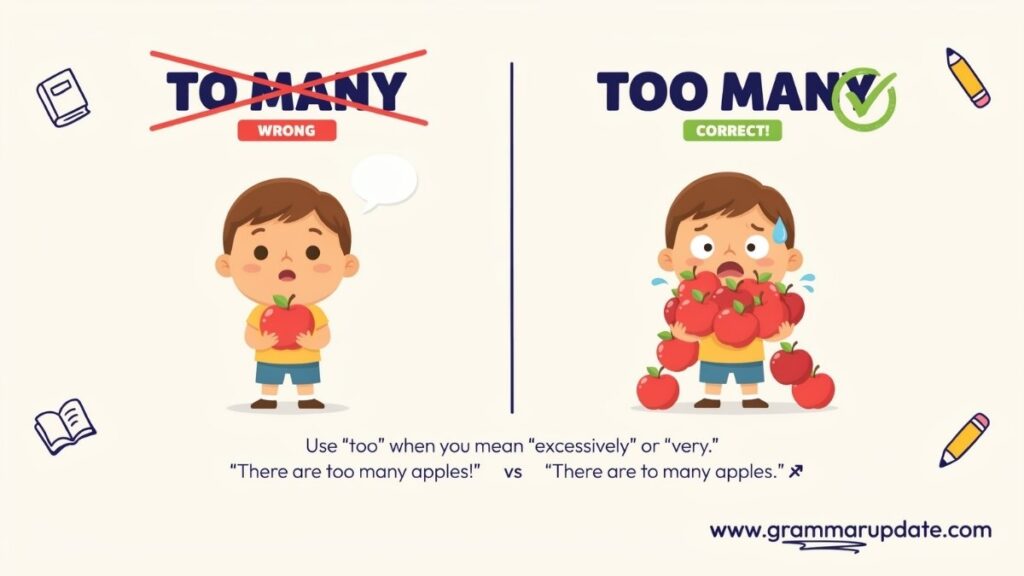
To many vs too many is a surprisingly common grammar mix-up. Since both phrases sound exactly the same, it’s easy to see why so many people confuse them. The only difference is one extra letter, yet that small change completely alters the meaning of a sentence. As a result, this mistake often slips into emails, school assignments, social media posts, and even business writing.
The good news is that you don’t need to memorize complicated grammar rules to get it right. Once you understand how each phrase works, the confusion disappears. In this guide, you’ll learn the difference between to many and too many, find out when each one is correct, avoid the mistakes that trip up many writers, and explore plenty of clear examples to help you use both phrases with confidence.
The Short Answer Is It To Many Vs Too Many?
Here’s the simple rule.
| Phrase | Correct? | When to Use It |
|---|---|---|
| Too many | Usually | When something exists in excessive quantity |
| To many | Sometimes | When to is a preposition followed by a noun phrase beginning with many |
Most of the time, if you’re talking about more than is needed, wanted, or acceptable, you should write too many.
For example:
- There are too many people in the room.
- I have too many emails to answer.
- She asked too many questions.
- We made too many mistakes.
Each sentence expresses excess.
Now compare these examples.
- The teacher spoke to many students after class.
- The award meant a lot to many families.
- The announcement came as a surprise to many people.
These sentences use to as a preposition, not an adverb. That’s why to many is perfectly grammatical here.
Quick Tip: If you can replace too many with an excessive number of, you’ve probably chosen the correct phrase.
For example:
- We received too many applications.
- We received an excessive number of applications.
Both sentences mean the same thing.
What Does “Too Many” Mean?
Understanding the too many meaning is surprisingly simple.
Too many means more than necessary, more than desired, or more than acceptable.
It always expresses the idea of excessive quantity.
Unlike words such as many or a lot of, too many carries a negative implication. It suggests there’s a problem because the quantity exceeds what’s appropriate.
Examples of “Too Many”
- There are too many cars on the highway.
- She owns too many shoes.
- We received too many complaints this week.
- The teacher assigned too many exercises.
- I ate too many cookies yesterday.
In every example, the speaker believes the amount is excessive.
Notice something else.
Every noun is countable.
- Cars
- Shoes
- Complaints
- Exercises
- Cookies
That’s not a coincidence. It’s one of the most important grammar rules surrounding too many in English grammar.
Why “Too” Changes Everything
Many learners already know the word many.
It simply refers to a large number.
For example:
- Many students attended the lecture.
- Many books were donated.
These sentences are neutral. They don’t express approval or criticism.
Now add the word too.
- Too many students attended the lecture.
- Too many books were donated.
The speaker now implies that the number became excessive.
That tiny extra letter transforms the meaning completely.
| Expression | Meaning |
|---|---|
| Many | A large number |
| Too many | More than necessary or desirable |
This distinction appears constantly in everyday English.
Learn the difference between confusing more English words
Nitch vs Niche Difference and Which Is Correct?
What Does “To Many” Mean?
One of the biggest misconceptions in English grammar is that to many is always wrong.
It isn’t.
Although it’s much less common than too many, to many becomes correct whenever to functions as a preposition instead of an adverb.
How “To” Works
The word to has several grammatical functions.
It can:
- Show direction
- Introduce an indirect object
- Connect ideas
- Begin a prepositional phrase
When a noun phrase begins with many, the combination naturally becomes to many.
For example:
- The speech appealed to many voters.
- The message was clear to many readers.
- The donation brought hope to many families.
- The policy mattered to many businesses.
Nothing is incorrect here.
The phrase simply means to a large number of people or things.
Compare the Meanings
Look at these two sentences.
The announcement confused too many employees.
This means an excessive number of employees became confused.
Now compare it with:
The announcement mattered to many employees.
This means it mattered to a large number of employees.
The grammar changes because the function of to changes.
Fix common more word mistakes in English
Clutz vs Klutz Which Spelling Is Correct in English?
Too Many vs To Many What’s the Difference?
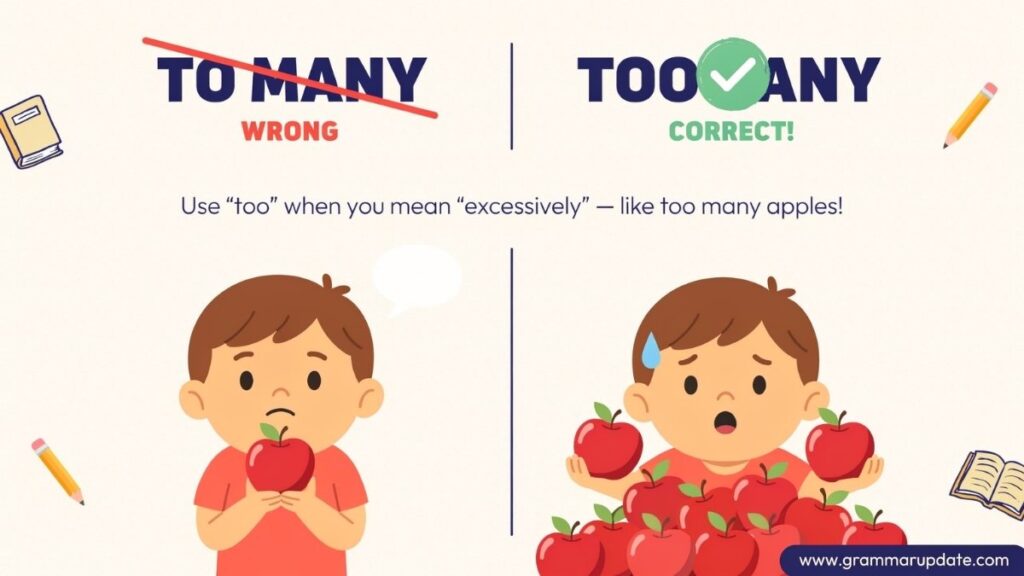
Although the phrases differ by just one letter, they serve completely different purposes.
| Feature | Too Many | To Many |
|---|---|---|
| Meaning | Excessive number | To a large number of |
| Function | Adverb + determiner | Preposition + determiner |
| Indicates excess | Yes | No |
| Common in English | Very common | Less common |
| Usually followed by | Countable plural nouns | A noun phrase beginning with many |
Think about the sentence structure.
Too many describes quantity.
To many connects a verb, adjective, or noun with another noun phrase.
Side-by-Side Examples
| Correct Usage | Why It Works |
|---|---|
| There are too many visitors today. | Excessive quantity |
| She answered too many emails before lunch. | More than desired |
| The announcement mattered to many people. | Prepositional phrase |
| The changes brought relief to many families. | Shows relationship |
Once you identify the role of to, choosing the correct phrase becomes much easier.
Manor vs Manner Which One Is Correct?
When Should You Use “Too Many”?
If you’re asking “How to use too many correctly,” remember one rule above all others.
Use “too many” only with countable plural nouns.
That’s because many modifies count nouns, not mass nouns.
Use It With Countable Nouns
Countable nouns are things you can count individually.
Examples include:
- Books
- Students
- Apples
- Files
- Cars
- Questions
- Mistakes
- Notifications
- Emails
- Visitors
Correct examples include:
- There are too many books on the shelf.
- We hired too many employees.
- I received too many notifications today.
- They asked too many questions.
Each noun has a singular and plural form.
That’s the key.
Use It When Quantity Becomes a Problem
The phrase doesn’t simply describe a large number.
It describes an excessive quantity.
Consider these examples.
| Sentence | Meaning |
|---|---|
| We invited many guests. | A lot of guests attended. |
| We invited too many guests. | More guests attended than expected or desired. |
The difference lies in the speaker’s opinion.
Use It in Everyday Conversation
You’ll hear too many constantly in spoken English.
For example:
- I have too many tasks today.
- There are too many options.
- We’ve had too many meetings this week.
- You bought too many groceries.
- She receives too many emails every morning.
- There are too many ads on this website.
These examples sound completely natural because native speakers frequently use too many to express frustration, inconvenience, or overload.
Common Situations Where “Too Many” Appears
The phrase often appears when discussing:
- Workload
- Traffic
- School assignments
- Technology
- Business reports
- Customer service
- Social media
- Shopping
- Travel
- Education
For example:
“There are too many notifications on my phone.”
Almost everyone has said something similar.
That’s why mastering this expression immediately improves your everyday English.
Learn the difference between confusing more English words
Wait vs Weight Difference and usage?
When Is “To Many” Actually Correct?
Many grammar articles oversimplify this topic by claiming that to many is always incorrect.
That’s simply not true.
The phrase appears naturally whenever to functions as a preposition.
Recognizing these situations helps you avoid overcorrecting perfectly good sentences.
After Certain Verbs
Some verbs naturally pair with to.
Examples include:
- Speak to
- Write to
- Explain to
- Give to
- Send to
- Listen to
- Introduce to
Now add a noun phrase beginning with many.
- She explained the policy to many employees.
- We spoke to many customers yesterday.
- The company sent invitations to many clients.
- The charity distributed meals to many families.
Every sentence follows standard English grammar.
After Adjectives
Some adjectives also require to.
For example:
- Important to
- Helpful to
- Familiar to
- Meaningful to
Examples:
- The update was important to many users.
- This lesson is helpful to many students.
- The tradition remains meaningful to many communities.
Again, to many is correct because to belongs with the adjective.
At the Beginning of a Sentence
You’ll also find to many at the start of sentences.
Examples include:
- To many readers, the ending was unexpected.
- To many scientists, the discovery marked a turning point.
- To many parents, online safety remains a major concern.
These introductory phrases express someone’s point of view.
They’re common in journalism, academic writing, and formal English.
Why Spell Check Doesn’t Always Catch the Mistake
Many writers assume grammar checkers catch every error.
Unfortunately, that’s not how language works.
Consider these two sentences.
- There were to many people at the concert.
- The award mattered to many people.
The first sentence contains a spelling error.
The second sentence is perfectly correct.
Because both phrases exist in English, many grammar checkers rely on context to decide whether you’ve made a mistake. Even advanced proofreading tools occasionally miss errors when the surrounding sentence is ambiguous.
Learn how to use confusing more words correctly
Ally vs Allie Differences and Correct Usage
Too Many vs. Too Much vs. Too Few vs. So Many
One of the easiest ways to improve your English is to understand how these four expressions differ. They all describe quantity, yet each serves a different purpose.
Choosing the wrong one can make an otherwise well-written sentence sound awkward or grammatically incorrect.
The good news? Once you know whether you’re talking about countable nouns or uncountable nouns, picking the right expression becomes much easier.
Quick Comparison
| Expression | Used With | Meaning | Example |
|---|---|---|---|
| Too many | Countable nouns | More than needed | There are too many books on the shelf. |
| Too much | Uncountable nouns | More than needed | There’s too much water in the glass. |
| Too few | Countable nouns | Less than needed | We have too few chairs for everyone. |
| So many | Countable nouns | A large number without implying a problem | She has so many friends. |
Although these phrases look similar, they don’t express the same idea.
- Too many and too much both suggest excessive quantity.
- Too few suggests there isn’t enough.
- So many simply emphasizes a large number. It doesn’t automatically imply anything negative.
When to Use “Too Many”
Use too many when something can be counted individually and the number is greater than what’s acceptable.
Examples include:
- There are too many people in the waiting room.
- I have too many emails to answer today.
- The report contains too many mistakes.
- We’ve received too many customer complaints this month.
- She asked too many questions during the meeting.
In each sentence, the noun has a singular and plural form.
- One email → two emails
- One visitor → many visitors
- One file → several files
That’s exactly when too many belongs.
When to Use “Too Much”
Now compare those examples with nouns that can’t usually be counted one by one.
For example:
- Water
- Sugar
- Information
- Advice
- Furniture
- Money
- Traffic
- Homework
These are uncountable nouns, sometimes called mass nouns.
Correct examples include:
- There’s too much traffic this morning.
- She drinks too much coffee.
- We received too much information at once.
- The recipe contains too much salt.
- He spends too much money on gadgets.
Notice that you wouldn’t normally say:
- ❌ Too many traffic
- ❌ Too many information
- ❌ Too many furniture
These nouns aren’t counted individually, so too much is the correct choice.
When to Use “Too Few”
While too many describes excess, too few describes shortage.
Examples include:
- We have too few volunteers.
- The classroom has too few desks.
- There are too few parking spaces.
- She made too few copies of the document.
Think of it this way:
| Expression | Meaning |
|---|---|
| Too many | More than needed |
| Too few | Fewer than needed |
They’re opposites.
When to Use “So Many”
Many learners confuse so many with too many, but their meanings aren’t the same.
Consider these sentences.
We have so many books.
This simply emphasizes the number.
Now compare it with:
We have too many books.
Now the speaker believes the number has become excessive.
The difference lies in attitude, not grammar.
A Simple Rule to Remember
Ask yourself two questions.
Can I count the noun?
If yes, use many.
Is the quantity excessive?
If yes, use too many.
If the noun can’t be counted, switch to too much instead.
Learn the difference between confusing more English words
Oftentimes vs Often Times Which One Is Correct?
Countable vs. Uncountable Nouns
Understanding countable nouns and uncountable nouns is the foundation of correct English grammar.
It’s also the key to learning how to use too many correctly.
Many grammar errors happen because writers focus on the adjective instead of the noun that follows it.
What Are Countable Nouns?
A countable noun refers to something you can count as individual units.
Examples include:
- Books
- Cars
- Students
- Pens
- Cookies
- Houses
- Files
- Questions
- Visitors
- Mistakes
You can say:
- One book
- Two books
- Fifty books
Because these nouns have singular and plural forms, they work perfectly with too many.
Examples:
- There are too many books on my desk.
- She owns too many pairs of shoes.
- We’ve scheduled too many meetings this week.
- The teacher assigned too many grammar exercises.
These are all examples of correct English usage.
What Are Uncountable Nouns?
An uncountable noun describes something viewed as a whole rather than individual items.
Common examples include:
- Water
- Milk
- Rice
- Air
- Furniture
- Information
- Advice
- Research
- Knowledge
- Equipment
You wouldn’t normally count these as one, two, or three.
Instead, you measure them.
For example:
- A glass of water
- A piece of furniture
- A bit of advice
- A grain of rice
That’s why these nouns require too much, not too many.
Correct examples:
- There’s too much noise outside.
- We collected too much data.
- He received too much advice.
- The room contains too much furniture.
Some Nouns Can Be Both
English includes a few nouns that change meaning depending on context.
Consider the word chicken.
- We bought too much chicken for dinner. (meat)
- There are too many chickens in the yard. (animals)
The same word changes from uncountable to countable depending on what it represents.
Other examples include:
- Paper
- Coffee
- Glass
- Hair
Context determines which grammar rule applies.
Quick Test
If you’re unsure which expression to use, ask yourself these questions.
| Question | If the Answer Is Yes |
|---|---|
| Can I count it? | Use too many |
| Is it measured instead of counted? | Use too much |
| Is there not enough? | Use too few |
| Am I simply emphasizing a large number? | Use so many |
This quick check solves most grammar questions in seconds.
Learn the difference between confusing more English words
Emersion vs Immersion Differences and Correct Usage
Common Examples of “Too Many”
Seeing grammar in context makes it much easier to remember.
Below are some of the most common expressions you’ll hear in everyday English.
Too Many People
This phrase appears frequently when discussing crowds or overcrowding.
Examples:
- There were too many people at the concert.
- The restaurant was closed because there were too many people waiting outside.
- We invited too many people to the party.
Too Many Times
This expression refers to repetition beyond what’s acceptable.
Examples:
- I’ve explained this too many times.
- She apologized too many times.
- We’ve watched that movie too many times.
Too Many Mistakes
Writers, students, and teachers often use this phrase.
Examples:
- The essay contains too many mistakes.
- Your report has too many spelling errors.
- The software produced too many bugs after the update.
Too Many Emails
Modern workplaces generate endless email traffic.
Examples:
- I receive too many emails every morning.
- We deleted too many emails by accident.
- There are too many unread emails in my inbox.
Too Many Questions
Examples:
- The interviewer asked too many questions.
- My toddler asks too many questions before bedtime.
- Customers submitted too many questions for one session.
Too Many Choices
Sometimes having more options isn’t better.
Examples:
- The menu has too many choices.
- Streaming services offer too many movies to choose from.
- There are too many options, so making a decision feels harder.
These too many sentence examples reflect natural, everyday English and show how often this expression appears in conversation, writing, and business communication.
Learn the difference between confusing more English words
Reinforce vs Reenforce Which Spelling Is Correct?
Is “Too Many More” Grammatically Correct?
Many English learners search for phrases like “too many more or to many more” or “to many or too many more years.”
The answer depends on context.
In most cases, too many more sounds awkward because both too and more increase quantity.
For example:
❌ We need too many more volunteers.
Native speakers usually choose a clearer alternative.
Better options include:
- We need many more volunteers.
- We need far more volunteers.
- We need a lot more volunteers.
However, too many more can be correct when emphasizing that the additional number itself is excessive.
For example:
We can’t wait too many more years before repairing the bridge.
Here, the speaker means that waiting any additional years would be unacceptable.
Although grammatically correct, this construction appears far less often than many more.
Common Alternatives
Instead of writing:
- Too many more people
- Too many more days
- Too many more mistakes
Consider using:
- Many more people
- Several more days
- Far more mistakes
- Much longer
- Considerably more
These alternatives usually sound smoother while preserving the intended meaning.
Learn the difference between confusing more English words
Molding vs Moulding Which Spelling Is Correct and Usage?
Common Grammar Mistakes and How to Fix Them
The confusion between to many vs too many is one of the most common English grammar mistakes. Since both phrases look almost identical, it’s easy to overlook the extra o. Even experienced writers make the mistake when typing quickly.
The good news is that once you understand how each phrase works, you’ll spot the error almost instantly.
Mistake: Using “To Many” Instead of “Too Many”
This is the mistake people make most often.
❌ There were to many people at the concert.
✅ There were too many people at the concert.
In this sentence, the speaker means there was an excessive quantity of people. Since too expresses excess, it’s the only correct choice.
Mistake: Using “Too Much” With Countable Nouns
Another common error is mixing up too much and too many.
❌ She has too much books.
✅ She has too many books.
Remember that books are countable nouns, so they require many, not much.
Mistake: Using “Too Many” With Uncountable Nouns
The opposite mistake happens just as often.
❌ We received too many information.
✅ We received too much information.
Words like information, advice, equipment, and furniture are uncountable nouns. Even though they may refer to several things, English treats them as singular quantities.
Mistake: Confusing “To,” “Too,” and “Two”
These three words sound alike, but they have different meanings.
| Word | Meaning | Example |
|---|---|---|
| To | Preposition or part of an infinitive | She spoke to the manager. |
| Too | Means also or more than enough | There are too many mistakes. |
| Two | The number 2 | I bought two tickets. |
When proofreading, pause whenever you write one of these words. A quick check can prevent a common spelling mistake.
A Simple Memory Trick You’ll Actually Remember
Grammar rules are helpful, but a simple memory trick is often easier to recall in the middle of writing.
Think of the extra “o” in too as standing for “over.”
- Too = Over the limit
- Too many = More than you need
For example:
- Too many emails
- Too many meetings
- Too many notifications
Each example describes something that has gone beyond an acceptable amount.
Another quick test is to replace too many with an excessive number of.
If the sentence still makes sense, you’ve probably chosen the correct phrase.
Example:
- There were too many cars on the road.
- There were an excessive number of cars on the road.
Both versions express the same idea.
Fix common more word mistakes in English
Muscle vs Mussel Which is Difference and usage?
Practice Session To Many vs Too Many
Fill in the Blanks
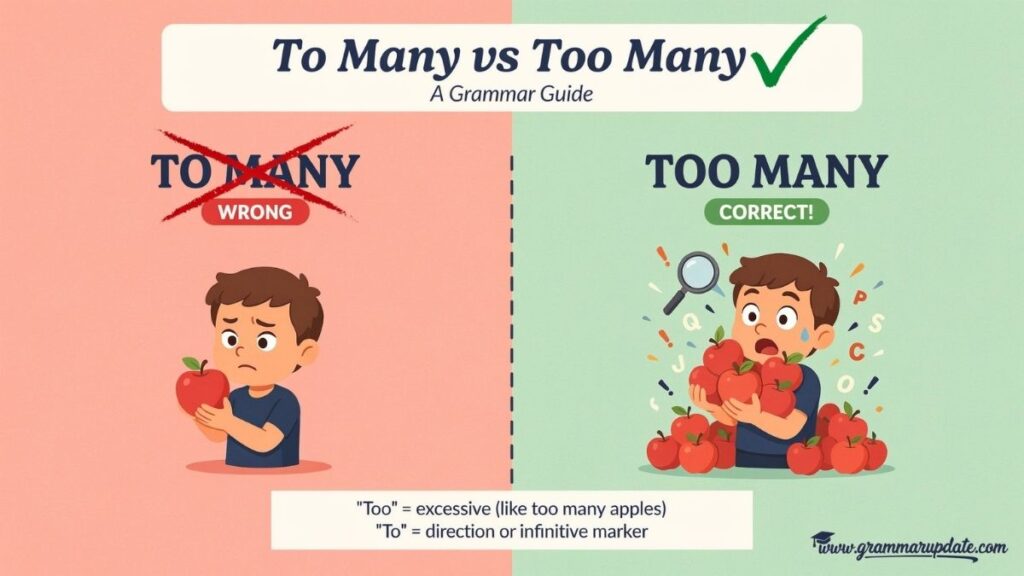
Test your understanding of to many and too many by completing the sentences below. Choose the correct phrase based on the context.
Questions
- There were __________ people waiting outside the stadium.
- The teacher spoke __________ students after class.
- We received __________ emails this morning.
- The announcement meant a lot __________ employees.
- I asked __________ questions during the interview.
- The new policy brought relief __________ families.
- There are __________ books on my desk.
- The manager explained the changes __________ team members.
- She made __________ mistakes on the final exam.
- The award was important __________ young athletes.
- We’ve had __________ meetings this week.
- The scholarship gave hope __________ students.
- There are __________ cars in the parking lot.
- The speech appealed __________ voters across the country.
- I ate __________ cookies after dinner.
- The charity distributed food __________ communities in need.
- There were __________ visitors at the museum today.
- The message was clear __________ readers.
- We encountered __________ problems during the project.
- The decision came as a surprise __________ employees.
- The report contains __________ spelling errors.
- The changes mattered __________ business owners.
- She received __________ notifications on her phone.
- The coach talked __________ players before the game.
- We’ve spent __________ hours discussing the same issue.
Answers
| Question | Correct Answer |
|---|---|
| 1 | too many |
| 2 | to many |
| 3 | too many |
| 4 | to many |
| 5 | too many |
| 6 | to many |
| 7 | too many |
| 8 | to many |
| 9 | too many |
| 10 | to many |
| 11 | too many |
| 12 | to many |
| 13 | too many |
| 14 | to many |
| 15 | too many |
| 16 | to many |
| 17 | too many |
| 18 | to many |
| 19 | too many |
| 20 | to many |
| 21 | too many |
| 22 | to many |
| 23 | too many |
| 24 | to many |
| 25 | too many |
Here’s a trusted source for clear word meanings:
FAQs
Is it to many or too many?
In most situations, the correct phrase is too many because it means “more than necessary” or “an excessive number.” Use to many only when to is a preposition.
Examples:
- There are too many people in the room.
- The announcement mattered to many people.
Learn how to use confusing more words correctly
Finaly vs Finally Differences and Usage
What is the difference between to many and too many?
The difference lies in their meaning and grammar.
- Too many expresses an excessive number of countable nouns.
- To many is a prepositional phrase where to connects the verb or adjective to a noun phrase beginning with many.
Although they look similar, they are not interchangeable.
What does too many mean?
Too many means more than is needed, wanted, or acceptable. It always describes an excessive quantity of countable nouns.
Examples:
- Too many books
- Too many emails
- Too many mistakes
- Too many visitors
When should you use too many?
Use too many whenever you’re talking about countable nouns and the quantity is excessive.
For example:
- There are too many students in the classroom.
- We received too many complaints this week.
- She asked too many questions during the meeting.
Is to many ever correct?
Yes. To many is grammatically correct when to functions as a preposition.
For example:
- The speech appealed to many voters.
- The decision was important to many employees.
- The new policy brought relief to many families.
Why is to many often incorrect?
People usually write to many when they actually mean too many. Since too expresses excess, it’s the correct choice when describing a number that’s larger than expected or desired.
How do you use too many in a sentence?
Here are a few examples:
- I have too many emails to answer.
- There are too many cars on the road.
- We’ve made too many mistakes.
- She owns too many books.
What are some common too many examples?
You’ll hear too many in everyday conversations and writing.
Some common examples include:
- Too many people
- Too many books
- Too many questions
- Too many mistakes
- Too many cookies
- Too many notifications
- Too many files
- Too many meetings
Learn how to use confusing more words correctly
Waring vs Wearing Differences and Usage with Examples
What is the difference between too many and too much?
The difference depends on the noun that follows.
| Expression | Used With | Example |
|---|---|---|
| Too many | Countable nouns | Too many students |
| Too much | Uncountable nouns | Too much traffic |
If you can count the noun, use too many. If you measure it instead, use too much.
Is it too much food or too many food?
The correct phrase is too much food because food is generally an uncountable noun.
Correct:
- We cooked too much food.
Incorrect:
- We cooked too many food.
Is it correct to say too much traffic?
Yes. Traffic is an uncountable noun, so too much traffic is the correct expression.
Example:
- There was too much traffic, so we arrived late.
Is to much ever correct?
No. To much is not correct in standard English when you mean an excessive amount. The correct expression is too much.
Which is correct: to much or too much?
The correct phrase is too much because too means “more than enough.”
Example:
- She spends too much money on clothes.
How do you use to and too correctly?
Use to as a preposition or before a verb.
Examples:
- I walked to the store.
- I want to learn English.
Use too to mean “also” or “more than enough.”
Examples:
- I’d like to come, too.
- There are too many mistakes in the report.
Why do people confuse to and too?
The words to and too sound exactly the same when spoken. Because they’re homophones, many people accidentally choose the wrong spelling while writing.
How can you remember the difference between to and too?
A simple trick is to remember that too has an extra o.
Think of the extra letter as standing for over.
- Too = Over the limit
- Too many = More than needed
This memory trick makes it easier to choose the correct spelling.
Can you say to many people?
Yes. To many people is correct when to is a preposition.
Example:
- The announcement mattered to many people.
Is too many people grammatically correct?
Yes. Too many people is grammatically correct because people is a countable noun and the phrase expresses an excessive number.
Is too many times correct?
Yes. Use too many times when something happens more often than it should.
Example:
- I’ve seen that movie too many times.
Is too many more grammatically correct?
Yes, but it’s uncommon. Native speakers often prefer many more, far more, or a lot more because those expressions sound smoother.
What part of speech is too in too many?
In the phrase too many, too is an adverb. It modifies many by showing that the quantity exceeds what’s needed or acceptable.
What part of speech is many?
Many is a determiner, also called a quantifier. It modifies countable nouns to indicate a large number.
Can grammar checkers detect to many and too many mistakes?
Not always. Since both to many and too many can be grammatically correct in different contexts, grammar checkers sometimes miss errors. Reading the sentence carefully is the most reliable way to catch mistakes.
Is too many appropriate in formal writing?
Yes. Too many is appropriate in both formal and informal English. You’ll find it in academic papers, business writing, news articles, and everyday conversations.
What’s the easiest way to choose between to many and too many?
Ask yourself this question:
Do I mean “more than necessary”?
If the answer is yes, use too many.
If to simply connects the sentence to a noun phrase, to many may be the correct choice.
Fix common more word mistakes in English
Girlie vs Girly Which Spelling Is Correct?
Conclusion
The to many vs. too many confusion comes down to one tiny letter, but that extra “o” makes a world of difference. Since both phrases sound exactly the same, it’s easy to see why this mistake appears in everything from classroom assignments to business emails. The good news is that once you understand the rule, you’ll rarely second-guess yourself again.
Here’s the rule you’ll want to remember: if you’re talking about more than necessary, the correct choice is too many. If to is simply functioning as a preposition, then to many is perfectly acceptable. Instead of relying on spell check, focus on the meaning of your sentence. A few extra seconds of proofreading can prevent a mistake that many writers overlook.
Think of the extra “o” in too as your grammar safety net. It may be small, but it carries all the weight when you’re expressing excess. After a little practice, choosing between to many and too many won’t feel like a grammar puzzle anymore. It’ll become a habit, and your writing will be clearer, more polished, and easier for every reader to understand.

Jhon AJS, the creative mind behind Grammar Update, is an experienced blogger passionate about simplifying English grammar. He focuses on explaining confusing word vs word differences, grammar rules, punctuation, and sentence structure in a clear and practical way. Through easy to understand guides and examples, Jhon helps readers improve their writing and communicate with confidence. With years of blogging experience, he continues to share helpful insights that make learning grammar simple, useful, and accessible for everyone.