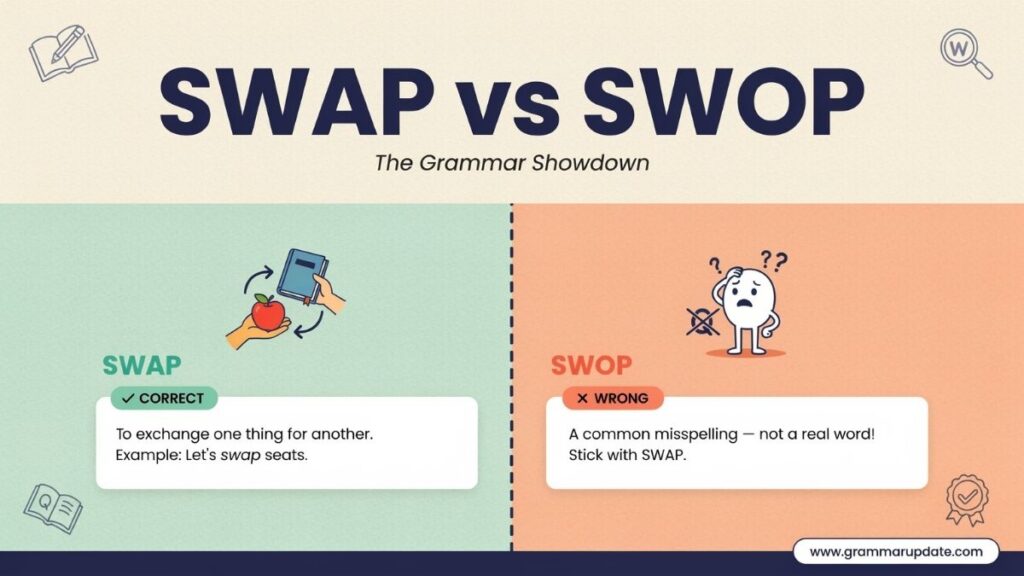
Have you ever paused while writing because you couldn’t decide between swap and swop? Don’t worry English loves keeping writers on their toes. The good news is that this confusion is easy to fix. In the swap vs swop debate, both words have the same meaning: to exchange one thing for another. The real difference isn’t grammar or definition it’s spelling and modern usage. Today, swap is the standard spelling, while swop is an older British variant that appears far less often. This guide explains everything in simple language, with practical examples, grammar tips, and expert guidance to help you choose the correct spelling every time.
Swap vs Swop The Quick Answer
If you’re short on time, remember this simple rule.
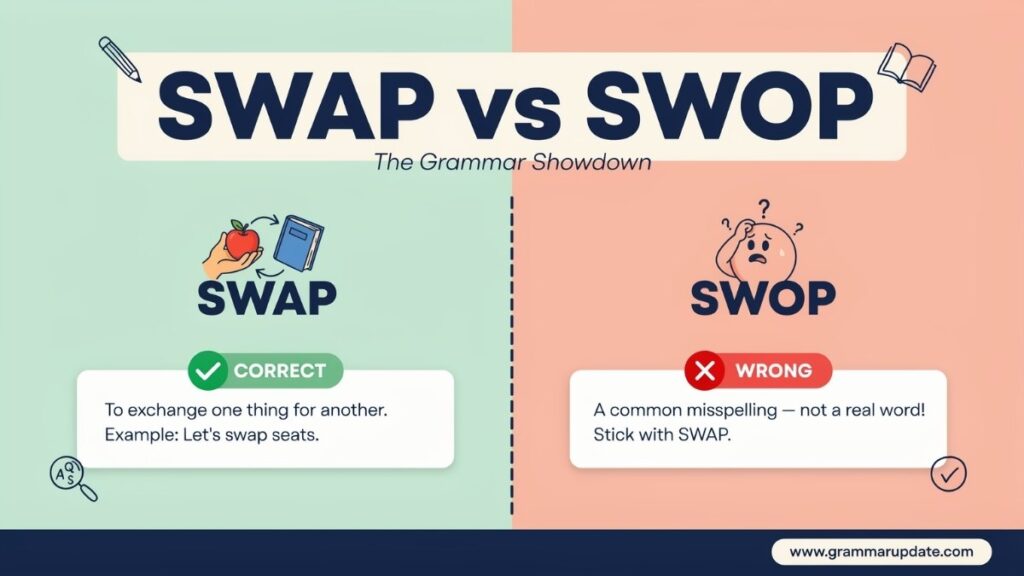
Use swap in almost every situation. Swop is an older British spelling that still appears occasionally, but swap is the standard spelling in modern English.
Both words have the same meaning. The difference is their spelling, popularity, and regional usage not their definition.
| Feature | Swap | Swop |
|---|---|---|
| Meaning | Exchange something | Exchange something |
| Part of speech | Noun and verb | Noun and verb |
| Modern status | Standard spelling | Historical or regional variant |
| Common in the US | Yes | Rare |
| Common in the UK | Yes | Occasionally |
| Common in Australia & Canada | Yes | Very uncommon |
| Recommended for most writing | Yes | No |
Quick Rule
- Use swap in school, business, and everyday writing.
- Use swop only when quoting historical sources or preserving older British spelling.
- If your audience is international, swap is the safest and clearest choice.
The Short Answer: Is It Swap or Swop?
The answer depends less on grammar than on modern language usage.
Today, swap is the accepted spelling across nearly every English-speaking country. You’ll find it in newspapers, books, websites, academic writing, business communication, and everyday conversation.
The spelling swop isn’t technically wrong. It simply isn’t the preferred choice anymore. Most dictionaries list it as a less common or chiefly British variant.
Think of it this way.
Both spellings mean exactly the same thing. One simply became the standard over time.
If you’re ever unsure which spelling to choose, use swap.
What Does “Swap” Mean?
Swap Definition
The swap definition is simple.
Swap means to exchange one thing for another.
The exchange may involve physical objects, information, ideas, responsibilities, positions, or digital assets.
Swap Meaning
The swap meaning includes several closely related ideas:
- Exchange something
- Trade one item for another
- Switch positions
- Replace one thing with another
- Interchange items
Unlike giving something away, a swap usually means both sides receive something in return.
For example:
- Let’s swap seats.
- We swapped phone numbers.
- The teams swapped players.
- Can you swap your shift with mine?
Each example describes an exchange between two people or groups.
Swap as a Verb
As a verb, swap describes the act of exchanging something.
Examples:
- We swapped gifts after dinner.
- They swapped ideas during the meeting.
- I’ll swap my sandwich for yours.
- She swapped apartments with her sister.
- The managers swapped responsibilities for the week.
Swap as a Noun
Swap also works as a noun.
Examples:
- The book swap attracted hundreds of readers.
- We organized a clothing swap.
- Their player swap changed the season.
- The memory swap improved system performance.
Its flexibility as both a noun and a verb is one reason the word appears so often in everyday English.
Common Contexts Where “Swap” Appears
You’ll find swap in many different situations.
Everyday Conversation
People commonly say:
- Swap seats
- Swap stories
- Swap recipes
- Swap gifts
- Swap clothes
Business
Organizations often:
- Swap contracts
- Swap inventory
- Swap suppliers
- Swap shifts
Technology
In computing, you’ll hear terms such as:
- Swap file
- Swap space
- Memory swap
Finance
Financial professionals use expressions like:
- Interest rate swap
- Currency swap
- Credit default swap
Although these technical meanings differ slightly from everyday conversation, they all involve some form of exchange.
What Does “Swop” Mean?
Swop Definition
The swop definition is almost identical to swap.
Swop means to exchange one thing for another.
The meaning hasn’t changed. Only the preferred spelling has.
Swop Meaning
The swop meaning includes:
- Exchange
- Trade
- Switch
- Replace
- Interchange
Examples:
- They swopped bicycles.
- We swopped addresses.
- She wants to swop shifts.
Each sentence means exactly the same thing as if swap had been used.
Is Swop Correct?
One of the most common questions is, “Is swop correct?”
Yes. Swop is a genuine English word.
However, it has become uncommon in modern writing. Most dictionaries recognize it as an older or chiefly British spelling rather than the standard form.
That’s why professional writers, editors, publishers, and educators almost always choose swap.
Swop Word Meaning in Modern English
The swop word meaning hasn’t changed over time.
What has changed is its popularity.
Many younger readers rarely encounter swop. Some may even assume it’s a spelling mistake because they almost always see swap instead.
That’s a good example of how language evolves. Meanings often stay the same while preferred spellings gradually change.
Learn the difference between more words people mix up
Tweek vs Tweak Difference and Correct Usage
Swap vs Swop The Key Difference
The swap vs swop difference is remarkably simple.
The two words have the same meaning, the same pronunciation, and the same grammatical function.
The only meaningful difference is that modern English overwhelmingly prefers swap.
| Feature | Swap | Swop |
|---|---|---|
| Meaning | Exchange | Exchange |
| Pronunciation | Same | Same |
| Grammar | Same | Same |
| Popularity | Very high | Low |
| Standard English | Yes | Rarely |
| Preferred today | Yes | No |
What Is the Difference Between Swap and Swop?
If someone asks, “What is the difference between swap and swop?” the answer is straightforward.
- They mean exactly the same thing.
- They are pronounced the same way.
- They follow the same grammar rules.
- Only the spelling differs.
For that reason, dictionaries classify swop as a spelling variant rather than a separate word.
Swap vs Swop Pronunciation
Both words are pronounced the same way.
- British English: /swɒp/
- American English: /swɑːp/
Because they sound identical, many people don’t notice the spelling difference until they see it in writing.
Swap vs Swop Grammar
The swap vs swop grammar rules are identical.
Both words function as nouns and verbs.
Examples:
Verb:
- We swapped books.
- We swopped books.
Noun:
- The swap saved everyone money.
- The swop saved everyone money.
Although both forms are grammatically acceptable, modern style guides and publishers overwhelmingly recommend using swap.
The History of Swap and Swop
Language never stands still.
The story behind swap and swop shows how English naturally changes over time.
No organization officially declared swap the winner. Instead, writers and speakers gradually favored one spelling until it became the standard.
Where Did “Swap” Come From?
The exact origin isn’t certain, but most language experts trace swap to northern English and Scottish dialects during the sixteenth and seventeenth centuries.
Early meanings included:
- Strike
- Exchange
- Bargain
- Trade
Over time, the word settled into its modern meaning of exchanging one thing for another.
How Did “Swop” Develop?
The spelling swop appeared later as a natural spelling variant.
Before English spelling became standardized, writers often spelled the same word in several different ways.
Examples include:
| Older Variant | Modern Standard |
|---|---|
| shew | show |
| connexion | connection |
| musick | music |
| publick | public |
| swop | swap |
This kind of variation was common for centuries.
Learn the difference between more words people mix up
Cheer vs Chear difference and Usage Guide
Why Is Swap More Common Than Swop?
Many people ask, “Why is swap more common than swop?”
Several factors explain the change.
- Dictionaries gradually adopted swap as the preferred spelling.
- Schools began teaching swap as the standard form.
- Publishers wanted consistency across books and newspapers.
- Global communication encouraged spellings that readers recognized everywhere.
As a result, swap became the accepted spelling in modern English.
Today, it’s the form you’ll see in newspapers, websites, business documents, academic writing, and everyday communication around the world.
“Language belongs to its speakers. Dictionaries record how people use words rather than deciding how they must be used.”
That idea explains why swap became the standard. People simply used it more often until it became the common spelling.
Learn the difference between more words people mix up
Placque vs Plaque Difference and Correct Usage
Swap vs Swop in British English and American English
One of the most common questions about swap vs swop is whether the spelling changes between British English and American English.
The short answer is yes but only to a certain extent.
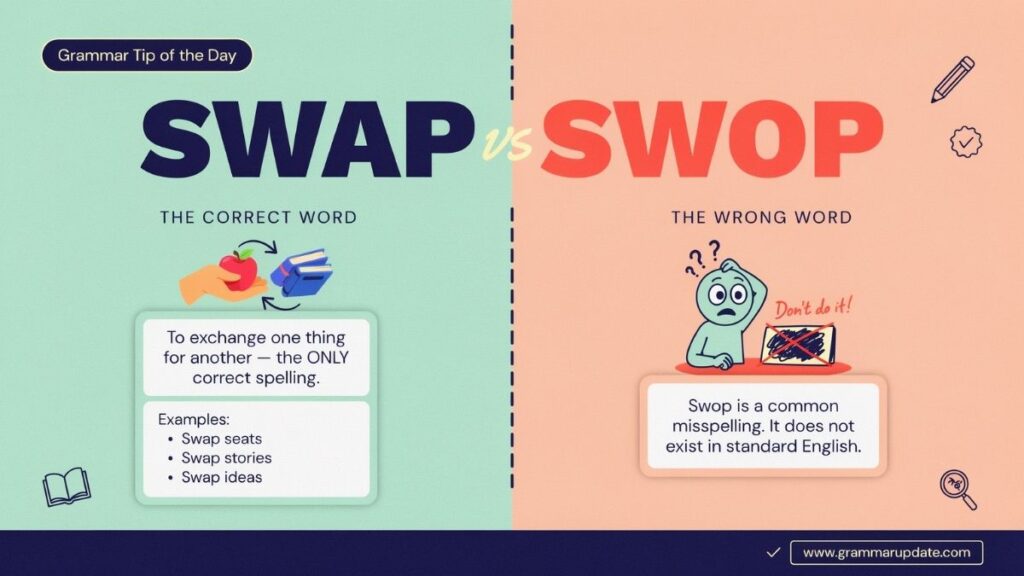
Historically, British English accepted both swap and swop. American English, however, has long favored swap. Over time, that preference spread across the English-speaking world. Today, swap is the standard spelling in nearly every variety of English, including British English.
Although swop still appears occasionally, especially in older books or historical texts, it’s no longer the spelling most writers or publishers choose.
Let’s see how each region uses the word today.
Swap vs Swop US
If you’re writing for an American audience, the choice couldn’t be simpler.
Swap is the only spelling you’ll regularly find in newspapers, books, websites, schools, and professional writing.
Examples include:
- Let’s swap phone numbers.
- The teams swapped players before the season.
- We swapped seats after intermission.
- She swapped her old laptop for a newer model.
The spelling swop is extremely uncommon in the United States. Most American readers would assume it’s either an old-fashioned spelling or a typo.
For that reason, always use swap when writing in American English.
Swap vs Swop UK
British English has a longer history with both spellings.
In the past, many British newspapers, magazines, and books used swop alongside swap. If you read older publications, you’ll still come across examples of swop from time to time.
Modern British English tells a different story.
Today, swap is the preferred spelling used by publishers, educators, businesses, and media organizations across the United Kingdom.
You’ll commonly see sentences such as:
- Let’s swap places.
- We swapped addresses.
- They swapped Christmas gifts.
- The clubs swapped players during the transfer window.
Although swop hasn’t disappeared completely, it now survives mainly in older writing, archived documents, and occasional stylistic choices.
Australian English
Australian English follows the same pattern.
Whether you’re reading a newspaper, browsing a website, or writing an email, swap is the accepted spelling.
Common examples include:
- Swap recipes.
- Swap jerseys after the game.
- Swap classrooms.
- Swap shifts next week.
You’ll rarely encounter swop in modern Australian publications.
Canadian English
Canadian English also favors swap.
It’s the spelling used in schools, government publications, newspapers, and everyday communication.
Examples include:
- Swap winter tires before the snow arrives.
- We swapped books at the library.
- Let’s swap schedules.
- They swapped contact information after the meeting.
As in other regions, swop appears only occasionally and is generally considered an older spelling.
Other English Speaking Countries
The same trend extends across the rest of the English-speaking world.
Whether you’re writing for readers in:
- Ireland
- New Zealand
- South Africa
- India
- Singapore
Swap is the spelling they’ll expect to see.
That consistency makes it the safest choice for international communication.
Regional Usage Comparison
| Region | Preferred Spelling | Is Swop Common? |
|---|---|---|
| United States | Swap | No |
| United Kingdom | Swap | Occasionally in older usage |
| Canada | Swap | Rare |
| Australia | Swap | Rare |
| New Zealand | Swap | Rare |
| International English | Swap | Very rare |
The pattern is clear.
No matter where your readers live, swap is the spelling they’ll recognize first.
What Major Dictionaries Say About Swap vs Swop
When deciding between two spellings, dictionaries are one of the most reliable sources.
Rather than telling people how language should work, dictionaries document how people actually use words.
In the case of swap vs swop, the evidence is remarkably consistent.
Every major dictionary recognizes swap as the standard spelling used in modern English. Most also include swop, but they identify it as a less common or chiefly British variant.
Oxford English Dictionary
The Oxford English Dictionary includes both spellings.
However, it lists swap as the standard modern form, while swop is identified as a variant that has become much less common over time.
Cambridge Dictionary
The Cambridge Dictionary consistently uses swap in its definitions and example sentences.
Typical examples include:
- Swap phone numbers.
- Swap ideas.
- Swap places.
The dictionary rarely uses swop except when discussing spelling variations.
Merriam-Webster
Merriam-Webster recognizes swap as both a noun and a verb.
The spelling swop appears only as a variant, reflecting its limited use in modern American English.
Collins Dictionary
Collins Dictionary also lists both spellings, but its examples and definitions consistently favor swap as the standard choice.
Dictionary Comparison
| Dictionary | Swap | Swop |
|---|---|---|
| Oxford English Dictionary | Standard spelling | Variant spelling |
| Cambridge Dictionary | Standard spelling | Variant spelling |
| Merriam-Webster | Standard spelling | Variant spelling |
| Collins Dictionary | Standard spelling | Variant spelling |
The message from these dictionaries is consistent.
While swop remains a legitimate word, swap is the accepted spelling for modern English.
Learn the difference between everyday English mistakes
Trauma vs Trama Difference and Correct Usage
What Style Guides Recommend
Professional editors value clarity and consistency. That’s why most style guides recommend using the spelling readers expect.
Fortunately, they all point in the same direction.
AP Style
The Associated Press Stylebook uses swap in news writing.
You’ll almost never see swop in AP publications unless the original source uses that spelling.
Chicago Manual of Style
The Chicago Manual of Style also favors swap.
When quoting historical documents, Chicago recommends preserving the original spelling. For all other writing, the modern standard is swap.
Academic Writing
Schools, colleges, and universities encourage students to use the standard spelling found in current dictionaries.
That means essays, research papers, dissertations, and academic articles should almost always use swap.
Business Writing
Clear communication matters in the workplace.
Whether you’re writing an email, report, proposal, or presentation, swap is the spelling readers expect.
Using swop may distract your audience because many people mistake it for a spelling error.
Learn the difference between everyday English mistakes
Bailer vs Baler the Difference and Usage
Swap vs Swop Examples
Nothing explains a word better than seeing it in context.
These examples show how swap naturally fits into modern English.
Everyday Conversation
- Let’s swap seats so everyone gets a better view.
- We swapped birthday gifts after dinner.
- Can we swap places for a few minutes?
- They swapped stories over coffee.
- We swapped recipes at the family reunion.
School
- The students swapped notebooks for peer review.
- We swapped project partners before the presentation.
- They swapped study guides to prepare for the exam.
- The teacher asked everyone to swap papers for grading.
Business
- The departments swapped responsibilities for the new project.
- Two employees swapped shifts to cover the weekend.
- They swapped office locations after the renovation.
- The companies swapped resources to reduce operating costs.
Sports
- The clubs swapped players before the transfer deadline.
- The athletes swapped jerseys after the match.
- The coaches swapped tactical ideas during the conference.
- The teams swapped ends at halftime.
Technology
- The operating system created a swap file to improve memory management.
- The computer relied on swap space when physical memory became full.
- The technicians swapped hard drives during maintenance.
- Engineers swapped hardware components for testing.
Coaches vs Coach’s Difference and Usage
Common Phrases with “Swap”
The word swap appears in countless everyday expressions.
| Phrase | Meaning |
|---|---|
| Swap places | Exchange positions |
| Swap seats | Exchange chairs |
| Swap stories | Share experiences |
| Swap ideas | Exchange suggestions |
| Swap numbers | Exchange phone numbers |
| Swap roles | Exchange responsibilities |
| Swap clothes | Exchange clothing |
| Swap gifts | Exchange presents |
| Swap recipes | Exchange cooking ideas |
| Swap files | Exchange digital files |
Every expression revolves around the same central idea: exchanging one thing for another.
Learn the difference between everyday English mistakes
Enflamed vs Inflamed Which One Is Correct?
Common Mistakes People Make
Although swap is an easy word to spell, a few common mistakes continue to confuse writers.
Assuming Swop Is Wrong
Many people believe swop isn’t a real word.
It is.
However, it’s an older spelling that has largely fallen out of everyday use.
Mixing Both Spellings
Avoid switching between swap and swop in the same document.
❌ We swapped books, and later we swopped magazines.
✅ We swapped books, and later we swapped magazines.
Consistent spelling makes your writing look polished and professional.
Using Swop in Formal Writing
While swop isn’t incorrect, it’s rarely the best choice for modern writing.
Most editors, publishers, and teachers expect the standard spelling: swap.
Learn the difference between similar more English words
Targetted vs Targeted Which Spelling Is Correct?
Thinking the Words Have Different Meanings
They don’t.
Both spellings mean “to exchange.”
Only their popularity and modern usage differ.
Confusing Swap with Similar Words
Although they’re related, these words aren’t always interchangeable:
- Exchange
- Trade
- Switch
- Replace
- Substitute
- Barter
For example, replacing a battery doesn’t necessarily involve receiving another one in return. A swap, however, always implies an exchange between two parties.
Choosing the right word helps your writing sound more precise.
Learn the difference between similar more English words
Socialise vs Socialize Which One Is Correct?
Why Consistency Matters
Consistency builds trust with your readers.
Imagine reading an article that switches between color and colour or organize and organise. Even if both spellings are correct, the inconsistency feels distracting.
The same principle applies to swap and swop.
If you’re writing for a modern audience, stick with swap throughout your document. Your writing will feel smoother, more professional, and easier to read.
It also improves:
- Readability
- Professionalism
- Editorial consistency
- Search engine optimization
- Reader confidence
Unless you’re quoting a historical source or preserving original spelling, swap is the clearest and most widely accepted choice in modern English.
In the next section, you’ll discover which spelling to use in different situations, explore more than 20 sentence examples, learn useful synonyms, test your knowledge with a practice quiz, and find answers to the most frequently asked questions about swap vs swop.
A polished version of Part 3 without bold text would improve readability and maintain a more natural editorial style.
Learn the difference between similar more English words
Persue vs Pursue Which Spelling Is Correct?
Which One Should You Use Today?
If you’re still wondering, should I use swap or swop?, the answer is straightforward.
For almost every situation, choose swap.
It is the standard spelling in modern English and the version readers expect to see. Whether you’re writing a school paper, a business email, a blog post, or a social media update, swap is the safest and most widely accepted choice.
Although swop is a genuine word with historical roots, it has become uncommon. Using it in modern writing may distract readers or make them think you’ve made a spelling mistake.
Here’s a quick reference.
| Writing Situation | Recommended Spelling |
|---|---|
| School assignments | Swap |
| Business writing | Swap |
| Academic papers | Swap |
| Websites and blogs | Swap |
| News articles | Swap |
| Social media | Swap |
| International communication | Swap |
| Historical quotations | Swop (when preserving the original text) |
Unless you’re quoting an older source or intentionally using historical British spelling, stick with swap.
Fix common more word mistakes in English
Eventhough vs Even Though Which Is Correct?
When to Use Swap
Use swap whenever you’re talking about exchanging one thing for another.
Examples include:
- We swapped phone numbers after class.
- Let’s swap seats before the movie starts.
- They swapped ideas during the meeting.
- Can we swap shifts next Friday?
- The children swapped trading cards.
You’ll also find swap in technical fields.
For example:
- The operating system created a swap file.
- Banks use currency swaps to manage financial risk.
- Developers increased the server’s swap space.
In every case, the idea remains the same: one thing is exchanged for another.
When to Use Swop
The situations where swop is appropriate are much more limited.
You might use it when:
- Quoting an older British newspaper or book.
- Preserving the spelling in a historical document.
- Editing archival material.
- Discussing the history of English spelling.
Outside these situations, swap is the better choice.
Fix common more word mistakes in English
Weak vs Week Difference which one is correct?
Swap vs Swop Examples in Sentences
The easiest way to understand a word is to see it used naturally.
Everyday Conversation
- We swapped gifts during the holiday party.
- Let’s swap places so everyone gets a better view.
- My sister and I swapped jackets for the weekend.
- They swapped recipes after dinner.
- We swapped contact details before leaving.
School
- The students swapped notebooks for peer review.
- We swapped project partners before the presentation.
- They swapped study guides before the exam.
- The teacher asked everyone to swap papers for grading.
Business
- The employees swapped shifts.
- Two companies swapped technology licenses.
- They swapped office locations.
- The departments swapped responsibilities for the new project.
Sports
- The teams swapped jerseys after the game.
- The coaches swapped strategies during halftime.
- The clubs swapped players before the transfer deadline.
- The captains swapped team pennants before kickoff.
Technology
- The operating system created a swap file.
- The computer relied on swap space when memory became full.
- Engineers swapped memory modules during testing.
- The technician swapped the damaged hard drive.
These examples reflect the way the word appears in modern English every day.
Swop in a Sentence
Although it’s uncommon today, swop still appears in historical writing and older British publications.
Examples include:
- They swopped horses before the journey.
- We swopped addresses after the meeting.
- The neighbors swopped gardening tools.
- The children swopped marbles during recess.
These sentences aren’t incorrect. They simply use an older spelling that has largely been replaced by swap.
Fix common more word mistakes in English
Due To vs Do To What’s the Difference and Which One Is Correct?
Swap Synonym
Sometimes another word fits your sentence better than swap.
Here are several useful alternatives.
| Synonym | Best Used When |
|---|---|
| Exchange | General or formal writing |
| Trade | Giving one thing for another |
| Switch | Changing positions or roles |
| Interchange | Exchanging items or ideas |
| Replace | Putting one thing in place of another |
| Substitute | Using an alternative |
| Barter | Trading goods without money |
| Transfer | Moving ownership or responsibility |
While these words are related, they aren’t always interchangeable.
For example:
- You exchange business cards.
- You switch seats.
- You replace a battery.
- You barter goods.
- You swap baseball cards.
Choosing the right word makes your writing more accurate and natural.
Swap vs Exchange
People often use swap and exchange as if they mean exactly the same thing.
In many situations, they do. However, there are subtle differences.
| Swap | Exchange |
|---|---|
| Usually sounds more informal | Works in both formal and informal writing |
| Suggests a two-way trade | Can refer to giving, receiving, or both |
| Common in everyday conversation | Common in academic and business writing |
For example:
- We swapped seats before the show.
- We exchanged emails after the conference.
Both sentences are correct, but exchange has a slightly more formal tone.
Swap vs Switch
Another comparison people frequently make is swap vs switch.
Although they’re related, they don’t always mean the same thing.
A switch doesn’t necessarily involve two people exchanging something.
For example:
- Switch on the lights.
- Switch lanes.
- Switch careers.
A swap, however, almost always involves exchanging one thing for another.
Examples include:
- Swap books.
- Swap jerseys.
- Swap ideas.
- Swap recipes.
Learn the difference between tricky more English words
Gluing vs Glueing Which Spelling Is Correct?
Practice Session swap vs swop
Choose the correct word to complete each sentence: swap vs swop.
- Let’s ______ seats so everyone has a better view.
- We decided to ______ phone numbers after the meeting.
- Most dictionaries recommend ______ as the standard spelling in modern English.
- The children wanted to ______ their trading cards during recess.
- Can we ______ shifts next Friday?
- The teams agreed to ______ players before the new season.
- She asked if we could ______ recipes for the holiday dinner.
- The operating system created a ______ file to manage memory.
- In modern business writing, ______ is the preferred spelling.
- The students ______ notebooks for peer review.
- Older British books sometimes use the spelling ______ instead of swap.
- We should ______ ideas before making a final decision.
- The two companies agreed to ______ resources to reduce costs.
- Let’s ______ places so you can sit closer to the stage.
- The neighbors ______ gardening tools for the weekend.
- Most professional editors recommend using ______ in everyday writing.
- The museum preserved the original ______ spelling because it appeared in a historical document.
- They decided to ______ jerseys after the championship match.
- Can you ______ your lunch with mine?
- The author kept the word ______ to match the original nineteenth-century manuscript.
- We ______ contact information before leaving the conference.
- If you’re writing for an international audience, you should use ______.
- The teacher asked everyone to ______ papers for grading.
- Although ______ is a real word, it is rarely used in modern English.
- The easiest way to remember the correct spelling is to use ______ in almost every situation.
Answers
- swap
- swap
- swap
- swap
- swap
- swap
- swap
- swap
- swap
- swapped
- swop
- swap
- swap
- swap
- swapped
- swap
- swop
- swap
- swap
- swop
- swapped
- swap
- swap
- swop
- swap
Here’s a trusted source for clear word meanings:
FAQs
Is it swap Vs swop in British English?
Both spellings are recognized in British English, but swap is the standard spelling used today. While swop appears in some older British texts, modern dictionaries and publishers overwhelmingly prefer swap.
Why is swap spelled with an “A”?
The spelling swap became the accepted standard through centuries of language evolution. Although swop existed as a historical variant, swap gradually became the preferred spelling in modern English.
Is there a difference between swop and swap?
No. They have the same meaning and pronunciation. The only difference is spelling. Swap is the modern standard, while swop is an older and much less common variant.
Is swop a valid Scrabble word?
Yes. Swop is a valid word in major Scrabble dictionaries, even though it is rarely used in modern writing.
Why do some people say swop?
Some people use swop because they learned the older British spelling, are quoting historical texts, or prefer traditional spellings. Today, however, most people use swap.
Is swop American or British?
Swop is primarily associated with older British English. It has never been common in American English, where swap has long been the standard spelling.
Is swop still used today?
Yes, but only occasionally. You’ll mostly see it in historical documents, older British publications, or quotations that preserve the original spelling.
What is the correct way to spell swap?
The correct modern spelling is swap. It is the form recommended by major dictionaries and style guides for everyday writing.
What does swop mean?
Swop means to exchange one thing for another. It has exactly the same meaning as swap.
Is it swapping or swopping?
In modern English, swapping is the standard form. Although swopping exists as the older variant, it is rarely used today.
How do you use swop in a sentence?
Here are a few examples:
- They swopped books after finishing the course.
- We swopped addresses before leaving.
- The neighbors swopped gardening tools for the weekend.
These sentences are correct but use an older spelling.
What is the meaning of swap and swop?
Both words mean to exchange, trade, or switch one thing for another. Their meanings are identical.
Is swap a real word?
Yes. Swap is a well established English word that functions as both a noun and a verb.
Is it swap duty or swop duty?
Swap duty is the correct and commonly used expression in modern English. Swop duty is extremely uncommon.
Is swops a word?
Yes. Swops is the third-person singular form of swop (for example, “She swops books with her sister”), but it is rarely used because swap is the preferred spelling today.
What is swap in slang?
In informal speech, swap simply means to exchange something with another person. For example, “Let’s swap jackets” means each person trades jackets with the other.
What is the past tense of “swap”?
The past tense and past participle of swap are swapped.
Examples:
- We swapped seats.
- They swapped ideas during the meeting.
Is it swap or swab?
These are different words.
- Swap means to exchange something.
- Swab refers to a cleaning tool or the act of collecting a sample with a cotton swab.
How do you pronounce swap?
swap (swahp)
In both British and American English, swap is pronounced with a single syllable.
Do people say swap or swop?
Today, almost everyone says and writes swap. Although swop still exists, it is rarely heard in everyday conversation.
Who uses swaps?
The word swaps is used by everyday speakers as well as professionals in finance, technology, business, education, and sports. Depending on the context, it can describe exchanging objects, responsibilities, ideas, or financial agreements.
What is the Old English word for swap?
There is no direct Old English equivalent of swap. The word developed much later from regional English and Scottish dialects before becoming part of standard English.
How do you do a swap?
A swap simply means exchanging one thing for another by mutual agreement.
For example:
- Swap books with a friend.
- Swap seats on a train.
- Swap phone numbers after meeting someone.
What is the plural form of swap?
The plural form is swaps.
Example:
- The event included several book swaps throughout the day.
Is swop in the dictionary?
Yes. Most major dictionaries include swop as a historical or variant spelling of swap, although they recommend swap for modern use.
Is “swap” an English word?
Yes. Swap is a standard English word used as both a noun and a verb. It appears in all major English dictionaries and is widely used around the world.
Learn the difference between tricky more English words
To Fast vs Too Fast What’s the Difference,and Correct Usage?
Conclusion
The swap vs swop confusion is much simpler than it first appears. Both words mean “to exchange,” so the meaning never changes. The only real difference is the spelling. Today, swap is the standard form used in modern English, while swop survives mainly in older British writing and historical texts. If you’re writing for school, work, publishing, or everyday communication, choosing swap is almost always the right decision. Think of swop as a retired spelling that occasionally makes a guest appearance. Keep this simple rule in mind, and you’ll never have to second-guess yourself again. Write with confidence, use swap, and let the confusion become history.

Jhon AJS, the creative mind behind Grammar Update, is an experienced blogger passionate about simplifying English grammar. He focuses on explaining confusing word vs word differences, grammar rules, punctuation, and sentence structure in a clear and practical way. Through easy to understand guides and examples, Jhon helps readers improve their writing and communicate with confidence. With years of blogging experience, he continues to share helpful insights that make learning grammar simple, useful, and accessible for everyone.