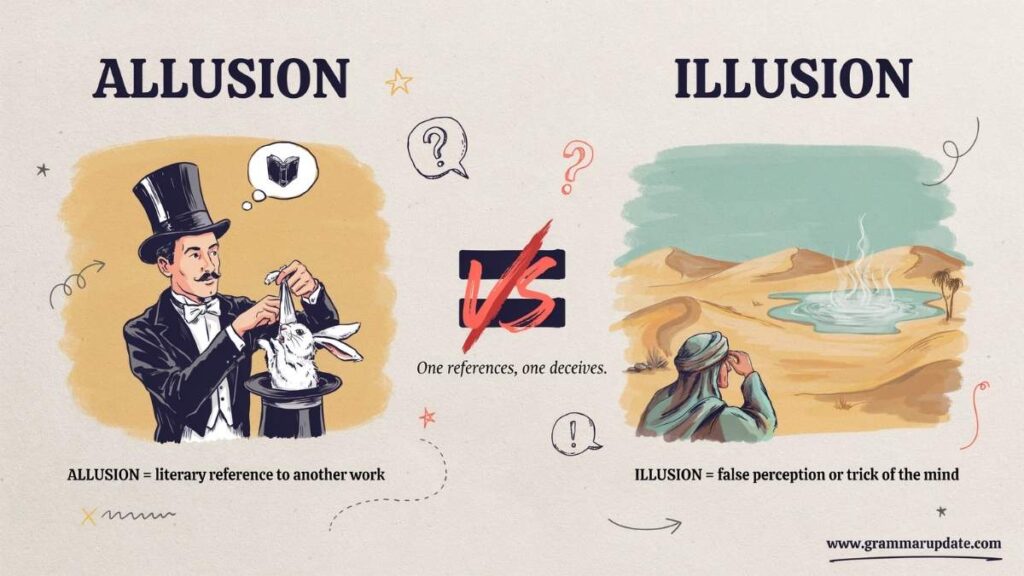
Have you ever stopped while writing and wondered whether to use allusion or illusion? If so, you’re not alone. These two words sound almost the same, which is why they confuse so many people. The good news is that their meanings are completely different once you know the simple rule. An allusion is an indirect reference to a well-known person, place, event, or story. An illusion is something that creates a false appearance or tricks your senses. In this guide, you’ll finally understand allusion vs illusion, learn the difference with simple examples, avoid common grammar mistakes, and choose the correct word with confidence every time.
Allusion vs Illusion Quick Comparison
If you’re looking for the quick answer, this table summarizes everything you need to know.
| Feature | Allusion | Illusion |
|---|---|---|
| Meaning | An indirect reference to a famous person, event, place, or work | A false appearance or mistaken perception |
| Part of Speech | Noun | Noun |
| Common Use | Literature, speeches, writing | Psychology, science, art, everyday conversation |
| Purpose | Adds meaning through a reference | Describes something that isn’t really what it appears to be |
| Related Concept | Literary reference | False perception |
| Example | “He’s no Einstein.” | “The magician created the illusion of floating.” |
Quick Memory Trick
Remember these simple clues.
- Allusion begins with “A,” which can remind you of “alludes.”
- Illusion begins with “I,” which can remind you of “image” or “imaginary.”
If the sentence points to another story, person, or event, you probably need allusion.
If the sentence describes something that tricks your eyes or mind, you need illusion.
What Is Allusion?
Before learning the difference between allusion and illusion, it’s important to understand the allusion definition.
An allusion is an indirect or implied reference to someone or something that readers are expected to recognize. Instead of explaining the entire background, the writer briefly mentions a familiar person, place, story, historical event, or cultural idea.
Because of this, allusions add depth without making the writing longer.
Allusion Definition
An allusion is an indirect reference to a famous person, event, work of literature, historical event, myth, or cultural idea.
Unlike a direct quotation, an allusion doesn’t explain itself. It relies on the reader’s background knowledge.
For example:
“She finally met her Waterloo.”
The sentence never explains what Waterloo means. Readers who know history understand that Waterloo represents a decisive defeat.
That single reference communicates an entire idea in just two words
Learn the difference between tricky more English words.
Comprable vs Comparable Which Spelling Is Correct?
Why Writers Use Allusions
An allusion is one of the most effective literary devices because it adds layers of meaning.
Rather than describing every detail, writers can connect readers to a larger idea with just a few carefully chosen words.
Good writers use allusions to:
- Make writing more engaging.
- Create emotional connections.
- Add historical or cultural depth.
- Keep writing concise.
- Reward readers who recognize the reference.
For example, calling someone “a real Sherlock Holmes” instantly suggests intelligence and detective skills without any lengthy explanation.
That’s the power of an implied reference.
Learn the difference between tricky more English words
Developed vs Developped Difference and Correct Usage
Common Types of Allusions
An allusion can point to many different sources. Some are literary, while others come from history, religion, mythology, or modern culture.
Literary Allusion
A literary allusion refers to another book, poem, or famous piece of writing.
Example:
“His endless pursuit became his own Moby Dick.”
This literary allusion refers to Herman Melville’s famous novel and suggests an obsession with achieving a difficult goal.
Historical Reference
A historical reference points to a famous event or person from history.
Examples include:
- Waterloo
- The Titanic
- The Great Depression
- The American Revolution
Sentence example:
“The company’s failed launch became its Titanic.”
The writer never explains the Titanic disaster because the audience already understands the comparison.
Biblical Allusion
A biblical allusion refers to stories or characters from the Bible.
Common examples include:
- David and Goliath
- Noah’s Ark
- The Good Samaritan
- The Prodigal Son
- Garden of Eden
Example:
“Helping complete strangers made her the Good Samaritan of the neighborhood.”
Mythological Allusion
Many writers borrow ideas from Greek and Roman mythology.
Popular mythological allusions include:
- Achilles’ heel
- Pandora’s box
- Hercules
- Medusa
- Narcissus
Sentence:
“Public speaking remained his Achilles’ heel.”
The phrase refers to a hidden weakness instead of explaining it directly.
Cultural Reference
Modern writers often use cultural references that readers immediately recognize.
These may include:
- Movies
- Television
- Sports
- Music
- Internet culture
Example:
“Monday morning felt like the Hunger Games.”
The sentence uses a cultural reference to describe fierce competition.
Shakespeare Reference
Shakespeare’s works continue to influence modern English.
Examples include references to:
- Romeo and Juliet
- Hamlet
- Macbeth
- Julius Caesar
Sentence example:
“Their relationship became another Romeo and Juliet story.”
Readers understand the tragic romance without additional explanation.
Learn the difference between tricky more English words
Stich vs Stitch Difference and Usage
Allusion in Literature
An allusion is one of the oldest and most widely used literary devices.
Authors use allusions to enrich stories by connecting them to familiar ideas, famous characters, or historical events.
Instead of explaining every comparison, they allow readers to discover the hidden meaning themselves.
Many classic novels contain hundreds of literary allusions.
| Author | Common Allusions | Purpose |
|---|---|---|
| William Shakespeare | Greek and Roman mythology | Add symbolism |
| T. S. Eliot | Biblical references | Build historical depth |
| F. Scott Fitzgerald | American Dream | Add social commentary |
| George Orwell | Historical events | Strengthen political themes |
Recognizing these literary references helps readers appreciate the deeper meaning behind the text.
Allusion in a Sentence
Here are several examples of allusion in a sentence.
- “His generosity made him a real Good Samaritan.”
- “She opened Pandora’s box with that decision.”
- “Winning the championship felt like discovering the Holy Grail.”
- “The lawyer argued like Perry Mason.”
- “His smile was a Mona Lisa mystery.”
- “She found her Achilles’ heel during the interview.”
Each sentence uses an indirect reference instead of explaining the comparison directly.
What Is Illusion?
Now let’s look at the illusion meaning.
Unlike an allusion, an illusion has nothing to do with literature or references.
An illusion happens when something appears different from reality. Your eyes, ears, or brain interpret information incorrectly, creating a false perception.
Magicians rely on illusions.
Artists create illusions.
Scientists study illusions.
Even everyday life is full of illusions that fool the human brain.
Illusion Definition
An illusion is a false appearance or mistaken perception that causes someone to believe something that isn’t actually true.
An illusion doesn’t change reality.
Instead, it changes how reality is perceived.
That distinction makes illusion an important concept in psychology, neuroscience, art, and visual design.
Learn the difference between tricky more English words
Descision vs Decision Which Spelling Is Correct?
Different Types of Illusions
Not every illusion works the same way.
Some deceive your eyes, while others affect your thoughts or hearing.
Optical Illusion
An optical illusion tricks your vision.
The object remains unchanged, but your brain interprets it differently.
Common optical illusion examples include:
- Lines that appear different lengths even though they’re equal.
- Still pictures that seem to move.
- Shapes that look larger or smaller than they actually are.
These famous visual illusion examples show that the brain doesn’t simply record information. It interprets it.
Visual Illusion
A visual illusion changes how an object appears.
Lighting, shadows, color, and perspective can all create misleading appearances.
Artists have used visual illusions for centuries to create depth on flat surfaces.
Psychological Illusion
Some illusions occur inside the mind rather than the eyes.
For example, people sometimes believe money guarantees happiness.
That mistaken belief creates an illusion of reality even when experience proves otherwise.
Psychologists study these mental shortcuts because they influence judgment and decision-making.
Auditory Illusion
Your hearing can also be deceived.
Certain sounds appear to rise forever.
Others seem to come from impossible directions.
These sensory deceptions reveal that hearing, like vision, depends heavily on how the brain interprets information.
Learn the difference between tricky more English words
Suprise vs Surprise Which is Correct Spelling?
Illusion in Psychology
Researchers study illusion in psychology because perception is not always accurate.
Your brain constantly fills in missing information, predicts patterns, and makes assumptions.
Most of the time, those assumptions help you understand the world quickly.
Sometimes, however, they create false perceptions that don’t match reality.
Understanding these processes helps scientists study memory, attention, learning, and decision-making.
Illusion in a Sentence
Here are several examples of illusion in a sentence.
- “The desert created the illusion of water.”
- “The magician perfected the illusion of disappearing.”
- “Distance gave the mountain the illusion of being much smaller.”
- “The mirror created a fascinating visual illusion.”
- “His confidence gave everyone the illusion that the project was under control.”
- “The movie created an incredible illusion of reality.”
Each sentence describes a deceptive appearance, false perception, or trick of the eye rather than a literary reference.
Learn the difference between tricky grammar more words
Pricy vs Pricey Which Spelling Is Correct?
Allusion vs Illusion The Key Differences
Now that you understand both definitions, the difference between allusion and illusion becomes much easier to remember.
Although these words differ by only one letter, they belong to completely different ideas.
An allusion connects readers to another person, story, place, or event through an indirect reference.
An illusion describes something that deceives the senses or creates a false appearance.
Understanding this allusion and illusion difference will improve your English vocabulary, strengthen your writing skills, and help you avoid one of the most common grammar mistakes in English.
In the next section, we’ll compare allusion vs illusion grammar in greater detail, explore allusion vs illusion in English with real-world examples, explain allusion vs illusion with examples across different contexts, and show exactly when to use allusion and when to use illusion with confidence.
Learn the difference between tricky grammar more words
Until vs Untill Which Spelling Is Correct and Difference?
Allusion vs Illusion vs Elusion
People often search for “allusion vs illusion vs elusion” because these three words look and sound similar. However, only two of them are commonly used in modern English.
Here’s the first thing to remember:
- Allusion is a standard English word.
- Illusion is a standard English word.
- Elusion is extremely rare and is almost never used in everyday writing.
Many people actually mean “evasion” or “eluding” when they write “elusion.”
What Is Elusion?
Elusion is a noun that means the act of escaping, avoiding, or evading something. Although dictionaries recognize the word, it has become uncommon in modern English. Most writers prefer words such as “evasion,” “avoidance,” or “escape.”
Example:
“His constant elusion of responsibility frustrated the entire team.”
Today, most professional writers would naturally write:
“His constant avoidance of responsibility frustrated the entire team.”
That’s why you’ll rarely see elusion in newspapers, books, or business writing.
Comparing the Three Words
| Word | Meaning | Example |
|---|---|---|
| Allusion | An indirect reference | “The speech contained an allusion to the American Revolution.” |
| Illusion | A false appearance or false perception | “The mirror created an illusion of extra space.” |
| Elusion | The act of escaping or avoiding something | “The suspect’s elusion of capture lasted several days.” |
Despite their similar spellings, these words belong to completely different contexts.
Easy Way to Remember
A quick memory trick can save you from mixing them up.
- Allusion = Alludes to something.
- Illusion = Illusion tricks your senses.
- Elusion = Eludes someone or something.
Once you connect each word to its verb, remembering the correct noun becomes much easier.
Learn the difference between tricky grammar more words
Cubical vs Cubicle Usage and Common Mistakes
Allusion vs Reference
Many learners wonder whether an allusion and a reference mean the same thing.
They don’t.
Every allusion is a type of reference, but not every reference is an allusion.
A reference directly mentions its source.
An allusion hints at the source without fully explaining it.
Direct Reference
A direct reference clearly identifies the person, event, or work.
Example:
“The speaker quoted Martin Luther King Jr. during the presentation.”
Nothing is hidden. The source is named directly.
Learn the difference between tricky grammar more words
Advice vs Advise What’s the Difference?
Allusion
An allusion expects readers to recognize the connection themselves.
Example:
“The speaker had a dream of equality.”
Readers familiar with Martin Luther King Jr.’s famous speech immediately recognize the implied reference.
The second sentence creates more depth while using fewer words.
Comparison Table
| Feature | Allusion | Reference |
|---|---|---|
| Directly names the source | No | Yes |
| Requires background knowledge | Yes | Usually no |
| Adds hidden meaning | Yes | Not necessarily |
| Common in literature | Yes | Yes |
Understanding this difference helps writers choose the right level of detail for their audience.
Learn the difference between tricky grammar more words
Entwined vs Intertwined What’s the Difference and usage?
Allusion vs Allegory
Another common source of confusion is the difference between an allusion and an allegory.
Although both appear in literature, they work in very different ways.
An allusion briefly points to another person, event, or work.
An allegory tells an entire story that represents a deeper message.
What Is an Allegory?
An allegory is a complete narrative in which characters, settings, and events symbolize larger ideas.
Instead of making one indirect reference, the entire work carries symbolic meaning.
Well-known allegories include:
- Animal Farm
- Pilgrim’s Progress
- Everyman
Each tells one story while representing another.
Key Differences
| Allusion | Allegory |
|---|---|
| Usually one sentence or phrase | Entire story or large section |
| Makes an indirect reference | Uses symbolism throughout |
| Depends on reader recognition | Builds meaning through the narrative |
| Brief literary device | Complete literary structure |
For example:
“He had an Achilles’ heel.”
This is an allusion.
A novel in which every character represents a political idea would be an allegory.
The scale is completely different.
Learn the difference between tricky grammar more words
That’s Mean vs that means Difference and which one is correct?
When to Use Allusion
Knowing the allusion definition is helpful.
Knowing when to use allusion is even more important.
Use allusion whenever you want to connect your writing to a familiar person, event, book, myth, or cultural idea without explaining it in detail.
Writers frequently use allusions because they make sentences richer while keeping them concise.
Use Allusion When You Want To
- Compare someone to a famous person.
- Mention a historical event indirectly.
- Refer to mythology.
- Connect to literature.
- Create deeper meaning.
- Reward readers who recognize the reference.
Examples
- “She finally found her Holy Grail.”
- “The project became his Everest.”
- “His generosity made him another Good Samaritan.”
- “The athlete had an Achilles’ heel.”
Each sentence communicates much more than its words alone.
Grammar Tips
Since allusion is a noun, it often follows articles and adjectives.
Examples:
- “The author included an allusion.”
- “The speech contains a clever allusion.”
- “Readers recognized the biblical allusion.”
You don’t use allusion as a verb.
Instead, the verb is allude.
Correct:
“The author alluded to Greek mythology.”
Not:
“The author allusioned to Greek mythology.”
Learn the difference between confusing word pairs
Smoothe vs Smooth Which is Correct and Usage?
When to Use Illusion
Use illusion whenever something appears different from reality.
The word commonly appears in discussions about science, psychology, magic, architecture, photography, and everyday perception.
Use Illusion When Talking About
- Optical illusions.
- Magic tricks.
- False appearances.
- Sensory deception.
- Visual effects.
- Mistaken beliefs.
Examples
- “The stage lights created an illusion of floating.”
- “The painting gives the illusion of movement.”
- “Heat created the illusion of water on the road.”
- “His confidence created the illusion that everything was under control.”
Each example describes appearance rather than reality.
Grammar Tips
Illusion is also a noun.
Examples:
- “The illusion disappeared.”
- “The magician perfected the illusion.”
- “The audience admired the illusion.”
The related adjective is illusory.
Example:
“Their sense of security proved illusory.”
Learn the difference between confusing word pairs
Swap vs Swop Difference which one is coorrect ?
Allusion vs Illusion Grammar
Although both words are nouns, they belong in completely different situations.
One refers to language.
The other refers to perception.
Understanding this distinction makes correct word choice much easier.
| Situation | Correct Word |
|---|---|
| Referring to mythology | Allusion |
| Mentioning Shakespeare | Allusion |
| Hinting at another book | Allusion |
| Talking about a magic trick | Illusion |
| Describing a deceptive appearance | Illusion |
| Discussing optical illusion examples | Illusion |
Whenever you feel uncertain, ask yourself one question.
“Am I referring to another story or describing something that isn’t really what it appears to be?”
That single question usually reveals the correct answer.
Learn the difference between confusing word pairs
To Fast vs Too Fast What’s the Difference,and Correct Usage?
Allusion and Illusion in Literature
Both words appear in literature, but they serve completely different purposes.
An allusion enriches the text by connecting it to another work or historical event.
An illusion becomes part of the story itself by affecting how characters or readers perceive reality.
Famous Literary Allusion Examples
Many classic authors rely heavily on allusions.
William Shakespeare
Shakespeare frequently referred to Greek and Roman mythology, the Bible, and English history.
These references helped audiences connect with characters on a deeper level.
John Milton
Paradise Lost contains hundreds of biblical and classical allusions.
Recognizing them reveals layers of meaning that casual readers often miss.
T. S. Eliot
The Waste Land is famous for its extensive literary, religious, and historical references.
Scholars have identified hundreds of allusions throughout the poem.
F. Scott Fitzgerald
The Great Gatsby includes subtle references to American ideals, wealth, and social ambition that strengthen its themes.
Illusion in Literature
Illusions often influence characters rather than simply decorating the language.
For example:
- Characters may live under the illusion that money guarantees happiness.
- A narrator may create the illusion of truth while hiding important facts.
- A setting may create the illusion of safety before revealing danger.
Unlike allusions, these illusions affect perception and drive the plot forward.
Learn the difference between confusing word pairs
Gluing vs Glueing Which Spelling Is Correct?
Case Study One Sentence, Two Different Words
Consider these examples.
Sentence 1:
“The author’s allusion to Pandora’s Box warned readers about unintended consequences.”
Here, Pandora’s Box is an indirect reference to Greek mythology.
Sentence 2:
“The mirror created the illusion of a much larger room.”
Here, illusion describes a visual effect that changes perception.
Only one letter separates the words.
Their meanings, however, couldn’t be more different.
In the next section, you’ll learn the most common mistakes people make with allusion and illusion, discover simple memory tricks, practice with real-world sentence examples, and test your knowledge with a quiz that reinforces everything you’ve learned so far.
Learn the difference between confusing word pairs
Due To vs Do To What’s the Difference and Which One Is Correct?
Common Mistakes with Allusion vs Illusion
Even after learning the definitions, many people still confuse these words because they look and sound alike. Fortunately, the mistakes are easy to avoid once you understand the context.
Let’s look at the errors people make most often.
Mistake 1 Using “Illusion” Instead of “Allusion”
This is the most common mistake.
Incorrect:
❌ “The author’s illusion to Greek mythology was easy to recognize.”
Correct:
✅ “The author’s allusion to Greek mythology was easy to recognize.”
Remember, an allusion is an indirect reference. It has nothing to do with deception or appearance.
Mistake 2 Using “Allusion” for a Magic Trick
Some learners assume both words describe something imaginary.
Incorrect:
❌ “The magician performed an amazing allusion.”
Correct:
✅ “The magician performed an amazing illusion.”
Magic shows create illusions, not allusions.
Mistake 3 Confusing Literature with Perception
Ask yourself one simple question.
Is the sentence talking about a reference?
Or is it talking about appearance?
If it’s a reference, choose allusion.
If it’s about something that isn’t what it seems, choose illusion.
Mistake 4 Assuming They Are Interchangeable
Although the words sound alike, they cannot replace one another.
Compare these sentences.
✅ “The novel contains several biblical allusions.”
✅ “The painting creates the illusion of movement.”
Replacing either word would make the sentence incorrect.
Learn the difference between similar more English words
Weak vs Week Difference which one is correct?
Allusion vs Illusion Pronunciation
These words sound similar, which explains why so many people confuse them.
Allusion is pronounced:
/ə-LOO-zhən/
Illusion is pronounced:
/ih-LOO-zhən/
The second syllable sounds almost identical.
The main difference is the first vowel sound.
Speaking them aloud several times helps train your ear to recognize the difference.
Learn the difference between similar more English words
Eventhough vs Even Though Which Is Correct?
Easy Memory Tricks
Sometimes one small trick makes a confusing word pair unforgettable.
Trick One
Allusion begins with “A.”
Think:
“A” stands for “Alludes.”
An allusion always alludes to something.
Trick Two
Illusion begins with “I.”
Think:
“I” stands for “Image.”
An illusion changes the image your brain sees.
Trick Three
Ask One Question
Before choosing the word, ask yourself:
“Am I talking about a reference or appearance?”
Reference = Allusion
Appearance = Illusion
That single question solves most grammar problems.
Learn the difference between confusing more English words
Persue vs Pursue Which Spelling Is Correct?
Allusion vs Illusion Examples
Learning from examples is one of the fastest ways to improve your English vocabulary.
Everyday Conversation
Allusion
- “That joke was an allusion to Star Wars.”
- “Her speech included an allusion to Abraham Lincoln.”
- “His comment contained a clever literary reference.”
Illusion
- “The mirror created the illusion of extra space.”
- “The magician amazed everyone with an illusion.”
- “Heat waves created the illusion of water.”
Academic Writing
Allusion
“The poem contains a biblical allusion that strengthens its central theme.”
Illusion
“The experiment demonstrates how visual illusions affect human perception.”
Business Writing
Allusion
“The CEO made an allusion to the company’s early struggles.”
Illusion
“The marketing campaign created the illusion of limited availability.”
Literature
Allusion
“The novel includes numerous Shakespeare references.”
Illusion
“The main character lives under the illusion that wealth guarantees happiness.”
Journalism
Allusion
“The columnist made an allusion to the Watergate scandal.”
Illusion
“The photograph creates the illusion that the buildings are touching.”
Learn the difference between confusing more English words
Socialise vs Socialize Which One Is Correct?
Allusion in a Sentence
Here are more examples showing correct usage.
- “The speech contained an allusion to the Civil Rights Movement.”
- “The writer used a mythological allusion to add symbolism.”
- “His remark was an indirect reference to the Titanic.”
- “The novel includes several biblical allusions.”
- “The article opens with a Shakespeare reference.”
- “Her essay contains a cultural reference that most readers recognize.”
- “The politician made an implied reference to history without naming the event.”
Illusion in a Sentence
Now compare these examples.
- “The painting creates the illusion of movement.”
- “The road produced the illusion of being wet.”
- “The mirror gives the illusion of depth.”
- “The audience applauded the magician’s illusion.”
- “Distance created a false appearance.”
- “The designer used lighting to create a visual illusion.”
- “The movie produced an illusion of reality.”
Learn how to use confusing more words correctly
Trouper vs Trooper Which One Is Correct?
Quick Comparison
| Question | Allusion | Illusion |
|---|---|---|
| Is it a literary device? | Yes | No |
| Is it a figure of speech? | Yes | No |
| Does it involve an indirect reference? | Yes | No |
| Does it involve false perception? | No | Yes |
| Used in literature? | Frequently | Sometimes |
| Used in psychology? | Rarely | Frequently |
| Related to optical illusion? | No | Yes |
Learn how to use confusing more words correc
Stolen vs Stollen Difference and usage?
Practice Session Allusion vs Illusion
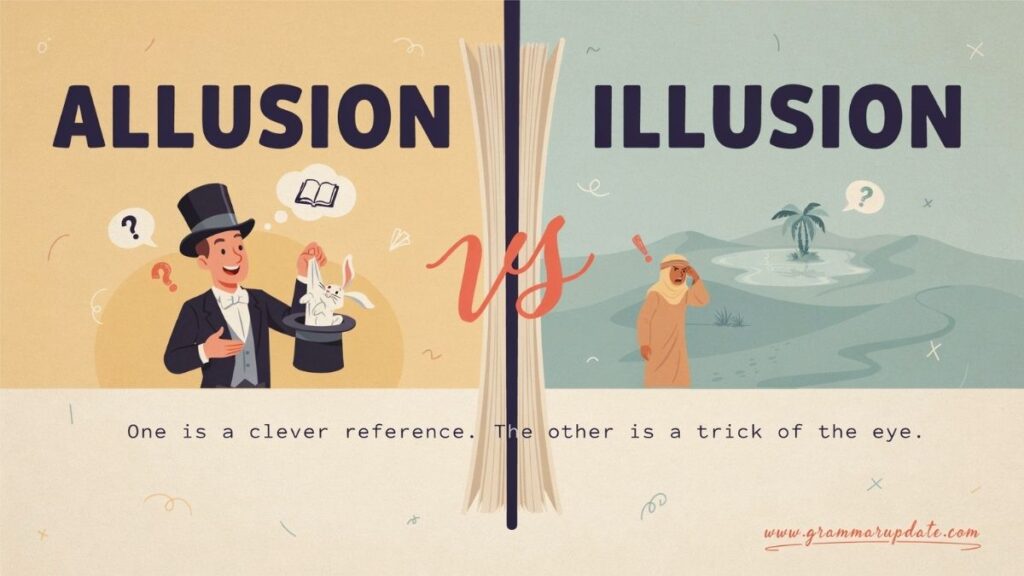
Choose the correct word allusion Allusion vs illusion.
Questions
- The author’s _____ to Greek mythology added depth to the novel.
- The magician created the _____ that he could fly.
- Her speech included an _____ to Martin Luther King Jr.’s famous address.
- The mirror gave the _____ of a much larger room.
- The poem contains a biblical _____ that many readers recognize.
- Heat rising from the road created the _____ of water in the distance.
- The professor explained every _____ in Shakespeare’s plays.
- The stage lighting created the _____ that the actor disappeared.
- His comment was an _____ to the Titanic disaster.
- The painting gives the _____ of movement even though it is completely still.
- The writer used a mythological _____ to enrich the story.
- The audience applauded the incredible _____ performed by the magician.
- The novel opens with an _____ to the Garden of Eden.
- The fog created the _____ that the mountains were floating.
- The journalist made an _____ to the Watergate scandal.
- The curved lines create an optical _____.
- The teacher asked students to identify every literary _____ in the passage.
- His confidence created the _____ that everything was under control.
- The speech included an _____ to Abraham Lincoln.
- The artist painted shadows that created the _____ of depth.
- The movie is full of historical _____ that history lovers will appreciate.
- The audience knew it was only an _____, but they were still amazed.
- Her essay contained a clever cultural _____.
- The bright sunlight created the _____ that the road was wet.
- The author included an _____ to Homer’s Odyssey.
Answer
- allusion
- illusion
- allusion
- illusion
- allusion
- illusion
- allusion
- illusion
- allusion
- illusion
- allusion
- illusion
- allusion
- illusion
- allusion
- illusion
- allusion
- illusion
- allusion
- illusion
- allusions
- illusion
- allusion
- illusion
- allusion
Here’s a trusted source for clear word meanings:
FAQs
What is the difference between allusion and illusion?
An allusion is an indirect reference to a well-known person, event, place, book, or idea. An illusion is a false appearance or mistaken perception that makes something seem different from reality.
When should I use allusion instead of illusion?
Use allusion when referring indirectly to something familiar. Use illusion when describing something that deceives the senses or creates a false impression.
What is an example of an allusion?
“He finally found his Achilles’ heel.”
This sentence alludes to Greek mythology to describe someone’s greatest weakness.
What is an example of an illusion?
“The mirror created the illusion of a much larger room.”
Here, illusion describes a visual effect that changes how the room appears.
How do you use allusion and illusion in the same sentence?
“The author’s allusion to Greek mythology created the illusion that the hero was invincible.”
What is a biblical allusion?
A biblical allusion is an indirect reference to a person, story, place, or event from the Bible without mentioning it directly.
What are the four main types of allusions?
The four most common types are:
- Biblical allusions
- Historical allusions
- Literary allusions
- Mythological allusions
What are the most common allusions?
Some of the best-known allusions include:
- Achilles’ heel
- Pandora’s Box
- David and Goliath
- The Good Samaritan
- Romeo and Juliet
- The Garden of Eden
- The Holy Grail
- Midas touch
Can an allusion refer to a fictional character?
Yes. An allusion can refer to either a real person or a fictional character, as long as the audience is likely to recognize the reference.
Is Romeo and Juliet an allusion?
Romeo and Juliet is not an allusion by itself. However, mentioning “Romeo and Juliet” to describe two lovers is an allusion to Shakespeare’s famous play.
How do you identify an allusion in writing?
Look for an indirect reference to a well-known person, event, book, myth, movie, or historical moment. If the writer expects readers to recognize the connection without explaining it, it’s likely an allusion.
What is another word for allusion?
Depending on the context, similar words include:
- Reference
- Mention
- Hint
- Suggestion
- Implication
- Citation
What is another word for illusion?
Common alternatives include:
- Delusion
- Mirage
- Deception
- False appearance
- Misperception
- Optical effect
What is the opposite of allusion?
The closest opposite is a direct reference or explicit statement because it clearly identifies the source instead of hinting at it.
What is the opposite of illusion?
Reality, truth, and actuality are common opposites because they describe things as they truly are.
What are the three main types of illusions?
The most common categories are:
- Optical illusions
- Auditory illusions
- Cognitive or psychological illusions
What are the four types of illusions?
Many psychology textbooks group illusions into these categories:
- Optical (visual)
- Auditory
- Tactile
- Cognitive (psychological)
What is the most famous optical illusion?
One of the most famous optical illusions is the Müller-Lyer illusion, where two lines of equal length appear different because of the direction of their arrowheads.
What is a literary allusion?
A literary allusion is an indirect reference to another book, poem, play, or literary character that adds meaning to the text.
Why do authors use allusions?
Authors use allusions to create deeper meaning, connect with readers, develop themes, add symbolism, and make writing more engaging without lengthy explanations.
Are allusions considered a figure of speech?
Yes. An allusion is a figure of speech because it conveys meaning through an indirect reference rather than a direct statement.
Can an allusion refer to modern movies or pop culture?
Yes. Allusions can reference modern films, television shows, songs, celebrities, video games, and other well-known aspects of popular culture.
Do allusions always come from literature?
No. While many allusions come from literature, they can also come from history, mythology, religion, politics, science, sports, and popular culture.
What is the difference between an allusion and a reference?
A reference directly names its source, while an allusion hints at it and relies on the reader’s knowledge to understand the connection.
Are allusions common in everyday conversation?
Yes. People frequently use allusions without realizing it. Phrases like “Achilles’ heel,” “Pandora’s Box,” and “Good Samaritan” are common examples used in everyday speech.
Why are allusion and illusion commonly confused?
They have similar spellings and nearly identical pronunciations. However, their meanings are completely different. One relates to language and literature, while the other relates to perception and appearance.
Conclusion
At first, allusion and illusion may seem like two words designed to confuse English learners. They look alike, sound alike, and have fooled plenty of writers along the way. Thankfully, the difference is much simpler than it appears .Just remember this: an allusion is an indirect reference to a well-known person, place, event, or story, while an illusion is a false appearance that tricks your eyes or mind. If you’re making a reference, choose allusion. If you’re describing something that isn’t really as it seems, choose illusion. Once you know that simple rule, choosing the right word becomes easy. The next time you come across allusion vs illusion, you won’t have to guess. You’ll know exactly which word fits your sentence and write with confidence every time.

Jhon AJS, the creative mind behind Grammar Update, is an experienced blogger passionate about simplifying English grammar. He focuses on explaining confusing word vs word differences, grammar rules, punctuation, and sentence structure in a clear and practical way. Through easy to understand guides and examples, Jhon helps readers improve their writing and communicate with confidence. With years of blogging experience, he continues to share helpful insights that make learning grammar simple, useful, and accessible for everyone.