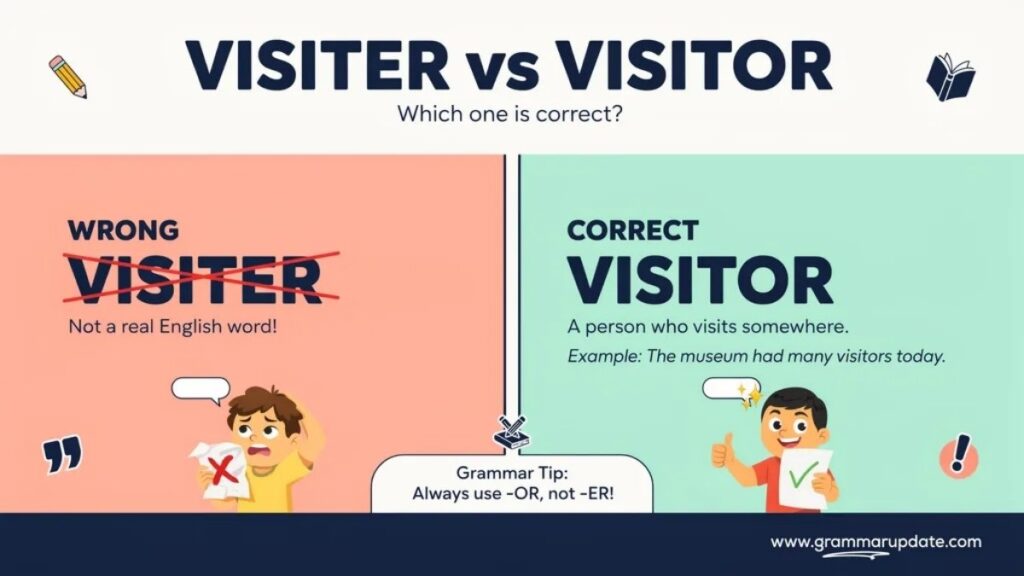
A single misplaced letter can completely change the meaning of a word, and Visiter vs Visitor is a perfect example. Although these two spellings look almost identical, only one is correct in English, while the other belongs to the French language. It’s a common source of confusion for students, professionals, content writers, and even native speakers because the words sound so similar. The good news is that the distinction is simple once you understand the grammar behind it. This guide breaks down Visiter vs. Visitor with clear explanations, real-world examples, pronunciation tips, and easy memory tricks so you can use the correct spelling confidently in every situation.
Visiter vs Visito Which One Is Correct?
If you’re looking for a quick answer, here it is:
- Visitor is the correct spelling in English.
- Visiter is not a correct English word.
- Visiter is a legitimate French verb, not an English noun.
Whenever you’re referring to a person who visits a place, always use visitor.
Correct examples:
- A visitor signed the guest book.
- Every visitor must wear an identification badge.
- The museum welcomed over one million visitors last year.
Incorrect examples:
- A visiter signed the guest book.
- Every visiter must register.
- We welcomed many visiters this weekend.
Although these mistakes appear frequently online, trusted dictionaries and style guides consistently recognize only visitor as the correct English spelling.
Visiter vs Visitor Quick Answer
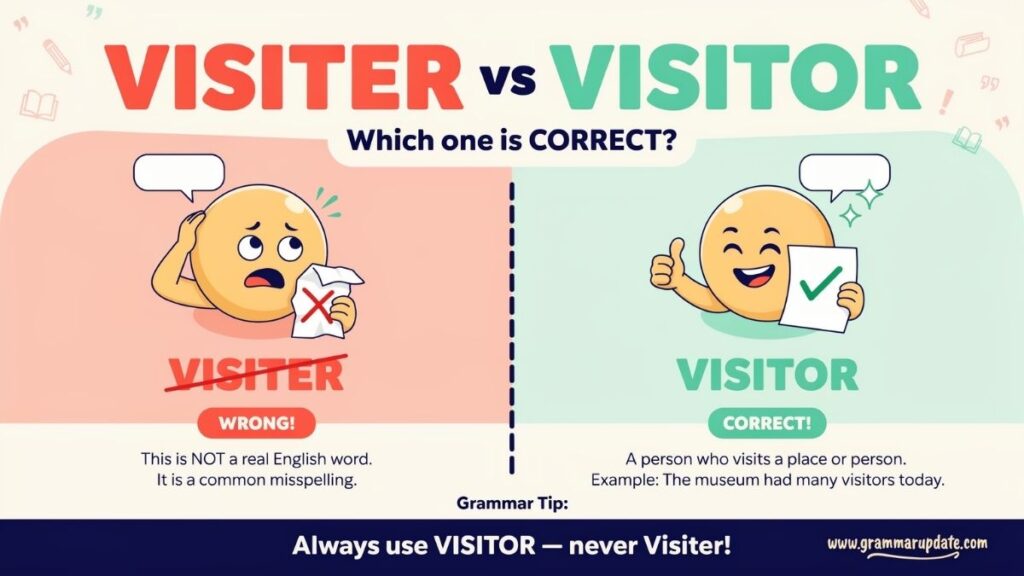
Many people wonder whether visiter or visitor is simply a difference between British and American English. Others assume one spelling is formal while the other is informal.
Neither assumption is correct.
| Word | English | French | Correct? |
|---|---|---|---|
| Visitor | Yes | No | Correct English noun |
| Visiter | No | Yes | Correct French verb |
| Visiter | No | No (as an English noun) | Incorrect English spelling |
A simple rule makes it easy to remember:
If you’re talking about someone who visits, use visitor.
If you’re studying French, visiter means “to visit.”
Remembering this one distinction will help you avoid the mistake almost every time.
Learn the difference between confusing more English words
Uncollectible vs Uncollectable and How to Use Each Word
Visitor Meaning in English
Understanding the visitor meaning in English makes the spelling much easier to remember.
A visitor is a person who goes to a place for a temporary period, whether for business, leisure, education, family, or official purposes.
Visitor is always a noun. It is never used as a verb.
Visitor Definition
Major English dictionaries define visitor as:
A person who visits a person, place, institution, or website for a limited period.
The word applies to many everyday situations, including personal, professional, educational, and digital contexts.
For example:
- a hospital visitor
- a museum visitor
- a website visitor
- an international visitor
- a first-time visitor
- a returning visitor
Today, the word is also common in technology and digital marketing.
Examples include:
- Unique website visitors
- Monthly visitors
- Returning visitors
- Visitor analytics
In every one of these cases, visitor is the only correct spelling.
Learn the difference between confusing more English words
Emaculate vs Immaculate Which One Is Correct?
Visitor Pronunciation
Many spelling mistakes happen because people write words exactly as they hear them.
Understanding visitor pronunciation in English helps explain why.
American English pronunciation:
/ˈvɪzɪtər/
Broken into syllables:
VIS-it-er
The final syllable sounds like “ter,” which leads many people to assume the word should end in -er. However, English spelling doesn’t always match pronunciation.
Even though it sounds that way, the correct spelling is still visitor.
Learn the difference between confusing more English words
Unenroll vs Disenroll Differences with Complete Guide
Parts of Speech
Grammar offers another simple way to remember the difference.
| Word | Part of Speech | Example |
|---|---|---|
| Visit | Verb | We visit our grandparents every month. |
| Visit | Noun | Our visit lasted two hours. |
| Visitor | Noun | The visitor arrived early. |
Notice that visitor names a person rather than an action.
Understand confusing English more words simply
Protestors or Protesters Which Spelling Is Actually Correct?
Common Collocations with Visitor
Native English speakers frequently combine visitor with other words. Learning these common expressions expands your English vocabulary and helps your writing sound more natural.
Some of the most common collocations include:
- visitor center
- visitor information
- visitor parking
- visitor pass
- visitor badge
- frequent visitor
- first-time visitor
- returning visitor
- overnight visitor
- unexpected visitor
- international visitor
- visitor statistics
- website visitor
- visitor log
Examples:
- Every visitor received a welcome package.
- Please park in the visitor parking area.
- The ranger directed us to the visitor center.
- Website visitor numbers increased by 25 percent last month.
Is “Visiter” a Real English Word?
One of the most common questions people ask is:
Is visiter a word?
The answer is simple.
No.
Visiter is not a standard English word.
It does not appear as the accepted spelling of visitor in respected English dictionaries.
If you’re writing an essay, business email, report, article, or social media post in English, you should always use visitor instead.
Why “Visiter” Is Incorrect in Standard English
English forms many nouns by adding endings such as:
- -er
- -or
- -ist
- -ian
However, English doesn’t follow one universal spelling pattern.
Consider these examples.
| Verb | Person | Ending |
|---|---|---|
| Act | Actor | -or |
| Invent | Inventor | -or |
| Translate | Translator | -or |
| Visit | Visitor | -or |
| Teach | Teacher | -er |
| Drive | Driver | -er |
| Paint | Painter | -er |
Many learners naturally expect visit to become visiter because words like teach become teacher.
English simply doesn’t follow that pattern here.
The correct noun has always been visitor.
When You Might See “Visiter” Online
Although visiter is incorrect in English, you’ll still come across it online.
Here are the most common reasons.
Typing mistakes
People often type quickly and don’t notice the spelling error before publishing.
Language interference
French speakers sometimes write visiter because they’re already familiar with the French spelling.
This is especially common in bilingual writing.
Search engine queries
Millions of people search phrases such as:
- visiter or visitor
- visitor vs visiter
- what does visiter mean
- is visiter a correct English word
Search engines record these misspellings because they’re frequently searched, not because they’re correct.
User-generated content
Forums, blogs, comments, and social media posts often contain spelling mistakes that editors never correct.
Whenever you’re unsure, check a trusted dictionary rather than relying on what you see online.
Why Is It “Visitor” Instead of “Visiter”?
At first glance, visitor may seem inconsistent.
Why doesn’t English simply use visiter?
The answer lies in the history of the language.
English borrowed thousands of words from Latin and French over many centuries. Many of those words kept their original spelling patterns instead of changing to match modern pronunciation.
Visitor is one of them.
Rather than adopting an -er ending, English preserved the historical -or ending inherited from Latin.
That’s why the correct spelling is visitor.
The Word Formation
From a grammar perspective, the structure is simple.
| Base Word | Suffix | Final Word |
|---|---|---|
| Visit | -or | Visitor |
Although many learners expect visit + er, English standardized visit + or centuries ago.
The same pattern appears in many familiar nouns, including:
- actor
- creator
- educator
- instructor
- translator
- administrator
- supervisor
These examples show that English noun formation often reflects history rather than modern spelling patterns.
Fix common more word mistakes in English
Their vs Thier Which One Is Correct in English Grammar?
Why English Uses “-or” Here
Unlike many languages, English developed by borrowing vocabulary from several sources.
Latin contributed thousands of words ending in -or, especially nouns describing people who perform a role or carry out an action.
Examples include:
| Word | Meaning |
|---|---|
| Actor | Person who acts |
| Creator | Person who creates |
| Translator | Person who translates |
| Educator | Person who educates |
| Visitor | Person who visits |
This historical influence explains why the correct spelling is visitor instead of visiter.
It isn’t a modern exception. It’s the spelling English has used for centuries.
Similar English Words Ending in “-or”
Learning a few related words makes visitor easier to remember.
| Verb | Correct Noun |
|---|---|
| Visit | Visitor |
| Create | Creator |
| Translate | Translator |
| Educate | Educator |
| Govern | Governor |
| Inspect | Inspector |
| Operate | Operator |
Some English nouns end in -er while others end in -or. The spelling depends on each word’s history rather than a single grammar rule.
Reading regularly and using these words in context is one of the best ways to strengthen your English vocabulary, improve your spelling, and build confidence in English grammar.
Understand confusing English more words simply
Outting vs Outing Correct Spelling and Proper Usage
The Origin and History of Visitor
The history of the word visitor explains why English uses its current spelling instead of visiter. While many English words follow predictable spelling patterns, others preserve forms that date back hundreds of years. Visitor belongs to that second group.
Understanding the word’s origin not only clears up the spelling confusion but also provides insight into how English vocabulary has evolved over time.
Latin Origins
The word visitor ultimately comes from the Latin verb visitare, which means “to go to see,” “to visit frequently,” or “to inspect.”
Latin also gave rise to the noun visitor, meaning “one who visits” or “an inspector.” As Latin influenced other European languages, this noun spread across many of them with only minor spelling changes.
Because English borrowed the word rather than creating it from scratch, it retained the traditional -or ending.
How the Word Entered English
After the Norman Conquest in 1066, French became the language of government, law, and education in England. Thousands of French and Latin words entered English during this period.
Visitor was one of those borrowed words.
Over time, it became the standard English noun for a person who visits someone or somewhere. Dictionaries, publishers, schools, and style guides have consistently used this spelling for centuries.
How the Spelling Became Standard
Modern English spelling wasn’t always consistent. Before dictionaries became widely available, writers often spelled words in different ways.
That changed during the eighteenth and nineteenth centuries as dictionaries standardized English spelling.
Today, every major English dictionary recognizes only one standard spelling:
- Visitor
The spelling visiter has never been accepted as the standard English form.
British English vs American English: Visitor or Visiter?
One of the biggest myths surrounding visiter or visitor UK is that one spelling belongs to British English while the other belongs to American English.
That isn’t true.
Both varieties of English use exactly the same spelling.
| English Variety | Correct Spelling |
|---|---|
| Visitor in British English | Visitor |
| Visitor in American English | Visitor |
| Visitor in UK English | Visitor |
| Visitor in US English | Visitor |
Unlike words such as colour/color or centre/center, there is no regional spelling difference here.
Whether you’re writing for readers in London, New York, Sydney, Toronto, or anywhere else where English is spoken, the correct spelling is always visitor.
This means the search term visiter or visitor UK has a simple answer:
The UK uses visitor, not visiter.
Likewise, American English also uses visitor.
Understand confusing English more words simply
Resale vs Resell What’s the Difference?
What Major Dictionaries Say
Trusted dictionaries agree on the spelling without exception.
| Dictionary | Accepted Spelling |
|---|---|
| Oxford Dictionary | Visitor |
| Cambridge Dictionary | Visitor |
| Merriam-Webster | Visitor |
| Collins Dictionary | Visitor |
| American Heritage Dictionary | Visitor |
If you’re ever unsure, checking one of these dictionaries will quickly confirm the correct spelling.
This agreement among respected references leaves no room for alternative English spellings.
Visiter in French vs Visitor in English
One reason this spelling mistake appears so often is the connection between English and French.
If you’ve studied French, you’ve probably seen the word visiter.
Unlike English, where visitor is a noun, French uses visiter as a verb.
Understanding this difference removes much of the confusion.
What Does “Visiter” Mean in French?
The French verb visiter means:
- to visit
- to tour
- to inspect
- to explore a place
In French grammar, visiter describes the action of visiting.
Examples include:
- Visiter Paris.
- Visiter un musée.
- Visiter un château.
Translated into English, these become:
- Visit Paris.
- Visit a museum.
- Visit a castle.
Notice that English uses the verb visit, not visitor.
This is the biggest difference between visiter meaning in French and visitor meaning in English.
French Verb Conjugation: Visiter
Like most French verbs ending in -er, visiter follows a regular conjugation pattern.
| Subject | French |
|---|---|
| Je | visite |
| Tu | visites |
| Il/Elle | visite |
| Nous | visitons |
| Vous | visitez |
| Ils/Elles | visitent |
If you’re learning French, these forms are perfectly correct.
However, they should never appear in English writing unless you’re specifically discussing the French language.
Why French Speakers Often Write “Visiter”
Many bilingual speakers accidentally write visiter in English because they’re transferring spelling from one language to another.
This is known as language transfer or language interference.
For example:
French:
- Je vais visiter Londres.
English:
- I am going to visit London.
Incorrect English:
- I am going to visiter London.
The last sentence mixes English grammar with French spelling.
It’s an understandable mistake, especially for beginners, but it’s still incorrect.
French to English Translation
This comparison makes the distinction much clearer.
| French | English |
|---|---|
| visiter | visit |
| visiteur | visitor |
| visite | visit |
| visiter un musée | visit a museum |
| visiter une ville | visit a city |
Notice something interesting.
The French noun for “visitor” isn’t visiter.
It’s visiteur.
That means English visitor and French visiteur actually have similar functions, even though their spellings differ slightly.
Understand confusing English more words simply
Allusion vs Illusion Difference and which is correct ?
Visiter vs Visitor What’s the Difference?
Now that we’ve looked at both languages, the distinction becomes simple.
| Feature | Visiter | Visitor |
|---|---|---|
| Correct English spelling | No | Yes |
| Standard English dictionaries | No | Yes |
| Used in American English | No | Yes |
| Used in British English | No | Yes |
| Used in French | Yes (verb) | No |
| Part of speech | Verb (French) | Noun (English) |
| Meaning | To visit | A person who visits |
A useful way to remember this comparison is:
- Visit is the English verb.
- Visitor is the English noun.
- Visiter is the French verb.
- Visiteur is the French noun.
Once you understand these four words, the confusion usually disappears.
Fix common more word mistakes in English
Advice vs Advise What’s the Difference?
When to Use Visitor
Whenever you’re referring to a person who comes to a place temporarily, choose visitor.
The word works in formal, informal, academic, and professional writing.
Referring to a Person
This is the most common use.
Examples:
- The visitor arrived early.
- Every visitor must sign the register.
- We welcomed visitors from around the world.
In Schools, Hospitals, and Businesses
Many organizations use the word every day.
Examples include:
- Visitor parking
- Visitor entrance
- Visitor badge
- Visitor reception
- Visitor log
- Visitor pass
You’ll see these signs in schools, hospitals, government buildings, offices, and universities across English-speaking countries.
In Travel and Tourism
The tourism industry also relies heavily on the word.
Examples include:
- Visitor center
- Visitor guide
- Visitor information
- Visitor attraction
- Visitor numbers
Travel reports often discuss annual visitor statistics because they measure tourism growth.
For example:
“The national park welcomed more than two million visitors last year.”
In Websites and Analytics
Digital marketing has introduced another common use of the word.
Website owners frequently measure:
- Unique visitors
- Returning visitors
- Monthly visitors
- Daily visitors
- Visitor engagement
- Visitor behavior
In this context, a visitor is someone who accesses a website, whether they’re a first-time user or a returning one.
Visitor Synonyms
Sometimes you’ll want to avoid repeating the word visitor throughout your writing.
Several synonyms work depending on the context.
| Synonym | Best Used When |
|---|---|
| Guest | Someone invited somewhere |
| Caller | Someone stopping by briefly |
| Tourist | Someone traveling for leisure |
| Attendee | Someone attending an event |
| Patron | Customer of a business |
| Sightseer | Someone visiting attractions |
Although these words have related meanings, they aren’t always interchangeable.
For example:
- Every guest is a visitor.
- Not every visitor is a guest.
A tourist visiting a museum is a visitor, but they aren’t necessarily a guest.
Learn the difference between commonly mixed-up more words
Entwined vs Intertwined What’s the Difference and usage?
Common Mistakes with Visiter or Visitor
The confusion between visiter or visitor usually comes down to spelling, pronunciation, or mixing English with French. While the mistake is common, it’s also easy to avoid once you understand why it happens.
Let’s look at the errors people make most often and how to fix them.
Assuming Every Verb Takes “-er”
One of the biggest reasons people write visiter is that many English nouns end in -er.
For example:
- teach → teacher
- drive → driver
- paint → painter
- work → worker
It’s natural to assume the same rule applies to visit. However, English doesn’t always follow a single pattern.
The correct noun is:
- visit → visitor
This spelling has been standard for centuries.
Mixing English with French Spelling
French learners often confuse the two languages because the French verb is spelled visiter.
For example:
Incorrect English:
- Every visiter must register.
Correct English:
- Every visitor must register.
The French spelling is perfectly correct when you’re writing in French. It simply doesn’t carry over into English.
Trusting Autocorrect Too Much
Modern spell checkers are helpful, but they aren’t perfect.
Some apps may not flag every mistake immediately, especially when typing quickly or using multilingual keyboards. Others may suggest words based on context rather than grammar.
Instead of relying entirely on software, develop the habit of recognizing the correct spelling yourself.
Ignoring Dictionary Spellings
If you’re unsure which spelling is correct, always verify it with a trusted dictionary.
Reliable dictionaries consistently recognize:
- visitor ✓
They do not accept:
- visiter ✗
A quick dictionary search can prevent an embarrassing spelling mistake in school assignments, business emails, or published content.
Confusing Visitor with the Verb Visit
Another common grammar mistake is using visitor where the verb visit belongs.
Incorrect:
- We will visitor the museum tomorrow.
Correct:
- We will visit the museum tomorrow.
Remember the difference:
- Visit = action (verb)
- Visitor = person (noun)
Keeping these roles separate will improve both your grammar and your writing.
Learn the difference between commonly mixed-up more words
That’s Mean vs that means Difference and which one is correct?
Visitor in Everyday Sentences
Learning through real examples is one of the fastest ways to remember new vocabulary.
Here are several examples showing how visitor appears in everyday English.
Workplace Examples
- Every visitor must check in at reception.
- The company welcomed several international visitors this week.
- Please escort your visitor to the meeting room.
School Examples
- Visitors must report to the main office before entering the building.
- Parents receive visitor badges during school events.
- Every visitor signed the attendance log.
Hospital Examples
- Visiting hours are limited to two visitors per patient.
- Each visitor must sanitize their hands before entering.
- The hospital issued temporary visitor passes.
Travel Examples
- The city attracts millions of visitors every year.
- Every visitor received a free map.
- The visitor center opens at 9:00 a.m.
Website Analytics Examples
Today, visitor is also common in digital marketing.
Examples include:
- The website gained 20,000 new visitors this month.
- Returning visitors spent more time on the site.
- Visitor engagement increased after the redesign.
These examples show that visitor isn’t limited to physical places. It also refers to people who access websites and online services.
Visiter vs Visitor Side-by-Side Examples
Sometimes the easiest way to understand a spelling rule is by comparing correct and incorrect sentences.
| Incorrect | Correct |
|---|---|
| She is a visiter from Canada. | She is a visitor from Canada. |
| Every visiter needs a badge. | Every visitor needs a badge. |
| The museum welcomed thousands of visiters. | The museum welcomed thousands of visitors. |
| We met an international visiter yesterday. | We met an international visitor yesterday. |
| Visitors must register at reception. | Correct |
Notice that every English sentence uses visitor.
The spelling visiter never becomes correct simply because it sounds similar.
Learn the difference between commonly mixed-up more words
Smoothe vs Smooth Which is Correct and Usage?
How to Remember the Correct Spelling
If you often hesitate between visiter and visitor, these simple memory tricks can help.
Think of Visit + Or
Remember this pattern:
- Visit → Visitor
Don’t try to force the -er ending.
English has many nouns ending in -or, including:
- actor
- creator
- translator
- educator
- operator
- visitor
Grouping these words together makes them easier to remember.
Associate Visitor with People
Ask yourself one simple question:
“Am I talking about a person?”
If the answer is yes, the correct word is almost certainly visitor.
Remember the French Difference
Another helpful reminder is:
- English: visit → visitor
- French: visiter → visiteur
Keeping the two languages separate prevents most spelling errors.
Learn the difference between commonly mixed-up more words
Swap vs Swop Difference which one is coorrect ?
What Dictionaries and Style Guides Say
If you’re wondering whether any respected language authority accepts visiter as an English word, the answer is no.
Major dictionaries all recognize visitor as the standard English spelling.
Oxford Dictionary
Oxford defines visitor as a person who visits a place or another person for a period of time.
Cambridge Dictionary
Cambridge uses visitor in everyday, academic, and business contexts.
Merriam-Webster
Merriam-Webster lists visitor as the correct noun derived from visit.
Collins Dictionary
Collins recognizes visitor across both British and American English.
American Heritage Dictionary
American Heritage also lists visitor as the accepted English spelling.
The agreement among these dictionaries makes the rule straightforward:
Use visitor whenever you’re writing in English.
Key Takeaways
If you remember only a few things from this guide, make them these:
- Visitor is the only correct spelling in English.
- Visiter is not an accepted English word.
- Visiter is a French verb meaning “to visit.”
- Both British English and American English use visitor.
- Visitor refers to a person, while visit describes an action.
- The confusion usually comes from pronunciation, spelling patterns, or the influence of French.
Learn the difference between commonly mixed-up more words
To Fast vs Too Fast What’s the Difference,and Correct Usage?
Practice Session Visiter vs Visitor
Complete each sentence by filling in the blank with the correct word: visit, visitor, visitors, or visiter.
Tip: Only one option is correct in each sentence.
- Every __________ must sign in at the reception desk.
- We plan to __________ the Grand Canyon this summer.
- The museum welcomed over 10,000 __________ last month.
- She is a frequent __________ at our local library.
- Please __________ your grandparents whenever you can.
- The security guard checked every __________ before allowing entry.
- The national park attracts millions of __________ every year.
- They hope to __________ Japan during their vacation.
- Each __________ received a map of the city.
- The children will __________ the science museum tomorrow.
- The hospital allows only one __________ per patient after 8 p.m.
- Thousands of __________ attended the annual flower festival.
- We usually __________ our cousins during the holidays.
- Every __________ must wear a visitor badge.
- The castle is open to __________ throughout the year.
- Is __________ the correct English spelling?
- Our first __________ arrived before everyone else.
- They decided to __________ the art gallery after lunch.
- Every __________ should follow the museum rules.
- The website recorded more than 50,000 unique __________ this month.
- We often __________ historical landmarks while traveling.
- The teacher welcomed each __________ into the classroom.
- The zoo received many international __________ during the holiday season.
- In English, __________ is the correct noun for someone who visits.
- The French verb meaning “to visit” is __________.
Answers
visiter
visitor
visit
visitors
visitor
visit
visitor
visitors
visit
visitor
visit
visitor
visitors
visit
visitor
visitors
visitor
visitor
visit
visitor
visitors
visit
visitor
visitors
visitor
Here’s a trusted source for clear word meanings:
FAQs
Which spelling visiter vs visitor is correct?
Visitor is the correct spelling in English. Visiter is not an accepted English word. However, visiter is a valid French verb that means “to visit.”
Is visiter a real English word?
No. Visiter is not a standard English word. If you’re referring to someone who visits a person, place, or website, always use visitor.
Why do people write visiter instead of visitor?
People often write visiter because the two words sound similar. Others assume the noun follows the common -er spelling pattern or confuse it with the French verb visiter.
What is the difference between visiter vs visitor?
Visitor is an English noun that refers to a person who visits. Visiter is a French verb that means “to visit.” Although the words look alike, they belong to different languages and serve different grammatical purposes.
What does visitor mean in English?
A visitor is a person who temporarily goes to a place, visits another person, enters a business or organization, or accesses a website. In English, the word is always used as a noun.
What does visiter mean in French?
In French, visiter means “to visit,” “to tour,” or “to inspect.” It is a regular -er verb commonly used when talking about visiting places such as cities, museums, landmarks, or attractions.
Is visitor used in both British and American English?
Yes. Visitor is the standard spelling in both British English and American English. There is no spelling difference between the two varieties of English.
How do you spell visitor correctly?
The correct spelling is visitor.
Common misspellings include:
- visiter
- visiter
- visitar
How do you pronounce visitor?
In American English, visitor is pronounced /ˈvɪzɪtər/, which sounds like VIS-it-er.
How do you pronounce visiter in French?
In French, visiter is pronounced /vi.zi.te/ with three clear syllables: vee-zee-tay.
Is visitor a noun or a verb?
Visitor is always a noun. The verb form is visit.
For example:
- We visit our grandparents every weekend.
- Every visitor must sign in at the front desk.
What is the correct spelling of visitor?
The only correct English spelling is visitor. Major dictionaries, including Oxford, Cambridge, Merriam-Webster, and Collins, all recognize visitor as the standard spelling.
What is the plural of visitor?
The plural form of visitor is visitors.
For example:
- Thousands of visitors attended the festival.
- The museum welcomes visitors throughout the year.
What is another word for visitor?
Depending on the context, common synonyms for visitor include:
- guest
- tourist
- caller
- attendee
- patron
- sightseer
Each synonym has a slightly different meaning, so choose the one that best matches your sentence.
What do you call a person who visits?
A person who visits someone or goes to a place temporarily is called a visitor.
Is a visitor the same as a guest?
Not always. A guest is usually invited, while a visitor is anyone who comes to a place temporarily. Every guest is a visitor, but not every visitor is a guest.
How do you use visitor in a sentence?
Here are a few examples:
- Every visitor must wear an identification badge.
- The national park welcomed thousands of visitors last year.
- Our first visitor arrived early this morning.
How do you use visiter in a French sentence?
Here are two examples:
- Je vais visiter Paris.
- Nous allons visiter le musée demain.
In English, these translate to:
- I am going to visit Paris.
- We are going to visit the museum tomorrow.
Can visitor refer to a website user?
Yes. In digital marketing and website analytics, a visitor is anyone who accesses a website. Common terms include unique visitors, returning visitors, and monthly visitors.
Is visiter ever correct in English?
No. Visiter is never correct in standard English. Use visitor when referring to a person and visit when referring to the action.
What’s the easiest way to remember visitor vs. visiter?
A simple memory trick is:
- Visitor = English noun (a person who visits)
- Visit = English verb (the action of going somewhere)
- Visiter = French verb (to visit)
Learn the difference between commonly mixed-up more words
Gluing vs Glueing Which Spelling Is Correct?
Conclusion
The confusion between Visiter vs Visitor may seem small, but choosing the correct spelling makes a big difference in clear, professional writing. Fortunately, the rule is easy to remember: visitor is the correct English noun for someone who visits, while visiter is a French verb meaning “to visit.” Once you understand that distinction, this common spelling mistake becomes one you’ll rarely make again. So, the next time you’re tempted to type visiter, give your keyboard a friendly reality check and let visitor take its rightful place. A single letter can change the language, but knowing the rule ensures your writing stays accurate, polished, and confidently English every time.

Jhon AJS, the creative mind behind Grammar Update, is an experienced blogger passionate about simplifying English grammar. He focuses on explaining confusing word vs word differences, grammar rules, punctuation, and sentence structure in a clear and practical way. Through easy to understand guides and examples, Jhon helps readers improve their writing and communicate with confidence. With years of blogging experience, he continues to share helpful insights that make learning grammar simple, useful, and accessible for everyone.