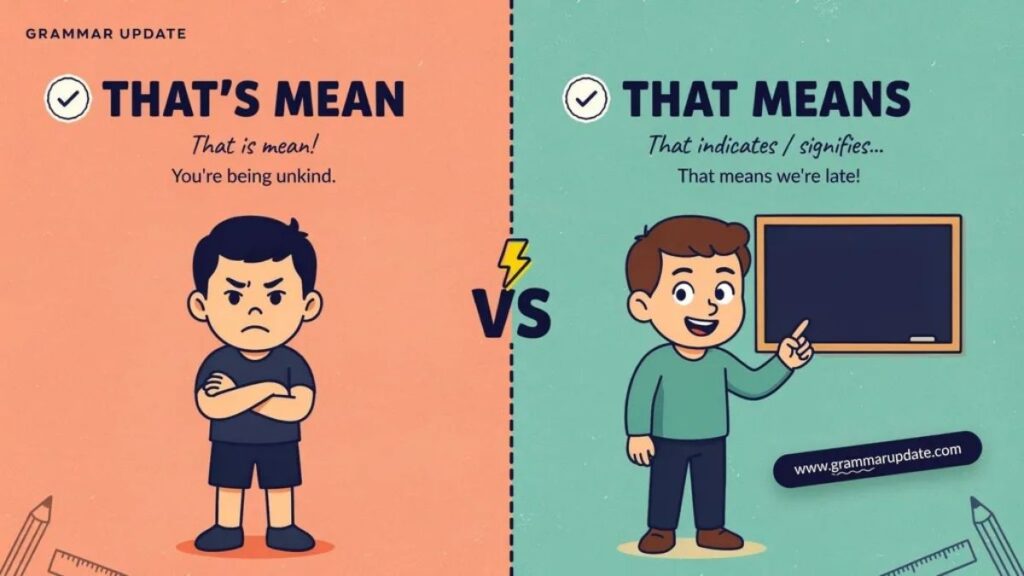
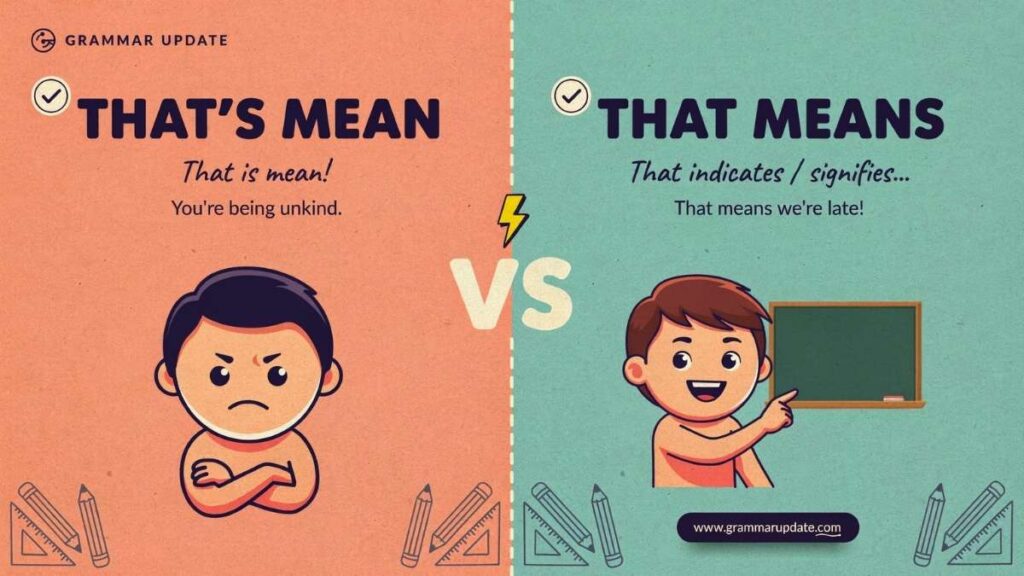
Have you ever stopped to wonder whether you should write that’s mean vs that means? If so, you’re not alone. The confusion behind that’s mean vs that means comes from how similar the phrases look and sound, even though they have completely different meanings. One describes someone’s unkind behavior, while the other explains a meaning, result, or conclusion. Mixing them up is an easy mistake, but it’s also one of the easiest grammar problems to fix. In this guide, you’ll learn the difference, understand the grammar behind each phrase, explore plenty of real-life examples, and discover a simple trick to choose the correct expression with confidence every time.
That’s Mean vs That Means at a Glance
If you’re in a hurry, here’s the short answer.
| Phrase | Meaning | Grammar | Example |
|---|---|---|---|
| That’s mean | Someone or something is unkind or cruel. | Contraction + adjective | That’s mean. You shouldn’t say that. |
| That means | Explains the meaning, result, or consequence of something. | Subject + verb | That means we’re leaving early. |
The easiest way to remember the difference is this:
- Use that’s mean when talking about someone’s behavior or attitude.
- Use that means when explaining an idea, definition, conclusion, or result.
Although the phrases differ by only one letter, they belong to different parts of speech and perform completely different jobs in English grammar.
For example:
Correct:
- That’s mean. You hurt her feelings.
- The store closes at six. That means we need to leave now.
Incorrect:
- That means. You hurt her feelings.
- That’s mean we need to leave now.
Once you understand what each phrase does, choosing the correct one becomes much easier.
Learn the difference between tricky more English words
Natzi vs Nazi Which Is the Correct Spelling?
What Does “That’s Mean” Mean?
The phrase that’s mean is used to describe someone or something as unkind, rude, cruel, or hurtful. It expresses an opinion about behavior rather than explaining information.
Here, that’s is the contraction of that is, while mean is an adjective describing a person’s actions, words, or attitude.
Think of it this way:
That is mean.
Since that’s simply replaces that is, the sentence still carries exactly the same meaning.
Learn the difference between tricky more English words
Insecure vs Unsecure Which One Is Correct?
Definition and Grammar
Many English learners ask about that’s mean meaning because the phrase seems similar to that means. In reality, they belong to different grammatical categories.
Here’s the breakdown:
- That’s = that is
- Mean = adjective
Together, they form a sentence describing a quality or characteristic.
Sentence pattern:
That is + adjective.
Examples include:
- That is funny.
- That is strange.
- That is unfair.
- That is mean.
Because mean functions as an adjective here, the sentence describes something rather than explaining it.
This is one of the most important points in that’s mean grammar.
Learn the difference between tricky more English words
Reoccurrence vs Recurrence Which One Is Correct?
When “That’s Mean” Is Correct
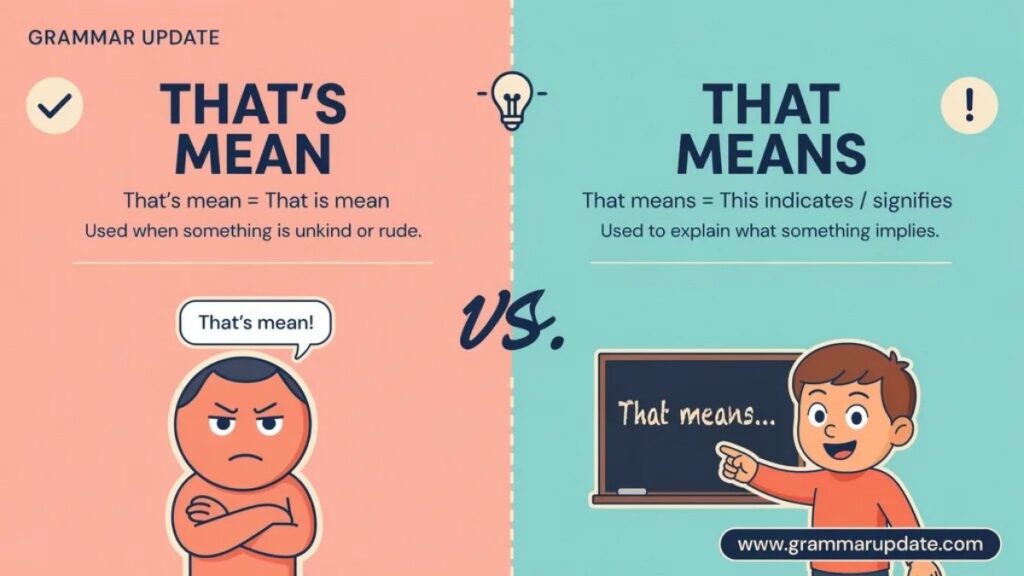
Use that’s mean whenever you’re commenting on behavior that seems hurtful, rude, selfish, or inconsiderate.
Imagine these everyday situations.
A child laughs at another student’s mistake.
You might say:
“That’s mean.”
Someone refuses to help a friend during a difficult time.
You could respond:
“That’s really mean.”
A coworker takes credit for another person’s work.
Again, you might naturally say:
“That’s mean.”
Notice that every example expresses a judgment about behavior rather than explaining a meaning.
This is the proper answer to questions like:
- Is that’s mean grammatically correct?
- When should I use that’s mean?
- Can I say that’s mean?
Yes. It is completely correct when you’re describing unkind actions.
That’s Mean Examples
Looking at real examples is one of the fastest ways to master confusing English phrases.
Here are several natural that’s mean examples.
Everyday conversation
- That’s mean. She worked hard on that project.
- I can’t believe he said that. That’s mean.
- Taking someone’s lunch is mean.
- That’s really mean of him.
- Making fun of people isn’t funny. That’s mean.
Family conversations
- That’s mean. Don’t tease your little brother.
- You shouldn’t ignore Grandma. That’s mean.
- That joke crossed the line. That’s mean.
School situations
- That’s mean. Everyone deserves a chance.
- Excluding someone from the group is mean.
- That’s mean. You should apologize.
Workplace conversations
- That’s mean. She didn’t deserve that criticism.
- Speaking behind someone’s back is mean.
- That comment sounded mean.
These examples show how naturally the phrase appears in spoken English.
Learn the difference between commonly mixed-up more words
Persue vs Pursue Which Spelling Is Correct?
That’s Mean in a Sentence
If you’re looking for that’s mean in a sentence, here are more examples.
- That’s mean, and you should apologize.
- That’s mean because she was only trying to help.
- I think that’s mean, even if you were joking.
- That’s mean. Please don’t say things like that.
- That’s mean, but I know you didn’t intend to hurt anyone.
Notice that every sentence describes behavior.
None of them explain a result or conclusion.
Tone and Context
The phrase that’s mean can sound different depending on the speaker’s tone.
Sometimes it’s serious.
“That’s mean. You really hurt her feelings.”
Sometimes it’s playful.
“You ate the last cookie? That’s mean!”
Friends often use the phrase jokingly without expressing genuine anger.
Context always determines whether the speaker is criticizing someone or simply teasing.
This flexibility makes that’s mean one of the most common everyday English expressions.
Learn the difference between commonly mixed-up more words
Weak vs Week Difference which one is correct?
Synonyms and Alternatives
Instead of repeating that’s mean, you can use similar expressions depending on the situation.
Some common alternatives include:
- That’s rude.
- That’s unkind.
- That’s cruel.
- That’s unfair.
- That’s insensitive.
- That’s harsh.
- That’s not nice.
- That’s disrespectful.
- That’s inconsiderate.
Each alternative carries a slightly different tone.
For example, cruel suggests intentional harm, while rude focuses more on poor manners. Choosing the right word helps your writing sound more precise and natural.
Learn the difference between commonly mixed-up more words
Due To vs Do To What’s the Difference and Which One Is Correct?
Common Mistakes with “That’s Mean”
Although that’s mean is a simple phrase, writers often make mistakes because it sounds similar to that means.
Here are the most common errors.
| Incorrect | Correct | Why |
|---|---|---|
| That’s means. | That’s mean. | “That’s” already means “that is.” An adjective should follow. |
| That mean. | That is mean. / That’s mean. | The verb “is” is missing. |
| That’s meaning. | That’s mean. | “Meaning” is a noun or gerund, not the adjective needed here. |
A useful trick is to expand the contraction.
If the sentence becomes:
That is mean.
and it sounds natural, you’ve chosen the correct phrase.
If expanding it produces something awkward like:
That is means.
the sentence is grammatically incorrect.
This simple test helps answer questions such as is that’s mean grammatically correct, that’s mean explained, and why is that’s mean wrong when it is written incorrectly as that’s means.
In the next section, you’ll learn what that means actually means, how it works in English grammar, and why it has a completely different purpose despite looking almost identical to that’s mean.
Learn how to use confusing more words correctly
Gluing vs Glueing Which Spelling Is Correct?
What Does “That Means” Mean?
The phrase that means is one of the most common expressions in English. People use it to explain an idea, clarify a statement, introduce a conclusion, or describe the result of something that has already been said.
Unlike that’s mean, which describes behavior, that means explains meaning or consequences. This small grammatical difference completely changes how the phrase functions in a sentence.
For example:
- The restaurant closes at 9 p.m. That means we need to leave now.
- She passed every exam. That means she’ll graduate this year.
- The roads are flooded. That means the trip has been canceled.
In each sentence, that means connects one piece of information to another. It tells the reader or listener what follows logically from what came before.
This is the foundation of that means meaning and one of the easiest ways to understand that means grammar.
Definition and Grammar
To understand that means definition, let’s break the phrase into two parts.
- That is a pronoun referring to something previously mentioned.
- Means is the third-person singular form of the verb mean.
Together, they form a complete clause.
Sentence pattern:
That + means + explanation, definition, result, or consequence.
For example:
- That means you’re correct.
- That means we have more work to do.
- That means the answer is yes.
Notice that means is a verb, not an adjective. It tells you what something signifies or what result follows.
Many learners confuse mean and means because they come from the same base word. However, they play different grammatical roles.
- Mean (verb): I mean what I say.
- Means (verb): That means it’s over.
- Mean (adjective): That teacher is mean.
Recognizing this difference is essential for proper English grammar.
Learn how to use confusing more words correctly
To Fast vs Too Fast What’s the Difference,and Correct Usage?
How “That Means” Explains Meaning or Results
One of the easiest ways to remember how to use that means is to think of it as an explanation bridge.
It connects one idea to another.
For example:
The sign says “Employees Only.”
That means customers cannot enter.
Or:
Your flight leaves at 6 a.m.
That means you’ll need to arrive at the airport early.
In both examples, the second sentence explains the first.
This is why you’ll often see that means after facts, statements, announcements, instructions, or observations.
It helps readers understand what those facts imply.
Learn the difference between tricky more English words
Swap vs Swop Difference which one is coorrect ?
When to Use “That Means”
If you’re wondering when to use that means, the answer is simple.
Use it whenever you want to explain:
- A meaning
- A definition
- A consequence
- A conclusion
- A logical result
Here are some examples.
1.Explaining a meaning
- “Bonjour” is French. That means “hello.”
2.Explaining a result
- It started snowing. That means school may close tomorrow.
3.Explaining a conclusion
- Nobody answered the phone. That means they’re probably out.
4.Explaining instructions
- The light is flashing red. That means stop immediately.
These examples demonstrate that means correct usage in everyday English.
Learn the difference between tricky more English words
Smoothe vs Smooth Which is Correct and Usage?
That Means Examples
Reading natural examples is one of the fastest ways to improve your grammar.
Here are several that means examples from everyday situations.
Everyday conversation
- I finished my homework. That means I can relax.
- She accepted the job offer. That means she’s moving next month.
- We missed the train. That means we’ll have to wait another hour.
School
- You scored 95 percent. That means you earned an A.
- This symbol represents water. That means H₂O.
Workplace
- The meeting was postponed. That means everyone has more time to prepare.
- The project was approved. That means we can begin immediately.
Travel
- Gate 12 has changed to Gate 18. That means we need to walk to the other terminal.
- The weather alert has ended. That means it’s safe to travel again.
Each example shows the phrase introducing a logical explanation or consequence.
That Means in a Sentence
If you’re searching for that means in a sentence, here are several examples.
- The package arrived early. That means we can finish today.
- The batteries are dead. That means the remote won’t work.
- You answered every question correctly. That means you passed the quiz.
- The recipe serves four people. That means we’ll need another dish for our guests.
- He apologized sincerely. That means he understands his mistake.
Notice how every sentence explains what another fact leads to.
That’s the defining characteristic of the phrase.
Common Sentence Patterns
The phrase appears in many common sentence structures.
Fact + that means + result
- It’s raining outside. That means the game is canceled.
Statement + that means + conclusion
- She declined the invitation. That means she won’t attend the event.
Observation + that means + explanation
- The computer won’t turn on. That means the battery may be dead.
Definition + that means + clarification
- “Bilingual” describes someone who speaks two languages. That means they can communicate in both.
These patterns appear constantly in spoken English and written English.
Similar Expressions
Sometimes you can replace that means with another phrase without changing the overall meaning.
Examples include:
- In other words…
- This means…
- As a result…
- Therefore…
- So…
- In other terms…
- In short…
- Put simply…
For example:
- The office is closed today. In other words, nobody is working.
- The office is closed today. That means nobody is working.
Both sentences communicate the same idea.
Using different expressions also makes your writing more varied and engaging.
That’s Mean vs That Means The Key Difference
Now that you’ve seen each phrase separately, comparing them side by side makes the difference much easier to remember.
Although they look alike, they perform completely different jobs in English.
| Feature | That’s Mean | That Means |
|---|---|---|
| Meaning | Describes someone or something as unkind | Explains a meaning, result, or conclusion |
| Grammar | Contraction + adjective | Subject + verb |
| Part of speech | Adjective | Verb |
| Purpose | Gives an opinion | Explains information |
| Example | That’s mean. | That means we’re late. |
This table summarizes the grammar difference between that means and that’s mean.
Meaning Comparison
Think about the questions each phrase answers.
That’s mean answers:
“What do you think about someone’s behavior?”
Example:
- That’s mean.
- That’s unfair.
- That’s rude.
On the other hand, that means answers:
“What does this information tell us?”
Example:
- The museum closes at five.
- That means we should leave now.
One phrase gives an opinion.
The other explains information.
Learn the difference between commonly mixed-up more words
Shinny vs Shiny Which Spelling Is Correct?
Grammar Comparison
Understanding the grammar makes the difference almost impossible to forget.
That’s mean
- That’s = that is
- Mean = adjective
Expanded form:
That is mean.
That means
- That = pronoun
- Means = verb
Expanded form:
That means we should go.
Notice that means is the action in the sentence, while mean describes something.
This distinction answers many common questions about English grammar that means, that means explained, and that’s mean explained.
Learn the difference between commonly mixed-up more words
Trauma vs Trama Difference and Correct Usage
Pronunciation Differences
Many people mix up these expressions because they sound nearly identical in everyday speech.
Native speakers often pronounce them quickly, making the difference difficult to hear.
Compare them slowly.
- That’s mean.
- That means.
The added s in means is subtle, especially during casual conversation.
As a result, English learners often spell one phrase when they actually mean the other.
This is one of the most common English grammar mistakes involving similar-sounding expressions.
Side-by-Side Examples
Reading the two phrases together highlights the difference immediately.
| Correct Use | Why It Works |
|---|---|
| That’s mean. | Describes someone’s behavior. |
| That means we have to wait. | Explains a result. |
| That’s mean of your brother. | Gives an opinion. |
| That means the store is closed. | Explains a consequence. |
| That’s mean. Please apologize. | Describes an action as unkind. |
| That means you’ll arrive early. | Explains what will happen. |
Here’s another comparison.
Correct:
- She laughed at him. That’s mean.
- She laughed at him. That means she wasn’t taking him seriously.
The first sentence judges the behavior.
The second explains what the behavior suggests.
That’s the simplest way to remember that means vs that’s mean, that means or that’s mean, and difference between that means and that’s mean.
Whenever you’re describing behavior, use that’s mean.
Whenever you’re explaining meaning, defining a phrase, or expressing a consequence, use that means.
Learn the difference between commonly mixed-up more words
Placque vs Plaque Difference and Correct Usage
Is “That’s Means” Ever Correct?
One of the most common grammar questions English learners ask is whether that’s means is ever correct. The short answer is no.
In standard English, that’s means is always grammatically incorrect because it combines a contraction with the wrong verb form.
Let’s expand the contraction.
- That’s = That is
Now read the sentence:
That is means…
It doesn’t make grammatical sense because is and means cannot appear together in this structure.
Instead, choose one of these correct forms:
| Incorrect | Correct |
|---|---|
| That’s means we’re late. | That means we’re late. |
| That’s means I should study. | That means I should study. |
| That’s means the answer is yes. | That means the answer is yes. |
Or, if you’re describing someone’s behavior:
| Incorrect | Correct |
|---|---|
| That’s means. | That’s mean. |
| You’re that’s means. | You’re mean. |
| That’s means of you. | That’s mean of you. |
Whenever you see that’s means, remove either is or means. The sentence will immediately become correct.
Why People Confuse “That’s Mean vs That Means”
It’s easy to see why these phrases confuse so many people. They differ by just one letter, and in casual conversation they often sound almost identical.
Several factors contribute to this mistake.
Nearly Identical Pronunciation
Native speakers usually talk quickly.
Compare these phrases aloud.
- That’s mean.
- That means.
The extra s in means is subtle. If you’re learning English by listening, it’s easy to mishear one phrase as the other.
Fast Typing
Many mistakes happen because people type quickly.
For example, someone may intend to write:
That means we should leave.
Instead, they accidentally write:
That’s mean we should leave.
The words look similar, so the error often goes unnoticed.
Confusing Mean and Means
Another source of confusion is that both words come from the same root.
However, they serve different grammatical functions.
| Word | Part of Speech | Example |
|---|---|---|
| Mean | Adjective | That teacher is mean. |
| Mean | Verb | I mean what I say. |
| Means | Verb | That means it’s finished. |
Understanding the role each word plays helps eliminate many common English grammar mistakes.
ESL and EFL Learning Challenges
For English learners, contractions add another layer of difficulty.
Many students memorize vocabulary before learning sentence structure.
As a result, they may recognize:
- that’s
- mean
- means
without fully understanding how they fit together.
Once you learn that that’s means that is, choosing the correct phrase becomes much easier.
Learn the difference between similar more English words
Togather vs Together Which Is the Correct Word to Use?
Grammar Rule Behind the Difference
The easiest way to master these phrases is to understand the grammar behind them.
Fortunately, the rule is straightforward.
Breaking Down “That’s”
The contraction that’s always stands for:
That is
or occasionally
That has
Examples:
- That’s amazing.
- That’s my favorite book.
- That’s been happening for years.
Notice that that’s never means that means.
Why “Means” Is a Verb
In the phrase that means, the word means functions as a verb.
It tells you what something signifies.
Examples:
- The sign is red. That means stop.
- She smiled. That means she’s happy.
- He’s already left. That means we’re too late.
Here, means performs the action of explaining.
Why “Mean” Is an Adjective
In that’s mean, the word mean describes someone’s behavior.
Examples:
- That’s mean.
- That joke was mean.
- Your comment sounded mean.
Since adjectives describe people or things, they cannot replace verbs like means.
That’s the core grammar difference.
Learn the difference between similar more English words
Convertor vs Converter Which Spelling Is Correct?
That’s Mean vs That Means Examples
The best way to remember grammar is through real examples.
Everyday Conversation
Correct:
- That’s mean. You didn’t have to say that.
- He forgot my birthday. That means he probably got busy.
- That’s mean of your classmates.
- The bus already left. That means we’ll be late.
Incorrect:
- That means of your classmates.
- That’s mean we’ll be late.
School and Academic Writing
Correct:
- The experiment failed. That means our hypothesis was incorrect.
- That’s mean isn’t appropriate in formal reports because it expresses a personal opinion.
Teachers often encourage students to distinguish between describing behavior and explaining information.
Workplace Communication
Correct:
- The client approved the proposal. That means we can begin immediately.
- That email sounded mean.
Incorrect:
- That’s mean we can begin immediately.
Social Media and Text Messages
You’ll frequently see both expressions online.
Examples:
- You ate the last slice? That’s mean.
- The concert sold out. That means we’ll need another plan.
- You didn’t invite me? That’s mean!
- The app keeps crashing. That means there’s probably a bug.
Although online writing is informal, the grammar rules remain the same.
Common Mistakes to Avoid
Many writers repeat the same mistakes.
Here are the ones you’ll see most often.
Using “That Means” to Describe Someone
Incorrect:
That means.
Correct:
That’s mean.
Remember, means cannot describe personality or behavior.
Using “That’s Mean” to Explain Information
Incorrect:
That’s mean we’re leaving now.
Correct:
That means we’re leaving now.
Writing “That’s Means”
Incorrect:
That’s means the meeting is canceled.
Correct:
That means the meeting is canceled.
Forgetting the Verb
Incorrect:
That mean you’re correct.
Correct:
That means you’re correct.
Forgetting the Adjective
Incorrect:
That’s means.
Correct:
That’s mean.
Learning these patterns helps improve both spoken English and written English.
Here’s a trusted source for clear word meanings:
ractice Section that’s mean vs that means
Choose the correct phrase to complete each sentence: that’s mean vs that means.
- You laughed at her presentation. __________.
- The store closes in five minutes. __________ we should hurry.
- He ignored his best friend all day. __________.
- The roads are icy. __________ school might be canceled tomorrow.
- You took the last slice of pizza without asking. __________!
- The package has arrived. __________ you can start the project today.
- Calling someone names is __________.
- She earned a perfect score. __________ she passed the exam with flying colors.
- Making fun of someone’s accent is __________.
- The weather forecast predicts heavy rain. __________ we’ll need umbrellas.
- You broke his toy on purpose. __________.
- The traffic is unusually light. __________ we’ll get there early.
- He apologized sincerely. __________ he understands what he did wrong.
- Excluding someone from the group is __________.
- The restaurant is fully booked. __________ we’ll need another place to eat.
- You spoiled the movie ending for everyone. __________!
- Your passport expires next month. __________ you should renew it soon.
- Refusing to help someone in need is __________.
- The batteries are dead. __________ the flashlight won’t turn on.
- She won the scholarship. __________ all her hard work paid off.
- You made your little brother cry. __________.
- The sign says “No Entry.” __________ visitors cannot go inside.
- Making fun of a classmate’s mistake is __________.
- The flight has been delayed by three hours. __________ we’ll arrive late.
- He shared his notes before the exam. That wasn’t __________. It was thoughtful.
Answers
- That’s mean
- That means
- That’s mean
- That means
- That’s mean
- That means
- That’s mean
- That means
- That’s mean
- That means
- That’s mean
- That means
- That means
- That’s mean
- That means
- That’s mean
- That means
- That’s mean
- That means
- That means
- That’s mean
- That means
- That’s mean
- That means
- That’s mean
FAQs
What is the difference between that’s mean vs that means?
That’s mean describes someone or something as unkind, rude, or hurtful. That means explains a meaning, result, or conclusion. Although the phrases look similar, they have different grammatical functions and should not be used interchangeably.
What’s the meaning of that’s mean?
That’s mean is a contraction of that is mean. You use it to express that someone’s words, actions, or behavior are unkind, cruel, or inconsiderate.
When should I use that means?
Use that means when you want to explain what something signifies or what result follows from a statement. It’s commonly used to introduce explanations, conclusions, or consequences.
Is that’s mean grammatically correct?
Yes. That’s mean is grammatically correct when you’re describing behavior as unkind. For example: That’s mean. You shouldn’t say that.
Is that means grammatically correct?
Yes. That means is grammatically correct when means is the verb explaining a meaning or result. For example: The store is closed. That means we’ll come back tomorrow.
Which is correct that means or that’s mean?
Both are correct, but they are used in different situations. Choose that’s mean to describe behavior and that means to explain information or a consequence.
How do I use that means in a sentence?
Use it to connect a fact with its logical conclusion. For example: The roads are closed. That means we’ll need another route.
How do I use that’s mean in a sentence?
Use it when commenting on someone’s behavior. For example: You made her cry. That’s mean.
Why do people confuse that’s mean vs that means?
The phrases are often confused because they look and sound very similar. However, mean is an adjective in that’s mean, while means is a verb in that means.
What is the grammar difference between that’s mean vs that means?
In that’s mean, that’s means that is, and mean is an adjective. In that means, means is a verb that explains or indicates something.
Can I replace that means with another phrase?
Yes. Depending on the context, you can replace that means with phrases such as this means, in other words, therefore, so, as a result, or which means.
What can I say instead of that’s mean?
You can use alternatives such as that’s rude, that’s unkind, that’s cruel, that’s unfair, that’s harsh, or that’s insensitive, depending on the situation.
Is “that’s means” ever correct?
No. That’s means is always grammatically incorrect because that’s already means that is. The correct forms are that’s mean vs that means, depending on what you want to say.
What’s the easiest way to remember the difference?
Think of mean = unkind and means = explains. If you’re describing behavior, use that’s mean. If you’re explaining an idea or result, use that means.
Can that means begin a sentence?
Yes. That means can begin a sentence when referring to information mentioned earlier. For example: That means we’ll need more time to finish the project.
Conclusion
At first glance, that’s mean vs that means look almost identical, but they have completely different jobs in English. That’s mean describes unkind behavior, while that means explains a meaning, result, or conclusion. Remembering this simple distinction will help you avoid one of the most common grammar mix-ups.Whenever you’re unsure, ask yourself a quick question: Am I describing someone’s behavior or explaining something? If you’re describing behavior, use that’s mean. If you’re explaining an idea or consequence, use that means.English has plenty of tricky word pairs, but this one doesn’t have to trip you up anymore. Now you know the difference, so the only thing left that’s mean is autocorrect when it changes the right phrase into the wrong one!

Jhon AJS, the creative mind behind Grammar Update, is an experienced blogger passionate about simplifying English grammar. He focuses on explaining confusing word vs word differences, grammar rules, punctuation, and sentence structure in a clear and practical way. Through easy to understand guides and examples, Jhon helps readers improve their writing and communicate with confidence. With years of blogging experience, he continues to share helpful insights that make learning grammar simple, useful, and accessible for everyone.